Sleep Hygiene — Sleep Tracking Tech
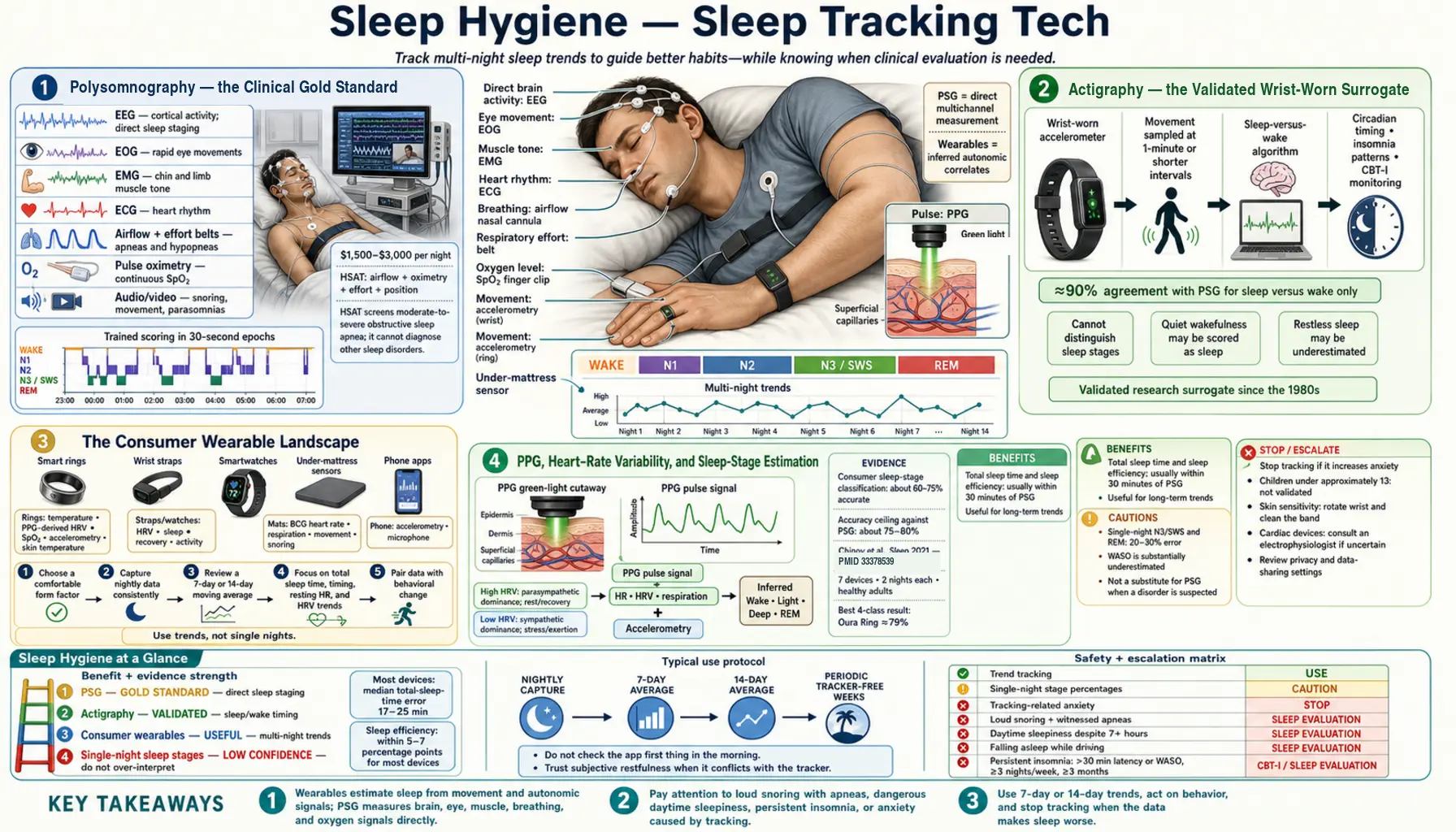
Consumer-grade sleep trackers (Oura Ring, Whoop Strap, Apple Watch, Fitbit, Garmin) have closed roughly 80% of the accuracy gap with clinical polysomnography (PSG) over the past decade — but they have not closed all of it, and the remaining 20% is concentrated precisely in the metrics consumers most want (REM percentage, slow-wave-sleep duration, sleep-stage transitions). Validation studies consistently find that consumer wearables estimate total sleep time and sleep efficiency reasonably well (within 30 minutes of PSG), but their sleep-stage classifications are about 60–75% accurate — better than nothing, but not a substitute for a sleep study when clinical suspicion of a sleep disorder is present. The Chinoy et al. 2021 Sleep study (PMID 33378539) is the largest head-to-head validation of seven consumer devices. This page walks through the polysomnography gold standard, the actigraphy reference, the consumer-wearable landscape, the new "orthosomnia" diagnosis, and the rules for when DIY tracking is enough versus when to escalate to a sleep medicine evaluation.
Table of Contents
- Polysomnography — the Clinical Gold Standard
- Actigraphy — the Validated Wrist-Worn Surrogate
- The Consumer Wearable Landscape
- PPG, Heart-Rate Variability, and Sleep-Stage Estimation
- The Chinoy 2021 Validation Study
- Oura, Whoop, Apple Watch, Fitbit — Practical Comparison
- What Trackers Get Right (and Wrong)
- Orthosomnia — When Tracking Makes Sleep Worse
- When to Escalate to a Sleep Study
- Cautions
- Key Research Papers
- Connections
- Featured Videos
Polysomnography — the Clinical Gold Standard
Polysomnography (PSG) is the multichannel physiological recording performed during overnight sleep, almost always in an accredited sleep laboratory. The standard PSG montage records:
- EEG (electroencephalogram): Multiple scalp electrodes detect cortical electrical activity, which is the only direct measure of sleep stages (N1, N2, N3/SWS, REM).
- EOG (electrooculogram): Eye-movement electrodes detect the characteristic rapid eye movements of REM sleep.
- EMG (electromyogram): Chin and limb electrodes detect muscle tone, which is dramatically reduced during REM (atonia) and important for diagnosing parasomnias and restless legs.
- ECG (electrocardiogram): Single-lead heart rhythm.
- Airflow sensors and respiratory belts: Detect apneas, hypopneas, and respiratory effort.
- Pulse oximetry: Continuous SpO2.
- Audio/video recording: For parasomnias, snoring characterization, and movement.
The American Academy of Sleep Medicine (AASM) scoring manual (Berry et al., updated annually) prescribes exactly how a trained polysomnographer scores sleep stages in 30-second epochs based on EEG, EOG, and EMG. This is the definition against which every other sleep-measurement technology is validated.
PSG is expensive ($1,500–$3,000 per night), inconvenient (requires lab visit and a night in an unfamiliar bed), and not scalable to longitudinal tracking. Home sleep apnea testing (HSAT) uses a stripped-down montage (typically airflow, oximetry, effort belts, position) and is appropriate for screening for moderate-to-severe obstructive sleep apnea but cannot diagnose other sleep disorders.
Actigraphy — the Validated Wrist-Worn Surrogate
Wrist actigraphy — a wrist-worn accelerometer that records movement at one-minute or shorter intervals — has been the validated research-grade surrogate for sleep timing since the 1980s. The fundamental observation is simple: humans are nearly motionless when sleeping and intermittently move when awake. Algorithms inferring sleep-versus-wake from movement reach approximately 90% agreement with PSG on the sleep-versus-wake judgment alone.
Actigraphy's strengths and limitations were documented by Ancoli-Israel et al. (Sleep 2003, PMID 12749557) and refined by Marino et al. (Sleep 2013, PMID 24179293). Strengths: passive, multi-night, real-world settings, validated. Weaknesses: cannot distinguish sleep stages without additional sensors, overestimates sleep in low-movement insomnia (a person lying still in bed for 90 minutes unable to sleep is scored as asleep), underestimates sleep in restless sleepers.
The American Academy of Sleep Medicine recognizes actigraphy as appropriate for: characterizing circadian rhythm disorders, evaluating insomnia patterns over weeks, monitoring response to behavioral interventions (CBT-I), and supplementing — not replacing — PSG when sleep disorders are suspected.
Consumer wearables that use only accelerometry (older Fitbit models, basic activity trackers) are essentially actigraphy in a consumer wrapper. Adding photoplethysmography (PPG, see below) is what enables the sleep-stage estimates that newer devices market.
The Consumer Wearable Landscape
The 2026 consumer-wearable landscape can be grouped by form factor and sensor stack:
- Smart rings: Oura Ring (Gen 4), Ultrahuman Ring AIR, RingConn. Worn on the finger; track temperature, PPG-derived HRV, SpO2, accelerometry, and skin temperature. Strengths: small, comfortable, do not vibrate at night. Weaknesses: subscription required for full features (Oura), single point of measurement.
- Wrist straps (no display): Whoop Strap (4.0), Whoop MG. Track HRV, sleep, recovery score, strain. Designed for athletes. Subscription-only business model.
- Smartwatches: Apple Watch (Series 9/10/Ultra), Garmin (Fenix, Forerunner, Venu), Fitbit Sense / Charge / Versa, Samsung Galaxy Watch. Same sensor stack as rings/straps plus larger battery and display. Strengths: full general-purpose smartwatch features. Weaknesses: wrist position uncomfortable for some sleepers; need nightly charging strategy.
- Non-wearable mat sensors: Withings Sleep Tracking Mat, Eight Sleep Pod (built-in tracking). Slide under the mattress; track heart rate via ballistocardiography (BCG), respiration, movement, snoring. Strengths: nothing on the body. Weaknesses: cannot measure HRV; less validation literature.
- Smartphone apps using only accelerometry / microphone: Sleep Cycle, Sleep as Android, Pillow. Phone on the bedside table detects movement and snoring. Useful for casual tracking; cannot replicate wearable physiological metrics.
PPG, Heart-Rate Variability, and Sleep-Stage Estimation
Photoplethysmography (PPG) is the green-light optical sensor on the back of every modern wearable. It measures changes in blood volume in superficial capillaries with each heartbeat, allowing computation of:
- Heart rate (HR): Beats per minute, continuously.
- Heart-rate variability (HRV): The beat-to-beat variation in interval, which reflects autonomic balance. High HRV = parasympathetic dominance = rest/recovery state. Low HRV = sympathetic dominance = stress/exertion state.
- Respiration rate: Inferred from the cyclic modulation of HR by breathing (respiratory sinus arrhythmia).
Sleep-stage estimation by consumer wearables fuses accelerometry, HR, HRV, and respiration. The principle: NREM stages are characterized by stable low HR, low HRV in N3/SWS, and steady respiration. REM is characterized by variable HR, irregular respiration, and (paradoxically) very low body movement (atonia). Wake is characterized by movement and elevated HR.
The fundamental limitation: these are inferences from autonomic correlates, not direct measurements of brain activity. EEG remains the only reliable way to distinguish N1 from N2, or to detect specific waveforms like sleep spindles, K-complexes, and the characteristic mixed-frequency low-voltage REM EEG. This is why consumer-wearable sleep-stage estimates have an accuracy ceiling around 75–80% against PSG.
The Chinoy 2021 Validation Study
Chinoy et al. (Sleep 2021, PMID 33378539) is the most comprehensive head-to-head validation of consumer sleep trackers to date. Healthy adults wore seven consumer devices simultaneously during PSG-monitored sleep over two nights each. Devices tested included Fitbit Alta HR, Fatigue Science ReadiBand, Garmin Fenix 5S, Garmin Vivosmart 4, EarlySense Live, Oura Ring (Gen 2), and Polar Vantage V.
Key findings:
- Total sleep time: Most devices were within 30 minutes of PSG (median error 17–25 minutes). Oura and Fitbit Alta HR performed best.
- Sleep efficiency: Similar accuracy — within 5–7 percentage points of PSG for most devices.
- Wake-after-sleep-onset (WASO): All devices substantially underestimated WASO. Trackers tend to score quiet wakefulness as sleep.
- Sleep-stage classification: Wide variation. Oura Ring achieved roughly 79% accuracy on a 4-class (Wake, Light, Deep, REM) basis — the best in the study. Several devices performed at chance for individual stages.
- Light sleep (N1+N2): Generally overestimated.
- Deep sleep (N3/SWS): Substantially underestimated by most devices.
- REM sleep: Variable; some devices accurate, others off by 30–40 minutes.
The Chinoy study concluded: consumer trackers are appropriate for tracking long-term trends in total sleep time and sleep efficiency, but should not be used to make clinical decisions about sleep architecture in any single night.
Oura, Whoop, Apple Watch, Fitbit — Practical Comparison
- Oura Ring (Gen 4): Best-in-class sleep tracking among consumer devices in independent validation. 7-day battery life. Subscription ($5.99/month) required for full features. Form factor (ring) preferred by users who dislike wrist wearables. Validated against PSG by de Zambotti et al. (Behav Sleep Med 2019, PMID 28323455).
- Whoop Strap 4.0 / MG: Subscription-only ($30/month). Strong HRV-based recovery score and strain measurement; sleep tracking solid but not best-in-class. Designed for athletic performance optimization. Battery roughly 5 days; charges via slide-on battery pack so device never needs to be removed.
- Apple Watch (Series 9/10/Ultra): Sleep tracking solid in recent watchOS versions. Major weakness: ~18-hour battery means most users charge it overnight (the opposite of what is needed for sleep tracking). Workaround: charge during morning routine or shower. Best-in-class for general-purpose smartwatch features.
- Fitbit (Sense 2, Charge 6, Versa 4): Long battery life (5–7 days). Strong sleep-tracking validation history (Fitbit was pioneer in this category). Premium subscription required for Sleep Profile and advanced analytics. Google ownership has not yet meaningfully changed the product.
- Garmin (Venu 3, Fenix 7/8, Forerunner 965): Excellent battery (1–3 weeks depending on model). Strong outdoor/fitness orientation. Sleep tracking adequate; sleep-stage accuracy historically behind Oura/Fitbit. Body Battery metric synthesizes sleep, HRV, and activity into a simple recovery indicator.
Decision shortcuts:
- Priority is sleep accuracy: Oura Ring (Gen 4).
- Priority is athletic recovery: Whoop.
- Already in Apple ecosystem and want one device: Apple Watch Ultra (better battery than standard Series).
- Priority is battery life: Garmin Fenix or Venu, or Oura.
- Priority is no monthly subscription: Apple Watch, Garmin, or older Fitbit models. Avoid Whoop (subscription only).
What Trackers Get Right (and Wrong)
Reliable metrics from modern consumer wearables (use these):
- Total sleep time, multi-night trend. Within 30 minutes of PSG; trends across weeks are reliable.
- Sleep onset and wake times. Very accurate for individuals with reasonably regular schedules.
- Resting heart rate trend. Excellent; downward trend indicates improving cardiovascular fitness.
- HRV trend (using a consistent measurement window). Excellent; HRV is the single best biomarker of recovery state available outside a clinical setting.
- Sleep regularity index. When sleep onset and wake times vary by hours, sleep quality degrades regardless of total duration. Trackers reliably document this.
- Detection of acute illness. Elevated resting HR + reduced HRV + temperature elevation 24–48 hours before symptom onset is a real signal.
- Snoring detection (microphone-based devices). Reliably catches habitual snoring and can prompt sleep apnea evaluation.
Unreliable metrics (do not over-interpret):
- Single-night sleep-stage percentages. Especially N3/SWS and REM — 20–30% error on any given night.
- "Sleep score" composites. These are proprietary algorithms with poor cross-device comparability. Use within a single device for trend, not as an absolute number.
- WASO (wake-after-sleep-onset). Substantially underestimated by all consumer devices.
- Apnea/hypopnea index (AHI) from consumer SpO2. Lacks the resolution of medical-grade pulse oximetry; cannot replace a home sleep apnea test.
Orthosomnia — When Tracking Makes Sleep Worse
"Orthosomnia" is the term coined by Baron, Abbott, Jao, and Manalo (J Clin Sleep Med 2017, PMID 28095969) for a patient population presenting to sleep clinics with insomnia-like complaints driven by anxiety about their sleep-tracker data. Patients report: "My Oura says I only got 45 minutes of deep sleep last night, so I must have a problem"; or "Whoop tells me my recovery is low, so I can't function today."
The pattern resembles other quantified-self pathologies (orthorexia for diet, orthorexia adapted for exercise). The patient places excessive trust in the tracker metric, develops anxiety about the metric, and the anxiety itself worsens sleep. The trackers' sleep-stage estimates are sufficiently inaccurate that the anxiety is often driven by noise, not signal.
Practical guardrails:
- Do not check the app first thing in the morning. Build a morning routine that does not involve interpreting overnight data before you have made coffee.
- Use trends, not single nights. A 7-day or 14-day moving average is meaningful; a single night is not.
- Trust your subjective experience over the tracker on a discrepancy. If you feel rested and the tracker says you slept poorly, you slept fine. The tracker is wrong sometimes.
- If tracking is increasing your anxiety, stop tracking. The point is better sleep, not better data.
- Take periodic tracker-free weeks. Especially when traveling or under acute life stress.
When to Escalate to a Sleep Study
Consumer trackers are an entry point to better sleep, not a substitute for clinical evaluation when an actual sleep disorder is suspected. Escalate to a board-certified sleep medicine evaluation when any of the following are present:
- Loud snoring with witnessed apneic pauses — strongly suggests obstructive sleep apnea. Home sleep apnea testing is appropriate for moderate-to-high pretest probability; in-lab PSG when comorbidities or central apnea are suspected.
- Excessive daytime sleepiness despite 7+ hours of nightly sleep — suggests OSA, narcolepsy, idiopathic hypersomnia, or restless legs disrupting sleep.
- Falling asleep at the wheel or other dangerous situations.
- Sleep paralysis, hypnagogic hallucinations, or cataplexy — the pentad of narcolepsy.
- Acting out dreams, kicking, or violent behavior during sleep — suggests REM sleep behavior disorder, which is associated with future Parkinson's and Lewy body dementia.
- Painful, irresistible leg movements at night relieved by walking — restless legs syndrome.
- Persistent insomnia (sleep onset latency >30 min or WASO >30 min, ≥3 nights/week, ≥3 months) with daytime impairment — chronic insomnia disorder; first-line treatment is CBT-I, not medication.
- Marked circadian phase delay or advance with social/occupational dysfunction.
The American Academy of Sleep Medicine (sleepeducation.org) maintains a directory of accredited sleep centers. A primary care physician or pulmonologist can refer; many sleep centers also accept self-referral.
Cautions
- Skin sensitivity: A small fraction of users develop contact dermatitis to wearable bands. Rotate wrist, clean band frequently, switch to silicone or fabric if metal triggers reaction.
- Children: Pediatric sleep-stage algorithms differ from adult; consumer wearables are not validated for children under approximately 13. Pediatric sleep concerns should be evaluated by a pediatric sleep specialist.
- Cardiac devices: No known interference between PPG wearables and pacemakers/ICDs, but consult your electrophysiologist if uncertain.
- Privacy: Sleep, HR, location, and activity data are highly sensitive and stored on company cloud servers. Review the privacy policy and data-sharing settings of any device. Some employers and insurers offer wearable programs with data sharing — understand the terms.
- Data does not equal action: The most accurate tracker in the world produces no benefit if the behavioral changes are not made. Pair tracking with the previous three deep-dive pages (light, temperature, caffeine) for actual sleep improvement.
Key Research Papers
- Chinoy ED et al., Performance of seven consumer sleep-tracking devices compared with polysomnography (Sleep 2021) — PMID 33378539
- de Zambotti M et al., The sleep of the ring: comparison of the OURA sleep tracker against polysomnography (Behav Sleep Med 2019) — PMID 28323455
- de Zambotti M et al., A validation study of Fitbit Charge 2 compared with polysomnography in adults (Chronobiol Int 2018) — PMID 29235907
- Baron KG et al., Orthosomnia: are some patients taking the quantified self too far? (J Clin Sleep Med 2017) — Search PubMed
- Ancoli-Israel S et al., The role of actigraphy in the study of sleep and circadian rhythms (Sleep 2003) — PMID 12749557
- Marino M et al., Measuring sleep: accuracy, sensitivity, and specificity of wrist actigraphy compared to polysomnography (Sleep 2013) — Search PubMed
- Berry RB et al., AASM scoring manual updates for 2017 (J Clin Sleep Med 2017) — PMID 28416048
- Mantua J et al., Reliability of sleep measures from four personal health monitoring devices (Sensors 2016) — PMID 27164110
- Roomkham S et al., Promises and challenges in the use of consumer-grade devices for sleep monitoring (IEEE Rev Biomed Eng 2018) — Search PubMed
- Miller DJ et al., A validation study of WHOOP Strap 3.0 against polysomnography PubMed: Miller WHOOP
- Walch O et al., Sleep stage prediction with raw acceleration and photoplethysmography heart rate data derived from a consumer wearable device (Sleep 2019) — PMID 31579900
- Kapur VK et al., Clinical Practice Guideline for Diagnostic Testing for Adult Obstructive Sleep Apnea: AASM (J Clin Sleep Med 2017) — PMID 28162150
Connections
- All Remedies
- Sleep Hygiene Benefits Hub
- Sleep Hygiene (Main)
- Circadian Light Exposure
- Temperature and Mattress
- Caffeine Cutoff Timing
- Insomnia
- Sleep Apnea
- Restless Legs Syndrome
- Lab Tests Index
- Meditation
- Breathing Exercises
- Magnesium Glycinate
- Valerian
- L-Theanine
- Glycine