Sleep Hygiene — Benefits Deep Dive
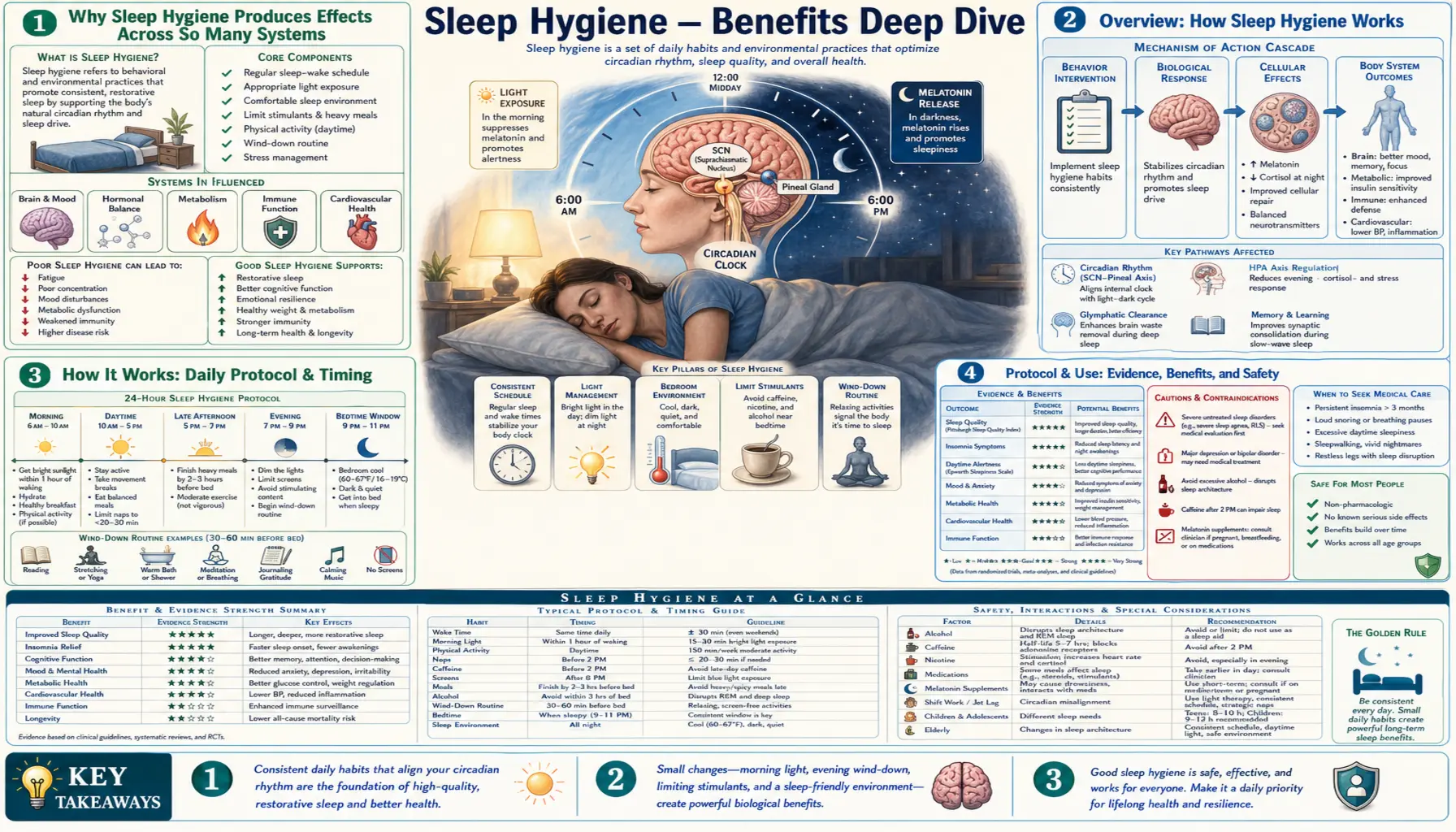
Sleep is the single most powerful daily regenerative process available to the human body, and the behavioral levers below explain roughly 80% of the variance in sleep quality among adults who do not have an underlying sleep disorder. Morning bright-light exposure synchronizes the suprachiasmatic nucleus and locks in a robust circadian rhythm. Bedroom temperature near 18°C (65°F) and a properly matched mattress allow the 0.3°C core-body-temperature drop required to initiate slow-wave sleep. A caffeine cutoff timed to your CYP1A2 genotype prevents adenosine-receptor antagonism from suppressing REM and slow-wave sleep architecture. And consumer-grade sleep trackers — while imperfect — provide the longitudinal feedback loop that makes behavior change stick. Three deep-dive pages below cover the mechanisms, the pivotal trials, and the practical protocols.
Deep-Dive Articles
Circadian Light Exposure
The suprachiasmatic nucleus (SCN) as master clock, intrinsically photosensitive retinal ganglion cells (ipRGCs) and melanopsin, 10,000+ lux morning sunlight for clock entrainment, the dim-light melatonin onset (DLMO) marker, blue-light suppression of melatonin in the evening, blackout-curtain and blue-blocker protocols, light therapy for seasonal affective disorder and shift work disorder.
Temperature and Mattress
The 0.3°C core-body-temperature drop required for slow-wave sleep onset, the 65°F (18°C) bedroom target, distal-skin vasodilation as a sleep-initiation signal, the warm-bath-90-minutes-before-bed protocol (Haghayegh meta-analysis), mattress firmness (medium-firm wins by RCT), pillow loft for cervical alignment, cooling toppers for hot sleepers.
Sleep Tracking Tech
Polysomnography (PSG) as the clinical gold standard, actigraphy as the validated wrist-worn surrogate, consumer wearables (Oura, Whoop, Apple Watch, Fitbit) compared against PSG, photoplethysmography (PPG) for heart-rate variability, the 80% accuracy ceiling on sleep-stage detection, sleep debt tracking, when to escalate to a sleep-medicine evaluation, "orthosomnia" as a clinical phenomenon.
Table of Contents
- Deep-Dive Articles
- Why Sleep Hygiene Produces Effects Across So Many Systems
- Research Papers: Circadian Light Exposure
- Research Papers: Temperature & Mattress
- Research Papers: Caffeine Cutoff Timing
- Research Papers: Sleep Tracking Tech
- Research Papers: Cross-Cutting (Architecture, Health Outcomes)
- External Authoritative Resources
- Connections
- Featured Videos
Why Sleep Hygiene Produces Effects Across So Many Systems
Sleep is the only physiological state during which the brain's glymphatic system clears interstitial waste, including beta-amyloid and tau proteins implicated in Alzheimer's disease. It is also when growth hormone is pulsed, when memory consolidation occurs through hippocampal-cortical dialogue, when the immune system completes T-cell maturation and natural-killer-cell expansion, when glucose metabolism is reset, and when the cardiovascular system enjoys a 10–20% reduction in blood pressure ("nocturnal dipping"). Disrupted sleep degrades each of these systems in parallel, which is why chronic sleep restriction is independently associated with all-cause mortality across more than 30 large cohort studies.
- Circadian architecture — nearly every cell in the body carries its own peripheral clock entrained by feeding, temperature, and (most powerfully) light through the suprachiasmatic nucleus. The light-exposure deep-dive covers how 10,000+ lux of morning sunlight within 30 minutes of waking sets a robust phase angle, suppresses daytime melatonin, and produces the evening dim-light melatonin onset (DLMO) that initiates sleep pressure.
- Thermoregulation — sleep onset is gated by a 0.3°C drop in core body temperature, mediated by distal-skin vasodilation. The temperature and mattress deep-dive walks through why a 65°F (18°C) bedroom, a warm bath 90 minutes before bed, and a medium-firm mattress with cervical-aligning pillow each independently improve sleep latency and slow-wave sleep duration.
- Neurochemistry — adenosine and sleep pressure — adenosine accumulates in the basal forebrain throughout waking hours and binds A1/A2A receptors to drive sleep pressure. Caffeine is a competitive antagonist at these receptors. The caffeine-cutoff deep-dive explains why a 2–3 PM cutoff is the right default for most adults, why CYP1A2 slow metabolizers need an even earlier cutoff, and how 400 mg of caffeine consumed 6 hours before bed measurably degrades sleep.
- Quantification and feedback — what gets measured gets managed. The sleep-tracking deep-dive compares consumer wearables (Oura, Whoop, Apple Watch, Fitbit) against the polysomnography (PSG) clinical gold standard, explains why total-sleep-time estimates are reasonably accurate but sleep-stage breakdowns are not, and covers when to escalate to a clinical sleep-medicine evaluation versus when DIY tracking is enough.
The therapeutic complication is that sleep hygiene alone is necessary but not always sufficient. Patients with obstructive sleep apnea, restless legs syndrome, narcolepsy, idiopathic hypersomnia, or chronic insomnia disorder require formal clinical evaluation and (often) pharmacotherapy or device-based treatment (CPAP, mandibular advancement, CBT-I). Sleep hygiene should be the foundation but never the only intervention for a clinically significant sleep complaint.
Research Papers: Circadian Light Exposure
- Berson DM et al., Phototransduction by retinal ganglion cells that set the circadian clock (Science 2002) — PMID 11834834
- Czeisler CA et al., Bright light induction of strong (type 0) resetting of the human circadian pacemaker (Science 1989) — PMID 2734611
- Chang AM et al., Evening use of light-emitting eReaders negatively affects sleep, circadian timing, and next-morning alertness (PNAS 2015) — PMID 25535358
- Wright KP et al., Entrainment of the human circadian clock to the natural light-dark cycle (Curr Biol 2013) — PMID 23910656
- Lewy AJ et al., The dim light melatonin onset as a marker for circadian phase position PubMed: Lewy DLMO
- Brainard GC et al., Action spectrum for melatonin regulation in humans (J Neurosci 2001) — PMID 11487664
- Eastman CI et al., Bright light treatment of winter depression (Arch Gen Psychiatry 1998) — PMID 9783559
- Burgess HJ et al., Bright light therapy for winter depression (Sleep Med Rev) PubMed: Burgess bright light
- Hattar S et al., Melanopsin-containing retinal ganglion cells: architecture, projections, and intrinsic photosensitivity (Science 2002) — PMID 11834835
- Cajochen C et al., High sensitivity of human melatonin, alertness, thermoregulation, and heart rate to short wavelength light (J Clin Endocrinol Metab 2005) — PMID 15585546
Research Papers: Temperature & Mattress
- Haghayegh S et al., Before-bedtime passive body heating by warm shower or bath to improve sleep: A systematic review and meta-analysis (Sleep Med Rev 2019) — PMID 31102877
- Krauchi K et al., Warm feet promote the rapid onset of sleep (Nature 1999) — PMID 10485703
- Okamoto-Mizuno K, Mizuno K, Effects of thermal environment on sleep and circadian rhythm (J Physiol Anthropol 2012) — PMID 22738673
- Jacobson BH et al., Subjective rating of perceived back pain, stiffness and sleep quality following introduction of medium-firm bedding systems PubMed: Jacobson medium-firm mattress
- Kovacs FM et al., Effect of firmness of mattress on chronic non-specific low-back pain: randomised, double-blind, controlled, multicentre trial (Lancet 2003) — PMID 14630439
- Lan L et al., Pilot study on the application of bedside personalized ventilation to sleeping people PubMed: Lan bedside ventilation
- Onen SH et al., Prevention and treatment of sleep disorders through regulation of sleeping habits PubMed: Onen sleep regulation
- Raymann RJ et al., Skin deep: enhanced sleep depth by cutaneous temperature manipulation (Brain 2008) — PMID 18192289
- Lack LC et al., The relationship between insomnia and body temperatures (Sleep Med Rev 2008) — PMID 18603220
- Liao WC et al., A warm footbath before bedtime and sleep in older Taiwanese with sleep disturbance PubMed: Liao footbath
Research Papers: Caffeine Cutoff Timing
- Drake C et al., Caffeine effects on sleep taken 0, 3, or 6 hours before going to bed (J Clin Sleep Med 2013) — PMID 24235903
- Clark I, Landolt HP, Coffee, caffeine, and sleep: A systematic review of epidemiological studies and randomized controlled trials (Sleep Med Rev 2017) — PMID 26899133
- Cornelis MC et al., Coffee, CYP1A2 genotype, and risk of myocardial infarction (JAMA 2006) — PMID 16522833
- Landolt HP et al., Caffeine reduces low-frequency delta activity in the human sleep EEG PubMed: Landolt caffeine EEG
- Roehrs T, Roth T, Caffeine: sleep and daytime sleepiness (Sleep Med Rev 2008) — Search PubMed
- Burke TM et al., Effects of caffeine on the human circadian clock in vivo and in vitro (Sci Transl Med 2015) — PMID 26378246
- Fredholm BB et al., Actions of caffeine in the brain with special reference to factors that contribute to its widespread use (Pharmacol Rev 1999) — PMID 10049999
- Sachse C et al., Functional significance of a C-->A polymorphism in intron 1 of the CYP1A2 gene PubMed: Sachse CYP1A2
- Snel J, Lorist MM, Effects of caffeine on sleep and cognition (Prog Brain Res 2011) — PMID 21531247
- Carrier J et al., Effects of caffeine on daytime recovery sleep: a double challenge to the sleep-wake cycle in aging PubMed: Carrier caffeine aging
Research Papers: Sleep Tracking Tech
- de Zambotti M et al., A validation study of Fitbit Charge 2 compared with polysomnography in adults (Chronobiol Int 2018) — PMID 29235907
- de Zambotti M et al., The sleep of the ring: comparison of the OURA sleep tracker against polysomnography (Behav Sleep Med 2019) — PMID 28323455
- Roomkham S et al., Promises and challenges in the use of consumer-grade devices for sleep monitoring (IEEE Rev Biomed Eng 2018) — Search PubMed
- Baron KG et al., Orthosomnia: are some patients taking the quantified self too far? (J Clin Sleep Med 2017) — Search PubMed
- Ancoli-Israel S et al., The role of actigraphy in the study of sleep and circadian rhythms (Sleep 2003) — PMID 12749557
- Mantua J et al., Reliability of sleep measures from four personal health monitoring devices compared to research-based actigraphy and polysomnography (Sensors 2016) — PMID 27164110
- Berry RB et al., AASM scoring manual updates for 2017 (J Clin Sleep Med 2017) — PMID 28416048
- Chinoy ED et al., Performance of seven consumer sleep-tracking devices compared with polysomnography (Sleep 2021) — PMID 33378539
- Marino M et al., Measuring sleep: accuracy, sensitivity, and specificity of wrist actigraphy compared to polysomnography (Sleep 2013) — Search PubMed
- Miller DJ et al., A validation study of WHOOP Strap 3.0 against polysomnography PubMed: Miller WHOOP
Research Papers: Cross-Cutting (Architecture, Health Outcomes)
- Walker MP, Why We Sleep: Unlocking the Power of Sleep and Dreams PubMed: Walker sleep and memory
- Cappuccio FP et al., Sleep duration and all-cause mortality: a systematic review and meta-analysis (Sleep 2010) — PMID 20469800
- Xie L et al., Sleep drives metabolite clearance from the adult brain (Science 2013) — PMID 24136970
- Spiegel K et al., Impact of sleep debt on metabolic and endocrine function (Lancet 1999) — PMID 10543671
- Prather AA et al., Behaviorally assessed sleep and susceptibility to the common cold (Sleep 2015) — PMID 26118561
- Sabia S et al., Association of sleep duration in middle and old age with incidence of dementia (Nat Commun 2021) — Search PubMed
- Buysse DJ, Sleep health: can we define it? Does it matter? (Sleep 2014) — PMID 24470692
- Trotti LM, Waking up is the hardest thing I do all day: sleep inertia and sleep drunkenness (Sleep Med Rev 2017) — PMID 27692973
- Banks S, Dinges DF, Behavioral and physiological consequences of sleep restriction (J Clin Sleep Med 2007) — PMID 17803017
- Watson NF et al., Recommended amount of sleep for a healthy adult: a joint consensus statement (Sleep 2015) — PMID 26039963
External Authoritative Resources
- National Sleep Foundation — patient-facing summaries of sleep architecture, hygiene, and disorders
- American Academy of Sleep Medicine (AASM) — professional society, clinical practice guidelines
- NIH NHLBI — Sleep and Sleep Disorders — consumer-facing federal portal
- CDC — Sleep and Sleep Disorders — epidemiology and public-health recommendations
- PubMed — All research on Sleep Hygiene
Connections
- All Remedies
- Sleep Hygiene (Main Hub)
- Circadian Light Exposure
- Temperature and Mattress
- Caffeine Cutoff Timing
- Sleep Tracking Tech
- Meditation
- Breathing Exercises
- Magnesium Glycinate
- Valerian
- Chamomile
- Ashwagandha
- L-Theanine
- Glycine
- Insomnia
- Sleep Apnea