Pine Needle Oil
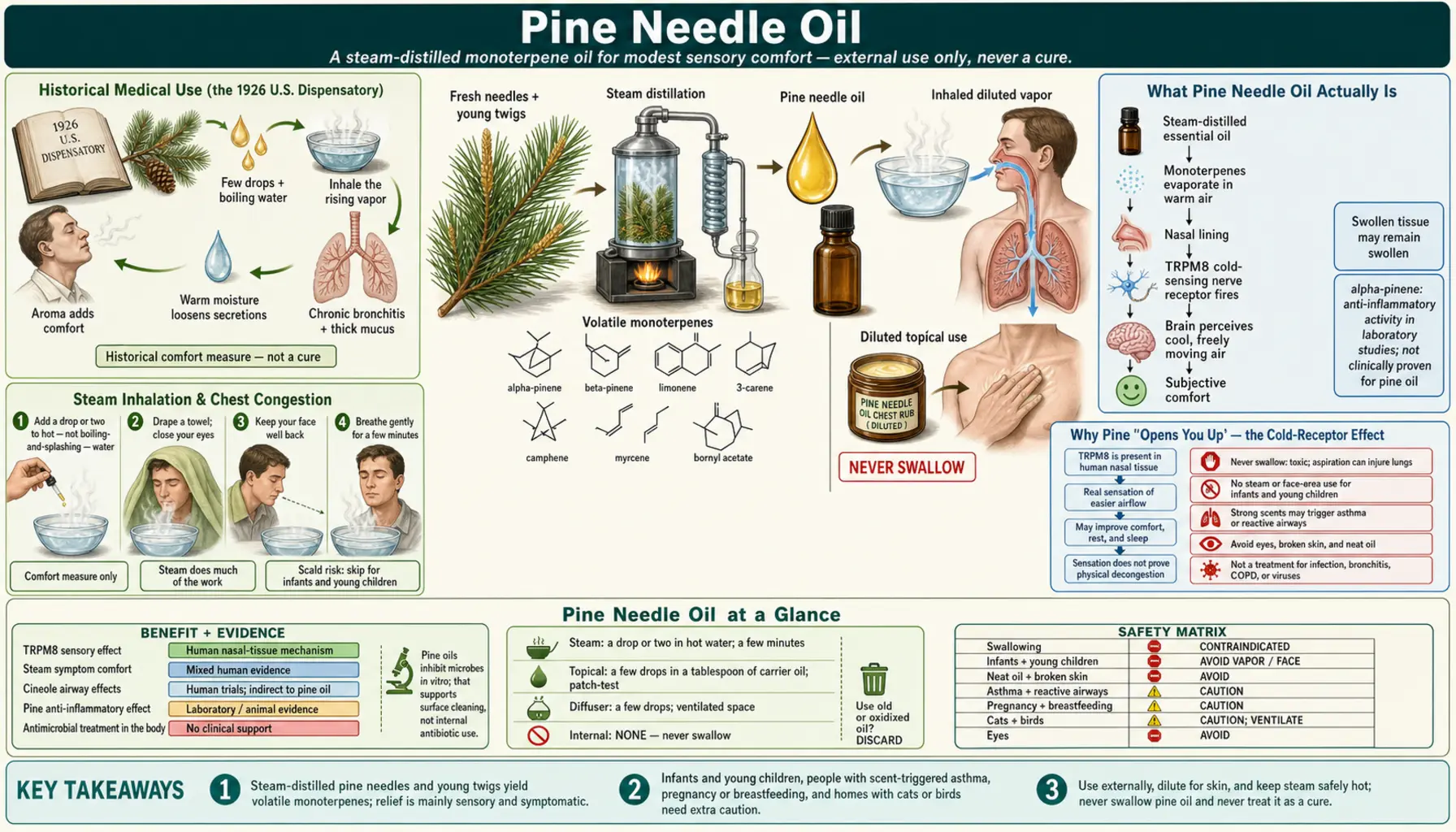
Pine needle oil is the fragrant volatile oil steam-distilled from the needles and young twigs of pine trees. It is one of the twenty remedies featured in this series drawn from the United States Dispensatory of 1926, when a doctor with a chest cold might tell you to drop a little pine oil into a bowl of boiling water and breathe in the steam. That advice was never a cure, but it wasn't pure folklore either: the warm, moist air loosens thick mucus, and the piney aroma can make a stuffed-up nose feel clearer. This page separates the small, real, comforting effect from the tall claims you may have seen online. Two things matter most before we begin, because the old texts and the modern videos both leave them out: pine needle oil is for breathing in or applying to the skin — never for swallowing, and the dramatic internet claims that "pine needle tea" or pine oil can fight viruses by blocking "spike protein" are not supported by evidence and are not made here.
Table of Contents
- Historical Medical Use (the 1926 U.S. Dispensatory)
- What Pine Needle Oil Actually Is
- Steam Inhalation & Chest Congestion
- Why Pine "Opens You Up" — the Cold-Receptor Effect
- Topical & Aromatic Uses
- Antimicrobial Activity in the Lab
- How It's Used Today
- Safety, Cautions & Myths
- Key Research Papers
- Connections
- Featured Videos
Historical Medical Use (the 1926 U.S. Dispensatory)
In the early twentieth century, before antibiotics and modern inhalers existed, doctors reached for whatever gave patients some relief. The United States Dispensatory of 1926 — the standard American drug reference of its day, written when roughly three-quarters of listed remedies were still plant-derived — described pine-derived volatile oils as a treatment for diseases of the airways. The classic instruction was simple: add a few drops of pine oil to boiling water and inhale the rising vapor, particularly for chronic bronchitis and other conditions where the lungs were clogged with thick, hard-to-clear mucus.
The reasoning of the era was that the aromatic oil, carried on hot steam deep into the breathing passages, would thin secretions and help the patient cough them up — acting as what was then called an expectorant (something that promotes the clearing of mucus). Pine, fir, and spruce oils, along with closely related products like turpentine (distilled from pine resin) and the eucalyptus and menthol preparations of the same period, were all used this way. Inhaled pine vapor was also valued simply for making a sickroom smell fresh and "antiseptic" at a time when foul air was widely blamed for spreading disease.
Here is the honest framing this series insists on: this is history, not present-day medical advice. In 1926, steam inhalation with pine oil was a reasonable comfort measure within the limits of the knowledge available — but it did not, and does not, cure bronchitis. Chronic bronchitis today is understood as long-term inflammation of the airways (most often from smoking, in the form of COPD) that needs proper diagnosis and modern treatment. What the old doctors observed was real but modest: the warmth and moisture, plus a fragrance that makes breathing feel easier, can soothe symptoms. The sections below explain what part of that 1926 practice holds up under modern evidence, and what does not.
What Pine Needle Oil Actually Is
Pine needle oil is an essential oil — a concentrated, aromatic, oily liquid — obtained by steam-distilling the fresh needles and young twigs of pine trees. Common sources include Scots pine (Pinus sylvestris), the species most often sold simply as "pine needle oil," along with other pines, firs (Abies), and spruces (Picea); their oils are chemically similar, which is why "pine," "fir," and "spruce" oils smell and behave much alike. It is not the same thing as pine resin products such as turpentine or rosin, and it is not "pine needle tea," which is simply water infused with needles.
What gives the oil its sharp, forest-fresh scent and its biological activity is a family of plant compounds called terpenes — specifically light, volatile monoterpenes. The headline ingredient is alpha-pinene (along with its cousin beta-pinene), the very molecule responsible for the smell of a pine forest. Depending on the species and season, the oil also contains limonene, 3-carene, camphene, myrcene, and small amounts of bornyl acetate and other terpenes. These are the same broad class of compounds found in eucalyptus oil (rich in 1,8-cineole, also called eucalyptol) and peppermint oil (rich in menthol), which is why all three are traditional "chest and sinus" aromatics.
Two practical points follow from this chemistry. First, these monoterpenes are volatile — they evaporate readily and travel on warm air, which is exactly why steam inhalation is the traditional delivery method. Second, the very properties that make the oil potent on a nerve ending or a bacterial membrane also make it an irritant in the wrong place — in the eyes, on broken skin, and above all in the stomach and lungs if swallowed. Concentration matters enormously: a whiff of diluted vapor is mild; the neat oil is harsh. Keep that in mind through the rest of this page.
Steam Inhalation & Chest Congestion
This is the use that connects directly to 1926, so it deserves an honest, careful look. The claim then was that inhaling pine vapor clears lung mucus in bronchitis. The modern, evidence-based version is narrower: steam inhalation provides mild, short-term, symptomatic relief of congestion, and pine-type terpenes may add a modest expectorant and decongestant sensation — but the effect is limited, and the steam itself does much of the work.
Start with the steam. Warm, humid air can loosen thick nasal and chest secretions and soothe irritated airways, which is why it feels good when you're stuffed up. But when researchers tested heated, humidified air rigorously for the common cold, the benefit was inconsistent: a Cochrane systematic review pooling multiple randomized trials found that steam inhalation did not reliably improve cold symptoms overall and produced no consistent objective benefit, while a few people experienced nasal discomfort or, rarely, minor burns from the hot water. In other words, steam is a reasonable comfort measure for many people, but it is not a proven treatment — and the hot water carries a real, if small, scald risk, especially for children.
Now the pine terpenes. Here the best human evidence actually comes not from pine oil itself but from its close chemical relative 1,8-cineole (eucalyptol), the dominant terpene in eucalyptus, which has been studied in proper clinical trials. In a placebo-controlled, double-blind trial, oral cineole improved symptoms in patients with acute bronchitis faster than placebo; in another double-blind trial, adding cineole reduced the frequency of COPD exacerbations; and in a third, it relieved acute rhinosinusitis. These trials used a standardized, regulated cineole capsule taken by mouth under medical supervision — not drops of pine oil swallowed at home, which is unsafe — but they establish a real principle: certain conifer/eucalyptus monoterpenes can have genuine, measurable effects on inflamed airways. Pine's alpha-pinene belongs to the same monoterpene family and shows anti-inflammatory activity in laboratory studies, which is a plausible (but not yet clinically proven for pine specifically) mechanism for symptom relief.
The honest bottom line: if you have a cold or bronchitis and breathing pine-scented steam makes you more comfortable, that's a legitimate small comfort, and the 1926 doctors weren't imagining it. But it is symptomatic relief, the evidence for steam is mixed, the strong airway data are for regulated cineole rather than home pine oil, and none of it treats the underlying infection or the chronic disease. Antibiotics (for bacterial infection), inhalers, and quitting smoking are what change the course of serious airway disease — pine vapor is, at most, a soothing add-on.
Why Pine "Opens You Up" — the Cold-Receptor Effect
There's a fascinating reason why pine, eucalyptus, and especially menthol vapors make a blocked nose suddenly feel clear even when measurements show the airway hasn't actually widened. Your nasal lining is studded with a cold-sensing nerve receptor called TRPM8 — the same receptor that makes mint feel "cold" and that detects a chilly breeze. When cooling aromatic terpenes reach it, TRPM8 fires and your brain interprets the signal as "air is moving freely and coolly through my nose." Researchers have confirmed that TRPM8 is present in human nasal tissue, which explains this sensation of improved airflow.
This is genuinely useful to understand because it tells you both why the remedy feels effective and where its limits are. The feeling of relief is real — your subjective comfort improves, which can help you rest and sleep — but it is largely a sensation of decongestion rather than true physical decongestion. The swollen tissue is still swollen; your nerves are just being told otherwise. That's not a trick or a failure; subjective comfort matters when you're sick. It simply means pine oil is best thought of as a soothing sensory aid, not a drug that shrinks swollen membranes the way a pharmacologic decongestant does.
Topical & Aromatic Uses
Beyond the steam bowl, pine needle oil has long been used diluted on the skin and as a room and household aroma. You will recognize its scent immediately: it is a classic note in chest rubs and vapor balms (usually alongside menthol, camphor, and eucalyptus), in muscle-warming liniments, in saunas and bath products, and in countless cleaning products and air fresheners marketed as "pine-fresh."
As a topical rub, pine oil — properly diluted in a carrier oil — is used traditionally for sore muscles and minor aches, where the warming, slightly tingling sensation and the act of massage provide comfort. This is in the same tradition as other aromatic counter-irritant rubs; the relief is real but largely symptomatic and sensory. As an aromatic, pine is popular in aromatherapy for its fresh, grounding, "outdoors" scent, and many people find it pleasant and calming. It's worth being candid here: while inhaling a forest atmosphere (the Japanese practice of shinrin-yoku, or "forest bathing") is associated in some studies with lower stress markers, that research is about being among living trees, not about a bottle of essential oil, and the two should not be conflated.
Pine oil is also a legitimate cleaning and disinfecting agent — pine-oil-based household cleaners genuinely have antimicrobial action on surfaces (see the next section). That is a real and longstanding use. It is, however, completely separate from any internal health benefit, and the presence of pine oil in a cleaning product is not evidence that pine oil belongs inside the body.
Antimicrobial Activity in the Lab
Pine needle oil does have measurable antimicrobial activity in laboratory tests, and this is the kernel of truth behind its old reputation as an "antiseptic." Studies that put pine essential oils against bacteria and fungi in a dish consistently find some inhibitory effect. For example, essential oil from Pinus sylvestris needles has shown antibacterial and antioxidant activity against a range of test organisms, and the essential oil of Pinus pinaster (maritime pine) has likewise demonstrated antimicrobial effects in vitro. The monoterpenes responsible — alpha-pinene and its relatives — are thought to work by disrupting microbial cell membranes.
It is essential to interpret this correctly, because lab antimicrobial data are the single most over-hyped category of "natural antibiotic" marketing. "Kills bacteria in a Petri dish" is not the same as "treats an infection in a person." In a dish, the oil sits in direct, high concentration against the microbes. Inside your body, an essential oil is diluted, metabolized, and cleared long before it could reach an infection at an effective and safe concentration — and the doses that would kill microbes internally would harm you first. Pine oil is not an internal antibiotic, it cannot treat pneumonia, bronchitis, sinus infections, urinary infections, or any systemic illness, and it is not a substitute for prescribed antibiotics when those are needed. Where the antimicrobial property is genuinely useful is exactly where it's already used: on surfaces, in cleaning products and air-freshening — not inside the body.
How It's Used Today
Used sensibly and externally, pine needle oil can be a pleasant, low-cost comfort aid. Here is the realistic, safe modern picture — no megadoses, no internal use.
- Steam inhalation (the traditional use): add a drop or two of pine oil to a bowl of hot — not boiling-and-splashing — water, drape a towel over your head, close your eyes, and breathe the vapor gently for a few minutes. Keep your face far enough away to avoid scalding. This may ease the feeling of congestion during a cold; it is a comfort measure, not a treatment. Skip it entirely for infants and young children (see Safety).
- Diluted topical rub: a few drops blended into a carrier oil (such as a tablespoon of a neutral oil) for massage onto sore muscles or the chest of an adult. Always do a small skin-patch test first. Never apply the neat (undiluted) oil to skin.
- Aromatic / diffuser: a few drops in a room diffuser or a sauna for the fresh scent, in a well-ventilated space. Keep diffusers away from infants, pets (birds are especially sensitive), and anyone with asthma who finds strong scents triggering.
- Household cleaning: as an ingredient in (or addition to) surface cleaners, where its real antimicrobial action belongs.
Quality and storage matter: buy oil clearly labeled with the botanical species (e.g., Pinus sylvestris) from a reputable supplier, keep it tightly closed away from heat and light, and don't use very old oil. As pine and other terpene oils age and oxidize, they form compounds that are more likely to irritate or sensitize the skin.
Safety, Cautions & Myths
The 1926 texts and the modern wellness videos share the same dangerous gap: they describe the benefits and skip the warnings. These come first here, because with essential oils the safety facts are not fine print — they are the most important thing on the page.
- Never swallow pine oil. This is the critical rule. Pine oil (and turpentine, with which it is often confused) is a toxic gastrointestinal and central-nervous-system irritant when ingested. Swallowing it can cause burning of the mouth and throat, nausea and vomiting, abdominal pain, dizziness, drowsiness, agitation, and in larger amounts confusion, seizures, and breathing problems. There is no safe culinary or "internal cleanse" dose of pine essential oil. Pine oil is the type of volatile hydrocarbon that is also dangerous if vomited and breathed into the lungs (aspiration), where it can cause a serious chemical pneumonitis. The oil is for the air and the skin, never the stomach.
- Keep it away from infants and young children. Strong volatile oils — pine, camphor, menthol, eucalyptus — can trigger laryngospasm (a sudden closing of the voice box) and breathing difficulty in babies and young children, even just from the vapor or from rubs applied near the face. Do not put these oils on or near the face of a child, do not use them in steam inhalation for young children, and store the bottle locked away — a few swallowed milliliters can poison a small child. If a child swallows essential oil or shows breathing trouble, treat it as an emergency and call Poison Control (in the U.S., 1-800-222-1222) or emergency services.
- Skin reactions. Undiluted pine oil can irritate and, with repeated exposure, sensitize the skin (causing allergic contact dermatitis). Always dilute in a carrier oil, patch-test first, and discard oxidized (old, off-smelling) oil, which is far more allergenic.
- Asthma and reactive airways. Strong scents and vapors can trigger coughing, wheezing, or bronchospasm in some people with asthma. If aromatics make your breathing worse, stop.
- Pregnancy, breastfeeding, and pets. Strong essential oils are best avoided internally and used cautiously around pregnancy and infants; many essential oils, including pine, can be toxic to pets — cats and birds in particular — so diffuse only in ventilated areas they can leave.
Myths to discard — explicitly:
- "Pine needle tea / pine needle oil fights viruses by blocking the spike protein." This claim, which spread widely online, is not supported by scientific evidence. The idea hinges on shikimic acid — a plant compound that is an early chemical raw material used in manufacturing the antiviral drug oseltamivir (Tamiflu). Shikimic acid is not itself an antiviral, and drinking pine tea or inhaling pine oil does not deliver an antiviral drug, does not "block spike protein," and is not a treatment or prevention for any viral illness. This page makes no such claim. If you want protection from a serious respiratory virus, the tools that work are vaccination where appropriate and proven antiviral medications prescribed by a clinician — not pine.
- "It's a natural antibiotic, so it can treat my infection." No. As explained above, lab activity against germs in a dish does not translate into treating an infection in the body, and the internal doses required would be toxic. Real infections need real antibiotics or antivirals when indicated.
- "Essential oils are gentle because they're natural." Concentrated essential oils are some of the most potent plant preparations there are. "Natural" does not mean harmless — turpentine and pine oil are natural and are classic poisons when swallowed.
The honest summary: pine needle oil is a pleasant, mild, symptomatic comfort aid for the nose and chest when inhaled as scented steam, a traditional topical rub when diluted, and a legitimate surface cleaner — and it is a toxin if swallowed and a hazard around small children. Used with respect for those limits, there's a small, real, soothing place for it. Used as a cure-all or an internal medicine, it is at best useless and at worst dangerous.
Key Research Papers
- Singh M, Singh M, Jaiswal N, Chauhan A. (2017). Heated, humidified air for the common cold. Cochrane Database of Systematic Reviews, Issue 8. — A pooled review of randomized trials finding that steam inhalation did not produce consistent objective benefit for cold symptoms and occasionally caused minor discomfort — the basis for treating steam as comfort, not cure.
- Fischer J, Dethlefsen U. (2013). Efficacy of cineole in patients suffering from acute bronchitis: a placebo-controlled double-blind trial. Cough, 9(1):25. — A randomized trial showing the conifer/eucalyptus monoterpene 1,8-cineole (a close relative of pine's terpenes) improved acute bronchitis symptoms faster than placebo, when taken as a regulated capsule.
- Worth H, Schacher C, Dethlefsen U. (2009). Concomitant therapy with Cineole (Eucalyptole) reduces exacerbations in COPD: A placebo-controlled double-blind trial. Respiratory Research, 10(1):69. — A double-blind trial in which adding cineole reduced the frequency, severity, and duration of COPD flare-ups, demonstrating real airway effects for this terpene class.
- Kehrl W, Sonnemann U, Dethlefsen U. (2004). Therapy for Acute Nonpurulent Rhinosinusitis With Cineole: Results of a Double-Blind, Randomized, Placebo-Controlled Trial. The Laryngoscope, 114(4):738–742. — Cineole relieved acute sinus inflammation versus placebo, supporting the principle that certain inhaled/ingested terpenes affect the upper airway.
- Keh SM, Facer P, Yehia A, Sandhu G, Saleh HA, Anand P. (2011). The menthol and cold sensation receptor TRPM8 in normal human nasal mucosa and rhinitis. Rhinology, 49(4):453–457. — Confirms that the cold-sensing receptor TRPM8 is present in human nasal tissue — the mechanism by which cooling pine/menthol vapors create a sensation of clearer breathing.
- Özbek H, Yılmaz BS. (2017). Anti-inflammatory and hypoglycemic activities of alpha-pinene. Acta Pharmaceutica Sciencia, 55(4):7. — Laboratory/animal evidence that alpha-pinene, pine oil's main terpene, has anti-inflammatory activity — a plausible (not yet clinically proven for pine) basis for symptom soothing.
- Namshir J, Shatar A, Khandaa O, et al. (2020). Antimicrobial, antioxidant and cytotoxic activity of essential oil from Pinus sylvestris var. mongolica needle. Mongolian Journal of Chemistry, 21(47):19–26. — In-vitro study documenting antibacterial and antioxidant activity of pine needle essential oil — lab activity that does not translate into internal antibiotic use.
- Chemical composition and antimicrobial activity of the essential oils of Pinus pinaster. (2013). Journal of Coastal Life Medicine, 1(1). — Characterizes a maritime-pine essential oil and its antimicrobial action against test organisms, consistent with pine oil's role as a surface antiseptic rather than a systemic drug.
Live PubMed Searches
- Pine oil poisoning and toxicity — the case literature behind the "never swallow it" warning.
- Alpha-pinene pharmacology — research on pine's principal terpene.
- Steam inhalation for respiratory infection — the evidence on the traditional method itself.
- Pinus essential oil antimicrobial activity — the in-vitro antimicrobial literature.
Connections
- All Remedies
- Eucalyptus
- Peppermint
- Thyme
- Bronchitis
- COPD
- Asthma
- Pulmonology
- Cold & Flu Treatments
- Immune Boosting
- Toxins