Mouth Taping — Benefits Deep Dive
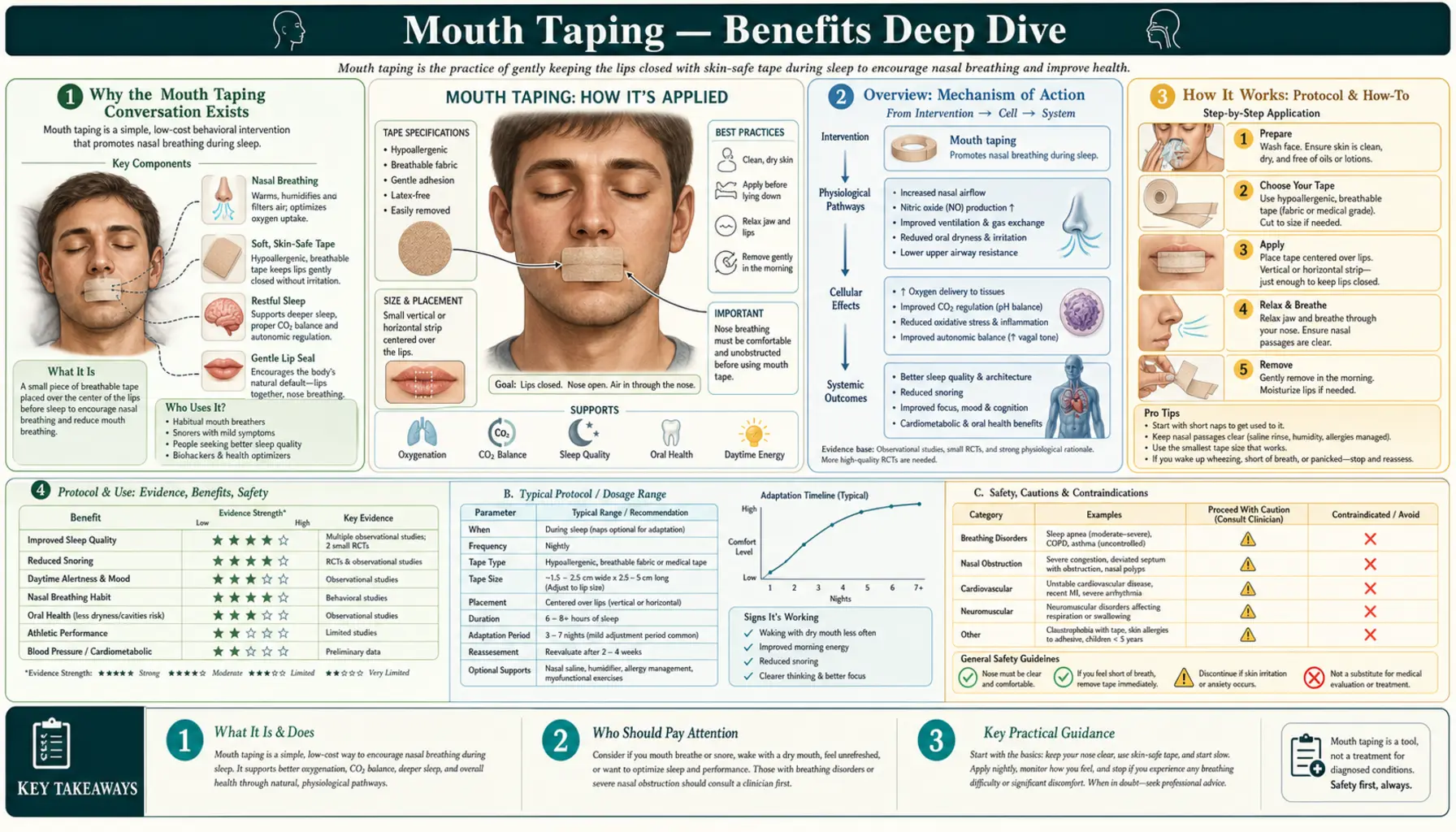
Mouth taping is the intentional use of a small piece of porous medical tape over the lips during sleep, with the goal of forcing obligate nasal breathing through the night. The practice is not a treatment for obstructive sleep apnea — it is a behavioral training tool that capitalizes on a simple physiological fact: the nose is a far better gas-exchange organ than the mouth. Nasal breathing humidifies, warms, and filters inspired air; produces nitric oxide in the paranasal sinuses (a potent bronchodilator and pulmonary vasodilator); and creates the small amount of expiratory resistance that maintains functional residual capacity. The four deep-dive pages below explore the physiology of nasal breathing, the narrow evidence base on snoring and mild positional apnea, the daytime breathing habits that reinforce nighttime gains, and the cautions that determine who should never tape.
Deep-Dive Articles
Nasal Breathing Benefits
Why the nose is the body's designed primary airway. Nitric oxide production in the paranasal sinuses (Lundberg's 1995 discovery), the humidification and warming function, particulate filtration by nasal hair and the mucociliary escalator, the 10–20% expiratory resistance that maintains alveolar recruitment, and the role of nasal breathing in carbon-dioxide tolerance and tidal-volume regulation.
Snoring and Sleep Apnea
What the evidence actually shows. Lee 2015 (Singapore) demonstrated reduced AHI in mild positional OSA with porous-strip mouth closure, but the evidence base remains small. Why mouth taping is contraindicated as a substitute for CPAP in moderate-to-severe OSA, the difference between snoring and apnea, polysomnography expectations, and the AASM/professional-society position.
Daytime Breathing Habits
Why nighttime taping fails when daytime habits are mouth-breathing dominant. Tongue posture (the "mewing"-popularized resting position), the Buteyko method's Control Pause measurement, slow nasal diaphragmatic breathing, the Bohr effect and chronic hyperventilation, and how to convert daytime mouth breathing without taping by retraining the autonomic baseline.
Cautions and Adaptation
The hard rules: never tape with untreated nasal obstruction, severe deviated septum, recent alcohol or sedatives, vomiting risk, claustrophobia, or in children without medical supervision. The graduated protocol — daytime trials first, then partial closure, then full closure — tape selection, skin reactions, and how to recognize when the practice is not working.
Table of Contents
- Deep-Dive Articles
- Why the Mouth Taping Conversation Exists
- Research Papers: Nasal Breathing Physiology
- Research Papers: Mouth Taping, Snoring, and OSA
- Research Papers: Daytime Breathing and Buteyko
- Research Papers: Safety, Adaptation, and Contraindications
- Research Papers: Cross-Cutting (Sleep, Oral Health, Posture)
- External Authoritative Resources
- Connections
- Featured Videos
Why the Mouth Taping Conversation Exists
The popular interest in mouth taping was largely driven by James Nestor's 2020 book Breath, which combined the author's personal Stanford-supervised mouth-blocking experiment with a review of the work of Patrick McKeown (Buteyko Clinic International), Konstantin Buteyko (the Soviet-era physiologist who founded the method), and George Catlin (the 19th-century American painter who studied indigenous breathing practices among Plains tribes and wrote The Breath of Life, or Mal-Respiration in 1862). The convergent claim across these sources is that habitual mouth breathing — especially during sleep — is associated with a wide range of negative outcomes, and that obligate nasal breathing is the body's evolutionary default.
The physiology behind this claim is real and well-documented in the peer-reviewed literature, even if the specific intervention of nighttime mouth taping has a thinner evidence base than its popularity suggests. The well-documented parts include:
- Nitric oxide production in the paranasal sinuses. Lundberg and colleagues demonstrated in 1995 (Acta Physiologica Scandinavica) that the paranasal sinuses continuously produce nitric oxide, which is inhaled with each nasal breath and acts as a potent bronchodilator and pulmonary vasodilator in the lower airways. Mouth breathing bypasses this NO delivery entirely. The mechanism is explored in the Nasal Breathing Benefits deep dive.
- Air conditioning function. The nasal turbinates warm inspired air to within 2-3°C of body temperature and humidify it to 80–90% relative humidity before it reaches the lower airway. Mouth-breathed cold dry air is a known trigger for exercise-induced bronchoconstriction and contributes to nocturnal asthma symptoms.
- Expiratory resistance and FRC maintenance. The nose provides approximately twice the airflow resistance of the open mouth on both inspiration and expiration. The expiratory component creates a small back-pressure that helps maintain functional residual capacity and alveolar recruitment — functionally similar in concept (though much milder in magnitude) to pursed-lip breathing in COPD or low-level PEEP in mechanical ventilation.
- Snoring physiology. Snoring is generated by vibration of the soft palate and oropharyngeal soft tissues during inspiration when the mouth is open. Closing the mouth shifts inspiration through the nose, which mechanically reduces palatal vibration in many (but not all) snorers. The Snoring and OSA deep dive reviews the limited but real evidence base.
What does not have strong evidence is the claim that mouth taping is a substitute for CPAP in moderate-to-severe obstructive sleep apnea. The American Academy of Sleep Medicine has been explicit on this point: mouth taping has not been validated as monotherapy for OSA and should not delay evaluation with a sleep study in any patient with witnessed apnea, oxygen desaturation, or excessive daytime sleepiness. The Cautions and Adaptation deep dive enumerates the absolute contraindications and the graduated adaptation protocol.
The fourth deep dive on Daytime Breathing Habits addresses a point most popular coverage misses: nighttime mouth taping rarely produces durable benefit if daytime breathing remains mouth-dominant. The autonomic baseline that determines nasal-versus-mouth breathing during sleep is set by the prevailing pattern during the 16 waking hours, and retraining that baseline (via Buteyko Control Pause work, tongue-posture awareness, and slow diaphragmatic nasal breathing) is the higher-leverage intervention.
Research Papers: Nasal Breathing Physiology
- Lundberg JO, Weitzberg E, et al. Nitric oxide in exhaled air, paranasal sinus origin Search PubMed
- Lundberg JO. Nitric oxide and the paranasal sinuses (Anatomical Record review) — PMID 18951492
- Scadding G. Nitric oxide in the airways Search PubMed
- Cole P. Nasal versus oral airflow resistance and warming/humidification PubMed: Cole nasal physiology
- Niinimaa V, Cole P, Mintz S, Shephard RJ. The switching point from nasal to oronasal breathing Search PubMed
- Saibene F, Mognoni P, Lafortuna CL, Mostardi R. Oronasal breathing during exercise PubMed: Saibene oronasal exercise
- Swift AC, Campbell IT, McKown TM. Oronasal obstruction, lung volumes, and arterial oxygenation Search PubMed
- Lundberg JO. Airborne nitric oxide: inflammatory marker and aerocrine messenger Search PubMed
- Settipane RA. Nasal-pulmonary interactions PubMed: Settipane nasal-pulmonary
- Djupesland PG, Chatkin JM, Qian W, Cole P, Zamel N, et al. Nitric oxide in the nasal airway PubMed: Djupesland nasal NO
Research Papers: Mouth Taping, Snoring, and OSA
- Lee YC, Lu CT, Cheng WN, Li HY. The impact of mouth-taping on snoring and OSA Search PubMed
- Huang TW, Young TH. Novel porous oral patches for mild to moderate OSA Search PubMed
- Meurice JC, Marc I, Carrier G, Series F. Effects of mouth opening on upper airway collapsibility Search PubMed
- Kim EJ, Choi JH, et al. The impacts of open-mouth breathing on upper airway space in obstructive sleep apnea Search PubMed
- Lee SH, Choi JH, Shin C, Lee HM, Kwon SY, Lee SH. How does open-mouth breathing influence upper airway anatomy? PubMed: Open-mouth airway anatomy
- Koutsourelakis I, Vagiakis E, Roussos C, Zakynthinos S. Obstructive sleep apnoea and oral breathing in patients free of nasal obstruction Search PubMed
- AASM clinical practice guidelines on OSA treatment (Patil et al.) — PMID 30736887
- Ohki M, Usui N, Kanazawa H, Hara I, Kawano K. Relationship between oral breathing and nasal obstruction PubMed: Ohki nasal obstruction
- Madronio MR, Di Somma E, Stavrinou R, Kirkness JP, Goldfinch E, Wheatley JR, Amis TC. Older individuals have increased oro-nasal breathing during sleep Search PubMed
- Fitzpatrick MF, McLean H, Urton AM, Tan A, O'Donnell D, Driver HS. Effect of nasal or oral breathing route on upper airway resistance during sleep — PMID 12882467
Research Papers: Daytime Breathing and Buteyko
- Bruton A, Lewith GT. The Buteyko breathing technique for asthma: a review Search PubMed
- Cooper S, Oborne J, Newton S, Harrison V, Thompson Coon J, Lewis S, Tattersfield A. Effect of two breathing exercises (Buteyko and pranayama) in asthma Search PubMed
- Bowler SD, Green A, Mitchell CA. Buteyko breathing techniques in asthma: a blinded randomised controlled trial Search PubMed
- McHugh P, Aitcheson F, Duncan B, Houghton F. Buteyko Breathing Technique for asthma: an effective intervention Search PubMed
- Courtney R. The functions of breathing and its dysfunctions and their relationship to breathing therapy PubMed: Courtney breathing therapy
- Courtney R, Cohen M. Investigating the claims of Konstantin Buteyko Search PubMed
- Russo MA, Santarelli DM, O'Rourke D. The physiological effects of slow breathing in the healthy human Search PubMed
- Jerath R, Crawford MW, Barnes VA, Harden K. Self-regulation of breathing as a primary treatment for anxiety — PMID 25869930
- Brown RP, Gerbarg PL. Sudarshan Kriya yogic breathing in the treatment of stress, anxiety, and depression — PMID 15750381
- Lehrer PM, Gevirtz R. Heart rate variability biofeedback: how and why does it work? — PMID 25101026
Research Papers: Safety, Adaptation, and Contraindications
- Georgalas C. The role of the nose in snoring and obstructive sleep apnoea: an update Search PubMed
- Friedman M, Maley A, Kelley K, Pulver TM, Foster M, Fisher M, Joseph N. Impact of nasal obstruction on OSA Search PubMed
- Mickelson SA. Nasal surgery for obstructive sleep apnea syndrome Search PubMed
- Park SY, Han DH, Hong SC, Cha HE, Lee YS, Kim DY, et al. Septoplasty and obstructive sleep apnea PubMed: Septoplasty OSA
- Robertson CJ. The link between adult bruxism and sleep apnoea PubMed: Bruxism and OSA
- Olsen KD, Kern EB, Westbrook PR. Sleep and breathing disturbance secondary to nasal obstruction PubMed: Olsen nasal obstruction
- Series F, St Pierre S, Carrier G. Effects of surgical correction of nasal obstruction in the treatment of OSA PubMed: Series nasal correction
- Choi JH, Kim EJ, Kim YS, Choi J, Kim TH, Kwon SY, et al. Effectiveness of nasal surgery alone on snoring and OSA PubMed: Choi nasal surgery
- Yu JL, Rosen I. Utility of the modified Mallampati grade and Friedman tongue position in the assessment of OSA Search PubMed
- Patil SP, Ayappa IA, Caples SM, Kimoff RJ, Patel SR, Harrod CG. Treatment of adult OSA with positive airway pressure (AASM CPG) — PMID 30736887
Research Papers: Cross-Cutting (Sleep, Oral Health, Posture)
- Surda P, Putala M, Siarnik P, Walker A, De Rome K, Amin N, Sangha MS, et al. Mouth breathing and dryness in the upper respiratory tract PubMed: Surda mouth breathing
- Choi JE, Waddell JN, Lyons KM, Kieser JA. Intraoral pH and temperature during sleep with and without mouth breathing Search PubMed
- Mummolo S, Nota A, Caruso S, Quinzi V, Marchetti E, Marzo G. Salivary markers and microbial flora in mouth breathing late adolescents PubMed: Mummolo oral microbiome
- Harari D, Redlich M, Miri S, Hamud T, Gross M. The effect of mouth breathing versus nasal breathing on dentofacial and craniofacial development Search PubMed
- Lin L, Zhao T, Qin D, Hua F, He H. The impact of mouth breathing on dentofacial development PubMed: Mouth breathing dentofacial
- Trabalon M, Schaal B. It takes a mouth to eat and a nose to breathe: abnormal oral respiration affects neonates' oral competence and systemic adaptation Search PubMed
- Gozal D, Kheirandish-Gozal L. The multiple challenges of OSA in children Search PubMed
- Brockmann PE, Bertrand P, Pardo T, Cerda J, Reyes B, Holmgren NL. Prevalence of habitual snoring and associated neurocognitive consequences among Chilean schoolchildren Search PubMed
- Bonuck K, Freeman K, Chervin RD, Xu L. Sleep-disordered breathing in a population-based cohort: behavioral outcomes at 4 and 7 years — PMID 22392181
- Guilleminault C, Huang YS. From oral facial dysfunction to dysmorphism and the onset of pediatric OSA — PMID 29103943
External Authoritative Resources
- American Academy of Sleep Medicine (AASM) — clinical practice guidelines for OSA evaluation and treatment
- Buteyko Clinic International (Patrick McKeown) — structured nasal-breathing retraining program
- PubMed — All research on mouth taping
- PubMed — Nasal breathing and nitric oxide
- PubMed — Buteyko breathing technique research
Connections
- All Remedies
- Mouth Taping (Main Hub)
- Nasal Breathing Benefits
- Snoring and Sleep Apnea
- Daytime Breathing Habits
- Cautions and Adaptation
- Breathwork
- Sleep Hygiene
- Oral Microbiome
- Obstructive Sleep Apnea
- Sinusitis