Aspirin for Heart Attack Prevention
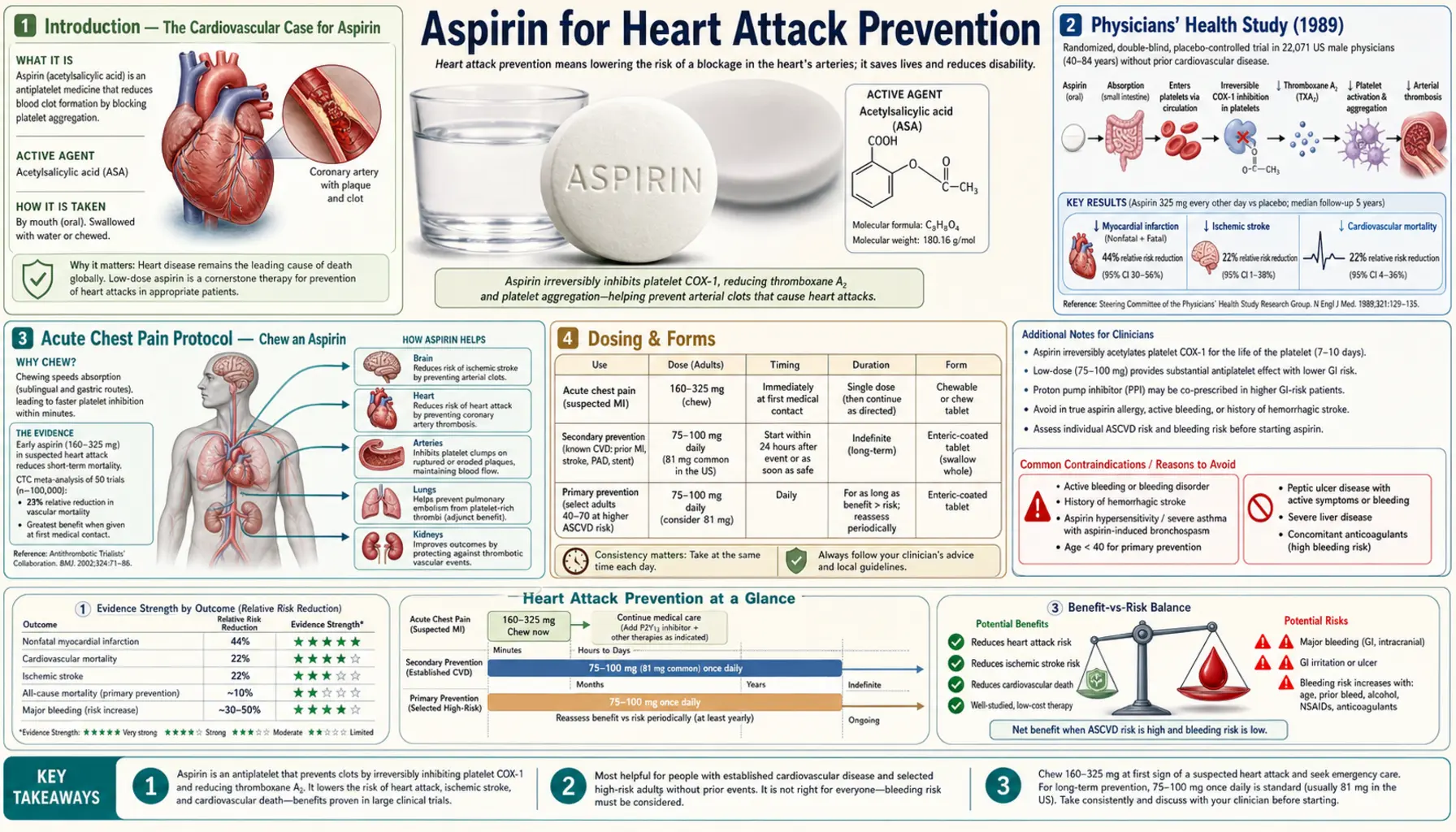
Aspirin (acetylsalicylic acid) has been tested against heart attack and other vascular events in large randomized trials for more than three decades. A low daily dose permanently inactivates the enzyme cyclooxygenase-1 (COX-1) in platelets, which prevents atherothrombosis but raises the risk of bleeding, particularly in the gut (PubMed). In people who already have vascular disease, the 2009 Antithrombotic Trialists' meta-analysis described low-dose aspirin as of definite and substantial net benefit for many; in people without vascular disease it called the net value uncertain (PubMed). In the 1988 ISIS-2 trial, one month of aspirin started within 24 hours of a suspected heart attack reduced 5-week vascular mortality by 23% (PubMed). This page covers the mechanism, the landmark trials, the 2018 primary-prevention trials, the 2019–2022 guideline statements, what guidelines and health services state about aspirin during a suspected heart attack, and what has been studied on dual antiplatelet therapy, aspirin “resistance” and doses.
Table of Contents
- Introduction — Where Aspirin Has Been Tested
- Mechanism — COX-1 Platelet Inhibition
- Secondary Prevention — The ATT Meta-Analyses
- ISIS-2 — The Landmark Acute MI Trial
- Physicians' Health Study (1989)
- The 2018 Primary Prevention Trials — ARRIVE, ASCEND, ASPREE
- USPSTF 2022 and ACC/AHA 2019 Statements
- Aspirin During a Suspected Heart Attack — What Guidelines State
- Post-PCI Dual Antiplatelet Therapy (DAPT)
- Diabetes & Cardiovascular Risk
- Aspirin Resistance
- Doses and Formulations Studied
- Key Research Papers
- Connections
- Featured Videos
Introduction — Where Aspirin Has Been Tested
A review of platelet biology describes the trade-off at the centre of aspirin's cardiovascular use: permanent inactivation of platelet COX-1 prevents atherothrombosis but increases the risk of bleeding, particularly gastrointestinal bleeding (PubMed). Randomized trials have studied aspirin in three distinct settings:
- Secondary prevention — people with established occlusive vascular disease (previous myocardial infarction, stroke or transient ischaemic attack, angina, peripheral arterial disease). The 2002 and 2009 Antithrombotic Trialists' meta-analyses found clear reductions in serious vascular events in these groups (PubMed) (PubMed).
- Suspected acute myocardial infarction — in ISIS-2, aspirin started within 24 hours of symptom onset reduced 5-week vascular mortality (PubMed).
- Primary prevention — people with no history of cardiovascular disease. Here the reduction in events is smaller and has to be weighed against an increase in major bleeding, and the 2018 trials and the 2019–2022 guideline statements changed how this use is described (PubMed) (PubMed).
Mechanism — COX-1 Platelet Inhibition
Aspirin permanently acetylates a serine residue (Ser-529) just below the catalytic pocket of COX-1, the enzyme platelets use to make thromboxane A2 (TXA2), which drives platelet activation. A 2026 review gives aspirin's half-life as about 20 minutes; its antiplatelet effect lasts far longer because the acetylation is irreversible (PubMed).
Why the Inhibition Lasts for Days
The same review notes that anucleate platelets have limited capacity to make new protein and that their lifespan is 7–10 days in humans, with an estimated 10–12% of circulating platelets newly formed each day. Nucleated cells, by contrast, can resynthesize the enzyme within 4–6 hours (PubMed).
Why Low Dose Works
Once-daily low-dose aspirin (30–100 mg) suppresses platelet COX-1 activity by more than 97% throughout the dosing interval, while largely sparing COX-2-dependent prostanoid production in other tissues such as the blood-vessel wall (PubMed). In clinical outcomes, the 2002 Antithrombotic Trialists' meta-analysis found 75–150 mg daily at least as effective as higher daily doses, with the effects of doses below 75 mg less certain (PubMed). Two large dose-comparison trials are described under Doses and Formulations Studied.
COX-1 in Platelets and in the Stomach Lining
COX-1 is also expressed constitutively in the gastrointestinal mucosa, where its prostaglandins (PGE2 and PGI2) support mucus and bicarbonate release, reduce acid secretion and maintain mucosal blood flow. The review attributes the higher acetylation of COX-1 in platelets than in the colorectal mucosa to platelets' exposure to higher concentrations of intact aspirin in the presystemic circulation (PubMed). Bleeding increased with aspirin in each of the primary-prevention trials described below.
Secondary Prevention — The ATT Meta-Analyses
The Antithrombotic Trialists' (ATT) Collaboration published two meta-analyses that are the main pooled evidence on aspirin in cardiovascular disease.
ATT 2002 (BMJ)
This meta-analysis pooled randomised trials of antiplatelet therapy in high-risk patients (with acute or previous vascular disease or another predisposing condition) reported before September 1997: 287 studies, with 135,000 patients in comparisons of antiplatelet therapy versus control and 77,000 in comparisons of different regimens. Aspirin was the most widely studied drug. Antiplatelet therapy reduced serious vascular events (non-fatal myocardial infarction, non-fatal stroke or vascular death) by about one quarter (PubMed).
Specific findings included:
- A one-third reduction in non-fatal myocardial infarction
- A one-quarter reduction in non-fatal stroke
- A one-sixth reduction in vascular death, with no apparent adverse effect on other deaths
- Absolute reductions in serious vascular events of 36 per 1000 treated for two years after a previous myocardial infarction and 38 per 1000 treated for one month in acute myocardial infarction, with separately significant results in stable angina, peripheral arterial disease and atrial fibrillation
- In each high-risk category, the authors reported that the absolute benefits substantially outweighed the absolute risks of major extracranial bleeding (PubMed)
ATT 2009 (Lancet)
The 2009 analysis used individual participant data from 16 secondary-prevention trials (17,000 individuals at high average risk) and 6 primary-prevention trials (95,000 individuals at low average risk). In secondary prevention, serious vascular events occurred at 6.7% vs 8.2% per year with aspirin vs control, with reductions of about a fifth in total stroke and in coronary events and a non-significant increase in haemorrhagic stroke. In primary prevention, aspirin reduced serious vascular events by 12% (0.51% vs 0.57% per year) and increased major gastrointestinal and extracranial bleeds (0.10% vs 0.07% per year); the main risk factors for coronary disease were also risk factors for bleeding (PubMed).
The authors described low-dose aspirin as of definite and substantial net benefit for many people who already have occlusive vascular disease, and of uncertain net value in primary prevention, where the reduction in occlusive events has to be weighed against the increase in major bleeds (PubMed). Daily doses named for long-term use vary: 75–150 mg in the ATT 2002 conclusion (PubMed), 75–162 mg for secondary prevention in the American Diabetes Association's 2025 Standards of Care (PubMed), and 81–325 mg as the maintenance dose in the 2014 AHA/ACC guideline for non-ST-elevation acute coronary syndromes, as quoted in a 2023 review (PubMed).
ISIS-2 — The Landmark Acute MI Trial
The Second International Study of Infarct Survival (ISIS-2), published in The Lancet in 1988, randomised 17,187 patients in 417 hospitals, up to 24 hours (median 5 hours) after the onset of suspected acute myocardial infarction, in a 2×2 factorial design to a 1-hour streptokinase infusion, one month of 160 mg/day enteric-coated aspirin, both, or neither (placebo) (PubMed). A 2023 review notes that the first aspirin tablet was sucked or chewed (PubMed).
Key Findings at 5 Weeks
- Aspirin: vascular deaths 9.4% vs 11.8% with placebo tablets (odds reduction 23%)
- Streptokinase: 9.2% vs 12.0% with placebo infusion (odds reduction 25%)
- Both: 8.0% vs 13.2% with neither (odds reduction 42%); the authors described the two effects as appearing additive
- Aspirin reduced non-fatal reinfarction (1.0% vs 2.0%) and non-fatal stroke (0.3% vs 0.6%), and was not associated with any significant increase in cerebral haemorrhage or in bleeds requiring transfusion
- Benefit from aspirin was seen across time from pain onset: odds reductions of 25%, 21% and 21% at 0–4, 5–12 and 13–24 hours (PubMed)
A 10-year follow-up reported that one month of aspirin was associated with 26 fewer deaths per 1000 during the first 35 days, with little further benefit or loss in later years; the authors concluded that the early survival advantage seemed to be maintained for at least 10 years (PubMed).
Physicians' Health Study (1989)
The Physicians' Health Study, published in the New England Journal of Medicine in 1989, was a randomized, double-blind, placebo-controlled trial of 325 mg aspirin every other day in 22,071 male physicians. The aspirin component was terminated earlier than scheduled; the final report covers an average follow-up of 60.2 months (PubMed):
- 44% reduction in the risk of myocardial infarction (relative risk 0.56), apparent only among participants aged 50 and older
- No reduction in mortality from all cardiovascular causes (relative risk 0.96)
- A slightly increased risk of stroke that was not statistically significant, seen mainly as haemorrhagic stroke (relative risk 2.14, P=0.06)
- A relative risk of 1.71 for requiring a blood transfusion, and of 1.22 for ulcer (not significant)
The investigators described a conclusive reduction in myocardial infarction but judged the evidence on stroke and total cardiovascular deaths inconclusive (PubMed). The 2005 Women's Health Study (39,876 women aged 45 or older, 100 mg every other day, 10 years) found a non-significant 9% reduction in major cardiovascular events, a 17% reduction in stroke, no significant effect on myocardial infarction and more gastrointestinal bleeding requiring transfusion (relative risk 1.40) (PubMed).
The 2018 Primary Prevention Trials — ARRIVE, ASCEND, ASPREE
Three large primary-prevention trials, each comparing 100 mg aspirin daily with placebo, were published in 2018.
ARRIVE (Lancet 2018)
ARRIVE randomized 12,546 men aged 55 or older and women aged 60 or older judged to be at moderate cardiovascular risk, excluding people with diabetes or at high risk of bleeding, to enteric-coated aspirin or placebo. Median follow-up was 60 months (PubMed):
- Primary composite endpoint: 4.29% vs 4.48% (hazard ratio 0.96, 95% CI 0.81–1.13)
- Gastrointestinal bleeding events, mostly mild: 0.97% vs 0.46% (hazard ratio 2.11)
- The event rate was much lower than expected, which the authors attributed probably to contemporary risk management, making the study more representative of a low-risk population
ASCEND (NEJM 2018)
ASCEND randomized 15,480 adults with diabetes and no evident cardiovascular disease. Mean follow-up was 7.4 years (PubMed):
- Serious vascular events: 8.5% vs 9.6% (rate ratio 0.88)
- Major bleeding: 4.1% vs 3.2% (rate ratio 1.29), mostly gastrointestinal and other extracranial bleeding
- The authors concluded that the absolute benefits were largely counterbalanced by the bleeding hazard
ASPREE (NEJM 2018)
ASPREE randomized 19,114 community-dwelling adults aged 70 or older (65 or older among Black and Hispanic participants in the United States) without cardiovascular disease, dementia or disability to enteric-coated aspirin or placebo. Median follow-up was 4.7 years:
- Cardiovascular disease: 10.7 vs 11.3 events per 1000 person-years (hazard ratio 0.95, 95% CI 0.83–1.08); major hemorrhage 8.6 vs 6.2 per 1000 person-years (hazard ratio 1.38) (PubMed)
- The primary endpoint, disability-free survival, did not differ (hazard ratio 1.01), and the trial was stopped early for lack of benefit on it (PubMed)
- Death from any cause: 12.7 vs 11.1 per 1000 person-years (hazard ratio 1.14, 95% CI 1.01–1.29), with cancer the major contributor; the investigators called this unexpected in the context of previous studies and said it should be interpreted with caution, and the cause-of-death analyses were post hoc and exploratory (PubMed)
The 2019 ACC/AHA primary-prevention guideline, published after these trials, lists among its top take-home messages that “aspirin should be used infrequently in the routine primary prevention of ASCVD because of lack of net benefit” (PubMed).
USPSTF 2022 and ACC/AHA 2019 Statements
In April 2022 the US Preventive Services Task Force updated its 2016 recommendation. The statement applies to adults 40 or older without signs, symptoms or history of cardiovascular disease who are not at increased risk for bleeding (PubMed):
- Adults aged 40–59 with a 10% or greater 10-year cardiovascular risk: the USPSTF concludes with moderate certainty that aspirin has a small net benefit and states that the decision to start low-dose aspirin should be an individual one; people not at increased bleeding risk and willing to take it daily are more likely to benefit (C recommendation).
- Adults aged 60 or older: the USPSTF concludes with moderate certainty that starting aspirin for primary prevention has no net benefit and recommends against starting it (D recommendation).
- The statement concerns starting aspirin for primary prevention; its population excludes people with known cardiovascular disease, including a history of myocardial infarction or stroke.
The 2019 ACC/AHA guideline on primary prevention states that aspirin should be used infrequently in routine primary prevention because of lack of net benefit (PubMed). On stopping aspirin that is already being taken, a Swedish nationwide cohort of 601,527 long-term users of low-dose aspirin for primary or secondary prevention found a higher rate of cardiovascular events after discontinuation than with continuation (adjusted hazard ratio 1.37), corresponding to one additional event per year in 1 of every 74 patients who discontinued; periods after major surgery or bleeding were excluded. This was an observational study, not a randomized comparison (PubMed). Decisions about starting or stopping aspirin belong with a clinician.
Aspirin During a Suspected Heart Attack — What Guidelines State
Guidance on aspirin during a suspected heart attack comes from guidelines and health services, and the wording differs between them:
- UK National Health Service: the NHS heart-attack page (last reviewed 31 March 2026), in its section on what to do while waiting for medical help after calling 999, states: “Take aspirin (300mg) if you have any – do not give aspirin to someone who has an aspirin allergy” (NHS: Heart attack).
- 2014 AHA/ACC guideline, non-ST-elevation acute coronary syndromes, as quoted in a 2023 review: “Non–enteric-coated, chewable aspirin (162 mg to 325 mg) should be given to all patients with NSTE-ACS without contraindications as soon as possible after presentation”, with a maintenance dose of 81–325 mg/day continued indefinitely (Class I, Level of Evidence A) (PubMed).
- 2013 ACC/AHA and 2017 ESC guidelines for ST-elevation myocardial infarction: the same review reports aspirin loading of 162–325 mg as a Class I, Level B indication; the 2020 ESC guideline for acute coronary syndromes without persistent ST elevation gives an initial oral loading dose of 150–300 mg (PubMed).
- The 2025 ACC/AHA/ACEP/NAEMSP/SCAI guideline for acute coronary syndromes replaces the 2013 and 2014 US guidelines (PubMed); its full text was not accessible for this page, so its aspirin wording is not quoted here.
The 2002 Antithrombotic Trialists' meta-analysis concluded that in acute settings an initial loading dose of at least 150 mg may be required, compared with 75–150 mg for long-term use (PubMed).
What Studies Show About Chewing and Enteric Coating
- In a randomized crossover study of 12 fasting volunteers given 325 mg buffered aspirin, serum thromboxane B2 fell by 50% in 5.0 minutes when the tablet was chewed for 30 seconds before swallowing, compared with 12.0 minutes when it was swallowed whole; the authors concluded that chewing was the most effective way of accelerating absorption and shortening the time to an antiplatelet effect (PubMed).
- In 400 healthy volunteers given a single 325 mg dose, variable absorption caused apparent non-response in up to 49% of those given enteric-coated aspirin and in none of those given immediate-release aspirin; the authors described this as pseudoresistance reflecting delayed and reduced absorption (PubMed).
Exclusions Named in the Guidance
The NHS page excludes people with an aspirin allergy, and the 2014 guideline wording applies to patients “without contraindications” (PubMed). Bleeding risks of aspirin are covered on the Bleeding Risks and Cautions page.
Post-PCI Dual Antiplatelet Therapy (DAPT)
After percutaneous coronary intervention (PCI) with a stent, patients receive dual antiplatelet therapy (DAPT): aspirin plus a P2Y12 receptor inhibitor. A 2023 review reports that, according to current guidelines, aspirin is continued indefinitely as single antiplatelet therapy after DAPT is completed (PubMed).
The P2Y12 Inhibitors
- Clopidogrel — in CURRENT-OASIS 7 (25,086 patients with acute coronary syndromes), a 7-day double-dose clopidogrel regimen did not reduce cardiovascular death, myocardial infarction or stroke at 30 days compared with standard dosing (4.2% vs 4.4%) and increased major bleeding (2.5% vs 2.0%) (PubMed)
- Prasugrel — in TRITON-TIMI 38 (13,608 patients with acute coronary syndromes and scheduled PCI), prasugrel reduced the primary ischaemic endpoint compared with clopidogrel (9.9% vs 12.1%) and stent thrombosis (1.1% vs 2.4%), with more major bleeding (2.4% vs 1.8%), including fatal bleeding (0.4% vs 0.1%) (PubMed)
- Ticagrelor — studied as monotherapy after a short course of DAPT in TWILIGHT (below) (PubMed)
Duration
The 2023 review reports that the 2023 AHA/ACC chronic coronary disease guideline recommends DAPT with aspirin and clopidogrel for 6 months after PCI followed by single antiplatelet therapy (Class 1), and that the 2023 ESC acute coronary syndrome guideline states that single antiplatelet therapy should be considered for patients who are event-free after 3–6 months of DAPT and not at high ischaemic risk (PubMed). In a prospective cohort of 2,229 patients with drug-eluting stents, stent thrombosis occurred in 1.3% at 9 months with a case fatality of 45%, and premature discontinuation of antiplatelet therapy was the strongest independent predictor (hazard ratio 89.78) (PubMed).
Bleeding vs. Ischemic Balance
In TWILIGHT, 7,119 high-risk patients who had completed 3 months of ticagrelor plus aspirin after PCI were randomized to continue ticagrelor with aspirin or with placebo for a year; clinically relevant bleeding was 4.0% with ticagrelor alone vs 7.1% with ticagrelor plus aspirin (hazard ratio 0.56), and death, myocardial infarction or stroke was 3.9% in both groups (PubMed). In STOPDAPT-2 (3,045 patients in Japan), 1 month of DAPT followed by clopidogrel alone was noninferior and superior to 12 months of DAPT for a composite of cardiovascular and bleeding events (2.36% vs 3.70%); the authors noted that additional research is needed in other populations (PubMed).
Diabetes & Cardiovascular Risk
In an individual-record meta-analysis of 102 prospective studies (698,782 people), diabetes was associated with about a two-fold excess risk of a wide range of vascular diseases, with an adjusted hazard ratio of 2.00 for coronary heart disease (PubMed).
The ASCEND Result Revisited
In ASCEND, in adults with diabetes and no evident cardiovascular disease, aspirin reduced serious vascular events (8.5% vs 9.6%) and increased major bleeding (4.1% vs 3.2%) over a mean of 7.4 years, and the authors judged the absolute benefits largely counterbalanced by the bleeding hazard (PubMed).
Current Diabetes Guidelines
- American Diabetes Association Standards of Care 2025, recommendation 10.38: “Aspirin therapy (75–162 mg/day) may be considered as a primary prevention strategy in those with diabetes who are at increased cardiovascular risk after a comprehensive discussion with the individual on the benefits versus the comparable increased risk of bleeding” (PubMed)
- Diabetes with established cardiovascular disease: recommendation 10.35 recommends aspirin (75–162 mg/day) for secondary prevention in people with diabetes and a history of atherosclerotic cardiovascular disease (PubMed)
Aspirin Resistance
Aspirin resistance is the laboratory finding that a patient's platelets continue to aggregate or produce thromboxane despite aspirin therapy. A 2013 study noted that no clear definition has emerged and that estimates of its incidence have varied remarkably (PubMed).
Reported Prevalence
- In a 2008 meta-analysis of 20 studies (2,930 patients with cardiovascular disease), 28% were classified as aspirin resistant using a variety of platelet function assays (PubMed)
- In 201 patients with stable coronary artery disease tested with six methods, the prevalence ranged from 4% by arachidonic-acid light transmission aggregometry to 59.5% by a platelet function analyser; the tests correlated poorly with each other (PubMed)
Causes Studied
- Enteric coating — in 400 healthy volunteers, apparent resistance to a single 325 mg enteric-coated dose reached 49% but did not occur with immediate-release aspirin; every participant responded on repeated exposure, and the study did not identify a single case of true pharmacological resistance (PubMed)
- Ibuprofen — when a single daily dose of ibuprofen was taken before aspirin, or ibuprofen was taken several times a day, aspirin's inhibition of thromboxane formation and platelet aggregation was blocked; acetaminophen, diclofenac and a COX-2 inhibitor did not have this effect (PubMed)
- Adherence — in the 2008 meta-analysis, compliance was confirmed directly in 14 of the 20 studies (PubMed)
Clinical Significance
In the 2008 meta-analysis, patients classified as aspirin resistant had higher odds of a cardiovascular event (odds ratio 3.85) (PubMed). In the ARCTIC trial, 2,440 patients scheduled for coronary stenting were randomized to platelet-function monitoring with drug adjustment or to conventional treatment; the primary endpoint occurred in 34.6% vs 31.1% (hazard ratio 1.13, not significant), and the authors found no significant improvement in clinical outcomes with monitoring (PubMed).
Doses and Formulations Studied
Lower vs. Higher Daily Doses
- CURRENT-OASIS 7 (25,086 patients with acute coronary syndromes): higher-dose aspirin (300–325 mg daily) and lower-dose aspirin (75–100 mg daily) did not differ in cardiovascular death, myocardial infarction or stroke at 30 days (4.2% vs 4.4%) or in major bleeding (2.3% vs 2.3%) (PubMed)
- ADAPTABLE (15,076 patients with established atherosclerotic cardiovascular disease, median 26.2 months): 81 mg and 325 mg daily did not differ significantly in death or hospitalization for myocardial infarction or stroke (7.28% vs 7.51%) or in hospitalization for major bleeding (0.63% vs 0.60%); 41.6% of those assigned 325 mg switched dose (PubMed)
- The 2002 ATT meta-analysis found 75–150 mg daily at least as effective as higher doses for long-term use (PubMed)
Enteric-Coated vs. Plain
- In a case-control study of 550 people hospitalized with upper gastrointestinal bleeding, the relative risks at average daily doses of 325 mg or less were 2.6 for plain, 2.7 for enteric-coated and 3.1 for buffered aspirin; the authors concluded that the assumption that these formulations are less harmful than plain aspirin may be mistaken (PubMed)
- Enteric coating was associated with delayed and reduced absorption and with apparent non-response to a single dose (PubMed)
- Chewed tablets reached a 50% fall in thromboxane faster than tablets swallowed whole (PubMed)
Timing of Daily Dose
In a randomized crossover trial of 290 patients taking 100 mg aspirin for cardiovascular prevention, bedtime intake did not reduce 24-hour blood pressure compared with intake on awakening, but it reduced morning platelet reactivity; the authors called for studies of its effect on cardiovascular events (PubMed).
Gastroprotection
In the COGENT trial of 3,761 patients taking aspirin and clopidogrel, the proton pump inhibitor omeprazole reduced gastrointestinal events compared with placebo (1.1% vs 2.9% at 180 days; hazard ratio 0.34), with no significant difference in cardiovascular events (hazard ratio 0.99); the authors noted that the results do not rule out a clinically meaningful difference in cardiovascular events (PubMed).
Key Research Papers
Landmark Acute MI & Secondary Prevention Trials
- ISIS-2 (Second International Study of Infarct Survival) Collaborative Group. Randomised trial of intravenous streptokinase, oral aspirin, both, or neither among 17,187 cases of suspected acute myocardial infarction. Lancet. 1988;2(8607):349-360. — doi:10.1016/S0140-6736(88)92833-4
- Steering Committee of the Physicians' Health Study Research Group. Final report on the aspirin component of the ongoing Physicians' Health Study. New England Journal of Medicine. 1989;321(3):129-135. — doi:10.1056/NEJM198907203210301
- Ridker PM, Cook NR, Lee IM, et al. A randomized trial of low-dose aspirin in the primary prevention of cardiovascular disease in women (Women's Health Study). New England Journal of Medicine. 2005;352(13):1293-1304. — doi:10.1056/NEJMoa050613
Antithrombotic Trialists' Collaboration Meta-Analyses
- Antithrombotic Trialists' Collaboration. Collaborative meta-analysis of randomised trials of antiplatelet therapy for prevention of death, myocardial infarction, and stroke in high risk patients. BMJ. 2002;324(7329):71-86. — doi:10.1136/bmj.324.7329.71
- Antithrombotic Trialists' (ATT) Collaboration. Aspirin in the primary and secondary prevention of vascular disease: collaborative meta-analysis of individual participant data from randomised trials. Lancet. 2009;373(9678):1849-1860. — doi:10.1016/S0140-6736(09)60503-1
Modern Primary Prevention Trials (2018)
- Gaziano JM, Brotons C, Coppolecchia R, et al. Use of aspirin to reduce risk of initial vascular events in patients at moderate risk of cardiovascular disease (ARRIVE): a randomised, double-blind, placebo-controlled trial. Lancet. 2018;392(10152):1036-1046. — doi:10.1016/S0140-6736(18)31924-X
- ASCEND Study Collaborative Group. Effects of aspirin for primary prevention in persons with diabetes mellitus. New England Journal of Medicine. 2018;379(16):1529-1539. — doi:10.1056/NEJMoa1804988
- McNeil JJ, Wolfe R, Woods RL, et al. Effect of aspirin on cardiovascular events and bleeding in the healthy elderly (ASPREE). New England Journal of Medicine. 2018;379(16):1509-1518. — doi:10.1056/NEJMoa1805819 (editorial note: this entry previously linked the DOI of the disability-free survival paper, now listed separately below.)
- McNeil JJ, Nelson MR, Woods RL, et al. Effect of aspirin on all-cause mortality in the healthy elderly. New England Journal of Medicine. 2018;379(16):1519-1528. — doi:10.1056/NEJMoa1803955
- McNeil JJ, Woods RL, Nelson MR, et al. Effect of aspirin on disability-free survival in the healthy elderly (ASPREE). New England Journal of Medicine. 2018;379(16):1499-1508. — doi:10.1056/NEJMoa1800722
USPSTF & Clinical Practice Guidelines
- US Preventive Services Task Force. Aspirin use to prevent cardiovascular disease: US Preventive Services Task Force recommendation statement. JAMA. 2022;327(16):1577-1584. — doi:10.1001/jama.2022.4983
- Arnett DK, Blumenthal RS, Albert MA, et al. 2019 ACC/AHA guideline on the primary prevention of cardiovascular disease. Circulation. 2019;140(11):e596-e646. — doi:10.1161/CIR.0000000000000678
- Lawton JS, Tamis-Holland JE, Bangalore S, et al. 2021 ACC/AHA/SCAI guideline for coronary artery revascularization. Circulation. 2022;145(3):e18-e114. — doi:10.1161/CIR.0000000000001038 (editorial note: the DOI previously linked here resolved to a JACC: Case Reports commentary on this guideline.)
- Virani SS, Newby LK, Arnold SV, et al. 2023 AHA/ACC/ACCP/ASPC/NLA/PCNA guideline for the management of patients with chronic coronary disease. Circulation. 2023;148(9):e9-e119. — doi:10.1161/CIR.0000000000001168
- Rao SV, O'Donoghue ML, Ruel M, et al. 2025 ACC/AHA/ACEP/NAEMSP/SCAI guideline for the management of patients with acute coronary syndromes. Circulation. 2025;151(13):e771-e862. — PubMed PMID: 40014670
- American Diabetes Association Professional Practice Committee. 10. Cardiovascular disease and risk management: Standards of Care in Diabetes—2025. Diabetes Care. 2025;48(Suppl 1):S207-S238. — PubMed PMID: 39651970
- Maqsood MH, Levine GN, Kleiman ND, et al. Do we still need aspirin in coronary artery disease? Journal of Clinical Medicine. 2023;12(24):7534. — PubMed PMID: 38137601
DAPT, Dosing, & Resistance
- CURRENT-OASIS 7 Investigators. Dose comparisons of clopidogrel and aspirin in acute coronary syndromes. New England Journal of Medicine. 2010;363(10):930-942. — doi:10.1056/NEJMoa0909475
- Mehran R, Baber U, Sharma SK, et al. Ticagrelor with or without aspirin in high-risk patients after PCI (TWILIGHT). New England Journal of Medicine. 2019;381(21):2032-2042. — doi:10.1056/NEJMoa1908419
- Krasopoulos G, Brister SJ, Beattie WS, Buchanan MR. Aspirin "resistance" and risk of cardiovascular morbidity: systematic review and meta-analysis. BMJ. 2008;336(7637):195-198. — doi:10.1136/bmj.39430.529549.be
- Watanabe H, Domei T, Morimoto T, et al. Effect of 1-month dual antiplatelet therapy followed by clopidogrel vs 12-month dual antiplatelet therapy on cardiovascular and bleeding events in patients receiving PCI: the STOPDAPT-2 randomized clinical trial. JAMA. 2019;321(24):2414-2427. — PubMed PMID: 31237644
- Wiviott SD, Braunwald E, et al. Prasugrel versus clopidogrel in patients with acute coronary syndromes (TRITON-TIMI 38). New England Journal of Medicine. 2007;357(20):2001-2015. — PubMed PMID: 17982182
- Iakovou I, Schmidt T, Bonizzoni E, et al. Incidence, predictors, and outcome of thrombosis after successful implantation of drug-eluting stents. JAMA. 2005;293(17):2126-2130. — PubMed PMID: 15870416
- Jones WS, Mulder H, Wruck LM, et al. Comparative effectiveness of aspirin dosing in cardiovascular disease (ADAPTABLE). New England Journal of Medicine. 2021;384(21):1981-1990. — PubMed PMID: 33999548
- Grosser T, Fries S, Lawson JA, et al. Drug resistance and pseudoresistance: an unintended consequence of enteric coating aspirin. Circulation. 2013;127(3):377-385. — PubMed PMID: 23212718
- Catella-Lawson F, Reilly MP, Kapoor SC, et al. Cyclooxygenase inhibitors and the antiplatelet effects of aspirin. New England Journal of Medicine. 2001;345(25):1809-1817. — PubMed PMID: 11752357
- Lordkipanidzé M, Pharand C, et al. A comparison of six major platelet function tests to determine the prevalence of aspirin resistance in patients with stable coronary artery disease. European Heart Journal. 2007;28(14):1702-1708. — PubMed PMID: 17569678
- Collet JP, Cuisset T, Rangé G, et al. Bedside monitoring to adjust antiplatelet therapy for coronary stenting (ARCTIC). New England Journal of Medicine. 2012;367(22):2100-2109. — PubMed PMID: 23121439
- Kelly JP, Kaufman DW, et al. Risk of aspirin-associated major upper-gastrointestinal bleeding with enteric-coated or buffered product. Lancet. 1996;348(9039):1413-1416. — PubMed PMID: 8937281
- Bhatt DL, Cryer BL, et al. Clopidogrel with or without omeprazole in coronary artery disease (COGENT). New England Journal of Medicine. 2010;363(20):1909-1917. — PubMed PMID: 20925534
- Bonten TN, Snoep JD, Assendelft WJ, et al. Time-dependent effects of aspirin on blood pressure and morning platelet reactivity: a randomized cross-over trial. Hypertension. 2015;65(4):743-750. — PubMed PMID: 25691622
Acute MI Follow-Up, Absorption, Mechanism & Epidemiology
- Baigent C, Collins R, et al.; ISIS-2 Collaborative Group. ISIS-2: 10 year survival among patients with suspected acute myocardial infarction in randomised comparison of intravenous streptokinase, oral aspirin, both, or neither. BMJ. 1998;316(7141):1337-1343. — PubMed PMID: 9563981
- Feldman M, Cryer B. Aspirin absorption rates and platelet inhibition times with 325-mg buffered aspirin tablets (chewed or swallowed intact) and with buffered aspirin solution. American Journal of Cardiology. 1999;84(4):404-409. — PubMed PMID: 10468077
- Patrono C, Burn J, et al. Platelet activation, aspirin, and cancer: from basic science to clinical trials. Pharmacological Reviews. 2026;78(1):100109. — PubMed PMID: 41592353
- Sundström J, Hedberg J, et al. Low-dose aspirin discontinuation and risk of cardiovascular events: a Swedish nationwide, population-based cohort study. Circulation. 2017;136(13):1183-1192. — PubMed PMID: 28947478
- Emerging Risk Factors Collaboration. Diabetes mellitus, fasting blood glucose concentration, and risk of vascular disease: a collaborative meta-analysis of 102 prospective studies. Lancet. 2010;375(9733):2215-2222. — PubMed PMID: 20609967
PubMed Topic Searches
Connections
- All Remedies
- Aspirin Overview
- Aspirin Side Effects
- Stroke
- Cardiovascular Disease
- Aspirin Health Benefits
- Aspirin and the Kidneys
- Aspirin for Stroke Prevention
- Oral Microbiome
- NAC (N-Acetylcysteine)
- Anti-Inflammatory Diet
- Hypertension
- Coronary Artery Disease
- Atrial Fibrillation
- Diabetes
- Aspirin and Cancer Prevention
- Chest Pain
- Cardiology