Aspirin Bleeding Risks and Cautions
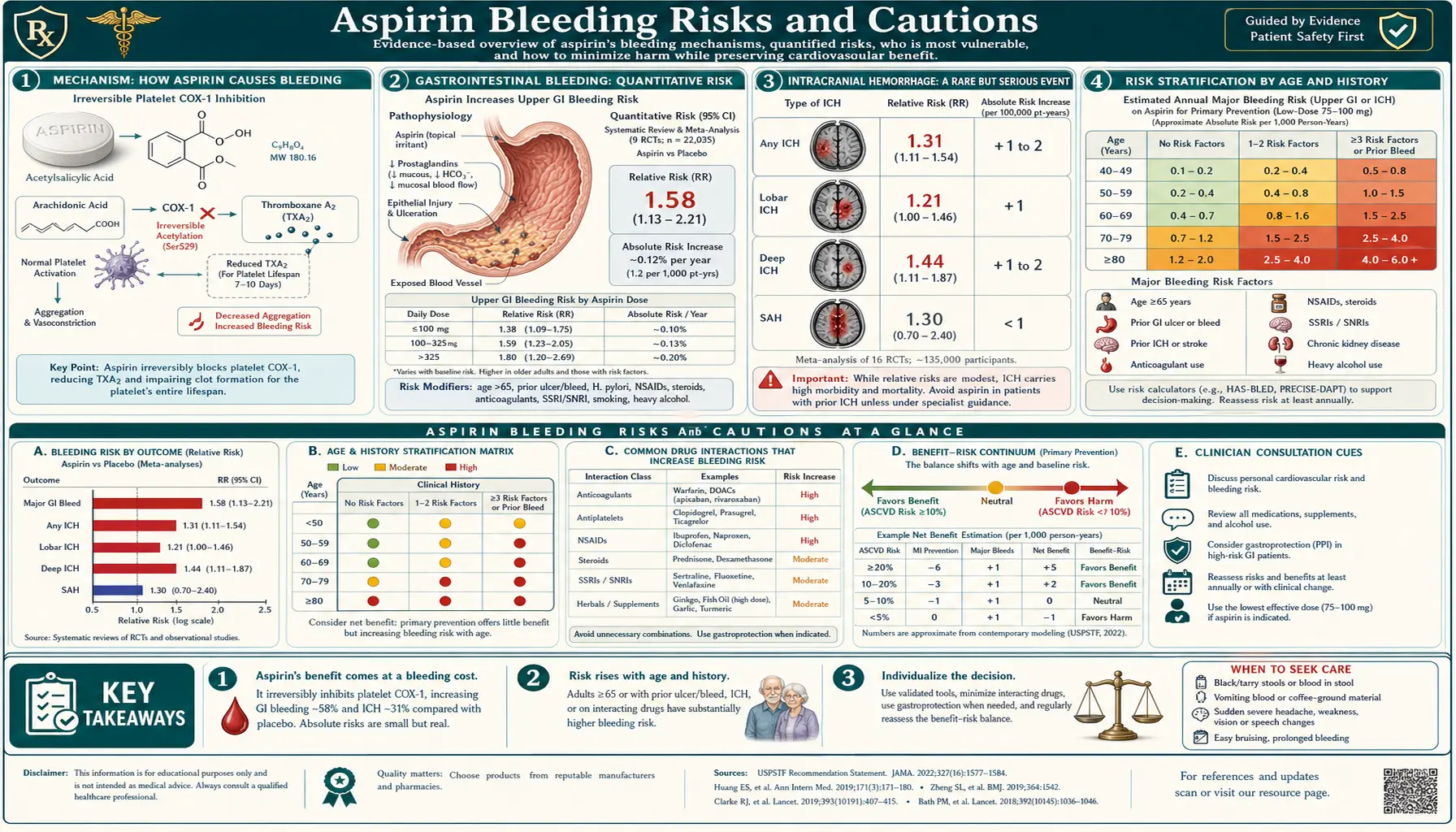
Bleeding is the main harm that limits low-dose aspirin. In a meta-analysis of randomized trials of low-dose aspirin (75-325 mg/day) given for cardiovascular prevention, aspirin raised the risk of major bleeding by about 70%, but the absolute increase was modest: about 0.13% per year for major bleeding, 0.12% per year for major gastrointestinal bleeding and 0.03% per year for intracranial bleeding (McQuaid and Laine 2006). The 2018 primary-prevention trials (ASPREE in adults 70 and older, ASCEND in diabetes, ARRIVE in moderate-risk adults) each found more bleeding on aspirin, and in ASPREE the absolute risk of serious gastrointestinal bleeding rose with age and additional risk factors. This page covers how aspirin causes bleeding, the measured rates, the risk factors studies identify, the H. pylori and proton pump inhibitor trials, interactions with other NSAIDs, the perioperative POISE-2 trial, label warnings, and Reye's syndrome.
Table of Contents
- Mechanism: How Aspirin Causes Bleeding
- Gastrointestinal Bleeding: Quantitative Risk
- Intracranial Hemorrhage: A Rare but Serious Event
- Risk Factors by Age and History
- The Helicobacter pylori Interaction
- Proton Pump Inhibitor Co-Therapy
- The NSAID + Aspirin Combination
- Ibuprofen Blocks Aspirin's Antiplatelet Effect
- Perioperative Aspirin: The POISE-2 Trial
- Label Warnings and Conditions of Concern
- Reye's Syndrome in Children and Teens
- Key Research Papers
- Connections
- Featured Videos
Mechanism: How Aspirin Causes Bleeding
Aspirin causes bleeding through two interacting effects. The first is on platelets: aspirin inhibits platelet cyclooxygenase-1 (COX-1) irreversibly, which researchers track through serum thromboxane B2, an index of platelet COX-1 activity (Catella-Lawson 2001, PubMed PMID: 11752357). How long the effect lasts after the last dose has been measured directly: in a study of 248 patients taking 100 mg daily, platelet reactivity normalized 96 hours after aspirin was stopped, although the guidance the authors cite (American College of Chest Physicians) gives a 7-10 day cessation period before surgery (Lee 2014, PubMed PMID: 25031665).
The second is on the lining of the gut: a review of aspirin's gastrointestinal effects describes both topical and systemic effects of aspirin on the gastrointestinal mucosa, causing damage in both the upper and the lower gastrointestinal tract (Sostres and Lanas 2011, PubMed PMID: 21647198). Coated products have been studied against plain aspirin: in a multicentre case-control study of 550 people hospitalized with upper gastrointestinal bleeding, the relative risks at daily doses of 325 mg or less were 2.6 for plain, 2.7 for enteric-coated and 3.1 for buffered aspirin, and the authors concluded that the assumption that these formulations are less harmful may be mistaken (Kelly 1996, PubMed PMID: 8937281). Enteric coating has also been studied for its effect on platelets: among 131 stable cardiovascular patients taking 75 mg enteric-coated aspirin, 44% had elevated serum thromboxane B2, a sign of incomplete platelet COX inhibition, most often in younger and heavier patients (Maree 2005, PubMed PMID: 16198840).
Gastrointestinal Bleeding: Quantitative Risk
The McQuaid and Laine 2006 systematic review (PubMed PMID: 16887404) pooled 22 randomized trials of low-dose aspirin (75-325 mg/day) against placebo for cardiovascular prevention. Aspirin roughly doubled major gastrointestinal bleeding (relative risk 2.07) and raised major bleeding overall by about 70% (relative risk 1.71); the absolute annual increases were 0.12% for major gastrointestinal bleeding and 0.13% for major bleeding, which the authors express as 769 people treated for a year for one additional major bleed. Risk did not differ between 75-162.5 mg/day and >162.5-325 mg/day.
A review of low-dose aspirin's gastrointestinal complications estimates the average excess risk of symptomatic or complicated ulcer at five cases per 1000 aspirin users per year, and notes that data on deaths from these complications are scarce (Sostres and Gargallo 2012, PubMed PMID: 22542152).
The García Rodríguez 2011 study in Circulation (PubMed PMID: 21357821), drawn from a UK primary-care database (2049 people aged 40-84 with upper gastrointestinal bleeding, 20,000 matched controls), found low-dose aspirin associated with a relative risk of 1.80 for upper gastrointestinal bleeding compared with non-use. Compared with aspirin alone, risk was higher when aspirin was combined with clopidogrel (2.08), oral anticoagulants (2.00), low/medium-dose NSAIDs (2.63), high-dose NSAIDs (2.66) or high-dose oral corticosteroids (4.43); statins and low-dose oral corticosteroids did not raise it.
The ASPREE trial in 19,114 adults aged 70 and older (PubMed PMID: 30221597) found major hemorrhage at 8.6 events per 1000 person-years on 100 mg enteric-coated aspirin vs 6.2 on placebo (hazard ratio 1.38) over a median 4.7 years, with no significant reduction in cardiovascular disease. A later ASPREE analysis of gastrointestinal bleeding (Mahady 2021, PubMed PMID: 32747412) counted 89 vs 48 upper gastrointestinal bleeds (hazard ratio 1.87) and 73 vs 54 lower gastrointestinal bleeds (hazard ratio 1.36, not statistically significant). The absolute 5-year risk of serious gastrointestinal bleeding ranged from 0.25% for a 70-year-old not taking aspirin to 5.03% for an 80-year-old taking aspirin with additional risk factors.
The other two 2018 primary-prevention trials found the same direction. In ASCEND (15,480 adults with diabetes, mean 7.4 years, PubMed PMID: 30146931), major bleeding occurred in 4.1% on aspirin vs 3.2% on placebo, most of the excess gastrointestinal and other extracranial bleeding, and the authors concluded that the absolute benefits were largely counterbalanced by the bleeding hazard. In ARRIVE (12,546 moderate-risk adults, median 60 months, PubMed PMID: 30158069), gastrointestinal bleeding events, mostly mild, occurred in 0.97% on aspirin vs 0.46% on placebo.
Intracranial Hemorrhage: A Rare but Serious Event
Intracranial bleeding on low-dose aspirin is rare. In the McQuaid and Laine meta-analysis, aspirin raised intracranial bleeding with a relative risk of 1.65, an absolute annual increase of 0.03%. The Antithrombotic Trialists' Collaboration meta-analysis of individual participant data (PubMed PMID: 19482214) found, in six primary-prevention trials (95,000 people), hemorrhagic stroke at 0.04% per year on aspirin vs 0.03% on control (p=0.05) and major gastrointestinal and extracranial bleeds at 0.10% vs 0.07% per year, against a 12% proportional reduction in serious vascular events; the main risk factors for coronary disease were also risk factors for bleeding. In the 16 secondary-prevention trials the increase in hemorrhagic stroke was not significant, and serious vascular events fell from 8.2% to 6.7% per year.
Bleeding is central to the current US Preventive Services Task Force position (2022, PubMed PMID: 35471505). Its review covered the harms of aspirin, particularly bleeding, and it recommends against initiating low-dose aspirin for primary prevention in adults 60 or older; for adults 40-59 with a 10-year cardiovascular risk of 10% or more it calls the net benefit small and the decision an individual one, with people not at increased bleeding risk more likely to benefit.
Risk Factors by Age and History
Bleeding-risk factors reported in the studies and labeling cited on this page:
- Older age — named as a risk factor for upper gastrointestinal bleeding on aspirin (Sostres and Lanas 2011) and in ASPREE (Mahady 2021), where absolute 5-year risk rose sharply between ages 70 and 80.
- Prior ulcer or upper gastrointestinal bleeding — an ulcer history raises risk (Sostres and Lanas 2011); in a cohort of aspirin users whose bleeding ulcers were not linked to H. pylori, recurrent bleeding ran at 5.22 per 100 patient-years (Chan 2013).
- Other NSAIDs, COX-2 inhibitors, corticosteroids, other antithrombotic drugs — named in the 2011 review and quantified by García Rodríguez 2011 (relative risks of about 2.0-4.4 compared with aspirin alone; see above).
- Selective serotonin reuptake inhibitors (SSRIs) — in a Danish cohort, SSRI use alone was linked to 3.6 times the expected rate of upper gastrointestinal bleeding, rising to 5.2 with low-dose aspirin and 12.2 with other NSAIDs (Dalton 2003, PubMed PMID: 12523917).
- Male sex (Sostres and Lanas 2011) and smoking, high blood pressure, chronic kidney disease and obesity (ASPREE, Mahady 2021).
- Alcohol — the US over-the-counter aspirin Drug Facts label lists three or more alcoholic drinks a day among the conditions that raise the chance of severe stomach bleeding, together with other NSAIDs, past stomach ulcers or bleeding, anticoagulant or steroid drugs, age 60 or older, and taking more or for longer than directed (labels searchable at DailyMed, US National Library of Medicine).
The Helicobacter pylori Interaction
Helicobacter pylori infection has been studied as a target in aspirin users who have already bled. In a randomized trial of 250 H. pylori-positive aspirin users with a prior upper gastrointestinal bleed (Chan 2001, PubMed PMID: 11274623), recurrent bleeding over six months on 80 mg aspirin was 1.9% after one week of eradication therapy and 0.9% on omeprazole, a difference that was not statistically significant; the authors judged eradication equivalent to omeprazole for aspirin users. For people taking naproxen, omeprazole was superior (4.4% vs 18.8%).
Eradication alone did not remove all risk in a second trial: among 123 people whose aspirin-related ulcer complications had healed and whose infection had been eradicated, recurrence over a median 12 months was 14.8% on placebo vs 1.6% on lansoprazole (Lai 2002, PubMed PMID: 12087138). In a long-term prospective cohort (Chan 2013, PubMed PMID: 23333655), aspirin users whose H. pylori had been eradicated after a bleeding ulcer had ulcer bleeding at 0.97 per 100 patient-years, not significantly different from new aspirin users with no ulcer history (0.66), while H. pylori-negative users with a prior bleeding ulcer had 5.22. That paper notes that guidelines at the time recommended H. pylori testing in high-risk low-dose aspirin users; the 2011 review describes eradication as a possible additional option in people with an ulcer history.
Proton Pump Inhibitor Co-Therapy
Proton pump inhibitors (PPIs) have been tested alongside aspirin in randomized trials. The COGENT trial (PubMed PMID: 20925534) randomly assigned 3873 patients taking aspirin plus clopidogrel to omeprazole or placebo (3761 analysed; the trial ended early when its funding stopped). The composite gastrointestinal end point occurred in 1.1% on omeprazole vs 2.9% on placebo at 180 days (hazard ratio 0.34), and overt upper gastrointestinal bleeding was also reduced (hazard ratio 0.13). Cardiovascular events were 4.9% vs 5.7% (hazard ratio 0.99); the authors found no apparent cardiovascular interaction between clopidogrel and omeprazole but wrote that their results do not rule out a clinically meaningful difference. Diarrhea was more common on omeprazole.
In people with prior aspirin-related ulcer complications, lansoprazole reduced recurrence after H. pylori eradication (Lai 2002, above). The 2011 review of aspirin's gastrointestinal effects adds that stopping aspirin can precipitate a cardiovascular event, and describes antisecretory therapy, especially PPIs, as the way gastrointestinal risk is reduced in patients whose bleeding risk may outweigh aspirin's cardiovascular benefit.
The NSAID + Aspirin Combination
Adding a non-aspirin NSAID (such as ibuprofen, naproxen or diclofenac) to low-dose aspirin raises bleeding risk further. In the García Rodríguez 2011 study, aspirin combined with low/medium-dose NSAIDs carried a relative risk of 2.63, and with high-dose NSAIDs 2.66, for upper gastrointestinal bleeding compared with aspirin alone. In the Danish SSRI cohort, combining an SSRI with an NSAID was linked to 12.2 times the expected rate (Dalton 2003).
US prescription ibuprofen labeling states that, as with other NSAIDs, concomitant administration of ibuprofen and aspirin is not generally recommended because of the potential for increased adverse effects (labels searchable at DailyMed). The over-the-counter aspirin label lists other NSAIDs among the conditions that raise the chance of severe stomach bleeding.
Ibuprofen Blocks Aspirin's Antiplatelet Effect
A separate concern is pharmacodynamic. In the Catella-Lawson 2001 crossover study (PubMed PMID: 11752357), participants took 81 mg aspirin each morning for six days with a second drug. When a single daily dose of ibuprofen (400 mg) was taken two hours before aspirin, or when ibuprofen was taken three times a day, aspirin's inhibition of serum thromboxane B2 and of platelet aggregation was blocked. Taking aspirin two hours before a single daily ibuprofen dose did not block it, and rofecoxib, acetaminophen and diclofenac did not affect aspirin's action. The authors concluded that ibuprofen may limit the cardioprotective effects of aspirin in people at increased cardiovascular risk; the study measured platelet function, not heart attacks or strokes.
US prescription ibuprofen labeling describes a possible increased risk of cardiovascular events from this interference and, for patients taking low-dose aspirin for cardioprotection who need an analgesic, says to consider an NSAID that does not interfere with aspirin's antiplatelet effect or a non-NSAID analgesic.
Perioperative Aspirin: The POISE-2 Trial
Practice around surgery varies widely, as the POISE-2 investigators noted (Devereaux 2014, PubMed PMID: 24679062). The trial randomly assigned 10,010 patients at risk of vascular complications who were having noncardiac surgery to aspirin (200 mg just before surgery, then 100 mg daily) or placebo, in two strata: 5628 not previously taking aspirin (treated for 30 days) and 4382 already on aspirin (treated for 7 days before resuming their usual regimen). Death or nonfatal myocardial infarction at 30 days occurred in 7.0% on aspirin vs 7.1% on placebo (hazard ratio 0.99), while major bleeding was more common on aspirin (4.6% vs 3.8%, hazard ratio 1.23). Results were similar in both strata.
For dental extraction, the Lee 2014 study found that platelet reactivity recovered 96 hours after stopping 100 mg aspirin, and that immediate bleeding after extraction in patients who had stopped for 0-5 days was similar to that in controls and was managed with local measures. Decisions about stopping or continuing antiplatelet drugs before a procedure belong with the treating clinicians.
Label Warnings and Conditions of Concern
- Allergy — the US over-the-counter aspirin Drug Facts label carries an allergy alert (hives, facial swelling, shock, asthma/wheezing) and lists allergy to aspirin or any other pain reliever/fever reducer as a reason not to use it.
- Aspirin-exacerbated respiratory disease (AERD) — adult-onset asthma, nasal polyps, chronic rhinosinusitis and aspirin sensitivity. A meta-analysis put its prevalence at about 7% of adults with asthma and about 15% of those with severe asthma (Rajan 2015, PubMed PMID: 25282015). The label lists asthma among conditions to raise with a doctor before use.
- Signs of stomach bleeding — the label lists vomiting blood, bloody or black stools, feeling faint and stomach pain that does not get better as reasons to stop use and ask a doctor.
- Other conditions on the label — high blood pressure, heart disease, liver cirrhosis, kidney disease, diuretic use, and a history of stomach problems are listed as conditions to discuss with a doctor before use.
- Children and teenagers with chickenpox or flu-like illness — the label's Reye's syndrome warning (see below).
- Pregnancy — the label states it is especially important not to use aspirin at 20 weeks or later in pregnancy unless definitely directed by a doctor, because it may cause problems in the unborn child or complications during delivery. Separately, the US Preventive Services Task Force (2021, PubMed PMID: 34581729) recommends low-dose aspirin (81 mg/day) after 12 weeks of gestation for pregnant people at high risk of preeclampsia who have no contraindication to it.
Reye's Syndrome in Children and Teens
Reye's syndrome is a rare illness of encephalopathy with fatty degeneration of the liver, usually following influenza or varicella (chickenpox). Warnings about salicylate use in children with those infections began in 1980. The Belay 1999 analysis of US surveillance (PubMed PMID: 10228187) counted 1207 cases in people under 18 from 1981 through 1997: after a peak of 555 cases in children in 1980, there were no more than 36 cases a year from 1987 on. Antecedent illness was reported in 93% and detectable blood salicylate in 82%. The overall case fatality rate was 31%, highest in children under five. Because the syndrome is now so rare, the authors note that inborn metabolic disorders that can mimic it need to be ruled out.
The US Public Health Service case-control study (Hurwitz 1987, PubMed PMID: 3820509), with 27 patients and 140 matched controls, found a strong association with aspirin taken during the preceding illness (odds ratio 26). The US over-the-counter aspirin label states that children and teenagers who have or are recovering from chickenpox or flu-like symptoms should not use the product, and that changes in behavior with nausea and vomiting could be an early sign of Reye's syndrome.
Key Research Papers
- McQuaid KR & Laine L, Am J Med 2006 — systematic review and meta-analysis of adverse events of low-dose aspirin and clopidogrel in randomized controlled trials. — PubMed PMID: 16887404
- Lanas A et al., AJG 2011 — GI bleeding population study. — Search PubMed (editorial note: no 2011 paper by Lanas in the American Journal of Gastroenterology matching this description was found in PubMed; the figures once attributed to it have been removed from this page.)
- Mahady SE et al., Gut 2021 — major GI bleeding in older persons using aspirin: incidence and risk factors in the ASPREE randomised controlled trial. — PubMed PMID: 32747412 (editorial note: previously listed as an NEJM 2018 paper.)
- García Rodríguez LA et al., Circulation 2011 — risk of upper gastrointestinal bleeding with low-dose aspirin alone and in combination with clopidogrel and other medications. — PubMed PMID: 21357821 (editorial note: previously listed as BMJ 2011.)
- Hochholzer W et al., Eur Heart J 2011 — intracranial hemorrhage with antiplatelet therapy. — Search PubMed (editorial note: no such paper was found in PubMed; the intracranial figures on this page are cited to McQuaid 2006 and the ATT Collaboration 2009.)
- Hawkey CJ et al., Aliment Pharmacol Ther 2008 — H. pylori eradication and aspirin GI risk. — Search PubMed (editorial note: the 2008 Hawkey trial in this journal compares lumiracoxib with traditional NSAIDs and is not an H. pylori study; the H. pylori findings on this page are cited to Chan 2001, Lai 2002 and Chan 2013.)
- Bhatt DL et al., NEJM 2010 — COGENT trial: clopidogrel with or without omeprazole in coronary artery disease. — PubMed PMID: 20925534
- Catella-Lawson F et al., NEJM 2001 — cyclooxygenase inhibitors and the antiplatelet effects of aspirin. — PubMed PMID: 11752357
- Sostres C & Gargallo CJ, Best Pract Res Clin Gastroenterol 2012 — gastrointestinal lesions and complications of low-dose aspirin in the gastrointestinal tract. — PubMed PMID: 22542152 (editorial note: the second author was previously given as Lanas A.)
- Belay ED et al., NEJM 1999 — Reye's syndrome in the United States from 1981 through 1997. — PubMed PMID: 10228187
- Maree AO et al., JACC 2005 — platelet response to low-dose enteric-coated aspirin in patients with stable cardiovascular disease. — PubMed PMID: 16198840
- Bibbins-Domingo K, USPSTF 2016 — aspirin use for the primary prevention of cardiovascular disease and colorectal cancer, Ann Intern Med (superseded by the 2022 statement). — PubMed PMID: 27064677
- USPSTF 2022 aspirin recommendation (with bleeding analysis) — PubMed PMID: 35471505
- Gaziano JM et al., Lancet 2018 — ARRIVE trial: aspirin in patients at moderate cardiovascular risk, including bleeding outcomes. — PubMed PMID: 30158069
- ASCEND bleeding outcomes in diabetes (NEJM 2018) — PubMed PMID: 30146931
- McNeil JJ et al., NEJM 2018 — ASPREE: effect of aspirin on cardiovascular events and bleeding in the healthy elderly. — PubMed PMID: 30221597
- Antithrombotic Trialists' (ATT) Collaboration, Lancet 2009 — aspirin in the primary and secondary prevention of vascular disease: individual participant data meta-analysis. — PubMed PMID: 19482214
- Kelly JP et al., Lancet 1996 — risk of aspirin-associated major upper-gastrointestinal bleeding with enteric-coated or buffered product. — PubMed PMID: 8937281
- Sostres C & Lanas A, Nat Rev Gastroenterol Hepatol 2011 — gastrointestinal effects of aspirin. — PubMed PMID: 21647198
- Chan FK et al., NEJM 2001 — preventing recurrent upper gastrointestinal bleeding in patients with Helicobacter pylori infection who are taking low-dose aspirin or naproxen. — PubMed PMID: 11274623
- Lai KC et al., NEJM 2002 — lansoprazole for the prevention of recurrences of ulcer complications from long-term low-dose aspirin use. — PubMed PMID: 12087138
- Chan FK et al., Gastroenterology 2013 — effects of Helicobacter pylori infection on long-term risk of peptic ulcer bleeding in low-dose aspirin users. — PubMed PMID: 23333655
- Dalton SO et al., Arch Intern Med 2003 — selective serotonin reuptake inhibitors and risk of upper gastrointestinal tract bleeding: a population-based cohort study. — PubMed PMID: 12523917
- Devereaux PJ et al., NEJM 2014 — POISE-2: aspirin in patients undergoing noncardiac surgery. — PubMed PMID: 24679062
- Lee J et al., Curr Ther Res Clin Exp 2014 — recovery time of platelet function after aspirin withdrawal. — PubMed PMID: 25031665
- Rajan JP et al., J Allergy Clin Immunol 2015 — prevalence of aspirin-exacerbated respiratory disease among asthmatic patients: a meta-analysis. — PubMed PMID: 25282015
- US Preventive Services Task Force, JAMA 2021 — aspirin use to prevent preeclampsia and related morbidity and mortality: recommendation statement. — PubMed PMID: 34581729
- Hurwitz ES et al., JAMA 1987 — Public Health Service study of Reye's syndrome and medications: report of the main study. — PubMed PMID: 3820509