Aspirin & Stroke Prevention
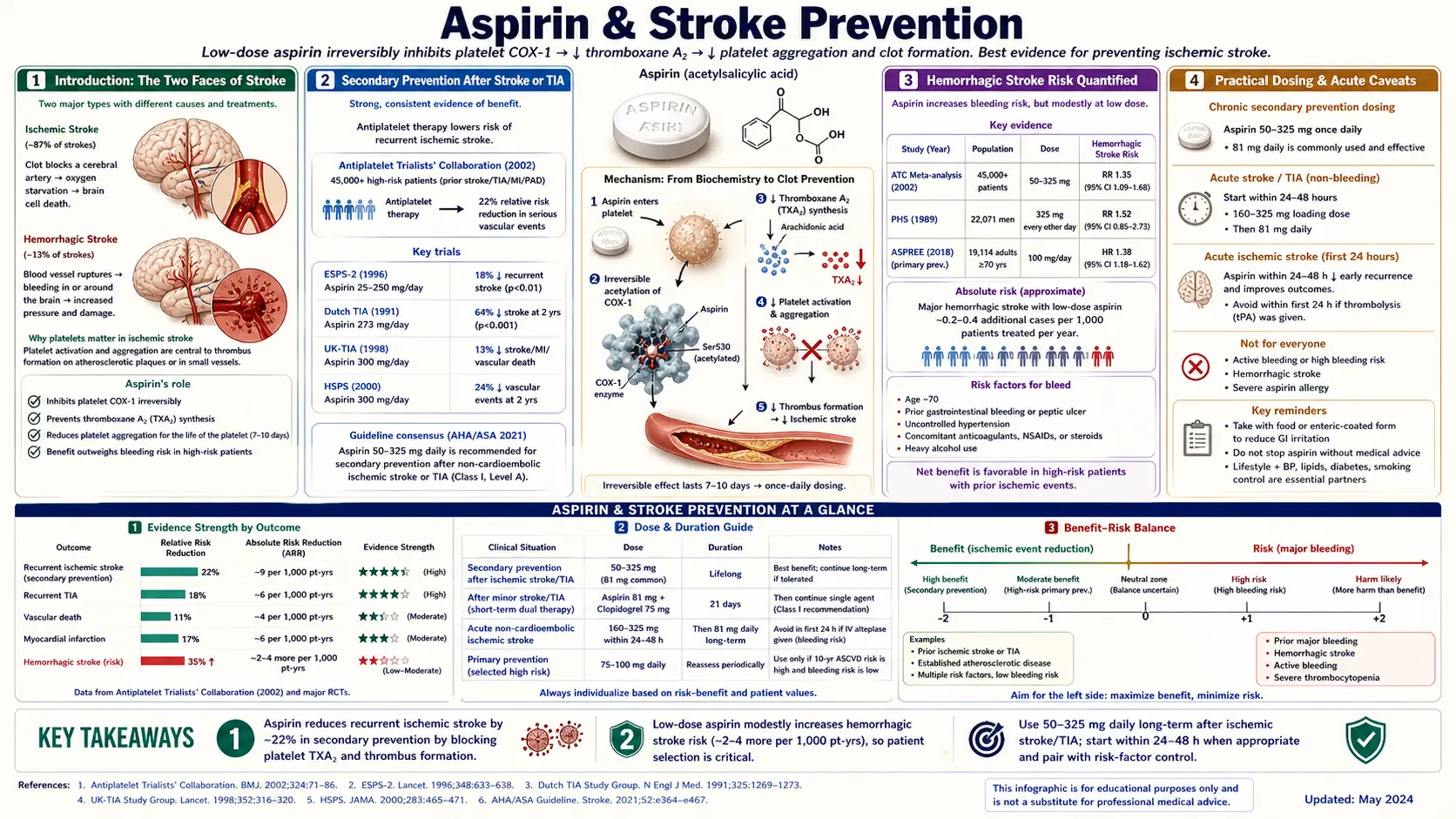
Aspirin (acetylsalicylic acid) is an antiplatelet drug, and in stroke its effects run in two directions. Trials show that it reduces clot-driven ischemic stroke in several settings, while the same antiplatelet effect is associated with a small increase in bleeding, including hemorrhagic stroke. This article summarizes the trial evidence and guideline statements on acute ischemic stroke, prevention after a stroke or transient ischemic attack (TIA), dual antiplatelet therapy, primary prevention, and atrial fibrillation, where trials found anticoagulants more effective than aspirin.
Table of Contents
- Introduction: The Two Faces of Stroke
- Mechanism: Irreversible COX-1 & TXA2 Blockade
- Acute Ischemic Stroke Treatment: IST & CAST
- Secondary Prevention After Stroke or TIA
- Primary Prevention: The Modern Picture
- Atrial Fibrillation: Aspirin Compared With Anticoagulants
- USPSTF 2022 Recommendation
- Hemorrhagic Stroke Risk Quantified
- Aspirin + Clopidogrel (DAPT) Duration
- Special Populations: Diabetes, Women, Elderly
- Doses Used in Trials & Acute Settings
- Key Research Papers
- Connections
- Featured Videos
Introduction: The Two Faces of Stroke
Stroke is not a single disease. About 87% of all strokes are ischemic strokes, in which blood flow to the brain is blocked, according to the US Centers for Disease Control and Prevention (CDC: Stroke Facts). Hemorrhagic strokes are caused by bleeding into or around the brain. Aspirin's antiplatelet action opposes clot formation, which is the basis for its use against ischemic stroke; the trials below also record more bleeding with aspirin, including bleeding inside the skull.
The acute-stroke trials enrolled patients with suspected acute ischaemic stroke. In the Chinese Acute Stroke Trial, 87% of patients had a CT scan before randomisation (PubMed PMID: 9186381).
For long-term use, the balance differs between groups. In the 2009 Antithrombotic Trialists' individual-participant meta-analysis, the authors described low-dose aspirin as of definite and substantial net benefit for many people who already have occlusive vascular disease, and of uncertain net value in primary prevention, where the reduction in occlusive events has to be weighed against the increase in major bleeds (PubMed PMID: 19482214).
Mechanism: Irreversible COX-1 & TXA2 Blockade
Aspirin acetylates cyclooxygenase-1 (COX-1) at serine-529 and COX-2 at serine-516 (Tacconelli 2020, PubMed PMID: 32535107). In 1975 Roth and Majerus reported that aspirin acetylates a single particulate-fraction protein in human platelets, possibly related to cyclo-oxygenase, and that the acetylation and its effect persist for the life-span of the aspirin-treated platelet (PubMed PMID: 1159076). A 2026 review states that once-daily low-dose aspirin (75–100 mg) completely and permanently inactivates the COX activity of COX-1 in platelets, suppressing thromboxane A2 (TXA2)-dependent platelet activation, which it describes as the established drug target of low-dose aspirin's antiplatelet effect (Patrono 2026, PubMed PMID: 41592353).
The Bleeding Side
The same antiplatelet effect is linked to bleeding. In a meta-analysis of 22 placebo-controlled trials of 75–325 mg aspirin daily for cardiovascular prophylaxis, aspirin increased major bleeding (relative risk 1.71), major gastrointestinal bleeding (relative risk 2.07) and intracranial bleeding (relative risk 1.65), and no difference was seen between 75–162.5 mg/day and >162.5–325 mg/day (McQuaid and Laine 2006, PubMed PMID: 16887404).
Acute Ischemic Stroke Treatment: IST & CAST
Two large trials published in 1997, planned to be analysed in parallel, tested aspirin started within 48 hours of suspected acute ischaemic stroke: the International Stroke Trial (19,435 patients) and the Chinese Acute Stroke Trial (21,106 patients).
International Stroke Trial (IST, 1997)
- 19,435 patients with suspected acute ischaemic stroke at 467 hospitals in 36 countries, randomised within 48 hours of symptom onset (PubMed PMID: 9174558).
- Open, factorial design: aspirin 300 mg daily or “avoid aspirin”, and subcutaneous heparin or “avoid heparin”, for up to 14 days.
- With aspirin there were non-significantly fewer deaths within 14 days (9.0% vs 9.4%), significantly fewer recurrent ischaemic strokes within 14 days (2.8% vs 3.9%) with no significant excess of haemorrhagic strokes (0.9% vs 0.8%), and a significant reduction in death or non-fatal recurrent stroke (11.3% vs 12.4%).
- At 6 months there was a non-significant trend towards fewer patients dead or dependent (62.2% vs 63.5%, 2p=0.07); after adjustment for baseline prognosis the difference (14 per 1000) was significant.
- Aspirin was associated with a significant excess of 5 transfused or fatal extracranial bleeds per 1000.
Chinese Acute Stroke Trial (CAST, 1997)
- 21,106 patients with acute ischaemic stroke at 413 Chinese hospitals, enrolled a mean of 25 hours after symptom onset (PubMed PMID: 9186381).
- Aspirin 160 mg/day vs placebo, started within 48 hours and continued in hospital for up to 4 weeks.
- Mortality during the treatment period fell by 14% proportionally (3.3% vs 3.9%), with fewer recurrent ischaemic strokes (1.6% vs 2.1%) and slightly more haemorrhagic strokes (1.1% vs 0.9%, not significant). Death or non-fatal stroke at 4 weeks: 5.3% vs 5.9%.
Pooled Interpretation
Taking the two trials together, the CAST investigators reported about 9 fewer deaths or non-fatal strokes per 1000 in the first few weeks and 13 fewer dead or dependent per 1000 after some weeks or months of follow-up (PubMed PMID: 9186381); the IST investigators described it as about 10 fewer deaths or recurrent strokes per 1000 during the first few weeks (PubMed PMID: 9174558). The 2002 Antithrombotic Trialists' meta-analysis estimated 9 fewer serious vascular events per 1000 patients treated for three weeks in acute stroke, and concluded that in acute settings an initial loading dose of at least 150 mg may be required (PubMed PMID: 11786451).
Secondary Prevention After Stroke or TIA
Rothwell and colleagues noted in 2016 that aspirin's place in secondary prevention after transient ischaemic attack (TIA) or ischaemic stroke had rested on trials showing a 13% reduction in long-term risk of recurrent stroke, while the risk of major stroke is very high for only the first few days after TIA and minor ischaemic stroke (PubMed PMID: 27209146).
Antithrombotic Trialists' Collaboration Meta-Analyses
- The 2002 meta-analysis pooled randomised trials of antiplatelet therapy in high-risk patients reported before September 1997: 287 studies, with 135,000 patients in comparisons of antiplatelet therapy versus control and 77,000 in comparisons of different regimens. Antiplatelet therapy reduced serious vascular events by about one quarter, non-fatal stroke by one quarter and vascular mortality by one sixth (PubMed PMID: 11786451).
- Among patients with previous stroke or TIA, the absolute reduction was 36 serious vascular events per 1000 treated for two years; in each high-risk category the authors reported that the absolute benefits substantially outweighed the absolute risks of major extracranial bleeding.
- The 2009 individual-participant meta-analysis of 16 secondary-prevention trials (17,000 individuals) found serious vascular events of 6.7% vs 8.2% per year with aspirin vs control and about a fifth fewer total strokes (2.08% vs 2.54% per year), with a non-significant increase in haemorrhagic stroke (PubMed PMID: 19482214).
The Early Benefit: Rothwell 2016 Time-Course Analysis
- Individual patient data for 15,778 participants from 12 randomised trials of aspirin versus control in secondary prevention after TIA or ischaemic stroke (PubMed PMID: 27209146).
- Aspirin reduced the 6-week risk of recurrent ischaemic stroke by about 60% (hazard ratio 0.42) and of disabling or fatal ischaemic stroke by about 70% (hazard ratio 0.29), with the greatest benefit in patients presenting with TIA or minor stroke.
- Part of the early effect was a reduction in the severity of recurrent strokes. Some further reduction accrued from 6 to 12 weeks, but there was no benefit of aspirin versus control after 12 weeks in this analysis (odds ratio 0.97).
- In 40,531 participants from three trials in major acute stroke, the reduction in recurrent ischaemic stroke at 14 days was substantial by the second day of treatment (2–3 day hazard ratio 0.37).
CHANCE Trial (2013) — Minor Stroke/High-Risk TIA
- Randomized, double-blind, placebo-controlled trial at 114 centers in China: 5,170 patients enrolled within 24 hours after the onset of minor ischemic stroke or high-risk TIA (PubMed PMID: 23803136).
- Clopidogrel (300 mg, then 75 mg/day for 90 days) plus aspirin 75 mg/day for the first 21 days, vs placebo plus aspirin 75 mg/day for 90 days; all participants received open-label aspirin 75–300 mg on day 1.
- Stroke within 90 days: 8.2% vs 11.7% (hazard ratio 0.68). Moderate or severe hemorrhage occurred in 0.3% of each group (7 vs 8 patients), and hemorrhagic stroke in 0.3% of each group.
POINT Trial (2018) — International Population
- 4,881 patients with minor ischemic stroke or high-risk TIA at 269 international sites (PubMed PMID: 29766750).
- Clopidogrel (600 mg loading dose, then 75 mg/day) plus aspirin 50–325 mg/day vs the same range of aspirin doses alone, for 90 days; the aspirin dose was selected by the site investigator.
- The trial was halted after 84% of planned enrollment. Major ischemic events: 5.0% vs 6.5% (hazard ratio 0.75), with most events in the first week after the initial event. Major hemorrhage: 0.9% vs 0.4% (hazard ratio 2.32).
- In a secondary analysis, the benefit occurred predominantly within the first 21 days (hazard ratio 0.65 for days 0–21 vs 1.38, not significant, for days 22–90), while the risk of major hemorrhage stayed low but relatively constant; the authors suggested that limiting the combination to 21 days may maximize benefit and reduce risk (Johnston 2019, PubMed PMID: 31238700).
A pooled analysis of both trials (10,051 patients) found major ischemic events at 90 days in 6.5% with clopidogrel-aspirin vs 9.1% with aspirin alone (hazard ratio 0.70), mainly within the first 21 days and not from day 22 to day 90; major hemorrhages were more frequent with the combination, but the difference was not significant (Pan 2019, PubMed PMID: 31424481).
The AHA/ASA 2021 Secondary-Prevention Guideline
The 2021 American Heart Association/American Stroke Association guideline on preventing stroke in patients with stroke and TIA (Kleindorfer 2021, PubMed PMID: 34024117) is summarized here as reported in a 2024 review based on it (Chan 2024, PubMed PMID: 38392262): a Class 1 recommendation for aspirin, clopidogrel, or aspirin plus extended-release dipyridamole for secondary stroke prevention, without preference among them; a Class 1 recommendation, based on CHANCE and POINT, for aspirin plus clopidogrel in minor non-cardioembolic ischemic stroke (NIHSS score of 3 or less) or high-risk TIA (ABCD2 score of 4 or more), ideally started within 12–24 hours but possibly up to 7 days after symptom onset, continued for 21 to 90 days and followed by single antiplatelet therapy; and a Class 2a recommendation that aspirin plus clopidogrel for up to 3 months is reasonable after a recent stroke or TIA caused by severe (70–99%) symptomatic intracranial stenosis.
Primary Prevention: The Modern Picture
Primary prevention refers to aspirin use in people who have never had a cardiovascular or cerebrovascular event. In the 2009 Antithrombotic Trialists' meta-analysis of six primary-prevention trials (95,000 individuals at low average risk), aspirin reduced serious vascular events by 12% (0.51% vs 0.57% per year), mainly through about a fifth fewer non-fatal myocardial infarctions; the net effect on stroke was not significant (0.20% vs 0.21% per year: haemorrhagic stroke 0.04% vs 0.03%, other stroke 0.16% vs 0.18%) (PubMed PMID: 19482214).
Women's Health Study (2005) — Stroke Reduced, Heart Attack Not
- 39,876 initially healthy women aged 45 or older randomized to 100 mg aspirin on alternate days or placebo and followed for 10 years (PubMed PMID: 15753114).
- The 9% reduction in major cardiovascular events was not significant (relative risk 0.91). Stroke was reduced by 17% (relative risk 0.83), owing to a 24% reduction in ischemic stroke (relative risk 0.76), with a non-significant increase in hemorrhagic stroke (relative risk 1.24).
- Aspirin had no significant effect on fatal or non-fatal myocardial infarction (relative risk 1.02) or cardiovascular death; gastrointestinal bleeding requiring transfusion was more frequent (relative risk 1.40).
- In women 65 or older, aspirin significantly reduced major cardiovascular events, ischemic stroke and myocardial infarction (a subgroup analysis).
ARRIVE (2018) — Moderate-Risk Patients
- 12,546 men aged 55 or older and women aged 60 or older, judged at moderate cardiovascular risk from their number of risk factors, in seven countries; people with diabetes or at high risk of bleeding were excluded (PubMed PMID: 30158069).
- Enteric-coated aspirin 100 mg/day vs placebo; median follow-up 60 months.
- The primary composite of cardiovascular death, myocardial infarction, unstable angina, stroke or TIA occurred in 4.29% vs 4.48% (hazard ratio 0.96, not significant).
- Gastrointestinal bleeding events, mostly mild, occurred in 0.97% vs 0.46% (hazard ratio 2.11).
- The event rate was much lower than expected, which the authors described as probably reflecting contemporary risk management, so that the role of aspirin at moderate risk could not be addressed.
ASCEND (2018) — Adults with Diabetes
- 15,480 adults with diabetes and no evident cardiovascular disease (PubMed PMID: 30146931).
- Aspirin 100 mg/day vs placebo, mean follow-up 7.4 years.
- Serious vascular events reduced (8.5% vs 9.6%, rate ratio 0.88).
- Major bleeding increased (4.1% vs 3.2%, rate ratio 1.29), most of the excess gastrointestinal and other extracranial bleeding.
- The authors concluded that the absolute benefits were “largely counterbalanced” by the bleeding hazard.
ASPREE (2018) — Healthy Older Adults
- 19,114 community-dwelling adults in Australia and the United States aged 70 or older (65 or older among Black and Hispanic participants in the United States) without cardiovascular disease, dementia or disability (PubMed PMID: 30221597).
- Enteric-coated aspirin 100 mg/day vs placebo, median 4.7 years.
- Cardiovascular disease (including fatal or non-fatal stroke): 10.7 vs 11.3 events per 1,000 person-years (hazard ratio 0.95, not significant); major hemorrhage 8.6 vs 6.2 events per 1,000 person-years (hazard ratio 1.38).
- Death from any cause was higher with aspirin (12.7 vs 11.1 per 1,000 person-years; hazard ratio 1.14), with cancer the major contributor; the investigators called this unexpected in the context of previous studies and said it should be interpreted with caution (PubMed PMID: 30221595).
Atrial Fibrillation: Aspirin Compared With Anticoagulants
In the 2002 Antithrombotic Trialists' meta-analysis, antiplatelet therapy gave a separately significant benefit in atrial fibrillation (AF) (P=0.01) (PubMed PMID: 11786451). Later trials compared aspirin with anticoagulants.
- A 2007 meta-analysis of 29 trials (28,044 participants with nonvalvular AF) found that, compared with control, adjusted-dose warfarin reduced stroke by 64% and antiplatelet agents by 22%; warfarin was more efficacious than antiplatelet therapy (relative risk reduction 39%) (Hart 2007, PubMed PMID: 17577005).
- The AVERROES trial randomly assigned 5,599 patients with AF at increased stroke risk, for whom vitamin K antagonist therapy was unsuitable, to the anticoagulant apixaban (5 mg twice daily) or aspirin (81–324 mg/day). It was stopped early for a clear benefit of apixaban: stroke or systemic embolism occurred at 1.6% vs 3.7% per year (hazard ratio 0.45), while major bleeding (1.4% vs 1.2% per year; hazard ratio 1.13) did not differ significantly; there were 11 intracranial bleeds with apixaban and 13 with aspirin (PubMed PMID: 21309657).
- The 2023 ACC/AHA/ACCP/HRS atrial fibrillation guideline recommends anticoagulation for patients with AF and an estimated annual thromboembolic risk of 2% or more (for example a CHA2DS2-VASc score of 2 or more in men and 3 or more in women), and recommends direct oral anticoagulants over warfarin for eligible patients without moderate-to-severe rheumatic mitral stenosis or a mechanical heart valve. For patients who are candidates for anticoagulation and have no indication for antiplatelet therapy, it states that aspirin, alone or combined with clopidogrel, as an alternative to anticoagulation “is not recommended to reduce stroke risk” (graded Class 3: Harm), and that in AF without risk factors for stroke, aspirin monotherapy for prevention of thromboembolic events “is of no benefit” (Joglar 2024, PubMed PMID: 38033089).
- The same guideline summarizes the direct-oral-anticoagulant trials as showing significantly lower risks of intracranial hemorrhage than warfarin.
USPSTF 2022 Recommendation
In 2022 the US Preventive Services Task Force updated its 2016 recommendation, drawing on a commissioned systematic review of aspirin's effects and harms (particularly bleeding) in people without cardiovascular disease and on a microsimulation model of benefits and harms by age, sex and cardiovascular risk (PubMed PMID: 35471505). The statement covers adults 40 or older without signs, symptoms or history of cardiovascular disease (including myocardial infarction or stroke) who are not at increased risk for bleeding.
Age 40–59 with ≥10% 10-Year CVD Risk
- C recommendation: the USPSTF states that the decision to initiate low-dose aspirin “should be an individual one”. It concludes with moderate certainty that the net benefit in this group is small, and that people not at increased risk for bleeding who are willing to take low-dose aspirin daily are more likely to benefit.
Age ≥60
- D recommendation: the USPSTF recommends against initiating low-dose aspirin for the primary prevention of cardiovascular disease in adults 60 and older, concluding with moderate certainty that initiating it in this group has no net benefit.
Scope of the Statement
The statement addresses starting aspirin for primary prevention. It does not apply to people with known cardiovascular disease, including a history of myocardial infarction or stroke, whose evidence is covered in the secondary-prevention section above.
Hemorrhagic Stroke Risk Quantified
The trials and meta-analyses report a small absolute increase in intracranial bleeding with aspirin.
- In the 2009 Antithrombotic Trialists' meta-analysis of six primary-prevention trials, haemorrhagic stroke occurred at 0.04% per year with aspirin vs 0.03% with control (p=0.05); major gastrointestinal and extracranial bleeds were 0.10% vs 0.07% per year. In the 16 secondary-prevention trials the increase in haemorrhagic stroke was not significant (PubMed PMID: 19482214).
- In the McQuaid and Laine meta-analysis of 22 placebo-controlled trials, aspirin raised intracranial bleeding with a relative risk of 1.65, an absolute annual increase of 0.03% (PubMed PMID: 16887404).
- A 2019 meta-analysis of 13 primary-prevention trials of low-dose aspirin (100 mg or less daily; 134,446 patients) found an increased risk of any intracranial bleeding (8 trials; relative risk 1.37), corresponding to 2 additional intracranial hemorrhages per 1,000 people, with the greatest relative increase for subdural or extradural hemorrhage (relative risk 1.53) and less for intracerebral and subarachnoid hemorrhage (Huang 2019, PubMed PMID: 31081871).
- In the primary-prevention trials the net effect on total stroke was not significant (0.20% vs 0.21% per year), and the 12% reduction in serious vascular events came mainly from fewer non-fatal myocardial infarctions (PubMed PMID: 19482214).
- Risk factors: the 2009 meta-analysis found that the main risk factors for coronary disease were also risk factors for bleeding (PubMed PMID: 19482214); the 2019 meta-analysis found a heightened risk of intracerebral hemorrhage with low-dose aspirin in people of Asian race/ethnicity and in people with a low body mass index (PubMed PMID: 31081871).
In the acute and secondary-prevention trials described above, haemorrhagic strokes were 0.9% vs 0.8% in IST and 1.1% vs 0.9% in CAST (neither difference significant), and 0.3% in each group in CHANCE.
Aspirin + Clopidogrel (DAPT) Duration
Trials of dual antiplatelet therapy (DAPT) with aspirin and clopidogrel after stroke differ mainly in how long the combination was given.
Minor Stroke or High-Risk TIA
- CHANCE gave aspirin with clopidogrel for 21 days and found no increase in moderate or severe hemorrhage (PubMed PMID: 23803136); POINT gave the combination for 90 days and found more major hemorrhage (PubMed PMID: 29766750).
- The POINT time-course analysis and the pooled CHANCE–POINT analysis both found the benefit concentrated in the first 21 days (PubMed PMID: 31238700; PubMed PMID: 31424481). The 2021 AHA/ASA guideline, as summarized by Chan 2024, gives a duration of 21 to 90 days followed by single antiplatelet therapy (PubMed PMID: 38392262).
Symptomatic Intracranial Atherosclerotic Disease
- SAMMPRIS randomly assigned patients with a recent TIA or stroke attributed to 70–99% stenosis of a major intracranial artery to aggressive medical management alone or with angioplasty and stenting. Enrollment stopped after 451 patients because the 30-day rate of stroke or death was 14.7% with stenting vs 5.8% with medical management (PubMed PMID: 21899409).
- Based on the outcome of SAMMPRIS's medical arm, the 2021 AHA/ASA guideline gives a Class 2a recommendation that aspirin plus clopidogrel for up to 3 months is reasonable after a recent stroke or TIA due to severe symptomatic intracranial stenosis (as summarized by Chan 2024, PubMed PMID: 38392262).
Long-Term DAPT: MATCH and CHARISMA
- MATCH randomised 7,599 high-risk patients with recent ischaemic stroke or TIA who were already taking clopidogrel 75 mg/day to aspirin 75 mg/day or placebo for 18 months. The primary endpoint occurred in 15.7% vs 16.7% (a non-significant difference), while life-threatening bleeding was higher with the combination (2.6% vs 1.3%) and major bleeding was also increased (PubMed PMID: 15276392).
- CHARISMA randomly assigned 15,603 patients with clinically evident cardiovascular disease or multiple risk factors to clopidogrel plus low-dose aspirin (75–162 mg/day) or placebo plus aspirin for a median of 28 months. Myocardial infarction, stroke or cardiovascular death occurred in 6.8% vs 7.3% (not significant), and severe bleeding in 1.7% vs 1.3% (P=0.09) (PubMed PMID: 16531616).
- Chan 2024 cites a meta-analysis in which DAPT for longer than 3 months was associated with significant increases in major bleeding and mortality and no significant reduction in ischaemic stroke or major vascular events (PubMed PMID: 38392262).
Special Populations: Diabetes, Women, Elderly
Diabetes
- In ASCEND, in adults with diabetes and no evident cardiovascular disease, aspirin reduced serious vascular events (rate ratio 0.88) and increased major bleeding (rate ratio 1.29), and the authors judged the absolute benefits largely counterbalanced by the bleeding hazard (PubMed PMID: 30146931).
Women
- In the Women's Health Study, aspirin lowered the risk of stroke without affecting the risk of myocardial infarction or cardiovascular death (PubMed PMID: 15753114).
- A 2006 sex-specific meta-analysis of six primary-prevention trials (95,456 individuals) found that aspirin reduced cardiovascular events through fewer ischemic strokes in women (odds ratio 0.76 for ischemic stroke; no significant effect on myocardial infarction) and fewer myocardial infarctions in men (odds ratio 0.68; no significant effect on stroke), and increased bleeding to a similar degree in both sexes (Berger 2006, PubMed PMID: 16418466).
- The USPSTF 2022 recommendation grades are set by age and cardiovascular risk, not by sex (PubMed PMID: 35471505).
- Preeclampsia is a separate indication: in 2021 the USPSTF recommended low-dose aspirin (81 mg/day) after 12 weeks of gestation in people at high risk for preeclampsia (B recommendation) (PubMed PMID: 34581729).
Elderly
- In ASPREE, starting aspirin in healthy adults aged 70 or older did not reduce cardiovascular disease and increased major hemorrhage (PubMed PMID: 30221597).
- In the Women's Health Study subgroup aged 65 or older, aspirin significantly reduced major cardiovascular events, ischemic stroke and myocardial infarction (PubMed PMID: 15753114).
Doses Used in Trials & Acute Settings
Long-Term Doses
- The 2002 Antithrombotic Trialists' meta-analysis found aspirin 75–150 mg daily at least as effective as higher daily doses; the effects of doses below 75 mg daily were less certain (PubMed PMID: 11786451).
- In the ADAPTABLE trial, 15,076 patients with established atherosclerotic cardiovascular disease were randomly assigned to 81 mg or 325 mg daily and followed for a median of 26.2 months. Death, hospitalization for myocardial infarction or hospitalization for stroke (7.28% vs 7.51%) and hospitalization for major bleeding (0.63% vs 0.60%) did not differ significantly, although 41.6% of those assigned 325 mg switched dose (PubMed PMID: 33999548).
- In the McQuaid and Laine meta-analysis, bleeding did not differ between 75–162.5 mg/day and >162.5–325 mg/day (PubMed PMID: 16887404).
- The primary-prevention trials used 100 mg on alternate days (Women's Health Study) or 100 mg daily (ARRIVE, ASCEND and ASPREE; enteric-coated in ARRIVE and ASPREE).
Doses in the Acute Trials
- Acute ischaemic stroke: 300 mg daily in IST and 160 mg/day in CAST, started within 48 hours (PubMed PMID: 9174558; PubMed PMID: 9186381). In CHANCE, all participants received open-label aspirin 75–300 mg on day 1, then 75 mg/day (PubMed PMID: 23803136); in POINT, aspirin was 50–325 mg/day (PubMed PMID: 29766750).
- Acute myocardial infarction: ISIS-2 randomised 17,187 patients up to 24 hours (median 5 hours) after the onset of suspected acute myocardial infarction to one month of 160 mg/day enteric-coated aspirin or placebo (and, factorially, streptokinase or placebo). Aspirin reduced 5-week vascular mortality from 11.8% to 9.4% (odds reduction 23%) and non-fatal stroke from 0.6% to 0.3%, without a significant increase in cerebral haemorrhage or bleeds requiring transfusion (PubMed PMID: 2899772).
Stopping and Surgery
- In a Swedish nationwide cohort of 601,527 long-term users of low-dose aspirin for primary or secondary prevention, those who discontinued had a higher rate of cardiovascular events than those who continued (adjusted hazard ratio 1.37), corresponding to one additional event per year in 1 of every 74 patients who discontinued; the risk rose shortly after discontinuation and did not appear to diminish. The first 3 months after major bleeding or surgery were excluded. This was an observational study (Sundström 2017, PubMed PMID: 28947478).
- In the POISE-2 trial, 10,010 patients at risk of vascular complications undergoing noncardiac surgery received aspirin (200 mg just before surgery, then 100 mg daily) or placebo, both among those not previously taking aspirin and among those already taking it. Death or non-fatal myocardial infarction at 30 days did not differ (7.0% vs 7.1%; hazard ratio 0.99), and major bleeding was more common with aspirin (4.6% vs 3.8%; hazard ratio 1.23); results were similar in both groups (PubMed PMID: 24679062).
Key Research Papers
- ISIS-2 (Second International Study of Infarct Survival) Collaborative Group. Randomised trial of intravenous streptokinase, oral aspirin, both, or neither among 17,187 cases of suspected acute myocardial infarction: ISIS-2. Lancet. 1988;2(8607):349-360. — PubMed PMID: 2899772
- International Stroke Trial Collaborative Group. The International Stroke Trial (IST): a randomised trial of aspirin, subcutaneous heparin, both, or neither among 19,435 patients with acute ischaemic stroke. Lancet. 1997;349(9065):1569-1581. — PubMed PMID: 9174558
- CAST (Chinese Acute Stroke Trial) Collaborative Group. CAST: randomised placebo-controlled trial of early aspirin use in 20,000 patients with acute ischaemic stroke. Lancet. 1997;349(9066):1641-1649. — PubMed PMID: 9186381
- Antithrombotic Trialists' (ATT) Collaboration. Aspirin in the primary and secondary prevention of vascular disease: collaborative meta-analysis of individual participant data from randomised trials. Lancet. 2009;373(9678):1849-1860. — doi:10.1016/S0140-6736(09)60503-1 · PubMed PMID: 19482214
- Wang Y, Wang Y, Zhao X, et al. Clopidogrel with aspirin in acute minor stroke or transient ischemic attack (CHANCE). N Engl J Med. 2013;369(1):11-19. — PubMed PMID: 23803136
- Johnston SC, Easton JD, Farrant M, et al. Clopidogrel and aspirin in acute ischemic stroke and high-risk TIA (POINT). N Engl J Med. 2018;379(3):215-225. — PubMed PMID: 29766750
- Gaziano JM, Brotons C, Coppolecchia R, et al. Use of aspirin to reduce risk of initial vascular events in patients at moderate risk of cardiovascular disease (ARRIVE): a randomised, double-blind, placebo-controlled trial. Lancet. 2018;392(10152):1036-1046. — doi:10.1016/S0140-6736(18)31924-X · PubMed PMID: 30158069
- ASCEND Study Collaborative Group. Effects of aspirin for primary prevention in persons with diabetes mellitus. N Engl J Med. 2018;379(16):1529-1539. — PubMed PMID: 30146931
- McNeil JJ, Wolfe R, Woods RL, et al. Effect of aspirin on cardiovascular events and bleeding in the healthy elderly (ASPREE). N Engl J Med. 2018;379(16):1509-1518. — PubMed PMID: 30221597
- US Preventive Services Task Force. Aspirin use to prevent cardiovascular disease: US Preventive Services Task Force recommendation statement. JAMA. 2022;327(16):1577-1584. — PubMed PMID: 35471505
- Chimowitz MI, Lynn MJ, Derdeyn CP, et al. Stenting versus aggressive medical therapy for intracranial arterial stenosis (SAMMPRIS). N Engl J Med. 2011;365(11):993-1003. — PubMed PMID: 21899409
- Diener HC, Bogousslavsky J, Brass LM, et al. Aspirin and clopidogrel compared with clopidogrel alone after recent ischaemic stroke or transient ischaemic attack in high-risk patients (MATCH). Lancet. 2004;364(9431):331-337. — doi:10.1016/S0140-6736(04)16721-4 · PubMed PMID: 15276392
- Antithrombotic Trialists' Collaboration. Collaborative meta-analysis of randomised trials of antiplatelet therapy for prevention of death, myocardial infarction, and stroke in high risk patients. BMJ. 2002;324(7329):71-86. — PubMed PMID: 11786451
- Rothwell PM, Algra A, Chen Z, et al. Effects of aspirin on risk and severity of early recurrent stroke after transient ischaemic attack and ischaemic stroke: time-course analysis of randomised trials. Lancet. 2016;388(10042):365-375. — PubMed PMID: 27209146
- Johnston SC, Elm JJ, Easton JD, et al. Time course for benefit and risk of clopidogrel and aspirin after acute transient ischemic attack and minor ischemic stroke. Circulation. 2019;140(8):658-664. — PubMed PMID: 31238700
- Pan Y, Elm JJ, Li H, et al. Outcomes associated with clopidogrel-aspirin use in minor stroke or transient ischemic attack: a pooled analysis of Clopidogrel in High-Risk Patients With Acute Non-Disabling Cerebrovascular Events (CHANCE) and Platelet-Oriented Inhibition in New TIA and Minor Ischemic Stroke (POINT) trials. JAMA Neurol. 2019;76(12):1466-1473. — PubMed PMID: 31424481
- Kleindorfer DO, Towfighi A, Chaturvedi S, et al. 2021 Guideline for the prevention of stroke in patients with stroke and transient ischemic attack: a guideline from the American Heart Association/American Stroke Association. Stroke. 2021;52(7):e364-e467. — PubMed PMID: 34024117
- Chan BPL, Wong LYH, Tan BYQ, Yeo LLL, Venketasubramanian N. Dual antiplatelet therapy for the acute management and long-term secondary prevention of ischemic stroke and transient ischemic attack, an updated review. J Cardiovasc Dev Dis. 2024;11(2):48. — PubMed PMID: 38392262
- Ridker PM, Cook NR, Lee IM, et al. A randomized trial of low-dose aspirin in the primary prevention of cardiovascular disease in women. N Engl J Med. 2005;352(13):1293-1304. — PubMed PMID: 15753114
- Berger JS, Roncaglioni MC, Avanzini F, et al. Aspirin for the primary prevention of cardiovascular events in women and men: a sex-specific meta-analysis of randomized controlled trials. JAMA. 2006;295(3):306-313. — PubMed PMID: 16418466
- McNeil JJ, Nelson MR, Woods RL, et al. Effect of aspirin on all-cause mortality in the healthy elderly. N Engl J Med. 2018;379(16):1519-1528. — PubMed PMID: 30221595
- Hart RG, Pearce LA, Aguilar MI. Meta-analysis: antithrombotic therapy to prevent stroke in patients who have nonvalvular atrial fibrillation. Ann Intern Med. 2007;146(12):857-867. — PubMed PMID: 17577005
- Connolly SJ, Eikelboom J, Joyner C, et al. Apixaban in patients with atrial fibrillation (AVERROES). N Engl J Med. 2011;364(9):806-817. — PubMed PMID: 21309657
- Joglar JA, Chung MK, Armbruster AL, et al. 2023 ACC/AHA/ACCP/HRS Guideline for the diagnosis and management of atrial fibrillation. Circulation. 2024;149(1):e1-e156. — PubMed PMID: 38033089
- McQuaid KR, Laine L. Systematic review and meta-analysis of adverse events of low-dose aspirin and clopidogrel in randomized controlled trials. Am J Med. 2006;119(8):624-638. — PubMed PMID: 16887404
- Huang WY, Saver JL, Wu YL, et al. Frequency of intracranial hemorrhage with low-dose aspirin in individuals without symptomatic cardiovascular disease: a systematic review and meta-analysis. JAMA Neurol. 2019;76(8):906-914. — PubMed PMID: 31081871
- Bhatt DL, Fox KA, Hacke W, et al. Clopidogrel and aspirin versus aspirin alone for the prevention of atherothrombotic events (CHARISMA). N Engl J Med. 2006;354(16):1706-1717. — PubMed PMID: 16531616
- Jones WS, Mulder H, Wruck LM, et al. Comparative effectiveness of aspirin dosing in cardiovascular disease (ADAPTABLE). N Engl J Med. 2021;384(21):1981-1990. — PubMed PMID: 33999548
- Sundström J, Hedberg J, Thuresson M, et al. Low-dose aspirin discontinuation and risk of cardiovascular events: a Swedish nationwide, population-based cohort study. Circulation. 2017;136(13):1183-1192. — PubMed PMID: 28947478
- Devereaux PJ, Mrkobrada M, Sessler DI, et al. Aspirin in patients undergoing noncardiac surgery (POISE-2). N Engl J Med. 2014;370(16):1494-1503. — PubMed PMID: 24679062
- US Preventive Services Task Force. Aspirin use to prevent preeclampsia and related morbidity and mortality: US Preventive Services Task Force recommendation statement. JAMA. 2021;326(12):1186-1191. — PubMed PMID: 34581729
- Roth GJ, Majerus PW. The mechanism of the effect of aspirin on human platelets. I. Acetylation of a particulate fraction protein. J Clin Invest. 1975;56(3):624-632. — PubMed PMID: 1159076
- Tacconelli S, Contursi A, Falcone L, et al. Characterization of cyclooxygenase-2 acetylation and prostanoid inhibition by aspirin in cellular systems. Biochem Pharmacol. 2020;178:114094. — PubMed PMID: 32535107
- Patrono C, Burn J, Patrignani P, Langley RE. Platelet activation, aspirin, and cancer: from basic science to clinical trials. Pharmacol Rev. 2026;78(1):100109. — PubMed PMID: 41592353