Aspirin for Cardiovascular Prevention
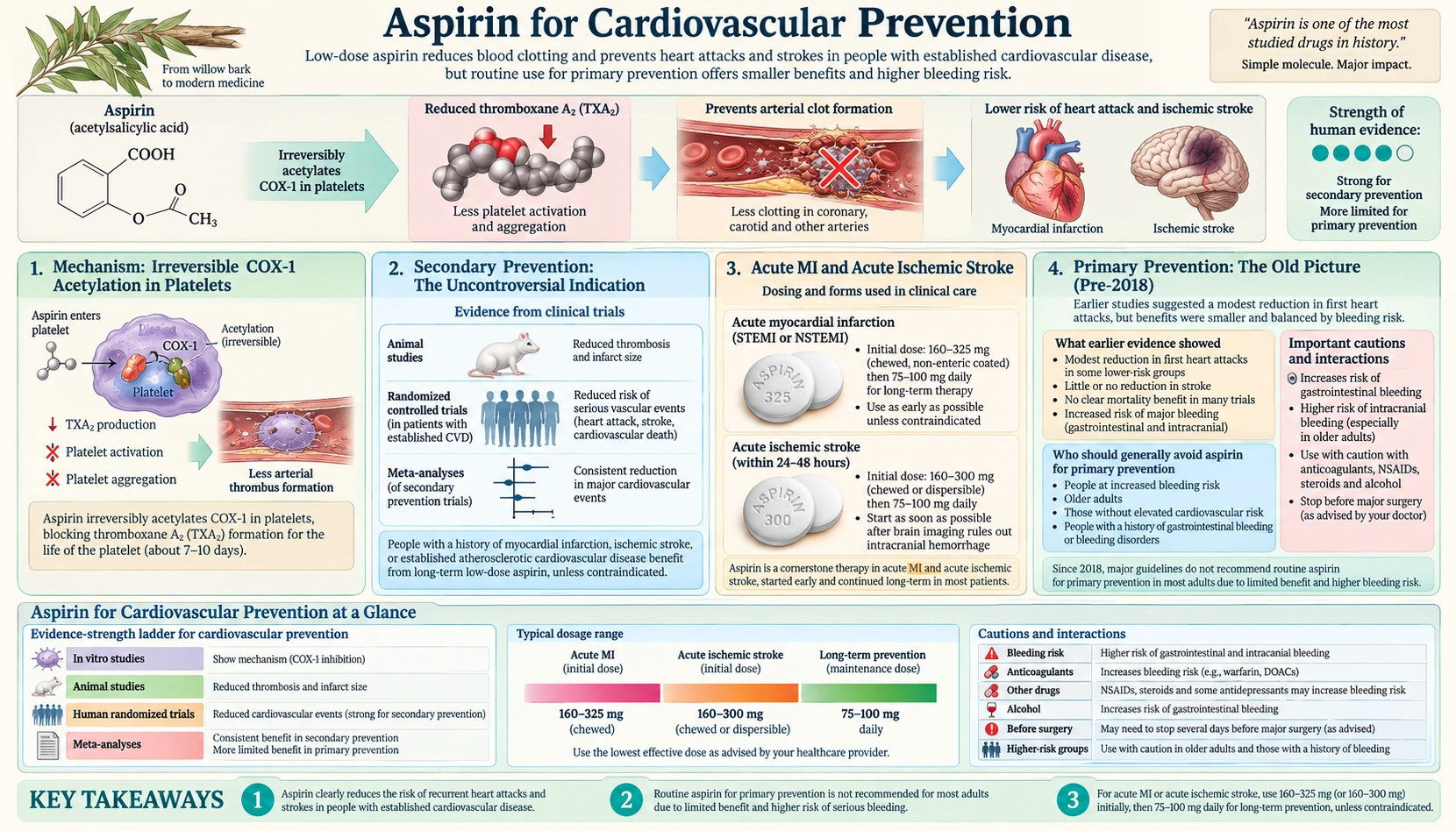
Aspirin's effect on cardiovascular events has been tested in large randomized trials for more than three decades. In the 2002 Antithrombotic Trialists' Collaboration meta-analysis (287 studies; 135,000 patients in comparisons with control), antiplatelet therapy in high-risk patients reduced serious vascular events by about one quarter, non-fatal myocardial infarction by one third, non-fatal stroke by one quarter and vascular death by one sixth. In people without cardiovascular disease the picture is different: in the 2009 individual-participant meta-analysis of six primary-prevention trials, aspirin reduced serious vascular events by 12% but increased major bleeding, and the authors called its net value uncertain. Three large trials published in 2018 (ARRIVE, ASCEND, ASPREE) found no reduction in cardiovascular events, or a reduction largely counterbalanced by bleeding, and in 2022 the USPSTF recommended against starting aspirin for primary prevention at 60 or older. This page covers the mechanism, the trials and the guideline statements.
Table of Contents
- Mechanism: Irreversible COX-1 Acetylation in Platelets
- Secondary Prevention: People With Vascular Disease
- Acute MI and Acute Ischemic Stroke
- Primary Prevention: The Earlier Trials
- Primary Prevention: The 2018 Trials
- USPSTF Statement (2022)
- Aspirin Combined With or Compared With Clopidogrel
- Peripheral Arterial Disease and Carotid Surgery
- Special Populations: Diabetes, CKD, Atrial Fibrillation
- Key Research Papers
- Connections
- Featured Videos
Mechanism: Irreversible COX-1 Acetylation in Platelets
John Vane's 1971 paper in Nature New Biology proposed inhibition of prostaglandin synthesis as the mechanism of action of aspirin-like drugs (PubMed PMID: 5284360); Vane shared the 1982 Nobel Prize in Physiology or Medicine with Sune Bergström and Bengt Samuelsson “for their discoveries concerning prostaglandins and related biologically active substances” (NobelPrize.org). In 1975 Roth and Majerus showed that aspirin permanently acetylates a single particulate-fraction protein of about 85,000 daltons in human platelets, that platelets from aspirin-treated donors stayed acetylated for their life-span, and that the protein might be related to cyclo-oxygenase (PubMed PMID: 1159076). The same year Roth, Stanford and Majerus concluded that aspirin acts as an active-site acetylating agent for cyclo-oxygenase (PubMed PMID: 810797). The acetylated residues are serine-529 in COX-1 and serine-516 in COX-2 (Tacconelli 2020, PubMed PMID: 32535107).
The irreversibility matters most in platelets. A 2026 review describes aspirin's half-life as about 20 minutes, yet its antiplatelet effect is long-lasting because it permanently acetylates Ser-529 of COX-1; anucleate platelets have limited capacity to make new protein and live 7–10 days in humans, with only about 10–12% of circulating platelets newly formed each day. Once-daily low-dose aspirin suppresses platelet COX-1 activity by more than 97% throughout the dosing interval, inhibiting thromboxane A2-dependent platelet activation, while leaving other cellular sources of COX-2-dependent prostanoids, such as the blood vessel wall, largely unaffected; nucleated cells can make new enzyme within 4–6 hours (Patrono 2026, PubMed PMID: 41592353).
Secondary Prevention: People With Vascular Disease
Secondary prevention means aspirin in people who already have occlusive vascular disease. The 2002 Antithrombotic Trialists' Collaboration meta-analysis pooled randomised trials of antiplatelet therapy in high-risk patients — those with acute or previous vascular disease or another predisposing condition — reported before September 1997: 287 studies, with 135,000 patients in comparisons of antiplatelet therapy versus control and 77,000 in comparisons of different regimens (PubMed PMID: 11786451). Aspirin was the most widely studied drug. The results:
- Serious vascular events (non-fatal myocardial infarction, non-fatal stroke or vascular death) reduced by about one quarter.
- Non-fatal myocardial infarction reduced by one third.
- Non-fatal stroke reduced by one quarter.
- Vascular death reduced by one sixth, with no apparent adverse effect on other deaths.
- Absolute reductions in serious vascular events of 36 per 1000 treated for two years after previous myocardial infarction; 38 per 1000 treated for one month in acute myocardial infarction; 36 per 1000 treated for two years after previous stroke or transient ischaemic attack; 9 per 1000 treated for three weeks in acute stroke; and 22 per 1000 treated for two years among other high-risk patients.
In each of these high-risk categories, the authors reported that the absolute benefits substantially outweighed the absolute risks of major extracranial bleeding (PubMed PMID: 11786451). The 2009 Antithrombotic Trialists' individual-participant meta-analysis of 16 long-term secondary-prevention trials (17,000 individuals) found serious vascular events of 6.7% vs 8.2% per year with aspirin vs control, reductions of about a fifth in total stroke and in coronary events, and a non-significant increase in haemorrhagic stroke; it described low-dose aspirin as of definite and substantial net benefit for many people who already have occlusive vascular disease (PubMed PMID: 19482214).
On dose, the 2002 meta-analysis found 75-150 mg daily at least as effective as higher daily doses, with the effects of doses below 75 mg less certain (PubMed PMID: 11786451). In the 2021 ADAPTABLE trial, 15,076 patients with established atherosclerotic cardiovascular disease were randomly assigned to 81 mg or 325 mg daily and followed for a median of 26.2 months; death, hospitalization for myocardial infarction or hospitalization for stroke (7.28% vs 7.51%) and hospitalization for major bleeding (0.63% vs 0.60%) did not differ significantly, although 41.6% of those assigned 325 mg switched dose (PubMed PMID: 33999548). See the Low Dose vs Full Dose deep-dive for the dose comparisons.
Stopping long-term aspirin has also been studied. In a Swedish nationwide cohort of 601,527 long-term users of low-dose aspirin for primary or secondary prevention, those who discontinued had a higher rate of cardiovascular events than those who continued (adjusted hazard ratio 1.37), corresponding to one additional event per year in 1 of every 74 patients who discontinued; the risk rose shortly after discontinuation and did not appear to diminish over time. Periods after major surgery or bleeding were excluded from the analysis (Sundström 2017, PubMed PMID: 28947478). This was an observational study, not a randomized comparison.
Acute MI and Acute Ischemic Stroke
ISIS-2 (Second International Study of Infarct Survival), published in The Lancet in 1988, randomised 17,187 patients in 417 hospitals, up to 24 hours (median 5 hours) after the onset of suspected acute myocardial infarction, to a 1-hour streptokinase infusion, one month of 160 mg/day enteric-coated aspirin, both, or neither (PubMed PMID: 2899772). Aspirin reduced 5-week vascular mortality from 11.8% to 9.4% (odds reduction 23%), similar to the 25% odds reduction with streptokinase, and the two effects appeared additive: 8.0% with both vs 13.2% with neither (odds reduction 42%). Aspirin also reduced non-fatal reinfarction (1.0% vs 2.0%) and non-fatal stroke (0.3% vs 0.6%) without a significant increase in cerebral haemorrhage or bleeds requiring transfusion. The mortality differences remained highly significant at a median of 15 months of follow-up.
The 2002 Antithrombotic Trialists' meta-analysis concluded that 75-150 mg daily is an effective regimen for long-term use, but that in acute settings an initial loading dose of at least 150 mg may be required (PubMed PMID: 11786451).
In acute ischaemic stroke, the Chinese Acute Stroke Trial gave 160 mg/day, started within 48 hours of onset and continued in hospital for up to 4 weeks, to 21,106 patients; mortality during treatment fell by 14% proportionally (3.3% vs 3.9%), with fewer recurrent ischaemic strokes (1.6% vs 2.1%) and slightly more haemorrhagic strokes (1.1% vs 0.9%, not significant) (PubMed PMID: 9186381). The International Stroke Trial allocated 300 mg daily, started within 48 hours, in 19,435 patients; there were non-significantly fewer deaths within 14 days (9.0% vs 9.4%), significantly fewer recurrent ischaemic strokes (2.8% vs 3.9%) and a significant reduction in death or non-fatal recurrent stroke (11.3% vs 12.4%) (PubMed PMID: 9174558). Taking the two trials together, the CAST investigators reported about 9 fewer deaths or non-fatal strokes per 1000 in the first few weeks and 13 fewer dead or dependent per 1000 after some weeks or months of follow-up.
Primary Prevention: The Earlier Trials
Primary prevention is the question of aspirin in people who have not had a cardiovascular event. The Physicians' Health Study, a randomized, double-blind, placebo-controlled trial of 325 mg every other day in 22,071 participants, terminated its aspirin component earlier than scheduled; at an average follow-up of 60.2 months it reported a 44% reduction in the risk of myocardial infarction (relative risk 0.56), apparent only among participants aged 50 and older. A slightly increased risk of stroke was not statistically significant, there was no reduction in cardiovascular mortality, and the authors judged the evidence on stroke and total cardiovascular deaths inconclusive (PubMed PMID: 2664509).
The 2005 Women's Health Study randomized 39,876 initially healthy women aged 45 or older to 100 mg every other day or placebo and followed them for 10 years. The 9% reduction in major cardiovascular events was not significant; stroke was reduced by 17% (ischemic stroke by 24%), with no significant effect on myocardial infarction or cardiovascular death, and more gastrointestinal bleeding requiring transfusion (relative risk 1.40). In women 65 or older, aspirin significantly reduced major cardiovascular events, ischemic stroke and myocardial infarction (PubMed PMID: 15753114). A 2006 sex-specific meta-analysis of six primary-prevention trials (95,456 individuals) found the same pattern: aspirin reduced cardiovascular events through fewer ischemic strokes in women and fewer myocardial infarctions in men, and increased bleeding to a similar degree in both (PubMed PMID: 16418466).
The 2009 Antithrombotic Trialists' individual-participant meta-analysis of six primary-prevention trials (95,000 individuals at low average risk) found a 12% proportional reduction in serious vascular events (0.51% vs 0.57% per year), mainly from about a fifth fewer non-fatal myocardial infarctions, no significant net effect on stroke or vascular mortality, and more major gastrointestinal and extracranial bleeds (0.10% vs 0.07% per year). The authors concluded that in primary prevention aspirin is of uncertain net value (PubMed PMID: 19482214).
The 2009 USPSTF statement encouraged aspirin for men aged 45 to 79 when the potential reduction in myocardial infarctions outweighed the potential increase in gastrointestinal hemorrhage, and for women aged 55 to 79 when the potential reduction in ischemic strokes outweighed it (A recommendations); evidence was insufficient at 80 or older (PubMed PMID: 19293072). The 2016 statement addressed both cardiovascular disease and colorectal cancer: it recommended initiating low-dose aspirin in adults 50 to 59 with a 10% or greater 10-year cardiovascular risk who were not at increased bleeding risk, had a life expectancy of at least 10 years and were willing to take it daily for at least 10 years (B recommendation), and called the decision an individual one at 60 to 69 (C recommendation) (PubMed PMID: 27064677). See the Colorectal Cancer Risk deep-dive.
Primary Prevention: The 2018 Trials
Three large primary-prevention trials, each of 100 mg aspirin daily versus placebo, were published in 2018.
- ARRIVE (PubMed PMID: 30158069) — 12,546 men 55 and older and women 60 and older judged to be at moderate cardiovascular risk, excluding people with diabetes or high bleeding risk; enteric-coated aspirin; median follow-up 60 months. The primary composite endpoint occurred in 4.29% vs 4.48% (hazard ratio 0.96, 95% CI 0.81-1.13). Gastrointestinal bleeding events, mostly mild, occurred in 0.97% vs 0.46% (hazard ratio 2.11). The event rate was much lower than expected, which the authors attributed probably to contemporary risk management, making the study more representative of a low-risk population.
- ASCEND (PubMed PMID: 30146931) — 15,480 adults with diabetes and no evident cardiovascular disease; mean follow-up 7.4 years. Serious vascular events: 8.5% vs 9.6% (rate ratio 0.88). Major bleeding: 4.1% vs 3.2% (rate ratio 1.29), mostly gastrointestinal and other extracranial bleeding. The authors concluded that the absolute benefits were largely counterbalanced by the bleeding hazard.
- ASPREE — 19,114 community-dwelling adults 70 or older (65 or older among Black and Hispanic participants in the United States) without cardiovascular disease, dementia or disability; enteric-coated aspirin; median follow-up 4.7 years. Cardiovascular disease: 10.7 vs 11.3 events per 1000 person-years (hazard ratio 0.95, 95% CI 0.83-1.08); major hemorrhage 8.6 vs 6.2 per 1000 person-years (hazard ratio 1.38) (PubMed PMID: 30221597). The primary endpoint, disability-free survival, did not differ (hazard ratio 1.01), and the trial was stopped early for lack of benefit on it (PubMed PMID: 30221596). Death from any cause was 12.7 vs 11.1 per 1000 person-years (hazard ratio 1.14, 95% CI 1.01-1.29), with cancer the major contributor (PubMed PMID: 30221595).
The ASPREE investigators described the higher all-cause mortality, attributed primarily to cancer-related death (3.1% vs 2.3%; hazard ratio 1.31), as unexpected in the context of previous studies and to be interpreted with caution; the analyses of specific causes of death were post hoc and exploratory (PubMed PMID: 30221595). In earlier pooled analyses of trials of daily aspirin, by contrast, a reduction in cancer deaths was apparent only after 5 years of follow-up (Rothwell 2011, PubMed PMID: 21144578).
USPSTF Statement (2022)
The 2022 USPSTF recommendation statement updated the 2016 recommendation and applies to adults 40 or older without signs, symptoms or history of cardiovascular disease who are not at increased risk for bleeding (for example, no history of gastrointestinal ulcers, recent bleeding, other medical conditions, or use of medications that increase bleeding risk) (PubMed PMID: 35471505):
- Adults aged 40 to 59 with a 10% or greater 10-year cardiovascular risk: the USPSTF concludes with moderate certainty that aspirin has a small net benefit and calls the decision to start low-dose aspirin an individual one; people not at increased bleeding risk and willing to take low-dose aspirin daily are more likely to benefit (C recommendation).
- Adults 60 or older: the USPSTF concludes with moderate certainty that starting aspirin for primary prevention has no net benefit and recommends against starting it (D recommendation).
The statement covers starting aspirin for primary prevention only; it does not address people with known cardiovascular disease, including a history of myocardial infarction or stroke. The 2019 ACC/AHA primary-prevention guideline is listed under Key Research Papers.
Aspirin Combined With or Compared With Clopidogrel
The CURE trial randomly assigned 12,562 patients with acute coronary syndromes without ST-segment elevation, within 24 hours of symptom onset, to clopidogrel (300 mg, then 75 mg daily) or placebo in addition to aspirin for 3 to 12 months. Cardiovascular death, non-fatal myocardial infarction or stroke occurred in 9.3% vs 11.4% (relative risk 0.80); major bleeding was more frequent with clopidogrel (3.7% vs 2.7%; relative risk 1.38), but life-threatening bleeding and hemorrhagic strokes were not significantly increased (PubMed PMID: 11519503).
CAPRIE compared clopidogrel 75 mg with aspirin 325 mg once daily, each alone, in 19,185 patients with recent ischaemic stroke, recent myocardial infarction or symptomatic peripheral arterial disease, followed for a mean of 1.91 years. The annual risk of ischaemic stroke, myocardial infarction or vascular death was 5.32% with clopidogrel vs 5.83% with aspirin, a relative-risk reduction of 8.7% (p=0.043), with no major differences in safety (PubMed PMID: 8918275).
Peripheral Arterial Disease and Carotid Surgery
Among the high-risk patients in the 2002 Antithrombotic Trialists' meta-analysis, the benefit of antiplatelet therapy was separately significant in peripheral arterial disease (P=0.004) (PubMed PMID: 11786451). Two trials of people without symptoms found no benefit. In POPADAD, 1,276 adults with diabetes and an ankle brachial pressure index of 0.99 or less but no symptomatic cardiovascular disease were randomised to 100 mg aspirin daily, an antioxidant, both or neither; primary events occurred in 18.2% with aspirin vs 18.3% without (hazard ratio 0.98) (PubMed PMID: 18927173). In the Aspirin for Asymptomatic Atherosclerosis trial, 3,350 people aged 50 to 75 in central Scotland with a low ankle brachial index (0.95 or less) found on screening received 100 mg enteric-coated aspirin or placebo; after a mean of 8.2 years there was no significant difference in the primary endpoint (13.7 vs 13.3 events per 1000 person-years; hazard ratio 1.03), and major hemorrhage requiring admission occurred in 2.5 vs 1.5 per 1000 person-years (hazard ratio 1.71, 95% CI 0.99-2.97) (PubMed PMID: 20197530).
In carotid endarterectomy, the ACE trial randomised 2,849 patients to 81, 325, 650 or 1300 mg aspirin daily, started before surgery and continued for 3 months; stroke, myocardial infarction or death at 3 months was lower with the two lower doses than with the two higher doses (6.2% vs 8.4%, p=0.03) (PubMed PMID: 10392981).
Special Populations: Diabetes, CKD, Atrial Fibrillation
Diabetes — In ASCEND, aspirin in adults with diabetes and no evident cardiovascular disease reduced serious vascular events (rate ratio 0.88) and increased major bleeding (rate ratio 1.29), and the authors judged the absolute benefits largely counterbalanced by the bleeding hazard (PubMed PMID: 30146931). In POPADAD, in people with diabetes and asymptomatic peripheral arterial disease, aspirin did not reduce events (PubMed PMID: 18927173).
Chronic kidney disease — A 2012 systematic review and meta-analysis of randomized trials in people with CKD (data mostly from post hoc subgroup analyses of broader trials) found that, compared with placebo or no treatment in people with stable or no cardiovascular disease, antiplatelet agents prevented myocardial infarction but had uncertain effects on mortality and increased minor bleeding, on generally low-quality evidence. The authors concluded that benefits of antiplatelet therapy in CKD are uncertain and potentially outweighed by bleeding hazards (Palmer 2012, PubMed PMID: 22431677).
Atrial fibrillation — In the 2002 meta-analysis, antiplatelet therapy gave a separately significant benefit in atrial fibrillation (P=0.01) (PubMed PMID: 11786451). In the AVERROES trial, 5,599 patients with atrial fibrillation at increased stroke risk for whom vitamin K antagonist therapy was unsuitable were randomly assigned to the anticoagulant apixaban or to aspirin (81-324 mg daily). The trial was stopped early: stroke or systemic embolism occurred at 1.6% per year with apixaban vs 3.7% per year with aspirin (hazard ratio 0.45), and major bleeding at 1.4% vs 1.2% per year (hazard ratio 1.13, not significant) (PubMed PMID: 21309657).
Key Research Papers
- Antithrombotic Trialists' Collaboration, BMJ 2002: collaborative meta-analysis of randomised trials of antiplatelet therapy for prevention of death, myocardial infarction, and stroke in high risk patients (287 studies; 135,000 patients in comparisons with control). — PubMed PMID: 11786451 (editorial note: previously described as 195 trials.)
- Antithrombotic Trialists' (ATT) Collaboration, Lancet 2009: aspirin in the primary and secondary prevention of vascular disease, collaborative meta-analysis of individual participant data from randomised trials. — PubMed PMID: 19482214
- ISIS-2 trial (Lancet 1988): aspirin in acute MI. — PubMed PMID: 2899772
- Physicians' Health Study (NEJM 1989): primary prevention foundation trial. — PubMed PMID: 2664509
- Women's Health Study (NEJM 2005): aspirin primary prevention in women. — PubMed PMID: 15753114
- Berger JS et al., JAMA 2006: aspirin for the primary prevention of cardiovascular events in women and men, a sex-specific meta-analysis of randomized controlled trials. — PubMed PMID: 16418466
- Gaziano JM et al., Lancet 2018: ARRIVE, aspirin in patients at moderate risk of cardiovascular disease. — PubMed PMID: 30158069
- ASCEND trial (NEJM 2018): primary prevention in diabetes. — PubMed PMID: 30146931
- McNeil JJ et al., NEJM 2018: ASPREE, effect of aspirin on cardiovascular events and bleeding in the healthy elderly. — PubMed PMID: 30221597
- McNeil JJ et al., NEJM 2018: ASPREE, effect of aspirin on disability-free survival in the healthy elderly. — PubMed PMID: 30221596
- McNeil JJ et al., NEJM 2018: ASPREE, effect of aspirin on all-cause mortality in the healthy elderly. — PubMed PMID: 30221595
- US Preventive Services Task Force, JAMA 2022: aspirin use to prevent cardiovascular disease, recommendation statement. — PubMed PMID: 35471505
- Bibbins-Domingo K, USPSTF, Ann Intern Med 2016 (superseded by the 2022 statement): aspirin use for the primary prevention of cardiovascular disease and colorectal cancer. — PubMed PMID: 27064677
- US Preventive Services Task Force, Ann Intern Med 2009 (superseded): aspirin for the prevention of cardiovascular disease, recommendation statement. — PubMed PMID: 19293072
- Arnett DK et al., JACC 2019: 2019 ACC/AHA Guideline on the Primary Prevention of Cardiovascular Disease. — PubMed PMID: 30894318
- CAPRIE trial (Lancet 1996): clopidogrel vs aspirin. — PubMed PMID: 8918275
- CURE trial (NEJM 2001): aspirin + clopidogrel in ACS. — PubMed PMID: 11519503
- Jones WS et al., NEJM 2021: ADAPTABLE, comparative effectiveness of aspirin dosing (81 mg vs 325 mg) in cardiovascular disease. — PubMed PMID: 33999548
- Sundström J et al., Circulation 2017: low-dose aspirin discontinuation and risk of cardiovascular events, a Swedish nationwide, population-based cohort study. — PubMed PMID: 28947478
- CAST Collaborative Group, Lancet 1997: early aspirin in 20,000 patients with acute ischaemic stroke. — PubMed PMID: 9186381
- International Stroke Trial Collaborative Group, Lancet 1997: aspirin, subcutaneous heparin, both, or neither among 19,435 patients with acute ischaemic stroke. — PubMed PMID: 9174558
- Belch J et al., BMJ 2008: the POPADAD trial, aspirin and antioxidants in patients with diabetes and asymptomatic peripheral arterial disease. — PubMed PMID: 18927173
- Fowkes FG et al., JAMA 2010: aspirin in a general population screened for a low ankle brachial index (Aspirin for Asymptomatic Atherosclerosis trial). — PubMed PMID: 20197530
- Taylor DW et al., Lancet 1999: low-dose and high-dose aspirin for patients undergoing carotid endarterectomy (ACE trial). — PubMed PMID: 10392981
- Palmer SC et al., Ann Intern Med 2012: antiplatelet therapy and mortality, cardiovascular and bleeding outcomes in chronic kidney disease, systematic review and meta-analysis. — PubMed PMID: 22431677
- Connolly SJ et al., NEJM 2011: AVERROES, apixaban vs aspirin in patients with atrial fibrillation. — PubMed PMID: 21309657
- Rothwell PM et al., Lancet 2011: effect of daily aspirin on long-term risk of death due to cancer, individual patient data from randomised trials. — PubMed PMID: 21144578
- Roth GJ & Majerus PW, J Clin Invest 1975: the mechanism of the effect of aspirin on human platelets, I. acetylation of a particulate fraction protein. — PubMed PMID: 1159076
- Roth GJ, Stanford N & Majerus PW, Proc Natl Acad Sci U S A 1975: acetylation of prostaglandin synthase by aspirin. — PubMed PMID: 810797
- Vane JR (Nat New Biol 1971): inhibition of prostaglandin synthesis as a mechanism of action for aspirin-like drugs. — PubMed PMID: 5284360
- Tacconelli S et al., Biochem Pharmacol 2020: characterization of cyclooxygenase-2 acetylation and prostanoid inhibition by aspirin in cellular systems. — PubMed PMID: 32535107
- Patrono C et al., Pharmacol Rev 2026: platelet activation, aspirin, and cancer, from basic science to clinical trials. — PubMed PMID: 41592353