Low Dose vs Full Dose Aspirin
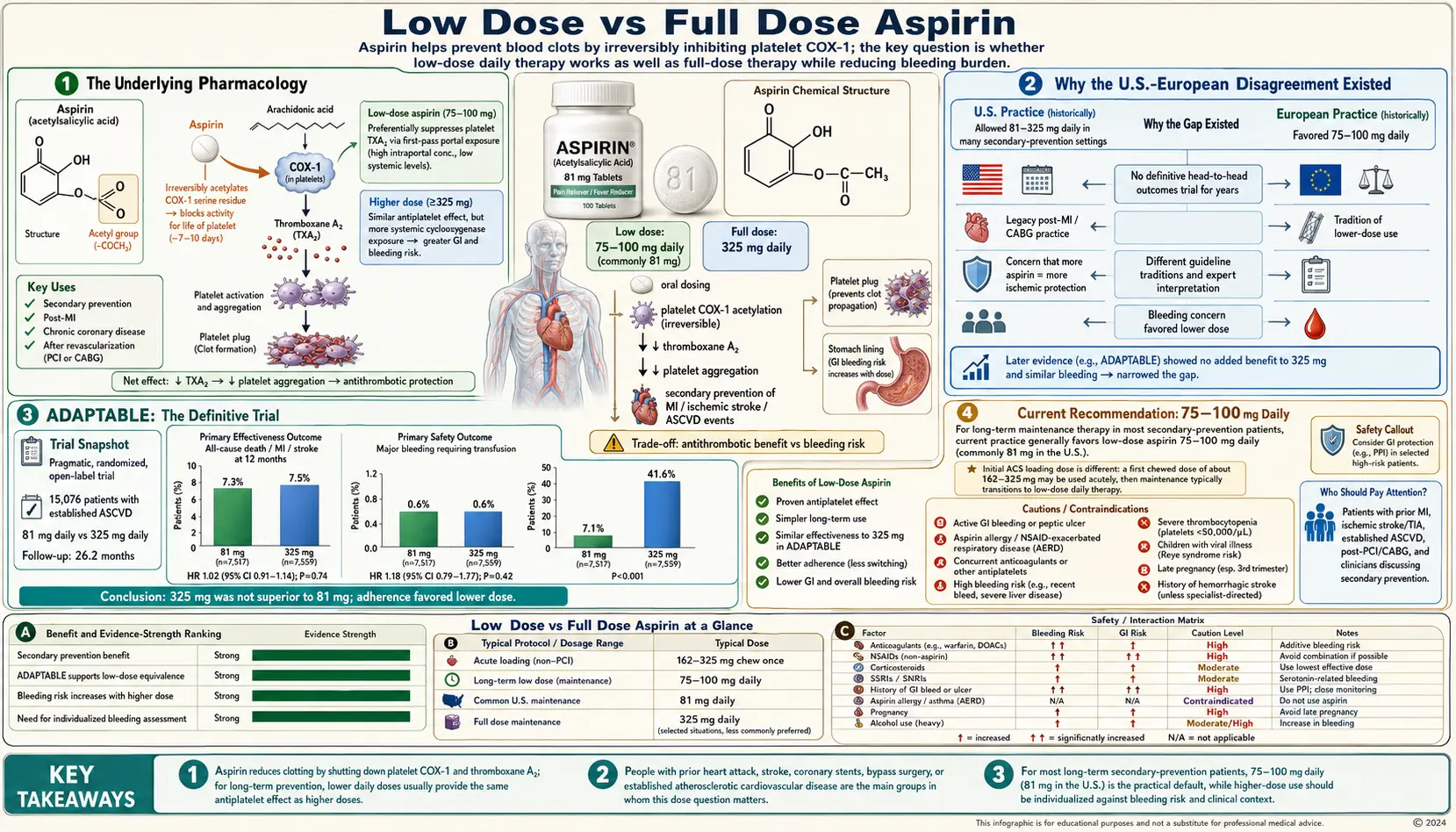
Aspirin has been studied at daily doses from below 75 mg to several grams. For long-term cardiovascular use, the 2002 Antithrombotic Trialists' meta-analysis found 75-150 mg daily at least as effective as higher daily doses, and in the 2021 ADAPTABLE trial of 15,076 patients with established atherosclerotic cardiovascular disease, 81 mg and 325 mg daily did not differ significantly in cardiovascular events or hospitalization for major bleeding over a median 26.2 months, although 41.6% of those assigned 325 mg switched dose. A 2026 review describes aspirin's effect on platelets as dose-independent above about 30 mg daily, while its effect on the protective prostaglandins of the stomach lining rises with dose. This page covers the pharmacology, the trials that compared doses, enteric coating, body weight, and other uses in which particular doses have been studied.
Table of Contents
- The Underlying Pharmacology
- Earlier Trials and Dose Comparisons
- ADAPTABLE: 81 mg vs 325 mg
- Long-Term Doses in Trials and Guidelines
- Doses Studied in Acute Heart Attack and Stroke
- Enteric-Coated vs Uncoated
- Body Weight and Dose Response
- Other Uses and the Doses Studied
- Aspirin "Resistance" and Variability
- Key Research Papers
- Connections
- Featured Videos
The Underlying Pharmacology
Aspirin itself has a half-life of about 20 minutes, yet its antiplatelet effect lasts far longer because it permanently acetylates a serine residue (Ser-529) of the platelet COX-1 enzyme. Anucleate platelets have limited capacity to make new protein and live 7-10 days in humans, and only about 10-12% of circulating platelets are newly formed each day (Patrono 2026, PubMed PMID: 41592353). In 1975 Roth and Majerus showed that aspirin acetylates a particulate-fraction protein of human platelets (PubMed PMID: 1159076).
Once-daily low-dose aspirin (30-100 mg) suppresses platelet COX-1 activity by more than 97% throughout the dosing interval (Patrono 2026). In 24 healthy volunteers taking enteric-coated aspirin 100 mg daily, serum thromboxane B2 was suppressed by about 99% throughout the 24 hours after the last dose, with about 76% of platelet COX-1 acetylated (Patrignani 2014, PubMed PMID: 24942808). In a sub-study of a trial in people with recently diagnosed cancer, 300 mg once daily gave no additional suppression of a urinary thromboxane metabolite compared with 100 mg, which the 2026 review describes as consistent with saturation of platelet COX-1 inactivation at 100 mg once daily.
The clinical comparisons point the same way. The 2002 Antithrombotic Trialists' meta-analysis (287 studies) found aspirin doses of 75-150 mg daily at least as effective as higher daily doses; the effects of doses below 75 mg were less certain (PubMed PMID: 11786451). For bleeding, the 2026 review describes the platelet effect as dose-independent above 30 mg daily, but the impairment of protective prostaglandin E2 in the stomach lining as dose-dependent up to analgesic and anti-inflammatory regimens (325-650 mg three to four times daily); it attributes the roughly 2-fold rise in upper gastrointestinal bleeding at 75-100 mg daily largely to inhibited platelet function. In the McQuaid and Laine meta-analysis of 22 placebo-controlled trials of 75-325 mg daily, aspirin increased major gastrointestinal bleeding (relative risk 2.07), and no difference was seen between 75-162.5 mg and >162.5-325 mg daily (PubMed PMID: 16887404).
Earlier Trials and Dose Comparisons
The early trials used a range of doses. The Physicians' Health Study gave 325 mg every other day to 22,071 participants and found a 44% reduction in the risk of myocardial infarction (PubMed PMID: 2664509). ISIS-2 gave one month of 160 mg/day enteric-coated aspirin to patients with suspected acute myocardial infarction (PubMed PMID: 2899772). In the CURE trial, patients with acute coronary syndromes took aspirin 75-325 mg daily together with clopidogrel or placebo (PubMed PMID: 11519503).
Aspirin dose was not randomised in CURE, but an observational analysis of the trial found that major bleeding rose with aspirin dose (1.9%, 2.8% and 3.7% in the placebo group at ≤100 mg, 101-199 mg and ≥200 mg daily) without any increase in efficacy; the authors suggested that the optimal daily dose may be between 75 and 100 mg (Peters 2003, PubMed PMID: 14504182). The 2010 CURRENT-OASIS 7 trial then randomised 25,086 patients with acute coronary syndromes referred for an invasive strategy to higher-dose (300-325 mg) or lower-dose (75-100 mg) aspirin daily. Neither the primary outcome of cardiovascular death, myocardial infarction or stroke at 30 days (4.2% vs 4.4%) nor major bleeding (2.3% vs 2.3%) differed significantly between the aspirin doses (PubMed PMID: 20818903).
ADAPTABLE: 81 mg vs 325 mg
ADAPTABLE was an open-label, pragmatic trial that randomly assigned patients with established atherosclerotic cardiovascular disease to a strategy of 81 mg or 325 mg of aspirin per day (Jones 2021, PubMed PMID: 33999548). The primary effectiveness outcome was a composite of death from any cause, hospitalization for myocardial infarction, or hospitalization for stroke; the primary safety outcome was hospitalization for major bleeding. A total of 15,076 patients were followed for a median of 26.2 months. Before randomization, 96.0% of those with information on earlier aspirin use were already taking aspirin, and 85.3% of these were taking 81 mg.
The primary outcome occurred in an estimated 7.28% of the 81 mg group and 7.51% of the 325 mg group (hazard ratio 1.02, 95% CI 0.91-1.14). Hospitalization for major bleeding occurred in an estimated 0.63% and 0.60% (hazard ratio 1.18, 95% CI 0.79-1.77).
Patients assigned to 325 mg switched dose more often than those assigned to 81 mg (41.6% vs 7.1%) and spent fewer median days on the assigned dose (434 vs 650 days). The investigators concluded that there was substantial dose switching to 81 mg and no significant differences in cardiovascular events or major bleeding between the two assigned doses.
Long-Term Doses in Trials and Guidelines
The long-term comparisons above all included doses of 75-100 mg: the 2002 meta-analysis found 75-150 mg at least as effective as higher doses, CURRENT-OASIS 7 compared 75-100 mg with 300-325 mg, and ADAPTABLE compared 81 mg with 325 mg. In the CURE analysis, adding clopidogrel to aspirin reduced cardiovascular death, myocardial infarction or stroke regardless of the aspirin dose (Peters 2003); in the main trial, clopidogrel plus aspirin reduced that outcome from 11.4% to 9.3%, with more major bleeding (3.7% vs 2.7%) (PubMed PMID: 11519503).
Primary prevention in people without cardiovascular disease is a separate question, covered in the Cardiovascular Prevention deep-dive. The 2022 USPSTF statement addresses whether to start low-dose aspirin at all: it calls the decision an individual one for adults aged 40-59 with a 10% or greater 10-year cardiovascular risk, in whom it found a small net benefit, and recommends against starting it for primary prevention at 60 or older (PubMed PMID: 35471505).
Doses Studied in Acute Heart Attack and Stroke
In ISIS-2 (17,187 patients with suspected acute myocardial infarction), one month of 160 mg/day enteric-coated aspirin reduced 5-week vascular mortality from 11.8% to 9.4% (odds reduction 23%) and reduced non-fatal reinfarction (1.0% vs 2.0%) and non-fatal stroke (0.3% vs 0.6%), without a significant increase in cerebral haemorrhage or bleeds requiring transfusion (PubMed PMID: 2899772). The 2002 Antithrombotic Trialists' meta-analysis concluded that 75-150 mg daily is an effective regimen for long-term use, but that in acute settings an initial loading dose of at least 150 mg may be required (PubMed PMID: 11786451).
In acute ischaemic stroke, the Chinese Acute Stroke Trial gave 160 mg/day, started within 48 hours of onset and continued in hospital for up to 4 weeks, to 21,106 patients; in-hospital mortality fell by 14% proportionally (3.3% vs 3.9%), with slightly more haemorrhagic strokes (1.1% vs 0.9%, not significant) (PubMed PMID: 9186381). The International Stroke Trial allocated 300 mg daily, started within 48 hours, in 19,435 patients and found non-significantly fewer deaths within 14 days (9.0% vs 9.4%) (PubMed PMID: 9174558). Taking the two trials together, the CAST investigators reported about 9 fewer deaths or non-fatal strokes per 1000 patients in the first few weeks.
Enteric-Coated vs Uncoated
Enteric coating is a polymer film meant to delay dissolution until the tablet reaches the small intestine. In a case-control study of 550 people admitted to hospital with major upper gastrointestinal bleeding and 1,202 controls, the relative risks at average daily doses of 325 mg or less were 2.6 for plain, 2.7 for enteric-coated and 3.1 for buffered aspirin; the authors concluded that the assumption that these formulations are less harmful than plain aspirin may be mistaken (Kelly 1996, PubMed PMID: 8937281). The 2026 review attributes most of the bleeding risk at 75-100 mg daily to inhibited platelet function rather than to the effect on the stomach lining (Patrono 2026).
Enteric coating may also lower the platelet effect. Maree and colleagues studied 131 stable cardiovascular patients taking 75 mg enteric-coated aspirin: 44% had elevated serum thromboxane B2, heavier and younger patients and those with a previous myocardial infarction were more likely to respond incompletely, and adding aspirin to the blood sample in the laboratory abolished platelet aggregation in every case (Maree 2005, PubMed PMID: 16198840). In 71 healthy volunteers, three enteric-coated 75 mg preparations were less effective than dispersible 75 mg aspirin at lowering serum thromboxane B2; treatment failure occurred in 14 subjects, none of them taking dispersible aspirin, and was more likely at higher body weight. The authors pointed to lower bioavailability and poor absorption from the small intestine (Cox 2006, PubMed PMID: 16794200).
Body Weight and Dose Response
Rothwell and colleagues analysed individual patient data from ten randomised primary-prevention trials (117,279 participants). The ability of 75-100 mg aspirin to reduce cardiovascular events decreased with increasing weight: benefit was seen in people weighing 50-69 kg (hazard ratio 0.75) but not in those weighing 70 kg or more (0.95). Higher doses (≥325 mg) had the opposite interaction, reducing cardiovascular events only at higher weight. The analysis also found harms of excess dosing at low weight, including more deaths from any cause in people under 50 kg taking 75-100 mg (hazard ratio 1.52), and the authors concluded that a one-dose-fits-all approach is unlikely to be optimal (PubMed PMID: 30017552).
This was an analysis of existing trials, not a trial that assigned doses by weight. The two enteric-coated aspirin studies above also found higher body weight linked to an incomplete platelet response (Maree 2005; Cox 2006), while ADAPTABLE, which did not select patients by weight, found no overall difference between 81 mg and 325 mg.
Other Uses and the Doses Studied
- Pain, fever and inflammation — the 2026 review gives analgesic and anti-inflammatory regimens as 325-650 mg three to four times daily, and describes the effect on the stomach lining as rising with dose up to these regimens (Patrono 2026, PubMed PMID: 41592353).
- Kawasaki disease (acute vasculitis of childhood) — aspirin is part of the recommended treatment, but the dose in the acute phase is debated. In a retrospective multicentre cohort of 1,213 children treated with aspirin and intravenous immunoglobulin, low-dose aspirin (3-5 mg/kg per day) was not inferior to high-dose aspirin (80 mg/kg per day) for coronary artery abnormalities (22.2% vs 20.5%) (Dallaire 2017, PubMed PMID: 28562282). American Heart Association statements in 2004 (Newburger, PubMed PMID: 15505111) and 2017 (McCrindle, PubMed PMID: 28356445) set out acute treatment and long-term antiplatelet management.
- Polycythemia vera — a low-dose use. In the ECLAP trial (518 patients), 100 mg daily reduced the combined endpoint of non-fatal myocardial infarction, non-fatal stroke, pulmonary embolism, major venous thrombosis or cardiovascular death (relative risk 0.40, P=0.03) without a significant increase in major bleeding (relative risk 1.62, 95% CI 0.27-9.71); overall and cardiovascular mortality were not significantly reduced (PubMed PMID: 14711910).
- Preterm preeclampsia — in the ASPRE trial, 1,776 women at high risk were randomised to 150 mg a day or placebo from 11-14 weeks until 36 weeks of gestation; preterm preeclampsia occurred in 1.6% vs 4.3% (odds ratio 0.38) (Rolnik 2017, PubMed PMID: 28657417).
- Carotid endarterectomy — the ACE trial randomised 2,849 patients to 81, 325, 650 or 1300 mg daily, started before surgery and continued for 3 months. Stroke, myocardial infarction or death at 3 months was lower with the two lower doses than with the two higher doses (6.2% vs 8.4%, p=0.03) (Taylor 1999, PubMed PMID: 10392981).
Aspirin "Resistance" and Variability
"Aspirin resistance" refers to either pharmacodynamic failure (laboratory evidence that platelet COX-1 is not fully inhibited despite aspirin therapy) or clinical failure (recurrent cardiovascular events despite aspirin therapy). The literature is heterogeneous because the term has been used both ways.
How common incomplete inhibition is depends on the measure and the product: in the Maree study, 44% of patients taking 75 mg enteric-coated aspirin had elevated serum thromboxane B2 (PubMed PMID: 16198840). Other drugs can interfere. When a single daily dose of ibuprofen was taken before aspirin, or ibuprofen was taken several times a day, aspirin's inhibition of serum thromboxane B2 and platelet aggregation was blocked; rofecoxib, acetaminophen and diclofenac did not have this effect (Catella-Lawson 2001, PubMed PMID: 11752357). In a nested case-control study within the HOPE trial (488 cases and 488 matched controls, all taking aspirin), patients in the highest quartile of urinary 11-dehydro thromboxane B2 had 1.8 times the risk of myocardial infarction, stroke or cardiovascular death of those in the lowest quartile (Eikelboom 2002, PubMed PMID: 11940542).
Clinical failure reflects the fact that aspirin reduces but does not eliminate cardiovascular risk. In the CURE trial, adding a second antiplatelet drug, clopidogrel, to aspirin in acute coronary syndromes further reduced cardiovascular death, myocardial infarction or stroke, at the cost of more major bleeding (PubMed PMID: 11519503).
Key Research Papers
- Jones WS et al., NEJM 2021: comparative effectiveness of aspirin dosing in cardiovascular disease (ADAPTABLE, 81 mg vs 325 mg). — PubMed PMID: 33999548
- Patrono C et al., NEJM 2005: low-dose aspirin for the prevention of atherothrombosis. — PubMed PMID: 16319386
- Antithrombotic Trialists' Collaboration (BMJ 2002): collaborative meta-analysis of randomised trials of antiplatelet therapy in high-risk patients. — PubMed PMID: 11786451
- Roth GJ & Majerus PW (J Clin Invest 1975): the mechanism of the effect of aspirin on human platelets, I. acetylation of a particulate fraction protein. — PubMed PMID: 1159076
- Vane JR (Nat New Biol 1971): aspirin and prostaglandin synthesis. — PubMed PMID: 5284360
- Patrono C (NEJM 1994): aspirin as an antiplatelet drug. — PubMed PMID: 8145785
- McQuaid KR & Laine L (Am J Med 2006): systematic review and meta-analysis of adverse events of low-dose aspirin and clopidogrel in randomized controlled trials. — PubMed PMID: 16887404
- Maree AO et al., JACC 2005: platelet response to low-dose enteric-coated aspirin in patients with stable cardiovascular disease. — PubMed PMID: 16198840
- Newby LK et al., AHA 2008: aspirin dose scientific statement. — Search PubMed (editorial note: no 2008 AHA statement by Newby on aspirin dose was found in PubMed, and the page no longer relies on it.)
- Rothwell PM et al., Lancet 2018: effects of aspirin on risks of vascular events and cancer according to bodyweight and dose. — PubMed PMID: 30017552
- Cox D et al., Stroke 2006: effect of enteric coating on antiplatelet activity of low-dose aspirin in healthy volunteers. — PubMed PMID: 16794200 (editorial note: previously described as a study of aspirin resistance and clinical outcomes.)
- Eikelboom JW et al., Circulation 2002: aspirin-resistant thromboxane biosynthesis and the risk of myocardial infarction, stroke, or cardiovascular death in high-risk patients. — PubMed PMID: 11940542
- Newburger JW et al., AHA 2004: diagnosis, treatment, and long-term management of Kawasaki disease. — PubMed PMID: 15505111
- Landolfi R et al., ECLAP trial NEJM 2004: efficacy and safety of low-dose aspirin in polycythemia vera. — PubMed PMID: 14711910
- ISIS-2 trial (Lancet 1988): intravenous streptokinase, oral aspirin, both, or neither in suspected acute MI. — PubMed PMID: 2899772
- Patrono C et al., Pharmacol Rev 2026: platelet activation, aspirin, and cancer, from basic science to clinical trials. — PubMed PMID: 41592353
- Patrignani P et al., J Thromb Haemost 2014: reappraisal of the clinical pharmacology of low-dose aspirin. — PubMed PMID: 24942808
- Peters RJ et al., Circulation 2003: effects of aspirin dose when used alone or with clopidogrel in acute coronary syndromes (CURE). — PubMed PMID: 14504182
- CURRENT-OASIS 7 Investigators (Mehta SR et al.), NEJM 2010: dose comparisons of clopidogrel and aspirin in acute coronary syndromes. — PubMed PMID: 20818903
- Yusuf S et al., NEJM 2001: effects of clopidogrel in addition to aspirin in acute coronary syndromes without ST-segment elevation (CURE). — PubMed PMID: 11519503
- Physicians' Health Study Research Group, NEJM 1989: final report on the aspirin component. — PubMed PMID: 2664509
- CAST Collaborative Group, Lancet 1997: early aspirin in 20,000 patients with acute ischaemic stroke. — PubMed PMID: 9186381
- International Stroke Trial Collaborative Group, Lancet 1997: aspirin, subcutaneous heparin, both, or neither among 19,435 patients with acute ischaemic stroke. — PubMed PMID: 9174558
- Kelly JP et al., Lancet 1996: risk of aspirin-associated major upper-gastrointestinal bleeding with enteric-coated or buffered product. — PubMed PMID: 8937281
- Catella-Lawson F et al., NEJM 2001: cyclooxygenase inhibitors and the antiplatelet effects of aspirin. — PubMed PMID: 11752357
- Taylor DW et al., Lancet 1999: low-dose and high-dose aspirin for patients undergoing carotid endarterectomy (ACE trial). — PubMed PMID: 10392981
- Dallaire F et al., Pediatrics 2017: aspirin dose and prevention of coronary abnormalities in Kawasaki disease. — PubMed PMID: 28562282
- McCrindle BW et al., Circulation 2017: diagnosis, treatment, and long-term management of Kawasaki disease, AHA scientific statement. — PubMed PMID: 28356445
- Rolnik DL et al., NEJM 2017: aspirin versus placebo in pregnancies at high risk for preterm preeclampsia (ASPRE). — PubMed PMID: 28657417
- US Preventive Services Task Force (Davidson KW et al.), JAMA 2022: aspirin use to prevent cardiovascular disease, recommendation statement. — PubMed PMID: 35471505