Aspirin and Colorectal Cancer Risk
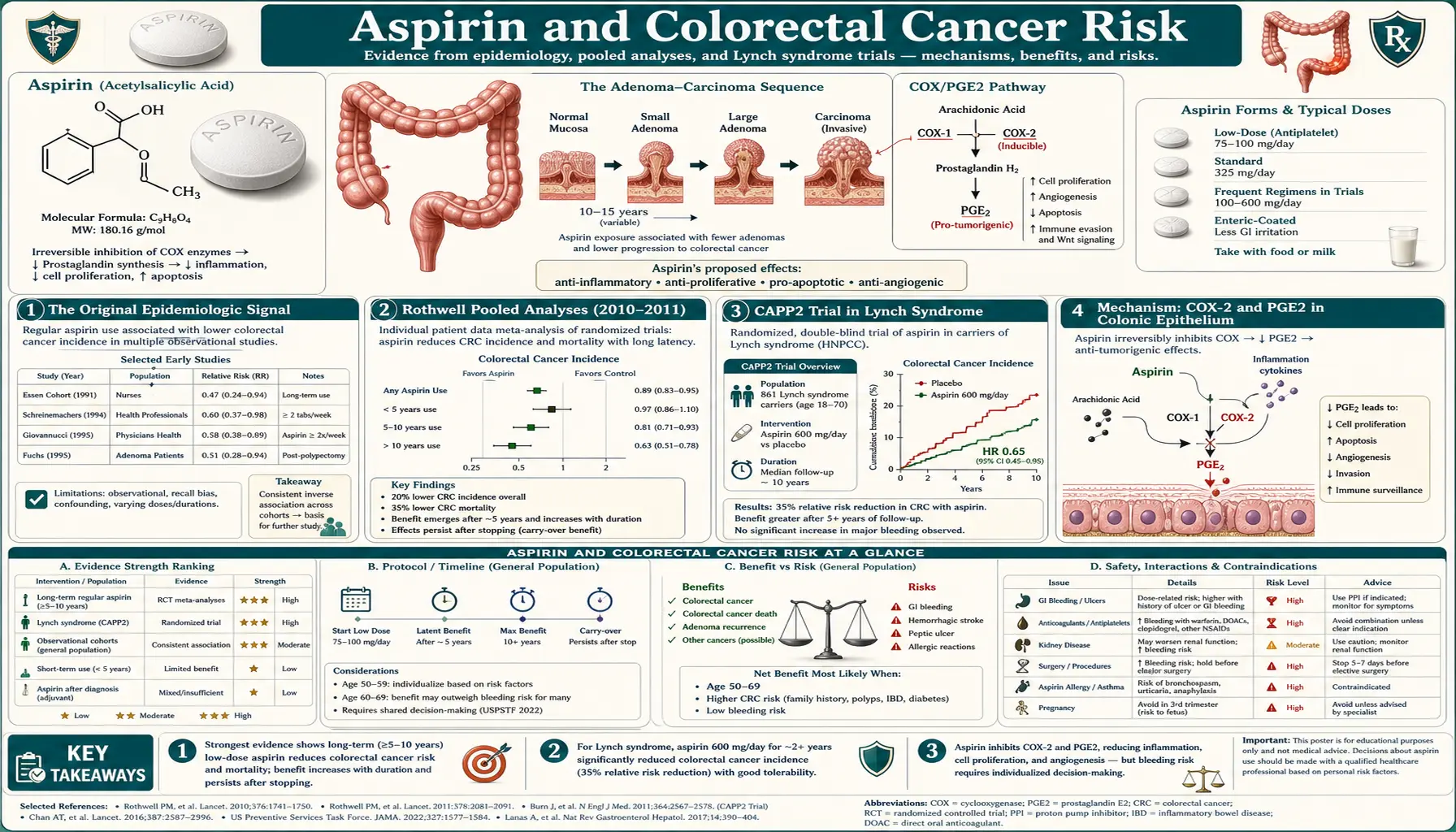
Randomised trials of daily aspirin, most of them run to prevent heart attack and stroke, have been followed for up to 20 years for cancer. In 20-year follow-up of four trials of aspirin versus control (14,033 patients), aspirin reduced colon cancer incidence (hazard ratio 0.76) and colon cancer mortality (0.65), but not rectal cancer overall; rectal cancer risk was reduced only with 5 or more years of scheduled treatment (Rothwell 2010, PubMed PMID: 20970847). A pooled analysis of eight trials (25,570 patients) found fewer cancer deaths with aspirin, an effect that appeared only after about 5 years of follow-up and later still for colorectal cancer (Rothwell 2011, PubMed PMID: 21144578). In the CAPP2 trial in people with Lynch syndrome, 600 mg aspirin daily did not significantly reduce colorectal cancer in the 2011 primary analysis (hazard ratio 0.63, p=0.12; PubMed PMID: 22036019), but at 10-year follow-up the hazard ratio was 0.65 and statistically significant (PubMed PMID: 32534647). How aspirin acts on colorectal cancer is still debated: an effect on COX-2 in colorectal lesions and a platelet-based explanation are both proposed. The benefit is delayed, while the risk and fatality of bleeding rise with age (PubMed PMID: 25096604), and in the ASPREE trial in adults aged 70 and older, cancer deaths were higher on aspirin, a result its authors called unexpected and to be interpreted with caution (PubMed PMID: 30221595). This page sets out the findings, the proposed mechanisms, and what guidelines state.
Table of Contents
- The Original Epidemiologic Signal
- Rothwell Pooled Analyses (2010-2011)
- CAPP2 Trial in Lynch Syndrome
- Mechanism: COX-2, Platelets and an Open Question
- The Latency Requirement (5-10 Years)
- Dose-Response: What the Studies Found
- Aspirin After Colorectal Cancer Diagnosis
- Other Cancers: Smaller and Less Consistent Signals
- Current Guideline Status
- Key Research Papers
- Connections
- Featured Videos
The Original Epidemiologic Signal
Among the early observational reports, the 1988 Melbourne Colorectal Cancer Study by Kune, Kune and Watson (715 people with colorectal cancer and 727 age- and sex-matched controls) found a statistically significant deficit of aspirin-containing medication use among the cases, consistent for colon and rectal cancer and for men and women (PubMed PMID: 3390835). A 2012 systematic review pooled 17 case-control studies: regular aspirin use was associated with a lower risk of colorectal cancer (pooled odds ratio 0.62), in good agreement with the effect of daily aspirin on 20-year risk of colorectal cancer death in the randomised trials (odds ratio 0.58) (Algra and Rothwell 2012, PubMed PMID: 22440112).
In the Nurses' Health Study (82,911 women followed for 20 years, 962 colorectal cancers), Chan and colleagues found a relative risk of 0.77 for colorectal cancer among women who regularly used two or more standard 325 mg tablets a week, but no significant reduction until more than 10 years of use. The association appeared related to dose: relative risks were 0.89 (not statistically significant) for 2-5 tablets a week, 0.78 for 6-14, and 0.68 for more than 14. Reported major gastrointestinal bleeding also rose with dose, from 0.77 per 1,000 person-years in women who reported no aspirin use to 1.57 at more than 14 tablets a week (PubMed PMID: 16118381).
Observational findings can be confounded because people who take aspirin differ from those who do not. The 2012 review compared observational studies with the randomised trials and found the estimates for individual cancers highly correlated (r² = 0.71), while noting that their reliability depends on detailed recording and analysis of aspirin use (PubMed PMID: 22440112).
Rothwell Pooled Analyses (2010-2011)
Rothwell and colleagues at Oxford pooled individual patient data from randomised aspirin trials originally run to prevent vascular events, with long-term follow-up for cancer during and after the trials (PubMed PMID: 20970847, PubMed PMID: 21144578).
The 2010 Lancet paper (PubMed PMID: 20970847) followed four trials of aspirin versus control (the Thrombosis Prevention Trial, British Doctors Aspirin Trial, Swedish Aspirin Low Dose Trial and UK-TIA Aspirin Trial) and one trial comparing aspirin doses (the Dutch TIA Aspirin Trial). In the four trials of aspirin versus control (mean scheduled treatment 6.0 years; 14,033 patients; median follow-up 18.3 years), aspirin reduced the 20-year risk of colon cancer (incidence hazard ratio 0.76, 95% CI 0.60-0.96; mortality 0.65, 0.48-0.88) but not rectal cancer (incidence 0.90, mortality 0.80, neither statistically significant). Where subsite data were available, aspirin reduced cancer of the proximal colon (incidence 0.45) but not the distal colon. With 5 or more years of scheduled treatment, the risk of proximal colon cancer fell by about 70% and rectal cancer was also reduced (incidence 0.58, mortality 0.47). The authors noted that proximal colon cancers are not otherwise prevented effectively by screening with sigmoidoscopy or colonoscopy.
The 2011 Lancet paper (PubMed PMID: 21144578) analysed cancer deaths in eight trials (25,570 patients, 674 cancer deaths): aspirin reduced death due to cancer (pooled odds ratio 0.79). In individual patient data from seven trials, the benefit was apparent only after 5 years of follow-up (all cancers, hazard ratio 0.66; gastrointestinal cancers, 0.46). In three large UK trials with 20-year follow-up, the risk of death from solid cancers remained lower in the aspirin groups (hazard ratio 0.80; gastrointestinal cancers, 0.65), and the benefit increased with the scheduled duration of trial treatment. Benefit was unrelated to aspirin dose from 75 mg upwards, to sex, or to smoking, and increased with age.
A 2012 systematic review by Algra and Rothwell (PubMed PMID: 22440112) compared these trial results with observational studies. In the observational data, regular aspirin use was associated with a lower proportion of cancers with distant metastasis (odds ratio 0.69, five studies) but not with any reduction in regional spread, consistent with the findings in the randomised trials.
CAPP2 Trial in Lynch Syndrome
Lynch syndrome, the major form of hereditary colorectal cancer, is associated with an increased risk of colorectal cancer and of a broader spectrum of cancers, especially endometrial cancer (PubMed PMID: 22036019, PubMed PMID: 32534647); the cancers it causes are mismatch repair-deficient (PubMed PMID: 42425127). Because carriers have a well-defined high cancer risk, they have been a focus of aspirin prevention research (Serrano 2022, PubMed PMID: 35328014).
In CAPP2, carriers were randomly assigned in a two-by-two factorial design to 600 mg aspirin or aspirin placebo and to resistant starch or starch placebo, for up to 4 years; 861 were assigned to aspirin or aspirin placebo, and development of colorectal cancer was the primary endpoint. At a mean follow-up of 55.7 months, 18 of 427 participants on aspirin and 30 of 434 on placebo had developed colorectal cancer; the intention-to-treat hazard ratio was 0.63 (95% CI 0.35-1.13, p=0.12), which was not statistically significant. An analysis counting multiple primary cancers (incidence rate ratio 0.56, p=0.05) and a per-protocol analysis of those completing 2 years of treatment (hazard ratio 0.41) favoured aspirin. Adverse events during the intervention did not differ between the aspirin and placebo groups (Burn 2011, PubMed PMID: 22036019).
The 10-year follow-up (PubMed PMID: 32534647, 2020), with English, Finnish and Welsh participants followed for up to 20 years through registries, found colorectal cancer in 40 of 427 participants (9%) on aspirin and 58 of 434 (13%) on placebo: an intention-to-treat hazard ratio of 0.65 (95% CI 0.43-0.97, p=0.035), and a per-protocol hazard ratio of 0.56 in those who completed 2 years of intervention. Mean age at the start of treatment was 45 years. Non-colorectal Lynch syndrome cancers were not reduced (36 on aspirin, 36 on placebo). The authors concluded that the case for prevention of colorectal cancer with aspirin in Lynch syndrome is supported by the results.
CaPP3, a dose non-inferiority trial, randomly assigned Lynch syndrome carriers (1,866 in the intention-to-treat population) to 100 mg, 300 mg or 600 mg aspirin daily, blinded for 2 years and open label for 3 more. At a median follow-up of 66.4 months, 100 mg was non-inferior to 600 mg for Lynch syndrome cancers in the intention-to-treat analysis (hazard ratio 0.97), but time to first cancer was not non-inferior in the per-protocol analysis, and non-inferiority was not established for 300 mg. Serious adverse events due to bleeding occurred in no participants on 100 mg, 0.5% on 300 mg and 1.5% on 600 mg. The authors wrote that non-inferiority could not formally be concluded for either lower dose, but that 100 mg had similar characteristics to 600 mg in terms of cancer risk, with fewer side effects and less risk of bleeding (PubMed PMID: 42425127).
Mechanism: COX-2, Platelets and an Open Question
Aspirin acetylates the cyclooxygenase enzymes, COX-1 at serine-529 and COX-2 at serine-516. Whether low-dose aspirin lowers colorectal cancer risk by affecting COX-2 activity in colorectal adenomas is still debated. A 2020 laboratory study developed a mass-spectrometry assay of COX-2 acetylation so that clinical studies can test this; in a human colon cancer cell line, monocytes and intestinal epithelial cells, COX-2 acetylation and the fall in prostaglandin E2 production both rose with aspirin concentration (Tacconelli 2020, PubMed PMID: 32535107).
A 2026 review sets out a platelet-based explanation. Once-daily low-dose aspirin (75-100 mg) permanently inactivates COX-1 in platelets and suppresses thromboxane A2-dependent platelet activation. The authors hypothesise that persistently enhanced platelet activation has two tumour-promoting effects mediated by thromboxane A2: at sites of gastrointestinal mucosal injury it promotes local inflammation with COX-2 induction and more prostaglandin E2, contributing to early events in carcinogenesis; and it inhibits T-cell immunity to cancer, promoting progression and metastasis. Abnormal and persistent platelet activation has been demonstrated in patients recently diagnosed with cancer and in those with adenomatous colonic polyps (Patrono 2026, PubMed PMID: 41592353).
Tumour COX-2 status also appeared to matter in an observational study of people already diagnosed: the association of aspirin with lower colorectal cancer death was seen in tumours that overexpressed COX-2 but not in those with weak or absent COX-2 expression (Chan 2009, PubMed PMID: 19671906; see below).
A 2016 review by Drew, Cao and Chan (PubMed PMID: 26868177) argues that wider adoption of aspirin chemoprevention is likely to require better identification of the people for whom the protective benefits outweigh the harms, which may follow from clarifying aspirin's mechanism of action.
The Latency Requirement (5-10 Years)
In the trials, the effect is delayed. In the 2011 pooled analysis, the reduction in cancer deaths appeared only after about 5 years of follow-up; the latent period was about 5 years for oesophageal, pancreatic, brain and lung cancer and longer for stomach, colorectal and prostate cancer (PubMed PMID: 21144578). In the 2010 analysis, the larger reductions in proximal colon and rectal cancer were seen with 5 or more years of scheduled treatment (PubMed PMID: 20970847). In the Nurses' Health Study, a significant reduction was not seen until more than 10 years of use (PubMed PMID: 16118381). A 2015 review of benefits and harms found the effects on cancer not apparent until at least 3 years after the start of use, with some benefits sustained for several years after stopping in long-term users (Cuzick 2015, PubMed PMID: 25096604).
The same review identified excess bleeding as the most important harm of aspirin, with its risk and fatality rate increasing with age (PubMed PMID: 25096604). The ASPREE trial enrolled people aged 70 or older (65 or older for Black and Hispanic participants in the United States) without cardiovascular disease, dementia or disability, and followed them for a median of 4.7 years on 100 mg enteric-coated aspirin or placebo. Death from any cause was more frequent on aspirin (hazard ratio 1.14), with cancer the major contributor: cancer-related death occurred in 3.1% of the aspirin group and 2.3% of the placebo group (hazard ratio 1.31). The authors wrote that, in the context of previous studies, this result was unexpected and should be interpreted with caution (PubMed PMID: 30221595). A detailed cancer analysis found no significant difference in incident cancers overall (hazard ratio 1.04) but more cancers that had metastasized or were stage 4 at diagnosis, and a higher risk of death for cancers presenting at stage 3 or 4; its authors suggested that in older people aspirin may accelerate the progression of cancer (McNeil 2021, PubMed PMID: 32778876).
The 2016 USPSTF statement, which covered colorectal cancer as well as cardiovascular disease, limited its B recommendation to adults aged 50-59 with a 10% or greater 10-year cardiovascular risk who had a life expectancy of at least 10 years and were willing to take low-dose aspirin daily for at least 10 years (PubMed PMID: 27064677).
Dose-Response: What the Studies Found
In the 2010 pooled trials, there was no increase in colorectal cancer benefit at doses above 75 mg daily; on long-term follow-up of the Dutch TIA trial, fatal colorectal cancer was more frequent on 30 mg than on 283 mg daily, though the difference was not statistically significant (odds ratio 2.02, p=0.15) (PubMed PMID: 20970847). The 2011 cancer-death analysis found the benefit unrelated to dose from 75 mg upwards (PubMed PMID: 21144578). In a randomised adenoma-prevention trial, 81 mg daily reduced adenomas (relative risk 0.81) while 325 mg did not significantly do so (0.96) (Baron 2003, PubMed PMID: 12621133); a meta-analysis of four adenoma trials (2,967 participants, 81-325 mg daily) found a pooled risk ratio of 0.83 for any adenoma and 0.72 for advanced lesions (Cole 2009, PubMed PMID: 19211452).
The observational Nurses' Health Study pointed the other way: the largest reduction was at more than 14 standard tablets a week, and its authors suggested that optimal chemoprevention might require doses substantially higher than those used for cardiovascular prevention, with the dose-related risk of gastrointestinal bleeding also to be considered (PubMed PMID: 16118381). In Lynch syndrome, CaPP3 compared 100, 300 and 600 mg daily (see above).
A 2018 individual-patient-data analysis of ten primary-prevention trials (117,279 participants) found that 75-100 mg aspirin reduced cardiovascular events only in people weighing less than 70 kg, and that aspirin's reduction in long-term colorectal cancer risk was also weight dependent; in participants aged 70 or older, the 3-year risk of cancer was increased by aspirin (hazard ratio 1.20). The authors concluded that a one-dose-fits-all approach to aspirin is unlikely to be optimal (PubMed PMID: 30017552).
Aspirin After Colorectal Cancer Diagnosis
In a prospective study of 1,279 men and women with stage I, II or III colorectal cancer from two US health-professional cohorts (median follow-up 11.8 years), regular aspirin use after diagnosis was associated with lower colorectal cancer-specific mortality (hazard ratio 0.71) and overall mortality (0.79); among those who had not used aspirin before diagnosis, starting after diagnosis was associated with a hazard ratio of 0.53. The association was seen in tumours that overexpressed COX-2 (0.39) but not in tumours with weak or absent COX-2 expression (1.22) (Chan 2009, PubMed PMID: 19671906). This is observational evidence.
Randomised trials have since tested aspirin after treatment. In ASCOLT (1,550 patients with Dukes' C or high-risk Dukes' B colon cancer or Dukes' B or C rectal cancer who had completed standard adjuvant chemotherapy), 200 mg aspirin daily for 3 years did not significantly improve 5-year disease-free survival (77.0% vs 74.8%; hazard ratio 0.91, p=0.38); it was well tolerated, with three major gastrointestinal bleeds on aspirin and one on placebo (PubMed PMID: 39824200). Add-Aspirin, described in a 2016 protocol paper, randomly assigns people after treatment for breast, colorectal, gastro-oesophageal or prostate cancer to 100 mg aspirin, 300 mg aspirin or placebo for at least five years, with disease-free survival the primary outcome in the colorectal cohort (PubMed PMID: 27777129); results of its main comparison were not found in PubMed as of October 2026. A 2026 review states that data from large randomised trials support aspirin in the adjuvant setting for patients with colorectal cancer whose tumours have a mutation in phosphatidylinositol 3-kinase pathway genes (PubMed PMID: 41592353).
Other Cancers: Smaller and Less Consistent Signals
In the 2011 pooled analysis, the latent period before an effect on cancer death was about 5 years for oesophageal, pancreatic, brain and lung cancer; for lung and oesophageal cancer the benefit was confined to adenocarcinomas, and the overall effect on 20-year risk of cancer death was greatest for adenocarcinomas (hazard ratio 0.66) (PubMed PMID: 21144578). The 2012 review of observational studies reported consistent reductions in the risk of oesophageal, gastric, biliary and breast cancer, and noted that the trials had too little statistical power to establish effects on less common cancers and on cancers in women (PubMed PMID: 22440112).
For prostate cancer, a 2010 meta-analysis of 10 case-control and 14 cohort studies (24,230 prostate cancer cases) found a pooled odds ratio of 0.83 for aspirin use and total prostate cancer and 0.81 for advanced prostate cancer; the authors judged the evidence suggestive but not conclusive, because most studies were limited by exposure and disease misclassification, inadequate information on dose and duration, and possible screening bias (Mahmud 2010, Int J Cancer, PubMed PMID: 20091856).
Current Guideline Status
The 2016 USPSTF statement (PubMed PMID: 27064677) covered aspirin for the primary prevention of both cardiovascular disease and colorectal cancer. It recommended initiating low-dose aspirin in adults aged 50-59 with a 10% or greater 10-year cardiovascular risk who are not at increased risk for bleeding, have a life expectancy of at least 10 years and are willing to take low-dose aspirin daily for at least 10 years (B recommendation); called the decision an individual one at ages 60-69 (C recommendation); and found the evidence insufficient for adults younger than 50 or aged 70 or older (I statements).
The 2022 USPSTF statement addresses cardiovascular prevention (PubMed PMID: 35471505). It concludes with moderate certainty that aspirin use in adults aged 40-59 with a 10% or greater 10-year cardiovascular risk has a small net benefit and calls that decision an individual one (C recommendation), and it recommends against initiating low-dose aspirin for primary prevention in adults 60 or older (D recommendation). Its evidence review found limited trial evidence on colorectal cancer, with findings highly variable by length of follow-up and statistically significant only when long-term observational follow-up beyond the randomised trial periods was considered (Guirguis-Blake 2022, PubMed PMID: 35471507).
A 2015 review by Cuzick and colleagues (PubMed PMID: 25096604) estimated that for average-risk people aged 50-65 taking aspirin for 10 years, there would be a relative reduction of 7% (women) to 9% (men) in the combined number of cancer, heart attack or stroke events over 15 years, and a 4% relative reduction in all deaths over 20 years. It observed no differences between low and standard doses (with no direct comparisons available) and concluded that use for at least 5 years at 75-325 mg daily appears to have a favourable benefit-harm profile, while calling for research on the optimum dose and duration and on identifying people at increased risk of bleeding.
For Lynch syndrome, a 2022 review states that the leading international guidelines suggest discussing low-dose aspirin for colorectal cancer prevention with carriers (Serrano 2022, PubMed PMID: 35328014), and a 2026 review by the CaPP investigators reports that an international Delphi report endorsed daily use of 75-100 mg aspirin in adults with Lynch syndrome before old age, when adverse effects become a greater concern (Burn and Bishop 2026, PubMed PMID: 42717387). Decisions about aspirin belong with a clinician.
Key Research Papers
- Rothwell PM et al., Lancet 2010 — long-term effect of aspirin on colorectal cancer incidence and mortality: 20-year follow-up of five randomised trials. — PubMed PMID: 20970847
- Rothwell PM et al., Lancet 2011 — effect of daily aspirin on long-term risk of death due to cancer: individual patient data from randomised trials. — PubMed PMID: 21144578
- Algra AM & Rothwell PM, Lancet Oncol 2012 — effects of regular aspirin on long-term cancer incidence and metastasis: observational studies versus randomised trials. — PubMed PMID: 22440112
- Burn J et al., Lancet 2011 — long-term effect of aspirin on cancer risk in carriers of hereditary colorectal cancer (Lynch syndrome): the CAPP2 randomised controlled trial. — PubMed PMID: 22036019
- Burn J et al., Lancet 2020 — cancer prevention with aspirin in Lynch syndrome: 10-year follow-up and registry-based 20-year data in the CAPP2 study. — PubMed PMID: 32534647
- Chan AT et al., JAMA 2005 — long-term use of aspirin and nonsteroidal anti-inflammatory drugs and risk of colorectal cancer (Nurses' Health Study). — PubMed PMID: 16118381
- Chan AT, Ogino S & Fuchs CS, JAMA 2009 — aspirin use and survival after diagnosis of colorectal cancer. — PubMed PMID: 19671906
- Cole BF et al., J Natl Cancer Inst 2009 — aspirin for the chemoprevention of colorectal adenomas: meta-analysis of the randomized trials. — PubMed PMID: 19211452 (editorial note: previously listed as NEJM 2003; Cole is second author of the 2003 NEJM trial listed next.)
- Baron JA et al., NEJM 2003 — a randomized trial of aspirin to prevent colorectal adenomas. — PubMed PMID: 12621133
- Cuzick J et al., Annals of Oncology 2015 — estimates of benefits and harms of prophylactic use of aspirin in the general population. — PubMed PMID: 25096604
- Drew DA, Cao Y & Chan AT, Nature Reviews Cancer 2016 — aspirin and colorectal cancer: the promise of precision chemoprevention. — PubMed PMID: 26868177 (editorial note: the link previously pointed to an unrelated review of p53 pathway genetics in the same journal.)
- Mahmud SM, Franco EL & Aprikian AG, Int J Cancer 2010 — use of nonsteroidal anti-inflammatory drugs and prostate cancer risk: a meta-analysis. — PubMed PMID: 20091856 (editorial note: previously listed as a JNCI 2010 paper on prostate cancer mortality; no such paper was found in PubMed.)
- Bibbins-Domingo K, U.S. Preventive Services Task Force, Ann Intern Med 2016 (superseded by the 2022 statement) — aspirin use for the primary prevention of cardiovascular disease and colorectal cancer: recommendation statement. — PubMed PMID: 27064677
- US Preventive Services Task Force, JAMA 2022 — aspirin use to prevent cardiovascular disease: recommendation statement. — PubMed PMID: 35471505
- McNeil JJ et al., NEJM 2018 — effect of aspirin on cardiovascular events and bleeding in the healthy elderly (ASPREE). — PubMed PMID: 30221597 (editorial note: previously labelled the ASPREE primary outcome paper; the primary outcome was disability-free survival.)
- McNeil JJ et al., NEJM 2018 — effect of aspirin on all-cause mortality in the healthy elderly (ASPREE). — PubMed PMID: 30221595
- McNeil JJ et al., J Natl Cancer Inst 2021 — effect of aspirin on cancer incidence and mortality in older adults (ASPREE). — PubMed PMID: 32778876
- Kune GA, Kune S & Watson LF, Cancer Res 1988 — colorectal cancer risk, chronic illnesses, operations, and medications: case-control results from the Melbourne Colorectal Cancer Study. — PubMed PMID: 3390835
- Rothwell PM et al., Lancet 2018 — effects of aspirin on risks of vascular events and cancer according to bodyweight and dose: individual patient data from randomised trials. — PubMed PMID: 30017552
- Burn J et al., Lancet Gastroenterol Hepatol 2026 — aspirin for cancer prevention in individuals with Lynch syndrome: first results from the CaPP3 multicentre, randomised, double-blind, non-inferiority trial. — PubMed PMID: 42425127
- Chia JWK et al., Lancet Gastroenterol Hepatol 2025 — aspirin after completion of standard adjuvant therapy for colorectal cancer (ASCOLT): a phase 3, randomised, double-blind, placebo-controlled trial. — PubMed PMID: 39824200
- Coyle C et al., Contemp Clin Trials 2016 — ADD-ASPIRIN: a phase III, double-blind, placebo-controlled, randomised trial of aspirin after primary therapy in common non-metastatic solid tumours (protocol). — PubMed PMID: 27777129
- Guirguis-Blake JM et al., JAMA 2022 — aspirin use to prevent cardiovascular disease and colorectal cancer: updated evidence report and systematic review for the USPSTF. — PubMed PMID: 35471507
- Patrono C et al., Pharmacol Rev 2026 — platelet activation, aspirin, and cancer: from basic science to clinical trials. — PubMed PMID: 41592353
- Tacconelli S et al., Biochem Pharmacol 2020 — characterization of cyclooxygenase-2 acetylation and prostanoid inhibition by aspirin in cellular systems. — PubMed PMID: 32535107
- Serrano D et al., Genes (Basel) 2022 — aspirin colorectal cancer prevention in Lynch syndrome: recommendations in the era of precision medicine. — PubMed PMID: 35328014
- Burn J & Bishop DT, Int J Cancer 2026 — an update on aspirin for cancer prevention in Lynch syndrome from the Cancer Prevention Programme (CaPP). — PubMed PMID: 42717387
PubMed Topic Searches
Connections
- All Remedies
- Aspirin Benefits Hub
- Cardiovascular Prevention
- Bleeding Risks and Cautions
- Low Dose vs Full Dose
- Aspirin Cancer Prevention
- Aspirin Main Hub
- Oncology
- Gastroenterology
- Colonoscopy
- Colorectal Cancer — the disease itself: staging, screening, symptoms and treatment behind the chemoprevention data on this page.