Nutrient-Dense Foods: Organ Meats, Eggs, Seafood, Bone Broth and Whole Dairy
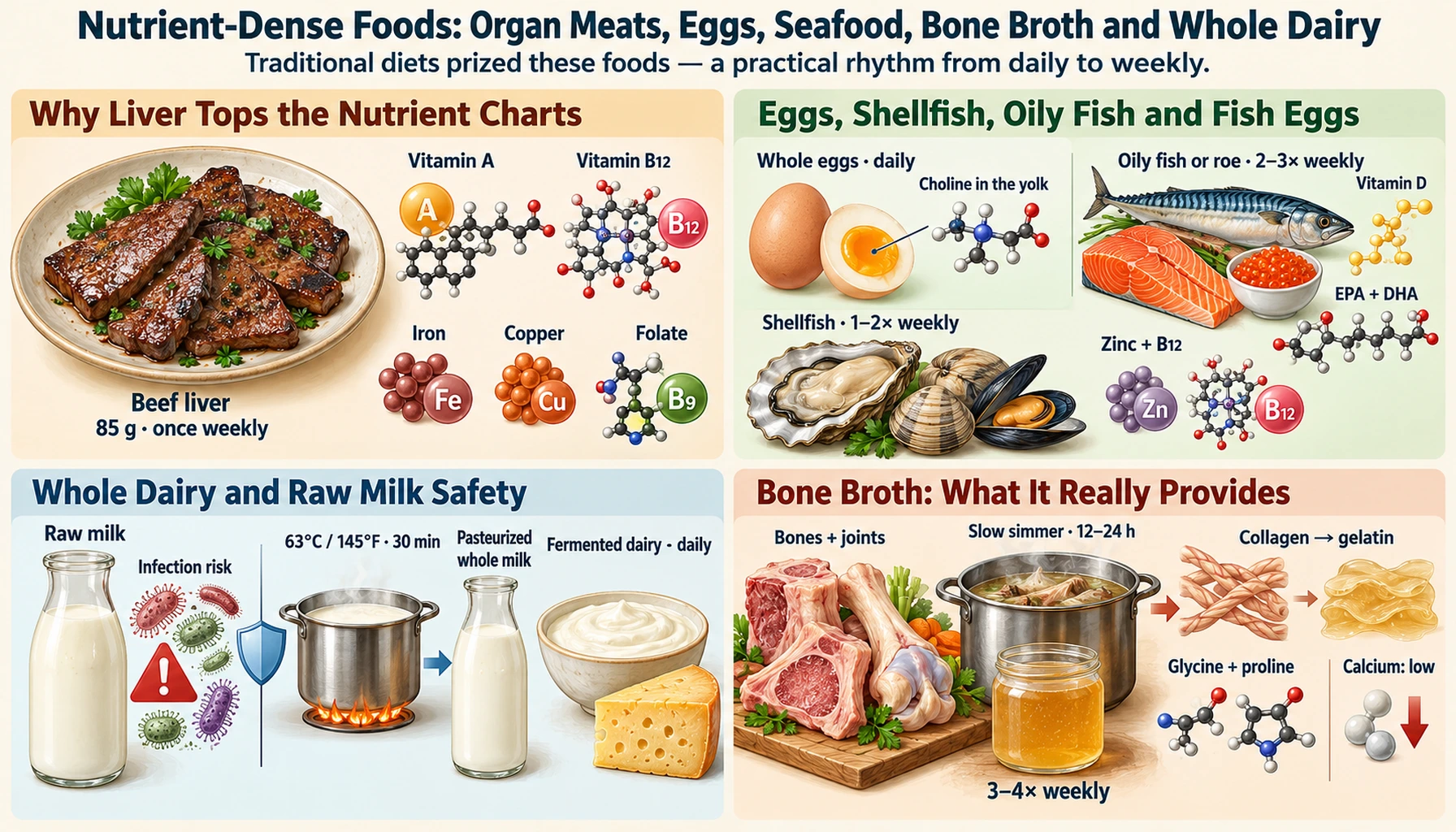
The Weston A. Price diet puts a handful of animal foods at the centre of the plate: liver and other organ meats, eggs, wild seafood and fish eggs, full-fat dairy, animal fats and homemade bone broth. Measured food-composition data back the core idea strongly — a small portion of liver or oysters carries more vitamins and minerals than almost anything else you can eat. Two parts need more care: raw milk, which the diet recommends but which carries a well-documented infection risk, and bone broth, which supplies gelatin but far less calcium than many people assume. This page goes food by food, with the USDA numbers, the evidence tier and the safety limits side by side.
Table of Contents
- What the Booklet Recommends
- Nutrient Density: Why Liver Tops the Charts
- Liver and Other Organ Meats: How Much, How Often
- Eggs, Shellfish, Oily Fish and Fish Eggs
- Whole Dairy, Butter, Aged Cheese and Animal Fats
- Raw Milk: What the Diet Says and What the Outbreak Data Show
- Bone Broth: What It Really Provides
- A Weekly Target List and Easy Ways to Eat Organ Meats
- Key Research Papers
- Connections
- Featured Videos
What the Booklet Recommends
The Weston A. Price Foundation's booklet Timeless Principles of Healthy Traditional Diets lists twenty dietary guidelines. Five of them describe the foods on this page. In paraphrase:
- Guideline 2: eat beef, lamb, pork, game, poultry, organ meats and eggs from animals raised on pasture.
- Guideline 3: eat wild fish, fish eggs and shellfish from clean waters, rather than farm-raised fish.
- Guideline 4: eat full-fat dairy from pasture-fed cows, preferably raw and/or fermented — whole milk, yogurt, kefir, cultured butter, full-fat cheeses and cream.
- Guideline 5: use animal fats generously: butter, lard, tallow, poultry fat, cream and egg yolks.
- Guideline 11: make stock from the bones of pasture-raised chicken, beef, lamb and wild fish, and use it freely in soups, stews, gravies and sauces.
The reasoning comes from Dr. Price's 1930s field work (see the History page). The booklet says that every traditional group he visited ate some animal food, that they ate the whole animal with organs and fats preferred, and that their diets carried far more minerals and fat-soluble vitamins than a modern Western diet. Its second principle puts it simply: organ meats and fat were the prized parts.
How does that hold up? The part about nutrient content holds up very well — it is a matter of measurement, not opinion, and the measurements are below. Some specific claims attached to these foods hold up less well: farmed fish is not lower in omega-3 fat by the USDA's own numbers, bone broth is a poor source of calcium, and raw milk carries an infection risk that pasteurized whole milk does not. Each is explained in its own section, and the wider claims are weighed on the Myths and Evidence page.
Nutrient Density: Why Liver Tops the Charts
"Nutrient density" means how many vitamins and minerals a food carries per bite (or per calorie). A useful analogy is luggage: two suitcases can weigh the same, but one is packed with essentials and the other with tissue paper. Organ meats are the suitcase packed to the zips.
The clearest modern test came from a 2022 analysis by Beal and Ortenzi, who built a global food-composition database and scored foods by how much of six commonly lacking nutrients they supply — iron, zinc, folate, vitamin A, calcium and vitamin B12. The top sources were organs, small fish, dark green leafy vegetables, bivalves (oysters, mussels, clams), crustaceans, goat, beef, eggs, milk and canned fish with bones (evidence tier: food-composition analysis). That list reads almost like the booklet's shopping list, with leafy greens added.
The chart below uses three foods from the USDA's FoodData Central database, per 100 g (about 3½ oz): pan-fried beef liver (FDC 168627, "Beef, variety meats and by-products, liver, cooked, pan-fried"), beef steak (muscle meat; USDA values from FDC 174763, a raw steak entry, "Beef, top sirloin, steak, separable lean only, trimmed to 1/8" fat, choice, raw") and raw spinach (FDC 168462). The liver figures are for cooked liver, because that is how liver is eaten; cooking drives out water, so cooked liver carries more of each nutrient per 100 g than the same liver raw. Each nutrient is shown as a percentage of the FDA Daily Value (DV): vitamin A 900 mcg, vitamin B12 2.4 mcg, iron 18 mg, copper 0.9 mg and folate 400 mcg. The bars stop at 200% DV so the smaller values stay readable; the three liver bars that run past it are labelled with their full figures.
- Beef liver, pan-fried, per 100 g: vitamin A 7,744 mcg RAE (860% DV), vitamin B12 83.1 mcg (3,464% DV), iron 6.17 mg (34% DV), copper 14.59 mg (1,621% DV), folate 260 mcg (65% DV). It also carries 418 mg of choline and 26.5 g of protein.
- Beef steak (muscle meat), per 100 g: vitamin A 0 mcg (0% DV), vitamin B12 1.19 mcg (50% DV), iron 1.63 mg (9% DV), copper 0.073 mg (8% DV), folate 13 mcg (3% DV).
- Raw spinach, per 100 g: vitamin A 469 mcg RAE (52% DV), vitamin B12 0 mcg (0% DV), iron 2.71 mg (15% DV), copper 0.13 mg (14% DV), folate 194 mcg (49% DV).
Two fair points for the vegetable. Spinach's folate is genuinely high (49% DV), and dark leafy greens made Beal and Ortenzi's top list too. But its "vitamin A" is beta-carotene, which the body has to convert, and its iron is the non-heme form, which is absorbed less well than the heme iron in meat. Liver supplies vitamin A already formed (retinol) — which is exactly why it needs a portion limit, explained next. The booklet's point that some nutrients come only, or most easily, from animal foods is well supported for vitamin B12 (0% in spinach) and preformed vitamin A.
Liver and Other Organ Meats: How Much, How Often
A standard 3 oz (85 g) serving of pan-fried beef liver, scaled from the same USDA entry (FDC 168627: 7,744 mcg RAE per 100 g), carries about 6,580 mcg of vitamin A, 70.7 mcg of vitamin B12, 12.4 mg of copper, 221 mcg of folate and 5.2 mg of iron. That is a remarkable amount of nutrition for a portion the size of a deck of cards.
The vitamin A ceiling
The adult Tolerable Upper Intake Level for preformed vitamin A is 3,000 mcg a day (10,000 IU). One 85 g serving of pan-fried beef liver is more than double that on the day you eat it. Eaten once a week, though, it averages out to about 940 mcg a day — a sensible contribution rather than an overload, because the liver stores vitamin A and releases it over weeks. That is why the common traditional pattern, and the target on this page, is about 85 g of liver once a week, not a daily habit.
Pregnancy needs the most care. In a cohort of 22,748 pregnant women, Rothman and colleagues found that birth defects of tissues derived from the cranial neural crest were more common among women who took more than 10,000 IU of preformed vitamin A a day from supplements, with the risk concentrated in exposure before the seventh week (evidence tier: prospective cohort). Supplements drove that finding, but the vitamin A in liver is the same molecule. Pregnancy-specific guidance, including the booklet's cod liver oil recommendation, is on the Pregnancy and Children page and the Fat-Soluble Activators page.
The copper ceiling
Copper is the less-known second limit. The adult upper limit is 10 mg a day, and 85 g of pan-fried beef liver supplies about 12.4 mg — above the limit on that day, but about 1.8 mg a day averaged over a week. A weekly serving is fine for most people; daily liver, or liver plus a copper supplement, is not. People with Wilson disease, a genetic condition in which copper builds up, should avoid liver entirely. More detail: Copper.
Other organs
Not every organ is liver. Heart is a hard-working muscle, so it tastes like a rich steak and is a gentle first step; it is rich in B vitamins and iron without liver's vitamin A load. Kidney is high in B12 and selenium. Chicken livers are milder than beef liver and a common entry point (see Chicken Liver). The site's Organ Meats and Beef Liver pages go organ by organ.
Does pasture-raised make a difference?
The booklet asks for meat and organs from pasture-fed animals. A 2010 review by Daley and colleagues, covering three decades of research, found that grass-finished beef carries more omega-3 fat, more conjugated linoleic acid (CLA) and its precursor trans-vaccenic acid, and more carotenoid and vitamin E precursors than grain-fed beef, measured per gram of fat (evidence tier: narrative review of composition studies). Its yellowish fat is the visible sign of those carotenoids. The review also notes a fair caveat: because grass-fed beef is leaner, a person eating a fattier grain-fed cut can take in similar total omega-3 and CLA. So pasture-raised is a real improvement in fat quality, but it is not the difference between a nourishing food and a poor one — liver from any healthy animal is still liver.
Eggs, Shellfish, Oily Fish and Fish Eggs
Eggs: the everyday choline source
A whole raw egg (FDC 171287) carries 293.8 mg of choline per 100 g, so one large 50 g egg supplies about 147 mg — around 27% of the 550 mg Daily Value. Choline builds cell membranes and the brain chemical acetylcholine, and most of it sits in the yolk. The booklet's warning against egg whites without yolks follows directly from this: the white is mostly protein, while the yolk holds the choline, vitamin A, vitamin D and fat. See Eggs and Choline and the Brain.
Oysters: zinc and B12 in one bite
Wild eastern oysters, raw (FDC 171978), carry 39.3 mg of zinc per 100 g (357% of the 11 mg DV) and 8.75 mcg of vitamin B12 (365% DV), plus 2.858 mg of copper. A 3 oz (85 g) serving supplies about 33.4 mg of zinc, which is close to the adult upper limit of 40 mg, so a weekly or twice-weekly serving is plenty. Raw oysters can carry Vibrio bacteria and norovirus; cooked oysters keep their minerals and remove that risk, which matters most for anyone with liver disease or weakened immunity.
Oily fish: vitamin D and omega-3
- Sardines, Atlantic, canned in oil with bones (FDC 175139), per 100 g: 4.8 mcg of vitamin D (24% of the 20 mcg DV), about 0.98 g of the omega-3 fats EPA plus DHA, and 382 mg of calcium from the soft edible bones.
- Sockeye salmon, raw (FDC 173691), per 100 g: 14.1 mcg of vitamin D (71% DV) and about 0.72 g of EPA plus DHA.
- Atlantic salmon, wild, raw (FDC 173686): about 1.44 g of EPA plus DHA per 100 g. Atlantic salmon, farmed, raw (FDC 175167): about 1.97 g of EPA plus DHA and 11 mcg of vitamin D.
That last comparison matters for guideline 3. The booklet prefers wild fish to farm-raised, but by the USDA's own figures farmed Atlantic salmon carries more omega-3 per 100 g than wild Atlantic salmon, mostly because it is fattier. The farmed fish's fatty-acid profile depends heavily on its feed, so values vary, but the claim that farmed fish is a poor omega-3 source is not supported by these data. Wild fish may be preferred for other reasons, such as environmental impact or taste, and both are good food.
Fish eggs (roe)
Price singled out fish eggs as a prized food, and the composition data agree. Mixed-species raw roe (FDC 175132) carries, per 100 g, 12.1 mcg of vitamin D, about 2.35 g of EPA plus DHA, 335 mg of choline and 10 mcg of vitamin B12. A tablespoon or two on eggs or toast is the practical serving.
Mercury: choose low-mercury species
The booklet asks for fish "from unpolluted waters". The practical version is choosing species low in mercury. The FDA and EPA fish advice lists salmon, sardines, anchovies, herring, trout, cod, shrimp and oysters among the "best choices", and advises avoiding king mackerel, marlin, orange roughy, shark, swordfish, tilefish from the Gulf of Mexico and bigeye tuna. A 2006 review by Mozaffarian and Rimm in JAMA concluded that modest fish intake (1–2 servings a week) lowered the risk of coronary death by about 36%, that the benefits outweigh the risks for adults, and that women of childbearing age should eat about 2 seafood servings a week while limiting a few high-mercury species (evidence tier: systematic review with meta-analysis). The small fish the booklet favours — sardines, anchovies, herring — sit at the low-mercury end. See Sardines: Low Mercury and Mercury.
Whole Dairy, Butter, Aged Cheese and Animal Fats
Why full-fat
The booklet's fourth and fifth guidelines ask for full-fat dairy and generous animal fats, and its list of "dietary dangers" warns against reduced-fat milk and lean protein eaten without fat. The nutritional logic is straightforward: vitamins A, D, E and K2 are fat-soluble, so they travel with the cream. Salted butter (FDC 173410) carries 684 mcg of vitamin A per 100 g; one tablespoon (14.2 g) supplies about 97 mcg, roughly 11% DV. Skim milk loses that unless it is added back. This site's doctrine matches the diet here: whole foods, full-fat versions.
Aged cheese and vitamin K2 — the measured numbers
Price's "Activator X" is now usually identified with vitamin K2, the menaquinone family (MK-4 through MK-10). The best direct measurements come from a 2018 study by Vermeer and colleagues, who analysed a wide range of European cheeses (evidence tier: food-composition analysis):
- Full-fat Gouda ripened 13 weeks contained about 656 ng of total K2 per gram — roughly 66 mcg per 100 g, or about 20 mcg in a 30 g slice. Most of it was the long-chain form MK-9 (396 ng/g), made by the bacteria in the starter culture.
- The same cheese at 4 weeks held 473 ng/g, so ripening raised K2. A lower-fat version at 13 weeks held 474 ng/g, so fat content mattered too.
- Farm-made raw-milk cheeses ranged from about 600 to 790 ng/g. Some soft cheeses were low (Brie 125 ng/g) and others high (Camembert 681 ng/g); the highest was a French Munster at 801 ng/g.
- By comparison, beef liver measured 112 ng/g and beef muscle 18.9 ng/g. So in this dataset hard and ripened cheeses, not beef liver, were the stronger K2 source. The booklet names goose and duck liver as rich sources; those were not measured here.
Grass-feeding changes milk fat as well. In a 3-year US study of 1,163 milk samples, Benbrook and colleagues found that milk from cows on a nearly 100% forage diet had an omega-6 to omega-3 ratio of 0.95, against 2.28 for organic and 5.77 for conventional milk measured in a similar nationwide study, and roughly double the CLA of conventional milk (evidence tier: cross-sectional composition survey). Fermented dairy — yogurt, kefir, cultured butter — adds live cultures (see Kefir and Yogurt).
Animal fats
Lard, tallow, duck and goose fat, and butter are stable for cooking because they are low in polyunsaturated fat. The full argument for traditional fats over industrial seed oils, with the evidence tiers, is on the Traditional Fats and Oils page.
Raw Milk: What the Diet Says and What the Outbreak Data Show
The booklet recommends raw (unpasteurized) whole milk from pasture-fed cows, and the Foundation campaigns for access to it. Supporters value its taste, its intact enzymes and its cream line. This page presents that view faithfully — and then has to be equally clear about the harm, because the outbreak data are consistent and the people most at risk are the ones least able to weigh it for themselves.
What the surveillance data show
- Outbreaks are rising. CDC researchers Mungai, Behravesh and Gould counted US outbreaks caused by unpasteurized milk: 30 in 2007–2009 rising to 51 in 2010–2012. Campylobacter caused 77% of them, and 81% involved milk bought in states where its sale was legal (evidence tier: national outbreak surveillance).
- A small share of drinkers, most of the illness. Costard and colleagues modelled US outbreak data for 2009–2014. Unpasteurized milk, drunk by only 3.2% of the population, and unpasteurized cheese, eaten by only 1.6%, caused 96% of the outbreak-related illnesses from contaminated dairy. Per serving consumed, unpasteurized products caused an estimated 840 times more outbreak-related illnesses and 45 times more hospitalizations than pasteurized dairy (evidence tier: risk model built on outbreak surveillance data).
- The pathogens: Campylobacter, Shiga toxin–producing E. coli such as O157:H7 (which can cause kidney failure in children), Listeria monocytogenes and Salmonella. Clean farms and testing lower the odds; they do not reduce them to zero, because a healthy-looking cow and a clean udder can still shed these bacteria.
H5N1 bird flu in milk (2024 onward)
In 2024 highly pathogenic avian influenza H5N1 was found in US dairy cattle. Burrough and colleagues reported that domestic cats on affected farms that were fed raw colostrum and milk from infected cows developed fatal systemic influenza (evidence tier: veterinary case series — animals, not people). Heat works against it: in a laboratory study by Alkie and colleagues, holding raw milk at 63 °C for 30 minutes inactivated H5N1 completely, and 72 °C for 15 seconds cleared the virus in 7 of 8 test runs, with a 4.44 log (about 27,000-fold) reduction in the remaining one (evidence tier: laboratory study). The FDA's H5N1 dairy investigation page states that the pasteurized commercial milk supply remains safe and advises against consuming raw milk.
Who should not drink raw milk
Four groups face the highest risk of severe illness, and public-health agencies advise them not to drink raw milk or eat soft raw-milk cheese at all: pregnant women (Listeria can cross the placenta and cause miscarriage, stillbirth or newborn infection — see Listeria in Pregnancy), young children, especially under 5 (E. coli O157 can cause haemolytic uraemic syndrome and kidney failure), adults over 65, and anyone with weakened immunity, such as people on chemotherapy or after a transplant.
Legal status
Federal rules have barred interstate sale of raw milk for drinking since 1987. Within a state, the law varies widely: some states allow retail sale, some allow sale only at the farm or through herd-share arrangements, and some forbid it. Cheese made from raw milk may be sold in the US if it has been aged at least 60 days. Aging is a safeguard, not a guarantee: in a 2008 laboratory study, D'Amico and colleagues found that Listeria monocytogenes introduced onto surface-mold-ripened soft cheeses after they were made fell at first and then grew again during the 60-day hold, in raw-milk and pasteurized-milk cheeses alike (evidence tier: laboratory challenge study). That is why the lower-risk ladder in the chart above puts aged raw-milk cheese under the pasteurized options, though still above raw fluid milk. As the Mungai data show, legality is not the same as safety — most outbreaks involved legally sold milk.
Lower-risk ways to follow the spirit of guideline 4
You can keep most of what the booklet values without the raw-milk risk:
- Full-fat fermented dairy made from pasteurized milk — whole yogurt, kefir, cultured butter, sour cream and aged hard cheeses. You keep the fat, the fat-soluble vitamins and the live cultures (added after heating).
- Low-temperature ("vat" or batch) pasteurized, non-homogenized whole milk — heated gently to 63 °C (145 °F) for 30 minutes rather than briefly at higher heat, with the cream left to rise. This is the closest in taste to raw milk, and in the Alkie laboratory study these conditions inactivated H5N1 completely.
- Pasture-fed whole milk, standard pasteurized, which keeps the forage-fed fat profile Benbrook measured.
For a fuller side-by-side, see Raw vs Pasteurized Milk and Milk.
Bone Broth: What It Really Provides
The booklet's tenth principle notes that traditional cultures used animal bones, usually as gelatin-rich broth, and its eleventh guideline asks for homemade stock used freely in cooking. Elsewhere it credits calcium from bone broth with protecting bones. Here is what laboratory analyses actually find.
Gelatin and amino acids: yes, but variable
Long-simmered bones, skin and joints release collagen, which cools into gelatin — the reason good broth sets like jelly in the fridge. Gelatin is rich in the amino acids glycine and proline. Alcock, Shaw and Burke measured these in commercial, café-made and laboratory-made broths. Broth made to a standard recipe supplied significantly less glycine, proline and hydroxyproline than a 20 g dose of the collagen supplements used in research, and non-standard recipes varied enormously, with café broths the richest (evidence tier: laboratory food analysis). The honest summary: broth is a real food source of gelatin and glycine, but its dose is unpredictable, so it cannot be relied on to match a measured collagen dose.
Calcium: much lower than people expect
Bones are mostly calcium, so it seems obvious that broth would be too. It is not. Hsu and colleagues tested how cooking time, acidity and bone type affect what leaches out. Adding acid (lowering the pH from 8.38 to 5.32) raised calcium extraction 17.4-fold and magnesium 15.3-fold, and cooking longer than 8 hours extracted more. Even so, homemade and commercial broths supplied less than 5% of the daily recommended calcium per serving (evidence tier: laboratory food analysis). Bone mineral is locked in a crystal that water dissolves only slowly. So the booklet's claim that broth calcium protects bones is not supported; for calcium, sardines with bones (382 mg per 100 g), cheese, yogurt and leafy greens do the job.
Lead: a small, manageable concern
Bones store lead from the environment. In a small blinded study, Monro and colleagues found organic chicken-bone broth contained 7.01 mcg of lead per litre and a skin-and-cartilage broth 9.5 mcg/L, against 0.89 mcg/L in tap water treated the same way (evidence tier: small laboratory analysis). Hsu and colleagues, testing more broths, judged the lead and cadmium risk minimal at a few micrograms per serving. Sensible practice: use bones from healthy, young, pasture-raised animals, and treat broth as one food among many rather than drinking litres a day. Background: Lead.
A basic bone broth
- Put about 1–1.5 kg (2–3 lb) of bones in a large pot — chicken backs, necks and feet, or beef knuckle and marrow bones. Joints and feet give the most gelatin. Roasting beef bones first deepens the flavour.
- Cover with cold water (about 3–4 litres) and add 2 tablespoons of vinegar. Let it stand 30–60 minutes.
- Bring slowly to a gentle simmer, skim off the foam, then keep it barely bubbling: about 12 hours for chicken and up to 24 hours for beef (12–24 h). Add onion, carrot, celery and herbs for the last few hours.
- Strain, cool quickly, and refrigerate. Use within 3–4 days or freeze.
- The gelatin set test: once chilled, a well-made broth wobbles like jelly when you tilt the jar. If it stays liquid, use more joints and feet, less water, or a longer simmer next time.
More on uses and the evidence: Bone Broth and Bone Broth for Joints and Collagen.
A Weekly Target List and Easy Ways to Eat Organ Meats
Put together, the evidence above turns into a simple weekly pattern. Treat it as a target, not a rulebook:
- Liver, about 85 g, once a week (1×) — the vitamin A and copper ceilings are why it is weekly, not daily.
- Oily fish or fish eggs, 2–3 times a week — sardines, salmon, herring, anchovies, roe.
- Eggs, daily — whole, yolk included; 7 days a week is reasonable for most people.
- Bone broth, 3–4 times a week — in soups, stews, sauces and for cooking grains such as brown rice.
- Fermented foods, daily — a spoonful of sauerkraut, a cup of whole yogurt or kefir.
- Oysters or other shellfish, once or twice a week, and full-fat cheese and butter in ordinary amounts.
Simple ways to eat organ meats
- Mix it into ground beef. Grind or finely chop raw liver and blend 10–20% into ground beef for burgers, meatballs, chili or bolognese. For 1 lb (454 g) of beef, that is about 45–90 g of liver — most people cannot taste it at 10%.
- Grate it frozen. Freeze liver in small portions and grate a little straight into sauces and stews.
- Make pâté. Sauté chicken livers with onion and butter, blend with a splash of cream, chill, and spread on sourdough. Butter and onion soften the flavour.
- Start with heart. Sliced thin and seared, beef heart eats like steak.
- Choose liver from pasture-raised animals when you can, as the booklet advises, and cook it to at least medium for safety.
The full shopping list and a 7-day menu are on the Getting Started page.
Who should be careful
- Pregnancy: keep liver to a small weekly portion or follow your prenatal advice, avoid preformed vitamin A supplements above 10,000 IU a day, and avoid raw milk, raw-milk soft cheeses and raw shellfish.
- Young children, adults over 65 and anyone with weakened immunity: no raw milk or raw oysters.
- Wilson disease or copper overload: avoid liver and oysters.
- Gout: organ meats and some seafood are high in purines and can trigger attacks.
- Fish and mercury: stick to the low-mercury species listed above, especially in pregnancy.
Key Research Papers
- Beal T, Ortenzi F (2022). Priority Micronutrient Density in Foods. Frontiers in Nutrition. — PubMed PMID: 35321287
- Daley CA, Abbott A, Doyle PS, Nader GA, Larson S (2010). A review of fatty acid profiles and antioxidant content in grass-fed and grain-fed beef. Nutrition Journal. — PubMed PMID: 20219103
- Benbrook CM, Davis DR, Heins BJ, et al. (2018). Enhancing the fatty acid profile of milk through forage-based rations, with nutrition modeling of diet outcomes. Food Science & Nutrition. — PubMed PMID: 29876120
- Vermeer C, Raes J, van 't Hoofd C, Knapen MHJ, Xanthoulea S (2018). Menaquinone Content of Cheese. Nutrients. — PubMed PMID: 29617314
- Rothman KJ, Moore LL, Singer MR, Nguyen US, Mannino S, Milunsky A (1995). Teratogenicity of high vitamin A intake. New England Journal of Medicine. — PubMed PMID: 7477116
- Mozaffarian D, Rimm EB (2006). Fish intake, contaminants, and human health: evaluating the risks and the benefits. JAMA. — PubMed PMID: 17047219
- Mungai EA, Behravesh CB, Gould LH (2015). Increased outbreaks associated with nonpasteurized milk, United States, 2007–2012. Emerging Infectious Diseases. — PubMed PMID: 25531403
- Costard S, Espejo L, Groenendaal H, Zagmutt FJ (2017). Outbreak-Related Disease Burden Associated with Consumption of Unpasteurized Cow's Milk and Cheese, United States, 2009–2014. Emerging Infectious Diseases. — PubMed PMID: 28518026
- D'Amico DJ, Druart MJ, Donnelly CW (2008). 60-day aging requirement does not ensure safety of surface-mold-ripened soft cheeses manufactured from raw or pasteurized milk when Listeria monocytogenes is introduced as a postprocessing contaminant. Journal of Food Protection. — PubMed PMID: 18724749
- Burrough ER, Magstadt DR, Petersen B, et al. (2024). Highly Pathogenic Avian Influenza A(H5N1) Clade 2.3.4.4b Virus Infection in Domestic Dairy Cattle and Cats, United States, 2024. Emerging Infectious Diseases. — PubMed PMID: 38683888
- Alkie TN, Nasheri N, Romero-Barrios P, et al. (2025). Effectiveness of pasteurization for the inactivation of H5N1 influenza virus in raw whole milk. Food Microbiology. — PubMed PMID: 39448163
- Alcock RD, Shaw GC, Burke LM (2019). Bone Broth Unlikely to Provide Reliable Concentrations of Collagen Precursors Compared With Supplemental Sources of Collagen Used in Collagen Research. International Journal of Sport Nutrition and Exercise Metabolism. — PubMed PMID: 29893587
- Hsu DJ, Lee CW, Tsai WC, Chien YC (2017). Essential and toxic metals in animal bone broths. Food & Nutrition Research. — PubMed PMID: 28804437
- Monro JA, Leon R, Puri BK (2013). The risk of lead contamination in bone broth diets. Medical Hypotheses. — PubMed PMID: 23375414
Food-composition figures on this page come from the USDA FoodData Central SR Legacy entries named in the text (FDC 168627, 174763, 168462, 171287, 171978, 175139, 173691, 173686, 175167, 175132, 173410).