Carnivore Reset — The Aggressive Elimination Tier
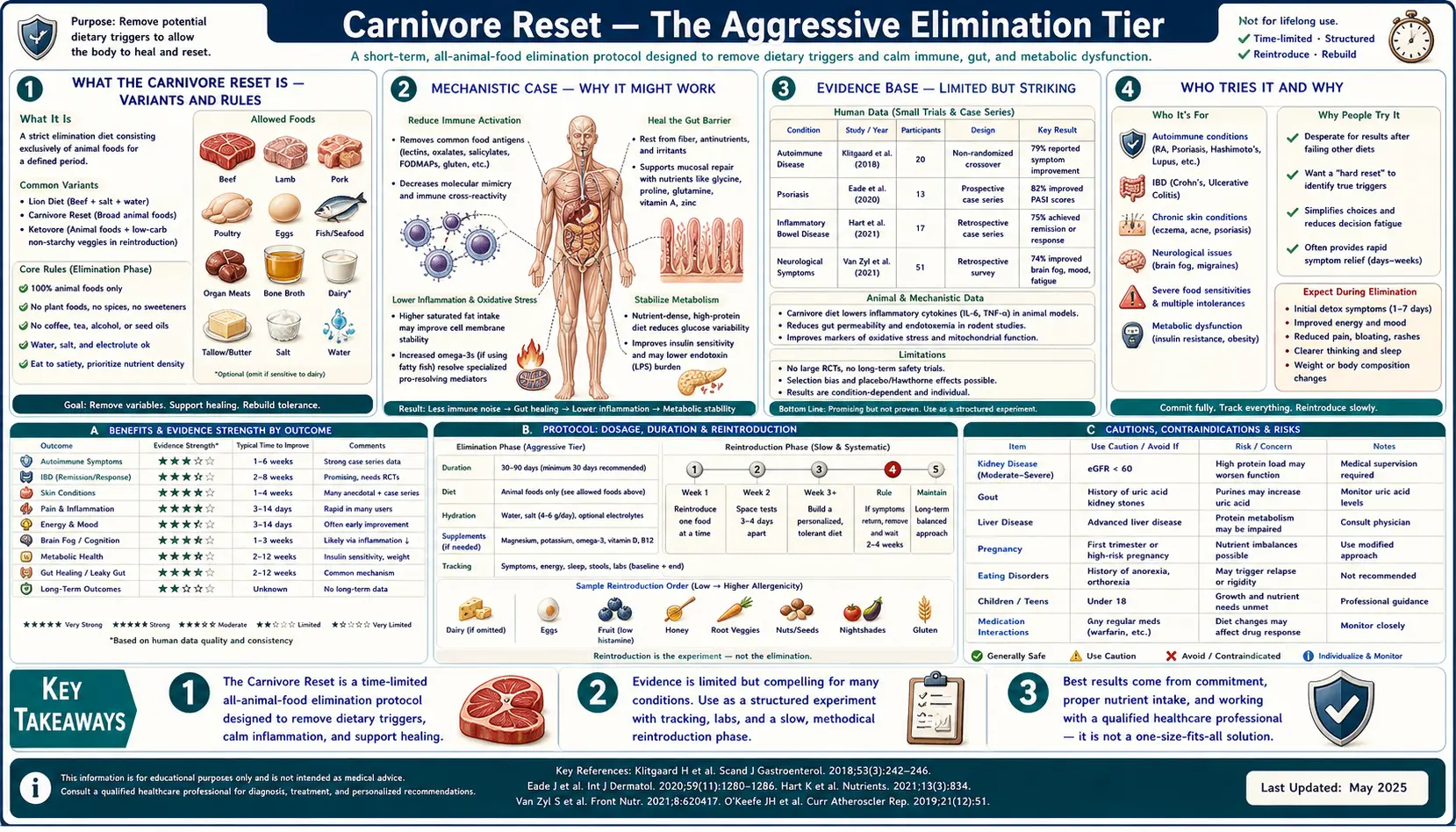
The carnivore diet is the most restrictive elimination approach covered in this deep dive: an almost exclusively animal-based pattern in which plant foods are removed entirely. A 2026 scoping review found no standardized definition; the strictest variant, called the "Lion Diet," is red meat, salt and water (Lietz 2026, PubMed PMID: 41599961). The largest published dataset is a 2021 social-media survey of 2,029 adults following the diet for at least six months (Lennerz 2021, PubMed PMID: 34934897): respondents reported few adverse effects, high satisfaction and improvements in overall health and in gastrointestinal, autoimmune, psychiatric, skin and metabolic conditions — while their reported LDL cholesterol was markedly elevated. The same scoping review found only nine human studies, all small, short and without control groups, and concluded that long-term adherence cannot be recommended on the current evidence. This page reports what those studies found, including the positive self-reports and the open safety questions.
Table of Contents
- What the Carnivore Diet Is — Variants
- Proposed Mechanisms
- The Evidence Base — Limited and Uncontrolled
- Who Tries It and Why
- The Adaptation Phase
- How It Is Eaten — Fat, Salt, Organ Meats and Nutrient Gaps
- Safety and Sustainability Concerns
- Reintroduction After a Carnivore Phase
- Who the Research Raises Concerns For
- Key Research Papers
- Connections
- Featured Videos
What the Carnivore Diet Is — Variants
The 2026 scoping review describes the diet as the consumption of minimally processed animal-source foods — meat (including organ meats), fish, seafood, eggs, animal fats and varying amounts of full-fat dairy — with plant foods eliminated and carbohydrates and highly processed products largely avoided. Red meat typically forms the base. Because there is no standard definition, the studies it reviewed implemented the diet in different ways:
- Lion Diet: red meat, salt and water only — the strictest variant, as described in a video by Mikhaila Peterson that the review cites. In one published case study and one case within a case series, the diet was beef only.
- Broader carnivore patterns: meat plus some combination of fish, seafood, eggs and dairy; popular sources the review cites include a 2019 book, Carnivore Diet, by Shawn Baker. Three of the nine studies it included did not exclude plant foods entirely.
- Organ-meat-inclusive patterns: organ meats were part of the diet in several studies; a 2021 survey of zero-carbohydrate followers described meals of predominantly meat and organ meats. The review notes that liver supplies folate and vitamin C but also a large amount of retinol, which limits how much can be eaten.
Duration varies. In the 2021 survey, respondents had followed the diet for a median of 14 months (range 6 to 337 months); in the inflammatory bowel disease case series described below, the diet was first used as an elimination diet in two participants, who then moved to a ketogenic, meat-centred pattern.
Proposed Mechanisms
The mechanisms put forward for symptom improvement, as the scoping review and the case-series authors describe them, are hypotheses rather than tested explanations:
- Removal of plant compounds: a central argument of proponents is the elimination of so-called antinutrients — lectins, phytic acid, oxalic acid, tannins, enzyme inhibitors, goitrogens and saponins. The review notes that removing them may raise the absorption of some nutrients but also removes fiber, health-promoting phytochemicals and several micronutrients.
- Ketosis: depending on protein intake, the diet can produce a ketogenic state. The review suggests some of the favorable metabolic results may be due to this, and raises the anti-inflammatory actions of beta-hydroxybutyrate as a possible explanation for the IBD reports; it also notes that high protein intake can block ketogenesis, so it is unclear whether participants were in sustained ketosis.
- Low-residue diet effects on the colon: the authors of the IBD case series relate their findings to studies showing an inverse association between intestinal ketone levels and IBD activity, and to the effects of low-residue elimination diets on colonic microbiota metabolism (Norwitz 2024, PubMed PMID: 39296504).
- Nutrient form and bioavailability: animal foods supply retinol, heme iron, essential amino acids and compounds such as creatine, carnitine, taurine and coenzyme Q10 in forms the review describes as generally well absorbed. The same review concludes that the diet still does not meet all reference intakes (see the nutrient-gap section below).
- Expectation: the review also states that the reported improvements may be partly attributable to placebo effects and to the strong beliefs and behavior changes that accompany the diet.
Ketogenic diets have their own evidence base. A 2020 Cochrane review of 13 randomized studies (932 participants) found that ketogenic diets could be effective in children with drug-resistant epilepsy, that the evidence in adults remains uncertain, and that all the evidence was of low to very low certainty (Martin-McGill 2020, PubMed PMID: 32588435). A 4-month single-arm Stanford pilot of a ketogenic diet in 23 people with schizophrenia or bipolar disorder and metabolic abnormalities reported metabolic and psychiatric-scale improvements (Sethi 2024, PubMed PMID: 38547601). Neither study tested a carnivore diet.
The Evidence Base — Limited and Uncontrolled
The 2026 scoping review (literature searched November 2025) found nine human studies published 2021–2025: case studies and case series, two social-media surveys, one exploratory study and one modelling study. It rated the evidence as low (NHMRC levels III–IV), with small samples, short durations and no control groups.
- Lennerz BS et al. 2021 (PMID 34934897): Online survey of 2,029 adults (median age 44, 67% male) who self-identified as following a carnivore diet for at least 6 months. 95% reported improved overall health. Among respondents who reported a given condition, the shares reporting it resolved or improved were: hypertension (n=374) 61% resolved, 32% improved; gastrointestinal conditions (n=531) 59% and 38%; autoimmune conditions (n=369) 36% and 53%; psychiatric conditions (n=479) 48% and 48%; skin conditions (n=690) 44% and 48%; diabetes or insulin resistance (n=402) 74% and 24%. Lipid abnormalities were the exception: 27% resolved, 29% improved, 19% worsened and 8% reported a new occurrence. In the subset reporting lab values, median LDL cholesterol was 172 mg/dL on the diet versus 126 mg/dL before it, while HDL cholesterol and triglycerides were in the optimal range and C-reactive protein fell. The authors state that selection bias limits generalizability, because people who had adverse effects or no benefit were likely to have stopped the diet and would not have been surveyed, and that the survey did not objectively measure diet or health outcomes.
- Inflammatory bowel disease case series (Norwitz and Soto-Mota 2024, PMID 39296504): 10 people with histologically confirmed ulcerative colitis (6) or Crohn's disease (4), recruited through a social-media survey; inclusion required that the disease had responded to a ketogenic or carnivore diet. All reported clinical improvement on the Inflammatory Bowel Disease Questionnaire (72 to 165 points). The scoping review adds that fecal calprotectin fell substantially in individual patients, while LDL and total cholesterol rose.
- Other case reports: the review lists a 47-month case report of a ketogenic all-meat diet in a woman with Candida vulvovaginitis and hidradenitis suppurativa, which the authors described as leading to remission; and a 2025 case report in which a patient's 24-hour urine profile shifted toward higher kidney-stone risk and gout flares recurred on the diet, with no further stones a year after stopping it (Wilson and Moe 2025, PubMed PMID: 39753382, as summarized in the review).
- German exploratory study (Klement and Matzat 2025): as summarized in the review, participants with pre-existing metabolic disorders showed improved HbA1c and triglycerides, while previously metabolically healthy participants saw these rise; median total cholesterol rose from 224 to 305 mg/dL and LDL from 157 to 256 mg/dL.
- Theoretical nutrient analysis (O'Hearn 2020, PubMed PMID: 32833688): a review of whether a plant-free diet can meet essential nutrient needs. It describes the carnivore diet as a newly popular but sparsely studied form of ketogenic diet, and discusses evidence that ketogenic diets can change nutrient needs, sometimes with nutrient-sparing effects. The scoping review describes O'Hearn's proposal that requirements for nutrients such as vitamin C may be altered as a hypothesis that remains speculative.
- Historical observations: a 1930 report by McClellan described "the effect of the prolonged use of exclusive meat diets on two men" (Journal of the American Dietetic Association); the scoping review describes the arctic explorer Vilhjalmur Stefansson's accounts as early case observations suggesting possible benefits as well as risks such as calcium deficiency.
- Indirect evidence from low-carbohydrate trials: randomized and controlled trials of very-low-carbohydrate or ketogenic diets in obesity, metabolic syndrome and type 2 diabetes — not carnivore diets — report greater weight loss and larger triglyceride falls and HDL rises than low-fat diets over 24 weeks (Yancy 2004, PubMed PMID: 15148063), greater short-term fat loss (Volek 2004, PubMed PMID: 15533250), improvement in metabolic syndrome without weight loss (Hyde 2019, PubMed PMID: 31217353), a 0.6% HbA1c reduction at 3 months (Saslow 2014, PubMed PMID: 24717684), and sustained glycemic improvement with less medication at 2 years in a non-randomized trial (Athinarayanan 2019, PubMed PMID: 31231311).
What does not exist, according to the scoping review: controlled trials of the carnivore diet, and systematic data on its short- and long-term health effects. It notes that many chronic diseases develop over decades, beyond the duration of any study so far.
Who Tries It and Why
In the 2021 survey, 93% of respondents named health or body weight as their reason for starting. Among those, the reasons given were body weight or composition (84%), focus and energy (74%), allergies, skin or autoimmunity (60%), digestive health (52%), athletic performance (46%), mental health (45%) and diabetes (12%); 33% also cited food preference and 9% ethics.
The scoping review describes the same pattern across studies: the diet is adopted mainly for perceived health benefits, often in the hope of relieving symptoms or improving performance, with simplicity of meal preparation as a further draw. The IBD case series recruited people whose disease had already responded to the diet; the Stanford psychiatric pilot mentioned above tested a ketogenic diet, not a carnivore diet.
The Adaptation Phase
The scoping review describes the early weeks as follows:
- "Keto flu": reduced carbohydrate intake lowers insulin and glycogen-associated water retention, promoting sodium and fluid loss. If sodium and fluid are not replaced, the resulting depletion can cause symptoms commonly described as "keto flu" — headache, dizziness, fatigue — and may raise the risk of orthostatic hypotension early on. This is why many followers increase their salt intake.
- Weakness and fatigue: possible nutrient shortfalls (such as vitamin C and some B vitamins) and the absence of readily available carbohydrate may contribute, particularly during adaptation.
- Muscle cramps: inadequate magnesium intake may predispose to muscle tension and cramps.
In the 2021 survey, the reported prevalence of adverse symptoms was low: gastrointestinal 3.1–5.5%, muscular 0.3–4.0% and skin 0.1–1.9%. In ketogenic-diet epilepsy trials, the most commonly reported adverse effects were vomiting, constipation and diarrhoea (Martin-McGill 2020).
How It Is Eaten — Fat, Salt, Organ Meats and Nutrient Gaps
What the published data report about how the diet is actually eaten, and what it supplies:
- Meat and fat: in the 2021 survey, 85% ate red meat daily or more often; 61% chose high-fat cuts, 37% moderate-fat and 2% lean; 76% preferred meat raw, rare or medium-rare. Under 10% ate vegetables, fruits or grains more often than monthly. A German study recorded meat intakes of up to 1,500 g a day.
- Salt: 56% of survey respondents intended a medium or high salt intake, which the authors describe as commonly recommended with low-carbohydrate diets because of increased sodium excretion. The scoping review notes that high sodium intake, reported in some carnivore versions, may raise the risk of hypertension and related cardiovascular and kidney disease.
- Organ meats, eggs and dairy: 42% of survey respondents ate organ meat weekly or more often and 72% ate non-milk dairy weekly or more often. In the review, eggs supply vitamin E and folate, and shellfish supply magnesium and vitamin E; excluding dairy or seafood raises the risk of low iodine, calcium, vitamin E and magnesium intake.
- Supplements: 37% of survey respondents used no vitamin supplements; in a zero-carbohydrate survey, supplement use was uncommon (7.56%), with some taking vitamins or minerals, collagen powder or encapsulated organ-meat products.
- Nutrient gaps in modelled meal plans: analyses summarized in the review found intakes below reference values for thiamine, vitamin C (about 1–33 mg a day against a reference of 45 mg), vitamin D, magnesium, iron (women), iodine (women), potassium and calcium; fiber below 1 g a day; and vitamin A well above reference values. Saturated fat substantially exceeded the WHO upper limit of less than 10% of energy.
Safety and Sustainability Concerns
The concerns raised in the published literature:
- LDL cholesterol: LDL and total cholesterol rose in several studies (median LDL 172 vs 126 mg/dL in the 2021 survey; 256 vs 157 mg/dL in the German study). A 2022 analysis of 548 adults on carbohydrate-restricted diets found that lower BMI and a low triglyceride-to-HDL ratio predicted larger LDL increases, and described a "lean mass hyper-responder" phenotype (LDL ≥200 mg/dL, HDL ≥80 mg/dL, triglycerides ≤70 mg/dL; n=100); in its case series, moderate carbohydrate reintroduction markedly lowered LDL (Norwitz 2022, PubMed PMID: 35106434). The survey authors state it is unclear whether the diet's apparent metabolic benefits would counterbalance any risk from the LDL rise; the scoping review states that whether these lipid changes translate into higher cardiovascular risk remains unclear given the limited data, and that high saturated-fat intake may raise long-term coronary heart disease risk.
- Fiber and the gut microbiome: the diet provides far less fiber than the WHO's 25 g a day. One single-person case study found no significant difference in microbiome diversity or function compared with an omnivorous diet. In a related cross-sectional study of long-term strict Paleolithic-diet followers (a diet that excludes grains and dairy, not a carnivore diet), gut microbiota differed and serum TMAO was higher than in controls (Genoni 2020, PubMed PMID: 31273523).
- TMAO: trimethylamine-N-oxide is a gut-derived metabolite associated with cardiovascular disease. In a 4-week randomized trial in 39 women, a Paleolithic diet did not significantly change serum TMAO despite more red meat and eggs (Genoni 2019, PubMed PMID: 30419974); the longer-term study above found higher TMAO in strict followers.
- Vitamin C: meat contains very little vitamin C and modelled intakes fall below reference values, yet the scoping review found no clinical cases of scurvy linked to the diet reported to date. O'Hearn's explanation (altered requirements, possible antiscorbutic properties of meat) is described in the review as speculative.
- Bone and kidney: calcium intake fell below reference values in modelled plans, and early observations raised possible calcium deficiency. In the 2025 kidney-stone case report, the urine profile shifted toward higher stone risk and gout flares recurred. The review also notes that ketogenic diets in general have been associated with slowed growth, kidney stones and fractures. In a 2-year ketogenic-diet trial in type 2 diabetes (not a carnivore diet), spine bone mineral density was unchanged (Athinarayanan 2019).
- Raw and undercooked meat: the review states that raw meat and dairy carry well-established infection risks, particularly Salmonella and Listeria, with people with weakened immune systems and young children particularly vulnerable, and that no evidence supports health benefits of eating animal products raw.
- Red meat in population studies: the review cites studies associating high intake of red and processed meat with cardiovascular disease, certain cancers and shorter life expectancy, and a 2025 systematic review concluding that long-term adverse effects outweigh potential benefits.
- Traditional meat-heavy populations: the review notes that the Inuit diet of raw meat and blubber was associated with generally good health outcomes, attributed largely to its fatty-acid composition and micronutrients, and that the low coronary heart disease rates of the Maasai reflect genetics, high physical activity and caloric restriction as well as diet, alongside documented micronutrient deficiencies, anemia and shorter life expectancy — limiting how far either can be applied to modern populations.
- Social cost: in a survey of zero-carbohydrate followers, participants frequently reported social conflict with family and friends and in dealings with healthcare professionals.
The scoping review concludes that the diet may bring short-term improvements in some individuals, that these are likely driven in part by subjective perception, placebo responses and ketosis-related adaptations, and that long-term safety cannot currently be assessed.
Reintroduction After a Carnivore Phase
No published study has tested a reintroduction method after a carnivore diet. In the IBD case series, two participants used the carnivore diet first as an elimination diet and then moved to a broader ketogenic, meat-centred pattern. The closest trial evidence for an elimination-then-reintroduction structure in IBD comes from a different diet: in an uncontrolled study of the autoimmune protocol diet (6-week elimination, 5-week maintenance) in 15 adults with active IBD, ulcerative colitis and Crohn's disease activity scores improved significantly, C-reactive protein did not change, and the authors called for randomized trials (Konijeti 2017, PubMed PMID: 28858071). In the lean mass hyper-responder case series, moderate carbohydrate reintroduction markedly lowered LDL cholesterol (Norwitz 2022).
The Reintroduction Phase deep dive covers how food challenges are structured in elimination diets generally.
Who the Research Raises Concerns For
- People with high LDL cholesterol or cardiovascular risk: LDL rose markedly in the surveys and case series, and the review states that the effect on cardiovascular risk is unclear and that high saturated-fat intake may raise long-term coronary risk.
- People with kidney stones or gout: the 2025 case report describes a shift toward higher stone risk and recurrent gout flares on the diet.
- People with weakened immune systems, and young children: the review names them as particularly vulnerable to infections from raw or undercooked meat and dairy.
- Pregnancy and breastfeeding: there are no controlled studies; the 2021 survey included 7 pregnant and 10 breastfeeding respondents, and modelled carnivore meal plans fell short of reference intakes for several nutrients, including folate in the review's discussion.
- Children: the review notes that ketogenic diets in general have been associated with slowed growth, kidney stones and fractures; no carnivore-diet study in children was included.
- People eating a narrow version of the diet: the review states that the more food groups are excluded (for example dairy, seafood or organ meats), the greater the risk of nutrient deficiencies.
Decisions about restrictive diets belong with a clinician.
Key Research Papers
- Lennerz BS et al. (2021). Behavioral Characteristics and Self-Reported Health Status among 2029 Adults Consuming a "Carnivore Diet". Current Developments in Nutrition — PubMed PMID: 34934897
- O'Hearn A. (2020). Can a carnivore diet provide all essential nutrients? Current Opinion in Endocrinology, Diabetes, and Obesity — PubMed PMID: 32833688
- Konner M, Eaton SB. (2010). Paleolithic nutrition: twenty-five years later. Nutrition in Clinical Practice — PubMed PMID: 21139123
- O'Keefe SJ et al. (2015). Fat, fibre and cancer risk in African Americans and rural Africans. Nature Communications — PubMed PMID: 25919227
- Yancy WS Jr et al. (2004). A low-carbohydrate, ketogenic diet versus a low-fat diet to treat obesity and hyperlipidemia. Annals of Internal Medicine — PubMed PMID: 15148063
- Volek JS et al. (2004). Comparison of energy-restricted very low-carbohydrate and low-fat diets on weight loss and body composition in overweight men and women. Nutrition & Metabolism — PubMed PMID: 15533250
- Hyde PN et al. (2019). Dietary carbohydrate restriction improves metabolic syndrome independent of weight loss. JCI Insight — PubMed PMID: 31217353
- Saslow LR et al. (2014). A Randomized Pilot Trial of a Moderate Carbohydrate Diet Compared to a Very Low Carbohydrate Diet in Overweight or Obese Individuals with Type 2 Diabetes Mellitus or Prediabetes. PLOS ONE — PubMed PMID: 24717684
- Athinarayanan SJ et al. (2019). Long-Term Effects of a Novel Continuous Remote Care Intervention Including Nutritional Ketosis for the Management of Type 2 Diabetes. Frontiers in Endocrinology — PubMed PMID: 31231311
- Genoni A et al. (2019). A Paleolithic diet lowers resistant starch intake but does not affect serum trimethylamine-N-oxide concentrations in healthy women. British Journal of Nutrition — PubMed PMID: 30419974
- Norwitz NG et al. (2022). Elevated LDL-Cholesterol with a Carbohydrate-Restricted Diet: Evidence for a "Lean Mass Hyper-Responder" Phenotype. Current Developments in Nutrition — PubMed PMID: 35106434
- Konijeti GG et al. (2017). Efficacy of the Autoimmune Protocol Diet for Inflammatory Bowel Disease. Inflammatory Bowel Diseases — PubMed PMID: 28858071
- Lietz A, Dapprich J, Fischer T. (2026). Carnivore Diet: A Scoping Review of the Current Evidence, Potential Benefits and Risks. Nutrients — PubMed PMID: 41599961
- Norwitz NG, Soto-Mota A. (2024). Case report: Carnivore-ketogenic diet for the treatment of inflammatory bowel disease: a case series of 10 patients. Frontiers in Nutrition — PubMed PMID: 39296504
- Wilson HE, Moe SM. (2025). You are what you eat—should it be all meat?: Impact of the carnivore diet on the risk of kidney stone development. American Journal of Clinical Nutrition — PubMed PMID: 39753382
- Martin-McGill KJ, Bresnahan R, Levy RG, Cooper PN. (2020). Ketogenic diets for drug-resistant epilepsy. Cochrane Database of Systematic Reviews — PubMed PMID: 32588435
- Sethi S et al. (2024). Ketogenic Diet Intervention on Metabolic and Psychiatric Health in Bipolar and Schizophrenia: A Pilot Trial. Psychiatry Research — PubMed PMID: 38547601
- Genoni A et al. (2020). Long-term Paleolithic diet is associated with lower resistant starch intake, different gut microbiota composition and increased serum TMAO concentrations. European Journal of Nutrition — PubMed PMID: 31273523
- McClellan WS. (1930). The Effect of the Prolonged Use of Exclusive Meat Diets on Two Men. Journal of the American Dietetic Association 6(3):216–228 — doi:10.1016/s0002-8223(21)35795-9