Elimination Diet — Benefits Deep Dive
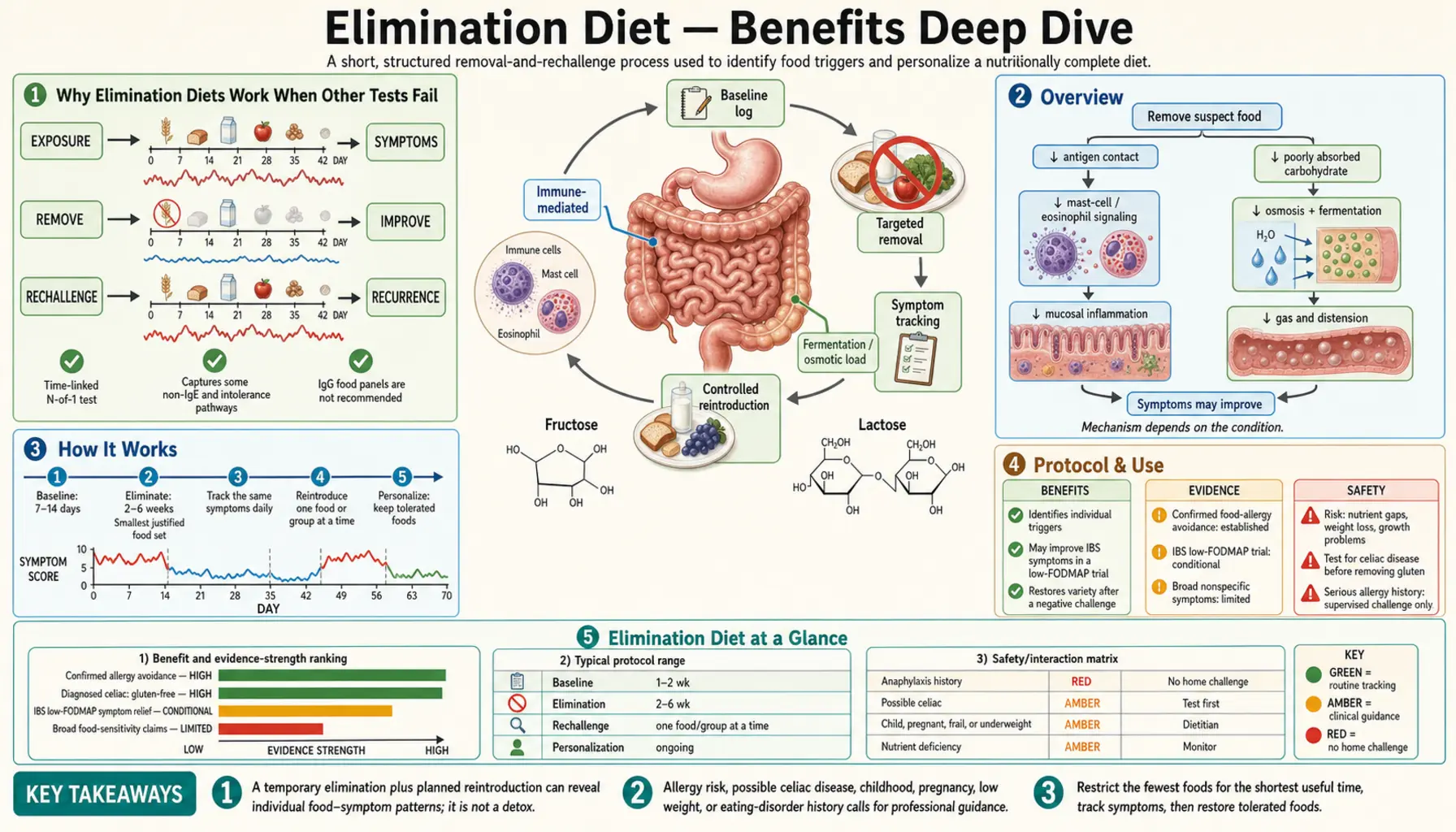
An elimination diet removes selected foods for a set period and then brings them back one at a time, to see whether symptoms improve without a food and return with it. The research is strongest in two conditions: the low-FODMAP diet in irritable bowel syndrome, which a 2022 network meta-analysis of 13 randomized trials ranked first against habitual diet for global symptoms (Black 2022, PubMed PMID: 34376515), and empiric food-group elimination in eosinophilic esophagitis, where reintroduced foods are judged by biopsy (Lucendo 2013, PubMed PMID: 23375693). Allergy bodies state that IgG antibodies to foods indicate exposure and tolerance rather than allergy or intolerance (Stapel 2008, PubMed PMID: 18489614; Carr 2012, PubMed PMID: 22835332). The four deep-dive pages below cover the Whole30 program, which has no indexed studies; the low-FODMAP diet; the carnivore diet, whose evidence is limited to small uncontrolled studies and surveys; and the reintroduction phase, in which the diagnostic information is gathered.
Deep-Dive Articles
Whole30
A commercial 30-day program, offered since 2009. Its current rules remove added sugar (real or artificial), alcohol, grains, legumes (including soy and peanuts), dairy, and baked goods, pasta, cereal, chips and fries, followed by a reintroduction period of 10 or more days in which the groups are added back one at a time. A PubMed search for "Whole30" returned no indexed studies (October 2026); the page reports the published rules and the research on related Paleolithic-type and autoimmune protocol diets.
Read the deep dive →Low FODMAP
A three-stage diet for irritable bowel syndrome: restriction of fermentable oligosaccharides, disaccharides, monosaccharides and polyols (FODMAPs), reintroduction to find personal triggers, and personalisation. A 2022 network meta-analysis of 13 randomized trials (944 patients) ranked it first against habitual diet for global symptoms; most of the trials did not study the reintroduction and personalisation stages.
Read the deep dive →Carnivore Reset
An almost exclusively animal-based diet with plant foods removed. A 2026 scoping review found no standardized definition and only nine human studies, with small samples, short durations and no control groups, and concluded that long-term adherence cannot be recommended on the current evidence. In the largest dataset, a 2021 social-media survey of 2,029 adults, respondents reported few adverse effects and improved health, while reported LDL cholesterol was markedly elevated.
Read the deep dive →Reintroduction Phase
The stage in which removed foods are brought back one at a time. A Monash University review calls the re-challenge phase crucial for identifying specific dietary triggers and reducing restriction, while noting that limited evidence is available to guide best practice. The page reports how studies structure challenges in irritable bowel syndrome, eosinophilic esophagitis, suspected food allergy and suspected gluten sensitivity, how a positive challenge is defined, and what blinded trials found about expectation (nocebo) effects.
Read the deep dive →Table of Contents
- Deep-Dive Articles
- How Elimination Diets Compare With Food Tests
- Research Papers: Whole30 & Paleo-Style Eliminations
- Research Papers: Low FODMAP for IBS
- Research Papers: Carnivore & Aggressive Eliminations
- Research Papers: Reintroduction Methodology
- Research Papers: Cross-Cutting (IgG Testing, Food Allergy, Eosinophilic Esophagitis)
- External Resources
- Connections
- Featured Videos
How Elimination Diets Compare With Food Tests
Food tests and elimination diets answer different questions. For suspected food allergy, a 2018 review states that diagnosis relies largely on the medical history, tests for sensitization and oral food challenges (Sicherer 2018, PubMed PMID: 29157945). Oral food challenges are described as procedures conducted by allergists/immunologists; a negative challenge allows the food into the diet, and a positive one provides a sound basis for continued avoidance (Nowak-Wegrzyn 2009, PubMed PMID: 19500710). The US expert-panel guidelines cover both IgE-mediated and non-IgE-mediated reactions, and state that patients frequently confuse nonallergic food reactions, such as food intolerance, with food allergies (Boyce 2010, PubMed PMID: 21134576).
Sensitization tests and challenge results do not always agree. In adult eosinophilic esophagitis, prior skin prick and serum IgE tests showed no concordance with the results of food reintroduction (Lucendo 2013). In 941 children with eosinophilic esophagitis, combined skin prick and atopy patch tests had an average negative predictive value of 92% (44% for milk) and an average positive predictive value of 44% (Spergel 2012, PubMed PMID: 22743304).
IgG food panels are a separate matter. A European Academy of Allergy and Clinical Immunology task force states that food-specific IgG4 indicates repeated exposure and immunological tolerance, not imminent food allergy or intolerance, and considers the test irrelevant to the laboratory work-up of food allergy or intolerance (Stapel 2008). The Canadian Society of Allergy and Clinical Immunology strongly discourages food-specific IgG testing for identifying or predicting adverse reactions to food (Carr 2012), and the American Academy of Allergy, Asthma & Immunology states that the test has never been scientifically proven to do what it reports. A 2018 review reports that blinded, controlled studies of several unconventional food tests have shown a lack of reproducibility and of correlation with disease (Kelso 2018, PubMed PMID: 29524991).
The diets studied are built in phases:
- Elimination — the length varies by study: 21 days of a low-FODMAP diet in an Australian crossover trial (Halmos 2014, PubMed PMID: 24076059), and 6 weeks of a six-food diet in adult eosinophilic esophagitis (Lucendo 2013) or of a two-food-group diet in the step-up 2-4-6 study (Molina-Infante 2018, PubMed PMID: 29074457).
- Reintroduction — foods are added back one at a time: in eosinophilic esophagitis, with endoscopy and biopsies every 6 weeks, a food counting as a trigger if 15 or more eosinophils per high-power field reappear (Lucendo 2013); in the low-FODMAP diet, with a challenge process tailored to the individual (Tuck 2017, PubMed PMID: 28244664).
- Personalisation — for the low-FODMAP diet, a less restrictive diet that excludes only the person's own triggers and allows a more diverse intake (Whelan 2018, PubMed PMID: 29336079).
The studies also describe limits. In 10 double-blind, placebo-controlled gluten-challenge trials, only 16% of patients with suspected gluten sensitivity showed gluten-specific symptoms, and 40% of these also reacted to placebo (Molina-Infante 2017, PubMed PMID: 27523634). In a New Zealand IBS trial, fiber intake fell from 33 to 21 g a day during FODMAP restriction and rose to 27 g a day after reintroduction (Harvie 2017, PubMed PMID: 28740352). A 2022 review states that the nutritional and psychological risks of the FODMAP diet must be mitigated (Sultan 2022, PubMed PMID: 35799231), and the Monash review states that patients are encouraged not to remain on a strict low-FODMAP diet long-term (Tuck 2017).
Research Papers: Whole30 & Paleo-Style Eliminations
- Whole30 program: no indexed studies. A PubMed search for "Whole30" returned no records (October 2026); the program is described on the Whole30 page from its published rules — PubMed search: Whole30
- Konijeti GG et al. Efficacy of the Autoimmune Protocol Diet for Inflammatory Bowel Disease. — PubMed PMID: 28858071
- Chandrasekaran A et al. (2019). The Autoimmune Protocol Diet Modifies Intestinal RNA Expression in Inflammatory Bowel Disease. Crohn's & Colitis 360 1(3):otz016 — PubMed PMID: 32309803
- Manheimer EW et al. (2015). Paleolithic nutrition for metabolic syndrome: systematic review and meta-analysis. American Journal of Clinical Nutrition 102(4):922–932 — PubMed PMID: 26269362
- Frassetto LA et al. Metabolic and physiologic improvements from consuming a paleolithic, hunter-gatherer type diet. — PubMed PMID: 19209185
- Lindeberg S et al. A Palaeolithic diet improves glucose tolerance more than a Mediterranean-like diet in individuals with ischaemic heart disease. — PubMed PMID: 17583796
- Jonsson T et al. A Paleolithic diet is more satiating per calorie than a Mediterranean-like diet in individuals with ischemic heart disease. — PubMed PMID: 21118562
- Otten J et al. (2018). A heterogeneous response of liver and skeletal muscle fat to the combination of a Paleolithic diet and exercise in obese individuals with type 2 diabetes: a randomised controlled trial. Diabetologia 61(7):1548–1559 — PubMed PMID: 29696296
- Boers I et al. Favourable effects of consuming a Palaeolithic-type diet on characteristics of the metabolic syndrome. — PubMed PMID: 25304296
- Mellberg C et al. Long-term effects of a Palaeolithic-type diet in obese postmenopausal women. — PubMed PMID: 24473459
Research Papers: Low FODMAP for IBS
- Halmos EP et al. A diet low in FODMAPs reduces symptoms of irritable bowel syndrome. — PubMed PMID: 24076059
- Staudacher HM et al. (2014). Mechanisms and efficacy of dietary FODMAP restriction in IBS. Nature Reviews Gastroenterology & Hepatology — PubMed PMID: 24445613
- Eswaran SL et al. A Randomized Controlled Trial Comparing the Low FODMAP Diet vs Modified NICE Guidelines in US Adults With IBS-D. — PubMed PMID: 27725652
- Böhn L et al. (2015). Diet low in FODMAPs reduces symptoms of irritable bowel syndrome as well as traditional dietary advice: a randomized controlled trial. Gastroenterology 149(6):1399–1407 — PubMed PMID: 26255043
- Marsh A et al. Does a diet low in FODMAPs reduce symptoms associated with functional gastrointestinal disorders? A meta-analysis. — PubMed PMID: 25982757
- Schumann D et al. (2018). Low fermentable, oligo-, di-, mono-saccharides and polyol diet in the treatment of irritable bowel syndrome: a systematic review and meta-analysis. Nutrition — PubMed PMID: 29129233
- Staudacher HM et al. A diet low in FODMAPs reduces symptoms in patients with irritable bowel syndrome and a probiotic restores Bifidobacterium species. — PubMed PMID: 28625832
- Hill P, Muir JG, Gibson PR. (2017). Controversies and Recent Developments of the Low-FODMAP Diet. Gastroenterology & Hepatology 13(1):36–45 — PubMed PMID: 28420945
- Tuck CJ et al. (2014). Fermentable oligosaccharides, disaccharides, monosaccharides and polyols: role in irritable bowel syndrome. Expert Review of Gastroenterology & Hepatology — PubMed PMID: 24830318
- Black CJ et al. Efficacy of a low FODMAP diet in irritable bowel syndrome: systematic review and network meta-analysis. — PubMed PMID: 34376515
Research Papers: Carnivore & Aggressive Eliminations
- Lennerz BS et al. Behavioral Characteristics and Self-Reported Health Status among 2029 Adults Consuming a "Carnivore Diet". — PubMed PMID: 34934897
- O'Hearn A. (2020). Can a carnivore diet provide all essential nutrients? Current Opinion in Endocrinology, Diabetes and Obesity 27(5):312–316 — PubMed PMID: 32833688
- Konner M, Eaton SB. (2010). Paleolithic nutrition: twenty-five years later. Nutrition in Clinical Practice 25(6):594–602 — PubMed PMID: 21139123
- O'Keefe SJ et al. Fat, fibre and cancer risk in African Americans and rural Africans. — PubMed PMID: 25919227
- McClellan WS, Du Bois EF. (1930). Clinical calorimetry: prolonged meat diets with a study of kidney function and ketosis. Journal of Biological Chemistry 87:651–668 (Crossref records the title as "Clinical calorimetry"; the subtitle was not checked against the original) — doi:10.1016/s0021-9258(18)76842-7
- Yancy WS Jr et al. (2004). A low-carbohydrate, ketogenic diet versus a low-fat diet to treat obesity and hyperlipidemia: a randomized, controlled trial. Annals of Internal Medicine 140(10):769–777 — PubMed PMID: 15148063
- Volek JS et al. Comparison of energy-restricted very low-carbohydrate and low-fat diets on weight loss and body composition in overweight men and women. — PubMed PMID: 15533250
- Hyde PN et al. (2019). Dietary carbohydrate restriction improves metabolic syndrome independent of weight loss. JCI Insight 4(12) — PubMed PMID: 31217353
- Saslow LR et al. (2014). A randomized pilot trial of a moderate carbohydrate diet compared to a very low carbohydrate diet in overweight or obese individuals with type 2 diabetes mellitus or prediabetes. PLoS One 9(4):e91027 — PubMed PMID: 24717684
- Athinarayanan SJ et al. Long-Term Effects of a Novel Continuous Remote Care Intervention Including Nutritional Ketosis for the Management of Type 2 Diabetes. — PubMed PMID: 31231311
Research Papers: Reintroduction Methodology
- Tuck CJ et al. Re-challenging FODMAPs: the low FODMAP diet phase two. — PubMed PMID: 28244664
- Whelan K et al. The low FODMAP diet in the management of irritable bowel syndrome: an evidence-based review of FODMAP restriction, reintroduction and personalisation in clinical practice. — PubMed PMID: 29336079
- Niec AM, Frankum B, Talley NJ. (1998). Are adverse food reactions linked to irritable bowel syndrome? American Journal of Gastroenterology — PubMed PMID: 9820394
- Nowak-Wegrzyn A et al. Work Group report: oral food challenge testing. — PubMed PMID: 19500710
- Sampson HA et al. (2012). Standardizing double-blind, placebo-controlled oral food challenges: American Academy of Allergy, Asthma & Immunology — European Academy of Allergy and Clinical Immunology PRACTALL consensus report. Journal of Allergy and Clinical Immunology 130(6):1260–1274 — PubMed PMID: 23195525
- Bischoff S, Crowe SE. (2005). Gastrointestinal food allergy: new insights into pathophysiology and clinical perspectives. Gastroenterology — PubMed PMID: 15825090
- Skypala IJ et al. (2015). The development of a standardised diet history tool to support the diagnosis of food allergy. Clinical and Translational Allergy 5:7 — PubMed PMID: 25741437
- Kelso JM. (2018). Unproven Diagnostic Tests for Adverse Reactions to Foods. Journal of Allergy and Clinical Immunology: In Practice 6(2):362–365 — PubMed PMID: 29524991
- Carr S et al. (2012). CSACI Position statement on the testing of food-specific IgG. Allergy, Asthma & Clinical Immunology 8(1):12 — PubMed PMID: 22835332
- Stapel SO et al. (2008). Testing for IgG4 against foods is not recommended as a diagnostic tool: EAACI Task Force Report. Allergy 63(7):793–796 — PubMed PMID: 18489614
- Harvie RM et al. (2017). Long-term irritable bowel syndrome symptom control with reintroduction of selected FODMAPs. World Journal of Gastroenterology 23(25):4632–4643 — PubMed PMID: 28740352
- Sultan N et al. (2022). How to Implement the 3-Phase FODMAP Diet Into Gastroenterological Practice. Journal of Neurogastroenterology and Motility 28(3):343–356 — PubMed PMID: 35799231
- Molina-Infante J, Carroccio A. (2017). Suspected Nonceliac Gluten Sensitivity Confirmed in Few Patients After Gluten Challenge in Double-Blind, Placebo-Controlled Trials. Clinical Gastroenterology and Hepatology 15(3):339–348 — PubMed PMID: 27523634
Research Papers: Cross-Cutting (IgG Testing, Food Allergy, Eosinophilic Esophagitis)
- Lucendo AJ et al. Empiric 6-food elimination diet induced and maintained prolonged remission in patients with adult eosinophilic esophagitis. — PubMed PMID: 23375693
- Kagalwalla AF et al. Effect of six-food elimination diet on clinical and histologic outcomes in eosinophilic esophagitis. — PubMed PMID: 16860614
- Molina-Infante J et al. Step-up empiric elimination diet for pediatric and adult eosinophilic esophagitis: The 2-4-6 study. — PubMed PMID: 29074457
- Atkins D, Furuta GT. (2010). Mucosal immunology, eosinophilic esophagitis, and other intestinal inflammatory diseases. Journal of Allergy and Clinical Immunology — PubMed PMID: 20176262
- Bredenoord AJ et al. Eosinophilic esophagitis: clinical presentation, diagnosis, and treatment. (No record with this title was found in PubMed or Crossref, October 2026; the citation could not be verified.) — PubMed search: Bredenoord, eosinophilic esophagitis
- Sicherer SH, Sampson HA. (2018). Food allergy: A review and update on epidemiology, pathogenesis, diagnosis, prevention, and management. Journal of Allergy and Clinical Immunology 141(1):41–58 — PubMed PMID: 29157945
- Boyce JA et al. (2010). Guidelines for the diagnosis and management of food allergy in the United States: report of the NIAID-sponsored expert panel. Journal of Allergy and Clinical Immunology 126(6 Suppl):S1–S58 — PubMed PMID: 21134576
- Catassi C et al. Diagnosis of Non-Celiac Gluten Sensitivity (NCGS): The Salerno Experts' Criteria. — PubMed PMID: 26096570
- Biesiekierski JR et al. No effects of gluten in patients with self-reported non-celiac gluten sensitivity after dietary reduction of fermentable, poorly absorbed, short-chain carbohydrates. — PubMed PMID: 23648697
- Skypala IJ. (2019). Food-Induced Anaphylaxis: Role of Hidden Allergens and Cofactors. Frontiers in Immunology — PubMed PMID: 31001275
External Resources
- Monash University FODMAP Program — the university group whose researchers authored several of the FODMAP studies listed above; its review authors disclose that the department financially benefits from sales of a FODMAP app, booklets and courses (Sultan 2022)
- American College of Gastroenterology — IBS Patient Resources
- AAAAI — The Myth of IgG Food Panel Testing
- Whole30 program rules — the commercial program's own site, the source of the rules reported on the Whole30 page (accessed October 2026); the program has no indexed studies in PubMed
- PubMed — All research on elimination diet