N-acetyl-cysteine — Benefits Deep Dive
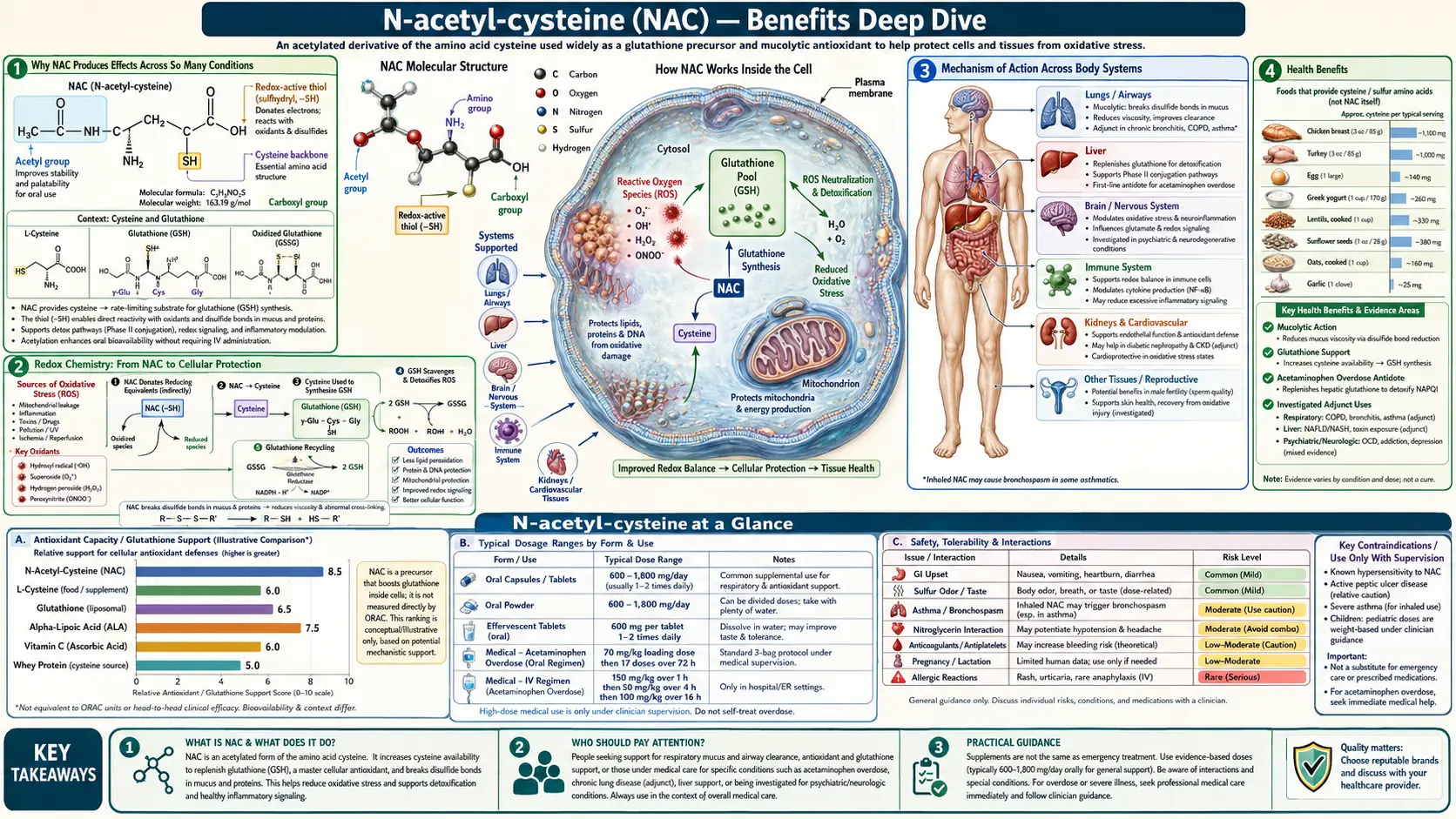
N-acetylcysteine (NAC) produces clinically meaningful effects across a remarkably wide range of conditions because four distinct biochemical mechanisms operate at once: glutathione precursor activity (delivering cysteine through the rate-limiting step of reduced glutathione (GSH) synthesis), direct thiol antioxidant action (scavenging hydroxyl radicals and hypochlorous acid), disulfide-bond cleavage (breaking mucus glycoproteins, plasma protein-homocysteine disulfides, and cystine crystals), and glutamate homeostasis via the cystine-glutamate antiporter in the brain. Each benefit page below explores one specific therapeutic application in clinical-trial depth.
Deep-Dive Articles
Acetaminophen (Paracetamol) Antidote
The original and most rigorously validated N-acetylcysteine indication. NAPQI generation by cytochrome P450 2E1 (CYP2E1), glutathione depletion as the proximate cause of hepatocyte death, and how N-acetylcysteine restores intrahepatic cysteine within hours. The Prescott intravenous (IV) protocol (150 mg/kg over 1 hour → 50 mg/kg over 4 hours → 100 mg/kg over 16 hours), the Smilkstein 72-hour oral protocol (140 mg/kg loading + 70 mg/kg q4h × 17 doses), the Rumack-Matthew nomogram, and why N-acetylcysteine delivers essentially 100% transplant-free survival when given inside the 8-hour window.
Read the deep dive →Chronic Obstructive Pulmonary Disease & Lung Health
The PANTHEON trial (Zheng 2014, 600 mg twice daily for one year, 22% reduction in exacerbations in moderate-to-severe chronic obstructive pulmonary disease (COPD)), the BRONCUS trial, the Cochrane mucolytic meta-analysis, and the IFIGENIA-vs-PANTHER-IPF reversal in idiopathic pulmonary fibrosis. Disulfide-bond cleavage as the mucolytic mechanism, bronchial-epithelial glutathione restoration, the nebulized-NAC bronchospasm caution in asthmatics, and where chronic bronchitis, cystic fibrosis, and bronchiectasis fit.
Read the deep dive →Mental Health: Obsessive-Compulsive Disorder, Trichotillomania & Beyond
The psychiatric N-acetylcysteine story. Grant 2009 launched the field with a placebo-controlled trichotillomania trial (1,200–2,400 mg/day). Afshar 2012 obsessive-compulsive disorder (OCD) augmentation (600 mg TID), Berk 2008 and 2014 bipolar depression trials (2 g/day as an adjunct), schizophrenia negative-symptom data, autism irritability (Hardan 2012), excoriation, nail biting, and addiction. The glutamate-homeostasis hypothesis through the cystine-glutamate antiporter (system xc−) and mGluR2/3 signaling in prefrontal cortex.
Read the deep dive →Glutathione Precursor — the Master Mechanism
Why oral free cysteine fails (gut degradation and rapid blood oxidation back to cystine) and how the acetyl group on N-acetylcysteine protects the thiol all the way to hepatocyte uptake. Glutamate-cysteine ligase (GCL) as the rate-limiting enzyme in glutathione synthesis. The 1-to-4-week kinetics of intracellular reduced glutathione restoration. Pairing N-acetylcysteine with glycine for the full GlyNAC effect (Sekhar). Why intact N-acetylcysteine bioavailability is only 4–10% — and why that does not matter for the clinical effect.
Read the deep dive →Interactive Visualization Free Radicals & Your Antioxidant Network Follow one superoxide radical down the whole relay — superoxide dismutase (SOD), catalase, glutathione, vitamin E, vitamin C, reduced nicotinamide adenine dinucleotide phosphate (NADPH) — then release free iron and watch a membrane tear itself apart. Launch →
Table of Contents
- Deep-Dive Articles
- Why N-Acetylcysteine Produces Effects Across So Many Conditions
- Research Papers: Acetaminophen Antidote
- Research Papers: Chronic Obstructive Pulmonary Disease & Lung Health
- Research Papers: Mental Health & Obsessive-Compulsive Disorder
- Research Papers: Glutathione Precursor
- Research Papers: Cross-Cutting (Forms, Safety, Mechanism)
- External Authoritative Resources
- Connections
- Featured Videos
Why N-Acetylcysteine Produces Effects Across So Many Conditions
Most small molecules used clinically have one or two primary mechanisms of action that produce a narrow range of effects. N-acetylcysteine is unusual because four distinct mechanisms operate simultaneously, and each mechanism maps to a different category of clinical benefit:
- Glutathione precursor / cysteine delivery — deacetylation releases L-cysteine, the rate-limiting substrate for glutamate-cysteine ligase (GCL), the rate-limiting enzyme of glutathione synthesis. This mechanism drives the acetaminophen-antidote effect, the broad antioxidant and detoxification effects, and the longevity-medicine GlyNAC story.
- Direct thiol-radical scavenger — the free -SH group reduces hydroxyl radicals, hypochlorous acid, and peroxynitrite independently of the glutathione system. This contributes to the kidney-protective, liver-protective, and cardiovascular effects covered on the Kidney Health and Cardiovascular Health pages.
- Disulfide-bond cleavage — the reduced thiol breaks S–S bonds in mucus glycoproteins (the mucolytic effect in chronic obstructive pulmonary disease and cystic fibrosis), plasma protein-homocysteine disulfides (homocysteine lowering), and cystine crystal precursors (cystinuria prevention).
- Glutamate homeostasis through system xc− — in the brain, cystine exchanges for glutamate via the cystine-glutamate antiporter, which normalizes extrasynaptic glutamate tone, signals through mGluR2/3 receptors, and underpins the psychiatric benefits in obsessive-compulsive disorder, trichotillomania, bipolar depression, and schizophrenia.
Two secondary mechanisms reinforce all four primary mechanisms. N-acetylcysteine restores S-nitrosothiol pools, donating NO to organic-nitrate molecules and reversing nitrate tolerance — the original cardiovascular use (Packer 1987, Horowitz 1988). And glutathione restoration tightly couples to suppression of NF-κB transcription, so cytokine output falls automatically as cellular redox state improves — explaining the anti-inflammatory thread that runs through every N-acetylcysteine indication.
Research Papers: Acetaminophen Antidote
- Prescott LF et al. (1979). Intravenous N-acetylcysteine: the treatment of choice for paracetamol poisoning — the original IV protocol — PubMed: Prescott 1979 IV protocol
- Smilkstein MJ et al. (1988). Efficacy of oral N-acetylcysteine in the treatment of acetaminophen overdose — the 72-hour oral protocol — PubMed: Smilkstein 72-hour oral
- Rumack-Matthew nomogram (Rumack & Matthew 1975) — PubMed: Rumack-Matthew nomogram
- NAPQI hepatotoxicity mechanism (Mitchell-Jollow series) — PubMed: NAPQI CYP2E1 glutathione
- Lee 2009 NAC in non-acetaminophen acute liver failure (Gastroenterology) — PubMed: Lee 2009 ALF
- NAC vs methionine for paracetamol overdose — PubMed: NAC vs methionine
- Kerr 2005 chronic alcohol risk-stratification for paracetamol — PubMed: paracetamol-alcohol risk
- Hodgman & Garrard 2012 review of paracetamol toxicity — PubMed: Hodgman 2012 review
- Anaphylactoid reactions to IV NAC — PubMed: IV NAC anaphylactoid
- SNAP shortened 12-hour NAC regimen — PubMed: SNAP 12-hour regimen
Research Papers: Chronic Obstructive Pulmonary Disease & Lung Health
- PANTHEON trial (Zheng 2014, Lancet Respiratory Medicine) — PubMed: PANTHEON 2014
- BRONCUS trial (Decramer 2005) — PubMed: BRONCUS 2005
- Cochrane mucolytics meta-analysis (Poole 2019) — PubMed: Cochrane mucolytic meta-analysis
- HIACE trial (Tse 2013) high-dose NAC stable COPD — PubMed: HIACE high-dose NAC
- IFIGENIA trial in IPF (Demedts 2005, NEJM) — PubMed: IFIGENIA 2005
- PANTHER-IPF (Raghu 2014) — the reversal — PubMed: PANTHER-IPF 2014
- Disulfide-bond cleavage mucolytic mechanism — PubMed: NAC mucin disulfide
- Bronchial-epithelial glutathione (Cantin 1989) — PubMed: Cantin GSH lung lining
- De Flora 1997 influenza prophylaxis trial — PubMed: De Flora 1997 influenza
- Nebulized NAC bronchospasm in asthma — PubMed: nebulized NAC bronchospasm
Research Papers: Mental Health & Obsessive-Compulsive Disorder
- Grant 2009 trichotillomania trial — the field-defining study — PubMed: Grant 2009 trichotillomania
- Afshar 2012 OCD augmentation — PubMed: Afshar 2012 OCD
- Berk 2008 bipolar depression (Biological Psychiatry) — PubMed: Berk 2008 bipolar
- Berk 2014 bipolar depression replication — PubMed: Berk 2014 bipolar
- Berk 2008 schizophrenia adjunct trial — PubMed: Berk 2008 schizophrenia
- Hardan 2012 Stanford autism irritability trial — PubMed: Hardan 2012 autism
- Gray 2012 adolescent cannabis cessation — PubMed: Gray 2012 cannabis
- LaRowe cocaine craving trials — PubMed: LaRowe cocaine
- Cystine-glutamate antiporter (system xc−) in addiction — PubMed: system xc- addiction
- Back 2016 PTSD-substance-use trial — PubMed: Back 2016 PTSD
- Deepmala 2015 NAC psychiatric review — PubMed: Deepmala 2015 review
Research Papers: Glutathione Precursor
- Sekhar GlyNAC trial in older adults (2021, Clinical and Translational Medicine) — PubMed: Sekhar GlyNAC aging
- Sekhar GlyNAC and HIV (2014) — PubMed: Sekhar HIV GlyNAC
- Glutamate-cysteine ligase (GCL) rate-limiting kinetics — PubMed: GCL rate-limiting
- Cysteine bioavailability and gut/blood degradation — PubMed: cysteine bioavailability problem
- NAC pharmacokinetics 4-10% bioavailability — PubMed: NAC pharmacokinetics
- Herzenberg HIV glutathione 1997 — PubMed: Herzenberg HIV 1997
- Oral NAC raises whole-blood glutathione — PubMed: oral NAC raises GSH
- Liposomal vs oral glutathione comparison — PubMed: liposomal vs oral GSH
- Whey protein cysteine bioavailability — PubMed: whey protein cysteine
- Selenium and glutathione peroxidase activity — PubMed: Se GPX cofactor
Research Papers: Cross-Cutting (Forms, Safety, Mechanism)
- NAC effervescent tablet vs capsule tolerance — PubMed: NAC effervescent vs capsule
- N-Acetylcysteine ethyl ester (NACET) and NACA — the next-generation cell-penetrating analogs — PubMed: NACET NACA
- NAC and nitric oxide donation / S-nitrosothiol formation — PubMed: NAC S-nitrosothiol
- NF-κB suppression by glutathione restoration — PubMed: NAC NF-kB
- FDA NAC dietary-supplement enforcement discretion 2022 — PubMed: FDA NAC supplement status
- NAC drug interactions (nitroglycerin, carbamazepine, activated charcoal) — PubMed: NAC drug interactions
- NAC + nitroglycerin hypotension (Horowitz 1988) — PubMed: Horowitz 1988 NAC-NTG
- NAC safety profile across chronic high-dose use — PubMed: NAC long-term safety
- NAC and pregnancy safety (Category B) — PubMed: NAC pregnancy safety
- Cystinuria stone prevention with NAC (thiol-disulfide exchange) — PubMed: NAC cystinuria
External Authoritative Resources
- PubMed — All research on N-acetylcysteine (over 25,000 papers as of 2026)
- LiverTox (U.S. National Institutes of Health, NIH) — Acetylcysteine
- U.S. National Center for Complementary and Integrative Health (NCCIH) — Herbs and Supplements at a Glance
- LiverTox (U.S. National Institutes of Health) — Acetaminophen — primary source for the acetaminophen-NAC dosing guidance
- American Liver Foundation — patient resources on acetaminophen safety
Connections
- Free Radicals & Your Antioxidant Network — interactive animation
- N-Acetylcysteine (Main Page)
- N-Acetylcysteine as Acetaminophen Antidote
- N-Acetylcysteine for Chronic Obstructive Pulmonary Disease & Lung Health
- N-Acetylcysteine for Mental Health & Obsessive-Compulsive Disorder
- N-Acetylcysteine as Glutathione Precursor
- N-Acetylcysteine & Glutathione (Overview)
- N-Acetylcysteine & Liver Health
- N-Acetylcysteine & Kidney Health
- N-Acetylcysteine & Respiratory Health
- N-Acetylcysteine & Mental Health (Overview)
- N-Acetylcysteine & Cardiovascular Health
- N-Acetylcysteine, Fertility & Polycystic Ovary Syndrome
- All Antioxidants
- Glutathione
- Alpha Lipoic Acid
- Coenzyme Q10
- Cysteine
- Glycine
- Liver Cleansing
- Detox Protocols
- Oxidative Stress
- Chronic Obstructive Pulmonary Disease
- Obsessive-Compulsive Disorder
- Bipolar Disorder
- Liver Disease
- History