Ronald Ross: The Mosquito, the Malaria Parasite, and Mosquito Day
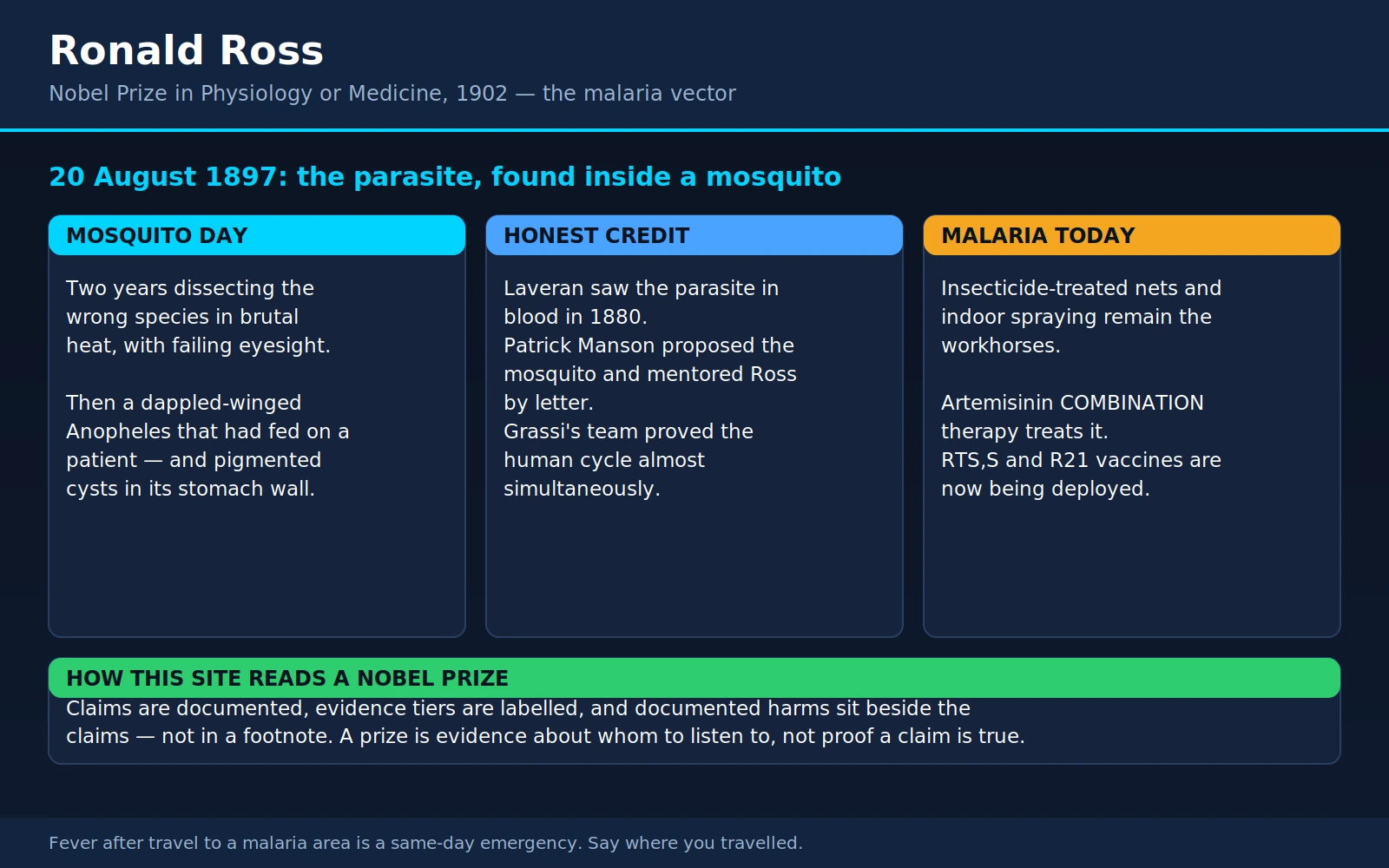
Table of Contents
- Who He Was
- What Malaria Was — and Is
- The State of the Question in 1894
- August 20, 1897 — Mosquito Day
- Completing the Cycle
- What the Discovery Bought
- Malaria Today
- Prevention for Travelers
- Herbal and Folk Antimalarials, Tiered Honestly
- Where Mainstream Medicine Agrees / What the Record Complicates
- Key Research Papers
- Connections
- Featured Videos
1. Who He Was
Sir Ronald Ross (1857–1932) proved that mosquitoes carry malaria. He won the Nobel Prize in Physiology or Medicine in 1902 — only the second ever awarded, after Emil von Behring's in 1901 — and the discovery behind it is one of the few in medical history you can date to a single afternoon. It is commemorated every year on August 20 as Mosquito Day.
He was born on 13 May 1857 in Almora, in the Himalayan foothills of northern India, eldest of ten children of Sir Campbell Claye Grant Ross, an officer who rose to general in the British Indian Army. What he wanted to be was a poet — also a novelist and a mathematician, and he pursued all of it his whole life, publishing verse and mathematical papers alongside his medical work. What he did not want to be was a doctor. His father chose that for him, and Ross entered St Bartholomew's in London in 1874 against his own inclination. He qualified, joined the Indian Medical Service in 1881, and spent a dozen years as an unremarkable army surgeon posted around India. He was thirty-seven before he began the work that made him famous, and he did it off duty, with equipment he largely paid for himself.
He was also, by the testimony of nearly everyone who dealt with him, a difficult man: quick to feel slighted, quicker to write a furious letter, permanently convinced he was being denied credit. That temperament is inseparable from the story — it is what let him dissect mosquitoes for two years in punishing heat after every sensible person had given up, and it is what wrecked his relationships with the colleagues and rivals who appear later on this page.
2. What Malaria Was — and Is
Malaria is not a historical curiosity or a tropical inconvenience: it is one of the great killers of human beings, and still is. The disease is caused by single-celled parasites of the genus Plasmodium; five species infect humans, and the one that matters most is Plasmodium falciparum. After a bite the parasites travel to the liver, multiply silently for a week or two, then burst into the bloodstream and invade red blood cells, feeding on hemoglobin and rupturing each cell to invade more. Because the broods rupture in synchrony, the illness comes in waves: a teeth-chattering chill no blanket touches, a fever past 40 °C, drenching sweats — and the whole thing again a day or two later. Repeated cycles destroy red cells faster than the body replaces them, producing the severe anemia that kills many small children.
Falciparum has a particular cruelty: infected red cells turn sticky and adhere to the lining of small blood vessels, including in the brain. That is cerebral malaria — seizures, coma, death. It most often takes children, can go from first fever to unconsciousness in a day or two, and leaves lasting neurological damage in a meaningful fraction of those who survive.
The current toll, stated as the approximation it is: roughly 600,000 deaths a year and on the order of 250 million cases, the large majority of deaths in sub-Saharan Africa and roughly three-quarters of them in children under five. These are modelled WHO estimates carrying real uncertainty, but the order of magnitude is not in doubt — nor is who bears it.
The name is a fossil of the wrong theory. Malaria is Italian for "bad air" — mal'aria — from the ancient observation that the fever clustered around marshes, and the inference that the vapour rising off them caused it. That miasma theory survived two thousand years because it fits the evidence: swamps really are dangerous, and draining them really does help. It made correct predictions for the wrong reason — which is why nobody looked hard at the mosquito biting people out of those same swamps until 1897.
3. The State of the Question in 1894
Ross did not discover the malaria parasite, and he did not invent the mosquito hypothesis. Two other men had already done those things, and the honest version of this story credits them plainly.
Charles Louis Alphonse Laveran, a French military surgeon at Constantine in Algeria, saw the parasite in 1880. Examining fresh, unstained blood from feverish soldiers, he found pigmented bodies among the red cells — and on 6 November 1880 watched one extrude thrashing, whip-like filaments. Something plainly alive was moving in a patient's blood, and it convinced him malaria was caused by a living organism rather than by air or soil. His claim was doubted for years, partly because most microscopists stained and dried their slides, killing the very motion that had convinced him. Laveran was right, he was first, and he received the 1907 Nobel Prize in Physiology or Medicine for it.
The second man is the one Ross owed most. Sir Patrick Manson — often called the father of tropical medicine — had shown in Amoy, China, in 1877–78 that Culex mosquitoes feeding on a patient with elephantiasis ingested the filarial worms that cause it, and that the worms then developed inside the insect. It was the first demonstration that a blood-sucking insect could be a stage in the life cycle of a human parasite. If a mosquito could carry a worm, why not the thing Laveran had seen?
That was Manson's mosquito hypothesis, and it is the idea Ross set out to test. In 1894, on home leave in London, Ross — who had been floundering, at one point publishing a paper arguing malaria might be an intestinal disorder — sought Manson out. Manson showed him Laveran's parasites down a microscope and laid out the hypothesis. Then he did something more valuable: when Ross returned to India in 1895, Manson kept teaching him by letter, across thousands of miles and months of postal delay, for years.
That correspondence is the real mentorship in this story. Manson supplied the theory, the technique, the encouragement when Ross was ready to quit, and the professional cover — and he published Ross's results in London to establish his priority. Ross supplied the two years of dissection. Manson's part deserves to be said generously, because Ross himself later said it less generously than he should have.
4. August 20, 1897 — Mosquito Day
The two years in between were miserable, and the discovery is unintelligible without that. Ross was posted where the army wanted him, not where the science was, with no laboratory, no funding, and superiors who regarded the project as an eccentric hobby. He worked in temperatures that could exceed 40 °C; he recorded that his eyes gave out from hours at the eyepiece, that the eyepiece cracked in the heat, and that his last microscope was corroding. He caught malaria himself.
And for most of that time he was dissecting the wrong mosquitoes. Ross was no entomologist. He worked through the common grey and brindled mosquitoes easy to catch around Secunderabad — species we would now call Culex and Aedes — fed them on malaria patients, dissected them, and found nothing, for two years. Those mosquitoes genuinely do not transmit human malaria; he had no way to know the failure was in the species rather than the hypothesis.
In August 1897, at Begumpet near Secunderabad, an assistant brought him an unfamiliar mosquito — brown, standing at an angle with its abdomen tilted up, with dappled wings. Ross had a few of these "dapple-wings" fed on the blood of a malaria patient named Husein Khan, who was paid one anna per mosquito that successfully fed on him — eight annas for the session, a fraction of a rupee. That detail is worth stating plainly rather than skipping, as it usually is: a sick, poor man in colonial India sold access to his own bloodstream so a British officer could dissect the insects afterwards, and he is almost never named.
Ross dissected the fed mosquitoes over the following days, killing them one at a time to catch successive stages. On 20 August 1897, on the fourth day after feeding, he examined the stomach wall of one dapple-wing and found what he had never seen in two years of looking: rounded, translucent cysts embedded in the outer wall of the stomach, holding granules of the dark malarial pigment he knew from infected human blood. The next day they were larger. They were growing — the parasite was not merely present in the mosquito but developing there, which meant the insect was a host, not a passive syringe. The dapple-wing belonged to the genus Anopheles, the only genus that transmits human malaria.
He wrote to Manson immediately, and then, being Ross, he wrote a poem: "This day relenting God / Hath placed within my hand / A wondrous thing; and God / Be praised. At His command, / Seeking His secret deeds / With tears and toiling breath, / I find thy cunning seeds, / O million-murdering Death." The scientific report — "On some peculiar pigmented cells found in two mosquitos fed on malarial blood" — was communicated by Manson and appeared in the British Medical Journal in December 1897.
5. Completing the Cycle
A cyst in a mosquito's stomach is not a transmission cycle. Two things still had to be shown: that the parasite travels from the stomach to somewhere it can be injected, and that an animal bitten by such a mosquito actually gets sick.
Ross could not finish the work in humans: the Indian Medical Service promptly transferred him to Rajputana, where there was essentially no malaria. Manson and others lobbied furiously, and in early 1898 Ross was sent to Calcutta with a laboratory. Human cases were scarce that season, so he switched to bird malaria — Plasmodium relictum in sparrows, transmitted by Culex mosquitoes — which could be infected deliberately, caged, and examined at any interval, so the experiment ran to completion in weeks. Between June and July 1898 Ross established the rest of the cycle:
- Mosquitoes fed on infected birds developed the same pigmented cysts on the stomach wall.
- The cysts matured and burst, releasing slender thread-like bodies — sporozoites — into the insect's body cavity.
- The sporozoites accumulated in the mosquito's salivary glands — the decisive fact, since that is the tissue injected into the next victim at the bite.
- Mosquitoes carrying salivary-gland sporozoites, allowed to bite healthy birds, gave those birds malaria.
The circle was closed: host → mosquito → host, by way of the bite. Malaria is a disease of two organisms, and the mosquito is not a dirty needle but a co-host.
The Italians, and the feud
At almost exactly the same time, a team in Italy was closing the same circle in humans. Giovanni Battista Grassi, a zoologist at the University of Rome working with the physicians Amico Bignami and Giuseppe Bastianelli, came at it from the entomology end. His insight was that malaria occurred in some marshy districts and not others, so the culprit had to be a particular kind of mosquito — and he identified the genus Anopheles. In 1898–99 the Italians then did what Ross could not: they demonstrated the complete human cycle, infecting volunteers in a malaria-free location with mosquitoes carried from a malarious district while protecting others from bites inside a malarial zone and watching them stay well.
Then it turned ugly. Ross regarded the Italians as having appropriated his discovery; Grassi regarded the human work, and the identification of Anopheles, as his own. Ross pursued the dispute for the rest of his life, in journals, letters, books, and public accusations of plagiarism that went well beyond scientific disagreement. The 1902 Nobel went to Ross alone; the committee had considered splitting it with Grassi and did not.
Told fairly: Ross was first to show the parasite developing in the mosquito and first to prove the complete cycle in any host, and the prize was legitimately his. Grassi's contribution was real and large — the identification of Anopheles, the human cycle, the detailed morphology — and modern histories treat the two as complementary rather than rival. And Ross's campaign damaged Ross: pursuing a man whose work supported his own made him enemies and shadowed a reputation the discovery had earned outright.
6. What the Discovery Bought
Knowing the vector converts an act of God into an engineering problem. If malaria travels by mosquito, the mosquito is the point of attack. Anopheles lays eggs in standing water and the larvae must breathe at the surface, so: drain it, fill the puddles, oil or larvicide the ponds you cannot drain so the larvae suffocate, screen the windows, and sleep under a net. None of that requires understanding the parasite. All of it follows from knowing which insect to hate.
The showcase was the Panama Canal. The French attempt under Ferdinand de Lesseps in the 1880s collapsed, and while bankruptcy and engineering misjudgements played their part, disease was decisive: yellow fever and malaria killed workers in the tens of thousands. When the Americans took over, William Crawford Gorgas, fresh from suppressing yellow fever in Havana by attacking mosquitoes, applied the same logic in the Canal Zone from 1904 — drainage, larviciding, screening, fumigation, run as a military-scale campaign. Malaria among canal employees fell dramatically and the canal opened in 1914.
Ross spent the rest of his career on this side of the problem, and made a second contribution arguably as important as the first. He asked a question nobody could answer: how much mosquito control is enough? The intuitive answer was "all of it," and the intuitive objection followed instantly — you can never kill every mosquito, so control is futile. Ross, the frustrated mathematician, attacked that with equations. From around 1908 he built what he called a priori pathometry: a model of malaria as a set of rates — mosquitoes per person, bites per mosquito, how long the parasite takes to develop, how long the mosquito lives. Out of it came his mosquito theorem: transmission has a threshold. Below a critical mosquito density, each infection fails on average to replace itself and the disease dies out — not because the mosquitoes are gone, but because the chain cannot sustain itself.
You do not have to kill every mosquito; you have to push the numbers below the line and hold them there. That idea is why malaria control is attempted at all, and it founded mathematical epidemiology — refined by George Macdonald in the 1950s into the Ross–Macdonald model, and the ancestor of R0 and the rule that an epidemic recedes once you drive it below one.
7. Malaria Today
The workhorses are still vector control. Insecticide-treated nets (ITNs) are the most cost-effective malaria intervention ever deployed: the Cochrane review of the randomised trials found they cut all-cause child mortality by roughly 17 percent versus no nets, on the order of 5 to 6 child deaths prevented per 1,000 children per year. The second is indoor residual spraying (IRS): coating interior walls with a long-lasting insecticide so a mosquito resting after feeding picks up a fatal dose. Both are pure Ross: they cure nobody, they push transmission below the threshold.
Treatment is artemisinin-based combination therapy (ACT). The fastest-acting antimalarials known come from sweet wormwood (Artemisia annua), isolated in 1972 by the Chinese chemist Tu Youyou, who received the 2015 Nobel Prize for it. Because artemisinin clears the body within hours it is always paired with a slower partner drug — artemether-lumefantrine, artesunate-amodiaquine, dihydroartemisinin-piperaquine — so the fast drug destroys the bulk of the parasites while the partner eliminates the survivors. Injectable artesunate is the standard of care for severe malaria.
There are now vaccines, and their numbers deserve to be stated honestly. RTS,S/AS01 (Mosquirix), WHO-recommended in 2021, gave about 36 percent protection against clinical malaria over four years in its pivotal phase 3 trial, in children aged 5–17 months at first vaccination. R21/Matrix-M, WHO-recommended in 2023, reported roughly 75 percent efficacy over 12 months at seasonal-transmission sites and about 68 percent where transmission runs year-round. Those figures should not be oversold — neither prevents most infections indefinitely, both need boosters, protection fades. But against the actual alternative, nothing, a 36-percent-effective vaccine given to millions of children prevents a very large number of deaths. Both are additions to nets and treatment, never replacements.
Two threats are live, and both are the parasite and the mosquito adapting. Insecticide resistance is widespread: pyrethroids, for years the only class approved for treating nets, have lost potency across most of Africa, and the response has been next-generation nets pairing a pyrethroid with a synergist (PBO) or with chlorfenapyr. Meanwhile Anopheles stephensi, a vector adapted to urban breeding sites, has invaded the Horn of Africa and can carry malaria into large African cities previously comparatively safe.
Artemisinin partial resistance is the drug-side threat: parasites carrying mutations in the kelch13 gene clear from the blood more slowly, giving the drug less time to work. First confirmed in the Greater Mekong region, kelch13 mutants have since emerged independently in Africa, documented in Rwanda and reported in Uganda and the Horn of Africa. ACTs still cure most patients, because the partner drug finishes the job; the catastrophe would be resistance to both halves at once, which is why monotherapy — herbal monotherapy included (section 9) — is a public-health hazard rather than a preference.
One newer idea sits squarely in Ross's tradition of attacking the vector by arithmetic: ivermectin as an endectocide. A person who has taken it has blood briefly lethal to the mosquito biting them, so mass drug administration could shorten mosquito lifespans community-wide. Trials in The Gambia, Mozambique, and Guinea-Bissau have been mixed — MATAMAL found no significant reduction in infection prevalence. Promising and unproven, it connects this page to Ōmura's ivermectin story and the 2015 Nobel that Tu Youyou shared.
8. Prevention for Travelers
If you are going somewhere with malaria, this is the practical payoff of everything above. Ross's threshold logic applies to you personally: every bite you do not receive is a transmission event that did not happen.
Bite avoidance — the part fully under your control
Anopheles bites mainly from dusk to dawn, so your defences matter most at night.
- Sleep under an insecticide-treated bed net if the room is not screened and air-conditioned. Tuck it under the mattress; check it for holes. This is the same intervention that cuts child mortality by roughly a sixth in endemic villages.
- Permethrin-treated clothing. Permethrin goes on fabric, not skin — it kills or repels insects on contact and survives multiple washes. Buy pre-treated shirts, trousers, and socks, or treat your own; treated clothing plus repellent on exposed skin beats either alone.
- Repellent on exposed skin: DEET or picaridin. These two have the strongest evidence behind them, and most alternatives underperform badly — the classic controlled comparison in the New England Journal of Medicine found a DEET product gave around five hours of complete protection, while botanical repellents gave minutes and ultrasonic wristbands essentially none. Picaridin (icaridin) at 20 percent performs comparably and is less greasy. Oil of lemon eucalyptus / PMD is the one plant-derived repellent with respectable data, but is not for children under three.
Chemoprophylaxis — and why you need a consultation, not a web page
Prophylactic drugs exist that make malaria very unlikely if taken correctly — mainly atovaquone-proguanil, doxycycline, mefloquine, and tafenoquine. We are deliberately not giving doses or a recommendation here, and that is not squeamishness: the right drug depends on exactly which country and region (resistance is geographically specific), on trip length, pregnancy, your other medicines, kidney and liver function, psychiatric history, and a G6PD test for some agents. Several must be started days to weeks before departure and continued for up to four weeks after you return — and the post-return doses are both the ones people skip and the ones that catch parasites emerging from the liver. Book a travel-medicine appointment four to six weeks before you go.
The one thing to remember: fever after travel is an emergency
If you develop a fever during or after travel in a malaria area, seek medical care the same day — and say where you have been.
Falciparum malaria can go from a first fever to organ failure or coma within a day or two, and imported malaria deaths in wealthy countries are overwhelmingly deaths of delay — the patient waited to see if it passed, or the clinician diagnosed flu because nobody mentioned the travel. Symptoms are generic: fever, chills, headache, body aches, sometimes vomiting or diarrhoea. Do not wait for the textbook cycle of chills and sweats; it is frequently absent. Say the words: "I was in [country] [x] weeks ago and I have a fever — please rule out malaria." The test is a blood film or rapid diagnostic test, quick and cheap. Most cases present within three months of return, but some emerge later, so mention travel from the past year — and do not self-medicate with leftover antimalarials while you wait.
9. Herbal and Folk Antimalarials, Tiered Honestly
This site takes traditional plant medicine seriously, and malaria is where that seriousness is most tested — because the tradition here produced two of the greatest drugs in history, and because the disease will kill a person who trusts a weaker version of them.
Tier 1: Cinchona bark and quinine — genuinely effective, genuinely historical
The bark of the South American Cinchona tree is the real thing. Indigenous peoples of the Andes used it; Jesuit missionaries carried it to Europe in the seventeenth century; and for roughly three hundred years it was the only effective treatment for malaria anywhere in the world. In 1820 the French chemists Pelletier and Caventou isolated the active alkaloid and named it quinine — one of the founding acts of pharmacology, and the same move Tu Youyou would repeat with artemisinin 150 years later. Quinine works, and it is the ancestor of the synthetic quinolines that followed, chloroquine chief among them: a plant remedy that was correct, survived scrutiny, and seeded an entire drug class.
It is also not a home remedy. Quinine has a narrow margin between the dose that treats malaria and the dose that harms: cinchonism (ringing in the ears, deafness, headache, nausea, visual disturbance), dangerous low blood sugar, cardiac rhythm disturbance, and a rare immune reaction that destroys platelets — regulators have warned specifically against using it for leg cramps because people were being hospitalised. Cinchona bark is a landmark, not a treatment plan.
Tier 2: Artemisia annua tea — the right plant, the wrong medicine
Sweet wormwood contains artemisinin, and artemisinin is the best antimalarial ever found, so it is tempting to conclude that Artemisia annua tea is a malaria treatment. The conclusion is wrong, for reasons worth understanding rather than simply asserting.
- The dose is unknowable. Artemisinin content varies enormously between cultivars, growing conditions, harvest time, plant part, drying method, and brewing — two cups from different batches are not the same medicine. Artemisinin is also poorly water-soluble and poorly absorbed from plant material.
- Sub-therapeutic dosing is worse than no dosing. A weak dose knocks the parasite population down without eliminating it, then the drug disappears — and the survivors are precisely the parasites least susceptible to it. That is a selection experiment for resistance, run in a human body, and the same mechanism that produced kelch13.
- It is monotherapy, which is banned for a reason. Modern malaria treatment rests entirely on never giving artemisinin alone. The WHO forced oral artemisinin monotherapy off the market to protect the drug class, and its position on non-pharmaceutical Artemisia preparations — teas, dried leaf, ground plant — for treating or preventing malaria is that they should not be used.
- It has failed in documented cases. A case report in the Journal of Travel Medicine describes a traveller who relied on a non-pharmaceutical Artemisia annua preparation for prophylaxis and contracted falciparum malaria anyway. A partially treated infection can also be more dangerous than an untreated one, because the symptoms blur and the diagnosis arrives late.
And here is the point that ties this page to Tu Youyou's: her Nobel Prize came from extracting the compound properly, not from drinking the tea. A classical Chinese text gave her the decisive clue — soak the herb in cold water, do not boil it — which she recognised as implying a heat-sensitive molecule. What followed was low-temperature ether extraction, 190 failed preparations before the 191st worked, animal models, human trials, and combination-therapy design. The tradition pointed at the plant; the chemistry produced the medicine.
Tier 3: Everything else
Many plants are used for fever in malarious regions — neem, papaya leaf, various bitters — and some show antiplasmodial activity in laboratory assays. That is a reason to investigate a plant, not to swallow it instead of getting a diagnosis; none has trial evidence as a malaria treatment. Traditional knowledge earned its place here twice over, with cinchona and qinghao, and it earned it by being tested — so the honest way to honour it is to keep testing.
The unambiguous version: malaria is not a self-treatment condition. Get the blood test, take the full prescribed course, finish it even when you feel better. If you want plant medicine's contribution to your treatment, you are already getting it — ACT is the herb, purified, dosed, and paired with a partner drug so the parasite cannot learn its way around it.
10. Where Mainstream Medicine Agrees / What the Record Complicates
Where the agreement is total. Ross's core finding is contested by nobody. Anopheles mosquitoes transmit human malaria; the parasite develops inside the insect and migrates to its salivary glands; the bite is the route. Every bed net, drainage ditch, and travel-clinic prescription written today descends from that, and his mathematical work is equally uncontested. This is a case where the establishment and the sceptic are on the same side.
What the record complicates is the man, because hagiography is its own kind of dishonesty.
The Grassi feud. Ross spent decades attacking Grassi in print, accusing him of plagiarism and bad faith, long after the Nobel had settled priority in his favour. Historians today treat the Italian team's work as a genuine complement to Ross's, and the feud as a wound Ross largely inflicted on himself. He won the prize and lost the argument about his own character.
Manson. The mentorship was extraordinary and Ross's acknowledgement of it was not. Manson supplied the hypothesis, taught him by post for years, defended his career with the Indian Medical Service, and published his findings to secure his priority. Ross later minimised that debt and eventually turned some of his combativeness on the man without whom there would have been no discovery.
The later career. Ross was knighted in 1911 and did serious work in malaria control and mathematics, but he also litigated, quarrelled with the Liverpool School of Tropical Medicine, and campaigned publicly over money and recognition. The Ross Institute for Tropical Diseases was founded in London in 1926 with him as director; he died in 1932.
His work was also done in and for British India, and its early application was substantially about keeping troops and administrators functional in the tropics. That does not diminish the science, but the setting is part of the record, and so is Husein Khan. What survives all of it is the afternoon of 20 August 1897: a man with failing eyes and a cracked eyepiece in a hot room in Secunderabad, looking at a pigmented cyst in a mosquito's stomach wall and understanding what it meant. Mosquito Day is worth keeping.
11. Key Research Papers
- Ross R. On some peculiar pigmented cells found in two mosquitos fed on malarial blood. British Medical Journal 1897;2:1786-88 Search PubMed
- Laveran A. Note on a new parasite found in the blood of patients with marsh fever (1880) — the first sighting of the malaria parasite. Search PubMed
- Cox FE. History of the discovery of the malaria parasites and their vectors. Parasit Vectors 2010;3(1):5
- RTS,S Clinical Trials Partnership. Efficacy and safety of RTS,S/AS01 malaria vaccine with or without a booster dose in infants and children in Africa: final results of a phase 3, individually randomised, controlled trial. Lancet 2015;386(9988):31-45
- Datoo MS, Dicko A, Tinto H, et al. Safety and efficacy of malaria vaccine candidate R21/Matrix-M in African children: a multicentre, double-blind, randomised, phase 3 trial. Lancet 2024;403(10426):533-544
- Pryce J, Richardson M, Lengeler C. Insecticide-treated nets for preventing malaria. Cochrane Database Syst Rev 2018;11(11):CD000363
- Uwimana A, Legrand E, Stokes BH, et al. Emergence and clonal expansion of artemisinin-resistant Plasmodium falciparum kelch13 R561H mutants in Rwanda. Nat Med 2020;26(10):1602-1608
- Hutchins H, Bradley J, Pretorius E, et al. Adjunctive ivermectin mass drug administration for malaria control in Guinea-Bissau (MATAMAL): a cluster-randomised trial. Lancet Infect Dis 2025;25(4):424-434
- Fradin MS, Day JF. Comparative efficacy of insect repellents against mosquito bites. N Engl J Med 2002;347(1):13-8
- Lagarce L, Lerolle N, Asfar P, et al. A non-pharmaceutical form of Artemisia annua is not effective in preventing Plasmodium falciparum malaria. J Travel Med 2016;23(5)
Live PubMed Searches
- Malaria transmission discovery history
- Insecticide-treated nets malaria
- RTS,S and R21 malaria vaccine
- Artemisinin combination therapy resistance
- Mosquito repellent DEET efficacy
Connections
- All Notable Doctors
- Nobel Prize in Physiology or Medicine — Ross's 1902 award was the second ever
- Tu Youyou — artemisinin, and why malaria is usually survivable today
- Satoshi Ômura — the 2015 co-laureate, behind ivermectin
- Ivermectin and Global Health — the endectocide trials against malaria
- Robert Koch — Ross's contemporary in germ theory
- Alter, Houghton and Rice — another invisible pathogen, chased down
- Malaria — the disease itself, in depth
- Parasites — the parasitic diseases section
- Sweet Wormwood (Artemisia annua) — why the tea is not the drug
- Wormwood (Artemisia absinthium) — a different species, no artemisinin
- Anemia — the red-cell destruction that makes childhood malaria lethal
- Covered in depth on its own page: Malaria