Dr. Sagen Ishizuka and the Shokuyō Food Cure
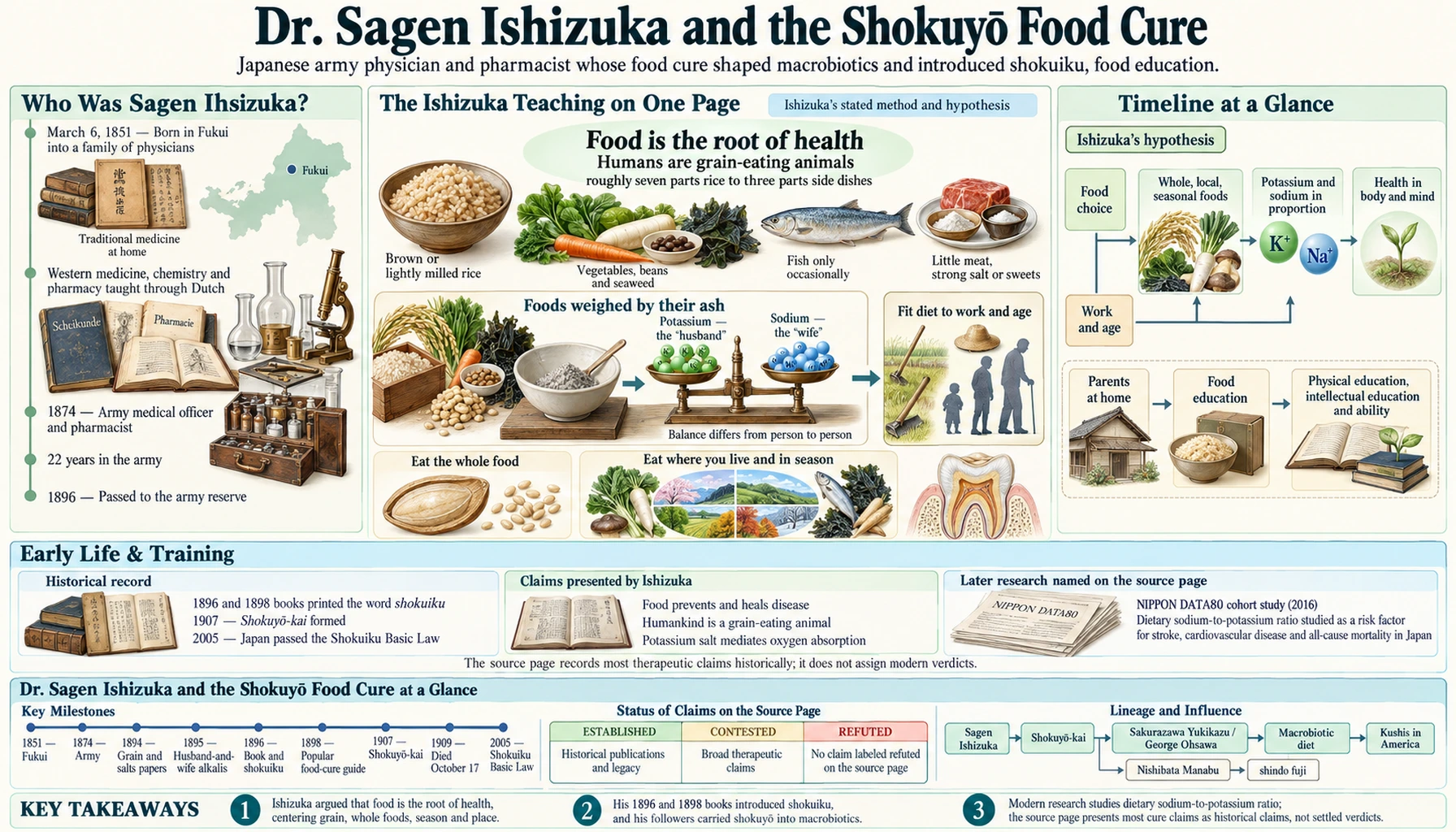
Sagen Ishizuka (石塚左玄, 1851–1909) was a Japanese army physician and pharmacist from Fukui who spent the last fifteen years of his life teaching that food is the root of health in body and mind. He called his method 食養 (shokuyō, “food cure”). He argued that humans are by nature grain-eating animals, that health depends on a balance between the potassium and sodium in food — the “husband and wife” alkalis — and that whole, local, seasonal food suited to each person’s work and age prevents and heals disease. In his books of 1896 and 1898 he was the first to print the word 食育 (shokuiku, “food education”), which Japan revived a century later in its 2005 Shokuiku Basic Law.
His followers in the Shokuyō-kai carried the food cure forward, and one of them, Sakurazawa Yukikazu — George Ohsawa — turned it into the macrobiotic diet known around the world. This hub gathers six deep-dive articles on his life and teaching, drawn from his own papers and books and from the Japanese historians of his work, and presented as he stated it.
Table of Contents
Deep-Dive Articles
1. Life and Career
Born in Fukui in 1851 to a doctor’s family, trained in Western medicine, chemistry and pharmacy, twenty-two years in the army, the papers of 1894–1895, the Tokyo food-cure clinic, and the Shokuyō-kai — with a full timeline.
Read the deep dive →2. Shokuyō: The Food Cure
Food as the root of health, the five doctrines of shokuyō, diagnosis by looking and prescriptions of food, the foods he favoured and warned against, and eating where you live and in season.
Read the deep dive →3. The Husband-and-Wife Alkali Theory
Potassium the husband, sodium the wife: his 1894–1895 papers, foods weighed by their ash, what happens when one salt overpowers the other, and white rice, barley rice and the army.
Read the deep dive →4. Humans as Grain Eaters
“Humankind is a grain-eating animal” (1894): the argument from the teeth, rice seven parts to side dishes three, brown rice and the milling of white rice, and eating the whole food.
Read the deep dive →5. Shokuiku: Food Education
How he coined the word: “body, intellect and ability are food education,” a duty for parents, Murai Gensai’s 1903 novel, the 2005 Shokuiku Basic Law, and Fukui as the home of the word.
Read the deep dive →6. From Shokuyō to Macrobiotics
The Shokuyō-kai after 1909, Nishibata Manabu and shindo fuji, George Ohsawa’s turn from husband and wife to yin and yang, the Kushis in America, and the Japanese revival today.
Read the deep dive →Who Was Sagen Ishizuka?
Ishizuka was born on March 6, 1851, in the castle town of Fukui, into a family of physicians. A sickly child, he studied both the traditional medicine of his father’s house and Western medicine, chemistry and pharmacy taught through Dutch. In 1874 he entered the army, where he served for twenty-two years as a medical officer and pharmacist, rising to the rank of army pharmacist-superintendent before passing to the reserve in 1896.
In the 1890s he published a series of papers in Japan’s pharmaceutical journal setting out his theory: that humankind is a grain-eating animal, and that health depends on the balance of potassium and sodium salts in food. His books of 1896 and 1898 — Kagakuteki Shokuyō Chōjuron and Tsūzoku Shokumotsu Yōjōhō — turned the theory into a practical food cure. In Tokyo he treated patients by diet alone, and contemporaries called him the “food doctor” and “Dr. Daikon.” Around his teaching the Shokuyō-kai, the Food Cure Society, was formed in 1907. He died on October 17, 1909.
The Ishizuka Teaching on One Page
- Food is the root of health. Body and mind are made from what we eat, so the first medicine is food.
- Humans are grain-eating animals. He read this from the shape of the teeth: grain should be the centre of the diet, roughly seven parts rice to three parts side dishes.
- Balance potassium and sodium. Potassium, the “husband,” and sodium, the “wife,” must be kept in proportion; too much of either brings illness, and the right proportion differs from person to person.
- Eat the whole food. Brown or lightly milled rice rather than polished white rice; vegetables, beans and seaweed; fish only occasionally; little meat, strong salt or sweets.
- Eat where you live and in season. Follow the food of the land you live in and fit the diet to your work and your age.
- Food education comes first. “Physical education, intellectual education and the education of ability are, in truth, food education” — and it begins with parents at home.
Timeline at a Glance
- 1851 — Born March 6 in Fukui.
- 1874 — Enters the army as a medical officer and pharmacist.
- 1894 — Publishes “Humankind is a grain-eating animal” and his chemical theory of the salts in food.
- 1895 — Sets out the husband-and-wife alkali theory of potassium and sodium.
- 1896 — Passes to the army reserve; publishes Kagakuteki Shokuyō Chōjuron, where the word shokuiku first appears.
- 1898 — Publishes Tsūzoku Shokumotsu Yōjōhō, his popular guide to the food cure.
- 1907 — The Shokuyō-kai is formed around his teaching.
- 1909 — Dies October 17.
- 2005 — Japan passes the Shokuiku Basic Law; Fukui honours him as the originator of the word.
Key Research Papers
- Ishizuka S. 人類ハ穀食動物ナリ [Humankind is a grain-eating animal]. Yakugaku Zasshi. 1894;(148):532-8. — DOI: 10.1248/yakushi1881.1894.148_532
- Ishizuka S. 飲食品化學的鹽類論 [A chemical theory of the salts in food and drink]. Yakugaku Zasshi. 1894;(149):650-67. — DOI: 10.1248/yakushi1881.1894.149_650
- Ishizuka S. 飲食品化學的鹽類論(續キ) [A chemical theory of the salts in food and drink, continued]. Yakugaku Zasshi. 1894;(151):886-901. — DOI: 10.1248/yakushi1881.1894.151_886
- Ishizuka S. 食物中ノ加里鹽ハ酸素吸収ノ媒介者ナリ [Potassium salt in food is the mediator of oxygen absorption]. Yakugaku Zasshi. 1895;(153):1066-73. — DOI: 10.1248/yakushi1881.1895.153_1066
- Ishizuka S. 第三章 食物中夫婦亞兒加里ノ性質論 [On the properties of the husband-and-wife alkalis in food]. Yakugaku Zasshi. 1895;(155):48-58. — DOI: 10.1248/yakushi1881.1895.155_48
- Ishizuka S. 第四章 入浴ハ亦人體ノ脱鹽法ナリ [Bathing, too, is a way of desalting the human body]. Yakugaku Zasshi. 1895;(156):150-9. — DOI: 10.1248/yakushi1881.1895.156_150
- 山本妃奈子. 石塚左玄の「食養道」における栄養教育的意義:健康食の思想と栄養教育との関連から [The significance for nutrition education of Ishizuka Sagen’s way of food cure]. Hiroshima Bunkyo Daigaku Kiyo. 2025;60:34-47. — DOI: 10.51095/kiyo.60.04
- Sugiyama Y, Seita A. Kanehiro Takaki and the control of beriberi in the Japanese Navy. J R Soc Med. 2013;106:332-4. — PubMed PMID: 23897451
- Itokawa Y. Kanehiro Takaki (1849-1920)—a biographical sketch. J Nutr. 1976;106:581-8. — PubMed PMID: 772183
- Okayama A, Okuda N, Miura K, Okamura T, Hayakawa T, Akasaka H, et al. Dietary sodium-to-potassium ratio as a risk factor for stroke, cardiovascular disease and all-cause mortality in Japan: the NIPPON DATA80 cohort study. BMJ Open. 2016;6:e011632. — PubMed PMID: 27412107