Humans as Grain Eaters: Ishizuka on Teeth, Brown Rice and Whole Foods
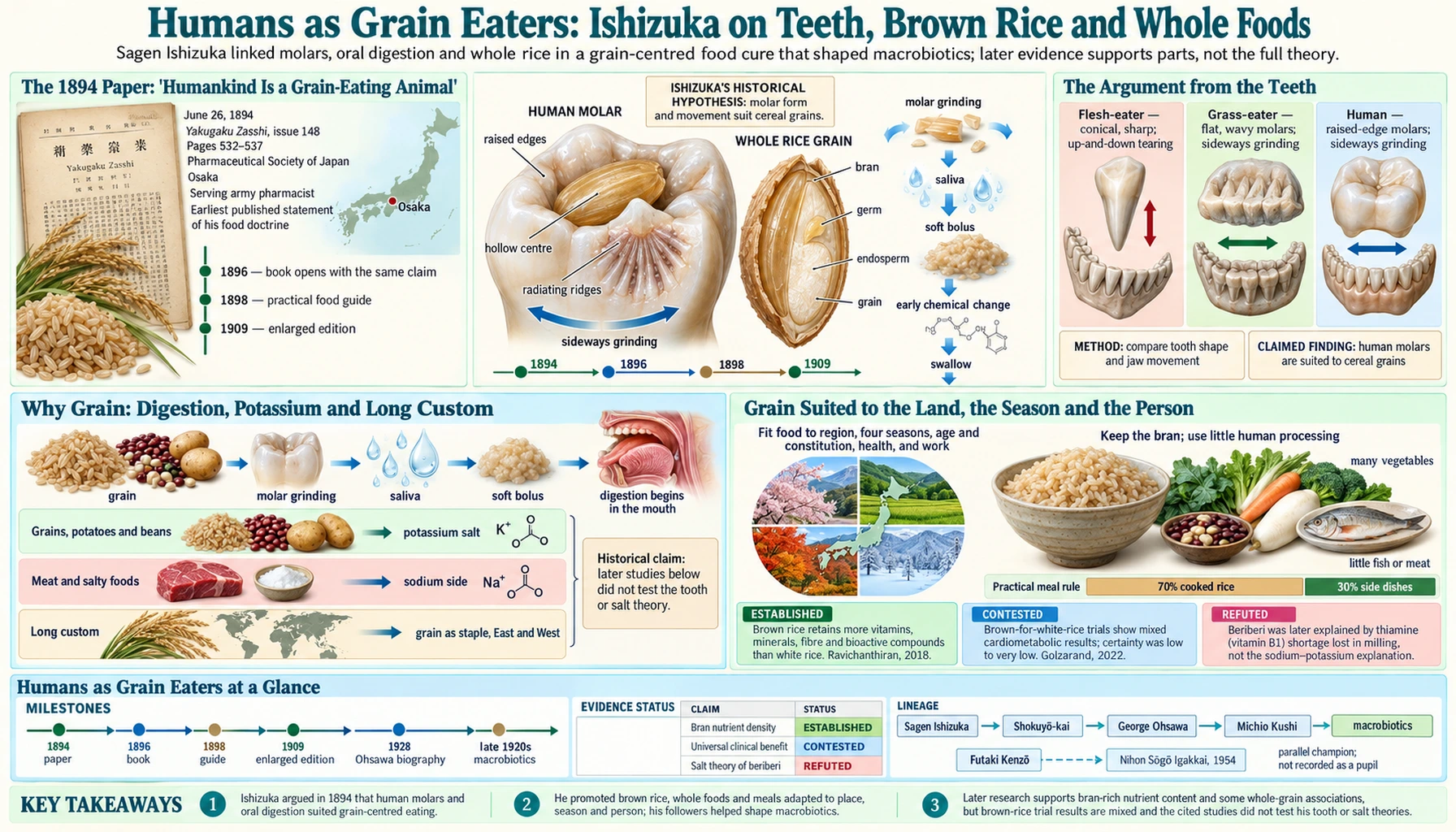
The first food-cure paper Sagen Ishizuka ever published carried its whole argument in its title: 「人類ハ穀食動物ナリ」, “Humankind is a grain-eating animal”. He printed it in June 1894 in 藥學雜誌 (Yakugaku Zasshi), the journal of the Pharmaceutical Society of Japan, and two years later he opened his great book of 1896 with the same sentence. Everything else in his teaching about everyday meals followed from it: that grain should be the staple, that the grain should be eaten whole as 玄米 (genmai, “brown rice”) rather than milled white, that vegetables and beans make the best side dishes, and that meat, heavy salt and refined sweets should stay small and occasional.
This page sets out that teaching as Ishizuka stated it, in his own words where his papers and books could be read directly: the 1894 paper itself (read from its scan on J-STAGE), the opening chapter of Kagakuteki Shokuyō Chōjuron (1896), and the pages of Tsūzoku Shokumotsu Yōjōhō (1898 and the enlarged 1909 edition) held by Japan’s National Diet Library. Where his words are known only through his historians, the page says so. A closing section describes, neutrally, what later research has examined on the same subject, whole grains and brown rice; it is not offered as a verdict on Ishizuka.
Table of Contents
- The 1894 Paper: “Humankind Is a Grain-Eating Animal”
- The Argument from the Teeth
- Why Grain: Digestion, Potassium and Long Custom
- Grain Suited to the Land, the Season and the Person
- The Proportion Rule: Rice Seven Parts, Side Dishes Three
- Brown Rice and the Milling of White Rice
- Ichibutsu Zentai: Eating the Whole Food
- Vegetables, Beans, Seaweed and Fish
- Meat, Strong Salt and Sweets
- How His Followers Carried the Brown-Rice Diet
- Later Research on Whole Grains and Brown Rice
- Key Research Papers
- Connections
- Featured Videos
1. The 1894 Paper: “Humankind Is a Grain-Eating Animal”
The paper 「人類ハ穀食動物ナリ」 appeared in issue 148 of Yakugaku Zasshi, dated June 26, 1894, on pages 532 to 537. It is signed 「在大阪 石塚左玄」, “Ishizuka Sagen, in Osaka”; he was then still a serving army pharmacist. It is short, about six printed pages of classical Japanese, and it is the earliest published statement of his food doctrine. For that reason this site dates the start of his active food-cure work to 1894.
The paper moves in four steps, and the rest of his teaching on grain keeps the same order:
- The teeth. The shape of human teeth, and the grinding way the jaw moves, show what kind of food the body is built for (section 2).
- Digestion. Grain chewed by the molars and mixed with saliva begins its chemical change in the mouth and is the food best suited to nourishing the body (section 3).
- Potassium. Nutrition science, he wrote, counted protein, fat and carbohydrate but ignored the mineral salts. He proposed adding potassium salt (加里 kari) to the list of what a human body needs, and he held that grains, potatoes and beans carry more of it than meat (section 3).
- Custom. East and West, for thousands of years, people have made grain their staple, and experience shows that grain and vegetables sustain life (section 3).
He closed with the sentence that sums up the paper: for human beings, “to choose the grains that suit the teeth is the finest way”, the more so because, from ancient times, custom has made it the rule and grain and vegetables have proved able to sustain life.
2. The Argument from the Teeth
Ishizuka began, in both the 1894 paper and the first chapter of the 1896 book, with a comparison of teeth across the animal world. As he described them:
- The teeth of flesh-eating animals are conical and sharp. Upper and lower teeth fit into each other’s gaps, like two saw blades, and the jaw works up and down to tear.
- Grass-eating animals such as cattle and horses have flat molars with wavy ridges, and the jaw moves sideways and at a slant to grind tough plant food.
- Human molars are set in rows like those of the grass-eaters and also grind with a sideways motion. But their biting surface is raised at the edges and hollow in the middle, like a small mortar, with ridges that radiate like the pattern of a chrysanthemum. When the upper and lower molars meet, they leave between them a flat, rounded space.
That shape, he wrote, is “exactly the natural form suited to the grains of cereal”. The 1896 book makes the same point and gives the chapter an English subtitle of its own: “Men are only nourishing with the cereals (the cerealian)”. Because the hollows of the molars hold single grains, he also called humans 粒食動物 (ryūshoku dōbutsu), “grain-particle eaters”, and wrote the book’s opening line as 「人類は穀食(粒食)動物なり」, “humankind is a grain-eating (grain-particle-eating) animal”.
From this he drew a rule of method. Anyone who wishes to say what food is right for people, he wrote, must first look at the gateway of the digestive tract, the form of the teeth and the way they move, and only then choose the kinds of food and weigh their chemical make-up, taking milk, the food each animal makes for its own young, as the standard.
The tooth count. Japanese Wikipedia summarises his teaching with a count: twenty molars for grinding grain, eight incisors for cutting vegetables and four canines for meat, so that by the teeth humans are grain eaters (a 5:2:1 ratio). It cites page 73 of the 1898 book for this paragraph. The 1894 paper and the opening chapter of the 1896 book, read for this page, argue from the shape of the molars and give no count, and the count was not found on pages 72–75 of the 1898 book either; those pages do state the conclusion, that a healthy life lies in fulfilling humanity’s nature as 「穀食動物」, a grain-eating animal. The count may come from elsewhere in his writing, but it is reported here as Japanese Wikipedia’s summary rather than as a quotation. (In an adult’s full set of thirty-two teeth, the twenty grinding teeth are the eight premolars and twelve molars.) The historian Namimatsu Nobuhisa puts the point without numbers: in Ishizuka’s teaching, “human teeth are mainly molars”.
3. Why Grain: Digestion, Potassium and Long Custom
Digestion begins in the mouth. The food the molars seek, Ishizuka wrote in 1894, is grain, and grain is the most suitable of all. Grain taken into the mouth is ground by the molars into a meal, mixed with saliva, turned on the tongue into a single soft lump and swallowed, so that it has already undergone some chemical change, the start of digestion, before it leaves the mouth; and its components are fit to nourish the body. That, he said, is why every country, East and West, has made grain its staple for thousands of years.
The missing nutrient. He then turned to the nutrition science of his day. Its writers counted three nourishing elements, protein, fat and starch, and discussed how quickly each is digested and absorbed, but they had not asked what promotes digestion and absorption. To nitrogen and carbon he proposed adding the mineral salts, above all potassium salt, as a fourth necessity of human nutrition. In support he described a feeding experiment reported in a European pharmacology text. Two dogs were fed meat from which its salts had been removed; one was given potassium salt and the other sodium salt. After ten-odd days the potassium-fed dog had gained 2,085 grams and the sodium-fed dog only 810, and the first was strong and lively while the second grew dull, haggard and off its food. When the salts were swapped, the dog now on potassium gained 1,810 grams and the dog now on sodium only 530. From this he concluded that potassium salt is used up in building muscle, which sodium salt cannot do, and that potassium keeps the blood alkaline and free-flowing so that it takes in oxygen well.
Where the potassium is. Potassium salt, he wrote, is found in grains and in potatoes and other tubers more than in meat, so these should be the main source of nourishment. Meat is not forbidden, but it is not needed as daily food. He quoted the old Chinese medical saying that in diseases of the blood one should not eat much salt, for much salt makes the pulse congeal and the complexion change. (The idea of sodium and potassium in balance became his 夫婦アルカリ論 fūfu arukari ron, the husband-and-wife alkali theory, explained on its own page.)
The teachers of old. He also called on tradition. The Buddha, he wrote, set up 精進 (shōjin), the meatless discipline, and forbade much meat; and of Confucius the Analects record that although there was much meat at table, he did not let it outweigh the rice. Monks who eat no meat at all, he noted, eat more beans than ordinary people, and the foods made from beans, miso, natto and tofu, mostly came from the hands of monks.
4. Grain Suited to the Land, the Season and the Person
Ishizuka did not teach one diet for everyone. Already in the 1896 opening chapter he wrote that food must be fitted not only to the teeth but to the terrain of one’s region, the weather of the four seasons, the constitution of young and old, healthy and sick, and the kind of work a person does. In the 1898 book he put it as the principle 入郷従郷 (nyūgō jūgō), “when you enter a district, follow its ways”: make the main local produce your staple and its by-products your side dishes. On pages 73–74 he wrote that health lies in eating according to land and climate so as to fulfil one’s nature as a grain-eating animal.
For Japan, a warm island country of “much sea and little land”, that meant rice. Namimatsu summarises his view: Japanese people should not copy European eating habits but should keep rice at the centre as their ancestors did, and should not eat much wheat or prize meat. (His followers later named this idea 身土不二 shindo fuji, “body and soil are not two”; the term was adopted about 1912 by Nishibata Manabu of the Shokuyō-kai, after Ishizuka’s death, and was not Ishizuka’s own word.)
He fitted the grain to the season too. A teaching verse of his, quoted by Fukui City, runs 「春苦味、夏は酢の物、秋は辛味、冬は脂肪と合点して食え」: “In spring bitter, in summer vinegared dishes, in autumn pungent, in winter fat: eat with this understood.”
5. The Proportion Rule: Rice Seven Parts, Side Dishes Three
How much grain? Namimatsu, in his 2015 study of the food-cure movement, gives Ishizuka’s practical rule under the heading of the grain-eating doctrine: if you can eat brown rice, brown rice alone is enough; if that is difficult, eat in the proportion of 「飯7割、副食物3割」, seventy percent cooked rice and thirty percent side dishes.
The rule is a proportion of the meal, staple to side dishes, rather than a ratio of plant to animal food; the side dishes themselves were to lean heavily to vegetables (section 8). It follows directly from his reading of the teeth: a mouth built mainly of grinding teeth should be fed mainly on grain.
The proportion also moved with a person’s age and work, in his scheme. According to Fujii Yoshihiro’s summary of his ten-point guide to eating for different occupations, schoolchildren should eat more potassium-rich grain, vegetables and fruit than adults, students nearing working life might add fish, meat and salty foods from time to time “but must never forget their proper part as grain-eating animals”, and the old, especially near the coast, should eat meals built on grain, such as rice cooked with barley or adzuki beans.
6. Brown Rice and the Milling of White Rice
Ishizuka recommended brown rice, 玄米 (genmai), rice with only its inedible husk removed, as the staple. He held that 「米穀は本来搗白すべきものに非ず」, “rice by nature is not something to be polished” (as quoted by Fujii from the 1896 book). In the 1898 book (page 72) he prescribed broths and soft gruels made from unpolished brown rice or from barley, rich in potassium and lowest in sodium, or fruit juices, for the illnesses he put down to a shortage of potassium.
His sharpest words on milling are on page 110 of the enlarged 1909 edition of the 1898 book. Strip the bran (糠 nuka) from rice, he wrote, and the character for rice, 米, joined to the character for white, 白, makes 粕 (kasu), “dregs”. People today, he went on, are not merely licking the dregs of the ancients: they call it “top-grade white” and eat nothing but the dregs. (Japanese Wikipedia condenses this as “white rice is the dregs”.)
He gave the change a history. The first- and second-grade white rice of his day, he wrote, had been sake rice and sushi rice, not the rice of ordinary meals before the Meiji era; but with growing luxury, by the Meiji 30s and 40s (the late 1890s and 1900s) the daily rice had become as white as sake rice, and people prized whiteness and looked down on the third grade and below. He blamed this rice, which he said is poorly digested and absorbed, for changes he saw in the young: smaller foreheads, lower noses and narrower faces than in people of fifty or sixty.
His practical advice on the next page is modest. He asked readers to “restore” the food of old, as the Meiji Restoration had restored the old order, and to raise the children of the household on well-cooked rice milled only to about half-white, with some of the bran still on, served with side dishes of “many vegetables and little fish, or little meat”, cooked with care.
His concern with milling came at the height of Japan’s beriberi problem, when the navy had already cut its cases by changing the sailors’ diet and the army fed rice mixed with barley. Ishizuka explained the barley ration’s success by its balance of sodium and potassium (Namimatsu); the later discovery that beriberi is a shortage of thiamine (vitamin B1), which is lost in milling, is told on Thiamine and Beriberi. Japanese debate over germ rice, seventy-percent-milled rice and brown rice ran on long after him.
7. Ichibutsu Zentai: Eating the Whole Food
The idea behind his brown rice is wider than rice. Namimatsu sets it out as the fourth of Ishizuka’s five doctrines: rice is better eaten as brown rice, and other foods, too, are better eaten whole, just as they come. Japanese Wikipedia adds that, in this teaching, eating a food in its entirety keeps its yin and yang in balance.
The name now attached to the idea, 一物全体 (ichibutsu zentai, “one thing, whole”), or 一物全体食 (ichibutsu zentai shoku, “whole-food eating”), was not Ishizuka’s own. Namimatsu writes that it was the Shokuyō-kai movement, the society his followers built, that called it the “ichibutsu zentai” doctrine. In his own pages the idea appears as plain advice: keep the bran on the rice, do not polish what nature made whole, prefer foods with “little human processing”.
The idea links to his view of salts. A grain eaten whole, with its bran and germ, keeps the potassium he valued; polishing, in his account, leaves a staple low in potassium, and when that staple is eaten with salty side dishes the balance tips toward disease (Japanese Wikipedia, citing page 49 of the 1898 book).
8. Vegetables, Beans, Seaweed and Fish
Within the thirty percent of side dishes, Ishizuka sorted foods by his two salts. In the 1898 book he grouped vegetables, fruit and plant foods as rich in potassium, and salt, meat, eggs, fish and animal foods in general as rich in sodium.
- Vegetables, beans and tubers were the side dishes he favoured. In 1894 he advised adding potassium-rich beans and potatoes as side dishes to the rice and barley staple, and pointed to the monks’ bean foods, miso, natto and tofu. His 1909 prescription was “many vegetables” with the rice.
- Sea vegetables and pickles. He noted that salted pickles and seaweed, though plant foods, come close to the sodium side because of the salt they carry (Japanese Wikipedia, citing pages 69–70 of the 1898 book). They had a place at the table, weighed as salty foods.
- Fish. Fish, birds and beasts contain less potassium than the plant world, he wrote in 1894, but because they taste good they may be eaten from time to time as a delicacy or a festive dish. His later formula was “little fish, or little meat” beside the vegetables.
- Milk. In 1894 he wrote that milk is the richest of all in potassium salt.
- Pungent foods. Fujii’s summary of the ten-point guide has those who eat rich food in business life take ginger, daikon radish, pepper or mustard after the meal.
He was not a strict vegetarian. He wrote that Zen monks and Western vegetarians can stay healthy and long-lived without animal food, but that in general one should eat grain-centred meals and keep a balance (Japanese Wikipedia’s article on the Shokuyō-kai, citing the 2004 translation). Fukui City’s summary of his teachings ends with 平衡, balance: eat a little of everything.
9. Meat, Strong Salt and Sweets
Meat. In 1894 Ishizuka rejected the opinion, current in Meiji Japan, that people must eat both meat and vegetables to be well nourished and that meat is richer and tastier than “plain” plant food. That view, he wrote, is not the intent of nature. Meat is not a daily food and is not to be craved, though eating it is not forbidden. Namimatsu records his later complaint that, though the Japanese climate called for brown rice, the Japanese had taken to white rice and then, following the West, to meat, and so had developed 才 (sai, quick talent) at the expense of 智 (chi, wisdom). In the 1898 book (page 74) he wrote that a diet heavy in meat and salt rouses a “light, greedy” spirit, while grain-eating supports the compassion the Buddhists call the great mind of mercy.
Strong salt. Heavily salted foods sit with meat on the sodium side of his scale, and he warned that too much sodium shortens life. His guidance for expectant mothers, as Fujii summarises it, was to eat plenty of grain and vegetables “with as little human processing as possible” and to cut down on strongly salted foods, on fish, bird and animal meat and eggs, and on processed sweets.
Sweets. His objection to confectionery followed the same chemistry: refined sweets carry almost no potassium. Fujii’s summary of the ten-point guide asks people to restrain themselves from snacking on low-potassium cakes such as castella sponge and neri-yōkan (firm sweet bean jelly), and warns against a habit of steamed confections and shiruko (sweet red-bean soup), which have “almost no potassium salt”. For city labourers living on white rice and salty side dishes, the guide recommended low-salt snacks instead: rice cakes, potatoes, dumplings and fruit.
10. How His Followers Carried the Brown-Rice Diet
Brown rice became the badge of Ishizuka’s school. Japanese Wikipedia calls him 「玄米・食養の元祖」, the originator of brown rice and food cure, and English-language histories report that supporters called him “Dr. Brown Rice” (no Japanese source for that nickname has been found).
After his death in 1909 the 食養会 (Shokuyō-kai, Food Cure Society) carried his diet forward. Its best-known pupil, Sakurazawa Yukikazu (桜沢如一, 1893–1966), known in the West as George Ohsawa, had recovered from tuberculosis as a student on Ishizuka’s food cure. He wrote Ishizuka’s biography in 1928, rose to lead the society, and from the late 1920s built his own 正食 (seishoku, “right eating”) movement, which the world came to know as macrobiotics. Namimatsu notes that Ohsawa recast the husband-and-wife alkali theory through the yin-yang philosophy of the I Ching rather than through chemistry. Through Ohsawa, and in the United States through his student Kushi Michio (久司道夫), brown rice travelled around the world.
Namimatsu describes the basis of macrobiotics in terms Ishizuka would have recognised: rice is eaten as brown rice, wheat is eaten unrefined as whole flour, and grain stands at the centre of the meal, at fifty to eighty percent of the diet. English-language reviews describe the macrobiotic diet as a mainly vegetarian, whole-foods, high-fibre diet built on whole grains.
Brown rice also had champions outside Ohsawa’s line. The bacteriologist Futaki Kenzō (二木謙三, 1873–1966) promoted brown rice as a 完全食, “complete food”. He is not recorded as Ishizuka’s pupil, but the society he founded in 1954, the Nihon Sōgō Igakkai, later carried on brown-rice food cure in Ishizuka’s line. The fuller story is on From Shokuyō to Macrobiotics.
11. Later Research on Whole Grains and Brown Rice
A century after Ishizuka, brown rice and whole grains have been studied in their own right. The studies below examine the same foods he wrote about; they were not designed to test his theory of teeth or of sodium and potassium, and they are described here as later research on the same subject.
- Whole grains and mortality. A 2016 meta-analysis of 45 prospective studies (Aune and colleagues) found that each extra 90 grams a day of whole grains, about three servings, was associated with a lower risk of coronary heart disease (relative risk 0.81), cardiovascular disease (0.78), total cancer (0.85) and death from all causes (0.83).
- White rice, brown rice and type 2 diabetes. A 2022 systematic review (Yu and colleagues) found that higher white-rice intake was associated with a higher risk of type 2 diabetes (pooled relative risk 1.16), and higher brown-rice intake with a lower risk (0.89), with each 50-gram daily serving of brown rice associated with a 13% lower risk. Trials that swapped brown rice for white rice gave inconsistent results on cardiometabolic risk factors.
- Trials of brown rice for white rice. A 2022 meta-analysis of 13 randomised trials (Golzarand and colleagues) found that brown rice reduced body weight, BMI and waist circumference compared with white rice but did not significantly change blood lipids or glucose markers; pre-germinated brown rice also lowered cholesterol, triglycerides and fasting glucose. The authors rated the certainty of the evidence low to very low.
- Prediabetes and diabetes. A 2021 meta-analysis of seven trials in 417 adults (Abdul Rahim and colleagues) found no effect on HbA1c or fasting glucose compared with white rice, but a fall in body weight (about 2.2 kg) and a rise in HDL cholesterol.
- A brown-rice-based diet. In a 12-week Korean randomised trial (Lee and colleagues, 2016), a brown-rice-based vegan diet lowered HbA1c in people with type 2 diabetes more than a conventional diabetic diet did (−0.5 versus −0.2 percentage points).
- What the bran carries. Reviews describe brown rice, unmilled or partly milled, as richer than white rice in vitamins, minerals, fibre and bioactive compounds, most of which sit in the bran layers (Ravichanthiran and colleagues, 2018), and describe germinated brown rice as richer still in compounds such as gamma-aminobutyric acid (GABA), ferulic acid and gamma-oryzanol (Wu and colleagues, 2013).
The site’s food pages cover the nutrition of the grain itself: Brown Rice, Brown Rice, Whole Grain and Diabetes, Phytate, Soaking and Germinated Brown Rice and Brown Rice: History and Origins.
Key Research Papers
- Ishizuka S. 人類ハ穀食動物ナリ [Humankind is a grain-eating animal]. Yakugaku Zasshi. 1894;(148):532-8. — DOI: 10.1248/yakushi1881.1894.148_532
- Ishizuka S. 飲食品化學的鹽類論 [A chemical theory of the salts in food and drink]. Yakugaku Zasshi. 1894;(149):650-67. — DOI: 10.1248/yakushi1881.1894.149_650
- 宝蔵もと子. 胚芽米・七分搗き米・玄米論争をめぐる系譜 [The genealogy of the germ-rice, 70%-milled rice and brown-rice debate]. Nihon Kaseigakkai Kenkyu Happyo Yoshishu. 2017;69:25. — DOI: 10.11428/kasei.69.0_25
- 山本妃奈子. 石塚左玄の「食養道」における栄養教育的意義:健康食の思想と栄養教育との関連から [The significance for nutrition education of Ishizuka Sagen’s way of food cure]. Hiroshima Bunkyo Daigaku Kiyo. 2025;60:34-47. — DOI: 10.51095/kiyo.60.04
- Aune D, Keum N, Giovannucci E, Fadnes LT, Boffetta P, Greenwood DC, et al. Whole grain consumption and risk of cardiovascular disease, cancer, and all cause and cause specific mortality: systematic review and dose-response meta-analysis of prospective studies. BMJ. 2016;353:i2716. — PubMed PMID: 27301975
- Yu J, Balaji B, Tinajero M, Jarvis S, Khan T, Vasudevan S, et al. White rice, brown rice and the risk of type 2 diabetes: a systematic review and meta-analysis. BMJ Open. 2022;12(9):e065426. — PubMed PMID: 36167362
- Golzarand M, Toolabi K, Eskandari Delfan S, Mirmiran P. The effect of brown rice compared to white rice on adiposity indices, lipid profile, and glycemic markers: a systematic review and meta-analysis of randomized controlled trials. Crit Rev Food Sci Nutr. 2022;62(27):7395-412. — PubMed PMID: 33905269
- Abdul Rahim AF, Norhayati MN, Zainudin AM. The effect of a brown-rice diets on glycemic control and metabolic parameters in prediabetes and type 2 diabetes mellitus: a meta-analysis of randomized controlled trials and controlled clinical trials. PeerJ. 2021;9:e11291. — PubMed PMID: 34123581
- Lee YM, Kim SA, Lee IK, Kim JG, Park KG, Jeong JY, et al. Effect of a brown rice based vegan diet and conventional diabetic diet on glycemic control of patients with type 2 diabetes: a 12-week randomized clinical trial. PLoS One. 2016;11(6):e0155918. — PubMed PMID: 27253526
- Ravichanthiran K, Ma ZF, Zhang H, Cao Y, Wang CW, Muhammad S, et al. Phytochemical profile of brown rice and its nutrigenomic implications. Antioxidants (Basel). 2018;7(6):71. — PubMed PMID: 29789516
- Wu F, Yang N, Touré A, Jin Z, Xu X. Germinated brown rice and its role in human health. Crit Rev Food Sci Nutr. 2013;53(5):451-63. — PubMed PMID: 23391013
- Sugiyama Y, Seita A. Kanehiro Takaki and the control of beriberi in the Japanese Navy. J R Soc Med. 2013;106(8):332-4. — PubMed PMID: 23897451
- Kushi LH, Cunningham JE, Hebert JR, Lerman RH, Bandera EV, Teas J. The macrobiotic diet in cancer. J Nutr. 2001;131(11 Suppl):3056S-64S. — PubMed PMID: 11694648
- Lerman RH. The macrobiotic diet in chronic disease. Nutr Clin Pract. 2010;25(6):621-6. — PubMed PMID: 21139126
PubMed Topic Searches
- https://pubmed.ncbi.nlm.nih.gov/?term=brown+rice+white+rice+health
- https://pubmed.ncbi.nlm.nih.gov/?term=macrobiotic+diet
- https://pubmed.ncbi.nlm.nih.gov/?term=beriberi+Japan+history
Further Reading
- 並松信久. 近代日本における食養論の展開 [The development of food-cure theory in modern Japan]. Bulletin of the Institute of Japanese Culture, Kyoto Sangyo University. 2015;20. — Handle: 10965/1239
- 藤井義博. 石塚左玄の食育食養法:栄養療法の知的枠組についての研究11 [Ishizuka Sagen’s food-education and food-cure method]. Bulletin of the Faculty of Human Life Sciences, Fuji Women’s University. 2014;51:25-38. — Repository record
- 石塚左玄. 化学的食養長寿論 [A chemical theory of food-cure for long life]. 1896. Chapter 1, “人類は穀食(粒食)動物なり”, p. 6. — National Diet Library Digital Collection
- 石塚左玄. 通俗食物養生法 [A popular guide to food for health]. 1898. pp. 72–74. — National Diet Library Digital Collection
- 石塚左玄. 通俗食物養生法, enlarged 7th edition. 1909. pp. 110–111. — National Diet Library Digital Collection