From Shokuyō to Macrobiotics: Ishizuka’s Disciples and Legacy
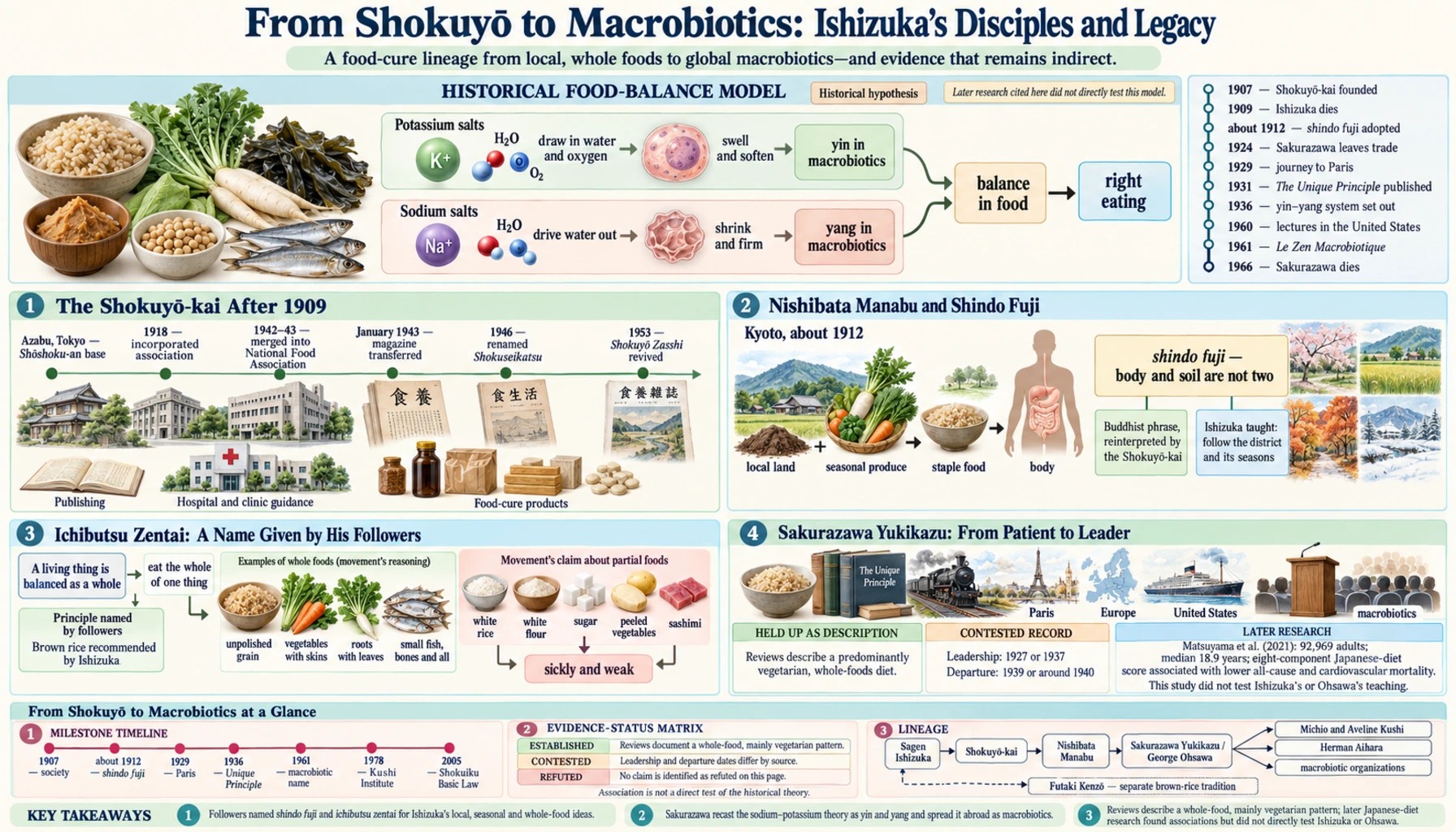
Sagen Ishizuka died in October 1909, but his food cure did not die with him. The society founded around him two years earlier, the 食養会 (Shokuyō-kai, Food Cure Society), kept publishing his books and its magazine, and a circle of followers gave his ideas the slogans by which they are still known in Japan: 身土不二 (shindo fuji, “body and soil are not two”) and 一物全体 (ichibutsu zentai, “the whole of one thing”). One of those followers, a sickly young man from Kyoto named Sakurazawa Yukikazu, recovered his health on Ishizuka’s diet, rose to lead the society, and then carried the teaching to Paris, to the rest of Europe and to America under a new name: macrobiotics.
This page follows that line of descent, as the Japanese historians of the movement and the reference literature record it. It covers the Shokuyō-kai after Ishizuka’s death, the two slogans and who coined them, how Sakurazawa, known in the West as George Ohsawa, met the teaching and turned Ishizuka’s chemistry of sodium and potassium into a philosophy of yin and yang, how the word “macrobiotic” came to be attached to it, the students who carried it to the United States, how English-language reviews describe the macrobiotic diet, a separate brown-rice tradition in Japan, and how Ishizuka is remembered in his home prefecture of Fukui today. Where the sources disagree, both accounts are given.
Table of Contents
- The Shokuyō-kai After 1909
- Nishibata Manabu and Shindo Fuji
- Ichibutsu Zentai: A Name Given by His Followers
- Sakurazawa Yukikazu: From Patient to Leader
- From Husband and Wife to Yin and Yang
- Paris, the Unique Principle and the Word “Macrobiotic”
- To America: Michio and Aveline Kushi, Herman Aihara
- The Macrobiotic Diet as the Reviews Describe It
- Futaki Kenzō: A Separate Brown-Rice Tradition
- Fukui and the Japanese Revival Today
- Key Research Papers
- Connections
- Featured Videos
1. The Shokuyō-kai After 1909
Ishizuka’s teaching had attracted organised followers before any society carried it. Around 1892 a food-cure group called the 双塩会 (Sōen-kai, “Double Salt Society”) existed in Osaka, and in 1905 the 帝国食育会 (Teikoku Shokuiku-kai, Imperial Food Education Society) was formed to spread his food cure; it had about three hundred members and had stopped its activity by 1907.
The Shokuyō-kai itself was founded in 1907, first under the name 化学的食養会 (“Chemical Food Cure Society”). The sources describe Ishizuka’s own place in it in two ways:
- As first president. Japanese Wikipedia’s article on the society, citing the history by the physician Hayashi Jin’ichirō, gives its founding date as October 17, 1907, lists Ishizuka as its first president (初代会長), and says it was founded because his supporters and the people who had regained their health on his diet had grown in number. Because he had been a senior army figure, its founders included army men and figures from politics and business, and the Home Ministry also wished it to be set up.
- As adviser. The scholar Fujii Yoshihiro, following a later study of the Meiji food-education movement, says the society was formed in November 1907 by members of the Teikoku Shokuiku-kai and Home Ministry officials, and that Ishizuka became its adviser (顧問).
Either way, the society was built around Ishizuka and his teaching, and it outlived him by decades. Its monthly magazine, 『食養雑誌』 (Shokuyō Zasshi, “Food Cure Magazine”), began on November 10, 1907. After his death the historian Namimatsu Nobuhisa records that the society spread the food cure from its base at the 正食庵 in Azabu, Tokyo, by publishing its magazine and books, giving guidance in hospitals and clinics, and selling food-cure products. It became an incorporated association (社団法人) in Taishō 7, that is 1918, and Japanese Wikipedia lists a member of the Mitsui family as its president from that year.
The society did not survive the war in its original form. Around 1942–43 it was merged, at the wish of the Ministry of Health and Welfare, into a wartime national food association, the 国民食協会. Its magazine passed to the new body in January 1943, was renamed 『国民食』 and then, from 1946, 『食生活』, and left the food cure behind; under that last name it was published until 2015. The physician Hayashi Jin’ichirō, who had recovered from a serious intestinal illness on Ishizuka’s brown-rice diet and directed the society’s hospital from 1937, revived Shokuyō Zasshi in 1953 and later presided over the Shokuyō-kai.
2. Nishibata Manabu and Shindo Fuji
The best-known slogan of the food-cure movement, 身土不二, is often credited to Ishizuka. It is not his term. Japanese Wikipedia’s article on the phrase, citing the historian Tanaka Satoshi, tells the story this way: in 1912 (Meiji 45) Nishibata Manabu (西端学), a director (理事) of the Shokuyō-kai and a cavalry colonel in the army, was explaining Ishizuka’s idea in a general form, that food from one’s own district is good for the body and food from other districts is bad for it. A monk in Kyoto told him that the Buddhist scriptures contain the phrase 身土不二. The Buddhist meaning is different: in Buddhist usage, read shindo funi, it says that a being and the environment it depends on cannot be separated. Nishibata nonetheless adopted the phrase, read it shindo fuji, and spread it as a principle peculiar to the Shokuyō-kai.
The same article’s opening line says the slogan was created by the Shokuyō-kai “in the Taishō era”, while its account gives 1912, the year the Meiji era ended and the Taishō era began; this page therefore says “about 1912”. Fukui City’s introduction to Ishizuka puts it more simply: “his disciples seem to have used the word shindo fuji to pass on his teaching.”
The idea behind the slogan was Ishizuka’s own. He had taught 入郷従郷 (nyūgō jūgō), “when you enter a district, follow its ways”: make the main produce of the land where you live your staple, eat what each season brings, and do not lightly change a people’s traditional diet. Fujii notes that Ishizuka’s own wording comes closer to 身食不二, “body and food are not two”. The fuller account of his teaching on local and seasonal food is on Shokuyō: Sagen Ishizuka’s Food Cure.
Who was Nishibata? Namimatsu describes him as an army colonel and Shokuyō-kai director whom Sakurazawa looked up to as his teacher (師), and records that he set out the principle in 『日本精神の生理学』 (“The Physiology of the Japanese Spirit”), published by the Shokuyō-kai in 1927 as Nishibata’s original text with commentary by Sakurazawa. English-language accounts call Nishibata a direct disciple of Ishizuka; the Japanese sources read for this page describe him only as a leader of the Shokuyō-kai after Ishizuka’s death, and none says he studied under Ishizuka in his lifetime.
3. Ichibutsu Zentai: A Name Given by His Followers
The second slogan, 一物全体 (ichibutsu zentai), means eating a food whole: grain unpolished, vegetables with their skins, root vegetables with their leaves, small fish bones and all. Japanese Wikipedia’s article on the Shokuyō-kai sums up the reasoning as the society taught it: a living thing is in balance as a whole, so eat the whole of it; eat only parts, such as sashimi, peeled vegetables, white rice, white flour or sugar, and people grow sickly and weak.
The idea is Ishizuka’s. He recommended brown rice (玄米 genmai) as the staple, and the enlarged 1909 edition of his popular book calls white rice the “dregs” (粕) of the grain; Fujii quotes his 1896 book: “rice by nature is not something to be polished.” But Namimatsu, who sorts Ishizuka’s doctrine under five headings, notes that the labels 身土不二 and 一物全体食 were the names the Shokuyō-kai movement gave to these ideas. It is therefore most accurate to speak of the principle his followers named ichibutsu zentai. Ishizuka’s arguments for brown rice and whole foods are told on Humans as Grain Eaters: Ishizuka on Teeth, Brown Rice and Whole Foods.
Both slogans travelled far beyond the society. Macrobiotic teachers carried them abroad, and in Japan, as section 10 describes, they now appear in school lunches and in the language of local food.
4. Sakurazawa Yukikazu: From Patient to Leader
Sakurazawa Yukikazu (桜沢如一, whose given name is also read Nyoichi) was born on October 18, 1893, near Kenninji temple in the Gion district of Kyoto, to a family of samurai descent that had come from Kishū (present-day Wakayama). English-language sources give his birthplace as Shingū in Wakayama Prefecture. His childhood was hard. His father left home when he was six, his mother died of lung disease when he was ten, and by 1908, at sixteen, he was suffering from pulmonary and intestinal tuberculosis among other illnesses.
How he met the teaching. Japanese Wikipedia’s article on him, drawing on the Ohsawa photo-album biography, says that in 1912, at about twenty, he came upon Ishizuka’s food cure and regained his health; another book it cites says he learned of it through a food-cure practitioner named Gotō Katsujirō. The English-language reference literature says that around 1913 he began studying in Tokyo with Nishibata Manabu. A later anthology of Ohsawa’s writings, cited by English Wikipedia, dates his recovery to 1912 on Ishizuka’s diet of whole brown rice, vegetables, sea salt and oil. Ishizuka had died three years earlier, so Sakurazawa learned the teaching from his books and his society, not from the man himself.
From trade to the food cure. He finished a commercial school in Kyoto in 1913 and a French-language school in Kobe, and worked in the import-export trade, exporting silk and importing cameras and film. Meanwhile he joined the Shokuyō-kai and began writing for its magazine. In 1924 he left business and devoted himself to reviving the society, which had stagnated since Ishizuka’s death.
When he led the society. The sources give two different dates:
- Namimatsu says he became an auditor (監事) of the Shokuyō-kai and chief editor of Shokuyō Zasshi in 1927, and dates the start of his own 正食 (seishoku, “right eating”) movement to the late 1920s.
- Japanese Wikipedia’s article on the Shokuyō-kai, citing Hayashi’s history, says he became secretary (幹事) and chief editor in April 1937, and lists him as the society’s president from 1937; its article on Sakurazawa agrees that he became president in 1937.
What is certain is that from the late 1920s into the 1930s he rose to lead the society. In 1927 he published Nishibata’s Physiology of the Japanese Spirit with his commentary, and in 1928 the biography 『石塚左玄』 (“Ishizuka Sagen”) and a series of food-cure lectures, the 『食養講義録』, whose volume on principles explained Ishizuka’s balance of sodium and potassium. Under his leadership the society flourished as never before: it built a four-storey hall in Tamura-chō, Tokyo, and its monthly reached about ten thousand subscribers.
Leaving. He did not stay. Japanese Wikipedia’s article on him dates his departure to 1939, when the society’s Mizuho hospital closed; its article on the society says that around 1940 he fell out with the directors and was forced out. In September 1940 he opened his own school, the 無双原理講究所 (“Institute for the Study of the Unique Principle”), in Ōtsu, Shiga Prefecture, to develop the food cure through the philosophy of the I Ching.
5. From Husband and Wife to Yin and Yang
The heart of what Sakurazawa inherited was Ishizuka’s 夫婦アルカリ論 (fūfu arukari ron), “the husband-and-wife alkali theory”: that the salts of sodium and potassium in food are alike yet opposite, complementary like a married couple, and that health depends on keeping them in balance. The theory is told in full on The Husband-and-Wife Alkali Theory: Sodium and Potassium in Food.
Which partner was which. Ishizuka’s 1895 paper on the husband-and-wife alkalis is explicit. In food, he wrote, potassium and sodium have natures that deserve the name husband-and-wife alkalis, “just like the husband and wife of one household”. In his scheme potassium is the husband, the “male alkali” (男性亞兒加里), which draws in water and oxygen and makes food swell and soften; and sodium is the wife, the “female alkali” (女性亞兒加里), which drives water out and makes food shrink and firm.
The yin and yang labels. Ishizuka himself also linked his chemistry to the old medicine: the Japanese sources report that in his 1898 book foods rich in sodium match what kanpō (漢方, traditional Japanese-Chinese medicine) called yang (陽), and foods rich in potassium match yin (陰). Macrobiotics kept that assignment and made it central: potassium is yin and sodium is yang. In macrobiotic writing, as English Wikipedia summarises it, yang foods are compact, dense, heavy and hot, and yin foods expansive, light, cold and diffuse.
The difference. In Chinese philosophy yang is the masculine pole and yin the feminine. So in Ishizuka’s marriage metaphor the male partner, potassium, is the one that the yin–yang scheme calls yin, and the female partner, sodium, is the one it calls yang. Ishizuka’s husband-and-wife language and the macrobiotic yin–yang language therefore do not line up in the way a reader might expect, and the two should not be merged: in Ishizuka’s own paper potassium is the husband, while in Ohsawa’s macrobiotics potassium is yin.
From chemistry to cosmology. Namimatsu draws the larger contrast. Ishizuka explained the balance of the two salts with everyday examples and scientific-sounding argument, not with the philosophy of the I Ching (易 eki), and he showed no interest in the traditional concept of 氣 (ki). Sakurazawa took over the husband-and-wife alkali theory and, to make the food cure general, recast it through the I Ching’s yin and yang as two poles that unify the world, developing it into a cosmological principle that could be applied to everything. He set it out in the 1936 book 『無双原理・易』 (“The Unique Principle: the I Ching”), the basis of his later teaching. Sodium and potassium became the chemical face of yang and yin, and the balance of the two in food became the organising idea of right eating.
6. Paris, the Unique Principle and the Word “Macrobiotic”
In 1929 Sakurazawa set out to make the food cure known to the world. He crossed Siberia by the Trans-Siberian Railway carrying rice balls and almost no money, and arrived in Paris, where for about three years, by his own account, he lived on broken rice, wild greens gathered in the suburbs and vegetable leaves thrown away at the market. Brown rice could not be bought in Paris then; he had it brought in from Italy and Spain. He studied at the Sorbonne and the Pasteur Institute, and began to write in French. It was in France that he adopted the name Ohsawa and the French first name Georges, later George.
In 1931 the Paris philosophical publisher Vrin issued his Le Principe Unique de la Philosophie et de la Science d’Extrême-Orient (“The Unique Principle of the Philosophy and Science of the Far East”), which explains the yin and yang order of the universe; books on flowers, acupuncture and Eastern medicine followed. He became known in Europe as an interpreter of Eastern thought, returned to Japan at the end of 1935, and in the following years published a large number of books on the food cure there. Japanese Wikipedia counts well over a hundred books in Japanese alone.
After the war. In 1945 he founded a cooperative in Tokyo for a “new life”, and joined the world-federalist movement. His centre, later called Maison Ignoramus, became in 1957 the 日本CI協会 (Nippon CI Kyōkai), the macrobiotic organisation that his widow, the macrobiotic cooking teacher Sakurazawa Lima (里真), led after his death. From 1953 he travelled through India, Africa, Europe and the Americas. Returning to France in the mid-1950s he found the seeds he had sown had grown: Paris had some thirty shops selling food grown without chemical fertiliser, and brown rice and soy sauce were on ordinary shelves. Lecturing in Belgium, Switzerland, Germany, Sweden, Italy and Britain, he saw some fifty groups organised in Europe and the Americas, along with food shops, restaurants and small factories, and his books were translated into about ten languages. In 1957 he founded a French monthly titled YIN-YANG.
The name. The word “macrobiotic” is older than Ohsawa. It comes from the Greek makrobios, “long-lived”, and was used by the German physician Christoph Wilhelm Hufeland, whose book on the art of prolonging human life, subtitled Makrobiotik, appeared in the late 1790s. Ohsawa took up the word for his own teaching in Le Zen Macrobiotique, published in Brussels in 1961; the English Zen Macrobiotics and You Are All Sanpaku followed in 1965. From then on his philosophy has been known abroad as macrobiotics, and in Japan as マクロビオティック, while his followers still also speak of 正食, right eating.
He crossed to the United States in 1960 and gave lectures and summer camps there in the following years. He died in Japan on April 24, 1966 (April 23 in some English sources), of a heart attack, aged seventy-two.
7. To America: Michio and Aveline Kushi, Herman Aihara
Ohsawa trained students who carried macrobiotics further than he could. Japanese Wikipedia’s article on macrobiotics names those who spread it mainly abroad as Kushi Michio, Kikuchi Tomio and Herman Aihara, and among those who spread it mainly in Japan Matsuoka Shirō, Ōmori Hideo and Okada Shūzō. Three of the overseas teachers matter most for the story in English.
- Michio Kushi (久司道夫, 1926–2014), born in Wakayama Prefecture, studied law and international relations at the University of Tokyo and studied with Ohsawa after the Second World War. He went to the United States in 1949 and continued his studies at Columbia University in New York. Namimatsu credits him with spreading macrobiotics in the United States. After moving to Boston in the 1960s he founded, with his wife, the East West Journal, the East West Foundation and, in 1978, the Kushi Institute, which later moved to Becket, Massachusetts, and taught macrobiotic cooking and philosophy. The couple wrote more than seventy books. The Archives Center of the Smithsonian Institution’s National Museum of American History holds the “Michio and Aveline Kushi Macrobiotics Collection”. He died in December 2014, aged eighty-eight.
- Aveline Kushi (1923–2001), born Yokoyama Tomoko in Yokota, Shimane Prefecture, was a schoolteacher until the end of the war, when she joined Ohsawa’s world-government association and took the name Aveline. She went to the United States for the group in 1951 and married Michio Kushi in 1954. In Boston she opened one of the first natural-food stores in the United States in the 1960s, and she wrote macrobiotic cookbooks, among them The Changing Seasons Cookbook (1987).
- Herman Aihara (1920–1998), born Nishiyama Nobuo in Arita, Saga Prefecture, received his American first name from Ohsawa, who suggested Western names to many of his students to ease their way abroad. He founded the George Ohsawa Macrobiotic Foundation in San Francisco, named in his teacher’s honour, and he and his wife taught macrobiotic philosophy, cooking, child care and home remedies for the rest of their lives. The foundation later moved to Oroville, California, where he died in 1998.
Japanese Wikipedia’s article on macrobiotics adds that Kushi, in the 1950s, met resistance because the teaching contradicted the nutrition science of the day, and that he reshaped it to suit Western conditions. Through these students the line that began with an army pharmacist’s papers on sodium and potassium reached American kitchens, health-food shops and cookbooks. English-language histories of the movement, among them Ronald Kotzsch’s Macrobiotics: Yesterday and Today (1985), whose second chapter is titled “Sagen Ishizuka: the Founder of Modern Macrobiotics”, trace it back to him.
8. The Macrobiotic Diet as the Reviews Describe It
Several English-language reviews in the medical literature describe what the macrobiotic diet is. In their words:
- Kushi and colleagues (2001), in a review in the Journal of Nutrition, describe macrobiotics as one of the most popular comprehensive lifestyle approaches used alongside or in place of conventional cancer care, and say its centrepiece is “a predominantly vegetarian, whole-foods diet”. They note the diet’s high content of phytoestrogens, plant compounds that act weakly like estrogen, and report that women eating macrobiotic diets have modestly lower circulating estrogen levels.
- Lerman (2010), in Nutrition in Clinical Practice, describes it as a high-fibre, high-complex-carbohydrate, mainly vegetarian diet, low in fat, that is “associated with a lifestyle system and a spiritual philosophy of life”. Unlike many diets, he writes, its composition is not fixed and may be altered depending on a person’s health status, among other considerations, an echo of Ishizuka’s own teaching that the right balance varies with the person, the place and the season. He adds that many aspects of currently popular dietary advice, “such as eating locally grown, in-season, fresh, organic foods”, are legacies of the macrobiotic lifestyle and diet.
- Bowman and colleagues (1984), in the Journal of Clinical Oncology, reviewed macrobiotic diets for cancer treatment and prevention in an earlier period of the movement’s American history.
In the reference literature the foods at the centre of the diet are whole cereal grains, above all brown rice, which macrobiotics considers the food in which yin and yang are closest to balance, with vegetables, beans and other pulses, sea vegetables, fermented soy foods such as miso, and fruit, combined according to the balance of yin and yang and chosen to be local and in season. Namimatsu describes the same basis from the Japanese side: rice is eaten as brown rice, wheat is eaten unrefined, and grain stands at the centre of the meal. Ohsawa’s earliest “Zen macrobiotic” regime of the 1960s was set out as a series of ten numbered stages, the highest made up of whole grains alone; the Kushis’ later standard version was broader. Japanese scholars have also studied the movement as a modern food culture, among them Kondō Miyuki (2001) and Kuroda Jun’ichirō (2015), listed below.
Researchers have also studied the traditional Japanese diet that Ishizuka wanted his countrymen to keep. In the Japan Public Health Center-based Prospective Study, Matsuyama and colleagues followed 92,969 adults for a median of 18.9 years and scored their diets on eight components (more rice, miso soup, seaweed, pickles, green and yellow vegetables, fish and green tea, and less beef and pork); those with the highest scores had a lower risk of death from all causes and from cardiovascular disease. A review by Sasaki for a Japanese nutrition research committee found that studies have so far used no single, systematic definition of the Japanese diet. These are later research on the same subject; they do not set out to test Ishizuka’s or Ohsawa’s teaching.
9. Futaki Kenzō: A Separate Brown-Rice Tradition
Not every brown-rice advocate in Japan came through Ishizuka’s line. The bacteriologist Futaki Kenzō (二木謙三, 1873–1966), a laureate of the Order of Culture, promoted brown rice as a 完全食 (kanzenshoku, “complete food”) and urged people to go without salt. Japanese Wikipedia records that his own turn to diet began when an army conscription examiner told him to eat barley rice. No source read for this page makes him Ishizuka’s pupil; he is best described as a parallel brown-rice advocate.
The two traditions met later. In 1954 Futaki founded the 日本綜合医学会 (Nihon Sōgō Igakkai, Japan Society of Comprehensive Medicine) and became its first president. Hayashi Jin’ichirō, the reviver of Shokuyō Zasshi, helped found it, rebuilt Futaki’s health society and presided over both the Shokuyō-kai and the Nihon Sōgō Igakkai. Another founder was the biochemist Numata Isamu, who had met Hayashi at the Kitasato Institute, worked to re-evaluate Ishizuka’s food cure from a biochemist’s standpoint, wrote books about him and became the society’s fourth president. The society, re-formed as a non-profit corporation in 2000, today carries on brown-rice food cure in Ishizuka’s line.
The feminist writer Hiratsuka Raichō, in a 1952 article in the former Shokuyō-kai magazine, wrote that in her mid-thirties, when she was suffering from headaches and vomiting that no doctor could cure, she read both Ishizuka’s food cure and Futaki’s writings on brown rice, and kept to that way of eating for nearly thirty years. Brown rice also had its debates: Japanese scholars have traced the long argument between germ rice, partly milled rice and brown rice in which these advocates took part (Hōzō 2017, listed below).
10. Fukui and the Japanese Revival Today
For most of the twentieth century Ishizuka was remembered in Japan mainly inside the food-cure and macrobiotic circles. His books stayed in print: the popular 1898 book went through twenty-odd editions by the end of 1926, and a modern-Japanese translation, 『食医石塚左玄の食べもの健康法』 (“The Food Doctor Sagen Ishizuka’s Food Health Method”), appeared in 2004. Several things have since brought him back into wider view.
- The word shokuiku. His word 食育 (shokuiku, food education) returned to public life in the early 2000s, and in 2005 Japan passed the 食育基本法 (Shokuiku Basic Law). The law does not name him, but Fukui City and Japanese scholars regard his idea as its root; the scholar Yamamoto Hinako writes that his idea “is reflected in” the law. The story is on Shokuiku: How Sagen Ishizuka Coined “Food Education”.
- Fukui, his home. Fukui City and Fukui Prefecture call him 食育の祖 (shokuiku no so), “the father of food education”, and the city calls itself “the home of the word shokuiku”. The prefecture’s history series titles its article on him “The father of food education who was called the food doctor”. The city’s food-education plans ask residents to get to know him, its schools teach about him, and its school lunches include 「まるごと給食」, “whole-food lunches” built on the principle of eating foods whole; a town elsewhere in the prefecture has served an “Ishizuka Sagen school lunch”. Fukui hosted the national Shokuiku Promotion Convention in 2007.
- The slogans in everyday use. Japanese Wikipedia records that shindo fuji spread in the Shōwa era through organic farming, natural-food shops, consumer cooperatives and farm groups. In 1989 the head of Korea’s national agricultural cooperative federation met the phrase in a Japanese book and made it the slogan of a buy-domestic movement, 신토불이 (sintoburi), and news of that campaign brought the phrase to a wide Japanese public in the mid-1990s. Today it is often used, somewhat loosely, alongside 地産地消 (chisan chishō), “produce locally, consume locally”. Ichibutsu zentai is used in the same way for whole-food cooking.
- The organisations. The macrobiotic bodies that grew from Ohsawa’s work, among them the Nippon CI Kyōkai that he founded and the Seishoku Kyōkai, and the brown-rice tradition of the Nihon Sōgō Igakkai, carry the food cure on in Japan. Macrobiotics has also returned to Japan from abroad, in the form the Kushis and others developed in the West.
Ishizuka is buried at Kōmyō-ji temple in Moto-Asakusa, Taitō ward, Tokyo. His life is told on Sagen Ishizuka: Life and Career.
Key Research Papers
- Ishizuka S. 第三章 食物中夫婦亞兒加里ノ性質論 [On the properties of the husband-and-wife alkalis in food]. Yakugaku Zasshi. 1895;(155):48-58. — DOI: 10.1248/yakushi1881.1895.155_48
- Ishizuka S. 飲食品化學的鹽類論 [A chemical theory of the salts in food and drink]. Yakugaku Zasshi. 1894;(149):650-67. — DOI: 10.1248/yakushi1881.1894.149_650
- Ishizuka S. 人類ハ穀食動物ナリ [Humankind is a grain-eating animal]. Yakugaku Zasshi. 1894;(148):532-8. — DOI: 10.1248/yakushi1881.1894.148_532
- Ishizuka S. 食物中ノ加里鹽ハ酸素吸収ノ媒介者ナリ [Potassium salt in food is the mediator of oxygen absorption]. Yakugaku Zasshi. 1895;(153):1066-73. — DOI: 10.1248/yakushi1881.1895.153_1066
- 山本妃奈子. 石塚左玄の「食養道」における栄養教育的意義:健康食の思想と栄養教育との関連から [The significance for nutrition education of Ishizuka Sagen’s way of food cure]. Hiroshima Bunkyo Daigaku Kiyo. 2025;60:34-47. — DOI: 10.51095/kiyo.60.04
- 近藤みゆき. マクロビオティックについて [A study on macrobiotics]. Nagoya Bunri Tanki Daigaku Kiyo. 2001;26:45-52. — DOI: 10.24609/nbukiyout.26.0_45
- 黒田純一郎. 代替的な食の文化の現代的展開:マクロビオティックを中心に [Alternative diets in modern society: the case of macrobiotics]. Shukyo Kenkyu. 2015;88(Suppl):467-8. — DOI: 10.20716/rsjars.88.Suppl_467
- 宝蔵もと子. 胚芽米・七分搗き米・玄米論争をめぐる系譜 [The genealogy of the germ-rice, 70%-milled rice and brown-rice debate]. Nihon Kaseigakkai Kenkyu Happyo Yoshishu. 2017;69:25. — DOI: 10.11428/kasei.69.0_25
- Kushi LH, Cunningham JE, Hebert JR, Lerman RH, Bandera EV, Teas J. The macrobiotic diet in cancer. J Nutr. 2001;131(11 Suppl):3056S-64S. — PubMed PMID: 11694648
- Lerman RH. The macrobiotic diet in chronic disease. Nutr Clin Pract. 2010;25(6):621-6. — PubMed PMID: 21139126
- Bowman BB, Kushner RF, Dawson SC, Levin B. Macrobiotic diets for cancer treatment and prevention. J Clin Oncol. 1984;2(6):702-11. — PubMed PMID: 6374060
- Matsuyama S, Sawada N, Tomata Y, Zhang S, Goto A, Yamaji T, et al. Association between adherence to the Japanese diet and all-cause and cause-specific mortality: the Japan Public Health Center-based Prospective Study. Eur J Nutr. 2021;60:1327-36. — PubMed PMID: 32676701
- Sasaki S, for Working Group 1 of the Healthy Diet Research Committee of International Life Sciences Institute, Japan. What is the scientific definition of the Japanese diet from the viewpoint of nutrition and health? Nutr Rev. 2020;78(Suppl 2):18-26. — PubMed PMID: 33259625
PubMed Topic Searches
- https://pubmed.ncbi.nlm.nih.gov/?term=macrobiotic+diet
- https://pubmed.ncbi.nlm.nih.gov/?term=shokuiku
- https://pubmed.ncbi.nlm.nih.gov/?term=brown+rice+white+rice+health
Further Reading
- 並松信久. 近代日本における食養論の展開 [The development of food-cure theory in modern Japan]. Bulletin of the Institute of Japanese Culture, Kyoto Sangyo University. 2015;20. — Handle: 10965/1239
- 藤井義博. 石塚左玄の食育食養法:栄養療法の知的枠組についての研究11 [Ishizuka Sagen’s food-education and food-cure method]. Bulletin of the Faculty of Human Life Sciences, Fuji Women’s University. 2014;51:25-38. — Repository record
- Kotzsch RE. Macrobiotics: Yesterday and Today. Japan Publications; 1985. Chapter 2, “Sagen Ishizuka: the Founder of Modern Macrobiotics”.
- Japanese Wikipedia, 食養会, 身土不二 and 桜沢如一, which cite Hayashi Jin’ichirō’s Shokuyō no Shōgai (1977), Tanaka Satoshi’s Kaibutsu Kagakusha no Jidai (1998) and the Ohsawa photo-album biography.