Sagen Ishizuka: Life and Career
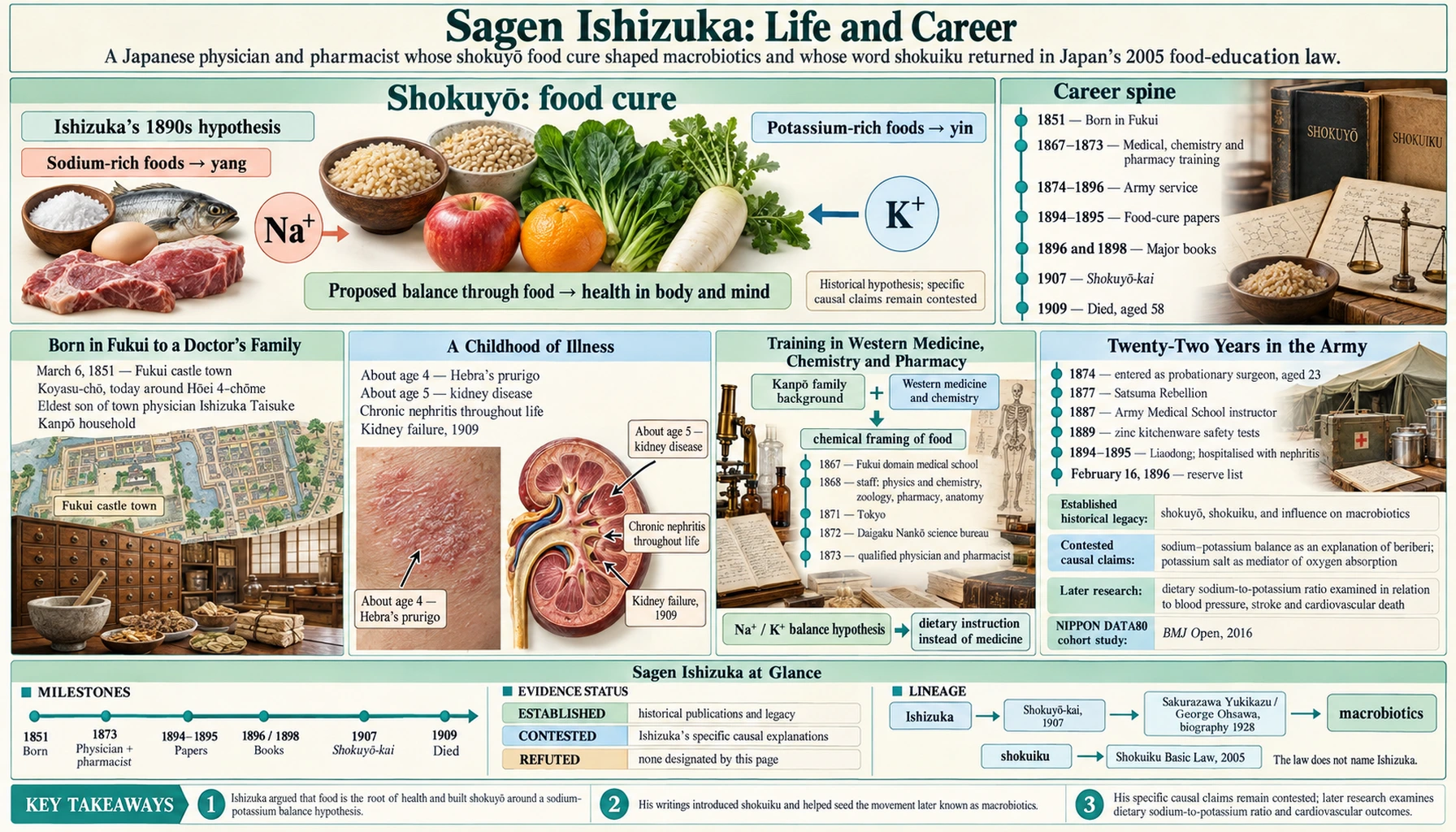
Sagen Ishizuka (石塚左玄, Ishizuka Sagen, 1851–1909) was a Japanese physician and pharmacist who spent twenty-two years in the Imperial Japanese Army and then devoted the rest of his life to a single idea: that food is the root of health in body and mind. He called his method 食養 (shokuyō, “food cure” or “nourishment through food”). It was the seed from which macrobiotics later grew, and in his books he became the first writer to put into print the word 食育 (shokuiku, “food education”), which Japan revived a century later in a national law.
This page tells the story of his life in plain language: a sickly boy from a doctor’s family in Fukui, a Western-style education in medicine and chemistry, a long army career that ended at the senior pharmacist grade, the scientific papers of 1894–95 in which he first set out his theory of sodium and potassium in food, the books of 1896 and 1898, the crowded clinic at his Tokyo home where he prescribed meals instead of medicines, and the society his followers founded around him two years before his death. The facts come from the Japanese historians of his work, from Fukui City and Fukui Prefecture, from the records of his own papers in the journal of the Pharmaceutical Society of Japan, and from the National Diet Library copies of his books as cited in the Japanese reference literature.
Table of Contents
- Born in Fukui to a Doctor’s Family
- A Childhood of Illness
- Training in Western Medicine, Chemistry and Pharmacy
- Twenty-Two Years in the Army
- The Papers of 1894–1895
- The Books of 1896 and 1898
- The Food-Cure Clinic in Tokyo
- Food Doctor, Contrary Doctor, Dr. Daikon
- The Shokuyō-kai and the Groups Before It
- Death in 1909 and Afterwards
- Timeline
- Key Research Papers
- Connections
- Featured Videos
1. Born in Fukui to a Doctor’s Family
Sagen Ishizuka was born on the fourth day of the second month of Kaei 4 in the old lunar calendar, which corresponds to March 6, 1851. (Some English-language summaries give 1850; the Japanese sources, including Fukui City, Fukui Prefecture and the Japanese biographers, agree on 1851.) His birthplace was the castle town of the Fukui domain, in the district then called Koyasu-chō, today around Hōei 4-chōme in Fukui City.
The family name came from Ishizuka village, a farming village near the castle town, where his grandfather Soan (素庵) had his roots. His father, Ishizuka Taisuke (石塚泰輔), was a town physician (町医師 machi-ishi), described by Japanese sources as a practitioner of 漢方 (kanpō), the traditional Chinese-derived medicine of Japan. Sagen was the eldest son. He therefore grew up in a household where medicine was the family trade and where the old herbal and dietary ideas of kanpō, including its language of yin and yang, were part of everyday life.
Fukui honours him today as a son of the city. The city’s food-education office and the prefecture’s series of stories from the late Edo and Meiji eras both present him as 食育の祖 (shokuiku no so), “the father of food education”, a modern title that reflects the revival of his word in the twenty-first century.
2. A Childhood of Illness
From early childhood Ishizuka was unwell. By about the age of four he had a stubborn, itching skin disease, which his biographer Fujii Yoshihiro records under the old European name “Hebra’s prurigo”. From about the age of five he also had kidney disease, which became the chronic nephritis (inflammation of the kidneys) that he carried for the rest of his life and that eventually ended it.
The Japanese accounts treat this lifelong illness as part of his story. A boy who could not take his own health for granted, and who grew up beside a father who treated patients, became a man who spent decades asking what in daily life, and above all in daily food, keeps the body well or makes it sick. His own illness returned at key moments of his career: it put him in hospital during the Sino-Japanese War (section 4) and it was the cause of his death at fifty-eight (section 10).
3. Training in Western Medicine, Chemistry and Pharmacy
Ishizuka came of age just as Japan was opening to Western science. In 1867 he studied at the Fukui domain’s medical school (医学所 igakusho). The next year, 1868, the school took him on as staff, and according to Fujii he taught and researched physics and chemistry, zoology, pharmacy and anatomy there. Japanese Wikipedia, drawing on his books, says he studied anatomy and other subjects through Dutch and other European languages, and Fujii adds that in 1868 he copied out a Dutch astronomy book by hand. In 1869 he became an assistant reading instructor (助句読師) for the domain, and in 1870 a dispenser (調合方 chōgōkata), that is, a pharmacist, at the domain hospital.
In 1871 he went to Tokyo to rely on Hashimoto Tsunatsune (橋本綱常), a senior physician from his home domain. In 1872 he was hired by the science bureau of Daigaku Nankō (大学南校), one of the forerunners of the University of Tokyo, and in 1873 he qualified as both a physician and a pharmacist (医師と薬剤師の資格). He then worked as an assistant in the medical bureau of the Ministry of Education.
The sources describe his training in two ways. Fukui City says he studied kanpō medicine, while Japanese Wikipedia and Fujii describe a Western, Dutch-language education in medicine, chemistry and pharmacy. Both fit the facts: he came from a kanpō household, and he was formally trained in Western medicine and chemistry. That double inheritance shows in his later writing, which uses the vocabulary of nineteenth-century chemistry (“natron salts” and “kali salts”) side by side with the traditional ideas of yin and yang.
4. Twenty-Two Years in the Army
In 1874, aged twenty-three, Ishizuka entered the Imperial Japanese Army as a probationary surgeon (軍医試補 gun’i shiho). He soon moved over to the army’s pharmacy service and climbed its grades through the late 1870s and 1880s. He rose to 陸軍薬剤監 (rikugun yakuzai-kan), army pharmacist-superintendent, the senior pharmacist grade. (The sources agree on that final rank but disagree on the year he reached it.) Fujii explains that the pharmacist-superintendent led the army pharmacists and was responsible for medicines and medical supplies, including shipping them to the field hospitals.
He served in two wars. In 1877 he went to the Satsuma (Seinan) Rebellion; Fukui Prefecture notes that a photograph of him was taken in Tokyo just before he left. In 1894–95, during the First Sino-Japanese War, he went with his division to the Liaodong peninsula, where his chronic nephritis flared and he was hospitalised. He recovered after returning home.
Between the wars he taught. On February 28, 1887, he was appointed an instructor at the Army Medical School (陸軍軍医学舎), as recorded in the official gazette (官報 kanpō, a different word from the medicine). His scientific work in these years was practical pharmacy and food safety: in 1889 he published in the journal of the Pharmaceutical Society of Japan a report on whether zinc kitchenware was safe to use, with the results of his own tests. The gazette also records his honours: the Order of the Rising Sun, fifth class, in 1886; Junior Sixth Rank in 1891; and the Order of the Sacred Treasure, fourth class, in 1894.
On February 16, 1896, he was placed on the reserve list (予備役 yobieki), ending about twenty-two years of active service. English-language summaries describe him as retiring as the army’s “chief military pharmacist”. (One Fukui City page calls him a major general; no other source says so, and the rank was a pharmacist rank, not a general’s.)
5. The Papers of 1894–1895
While still in uniform, Ishizuka began to publish the ideas that made his name. In 1890s Japan the great medical question of the day was 脚気 (kakke), beriberi, which struck soldiers and sailors who lived on polished white rice. The navy had cut its beriberi cases in the 1880s by changing the sailors’ diet, and army units used rations of rice mixed with barley. Ishizuka offered his own chemical explanation. Already in 1894, according to the historian Namimatsu Nobuhisa, he argued that the barley-rice ration worked because of its balance of sodium and potassium salts, and he wrote that beriberi, too, came from too much sodium salt and too little potassium salt.
His papers appeared in 藥學雜誌 (Yakugaku Zasshi), the journal of the Pharmaceutical Society of Japan. The titles show the shape of his doctrine:
- 人類ハ穀食動物ナリ, “Humankind Is a Grain-Eating Animal” (June 1894), his first published food-cure paper.
- 飲食品化學的鹽類論, “A Chemical Theory of the Salts in Food and Drink”, in two parts (1894).
- 食物中ノ加里鹽ハ酸素吸収ノ媒介者ナリ, “Potassium Salt in Food Is the Mediator of Oxygen Absorption” (1895).
- 食物中夫婦亞兒加里ノ性質論, “On the Properties of the Husband-and-Wife Alkalis in Food” (1895), the paper that named his 夫婦アルカリ論 (fūfu arukari ron), the husband-and-wife alkali theory.
- 入浴ハ亦人體ノ脱鹽法ナリ, “Bathing, Too, Is a Way of Desalting the Human Body” (1895).
In these papers Ishizuka taught that sodium salts and potassium salts are alike yet opposite and complementary, “like husband and wife”, and that health depends on keeping them in the right balance through food. He matched sodium-rich foods (salt, meat, eggs, fish and animal foods) with what kanpō called yang, and potassium-rich foods (vegetables, fruit and plant foods) with yin. The full theory is explained on The Husband-and-Wife Alkali Theory: Sodium and Potassium in Food, and his argument from human teeth and grains on Humans as Grain Eaters: Ishizuka on Teeth, Brown Rice and Whole Foods.
6. The Books of 1896 and 1898
In June 1896, the year he left active service, Ishizuka published 『化学的食養長寿論』 (Kagakuteki Shokuyō Chōjuron, “A Chemical Theory of Food-Cure for Long Life”). Fujii reports that about a thousand copies were printed with financial help from a senior pharmacist-superintendent, so that it was “almost self-published”; Namimatsu calls it privately printed. (Some English sources date it to 1897, which is wrong.) The book opens with the statement 「人類は穀食(粒食)動物なり」, “humankind is a grain-eating (grain-particle-eating) animal”, and on page 276 it contains his famous sentence on food education.
In January 1898 he followed it with a popular version, 『通俗食物養生法』 (Tsūzoku Shokumotsu Yōjōhō, “A Popular Guide to Food for Health”), with the alternative title 『化学的食養体心論』 (“A Chemical Food-Cure Theory of Body and Mind”). Fujii describes it as a best seller that went through twenty-odd editions by the end of 1926. An enlarged seventh edition appeared in December 1909, two months after his death. Its first page states his central principle:
「食は本なり、体は末なり、心はまたその末なり」 — “Food is the root; the body is the branch; and the mind is the branch of that.”
In the introduction of the 1898 book he wrote 「躰育智育才育は即ち食育なり」: “Physical education, intellectual education and the education of ability are, in truth, food education.” He described the book as an easy chemical explanation of the cause and effect that lets one say this, and as a practical guide to food education and food cure that the people of a warm island nation in the East should put into practice at once, beginning with how they combine their dishes. The story of that word is told on Shokuiku: How Sagen Ishizuka Coined “Food Education”, and his whole system on Shokuyō: Sagen Ishizuka’s Food Cure.
His other writings, listed in the Japanese reference literature, span his whole career: a handbook of urine testing (『検尿必携』) and a pharmacy text (『鑑薬精義』), both 1876; an essay on drinking water (『飲水要論』, 1880); the book form of his salts theory (『飲食品化学的塩類論』, 1894); 『礼義廉耻の食養論』 (1904), on food cure and moral character; a commentary on his own food-cure verses (『食養道歌俗解』, vol. 1, 1906); and a chapter on food cure in a 1907 collection on health of body and mind.
7. The Food-Cure Clinic in Tokyo
From the late 1890s Ishizuka received patients at his home in Ichigaya, in Tokyo’s old Ushigome ward. Fukui Prefecture names the practice 石塚食療所 (Ishizuka Shokuryōjo, the Ishizuka Food-Treatment Clinic) and dates its opening to 1896; Namimatsu puts it “around 1898”. By 1898, Japanese Wikipedia records, patients from all over Japan were crowding into it.
He examined patients by 望診 (bōshin), his own method of diagnosis by looking at the patient, and he treated them by instruction in diet. As Fukui Prefecture puts it, a doctor’s prescription normally names a drug, but Sagen’s prescriptions set out what to eat and how.
Fujii, following the 1928 biography by his disciple Sakurazawa Yukikazu, describes the scene. So many people came that Ishizuka limited consultations to a hundred a day and made house calls afterwards. He charged no fee and gave no medicine, only careful dietary instructions written for each patient. Among those who followed him were nobles, senior army officers and members of one of Japan’s great merchant families, and through his lectures around the country word of “the Ishizuka school” (石塚宗) spread widely.
8. Food Doctor, Contrary Doctor, Dr. Daikon
Ishizuka collected several nicknames, and the sources are worth keeping apart:
- 食医 (shokui), “the food doctor”, the name his patients gave him because he prescribed food instead of drugs. Fukui Prefecture titles its article on him 「食医」と呼ばれた食育の祖, “the father of food education who was called the food doctor”.
- 反対医者 (hantai isha), “the contrary doctor”, and 大根医師 (daikon ishi), “Dr. Daikon” (the daikon is the Japanese white radish). Fujii, following Sakurazawa’s biography, writes that he was called these because he directed treatments that ran opposite to those of modern Western medicine.
- English-language histories add others. One reference summary says that many of his Japanese supporters called him “Dr. Miso Soup” and “Dr. Brown Rice”, and English Wikipedia gives “the anti-doctor doctor” and “Doctor Vegetables”. No Japanese source for “Dr. Miso Soup” or “Dr. Brown Rice” was found; “the anti-doctor doctor” and “Dr. Daikon” correspond to the Japanese 反対医者 and 大根医師.
- 食育の祖, “the father of food education”, is a modern title used by Fukui City and Fukui Prefecture.
9. The Shokuyō-kai and the Groups Before It
Ishizuka’s ideas gathered followers before any society carried his name. Around 1892–93, acquaintances from his time with the army’s 4th Division formed the 双塩会 (Sōen-kai, “Double Salt Society”) in Osaka, a food-cure group named for his two salts. In 1905 the 帝国食育会 (Teikoku Shokuiku-kai, Imperial Food Education Society) was founded; it had about three hundred members but had become inactive by 1907.
In 1907 the 食養会 (Shokuyō-kai, Food Cure Society) was founded around Ishizuka and his teaching, first under the name 化学的食養会 (Chemical Food Cure Society). Japanese Wikipedia gives the date as October 17, 1907, and lists Ishizuka as its first president; Fujii, following a later study, says it was formed in November 1907 by members of the Teikoku Shokuiku-kai and officials of the Home Ministry, with Ishizuka as its adviser. Its founders included army men and figures from politics and business. Its monthly magazine, 『食養雑誌』 (Shokuyō Zasshi), began on November 10, 1907. Namimatsu describes the society simply as formed by followers of Ishizuka’s method.
The Shokuyō-kai outlived him by decades and carried his teaching to the generation that turned it into macrobiotics. That story is told on From Shokuyō to Macrobiotics: Ishizuka’s Disciples and Legacy.
10. Death in 1909 and Afterwards
Sagen Ishizuka died on October 17, 1909 (Meiji 42), aged fifty-eight, two years to the day after the date Japanese Wikipedia gives for the Shokuyō-kai’s founding. Japanese Wikipedia, citing a Meiji-era newspaper collection, gives the cause as 萎縮腎 (ishukujin), a shrunken, end-stage kidney, after a lifetime of illness; Fukui Prefecture gives uremia (尿毒症). The two describe the same thing: kidney failure at the end of the chronic nephritis he had had since boyhood. He is buried at Kōmyō-ji temple in Moto-Asakusa, Taitō ward, Tokyo.
His books kept selling. In 1928 his disciple Sakurazawa Yukikazu (桜沢如一), later known in the West as George Ohsawa, published a biography titled simply 『石塚左玄』 through the Shokuyō-kai; Fujii’s modern account of his life follows it. A modern-Japanese translation of the 1898 book, 『食医石塚左玄の食べもの健康法』 (“The Food Doctor Sagen Ishizuka’s Food Health Method”), was published in 2004.
His word 食育 stayed obscure for most of the twentieth century; Fujii reports a survey that found it in none of twenty-eight Taishō- and Shōwa-era dictionaries at the National Diet Library. It came back in the early 2000s, and in 2005 Japan passed the 食育基本法 (Shokuiku Basic Law). The law does not name him, but Fukui City and Japanese scholars regard his idea as its root; the scholar Yamamoto Hinako writes that his idea “is reflected in” the law. Later research has also returned to the subject at the centre of his work, the balance of sodium and potassium in the diet, and Japanese cohort studies have examined the dietary sodium-to-potassium ratio in relation to blood pressure, stroke and cardiovascular death (for example the NIPPON DATA80 study listed below).
11. Timeline
| Year | Event |
|---|---|
| 1851 | Born March 6 (Kaei 4, 2nd month, 4th day) in the Fukui castle town, eldest son of the town physician Ishizuka Taisuke. |
| c. 1855–1856 | Itching skin disease from about age 4; kidney disease from about age 5, later chronic nephritis. |
| 1867 | Studies at the Fukui domain medical school. |
| 1868 | Joins the domain medical school, teaching physics and chemistry, zoology, pharmacy and anatomy. |
| 1869–1870 | Assistant reading instructor for the domain (1869); dispenser at the domain hospital (1870). |
| 1871 | Goes to Tokyo under the patronage of Hashimoto Tsunatsune. |
| 1872 | Hired by the science bureau of Daigaku Nankō. |
| 1873 | Qualifies as physician and pharmacist; assistant in the Ministry of Education’s medical bureau. |
| 1874 | Enters the army as a probationary surgeon, aged 23. |
| 1876 | Joins the army pharmacy service; publishes a urine-testing handbook and a pharmacy text. |
| 1877 | Serves in the Satsuma (Seinan) Rebellion. |
| 1880 | Publishes an essay on drinking water. |
| 1886 | Order of the Rising Sun, fifth class. |
| 1887 | Instructor at the Army Medical School (February 28). |
| 1889 | Paper on the safety of zinc kitchenware in the journal of the Pharmaceutical Society of Japan. |
| 1891 | Junior Sixth Rank. |
| c. 1892–1893 | Followers form the Sōen-kai (Double Salt Society) in Osaka. |
| 1894 | “Humankind Is a Grain-Eating Animal” (June) and “A Chemical Theory of the Salts in Food and Drink”; Order of the Sacred Treasure, fourth class. |
| 1894–1895 | Sino-Japanese War: goes to Liaodong, hospitalised when his nephritis worsens. |
| 1895 | Papers on potassium and oxygen, on the husband-and-wife alkalis, and on bathing as desalting. |
| 1896 | Placed on the reserve list (February 16) as army pharmacist-superintendent; publishes Kagakuteki Shokuyō Chōjuron (June). |
| Late 1890s | Runs a food-cure clinic at his home in Ichigaya, Tokyo; patients come from all over Japan. |
| 1898 | Publishes Tsūzoku Shokumotsu Yōjōhō (January), the popular version of his theory. |
| 1904 | Publishes a book on food cure and moral character. |
| 1905 | The Teikoku Shokuiku-kai (Imperial Food Education Society) is founded. |
| 1906 | Commentary on his food-cure verses, vol. 1. |
| 1907 | The Shokuyō-kai is founded around him and his teaching; Shokuyō Zasshi begins (November 10). |
| 1909 | Dies October 17 of end-stage kidney disease, aged 58; enlarged 7th edition of the 1898 book (December). |
| 1928 | Sakurazawa Yukikazu (George Ohsawa) publishes the biography 『石塚左玄』. |
| 2005 | Japan’s Shokuiku Basic Law revives his word shokuiku. |
Sources for these dates: Japanese Wikipedia’s article 石塚左玄 (which cites his books on the National Diet Library Digital Collection and the official gazette) and its article on the Shokuyō-kai; Fukui City’s introduction to Ishizuka Sagen; Fukui Prefecture’s story no. 47; and the studies by Fujii (2014) and Namimatsu (2015) listed under Further Reading below.
Key Research Papers
- Ishizuka S. 亞鉛厨房具用否ノ參照及ヒ試驗成績 [On whether zinc kitchenware may be used, with test results]. Yakugaku Zasshi. 1889;(91):640-61. — DOI: 10.1248/yakushi1881.1889.91_640
- Ishizuka S. 人類ハ穀食動物ナリ [Humankind is a grain-eating animal]. Yakugaku Zasshi. 1894;(148):532-8. — DOI: 10.1248/yakushi1881.1894.148_532
- Ishizuka S. 飲食品化學的鹽類論 [A chemical theory of the salts in food and drink]. Yakugaku Zasshi. 1894;(149):650-67. — DOI: 10.1248/yakushi1881.1894.149_650
- Ishizuka S. 飲食品化學的鹽類論(續キ) [A chemical theory of the salts in food and drink, continued]. Yakugaku Zasshi. 1894;(151):886-901. — DOI: 10.1248/yakushi1881.1894.151_886
- Ishizuka S. 食物中ノ加里鹽ハ酸素吸収ノ媒介者ナリ [Potassium salt in food is the mediator of oxygen absorption]. Yakugaku Zasshi. 1895;(153):1066-73. — DOI: 10.1248/yakushi1881.1895.153_1066
- Ishizuka S. 第三章 食物中夫婦亞兒加里ノ性質論 [On the properties of the husband-and-wife alkalis in food]. Yakugaku Zasshi. 1895;(155):48-58. — DOI: 10.1248/yakushi1881.1895.155_48
- Ishizuka S. 第四章 入浴ハ亦人體ノ脱鹽法ナリ [Bathing, too, is a way of desalting the human body]. Yakugaku Zasshi. 1895;(156):150-9. — DOI: 10.1248/yakushi1881.1895.156_150
- 山本妃奈子. 石塚左玄の「食養道」における栄養教育的意義:健康食の思想と栄養教育との関連から [The significance for nutrition education of Ishizuka Sagen’s way of food cure]. Hiroshima Bunkyo Daigaku Kiyo. 2025;60:34-47. — DOI: 10.51095/kiyo.60.04
- 河野公子. 食育 [Food education]. Nippon Shokuhin Kagaku Kogaku Kaishi. 2007;54(4):204. — DOI: 10.3136/nskkk.54.204
- 宝蔵もと子. 胚芽米・七分搗き米・玄米論争をめぐる系譜 [The genealogy of the germ-rice, 70%-milled rice and brown-rice debate]. Nihon Kaseigakkai Kenkyu Happyo Yoshishu. 2017;69:25. — DOI: 10.11428/kasei.69.0_25
- Sugiyama Y, Seita A. Kanehiro Takaki and the control of beriberi in the Japanese Navy. J R Soc Med. 2013;106:332-4. — PubMed PMID: 23897451
- Itokawa Y. Kanehiro Takaki (1849-1920)—a biographical sketch. J Nutr. 1976;106:581-8. — PubMed PMID: 772183
- Okayama A, Okuda N, Miura K, Okamura T, Hayakawa T, Akasaka H, et al. Dietary sodium-to-potassium ratio as a risk factor for stroke, cardiovascular disease and all-cause mortality in Japan: the NIPPON DATA80 cohort study. BMJ Open. 2016;6:e011632. — PubMed PMID: 27412107
- Oberländer C. The rise of scientific medicine in Japan: beriberi as the driving force in the quest for specific causes and the introduction of bacteriology. Hist Sci (Tokyo). 2004;13:176-99. — PubMed PMID: 15212048
PubMed Topic Searches
- https://pubmed.ncbi.nlm.nih.gov/?term=beriberi+Japan+history
- https://pubmed.ncbi.nlm.nih.gov/?term=shokuiku
- https://pubmed.ncbi.nlm.nih.gov/?term=macrobiotic+diet
- https://pubmed.ncbi.nlm.nih.gov/?term=sodium+potassium+ratio+Japan
Further Reading
- 藤井義博. 石塚左玄の食育食養法:栄養療法の知的枠組についての研究11 [Ishizuka Sagen’s food-education and food-cure method]. Bulletin of the Faculty of Human Life Sciences, Fuji Women’s University. 2014;51:25-38. — Repository record
- 並松信久. 近代日本における食養論の展開 [The development of food-cure theory in modern Japan]. Bulletin of the Institute of Japanese Culture, Kyoto Sangyo University. 2015;20. — Handle: 10965/1239