Max Theiler: The Yellow Fever Vaccine, and the 17D Strain That Still Protects You
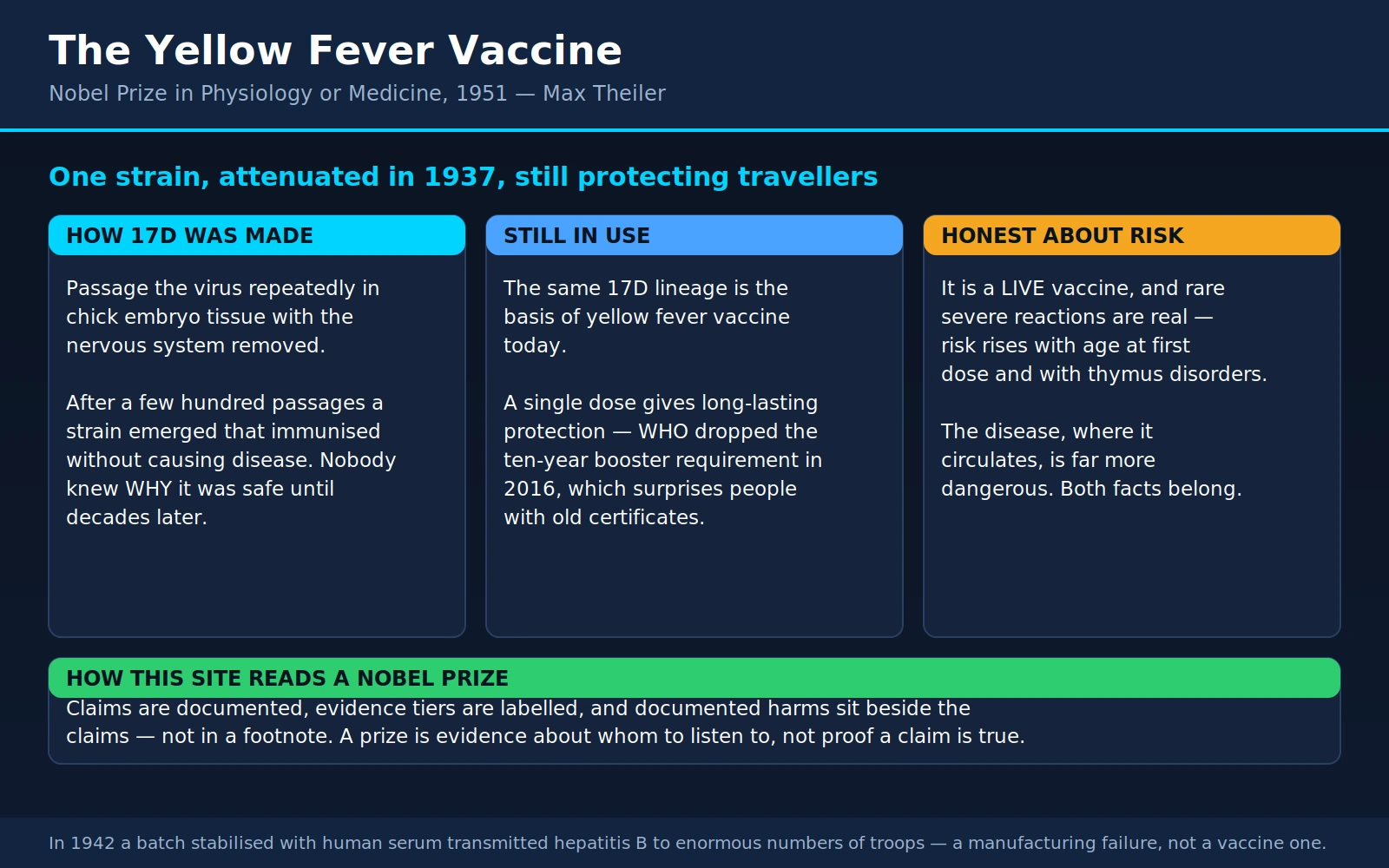
Table of Contents
- The Man Who Never Took the Doctorate
- What Yellow Fever Is, and What It Does
- Reed, Lazear, and the Mosquito
- The Laboratory Problem — and the Mouse
- The 17D Strain, 1937
- Why 17D Is Remarkable
- The Honest Safety Record
- The 1942 Contamination Disaster
- Yellow Fever Today
- What a Traveller Actually Needs to Know
- Live-Attenuated Vaccines as a Class
- Where Mainstream Medicine Agrees / What Remains Debated
- Key Research Papers
- Connections
- Featured Videos
1. The Man Who Never Took the Doctorate
Max Theiler (1899–1972) received the Nobel Prize in Physiology or Medicine in 1951 for the yellow fever vaccine. In the seventy-odd years since, no one else has won a Medicine Nobel for developing a virus vaccine. Erling Norrby, who went through the Nobel Committee's own archives for the story, put it flatly in the title of his account: this was the only Nobel Prize for a virus vaccine — the first, and so far the last.
He was born in Pretoria, South Africa, on 30 January 1899, the youngest child of Sir Arnold Theiler, a Swiss-born veterinary bacteriologist who had emigrated to the Transvaal and become the dominant figure in South African animal disease research — horse sickness, East Coast fever, the mineral deficiencies that were wrecking cattle on the veld. Max grew up around a working laboratory and around the specific intellectual habit that shaped his career: the belief that if you want to understand a disease, you find an animal you can give it to. His father had spent a life doing that with livestock. His son would do it with mice.
What makes the 1951 prize quietly delicious is Theiler's paperwork. He entered the medical school of the University of Cape Town, then finished his training in London rather than in a university faculty, qualifying in 1922 by the licentiate route of the English royal colleges together with a diploma from the London School of Hygiene and Tropical Medicine. It was a legitimate licence to practise medicine. It was not a doctorate. Max Theiler never held an M.D. He spent his career surrounded by people who did, was appointed to Harvard's Department of Tropical Medicine in 1922 without one, joined the Rockefeller Foundation's International Health Division in New York in 1930 without one, and collected the highest honour in medicine in 1951 still without one. He ended his career as a professor of epidemiology and public health at Yale, a post he held from 1964 to 1967, having produced one of the most successful medicines in history without ever writing a thesis.
Theiler was, by every account, an unshowy man: a reader of detective novels and cricket scores, sceptical of grand theory, allergic to publicity. When a journalist asked what he would do with the prize money he is said to have replied that he would buy books and Scotch. He was also a good deal more than a one-idea scientist. In 1934 he described a paralytic disease of laboratory mice caused by a virus that now carries his name — Theiler's murine encephalomyelitis virus, characterised in detail in a 1940 paper with Sven Gard. That virus remains, ninety years later, one of the standard animal models used to study multiple sclerosis. Most researchers would take that as a career. For Theiler it is a footnote.
This page is about the main event: how a virus that killed people in port cities from Philadelphia to Rio was turned into a single injection that has now protected roughly a billion arms, and what that injection genuinely costs in risk — because it is not zero, and the honest version of this story is better than the tidy one.
2. What Yellow Fever Is, and What It Does
Yellow fever is caused by a flavivirus — the same family as dengue, Zika, West Nile and Japanese encephalitis — and it is spread by mosquitoes, above all Aedes aegypti, the same small striped, daytime-biting, city-dwelling mosquito that spreads dengue and Zika. It is not a jungle-only disease and never was. Aedes aegypti breeds in water barrels, cisterns, flowerpots, discarded tyres and roof gutters. It is a domestic animal, and that is precisely what made yellow fever a disease of towns.
The two faces of the infection
Most people who catch yellow fever do not get the disease that made it famous. Infection is often silent, or produces a few days of fever, headache, muscle ache and nausea that resolve on their own and would be recorded, if recorded at all, as "a bad flu." That is the ordinary outcome.
A minority of people, after an apparent recovery lasting a day or so, enter what clinicians call the toxic phase, and this is a different disease altogether. The fever returns. The liver fails, and with it comes the jaundice that gives the illness its name — the yellowing of the skin and the whites of the eyes as bilirubin the liver can no longer clear accumulates in the blood. Clotting fails, because the liver makes clotting factors: patients bleed from the gums, the nose, the injection sites, and into the stomach, where blood is partly digested and then vomited as the black, granular material that seventeenth- and eighteenth-century observers called vómito negro — the black vomit. The kidneys shut down. Some patients become delirious, then comatose. Among those who reach the toxic phase, death is common; the figure the World Health Organization quotes in its public guidance is that about half die within seven to ten days of the toxic phase beginning. Those who survive it generally recover fully, and are immune for life.
There is still no antiviral drug for yellow fever. Treatment is supportive — fluids, blood products, dialysis, intensive care. That fact is the whole reason the vaccine matters as much as it does. For most of the diseases on this site there is a treatment to fall back on if prevention fails. For yellow fever, in 2026, there is essentially nothing but nursing.
Why it shaped the map
Yellow fever is one of a handful of diseases that visibly bent history. The virus almost certainly originated in Africa and travelled to the Americas in the holds of slave ships, along with the mosquito that carries it — Aedes aegypti breeds happily in the water casks of a sailing vessel, which is as neat a description of an epidemic delivery system as exists.
In the Caribbean it repeatedly destroyed European armies. In North America it reached far further north than people expect: the Philadelphia epidemic of 1793 emptied the city, killed something on the order of a tenth of its population, and drove the federal government out of town. New Orleans, Memphis, Havana, Rio de Janeiro and the ports of West Africa lived with it as a recurring terror, and quarantine flags and shotgun cordons became part of civic life.
And it broke the first attempt at the Panama Canal. The French company under Ferdinand de Lesseps, fresh from Suez, began work in 1881 and abandoned it in 1889, financially ruined and having lost many thousands of workers to yellow fever and malaria — the hospitals in Panama were, in a detail that is almost too grim to be true, keeping the legs of patients' beds standing in bowls of water to deter ants, which produced ideal mosquito nurseries at every bedside. When the Americans returned to the isthmus in 1904 they came with William Gorgas and a mosquito-control campaign that had already cleared yellow fever out of Havana, and the canal was finished. The engineering did not change much between the two attempts. The entomology did.
3. Reed, Lazear, and the Mosquito
Theiler's vaccine sits on top of an earlier discovery that has its own honour roll, and it is worth pausing on it, because none of the people who made it won a Nobel Prize.
The Cuban physician Carlos Finlay proposed in 1881 that yellow fever was carried by a mosquito. He was largely disregarded for twenty years; his experiments were not convincing and the germ theory of the day was still preoccupied with bacteria. He was, nonetheless, right.
In 1900, the US Army sent a commission to Havana under Walter Reed to settle the question. Its members — Reed, James Carroll, Aristides Agramonte and Jesse Lazear — ran a series of human experiments that would be ethically unthinkable today and that were, in their own time, already understood to be dangerous: volunteers were bitten by mosquitoes that had previously fed on yellow fever patients, and volunteers were made to sleep in a sealed hut on the soiled bedding and clothing of the dead to test the rival "fomite" theory. The bedding sleepers stayed well. The mosquito-bitten volunteers got yellow fever. Finlay was vindicated, the fomite theory collapsed, and Gorgas was handed the tool that cleared Havana and then Panama.
Jesse Lazear died of yellow fever on 25 September 1900, aged thirty-four, having been bitten during the work. James Carroll contracted the disease too, survived it, and died a few years later of complications generally attributed to it. Walter Reed himself was dead of a ruptured appendix by 1902. The Nobel Prize in Physiology or Medicine was first awarded in 1901; none of them ever received one, and Finlay was nominated repeatedly and never selected. If you want a single sentence about how the Nobel record actually maps onto medical progress, that is a good one — and it is the same lesson our page on prizes that aged badly approaches from the other direction.
The mosquito discovery mattered enormously and it did not solve the problem. Vector control works where you can afford to do it street by street, cistern by cistern; it does not work across the forests of the Amazon and the Congo basin, where the virus circulates permanently between monkeys and canopy-dwelling mosquitoes and spills over into humans who go into the trees. To get rid of yellow fever as a threat to individual people rather than to individual cities, you needed a vaccine. That is where Theiler comes in.
4. The Laboratory Problem — and the Mouse
By the late 1920s the yellow fever agent had finally been pinned down. In 1927 a Rockefeller Foundation team in Accra, on the Gold Coast, isolated the virus from a young Ghanaian man named Asibi and passed it into rhesus monkeys. The Asibi strain is the ancestor of every dose of yellow fever vaccine given anywhere in the world today, and it carries that man's name.
Having the virus in monkeys was a breakthrough and an obstacle at once. Rhesus monkeys were expensive, hard to obtain, hard to keep, and they died. Every experiment cost real money and a real animal, which meant nobody could run the hundreds of parallel comparisons that virology actually requires. Worse, working with the virus was lethal to the workers. The Rockefeller yellow fever programme lost Adrian Stokes in 1927, Hideyo Noguchi and William Young in 1928, and Paul Lewis in 1929, all to laboratory-acquired yellow fever. Theiler himself contracted the infection during this period, was seriously ill, and recovered — which left him with lifelong immunity and made him, for the rest of his career, one of the few people in the building who could handle the virus without becoming the next name on that list.
The mouse
Theiler's first great contribution was to make the virus cheap to study. In a brief note in Science in April 1930, and at length in the Annals of Tropical Medicine and Parasitology the same year, he reported that ordinary white mice could be infected with yellow fever virus if it was injected directly into the brain. Nobody had managed it before because they had been injecting mice the way you would infect a monkey — under the skin — and by that route mice are resistant.
The consequences were immediate. A mouse costs almost nothing. You can use hundreds. Suddenly it was possible to titrate the virus, to test whether a serum neutralised it, to survey whole populations for past infection, and to run the serial-passage experiments that the next step depended on. The mouse protection test became the standard tool for mapping where yellow fever had been, and much of what was then learned about the geography of the disease in Africa and South America came out of it.
What passage does, and what "attenuation" actually means
Then Theiler noticed something stranger and much more important. As he passed the virus from mouse brain to mouse brain, over and over, the virus changed. It became better and better at killing mice by the brain route — more neurotropic, more nerve-loving. And at the same time it became worse at doing what it does in a human being or a monkey: it lost much of its ability to attack the liver and the other internal organs. It became less viscerotropic.
This is the central idea of the whole field, and it is worth stating in plain language, because it sounds like magic and is not. A virus is not a fixed object. Every time it copies itself it makes small errors, and a population of virus in a flask or an animal is a swarm of slightly different variants. Whichever variants happen to grow best in the environment you have put them in will come to dominate the swarm. So if you grow a virus for long enough in an environment that is nothing like a human being, you are running a breeding programme — and what you are breeding for is a virus that is very good at living in mouse brain or chicken cells and correspondingly clumsy at causing the disease you actually care about. That is attenuation. You are not weakening the virus in some general sense; you are making it specialised for the wrong host.
The catch, which nearly sank the whole enterprise, is that Theiler's mouse-adapted virus had been bred to be better at attacking nervous tissue. A French group at the Pasteur Institute in Dakar took a mouse-adapted strain down exactly this road and produced the French neurotropic vaccine, which was administered by scratching it into the skin, was used on an enormous scale in French West Africa, and did genuinely suppress yellow fever there. It also caused encephalitis, particularly in children, at a rate that would be intolerable today. It was eventually withdrawn. Theiler's problem, from about 1932 onwards, was to attenuate the virus for the liver without making it a brain virus in the process.
5. The 17D Strain, 1937
The solution was to stop using animals and start using tissue culture, and then to be very careful about which tissue.
Theiler and his colleague Hugh Smith grew the Asibi virus in flasks containing minced embryonic tissue, in long unbroken series lasting years, and they ran several lines in parallel with different tissue in the medium. Their 1937 report in the Journal of Experimental Medicine lays out the comparison with unusual clarity. Virus grown for over three years in whole mouse embryo changed very little: slightly less able to kill monkeys through the bloodstream, but with its neurotropic virulence entirely intact. Virus grown in testicular tissue lost much of its liver tropism but still produced fatal encephalitis when injected into a monkey's brain.
The line that worked was the one grown in chick embryo tissue from which the head and the spinal cord had been removed. That single procedural decision — dissecting the nervous system out of the substrate before mincing it into the medium — is the hinge of the whole story. It meant the virus was being cultured in an environment that offered it no nervous tissue to adapt to. Whatever the swarm was being selected for, it was not neurovirulence.
Theiler and Smith described the result in their own summary: the viscerotropic virulence was largely lost, monkeys inoculated under the skin developed only a very mild generalised infection with minimal virus in the blood, and — the crucial sentence — virus injected directly into a monkey's brain no longer produced a fatal encephalitis, but only a moderate fever, followed by recovery and solid immunity against subsequent challenge with fully virulent virus. They had a virus that could not kill a monkey by either route and that still produced protective immunity.
The subculture that emerged from this line was labelled 17D. In the companion paper published in the same issue of the same journal, Theiler and Smith reported the first human use: eight normal volunteers vaccinated with the culture virus, minimal reactions, the highest temperature recorded after vaccination being 37.4 °C, and yellow fever antibodies present in all eight when their serum was tested two to four weeks later.
Two field-scale programmes followed almost immediately, the largest in Brazil, where hundreds of thousands and then millions of people were vaccinated from 1937 onward. The vaccine worked. It has essentially not changed since.
The honest part: nobody knew why
It is important to say this plainly, because the retellings tend to skate over it. Theiler did not know why 17D was safe. Nobody did. The attenuation was entirely empirical — a long series of passages, several parallel lines, one of which happened to come out right, and a set of monkey experiments demonstrating that it was attenuated without any account of how. Theiler said as much himself. He could not have told you which mutations mattered, because in 1937 the concept of a viral genome as a readable sequence did not exist.
The molecular comparison had to wait fifty years. In 1987, Hahn, Dalrymple, Strauss and Rice sequenced the virulent Asibi strain and set it against 17D, which by then was separated from its parent by more than 240 passages. The two genomes are 10,862 nucleotides long and differ at just 68 nucleotide positions, producing 32 amino acid changes — about 0.63 per cent of the sequence. The changes are scattered, most of the major non-structural proteins are barely touched, and the concentration of change is in the envelope protein, which carries twelve amino acid substitutions, many of them non-conservative. The envelope protein is what the virus uses to attach to and enter host cells, so the authors' inference — that altered receptor binding accounts for much of the lost neurotropism and viscerotropism — is the obvious one.
Even so, there is still no single identified "attenuation gene" for 17D, no one mutation you could point to and say that is what makes it safe. The safety is distributed across a set of changes acquired by accident and preserved by the seed-lot system described below. A vaccine that has protected close to a billion people is, at bottom, a lucky flask that everyone has since been extremely careful not to disturb.
The seed-lot system
That care has a name. Because 17D is a live virus that mutates every time it replicates, continuing to passage the working stock indefinitely would eventually drift it into something else — possibly something less protective, possibly something less safe. The fix, adopted after early production problems, is the seed-lot system: a frozen master seed is held under lock, a limited number of passages are permitted between that seed and the vial in the clinic, and no manufacturer is allowed to keep passaging the vaccine to make more vaccine. Every dose given today is a small, tightly bounded number of steps from a stock laid down decades ago. It is the reason a strain attenuated by uncontrolled drift can be manufactured safely by controlling drift.
Two substrains descend from Theiler's original line and are both in use: 17D-204, used by most manufacturers, and 17DD, used in Brazil. They differ by a handful of passages and a small number of nucleotides. Both are the 1937 virus.
6. Why 17D Is Remarkable
Set beside almost any other vaccine, 17D is an outlier on several axes at once.
- It is nearly ninety years old and has not been replaced. Every licensed yellow fever vaccine in the world descends from Theiler's 1937 flask. Nothing has been produced that is better enough to displace it. Compare influenza, where the vaccine is rebuilt every year, or the acellular pertussis switch, or the constant iteration in the pneumococcal conjugates.
- One dose is enough, and the protection lasts. Seroconversion after a single standard dose is very high — the high nineties as a percentage — and it arrives fast. In Theiler's own monkey work, resistance to challenge was already present seven days after vaccination; in humans the conventional figure used by health authorities is that protection is established by ten days, which is why the international certificate becomes valid on the tenth day.
- The booster requirement was abolished, not quietly forgotten. For decades the International Health Regulations required revaccination every ten years, and a great many people still hold certificates stamped with a ten-year expiry. In 2013 a systematic review by Gotuzzo, Yactayo and Córdova examined thirty-six studies and twenty-two reports covering immunogenicity, duration of immunity, and vaccine response in particular groups — infants and children, pregnant women, people with HIV, severely malnourished children — and concluded that a single dose of yellow fever vaccine is highly immunogenic and confers sustained lifelong protective immunity, so that a booster dose is not needed. WHO adopted that position in its 2013 position paper, the International Health Regulations annex was amended accordingly, and from 11 July 2016 the international certificate of vaccination against yellow fever has been valid for the life of the person vaccinated.
If you are looking at an old yellow card with a ten-year expiry date printed on it: that certificate did not stop being valid. Under the current regulations it is valid for life, expiry stamp or not. Some national authorities and some travel clinics still advise a booster for particular situations — see the debated points in section 12 — but the certificate itself no longer expires.
- It is one of the cheapest effective vaccines in existence. It is grown in embryonated chicken eggs by a process that has not fundamentally changed in decades, which is both its great virtue and, as section 9 explains, the reason the world cannot make it fast enough in an emergency.
- It set the template. The 17D backbone has since been used as a chassis for engineered chimeric flavivirus vaccines — the licensed dengue vaccine CYD-TDV is built on it, replacing the yellow fever envelope genes with dengue ones. Theiler's virus is still doing work he could not have imagined.
7. The Honest Safety Record
Here is the section that most popular accounts skip, and the reason this page is worth writing at all.
17D is a live virus. When you are vaccinated, the attenuated virus replicates in you — that is how it produces such durable immunity, and it is also the source of the risk. Most people get nothing worse than a sore arm, and perhaps a few days of headache, mild fever and aching that peak around the end of the first week. But in a small number of people, the vaccine virus behaves like the wild virus, and when that happens the results can be severe or fatal.
The two serious syndromes
YEL-AVD — yellow fever vaccine-associated viscerotropic disease — is the vaccine virus doing what wild yellow fever does: replicating in the liver and other organs and producing a multisystem illness that, as Seligman put it in his 2014 review, "resembles the disease it was designed to prevent." It was not recognised at all until reports began appearing in 2001. It is rare and it is lethal in a large proportion of the people who develop it: across the sixty-four cases Seligman analysed, the overall case-fatality rate was 66 per cent.
YEL-AND — yellow fever vaccine-associated neurotropic disease — is inflammation of the brain or of the nerves: encephalitis, Guillain-Barré syndrome, or acute disseminated encephalomyelitis appearing in the weeks after vaccination. It is generally less lethal than YEL-AVD and most patients recover, though recovery can be slow and is not always complete.
How often
Rates from passive surveillance are floors, not true incidences — they count events somebody bothered to report to a reporting system, divided by doses distributed rather than doses actually given. Read them as "at least this often," not "exactly this often."
The most useful single dataset is the US Vaccine Adverse Event Reporting System. Lindsey and colleagues analysed 2007–2013 and found 938 adverse-event reports after yellow fever vaccination, of which 84 (9 per cent) were classified as serious — a reporting rate of 3.8 serious adverse events per 100,000 doses distributed. Within that, YEL-AND was reported at 0.8 per 100,000 and YEL-AVD at 0.3 per 100,000 doses distributed. Anaphylaxis was reported at 1.3 per 100,000, and was highest in people aged 18 and under. Seligman's review of the international YEL-AVD literature notes the same 0.3–0.4 per 100,000 figure from US passive surveillance while pointing out that other published estimates range from zero to as high as 12 per 100,000 in particular settings — which is an honest way of saying the true rate is uncertain and depends heavily on who is being vaccinated.
Who is at higher risk
Age is the clearest risk factor, and it is age at first vaccination that matters. Lindsey's data show serious adverse event reporting rates climbing steeply with age: 3.8 per 100,000 overall, 6.5 per 100,000 in people aged 60–69, and 10.3 per 100,000 in those aged 70 and over. An earlier CDC analysis by Khromava and colleagues, covering 722 reports from 1990–2002, found the reporting rate of serious adverse events significantly higher in vaccinees aged 60 and over than in those aged 19–29 — a reporting rate ratio of 5.9 (95% CI 1.6–22.2). Note how wide that confidence interval is; the direction of the effect is solid, the exact multiple is not.
The thymus is the strangest and most specific risk factor. People who have had the thymus gland removed — usually because of a thymoma, a tumour of that gland — are a statistically confirmed risk group for YEL-AVD. So are people with a range of autoimmune diseases. Seligman's confirmed risk groups (elderly men, women aged roughly 19–34, people with various autoimmune conditions, and people thymectomised for thymoma) between them accounted for 77 per cent of the known cases and 76 per cent of the deaths. The case-fatality rate among young women in that series was strikingly high — 12 of 15 — though on small numbers.
Any history of thymus disease or thymectomy is therefore a hard stop, and it is worth saying explicitly because most people have no idea the thymus is relevant to anything and will not think to mention it.
Who should not receive it
The standard contraindications, in the form clinicians actually apply them:
- Infants below the threshold age. The vaccine is not given under six months of age at all — the risk of YEL-AND in very young infants is the reason — and vaccination between six and eight months is normally avoided and reserved for situations where the risk of the disease itself is high and immediate.
- Significant immunosuppression. This includes active leukaemia and lymphoma, generalised malignancy, transplant recipients, people on high-dose corticosteroids or on biologic and cytotoxic immunosuppressive drugs, and people with symptomatic HIV or a substantially depleted CD4 count. The principle is general to live vaccines and is discussed in section 11.
- Thymus disorder, or thymectomy for thymoma, as above — including myasthenia gravis treated by thymectomy.
- Severe allergy to eggs, egg products, chicken proteins or gelatin. The vaccine is grown in chicken embryos.
- Pregnancy and breastfeeding are precautions rather than absolute bars: the vaccine is normally deferred, but may be given if travel to an area of genuine ongoing transmission is unavoidable. There are documented cases of YEL-AND in breastfed infants of recently vaccinated mothers, which is why breastfeeding is treated as a precaution rather than ignored.
Where a traveller has a genuine contraindication but a destination that legally requires a certificate, the usual route is a signed medical waiver from the vaccinating clinic. A waiver satisfies a border official. It does not protect against the virus, so a traveller carrying one needs to take mosquito avoidance far more seriously than a vaccinated traveller does — and, honestly, to reconsider the trip.
How to hold these two facts at once
This is the part worth getting right, because it is a model for reading risk in general.
The rare severe events are real. They are not a scare story, they are not vanishingly hypothetical, and people have died of them. A serious adverse event at roughly 4 per 100,000 doses distributed, rising past 10 per 100,000 in the over-seventies, is a real number attached to real people.
And yellow fever is far more dangerous than the vaccine, where yellow fever exists. A disease with no antiviral treatment, in which about half of those reaching the toxic phase die, is not in the same risk class as a vaccine whose worst outcome occurs in a handful of people per hundred thousand. Khromava's paper ends on exactly this point — that for elderly travellers the risk of severe illness and death from yellow fever infection must be balanced against the risk of a serious adverse event from the vaccine — and the balance in an area of active transmission is not close.
What follows from holding both facts is the actual clinical rule, and it is not "vaccinate everyone" or "avoid the vaccine":
- If you are going somewhere yellow fever is genuinely transmitted, the vaccine's benefit is large and it should be given unless you have a real contraindication.
- If you are being vaccinated only to satisfy a certificate requirement for a country where yellow fever does not circulate — a transit rule, an entry rule for arrivals from an endemic country — then you are taking on the vaccine's risk with no offsetting disease risk at all. That is the situation in which age, thymus history and immune status deserve genuine scrutiny, and in which a waiver may be the better answer.
- The risk sits disproportionately on the first dose. Someone vaccinated at 25 who is now 70 is not in the high-risk group that a 70-year-old receiving a first dose is in.
That is what honest risk-benefit reasoning looks like. Not "safe and effective," and not "they don't tell you about the risks." Both numbers, on the table, and a decision that depends on where you are going.
8. The 1942 Contamination Disaster
In 1942 the United States Army vaccinated its personnel against yellow fever on a vast scale. Some of the vaccine lots had been stabilised with pooled human serum — a common practice at the time, intended to protect the live virus during processing and storage. Some of that donated serum came from people carrying a virus nobody yet knew existed.
The result was an epidemic of jaundice in the US Army in 1942 affecting approximately 50,000 service members. It was traced within months to specific lots of yellow fever vaccine, human serum was pulled out of the manufacturing process immediately, and the outbreak stopped. What it was remained a mystery for a generation.
The answer came from a remarkable follow-up study published in the New England Journal of Medicine in 1987 — forty-five years after the event. Seeff and colleagues traced and serologically screened 597 veterans who had been in the Army in 1942, comparing three groups: men who had received the implicated vaccine and developed jaundice, men who had received it and stayed well, and men who had received the later serum-free vaccine. Ninety-seven per cent of the first group and 76 per cent of the second carried antibodies to hepatitis B, against 13 per cent of the controls. The verdict was unambiguous: hepatitis B caused the outbreak, and on the basis of the antibody prevalence in the vaccinated-but-well group, the investigators estimated that about 330,000 people may have been infected — the roughly 50,000 who turned yellow were only the visible fraction.
That makes it one of the largest single-source outbreaks of an infectious disease ever documented from one identifiable cause.
The follow-up work also brought good news that has shaped hepatitis B epidemiology since. Only one of the 597 men screened was still carrying hepatitis B surface antigen — a carrier rate of 0.26 per cent among vaccine recipients — and the antibodies induced by the 1942 infection were still present in 1985, apparently for life. A companion mortality study by Norman and colleagues in Hepatology in 1993 followed a cohort of 69,988 men and found only a slight excess of liver cancer deaths in the subclinically infected group. Their conclusion — that immunocompetent adult men rarely become chronic carriers after hepatitis B infection, far less often than the 5–10 per cent then commonly assumed — is one of the foundations of the modern understanding that age at infection determines chronicity: infect an adult and they almost always clear it; infect a newborn and they almost always do not.
The virus itself was not identified until Baruch Blumberg found the "Australia antigen" in 1965 and worked out over the following years that it was the surface protein of a hepatitis virus — work that earned him the 1976 Nobel Prize and produced the first hepatitis B vaccine, and therefore the first vaccine that prevents a human cancer. Twenty-three years separate the outbreak from the discovery of what caused it. For most of that time, the largest known outbreak of hepatitis B in history had no known agent.
The lesson, stated precisely
The 1942 disaster was a manufacturing failure, not a failure of the vaccine. The 17D virus did not cause hepatitis. The stabiliser did. Change the stabiliser and the problem disappears — which is exactly what happened, permanently, in 1942, and is why no vaccine has been stabilised with pooled human serum since.
This is the same distinction the site draws on the polio page. The Cutter Incident of 1955 — in which a manufacturer's incompletely inactivated batches of Salk vaccine caused paralytic polio in children — was likewise a production failure, not evidence that inactivated poliovirus vaccine was a bad idea. The concept was sound in both cases; the process was not; and in both cases the process was fixed and the vaccine went on to do exactly what it was designed to do. See Enders, Weller & Robbins for that story, and for the tissue-culture technique that made both the Salk and Sabin vaccines possible.
It is worth being careful with this argument in both directions. "It was a manufacturing failure" is not a way of waving the deaths away — 330,000 infections is not a footnote, and neither is a paralysed child. It is a statement about what needs fixing. When something goes wrong with a vaccine, the useful question is always which layer failed: the biological idea, the specific product, the manufacturing process, or the way it was used. Those four have completely different remedies, and collapsing them into a single verdict about "vaccines" throws away all the information.
9. Yellow Fever Today
Yellow fever has never been eradicated and, unlike smallpox, it cannot be. The virus maintains a permanent sylvatic cycle between monkeys and forest mosquitoes in the Amazon basin and across tropical Africa. You cannot vaccinate the monkeys. As long as the forest reservoir exists, human cases will keep occurring wherever people and the forest meet, and every one of those cases is a potential seed for an urban epidemic if it reaches a city with plenty of Aedes aegypti.
Roughly forty-odd countries in Africa and South America are considered at risk. The African burden is much the larger of the two. Case counts are notoriously unreliable, because mild yellow fever is indistinguishable from a dozen other febrile illnesses and because the areas where it circulates are the areas with the least surveillance capacity — which is why modelling studies build in explicit under-reporting corrections rather than using reported cases directly.
The EYE strategy
In 2017, WHO, UNICEF and Gavi launched EYE — Eliminate Yellow fever Epidemics, a long-horizon partnership aimed at the 2020s with three objectives: protect at-risk populations through routine immunisation and preventive mass campaigns, prevent international spread through the certificate requirements and traveller vaccination, and contain outbreaks rapidly when they start.
The scale involved is enormous. Jean and colleagues, modelling for the EYE strategy in PLoS Neglected Tropical Diseases, estimated that vaccination activities conducted in Africa between 2005 and 2017 would prevent somewhere between 3.3 and 6.1 million deaths over the lifetimes of the people vaccinated, the range depending on assumptions about herd effects. Their forward projection called for an average of around 37.7 million doses a year for preventive campaigns over eight years, which gives a sense of the manufacturing problem.
The supply problem, and fractional dosing
17D is grown in embryonated chicken eggs. That process is cheap, well understood and completely inelastic: you cannot substantially increase output in the weeks that an outbreak gives you, because eggs and their incubation take the time they take, and a handful of manufacturers make the world's entire supply. There is a global emergency stockpile, and it is small relative to a real urban epidemic.
In 2016 this became concrete. An outbreak that began in Angola and spread to the Democratic Republic of the Congo exhausted the global stockpile. Kinshasa, a city of more than ten million people, was facing an urban yellow fever epidemic with nothing like enough vaccine.
The response was fractional dosing: giving each person one fifth of a standard dose (0.1 mL of 17DD) to stretch the available supply across a whole city. In August 2016, 7.6 million children over two and non-pregnant adults were vaccinated this way in a pre-emptive campaign in Kinshasa. It was an emergency improvisation, and the obvious question was whether it worked.
It did, at least on the measures available. Casey and colleagues followed a cohort from that campaign and reported in the New England Journal of Medicine that among 716 participants completing one-month follow-up, 705 (98 per cent) were seropositive; among the 493 who had been seronegative at baseline, 482 (98 per cent) seroconverted; and at one year, 666 of 684 (97 per cent) remained seropositive. Doshi and colleagues brought the same cohort back five years later and found 95.2 per cent still seropositive, including 94.3 per cent of those who had been seronegative before vaccination. WHO issued a position on the use of fractional doses in 2017 as an addendum to its yellow fever position paper.
Two honest caveats. First, seropositivity by neutralisation assay is a correlate of protection, not a direct measurement of it; nobody has run — and nobody could ethically run — a trial in which fractionally dosed people are deliberately exposed to yellow fever. Second, the fractional-dose evidence base is strongest in the age groups that were studied and weakest in the ones that were excluded, notably children under two and pregnant women. Fractional dosing is an outbreak measure, deployed when the alternative is leaving most of a city unvaccinated. It is not the standard schedule, and the standard full dose remains what a traveller receives.
The certificate
Under the International Health Regulations, a number of countries require proof of yellow fever vaccination for entry — some from all arriving travellers, many more only from travellers arriving from, or transiting through, a country with risk of transmission. The document is the International Certificate of Vaccination or Prophylaxis, the "yellow card," which becomes valid ten days after vaccination and, since July 2016, remains valid for life.
It is worth understanding what this requirement is for. It is not primarily there to protect the traveller. It is there to protect the destination country from having yellow fever introduced into a population of susceptible people and a healthy supply of Aedes aegypti. It is a border-control measure for a virus.
The Asian question
Which brings up the scenario that keeps epidemiologists up at night. Yellow fever has never established itself in Asia, despite Asia having enormous populations, enormous Aedes aegypti populations, and centuries of maritime trade with endemic regions. Why not is genuinely unresolved — proposed explanations include cross-protection from the region's intense dengue circulation, differences in mosquito competence between populations, and simple historical luck.
Whatever the reason, the conditions for an epidemic are all present, and in 2016 the theoretical became concrete. During the Angolan outbreak, infected travellers — part of the large Chinese workforce in Angola, many of them unvaccinated — carried yellow fever to China, producing what Wasserman, Tambyah and Lim described as the first documented cases of yellow fever in Asia. Their assessment is worth quoting in substance: sustained introduction of viraemic travellers, an ecology conducive to local transmission, a population with no immunity, a depleted emergency stockpile and untested regional surveillance together raise the possibility of a yellow fever epidemic in Asia, and that would be a major global health emergency.
None of the imported cases in 2016 produced local transmission. That is reassuring and it is not a guarantee, and it is a large part of why the certificate rules exist and why the EYE strategy treats preventing international spread as a distinct objective.
10. What a Traveller Actually Needs to Know
Practical section. None of this replaces a travel clinic consultation — and unlike most health advice, that is not a throwaway line here, because in many countries yellow fever vaccine can only legally be given at a designated, registered yellow fever vaccination centre, which is the only place that can issue a valid certificate.
Do you need it?
There are two separate questions and travellers routinely conflate them.
- Is there a risk of yellow fever where you are going? This is the medical question. If yes, you want the vaccine for your own sake.
- Does a country on your route legally require a certificate? This is the administrative question. Requirements commonly apply to travellers arriving from a country with risk of transmission, which means a stopover can trigger a requirement that your destination alone would not.
Check both against current official sources — the WHO country list and your national travel health service — because both risk maps and entry requirements are revised. Do not rely on a friend's recollection or on this page for the specifics of a country; check the country.
Timing
Get vaccinated at least ten days before you need protection or a valid certificate. Ten days is the point at which the certificate becomes valid and at which protection is conventionally considered established. Booking a travel clinic three days before a flight is a common and avoidable mistake — it will not produce a usable certificate in time.
In practice, aim for four to six weeks ahead, which leaves room for other travel vaccines, for a rabies or hepatitis schedule that needs multiple visits, for antimalarial prescriptions, and for the clinic's actual availability.
The certificate
Valid from day ten. Valid for life since July 2016. Keep it with your passport — a photograph on your phone is a sensible backup but the physical card is what a border official wants. If you hold an old card with a ten-year expiry printed on it, that card is still valid; you do not need a new dose to refresh a stamp.
Who should not have it
Tell the clinic, without waiting to be asked, if any of the following apply: you have had your thymus removed or have any thymus disorder (including myasthenia gravis treated by thymectomy); you have a weakened immune system for any reason — cancer treatment, transplant medication, steroids, biologics, HIV; you have a severe egg allergy; you are pregnant or breastfeeding; the traveller is an infant under nine months; or you are over 60 and this would be your first ever yellow fever vaccination.
None of these is automatically disqualifying except the youngest infants and significant immunosuppression, but each changes the calculation, and the last one changes it in a way many travellers do not expect. If a genuine contraindication meets a legal requirement, ask about a medical waiver letter.
Mosquito avoidance still matters
Two reasons, and the second is the one people miss.
First, no vaccine is 100 per cent effective, and a waiver holder has no protection at all. Second, and more importantly: Aedes aegypti also carries dengue, Zika and chikungunya, and there is no yellow fever certificate in the world that does anything about those. The same bite avoidance protects against all four.
The practical measures are unglamorous and they work: DEET, picaridin or lemon eucalyptus (PMD) repellent on exposed skin, reapplied per the label; permethrin-treated clothing, which repels through the fabric; long sleeves and long trousers in the daytime, because Aedes aegypti is a day-biting mosquito and unlike the malaria Anopheles it will not wait for dusk; air conditioning or screens; and a bed net if the room is neither screened nor air-conditioned. Our page on Ronald Ross goes through the repellent evidence in more detail, including the head-to-head comparisons of DEET against the botanical alternatives, and it is worth reading before you buy anything on the strength of packaging claims.
After vaccination
Expect a sore arm, and possibly a few days of low-grade fever, headache and muscle aches beginning within the first week — that is the live virus replicating, and it is a sign the vaccine is doing its job. Seek medical attention promptly, and mention the vaccination, if you develop a high fever, jaundice, severe fatigue and vomiting, dark urine, or any neurological symptoms — confusion, severe headache with neck stiffness, weakness or numbness — in the days to weeks after vaccination. These are rare. They are also exactly what YEL-AVD and YEL-AND look like, and both are managed far better when the connection to the vaccine is made early.
11. Live-Attenuated Vaccines as a Class
17D belongs to a family, and understanding the family explains most of what is confusing about vaccine advice.
What "live attenuated" means
A live-attenuated vaccine contains a whole, living, replicating pathogen that has been bred to be bad at causing disease — usually by the same brute-force method Theiler used, growing it for many generations in an environment unlike the human body until the variants that dominate the population are the ones adapted to that environment. When it is given, it establishes a genuine but abortive infection: it replicates, it is seen by the immune system in its natural form, in the right tissues, and then it is cleared.
Contrast the alternatives. An inactivated vaccine contains the killed pathogen, which cannot replicate. A subunit or conjugate vaccine contains only a purified piece of it. A toxoid vaccine contains a chemically disarmed toxin — the approach that descends from Emil von Behring's work on diphtheria antitoxin. An mRNA vaccine supplies genetic instructions for one protein and nothing else.
The ones you will recognise
- MMR — measles, mumps and rubella, three attenuated viruses in one injection.
- Varicella (chickenpox), and the older live shingles vaccine, now largely replaced in many countries by a recombinant subunit product.
- BCG — an attenuated Mycobacterium bovis used against tuberculosis, and the oldest attenuated vaccine still in wide use.
- Oral polio vaccine (Sabin) — live attenuated poliovirus, cheap and orally administered, which is why it did most of the work of the global eradication campaign.
- Rotavirus — oral, live, given to infants.
- Live attenuated influenza vaccine — the nasal spray, as distinct from the inactivated injection.
- Oral typhoid (Ty21a) — another travel vaccine, and another live one.
- Yellow fever 17D — the subject of this page.
Why they work so well
Because a replicating pathogen looks to the immune system like a real infection. It presents the full set of antigens rather than one selected protein; it presents them in the tissue where the real pathogen would be found; and it persists for days rather than minutes, which is roughly what the immune system needs to build durable memory. The consequences show up as the properties live vaccines are known for: strong responses from a small number of doses, and immunity that lasts a long time — often decades, sometimes life. That is why one dose of yellow fever vaccine can carry a person for a lifetime while a tetanus toxoid needs boosting, and why measles immunity from two doses of MMR is effectively permanent.
Why they are contraindicated in immunosuppression and pregnancy
The same mechanism, viewed from the other side. If a live vaccine works by establishing a controlled infection, then it depends on the recipient being able to control it. In someone whose immune system cannot, the attenuated organism may replicate beyond the intended limits — which is, in essence, what YEL-AVD is.
Hence the general rules that apply across the whole class:
- Significant immunosuppression is a contraindication to live vaccines. Chemotherapy, transplant immunosuppression, high-dose systemic steroids, biologic agents, advanced HIV, and primary immunodeficiencies. The specifics vary — low-dose steroids and topical steroids generally do not count, and people with well-controlled HIV and adequate CD4 counts can often receive some live vaccines — and this is a genuine specialist judgement rather than a rule to apply from a website.
- Pregnancy is a contraindication or precaution, on the theoretical basis that a replicating organism could reach the fetus. In practice the evidence of harm for most live vaccines is thin to absent, and inadvertent vaccination in early pregnancy is generally managed with reassurance rather than alarm; but the recommendation stands, and elective live vaccination is deferred.
- Household contacts matter for some. A few live vaccines can shed transmissible virus — oral polio famously so, which is both the reason it spread immunity so effectively through communities and the reason vaccine-derived poliovirus outbreaks are now a problem in under-immunised populations. Yellow fever 17D is not transmissible between people by any ordinary route.
- Spacing. Two live vaccines are given either on the same day or about four weeks apart, because the immune response to the first can blunt the take of the second.
If you take one thing from this section: the reason a live vaccine gives such good immunity and the reason it carries a specific risk are the same reason. It is a real infection with the volume turned down. That trade is nearly always worth making for a healthy person facing a serious disease, and it is the trade that has to be reconsidered whenever the person's immune system is not intact.
12. Where Mainstream Medicine Agrees / What Remains Debated
Where the agreement is essentially total
- 17D works. A single standard dose produces neutralising antibody in the high nineties per cent of healthy recipients, within about ten days.
- Yellow fever is a severe disease with no specific treatment. Nothing in the vaccine debate touches this. There is no antiviral.
- The rare serious adverse events are real and are caused by the vaccine. YEL-AVD and YEL-AND are not disputed by anyone; they were identified by the vaccine safety surveillance system itself, published by public health agencies, and led directly to expanded contraindications.
- Age at first vaccination and thymus disorders raise the risk. Consistently found across independent datasets.
- The 1942 hepatitis outbreak was caused by the human serum stabiliser, not by 17D, and the fix has held for more than eighty years.
- Vector control alone is not sufficient where a sylvatic reservoir exists, which is why the vaccine remains the primary tool.
What is genuinely still debated
Does one dose really protect everyone for life? This is the live disagreement, and it is a good example of a policy question sitting slightly ahead of the evidence. The WHO position — single dose, lifelong, no booster — rests on the Gotuzzo review and on serological follow-ups showing antibody persisting for decades in most people. But "most people" is doing work in that sentence. Several specific groups have thinner evidence behind them, and some national authorities and specialist bodies continue to recommend a booster for them:
- people vaccinated as infants or young children, whose antibody titres decline faster than adults';
- people vaccinated during pregnancy, in whom seroconversion appears less reliable;
- people living with HIV, in whom responses are lower and less durable;
- people who received a haematopoietic stem cell transplant after vaccination, who have effectively had their immune memory replaced;
- and, in some guidance, travellers heading into an area of intense active transmission whose last dose is decades old.
Nobody in this argument thinks a booster is harmful for someone who tolerated the first dose; the disagreement is about whether it is necessary, and the honest answer is that for the general adult population it appears not to be, and for these specific groups the evidence is not settled. If you are in one of them, this is a question to raise with a travel clinic rather than to settle from a table.
Fractional dosing: emergency measure or standard practice? The Kinshasa data are genuinely encouraging — 98 per cent seropositive at one month, 97 per cent at one year, 95 per cent at five years. But the outcome measured is antibody, not disease; children under two and pregnant women were not included; five years is not a lifetime; and there is no direct evidence about how a fractional dose performs in the immunologically vulnerable. WHO's position treats fractional dosing as an outbreak-response tool, not a replacement for the standard dose, and that is where the evidence supports leaving it. The pressure to go further is not scientific but logistical: with an egg-based supply chain and an EYE strategy that needs tens of millions of doses a year, a fivefold multiplication of supply is very attractive.
How common is YEL-AVD really? Passive surveillance gives 0.3–0.4 per 100,000 doses distributed in the United States; other published estimates run as high as 12 per 100,000. The spread reflects real differences in who is being vaccinated and enormous differences in how hard anyone is looking. Anyone who quotes a single confident number for this is over-claiming.
Should older first-time travellers be vaccinated at all? The risk of serious adverse events rises with age; so does the risk of dying of yellow fever if infected. For a destination with genuine transmission the balance still favours vaccination. For a certificate-only requirement it may not. Reasonable clinicians reach different conclusions in individual cases, and that is a legitimate area of judgement rather than a failure of guidance.
Will a better vaccine arrive? Non-replicating and inactivated yellow fever vaccine candidates have been investigated precisely because they would remove the live-vaccine risk and the contraindications that come with it. None has displaced 17D. Beating a vaccine that gives lifelong protection from one cheap dose is a high bar, and the market is small and poor. It is entirely possible that Theiler's 1937 flask will still be in service at its centenary.
13. Key Research Papers
- Theiler M. Susceptibility of white mice to the virus of yellow fever. Science 1930;71(1840):367 — the short note that made yellow fever a laboratory disease.
- Theiler M. Studies on the action of yellow fever virus in mice. Ann Trop Med Parasitol 1930;24(3):249-272 — the full report of the mouse work; not indexed in PubMed, linked here by DOI.
- Theiler M, Smith HH. The effect of prolonged cultivation in vitro upon the pathogenicity of yellow fever virus. J Exp Med 1937;65(6):767-86 — the parallel tissue lines, and why chick embryo without head and spinal cord was the one that worked.
- Theiler M, Smith HH. The use of yellow fever virus modified by in vitro cultivation for human immunization. J Exp Med 1937;65(6):787-800 — the companion paper in the same issue: monkey protection, and the first eight human volunteers.
- Smith HH, Theiler M. The adaptation of unmodified strains of yellow fever virus to cultivation in vitro. J Exp Med 1937;65(6):801-8 — the third paper of the same 1937 set, on getting wild strains into culture.
- Hahn CS, Dalrymple JM, Strauss JH, Rice CM. Comparison of the virulent Asibi strain of yellow fever virus with the 17D vaccine strain derived from it. Proc Natl Acad Sci U S A 1987;84(7):2019-23 — 68 nucleotide and 32 amino acid differences, fifty years after the fact.
- Seeff LB, Beebe GW, Hoofnagle JH, et al. A serologic follow-up of the 1942 epidemic of post-vaccination hepatitis in the United States Army. N Engl J Med 1987;316(16):965-70 — identifies hepatitis B as the cause and estimates about 330,000 infections.
- Norman JE, Beebe GW, Hoofnagle JH, Seeff LB. Mortality follow-up of the 1942 epidemic of hepatitis B in the U.S. Army. Hepatology 1993;18(4):790-7 — the 69,988-man cohort, and the finding that adult infection rarely produces a carrier state.
- Khromava AY, Eidex RB, Weld LH, et al. Yellow fever vaccine: an updated assessment of advanced age as a risk factor for serious adverse events. Vaccine 2005;23(25):3256-63 — reporting rate ratio 5.9 (95% CI 1.6-22.2) for age 60+ versus 19-29.
- Seligman SJ. Risk groups for yellow fever vaccine-associated viscerotropic disease (YEL-AVD). Vaccine 2014;32(44):5769-75 — the thymectomy and autoimmune risk groups, and a 66% case-fatality rate across 64 cases.
- Lindsey NP, Rabe IB, Miller ER, Fischer M, Staples JE. Adverse event reports following yellow fever vaccination, 2007-13. J Travel Med 2016;23(5) — the US VAERS rates used throughout section 7.
- Gotuzzo E, Yactayo S, Córdova E. Efficacy and duration of immunity after yellow fever vaccination: systematic review on the need for a booster every 10 years. Am J Trop Med Hyg 2013;89(3):434-44 — the review behind the abolition of the ten-year booster.
- World Health Organization. Vaccines and vaccination against yellow fever: WHO position paper, June 2013. Wkly Epidemiol Rec 2013;88(27):269-83 — the policy document itself.
- Casey RM, Harris JB, Ahuka-Mundeke S, et al. Immunogenicity of fractional-dose vaccine during a yellow fever outbreak — final report. N Engl J Med 2019;381(5):444-454 — the Kinshasa 2016 campaign at one fifth of a dose.
- Doshi RH, Mukadi PK, Casey RM, et al. Immunological response to fractional-dose yellow fever vaccine administered during an outbreak in Kinshasa: results 5 years after vaccination. Lancet Infect Dis 2024;24(6):611-618 — 95.2% still seropositive at five years.
- Wasserman S, Tambyah PA, Lim PL. Yellow fever cases in Asia: primed for an epidemic. Int J Infect Dis 2016;48:98-103 — the 2016 importations into China, and why Asia is the standing worry.
- Jean K, Hamlet A, Benzler J, et al. Eliminating yellow fever epidemics in Africa: vaccine demand forecast and impact modelling. PLoS Negl Trop Dis 2020;14(5):e0008304 — 3.3 to 6.1 million deaths averted by African vaccination activity, 2005-2017.
- Norrby E. Yellow fever and Max Theiler: the only Nobel Prize for a virus vaccine. J Exp Med 2007;204(12):2779-84 — written from the Nobel Committee's own archives.
- Frierson JG. The yellow fever vaccine: a history. Yale J Biol Med 2010;83(2):77-85 — the full arc, including the seed-lot system and the removal of dangerous contaminants.
- Clements AN, Harbach RE. History of the discovery of the mode of transmission of yellow fever virus. J Vector Ecol 2017;42(2):208-222 — Finlay, Reed, Lazear, and what each actually established.
Live PubMed Searches
- Yellow fever 17D vaccine attenuation
- Yellow fever vaccine adverse events, viscerotropic
- Yellow fever vaccine duration of immunity
- Fractional dose yellow fever vaccine
- 1942 hepatitis outbreak and yellow fever vaccine
Connections
- All Notable Doctors
- The Nobel Prize in Medicine — the full roll of laureates, and where the 1951 prize sits in it
- Yellow Fever — the disease itself: transmission, clinical course, diagnosis and management
- Ronald Ross — the other mosquito-borne disease, and the repellent evidence for travellers
- Enders, Weller & Robbins — growing poliovirus in culture, and the Cutter Incident as the other manufacturing lesson
- Baruch Blumberg — who finally identified the virus behind the 1942 outbreak, twenty-three years later
- Alter, Houghton & Rice — hepatitis C; Charles Rice also co-authored the 1987 Asibi-versus-17D sequencing paper cited above
- Emil von Behring — serum therapy and the toxoid principle, the other great route to immunity
- Tu Youyou — artemisinin, and another Nobel awarded for a tropical-disease medicine
- Prizes That Aged Badly — the counterpoint to Reed, Lazear and Finlay, who never received one
- Infectious Disease — the full category index
- Dengue Fever — the same mosquito, the same virus family, and the vaccine built on the 17D backbone
- Zika Virus — another Aedes aegypti flavivirus, and another reason bite avoidance matters
- Hepatitis B — the virus in the 1942 vaccine lots, and what adult versus infant infection means
- Malaria — the other disease that broke the French Panama Canal
- Nephrology & Hepatology — the liver and kidney failure that define yellow fever's toxic phase