Julius & Patapoutian: The Receptors for Heat, Chili, Menthol, and Touch
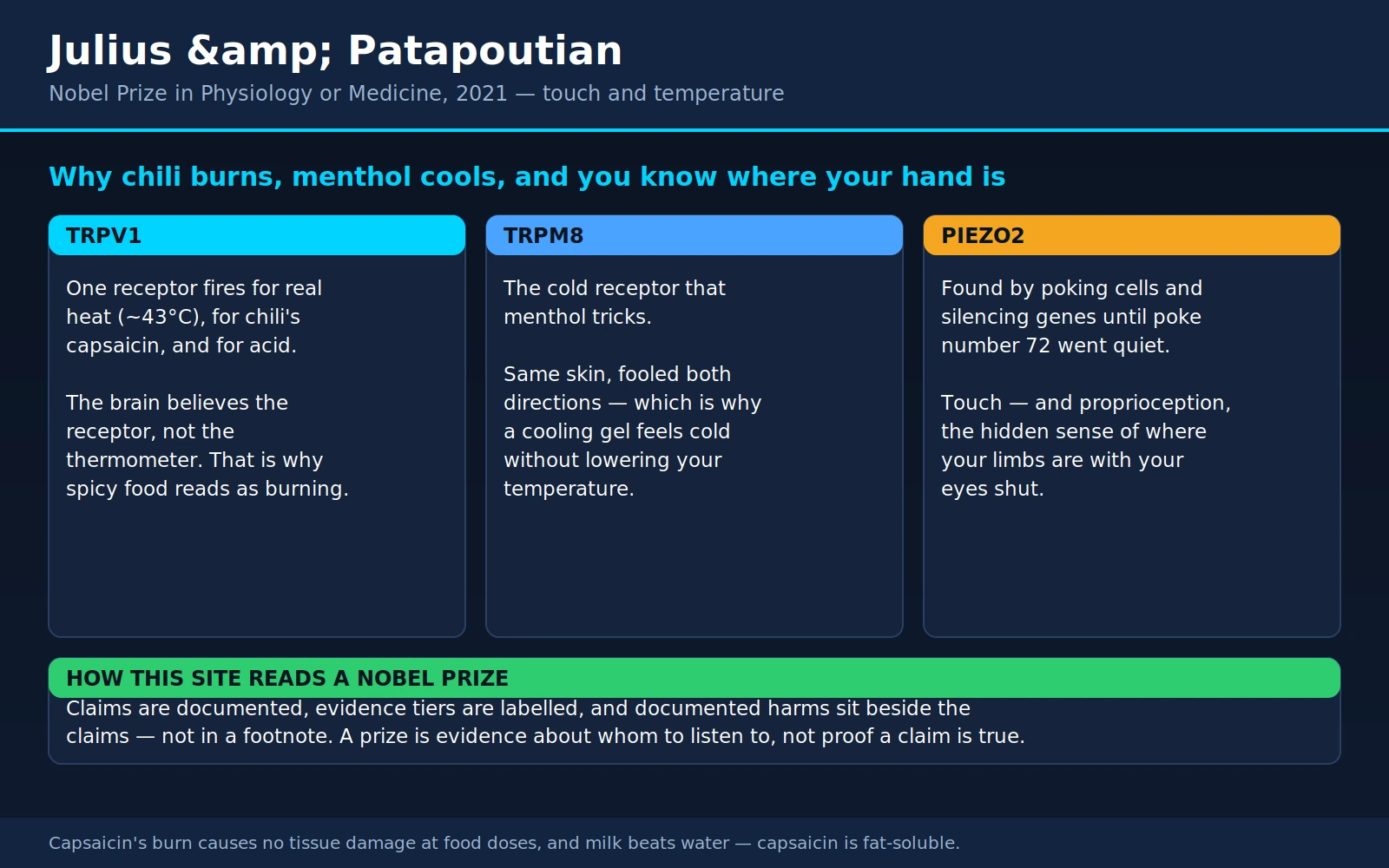
Table of Contents
- The Prize and the Two Men
- Why This Was Even a Mystery
- TRPV1, 1997: The Chili Receptor
- The Menthol Mirror: TRPM8 and Wasabi's TRPA1
- Patapoutian's Poke: Piezo1 and Piezo2
- Chili, Honestly
- Capsaicin as Medicine
- Cold, Menthol, and the Plunge
- The Drug Hunt and Its Lesson
- Where Mainstream Medicine Agrees — and Where Claims Outrun Evidence
- Key Research Papers
- Connections
- Featured Videos
1. The Prize and the Two Men
On 4 October 2021, the Nobel Assembly at the Karolinska Institute awarded the Nobel Prize in Physiology or Medicine jointly to David Julius and Ardem Patapoutian — "for their discoveries of receptors for temperature and touch." Between them they had answered a question so basic that most people never think to ask it: how does your skin tell your brain what it is touching?
Not the nerve. We had known about nerves for a century and a half. The question was the very first step — the molecule at the tip of a nerve ending that takes something physical, a temperature or a poke, and converts it into the electrical language a neuron can carry. Julius found the one that answers to heat and to chili peppers. Patapoutian found the one that answers to pressure. Together they turned the sense of touch from a black box into biochemistry.
David Julius was born in 1955 in Brighton Beach, Brooklyn, the son of a Russian-Jewish family. He studied at MIT, earned his PhD at the University of California, Berkeley, and did his postdoctoral work with Richard Axel at Columbia, where he learned a technique that would later make his career: expression cloning — the brute-force art of taking a library of genes, putting them into cells that ordinarily do nothing interesting, and watching for the one that suddenly does. He joined the University of California, San Francisco in 1989 and has been there ever since, eventually chairing its Department of Physiology.
Julius's question came from an ordinary place. He has told the story of standing in front of a supermarket shelf of hot sauces, looking at bottles that people pay money for in order to hurt themselves, and thinking: a plant makes a chemical that my nervous system reads as fire, and nobody knows what it is binding to. He was interested less in chili than in what chili could be used for — a chemical key that had to fit a lock, and a lock that would turn out to be the lock for pain itself.
Ardem Patapoutian was born in 1967 in Beirut, Lebanon, into the city's Armenian community. He grew up through the Lebanese civil war — a childhood punctuated by shelling, blackouts, and one afternoon when he was briefly detained by armed men on his way home from university. In 1986, at eighteen, he left. He arrived in Los Angeles with almost nothing, worked odd jobs to stay afloat, wrote for an Armenian-language newspaper, and delivered pizzas. He enrolled at UCLA intending to become a physician, took a job washing glassware in a research lab, and discovered that he liked the questions better than the medicine. He earned his PhD at Caltech in 1996, did a postdoc at UCSF, and joined Scripps Research in La Jolla in 2000, where he is a professor and a Howard Hughes Medical Institute investigator.
The two men's work is intertwined in a way the prize citation only hints at. They were competitors on the cold receptor and published within weeks of each other in 2002. Patapoutian's postdoctoral years overlapped with the temperature-sensing field that Julius had just cracked open. And when the Nobel committee tried to reach Patapoutian on the morning of the announcement, his phone was silenced; they called his elderly father in Los Angeles instead, who then woke his son with the news. It remains one of the better Nobel telephone stories.
2. Why This Was Even a Mystery
By the 1990s, sensory physiology looked finished from a distance. We knew that specialized nerve fibers in the skin report temperature, pressure, vibration, and damage. We could record from them. We could map them. We knew that some fibers fire when the skin is warmed past a threshold, others when it is cooled, others when it is pinched. We knew the wiring diagram from skin to spinal cord to brain in considerable detail.
What we did not know was the first line of the story. Every one of those measurements starts with a physical event — heat, or a mechanical deformation — and ends with an electrical one. Somewhere in between, something has to do a conversion that no other cell in the body performs. Vision had its answer decades earlier: rhodopsin, a protein that changes shape when a photon hits it. Smell had its answer from Richard Axel and Linda Buck in 1991: a family of odorant receptors, each a protein pocket shaped to catch a particular molecule. Touch and temperature had nothing. There was a lock everyone could feel and nobody could name.
The difficulty was that heat and pressure are not molecules. A receptor for a smell can be found by asking what binds the smell. But what "binds" 45 °C? What binds a poke? There was no chemical handle to pull on — and that, precisely, is why capsaicin mattered so much. Chili's active compound is a molecule that produces the sensation of burning heat without any heat being present. If a molecule could impersonate a temperature that convincingly, then somewhere there was a protein that could not tell the difference. Find the protein that answers to capsaicin, and you would very likely have found the protein that answers to real heat.
That was the bet. It was not obviously going to pay off — capsaicin might have been acting through some indirect route, three steps removed from the actual heat sensor. It was not.
3. TRPV1, 1997: The Chili Receptor
Julius's laboratory, working with graduate student Michael Caterina, attacked the problem the slow way. They built a library of complementary DNA from rat sensory neurons — the dorsal root ganglion cells whose endings reach into the skin — on the assumption that whatever the capsaicin receptor was, its gene had to be switched on in those cells. Then they took kidney cells that ordinarily ignore capsaicin completely, and forced them to express pools of that DNA, a few hundred genes at a time. Each pool was bathed in capsaicin while the cells were watched with a calcium-sensitive dye.
Thousands of clones did nothing. Then one pool lit up. The pool was split, and split again, and again, until the responsibility narrowed from hundreds of genes to dozens to one. A single gene, introduced into a cell that had never cared about chili in its life, made that cell answer to capsaicin with a flood of calcium.
The 1997 Nature paper reporting it — "The capsaicin receptor: a heat-activated ion channel in the pain pathway" — announces the punchline in its own title. The protein was an ion channel, a pore in the cell membrane that opens to let positive charge in. They called it VR1, the vanilloid receptor; it is now known as TRPV1. And it did not only open for capsaicin. It opened for heat above roughly 43 °C — almost exactly the temperature at which human beings stop calling something "warm" and start calling it "painful." It also opened for acid, the low pH found in inflamed and injured tissue.
One channel, three triggers: chili, burning heat, and acid. That is not a coincidence, it is the design. TRPV1 is the body's damage-imminent alarm for the thermal and chemical world, and it is built to be set off by several kinds of trouble at once. It is also why the alarm can be raised by things that are not, in fact, trouble.
Here is the single most useful idea on this page, and it explains almost everything that follows:
The brain believes the receptor, not the thermometer. Your brain has no direct access to the temperature of your tongue. It has access to a stream of nerve impulses, and it interprets impulses arriving on that particular line as heat, because in the ordinary course of life that is what causes them. Capsaicin picks the lock. It opens the heat channel chemically, at room temperature, and the resulting signal is indistinguishable at the brain's end from a genuine burn. The sensation is not a metaphor and it is not psychological. Spicy food is literally read as hot by the same molecular machinery that reads a hot pan — and this is also why the burn does no damage. The alarm is real; the fire is not.
TRPV1 was the first of a wave. Julius's lab and others went on to find relatives tuned to other bands of the thermal spectrum, so that the skin ended up with something like a set of overlapping thermometers, each a member of the TRP (transient receptor potential) family, each covering a range, together spanning noxious cold to noxious heat.
4. The Menthol Mirror: TRPM8 and Wasabi's TRPA1
If a plant chemical could impersonate heat, the reverse ought to be findable too — and everyone in the field knew exactly which chemical to use. Menthol, from peppermint, makes the mouth and skin feel cool without removing a single joule of heat. It is the mirror image of capsaicin, and it pointed at a mirror-image receptor.
In early 2002 two laboratories found it within weeks of each other. David McKemy, working with Julius, reported it in Nature; Andrea Peier, working with Patapoutian, reported it in Cell. The channel is now called TRPM8. It opens when the skin cools below roughly 25–28 °C, and it opens for menthol, and once again the brain cannot tell the two apart.
This is why the same square inch of skin can be fooled in both directions on the same afternoon. Rub capsaicin cream on your forearm and it feels hot; rub menthol gel on the same spot and it feels cold; neither has changed the temperature of your arm by any amount a thermometer would notice. The two channels sit in overlapping populations of nerve endings, each with its own hotline to the brain, and each can be opened by a plant that never had your comfort in mind. Chili's capsaicin and mint's menthol are both, from the plant's point of view, deterrents — chemicals evolved to make a mammal chewing the plant regret it. Humans are the species that responded by cultivating both.
One more entry deserves a sentence: the pungency of wasabi, mustard, and horseradish — that sharp, sinus-clearing sting quite unlike chili's slow burn — runs through a third channel, TRPA1, which answers to the isothiocyanates in those plants as well as to a long list of environmental irritants including tear gas, cigarette smoke, and formaldehyde. Different key, different lock, genuinely different sensation, and the reason wasabi's heat vanishes in seconds while a chili's persists for minutes.
5. Patapoutian's Poke: Piezo1 and Piezo2
Temperature had a chemical handle. Pressure did not. There is no plant compound that makes your skin feel poked. Patapoutian's laboratory therefore had to invent a different kind of search, and what they came up with was, in outline, comically direct: find a cell that responds to being poked, then take away its genes one at a time until it stops.
They found a mouse neuroblastoma cell line that produced a measurable electrical current when prodded with a fine glass probe. They assembled a list of 72 candidate genes — genes expressed in that cell line and plausibly encoding a membrane channel. Then they silenced them one by one, poking the cells after each knockdown and recording whether the current survived.
Gene after gene made no difference. The current came back every time. Then they silenced number seventy-two, poked the cell, and got nothing. Silence.
The 2010 Science paper from Bertrand Coste and colleagues named the gene Piezo1, from the Greek píesi, pressure, and a close relative in sensory neurons Piezo2. These turned out to be a genuinely new kind of ion channel, unrelated to anything previously known — and unusually large, among the biggest membrane proteins in the body. Later structural work revealed the shape: a three-bladed propeller, its curved arms bowing the surrounding membrane into a dome. Stretch the membrane and the blades flatten; flattening pulls the central pore open. It is a mechanical device made of protein, and its function is visible in its shape the way a hinge's function is visible in a hinge.
What Piezo2 does all day. In the skin, Piezo2 sits in the nerve endings that report light touch — the difference between a shirt collar and a fingertip, the texture of paper, the feel of a keyboard. Take it away in mice and gentle touch essentially disappears while pain and temperature carry on unaffected.
But the larger surprise was elsewhere. Piezo2 also sits in the muscle spindles and tendon organs, the stretch detectors buried inside muscle, which means it is the molecular basis of proprioception — the sense of where your limbs are. This is the hidden sixth sense, the one nobody thinks about because it never stops working. Close your eyes and touch your nose. You did not see your hand. You did not feel your way there. You simply knew where your arm was, continuously, the entire time. That knowledge is Piezo2 channels opening and closing inside your muscles as they lengthen and shorten, thousands of times a minute, for your entire life.
The proof that this is not just a mouse story is one of the most striking papers in modern sensory science. In 2016, Alexander Chesler and colleagues at the NIH described patients born with loss-of-function mutations in PIEZO2. These individuals have joint contractures and scoliosis, and profound sensory deficits of an exquisitely specific kind: they cannot feel light touch or vibration, and with their eyes closed they do not know where their own limbs are. Ask one of them to reach for an object without looking and the arm wanders. Ask them to walk in the dark and they stagger. Yet pain, temperature, and itch are entirely normal — they feel heat and cold perfectly well. What they have lost is exactly the modality the mouse work predicted, and nothing else. These patients learn to compensate with vision, which works well enough that the deficit can go undiagnosed for years, and disappears the moment the lights go out.
Piezo1's day job is quieter and just as fundamental. It is not primarily a skin protein; it is an internal pressure gauge. Piezo1 sits in the blood-vessel wall and in the baroreceptors that sense arterial stretch and feed the reflex that keeps your blood pressure from collapsing when you stand up. It is required for normal blood-vessel development in the embryo. It participates in sensing bladder filling — the signal that eventually becomes the urge to urinate. And it regulates the volume and shape of red blood cells: inherited gain-of-function mutations in PIEZO1 cause hereditary xerocytosis, in which red cells leak potassium, dehydrate, stiffen, and are cleared early. A channel discovered by poking cells in a dish turned out to be doing quiet, continuous work in the vasculature, the bladder, and the blood.
6. Chili, Honestly
Now the practical part — because most readers arrive here from the kitchen rather than the laboratory.
The burn does not injure you. At any dose you can reach through food, capsaicin activates TRPV1 without damaging tissue. There is no burn in the burn: no protein is denatured, no cell is killed, nothing needs to heal. What you feel is a false alarm on a working alarm system. (Extremely concentrated preparations — superhot-pepper eating contests, undiluted extracts, pepper spray — are a different matter and can cause vomiting, severe pain, and, in rare documented cases, worse. The chili on your plate is not that.)
Milk beats water, and this is not folklore. Capsaicin is fat-soluble and barely soluble in water, so a mouthful of water spreads it around your mouth without removing much of it. Whole milk works because the fat dissolves it and the milk protein casein helps lift it off the receptors. Yogurt, full-fat sour cream, coconut milk, and ice cream all work on the same principle. Bread and rice help mechanically by absorbing and wiping. Beer does not help much; alcohol is a poor capsaicin solvent at drinking strengths. Choose the dairy.
Regular chili eaters genuinely desensitize — the tolerance is physical, not psychological. Repeated TRPV1 activation drives calcium into the nerve terminal, and sustained calcium loading progressively quietens that terminal, a process called defunctionalization. The endings become less responsive and, with strong or prolonged exposure, partially retract from the epidermis. This is reversible: the fibers regrow and sensitivity returns over weeks if the exposure stops, which is why someone who moves away from a chili-eating culture loses their tolerance and has to earn it back. Hold on to this mechanism — the entire medical use of capsaicin is built on it.
Metabolism: real, small, and oversold. Capsaicin does produce a measurable increase in energy expenditure and a modest reduction in appetite and subsequent food intake in short controlled studies. The effects are genuine — they show up in metabolic-chamber measurements — and they are also small enough that they are essentially invisible on a bathroom scale. Meta-analyses of capsaicin and weight loss find effects that are statistically detectable and clinically trivial. Chili is a fine reason to enjoy vegetables you would otherwise find dull, which is worth more than the thermogenesis. It is not a weight-loss drug and no honest reading of the data makes it one.
The mortality cohorts: interesting, and not proof. The China Kadoorie Biobank followed roughly half a million adults and found that people who ate spicy food six or seven days a week had noticeably lower all-cause mortality than those who ate it less than once a week. An Italian cohort reported a similar direction for regular chili consumption. These are large, careful, well-analyzed studies, and they are still observational. People who eat chili daily differ from people who never do in dozens of ways — cuisine, vegetable intake, cooking from scratch, income, region, smoking, drinking, physical work. The investigators adjusted for what they could measure; nobody can adjust for what they did not measure. There is no randomized trial in which people were assigned to eat chili for a decade, and until there is, the correct reading is: consistent with a benefit, nowhere near established, and certainly not a reason to start choking down heat you dislike.
7. Capsaicin as Medicine
Defunctionalization is the whole trick. If firing a pain fiber hard enough and long enough makes it go quiet, then a chemical that fires it — capsaicin — can be used as a painkiller. This is deeply counterintuitive: the treatment for pain is a substance whose entire effect is to cause pain first. But it is exactly how these products work, and understanding that changes how you use them.
Over-the-counter creams (typically 0.025–0.1% capsaicin). Sold for osteoarthritis of the hands and knees, back pain, and neuropathic pain. Three things determine whether they help:
- The burn is the mechanism, not a side effect. A cream that does not sting is not doing anything. Expect warmth or stinging for the first several days.
- It takes weeks of regular use. Applied three or four times daily, benefit typically appears somewhere in the second to fourth week and builds. People who apply it twice, find it unpleasant, and stop, have not run the treatment — they have only run the unpleasant part.
- Stopping resets it. The nerve endings recover. This is a maintenance treatment, not a cure.
Practical notes: wash your hands thoroughly afterward or use a glove, because capsaicin transferred to an eye is memorable; do not apply to broken skin; and do not apply heat over it. Evidence quality for the low-concentration creams is modest — the trials are small and hard to blind, precisely because a cream that burns is obvious to the participant. They are cheap and low-risk, which is a reasonable basis for a trial of one on yourself, and a poor basis for confident claims.
The prescription 8% patch (Qutenza). This is a genuinely different intervention: a high-concentration capsaicin patch applied in a clinic by trained staff, often after a topical anesthetic, for 30 to 60 minutes depending on the site. It is approved for postherpetic neuralgia — the persistent nerve pain that can follow shingles — and for painful diabetic peripheral neuropathy of the feet. A single application can reduce pain for up to about three months, after which it can be repeated.
The honest picture from the Cochrane review of high-concentration capsaicin is a real but partial one: compared with a low-dose control patch, roughly one additional person in every ten or so treated achieves substantial pain relief. That is not nothing in a condition where most drugs fail most people, and it is not the miracle the marketing suggests. Application is genuinely painful for many patients and transient increases in blood pressure during treatment are expected, which is one reason it is done under supervision.
Who should talk to a clinician first. Anyone considering the 8% patch (it is prescription-only regardless). Anyone with an open wound, an active skin infection, or severe eczema at the site. Anyone with poorly controlled hypertension or unstable cardiac disease, given the transient pressure rise with the high-dose patch. And anyone with diabetic foot disease, who should have the feet examined before applying anything that deliberately quiets sensory nerves in a limb where sensation is already a safety system.
8. Cold, Menthol, and the Plunge
The TRPM8 side of the story has its own set of everyday applications, and the same discipline is required in reading them: the receptors explain the sensation reliably; the therapeutic claims sit on separate and generally weaker evidence.
Menthol rubs and cooling gels. When a menthol gel makes a sore shoulder feel better, two things are happening and neither is anti-inflammatory. First, TRPM8 activation generates a strong cooling sensation that competes for attention with the pain — the gate-control principle, the same reason rubbing a banged elbow helps. Second, menthol at higher concentrations produces a counter-irritant effect that can transiently reduce pain sensitivity in the area. The relief is real, symptomatic, and short-lived. Nothing about the underlying tissue has changed. That is a perfectly respectable thing for a product to do, as long as it is not sold as healing.
Peppermint oil for irritable bowel syndrome. This one has better evidence than most natural remedies on any shelf. Meta-analysis of randomized trials of enteric-coated peppermint oil in IBS finds patients roughly twice as likely to report global symptom improvement as those on placebo, with improvement in abdominal pain as well. The mechanism is mostly not TRPM8: menthol relaxes intestinal smooth muscle by blocking calcium entry, making it a genuine antispasmodic, with a probable additional contribution from TRPM8-mediated damping of visceral hypersensitivity. Two practical points: the enteric coating matters, because uncoated peppermint oil relaxes the lower esophageal sphincter and causes heartburn, which is the most common reason people abandon it; and it is worth discussing with a clinician if you take medication for reflux, or have a hiatal hernia or gallstones.
Cold plunges, ice baths, and cryotherapy. Now the discipline. TRPM8 explains, completely and satisfyingly, why cold water feels the way it does — the shock, the gasp, the strange euphoric glow afterward as the cold signal fades and blood returns to the skin. It explains why the experience is so vivid that it feels like it must be doing something profound. It does not, by itself, establish that anything profound is being done.
The recovery literature is genuinely mixed, and it separates into questions that have different answers. Does cold-water immersion reduce perceived muscle soreness after hard exercise? Fairly consistently, yes. Does it accelerate the recovery of strength and performance? The results are inconsistent and the effects, where present, are small. Does routine post-workout cold immersion interfere with the muscle-building adaptations you were training for? There is real evidence that it can blunt strength and hypertrophy gains when used habitually after resistance training — which makes cold plunging arguably counterproductive on exactly the days a lifter most wants to use it. And whole-body cryotherapy chambers, the commercial version, rest on a thinner evidence base still. Our Cryotherapy hub goes through these tiers in detail.
The general rule this section is really about: a well-understood sensory mechanism is not a clinical claim. Julius and Patapoutian explained the feeling with great precision. What the feeling is good for is a separate question, answered by trials, and it must be asked separately every time.
9. The Drug Hunt and Its Lesson
The moment TRPV1 was cloned, the pharmaceutical industry saw an obvious opportunity. Here was a molecule sitting at the very front of the pain pathway, activated by heat, acid, and inflammation, expressed in exactly the neurons that report tissue damage. Block it and you should have a non-opioid painkiller of a genuinely new class. Several major companies built programs. Potent, selective TRPV1 antagonists were made and taken into human trials.
They ran into two problems, and both of them are the same problem wearing different clothes.
They caused fever. Volunteers given TRPV1 blockers developed elevated core body temperature — in some trials substantially, into a range that stopped the study. This was not a chemical quirk of one compound; it recurred across structurally different drugs from different companies, which is how a field learns that it has found biology rather than a side effect. TRPV1 turns out to contribute to the body's ongoing regulation of its own temperature, and switching it off shifts the thermostat.
They caused burns. Trial participants sustained accidental thermal injuries — scalds from beverages, burns from touching hot objects — because the drug had done precisely what it was designed to do. It had raised the threshold for detecting noxious heat. A person who cannot feel that a mug is too hot does not put it down.
The lesson is one worth carrying beyond this story: the receptor was not a design flaw, it was doing a job. Pain fibers exist because organisms that cannot detect damage do not survive it. A drug that abolishes a warning system inherits the consequences of the warning going unheard. This is the same reason people born with congenital insensitivity to pain die young — not from a disease, but from unnoticed injuries.
The field adapted rather than gave up. Newer approaches try to block only some modes of TRPV1 activation — sparing the acid-sensing or heat-sensing arm to preserve thermoregulation — or to keep the drug out of the brain and confine it to peripheral nerve endings. A separate and rather elegant strategy runs the other way entirely: resiniferatoxin, an ultrapotent TRPV1 agonist from a Moroccan spurge plant, is being trialed as a targeted injection into a painful joint or around a nerve, where it opens TRPV1 so violently that it permanently silences the specific fibers carrying the pain, leaving touch and motor function intact. That approach — overstimulate rather than block — is a direct descendant of the capsaicin patch, and it is the one that has worked best so far.
Piezo pharmacology is younger and has no approved drugs. There are laboratory tools that open Piezo1 chemically, and considerable interest in conditions where mechanical sensing has gone wrong: bladder dysfunction, some forms of chronic pain in which touch becomes painful, blood-cell disorders, and lymphatic malformations caused by PIEZO1 mutations. It is a fifteen-year-old target rather than a twenty-eight-year-old one, and it will take time.
10. Where Mainstream Medicine Agrees — and Where Claims Outrun Evidence
This site tries to be explicit about evidence tiers rather than leaving readers to guess. Here is the honest ledger for everything above.
Settled science, not controversial anywhere:
- TRPV1 is the receptor for capsaicin, noxious heat, and acid. This is textbook material and has been for two decades.
- TRPM8 is the receptor for cool temperatures and menthol; TRPA1 for the pungency of mustard, wasabi, and horseradish.
- Piezo1 and Piezo2 are the mechanically activated channels underlying touch and proprioception, confirmed in humans by PIEZO2 loss-of-function patients.
- Capsaicin causes no tissue damage at culinary doses; the burning sensation is a receptor event, not an injury.
- Capsaicin desensitization (defunctionalization) is real and is the mechanism of every topical capsaicin product.
- Fat and casein remove capsaicin from the mouth better than water does.
Good evidence, with real limits:
- The prescription capsaicin 8% patch reduces postherpetic neuralgia and painful diabetic neuropathy in a minority of patients — a meaningful minority in conditions where most treatments fail.
- Enteric-coated peppermint oil improves global symptoms and abdominal pain in IBS relative to placebo across multiple randomized trials.
- Cold-water immersion reliably reduces perceived soreness after exercise.
Weak, mixed, or confounded — treat with caution:
- Low-concentration over-the-counter capsaicin creams: plausible, cheap, hard to blind, modest and inconsistent trial results.
- Chili consumption and longevity: large observational cohorts pointing the same direction, with unmeasured confounding that no adjustment can remove.
- Capsaicin for weight loss: measurable thermogenesis and appetite effects, clinically negligible magnitude.
- Cold immersion for performance recovery: inconsistent, and plausibly counterproductive for strength and hypertrophy when used routinely after resistance training.
- Whole-body cryotherapy chambers: a thin evidence base relative to the confidence of the marketing.
Claims that outrun the evidence entirely:
- That eating chili "boosts metabolism" enough to matter for body weight. It does not.
- That capsaicin supplements treat cancer, because capsaicin kills cancer cells in a dish. Almost everything kills cancer cells in a dish; that is not a stage of drug development, it is the doorway to one.
- That cold plunges "reduce inflammation" in a way that is generally beneficial. Some inflammation after training is the signal that drives adaptation, and blunting it is not automatically a win.
- That menthol or capsaicin rubs heal an injury. They alter sensation. That is a genuine benefit and a different one.
The pattern is consistent and it is worth naming. Julius and Patapoutian gave us an unusually clear account of why things feel the way they feel. The clarity of that account has a way of leaking sideways into confidence about what those feelings do for health — and that second question was never answered by their work at all. It is answered by trials, one intervention at a time, and the answers are more modest.
11. Key Research Papers
- Caterina MJ, Schumacher MA, Tominaga M, Rosen TA, Levine JD, Julius D. The capsaicin receptor: a heat-activated ion channel in the pain pathway. Nature 1997;389(6653):816-24
- McKemy DD, Neuhausser WM, Julius D. Identification of a cold receptor reveals a general role for TRP channels in thermosensation. Nature 2002;416(6876):52-8
- Peier AM, Moqrich A, Hergarden AC, Reeve AJ, Andersson DA, Story GM, et al. A TRP channel that senses cold stimuli and menthol. Cell 2002;108(5):705-15
- Bautista DM, Jordt SE, Nikai T, Tsuruda PR, Read AJ, Poblete J, et al. TRPA1 mediates the inflammatory actions of environmental irritants and proalgesic agents. Cell 2006;124(6):1269-82
- Coste B, Mathur J, Schmidt M, Earley TJ, Ranade S, Petrus MJ, et al. Piezo1 and Piezo2 are essential components of distinct mechanically activated cation channels. Science 2010;330(6000):55-60
- Ranade SS, Woo SH, Dubin AE, Moshourab RA, Wetzel C, Petrus M, et al. Piezo2 is the major transducer of mechanical forces for touch sensation in mice. Nature 2014;516(7529):121-5
- Woo SH, Lukacs V, de Nooij JC, Zaytseva D, Criddle CR, Francisco A, et al. Piezo2 is the principal mechanotransduction channel for proprioception. Nat Neurosci 2015;18(12):1756-62
- Chesler AT, Szczot M, Bharucha-Goebel D, Čeko M, Donkervoort S, Laubacher C, et al. The role of PIEZO2 in human mechanosensation. N Engl J Med 2016;375(14):1355-64
- Derry S, Rice AS, Cole P, Tan T, Moore RA. Topical capsaicin (high concentration) for chronic neuropathic pain in adults. Cochrane Database Syst Rev 2017;1(1):CD007393
- Anand P, Bley K. Topical capsaicin for pain management: therapeutic potential and mechanisms of action of the new high-concentration capsaicin 8% patch. Br J Anaesth 2011;107(4):490-502
- Alammar N, Wang L, Saberi B, Nanavati J, Holtmann G, Shinohara RT, et al. The impact of peppermint oil on the irritable bowel syndrome: a meta-analysis of the pooled clinical data. BMC Complement Altern Med 2019;19(1):21
- Lv J, Qi L, Yu C, Yang L, Guo Y, Chen Y, et al. Consumption of spicy foods and total and cause specific mortality: population based cohort study. BMJ 2015;351:h3942
- Garami A, Shimansky YP, Rumbus Z, Vizin RCL, Farkas N, Hegyi J, et al. Hyperthermia induced by transient receptor potential vanilloid-1 (TRPV1) antagonists in human clinical trials. Pharmacol Ther 2020;208:107474
Live PubMed Searches
- TRPV1 capsaicin receptor
- PIEZO2 mechanosensation
- Topical capsaicin for neuropathic pain
- Peppermint oil for irritable bowel syndrome
- Cold water immersion and recovery
Connections
- All Notable Doctors — the full index of laureates, pioneers, and dissenters
- Nobel Prize in Physiology or Medicine — every laureate, 1901 onward
- Hall, Rosbash & Young — the 2017 prize for the molecular clock; another sense the body keeps without being told
- Furchgott, Ignarro & Murad — nitric oxide; another case of a signal molecule hiding in plain sight
- Why Chili Burns: Capsaicin & the TRPV1 Heat Sensor — interactive diagram of the channel described above
- Peppermint — menthol, TRPM8, and the enteric-coated oil used for IBS
- Cryotherapy — cold plunges, ice baths, and what the recovery evidence actually shows
- Pain & Allergy — the category these receptors sit underneath
- Neuropathic Pain — the condition the capsaicin 8% patch was approved for
- Chronic Pain — when the alarm system stops switching off
- Neurology — nerves, sensation, and the conditions that disrupt them
- Peripheral Neuropathy — damage to the fibers that carry all of this
- Irritable Bowel Syndrome — where peppermint oil has its best trial evidence
- Shingles — the infection whose aftermath, postherpetic neuralgia, capsaicin treats