Hall, Rosbash & Young: The Body Clock, from Fly Genes to Your Sleep
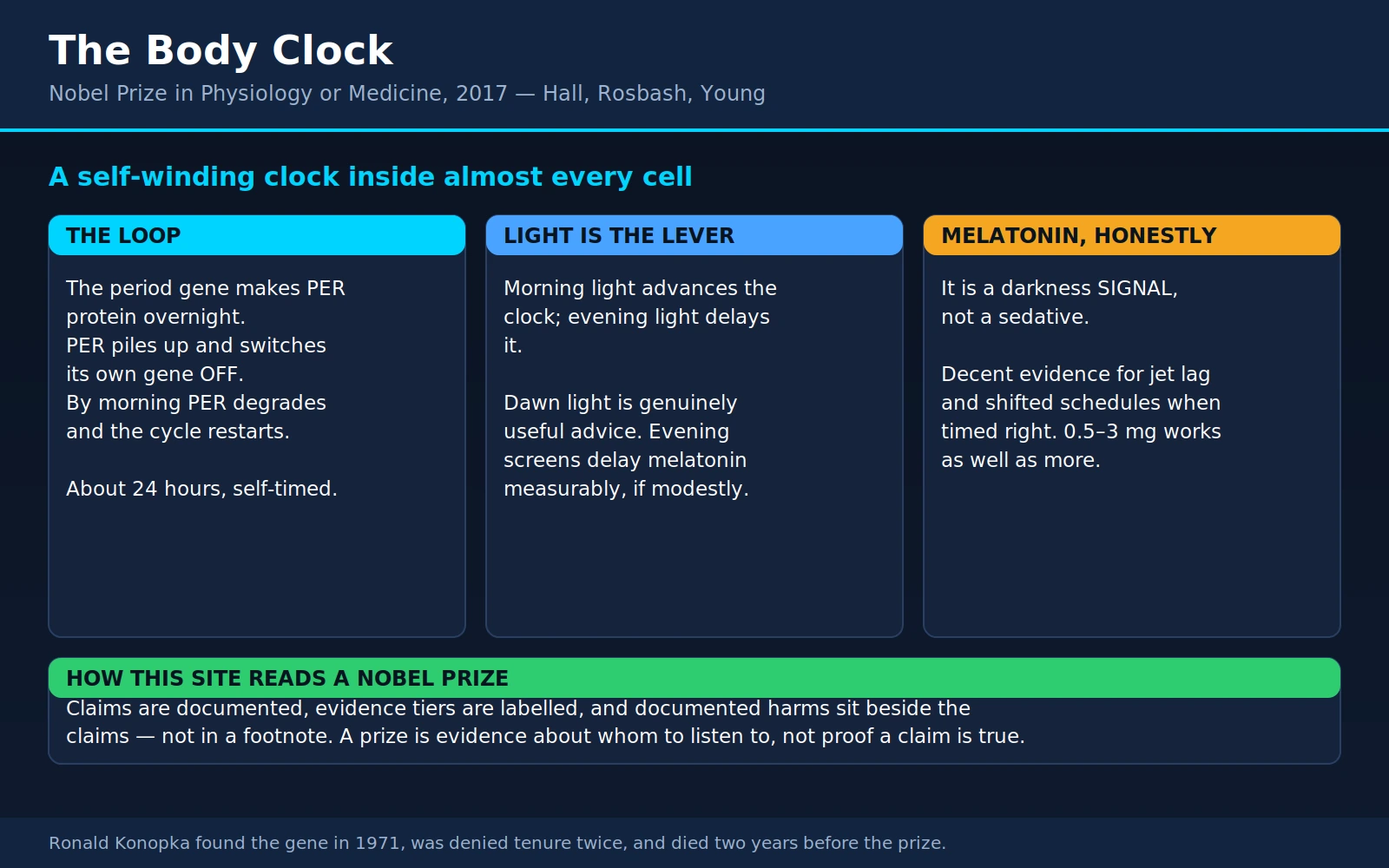
Table of Contents
- The Prize and the Three Men
- The Founding Debt: Benzer and Konopka
- Cloning the period Gene, 1984
- The Loop, 1990
- From Flies to You
- Light Is the Lever
- Melatonin, Honestly
- When Clocks Fight the World
- Food as a Time Cue
- Where Medicine Agrees — and Where Claims Outrun Evidence
- Key Research Papers
- Connections
- Featured Videos
1. The Prize and the Three Men
On October 2, 2017, the Nobel Assembly at the Karolinska Institute awarded the Nobel Prize in Physiology or Medicine to three American geneticists — Jeffrey C. Hall, Michael Rosbash, and Michael W. Young — "for their discoveries of molecular mechanisms controlling the circadian rhythm." In plainer words: they worked out, gear by gear, how a living cell keeps time. The clock they dismantled belonged to a fruit fly. The clock it explained is yours — the one that makes you sleepy at midnight and hungry at noon, that makes jet lag miserable and night shifts hard, and that quietly schedules your blood pressure, your hormones, your body temperature, and your liver's workday.
Jeffrey Hall (born 1945 in New York) and Michael Rosbash (born 1944 in Kansas City, the son of Jewish refugees who fled Nazi Germany) were the Brandeis University pair — colleagues down the hall from each other, close friends, and eventually collaborators whose joint papers carried the project's biggest single insight. Hall was the fly geneticist, trained at the University of Washington and then as a postdoc at Caltech in the orbit of Seymour Benzer, where the story of clock genes had just begun. Rosbash was the molecular biologist, an RNA specialist trained at MIT who at first regarded fly behavior as a curiosity next door — until the two realized that Hall's mutant flies and Rosbash's molecular tools fit together perfectly.
Michael Young (born 1949 in Miami) built the rival operation at Rockefeller University in New York. For more than a decade the Brandeis group and the Young group raced each other — to clone the first clock gene, to explain how it worked, to find the missing parts. It was, by most accounts, a hard-fought and sometimes tense rivalry, and it was also exactly what the science needed: each group's claims were immediately tested, repeated, and extended by the other. Young was the rival who kept them honest, and they returned the favor. Several of the mechanism's essential pieces — genes Hall and Rosbash's model needed but had not found — came from Young's lab.
When the 5 a.m. call from Stockholm came, Rosbash reportedly answered with "You are kidding me." Hall, by then retired to rural Maine and openly disenchanted with how science funding had treated his field, spent much of his first interviews crediting a man who was not on the prize — more on him in the next section. The three shared the award equally, one third each.
Why did medicine's top prize go to fruit-fly genetics? Because the fly was never the point. The committee's reasoning — the same logic behind the 2016 prize to Yoshinori Ohsumi for autophagy in baker's yeast — is that the deep machinery of life is ancient and shared. The clock mechanism worked out in Drosophila melanogaster turned out, nearly part for part, to be the mechanism running in your own brain and liver right now. Almost every claim on this page about your sleep, your light exposure, and your mealtimes traces back to it. The full roster of medicine's laureates is in our Nobel Prize in Medicine wing.
2. The Founding Debt: Benzer and Konopka
Every Nobel story has a chapter zero, and the laureates themselves have been unusually insistent about this one. In the late 1960s at Caltech, Seymour Benzer — a physicist turned geneticist, and one of the most original minds in twentieth-century biology — proposed an idea most colleagues considered somewhere between naive and absurd: that individual genes might control complex behaviors, and that you could find them by breeding mutant flies and watching what they do. His graduate student Ronald Konopka took on the least promising-sounding project of all: the flies' daily rhythm.
Fruit flies keep a strict schedule. Adults emerge from their pupal cases around dawn, and their activity rises and falls on a near-24-hour cycle even in constant darkness — proof of an internal clock rather than a mere reaction to light. Konopka fed flies a chemical mutagen and screened their offspring for individuals whose timing was wrong. In 1971, Konopka and Benzer published the result: three mutant strains — one whose clock ran fast (a 19-hour day), one that ran slow (a 28-hour day), and one with no rhythm at all. The astonishing part was that all three mutations mapped to a single spot on the X chromosome. One gene, damaged three different ways, could speed up, slow down, or stop a living clock. They named it period.
It is hard to overstate how radical this was. A single gene — a stretch of DNA — setting the tempo of a whole animal's day implied that time itself was written in molecules, and that the molecules could be found. Everything on this page descends from that 1971 paper.
Now the honest-credit note, stated plainly because it deserves to be. Ronald Konopka's own career did not survive the science it started. He joined the Caltech faculty and was denied tenure. He moved to Clarkson University and was denied tenure again. In the mid-1980s he left research altogether, returned to Pasadena, and spent his later years tutoring students. He died of a heart attack in February 2015 — two years before the Nobel Prize awarded for the field his discovery seeded. Nobel rules forbid posthumous awards, so the question of whether he would have shared it can never be tested. Jeffrey Hall, who knew him from the Benzer lab days, said for decades and said again on prize day that without Konopka none of it would have happened. Science's reward system optimizes for many things; fairness is not reliably one of them, and this page will not pretend otherwise.
3. Cloning the period Gene, 1984
Konopka's mutants proved a clock gene existed. For thirteen years, nobody could touch it. That changed in 1984, when two groups — Hall and Rosbash's team at Brandeis, and Young's team at Rockefeller — raced to clone the period gene, and both got there the same year.
"Cloning a gene" sounds like science fiction but means something concrete and almost bureaucratic: finding the exact physical stretch of DNA among the fly's roughly 14,000 genes, cutting it out, and copying it in bacteria so you have enough of it to read its sequence and experiment with it. Before cloning, period was an address on a map — "the gene is roughly here." After cloning, it was a text you could read, edit, and, crucially, put back.
Putting it back was the decisive experiment. Young's group showed in Nature that inserting a healthy copy of period into arrhythmic mutant flies restored their 24-hour rhythm — the flies got their clock back from a piece of transplanted DNA. The Brandeis group published the same rescue independently in Cell that year. A behavior as intimate as the rhythm of sleep and waking had been handed back to an animal on a snippet of DNA. That is as close as biology gets to proof.
What cloning did not reveal was almost as important: the gene's sequence looked like nothing anyone had seen. The PER protein it encoded resembled no known enzyme, no channel, no receptor. The field had the clock's mainspring in hand and no idea what it did. Answering that took six more years.
4. The Loop, 1990
The mechanism, when it finally surfaced, was beautiful — simple enough to explain at a kitchen table, precise enough to run your life.
In 1990, Paul Hardin, Jeffrey Hall, and Michael Rosbash reported in Nature that the period gene's messenger RNA — the working copy read off the DNA — doesn't sit at a steady level. It rises and falls on a 24-hour cycle, and so does the PER protein made from it, with the protein peaking a few hours after its message. From that timing pattern, they proposed the idea the Nobel committee later called the heart of the discovery: PER protein shuts off its own gene.
Here is the whole clock, in plain language:
- At night, the period gene is switched on. The cell reads it and builds PER protein, which accumulates hour by hour, like sand piling up.
- By late night, PER has piled high enough to enter the cell's nucleus, where it blocks the machinery reading its own gene. The factory's product walks back in and turns off the factory.
- Through the morning, with production stopped, PER is steadily broken down. The pile drains away.
- When PER is gone, the blockade lifts, the gene switches back on — and the cycle begins again, one turn per day.
Scientists call this a transcription–translation feedback loop. You can think of it as a self-winding hourglass: an hourglass that, on emptying, flips itself over — except this one also builds its own sand at night and dissolves it by morning, tuned so one full flip takes almost exactly 24 hours. A thermostat is the other homely comparison: PER is both the furnace's output and the sensor that shuts the furnace off.
Two pieces were missing, and both came from Michael Young's lab. In 1994 his group found timeless: its TIM protein is PER's essential partner. PER alone is unstable and cannot enter the nucleus; TIM binds it, steadies it, and escorts it in — and, elegantly, TIM is destroyed by light, which is a large part of how morning resets the clock. In 1998 Young's group found doubletime, an enzyme (a kinase, cousin of your own casein kinase 1) that tags PER for destruction. Doubletime is the clock's escapement: by controlling how fast PER accumulates and decays, it builds in the delay that stretches the loop to ~24 hours instead of letting it race. Speed the tagging up or slow it down and the whole animal's day shortens or lengthens — exactly what Konopka's fast and slow mutants had been showing everyone since 1971.
5. From Flies to You
The reason three fly geneticists hold a medicine prize is what happened in the late 1990s: the same loop, nearly part for part, was found running in mammals. In your cells, proteins called CLOCK and BMAL1 play the "switch on" role, and your own PER genes (you have three) plus two cryptochrome genes (CRY1 and CRY2) play the "pile up and shut it off" role. The mouse Clock gene was tracked down in 1997 by Joseph Takahashi's laboratory — a landmark fully deserving of the word Nobel-caliber that the Nobel did not include, and this page credits him because the fly story alone doesn't get you to human medicine.
Your timekeeping is organized like a federation:
The master clock behind your eyes
Sitting in the hypothalamus, just above the point where your optic nerves cross — roughly behind the bridge of your nose — is the suprachiasmatic nucleus (SCN), a paired cluster of about 20,000 neurons. Each one runs the molecular loop above. Special light-sensing cells in your retinas (separate from the ones you see with) report overall brightness straight to the SCN, which is why light, not willpower, is what actually sets this clock — and why some totally blind people, lacking those cells' signal, drift on a roughly 24.2-hour "free-running" schedule through the calendar.
The provincial clocks everywhere else
Nearly every cell in your body — liver, gut, muscle, fat, heart, immune cells, skin — runs its own copy of the loop. These peripheral clocks schedule local business: the liver queues up glucose handling and detox enzymes for the expected day shift, the gut times its motility and enzyme output, muscle times its fuel switching. The SCN is the conductor keeping the provinces synchronized, using light as its own cue — but the provinces also listen to other signals, and the loudest of these is food timing (Section 9). When conductor and provinces disagree — night-shift weeks, transatlantic flights, 2 a.m. meals — you are, biologically, a country whose time zones have stopped agreeing with the capital. That state has a name, circadian misalignment, and much of modern chronobiology is the study of what it costs.
6. Light Is the Lever
If you take one practical idea from the fly work, take this: light is not just illumination; it is the input dial of the clock — the mammalian equivalent of light destroying TIM. And the dial turns in different directions depending on when you turn it.
- Morning light advances the clock. Bright light in the hours after your body's temperature minimum (for most people, shortly before natural wake time) pulls your whole schedule earlier: earlier sleepiness that night, earlier waking tomorrow.
- Evening and night light delays the clock. The same brightness late in the day pushes everything later — which is exactly what most people struggling to fall asleep do not want.
This is why the unglamorous advice to take a morning walk outside is genuinely mechanistic, not folk wisdom. Even an overcast sky delivers on the order of 1,000–10,000 lux to your retinas; a well-lit living room is often 100–300. Ten to thirty minutes of outdoor light soon after waking is the cheapest, best-supported circadian intervention there is — it anchors the clock earlier, deepens evening sleepiness, and costs nothing.
Blue light, honestly
The clock's light sensors are most sensitive to blue-shifted light, and that fact has been marketed hard. Here is the honest state of it. In controlled studies, hours of bright, close-range screen use in the evening measurably delays melatonin onset and shifts the clock later — the effect is real. It is also modest: the sleep differences in such studies are typically shifts of minutes-to-an-hour in hormone timing, not ruined nights, and ordinary evening screen use at arm's length is far weaker than the laboratory maximum. The interventions that clearly help, ranked by evidence and price: an earlier screen cutoff, dimmer and warmer room light in the last hours before bed, and keeping screens out of the bedroom — all free. Amber "blue-blocking" glasses sit at the bottom of the list: a 2023 Cochrane review found little to no clear benefit for sleep, so treat them as an inexpensive maybe, never as the fix. More practical detail lives on our Sleep Hygiene page.
Winter darkness and light therapy
The lever works in reverse, too: when high-latitude winters withhold morning light, a predictable minority of people slide into seasonal affective disorder — and here the evidence is solid, not merely mechanistic. Bright-light therapy (a 10,000-lux box for 20–30 minutes shortly after waking, angled toward but not stared at) has randomized-trial support comparable to antidepressants for seasonal depression, with response typically inside one to two weeks. It is one of the clearest cases in medicine of a Nobel-grade mechanism translating directly into a cheap, effective treatment.
7. Melatonin, Honestly
Melatonin is the molecule most people meet this science through, and most of what the bottle implies is subtly wrong. Melatonin is the hormone of darkness, not a sleeping pill. Your pineal gland releases it when the SCN reads that night has fallen; its job is to broadcast "it is biological night" to the federation of clocks. It opens the gate to sleep rather than sedating you through it — which is why swallowing it works very differently depending on when you swallow it, and why timing matters more than dose.
The supplement evidence, tiered honestly:
- Decent evidence — jet lag and shifted schedules. The Cochrane review by Herxheimer and Petrie found melatonin taken close to the destination bedtime clearly reduced jet lag, especially eastward across five or more zones. Timed evening doses can likewise help pull a delayed body clock earlier (the night-owl pattern, and adaptation around shift work). This is melatonin used as what it is — a time signal.
- Modest evidence — ordinary insomnia. Meta-analyses find melatonin shortens time-to-sleep by only minutes on average in garden-variety insomnia. If your problem is a misaligned clock, it can genuinely help; if your problem is pain, apnea, anxiety, or caffeine, it mostly cannot.
- Dose: less is as good as more. Doses of 0.5–3 mg perform about as well as larger ones in comparative data — the Cochrane jet-lag review found 5 mg no better than lower doses in the physiologic range, and higher doses mainly add next-day grogginess and, at habitual nightly use, an unknown long-term ledger. The 10 mg gummies are marketing, not pharmacology.
- Know what US bottles actually contain. Because melatonin is sold as a dietary supplement, content is not verified before sale. A published laboratory analysis of 31 retail products (Erland & Saxena, 2017) found actual melatonin ranging from 83% below to 478% above the label, batch-to-batch swings within single products, and unlisted serotonin in about a quarter of them. If you use melatonin, a third-party-verified (e.g. USP) product is not fussiness; it is the only way to know your dose.
Ask a clinician first if the melatonin is for a child (use is widespread, long-term developmental data are thin), if you are pregnant or breastfeeding, or if you have epilepsy, an autoimmune condition, or take anticoagulants, immunosuppressants, or sedatives — interactions and case reports exist for each. And persistent insomnia deserves an actual evaluation before a nightly hormone: the best-supported treatment for chronic insomnia is not a molecule at all but CBT-I, and an unrecognized sleep-apnea case helped by nothing on this page is common.
8. When Clocks Fight the World
The fly work explains why certain ordinary modern arrangements feel bad and, over years, may do worse than feel bad. Our circadian rhythm sleep–wake disorders page covers the clinical versions; here is the honest map.
Shift work
About one worker in five works evenings, nights, or rotations, living in chronic misalignment: the SCN says night while the shift says work. In 2007 the WHO's International Agency for Research on Cancer classified shift work involving circadian disruption as Group 2A — "probably carcinogenic to humans" — and reaffirmed that classification for night-shift work in 2019. State that at its real evidence level: Group 2A means limited evidence in humans (associations with breast, prostate, and colorectal cancer, strongest for many years of night work) plus sufficient evidence in animal experiments — a serious, credible concern, not a proven sentence, and one entangled with everything else that comes with night work. Misalignment's shorter-term costs — worse glucose control, blood pressure, mood, and alertness — are better established. If night work is your reality, the levers are the ones this whole page teaches: keep your sleep window as consistent as you can across the week, get bright light during your shift and wear dark glasses on the morning commute home (that morning light otherwise yanks your clock away from your daytime sleep), keep the bedroom truly dark, and keep meals to scheduled times rather than grazing through the night.
Jet lag arithmetic
The clock re-entrains at very roughly one time zone per day, so a six-zone hop costs most people the better part of a week of fully synchronized function. Eastward is harder than westward: your internal period runs slightly longer than 24 hours, so the clock delays (stays up later) more easily than it advances. Working with it — morning light and earlier melatonin when flying east, evening light when flying west — beats willpower every time.
Social jet lag and teenagers
Social jet lag is the researcher Till Roenneberg's name for the shift many people impose on themselves weekly: sleeping 7 a.m.-centered on weekends and 3 a.m.-centered on workdays is a two-time-zone flight every Friday and Monday, no airport required. Observationally it tracks with weight gain and metabolic markers; the causal case is not closed, but the mechanism is exactly the one in Section 5. Teenagers deserve a specific defense: adolescence biologically delays the clock, so a teen who cannot fall asleep at 10 p.m. and cannot wake at 6:30 a.m. is displaying endocrinology, not character. Pediatric bodies including the American Academy of Pediatrics recommend later school start times (8:30 a.m. or after) for exactly this reason.
The rare families who prove it in humans
If any doubt remained that the fly genes matter in people, a few remarkable families ended it. In familial advanced sleep phase syndrome, affected relatives fall asleep around 7–9 p.m. and wake, fully rested, at 3–5 a.m., generation after generation. In 2001, Toh, Fu, Ptáček and colleagues showed the cause in one family: a single-letter mutation in human PER2 — sitting precisely in the site where casein kinase 1, the human counterpart of the fly's doubletime enzyme, tags PER for degradation. The human fast-clock family and Konopka's fast-clock fly carry lesions in the same mechanism, thirty years and half a billion years of evolution apart. The mirror-image condition, severe familial night-owlism (delayed sleep phase), was tied by Young's own lab in 2017 to a common variant in CRY1. These families are rare; their genes are the ones scheduling everyone.
(True clock-gene disease is rare, but note what it is not: narcolepsy, for instance, is a failure of sleep-state switching, not of the circadian clock — different machinery, different page.)
9. Food as a Time Cue
Light sets the master clock, but the provincial clocks — above all the liver's — take their cue substantially from when you eat. Feed a mouse only during its biological night and its liver clock detaches from its brain clock entirely and follows the food. This is the mechanistic root of chrononutrition, and it deserves honest tiering, because it is currently sold well past its evidence.
- Solid: peripheral clocks entrain to meal timing; your glucose tolerance is measurably worse in the biological evening and night than in the morning — the identical dinner costs more, metabolically, at 11 p.m. than at 6 p.m.; and eating during the biological night (the shift-worker's situation) reliably produces unfavorable glucose and lipid responses in controlled studies.
- Promising but small: early time-restricted eating. In the most cited trial (Sutton et al., 2018), eight men with prediabetes ate all meals in a 6-hour window ending mid-afternoon versus a 12-hour window, in a tightly controlled 5-week crossover where food and weight were held constant: insulin sensitivity, blood pressure (about 10 mmHg systolic), and oxidative-stress markers all improved without weight loss. That is a genuinely striking result — from eight people. Later, larger time-restricted-eating trials show more modest and mixed effects, and much of the benefit in free-living trials travels with eating less. Read it as: meal timing is a real metabolic dial, with the effect size still being measured — relevant context for type 2 diabetes and its runway, and mechanistic kin to our fasting page.
- Folklore: "never eat after 7 p.m." as a magic hour. There is nothing about 7:00; there is something about the pattern behind the rule. The real signal, as far as current trials can see: keep meal times consistent, place more of the day's calories earlier, and stop eating two to three hours before bed so your liver's night shift is a fast, as its clock expects. A rule of thumb pointing the right direction — hold the superstition about the clock face.
10. Where Mainstream Medicine Agrees — and Where Claims Outrun Evidence
This site covers plenty of contested figures; these three are not among them. But their prestige is now borrowed by a marketplace they have nothing to do with, so the line is worth drawing carefully.
Bedrock — essentially uncontested
- The transcription–translation feedback loop is textbook molecular biology, replicated across flies, mice, and humans for three decades.
- The SCN master clock, light entrainment via dedicated retinal cells, and the morning-advance/evening-delay rule.
- Peripheral organ clocks, and their entrainment by feeding time.
- The adolescent phase delay; the rare familial clock-gene sleep disorders.
- Bright-light therapy for seasonal depression; properly timed melatonin for jet lag and circadian sleep–wake disorders.
- Shift-work circadian disruption as a probable (Group 2A) carcinogen and an established short-term metabolic stressor — stated, as always, at its real evidence level.
Where claims outrun evidence
- "Circadian" as a marketing prefix. Circadian lighting systems, circadian supplements stacks, circadian skincare, wearable "circadian scores" — the word is doing sales work the trials have not done. No consumer gadget validated against actual physiology (dim-light melatonin onset, core temperature) is currently sold at retail.
- Blue-blocker maximalism. A real mechanism, a modest measured effect, and a product category whose claims dwarf both (Section 6).
- Melatonin as a harmless nightly sleeping pill at any dose — wrong on "sleeping pill," wrong on "any dose," unverifiable on contents without third-party testing (Section 7).
- Rigid eating-hour dogma sold as settled metabolic law on the strength of small, short trials (Section 9).
- The quiet substitution — circadian optimization offered to people whose actual problem is untreated sleep apnea, chronic insomnia (whose first-line treatment is CBT-I), depression, or a medication effect. The clock is one system, not the explanation for everything tired.
The irony the laureates themselves point out: the best-supported circadian interventions are free — morning daylight, regular sleep and meal times, dim evenings, a dark bedroom. The mechanism won a Nobel Prize; the prescription would fit on an index card.
11. Key Research Papers
- Konopka RJ, Benzer S. Clock mutants of Drosophila melanogaster. Proc Natl Acad Sci U S A 1971;68(9):2112-6
- Bargiello TA, Jackson FR, Young MW. Restoration of circadian behavioural rhythms by gene transfer in Drosophila. Nature 1984;312(5996):752-4
- Hardin PE, Hall JC, Rosbash M. Feedback of the Drosophila period gene product on circadian cycling of its messenger RNA levels. Nature 1990;343(6258):536-40
- Sehgal A, Price JL, Man B, Young MW. Loss of circadian behavioral rhythms and per RNA oscillations in the Drosophila mutant timeless. Science 1994;263(5153):1603-6
- Toh KL, Jones CR, He Y, et al. An hPer2 phosphorylation site mutation in familial advanced sleep phase syndrome. Science 2001;291(5506):1040-3
- Herxheimer A, Petrie KJ. Melatonin for the prevention and treatment of jet lag. Cochrane Database Syst Rev 2002;(2):CD001520
- Erland LA, Saxena PK. Melatonin Natural Health Products and Supplements: Presence of Serotonin and Significant Variability of Melatonin Content. J Clin Sleep Med 2017;13(2):275-281
- Sutton EF, Beyl R, Early KS, Cefalu WT, Ravussin E, Peterson CM. Early Time-Restricted Feeding Improves Insulin Sensitivity, Blood Pressure, and Oxidative Stress Even without Weight Loss in Men with Prediabetes. Cell Metab 2018;27(6):1212-1221.e3
- IARC Monographs Vol 124 group. Carcinogenicity of night shift work. Lancet Oncol 2019;20(8):1058-1059
- Allada R, Bass J. Circadian Mechanisms in Medicine. N Engl J Med 2021;384(6):550-561
Live PubMed Searches
- Circadian clock period gene
- Melatonin for jet lag
- Time-restricted eating trials
- Shift work and cancer risk
- Light therapy for seasonal affective disorder
12. Connections
- All Notable Doctors
- Nobel Prize in Medicine — the wing this page belongs to: medicine's laureates and what their prizes actually established
- Yoshinori Ohsumi — the 2016 laureate, one year before them: autophagy, another universal cell mechanism found in a humble organism
- Hans Krebs — the citric-acid cycle: the metabolic wheel the circadian clock schedules
- Melatonin — the darkness hormone in full: biology, benefits, and supplement evidence
- Sleep Hygiene — the practical daily habits that keep the clock entrained
- Circadian Rhythm Sleep–Wake Disorders — delayed phase, advanced phase, shift-work disorder, and non-24
- Insomnia — when sleeplessness is the illness itself, and what actually treats it
- Seasonal Affective Disorder — winter darkness and the light-therapy evidence
- Depression — mood and the clock: rhythm disruption as symptom and contributor
- Narcolepsy — the sleep-switch disorder that is not a clock disorder
- Fasting — meal timing's older cousin: what eating windows and fasts do
- Exercise — a secondary time cue, and the evidence for timing workouts
- Type 2 Diabetes — where circadian misalignment and glucose metabolism collide