Goldstein & Brown: The LDL Receptor and the Honest Cholesterol Story
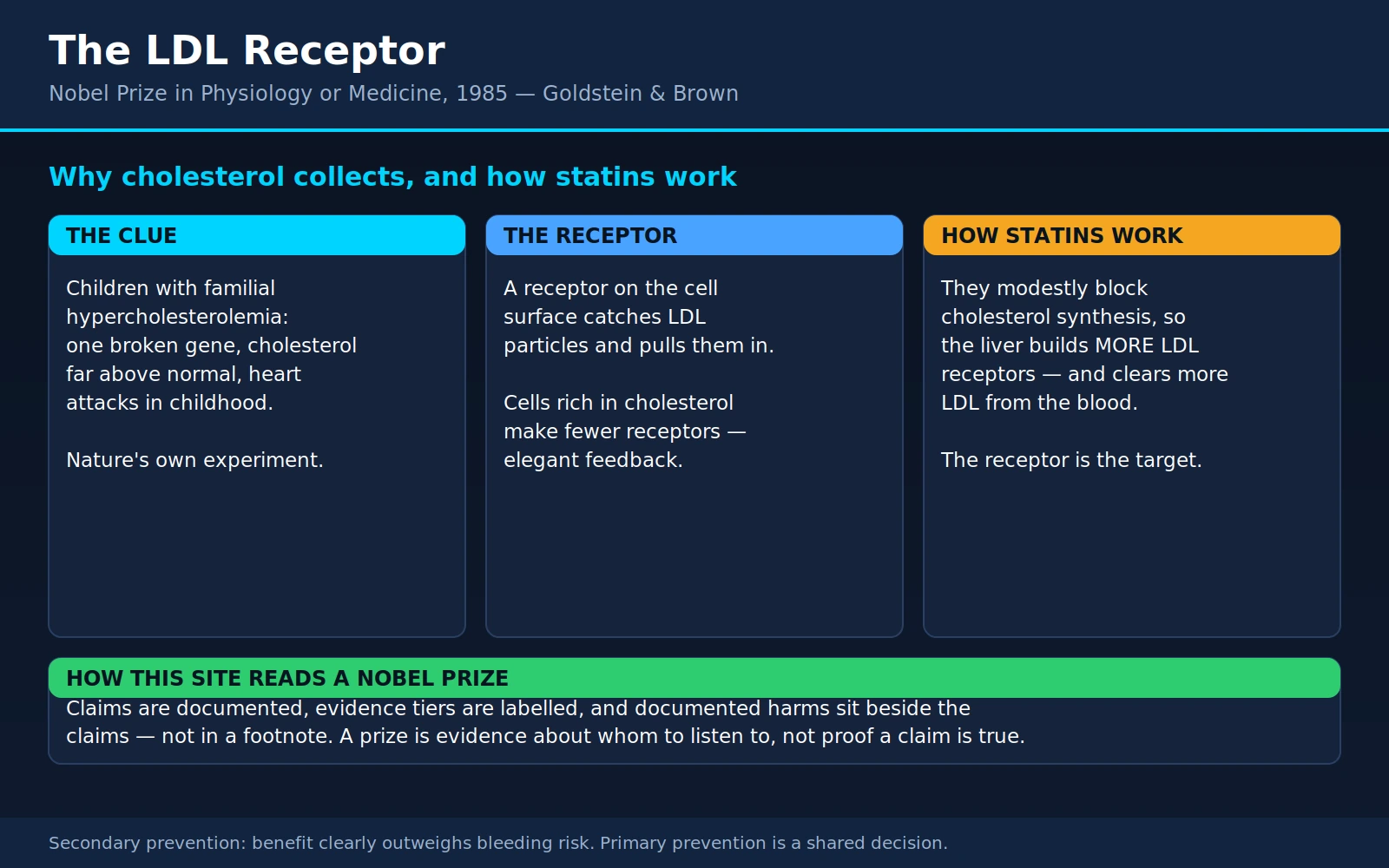
Table of Contents
- The Prize and the Partnership
- The Children Who Taught Them
- The Receptor, 1973–74
- What Cholesterol Actually Is
- Statins Enter
- The Case That LDL Causes Heart Disease
- The Skeptics' Case, Documented
- Statin Side Effects, Honestly
- The PCSK9 Postscript
- Food, Honestly
- Where Medicine Agrees — and What Is Debated
- Key Research Papers
- Connections
- Featured Videos
1. The Prize and the Partnership
Michael S. Brown (born 1941, New York) and Joseph L. Goldstein (born 1940, Sumter, South Carolina) met in 1966 as interns at Massachusetts General Hospital, worked side by side at the National Institutes of Health, and then did something almost no pair of ambitious young scientists does: instead of founding rival labs, they fused into one. By 1972 both had landed at the University of Texas Southwestern Medical Center in Dallas, where they set up adjacent offices, a single shared laboratory, and a division of labor so complete that colleagues learned to treat "Brown & Goldstein" as one scientist with two heads. They alternated the order of their names on papers — Brown & Goldstein on one, Goldstein & Brown on the next — so that neither would accumulate first-author credit at the other's expense.
The partnership has now run for more than five decades in the same institution, through hundreds of joint papers, still appearing under both names as the two men moved through their eighties — probably the most durable two-person scientific partnership on record, in a field where famous collaborations routinely end in feuds over credit.
In 1985 they shared the Nobel Prize in Physiology or Medicine "for their discoveries concerning the regulation of cholesterol metabolism" — the discovery of the LDL receptor, the molecular machine that pulls cholesterol-carrying particles out of the blood, and of the elegant feedback system by which cells decide how much cholesterol to take in and how much to make. The official summary is at nobelprize.org — 1985 Prize in Physiology or Medicine. The same year they received the Albert Lasker Basic Medical Research Award; the National Medal of Science followed in 1988.
This page tells their story — then walks straight into the argument their discovery sits at the center of, because cholesterol and statins are among the most fought-over topics in health and readers arrive from both camps. Our approach is the site's standard one: document the strongest version of each side, label the evidence behind every claim, and let the reader see where the weight falls. Throughout, claims carry an evidence tier: Tier 1 (replicated randomized trials and/or human genetics), Tier 2 (single trials or consistent observational data), Tier 3 (mechanism, animal, or preliminary human data), Tier 4 (claim without supporting evidence, or contradicted by it).
2. The Children Who Taught Them
The discovery began not with a molecule but with patients — specifically, with children carrying a death sentence written in a single gene. Familial hypercholesterolemia (FH) is an inherited condition that comes in two doses. Carriers of one defective gene copy (heterozygotes, roughly 1 in 250–500 people) run total cholesterol around 300–500 mg/dL from birth and, untreated, face heart attacks in their 30s, 40s, and 50s. Children who inherit defective copies from both parents (homozygotes, roughly one in a million) are far rarer and far worse off: total cholesterol of 600–1,000 mg/dL, waxy cholesterol deposits called xanthomas bulging from their tendons, elbows, and knees, and coronary artery disease in childhood. Heart attacks in homozygous FH have been documented before age 10, and untreated homozygotes rarely survived their twenties.
Goldstein met such patients as a medical resident, and the encounter set the research program; his Seattle fellowship work showing inherited high cholesterol to be among the most common genetic contributors to early heart attacks made clear this was a population problem, not a curiosity.
Scientifically, FH was a natural experiment nobody could ethically design: children with no smoking history, no diabetes, no hypertension, no bad diet worth naming — nothing wrong except one broken gene and a bloodstream overloaded with LDL — and they developed exactly the same artery-clogging disease, atherosclerosis, that kills middle-aged adults, only decades faster. One variable, one outcome. Nature was saying, about as plainly as nature ever says anything, that a high enough level of LDL in the blood is sufficient by itself to cause atherosclerotic heart disease (Tier 1 — a mendelian disease with a dose-response: two bad genes are catastrophically worse than one, and one is measurably worse than none). Every argument in the cholesterol wars eventually has to reckon with these children, which is why this page introduces them before any statistics.
What nobody knew in 1972 was why the gene defect raised cholesterol. The reigning assumption was that FH patients simply manufactured too much of it. Brown and Goldstein decided to find out, using an unglamorous tool: skin cells (fibroblasts) from FH patients, grown in dishes.
3. The Receptor, 1973–74
Their first landmark came in 1973. Cholesterol synthesis is controlled by an enzyme with an ungainly name — HMG-CoA reductase — that normal cells throttle down when cholesterol is already plentiful. Goldstein and Brown showed that fibroblasts from a homozygous FH patient had lost this regulation: the enzyme ran at 40 to 60 times the normal rate and refused to shut off when cholesterol-rich serum was supplied. The thermostat was broken; the question was where.
The answer, published in 1974, redirected the field. The defect was not in the synthesis machinery at all. Normal fibroblasts turned out to carry a specific, high-affinity receptor on their surface that binds LDL particles, pulls them into the cell, and dismantles them — and it is the cholesterol delivered by this route that tells the cell to stop making its own. FH cells lacked functional LDL receptors. They could not import cholesterol, so they behaved as if starved of it — synthesizing furiously — while the LDL they could not take in piled up outside in the blood. One receptor explained everything: the biochemistry of the cells, the genetics of the families (heterozygotes have half the receptors and intermediate cholesterol), and the arithmetic of the bloodstream, since the liver's receptors turn out to do most of the body's LDL clearance.
Working out how the receptor swallows its cargo, Brown and Goldstein (with colleagues including Richard Anderson) described receptors clustering into "coated pits" that pinch off into the cell — a mechanism they named receptor-mediated endocytosis, now a founding concept of cell biology (the same doorway imports iron, vitamin B12, and hormones). Their lab went on to purify the receptor, clone its gene, catalog the mutations that break it, and, in a celebrated 1990s second act, discover the SREBP transcription factors — the master switches that carry out the feedback they had observed twenty years earlier.
The feedback loop deserves one more sentence, because the entire statin story hangs on it: a cell rich in cholesterol makes fewer LDL receptors; a cell short of cholesterol makes more. Remember that seesaw — it is the hinge of Section 5.
4. What Cholesterol Actually Is
Before the debate, the primer — because a surprising amount of cholesterol argument dissolves once the vocabulary is straightened out.
Cholesterol itself is not a poison; it is one of the most essential molecules you own. It stiffens and organizes every cell membrane in your body; it is the raw material for cortisol, estrogen, testosterone, and the other steroid hormones; it is the backbone of the bile acids that digest fat; it is a precursor of vitamin D; and the myelin insulation of your brain and nerves is loaded with it. The skeptics who open with "your body needs cholesterol" are correct (Tier 1 — textbook biochemistry). No one on the mainstream side disputes it, and no cholesterol drug in use is trying to remove cholesterol from your cells.
Your body makes most of its cholesterol. The liver and other tissues synthesize on the order of a gram a day — several times what a typical diet supplies — and, as Section 10 covers, dietary cholesterol has only a modest effect on blood levels for most people. This is also why "cholesterol is bad, so cholesterol-containing food is bad" was always too simple.
What your lab slip measures is not cholesterol floating free — it is cargo in transit. Cholesterol is an oil and blood is water, so it travels packaged inside protein-wrapped shuttle particles called lipoproteins. LDL (low-density lipoprotein) particles are the delivery fleet, carrying cholesterol outbound from the liver; HDL particles run pickup routes, scavenging excess back for disposal. "LDL cholesterol" on a lipid panel is the total mass of cholesterol riding inside your LDL fleet. The trouble starts when LDL particles are numerous enough, for long enough, that some slip through the artery wall's inner lining, lodge there, oxidize, and trigger the smoldering immune reaction that builds plaque — the process our atherosclerosis page walks through step by step.
That "numerous enough" points at a refinement worth knowing. Each LDL particle carries exactly one molecule of a protein called apolipoprotein B, so an ApoB test is a direct particle count rather than a cargo-mass estimate. Usually the two move together, but they can split: a person with insulin resistance may run many small, cholesterol-poor particles — a modest LDL-C hiding a high particle number and higher risk. When the measures disagree, particle number (ApoB) tracks risk more cleanly than cholesterol mass (Tier 2 — consistent across large cohort and genetic analyses). This matters to the debate: the mainstream model's actual claim is that risk follows the number of ApoB-carrying particles crossing the artery wall over a lifetime — a mechanistic statement, not a demonization of the cholesterol molecule.
5. Statins Enter
The statin story begins with someone this page must credit plainly, because the prize committees never did: Akira Endo, a Japanese biochemist who reasoned that since fungi wage chemical warfare on competitors, some mold might have evolved a molecule that jams cholesterol synthesis. After screening some 6,000 fungal cultures, in 1973 he isolated compactin from a Penicillium mold — the first statin, a potent inhibitor of HMG-CoA reductase, the very enzyme at the center of Brown and Goldstein's feedback loop. Endo, who was directly inspired by Alexander Fleming's penicillin story, watched the drug class he founded become the most prescribed in the world, and died in 2024 at age 90 without a Nobel Prize — an omission worth filing beside the others documented on this wing. His own history of the discovery is in the research list below.
Here is where the two stories fuse, and where a genuine paradox got resolved. Blocking the synthesis enzyme should only starve cells of cholesterol — so why would it lower blood LDL? Brown and Goldstein supplied the answer, and it is their feedback seesaw in action: a liver cell that senses less internal cholesterol responds by making more LDL receptors, and each added receptor pulls more LDL out of the blood. A statin's real therapeutic act is not the modest synthesis block itself — the liver largely compensates — but the receptor upregulation it provokes. Statins are, mechanistically, LDL-receptor amplifiers. Fittingly, when Merck developed lovastatin (approved 1987), the company leaned on Brown and Goldstein's science; the two fields validated each other (Tier 1 — mechanism established in cell, animal, and human studies). Notably, statins fail in homozygous FH children who have no receptors to amplify — a fact that confirms the mechanism.
Whether any of this saved lives took another decade to prove, and skeptics of the era were right to demand the proof: earlier cholesterol drugs (fibrates, high-dose niacin) had lowered numbers without convincingly lowering mortality, and some early trials hinted at harm. The answer came in 1994 from Scandinavia. The 4S trial randomized 4,444 patients with existing coronary disease and high cholesterol to simvastatin or placebo for a median of 5.4 years. Simvastatin cut all-cause mortality by 30 percent in relative terms — 12 percent of the placebo group died versus 8 percent on the drug, about one death prevented per 30 patients treated, with coronary deaths down by roughly 42 percent and no rise in non-cardiac deaths (Tier 1 — large randomized double-blind trial, since replicated). 4S was the first hard demonstration in history that a cholesterol-lowering drug extends life, and in secondary prevention — people who already have heart disease — that verdict has been replicated so many times that no serious critic contests it. The genuinely contested ground lies elsewhere, and we go there now.
6. The Case That LDL Causes Heart Disease
Stated at its strongest, the mainstream case rests on three independent legs that all point the same direction — and the convergence, not any single leg, is the argument.
Leg one: the natural experiments. FH, as Section 2 laid out: lifelong high LDL from a single gene produces early atherosclerosis in a dose-dependent way, with no other risk factor required. And the experiment runs in reverse, too — Section 9's PCSK9 story describes people genetically endowed with lifelong low LDL, who turn out to have strikingly less heart disease. High-LDL genes give early disease; low-LDL genes give protection (Tier 1 — human genetics, replicated).
Leg two: mendelian randomization. This technique deserves a plain-language beat, because it is the strongest tool in the box and most readers have never heard of it. Genes are dealt at conception, effectively at random, like a shuffled deck — a person's LDL-raising or LDL-lowering variants are not caused by their diet, wealth, smoking, or doctor visits. So comparing heart-disease rates across people sorted by their LDL genetics is nature running a randomized trial with a lifetime of follow-up, immune to most of the confounding that plagues nutrition studies. Dozens of such analyses, across many different genes acting through different mechanisms, find the same thing: lifelong genetically lower LDL means proportionally lower coronary risk, no matter which gene does the lowering — and the benefit per mg/dL is larger than in drug trials, exactly as you'd expect when the exposure runs from birth rather than from age 60 (Tier 1). If LDL were a mere bystander — a marker traveling alongside the "real" cause — there is no reason a dozen unrelated genetic mechanisms of lowering it should all deliver the same protection.
Leg three: trial concordance across drug classes. Statins were long attacked with "maybe they work through something else — anti-inflammatory effects, say — and LDL is coincidental." A fair hypothesis, testable, and now tested. Ezetimibe lowers LDL by a completely different mechanism (blocking intestinal absorption); added to a statin in a 18,000-patient trial, it produced a further modest event reduction in line with its modest LDL reduction. PCSK9 inhibitors lower LDL by a third mechanism (more receptor recycling; Section 9); in outcome trials they cut events, again in proportion to the LDL drop. Across statins, ezetimibe, and PCSK9 inhibitors — three unrelated pharmacologies — event reduction tracks the size and duration of LDL lowering on a common line (Tier 1 — multiple randomized outcome trials).
In 2017 the European Atherosclerosis Society convened a consensus panel (Ference and colleagues; full citation below) that assembled all three legs — over 200 studies covering more than 2 million participants and 20 million person-years — and concluded that LDL is not merely associated with atherosclerotic cardiovascular disease but causes it. That paper is the clearest single statement of the mainstream case, and any serious skeptic engagement has to answer it — not the strawman version of it.
7. The Skeptics' Case, Documented
Per this site's policy, here is the skeptical case at its strongest — not the internet-meme version, but the arguments as careful critics (including physicians and researchers among them) actually make them. After each, we say plainly where the argument lands against the evidence. Several of these points survive, and readers deserve to know which.
Argument 1: Relative-risk marketing hides small absolute benefits in primary prevention. "30 percent fewer heart attacks" sounds like 30 of 100 users spared. It is not. In primary prevention — people with risk factors but no diagnosed heart disease — a realistic five-year picture for a moderate-risk adult looks like this: of 100 such people taking a statin for five years, roughly 97–98 get the same outcome they would have gotten anyway (most were never going to have an event this decade; a few have one despite the pill), and about 1 to 3 avoid a heart attack or stroke — a number-needed-to-treat in the range of 40 to 100+ depending on baseline risk. Prevented deaths are rarer still, and in the lowest-risk groups a mortality benefit within five years is too small to measure. Verdict: this argument survives. The arithmetic is real, it comes from the trials themselves, and the honest framing is exactly the one shared-decision guidelines now use: a statin in primary prevention is a modest, real, cumulative risk reduction — a bet that makes more sense the higher your baseline risk and the more years you expect to take it — not a rescue. Where the argument overreaches is the jump from "modest" to "worthless": the same absolute-risk logic applied to secondary prevention or to high-risk primary patients (FH, diabetes, calcium score in the hundreds — see the coronary calcium score) yields NNTs in the 20s and 30s, which nobody dismisses. The lesson is stratification, not abstention (Tier 1 numbers on both sides of the ledger).
Argument 2: Trial populations are not the people the prescriptions go to. The landmark trials enrolled mostly middle-aged, adherent, higher-risk patients — disproportionately men — and ran about five years. Real-world prescribing extends to 78-year-olds, to low-risk women, to people expected to take the drug for thirty years. Extrapolation beyond the evidence is a legitimate critique, and for adults over 75 without existing cardiovascular disease the primary-prevention trial base genuinely is thin (dedicated trials in that group were still underway in the mid-2020s). Verdict: partially survives — a fair caution for the very elderly and the very low-risk, and an argument for individualized decisions; not a general refutation, since meta-analyses find consistent relative benefit across the age and sex ranges the trials did cover (Tier 2).
Argument 3: "Cholesterol is vital, and people with low cholesterol die more." The premise is true (Section 4) and the observation is real: in elderly cohorts, low total cholesterol associates with higher mortality — a J-shaped curve skeptical books lean on heavily. But an association in the elderly runs headlong into reverse causation: cancer, liver disease, malnutrition, frailty, and chronic inflammation all lower cholesterol in the months and years before they kill. The dying get low cholesterol more than the low-cholesterol get dying. How do we know that is the right reading? Because the confound can be removed: people with lifelong genetically low LDL (Section 9) — low cholesterol without underlying illness — show less disease and no excess mortality, and trials driving LDL to extraordinarily low levels (below 30 mg/dL with PCSK9 inhibitors) found no increase in death, cancer, hemorrhagic stroke beyond expectation, or cognitive harm over their follow-up. Verdict: fails as causal claim; survives as a reminder that in a frail 85-year-old, a falling cholesterol is a prognostic red flag to investigate, not a success (Tier 1 genetics and trials versus Tier 2 confounded observation).
Argument 4: "It's the sugar and insulin resistance, not the cholesterol." Half right, and the right half matters. Insulin resistance, visceral fat, high triglycerides, hypertension, and smoking are enormous, underemphasized drivers of heart disease, and a normal-LDL patient with metabolic syndrome is not "low risk." But this is an and, not an instead: the FH children had pristine insulin sensitivity and still got the disease, and LDL-lowering works in trials regardless of glycemic status. Verdict: survives as an addition, fails as a substitution (Tier 1).
Argument 5: Industry funding corrupts the evidence base. Most major statin trials were drug-company funded; the Cholesterol Treatment Trialists' collaboration analyzing them held individual-level data that outside critics could not freely reanalyze; and trials published after mandatory registration have, in general, reported less flattering results across all of medicine. These are documented facts, and demanding independent replication and data access is simply good epistemics — skeptics also fairly note that a large government-funded open-label trial (ALLHAT-LLT) showed no significant mortality benefit, though its heavy crossover between arms diluted any possible effect. Verdict: survives as vigilance, fails as dismissal. The reason it cannot carry the full skeptical conclusion is triangulation: the genetics (Sections 6 and 9) were largely academically funded, the 4S-era results have been replicated across rival companies' competing molecules — rivals have every incentive to expose each other's inflated claims — and ezetimibe's modest reported benefit is itself evidence the system can return unflattering answers (Tier 2 concern, answered mainly by Tier 1 convergence).
Argument 6: outright LDL denial — the claim that LDL is a mere bystander and the lipid hypothesis a decades-long error. This is the position of the best-selling skeptical literature, and it earns a plain answer: it fails. To hold it, one must explain away the FH children, a dozen independent genetic mechanisms that all map LDL to risk, and three unrelated drug classes whose benefits scale with LDL reduction — each with a separate ad-hoc excuse. No published skeptical account has met the mendelian-randomization evidence head-on (Tier 4 against Tier 1).
Summing the ledger: the skeptics have genuinely improved the conversation — honest absolute-risk framing, shared decision-making in primary prevention, humility about the very elderly, scrutiny of industry data — and this page adopts all of it. What the evidence does not permit is the leap from those fair caveats to "cholesterol doesn't matter" or "statins are a scam."
8. Statin Side Effects, Honestly
Nothing fuels statin skepticism like side effects, and nothing has been handled less honestly — in both directions. Patients reporting muscle pain have been waved off with "the trials say that's rare"; meanwhile "statins destroyed my muscles" testimonials circulate stripped of denominators. Here is the evidence, tiered.
Muscle symptoms: two things are true at once. First, statin muscle toxicity is real pharmacology. Measured-CK myopathy (true muscle injury with enzyme elevation) occurs in roughly 1 in 1,000 to 1 in 10,000 users per year, rising with dose, age, hypothyroidism, and interacting drugs; frank rhabdomyolysis — the dangerous form — is on the order of a few cases per 100,000 treated per year (Tier 1 — consistently measured across trials and registries). One statin, cerivastatin, was withdrawn in 2001 for exactly this. Anyone who tells you statin muscle damage is mythical is wrong.
Second: the everyday aches that lead millions to quit are mostly not the drug — they are the nocebo effect, the evil twin of placebo, in which expecting harm produces genuine, physically felt symptoms. The cleverest demonstration is the SAMSON trial (2020; citation below): 60 people who had already abandoned statins over intolerable side effects each took, in randomized monthly blocks, atorvastatin, an identical placebo, or nothing, scoring symptoms daily on a phone app. Symptom intensity on placebo reached 90 percent of the level on the real statin — both far above the no-tablet months. The symptoms were real; the attribution was wrong. Most participants, shown their own data, successfully restarted therapy (Tier 1 for the nocebo dominance — randomized, blinded, replicated by the similar StatinWISE trial and by blinded-phase analyses of large trials, where statin and placebo arms report muscle symptoms at nearly identical rates). The honest synthesis: if you ache on a statin, you are neither lying nor doomed — get a CK level, try a washout and rechallenge, a lower dose, or a different statin, because the great majority of "statin-intolerant" patients tolerate a reworked regimen.
New-onset diabetes: a real signal, stated plainly. The Sattar meta-analysis of 13 trials (91,140 participants; citation below) found statin users developed diabetes about 9 percent more often — roughly one extra diagnosis per 255 people treated for four years, with intensive dosing carrying more risk than moderate, and people already on the brink of diabetes supplying most of the cases. Genetic studies confirm it is an on-target effect of HMG-CoA reductase inhibition, not an accident of one drug (Tier 1). The tradeoff, said without spin: in a higher-risk patient, the same trials show several heart attacks and strokes prevented for each diabetes case advanced — a trade most would take, but it is a trade, and a low-risk patient is entitled to weigh it differently.
Cognition: the signal did not hold up. The FDA added a label note in 2012 based on case reports of fuzzy thinking. Randomized trials, including large ones with formal cognitive testing, and the FDA's own review found no consistent cognitive harm; the dedicated cognitive study inside a PCSK9-inhibitor trial — testing patients driven to very low LDL — was also negative (Tier 1 null from trials versus Tier 3 case reports). Individual idiosyncratic reactions can't be ruled out — stopping resolves them — but a population-level effect has been looked for and not found.
The CoQ10 story, since this site's readers will ask. The theory is sound chemistry: statins block the mevalonate pathway upstream of coenzyme Q10 synthesis, and blood CoQ10 measurably falls on therapy (Tier 1 for the biochemical effect). The therapeutic leap — that supplementing CoQ10 prevents or cures statin muscle symptoms — has been tested in randomized trials, and the results are mostly null: several trials and pooled analyses found no significant symptom benefit, while some smaller or lower-quality ones did, leaving the honest label at (Tier 3 — plausible mechanism, unconvincing clinical trials). CoQ10 is safe and inexpensive, so trying it is a reasonable personal experiment — just know the blinded evidence says the odds are against it being the fix.
9. The PCSK9 Postscript
If FH was nature's first experiment, PCSK9 was the second — and it answered the question the first one couldn't: what happens to people whose LDL is low for life?
In 2003, Catherine Boileau, Marianne Abifadel, and colleagues studying French families with inherited sky-high cholesterol — but with intact LDL-receptor genes — traced their disease to gain-of-function mutations in a then-obscure gene called PCSK9 (citation below). The protein turned out to be a receptor assassin: PCSK9 latches onto LDL receptors and routes them for destruction, so an overactive version strips the liver of receptors and reproduces FH. The logic instantly suggested its own mirror image: what about people whose PCSK9 is broken?
Helen Hobbs and Jonathan Cohen in Dallas — Goldstein and Brown's own institution, no coincidence, as both trained in that orbit — went looking in the biracial Dallas Heart Study and the ARIC cohort. About 2–3 percent of Black participants carried a nonsense mutation disabling one PCSK9 copy: their LDL ran 28 percent lower lifelong, and their coronary heart disease over 15 years was 88 percent lower. White carriers of a milder variant averaged 15 percent lower LDL and 47 percent less coronary disease — benefit far exceeding what five-year drug trials achieve per mg/dL, because the exposure started at conception (citation below; Tier 1). Researchers even found a healthy Dallas woman with both PCSK9 copies inactivated: her LDL was about 14 mg/dL — a level "incompatible with health" by the your-body-needs-high-LDL argument — and she was a well, fertile adult. That single fortune-favored family is worth an entire shelf of theorizing about how dangerous low cholesterol must be.
The mutation designed the medicine. Antibodies that neutralize PCSK9 (evolocumab, alirocumab — approved 2015) and an siRNA that silences it (inclisiran) spare LDL receptors exactly as the lucky mutations do, cutting LDL by 50–60 percent on top of statins; the outcome trials showed event reductions in proportion, at achieved LDL levels below 30 mg/dL, without the feared harms over trial follow-up (Tier 1). For the cholesterol debate, the PCSK9 families are the cleanest possible rebuttal to "the body sets your LDL where it needs it": here are people whose bodies set it at a quarter of average, and their reward was not hormone failure or brain trouble but the near-abolition of coronary disease. Cells make the cholesterol they need on-site; a small delivery fleet in the blood is, on all the evidence we have, a feature and not a bug.
10. Food, Honestly
Finally, the kitchen — where official advice has reversed itself often enough that skepticism is understandable, and earned.
Dietary cholesterol is not blood cholesterol. The old advice to fear eggs rested on conflating the two. Because your liver makes most of your cholesterol and dials synthesis down when the diet supplies more (Brown and Goldstein's feedback, working as designed), eating cholesterol raises blood LDL only modestly for most people. Decades of cohort data on an egg a day in healthy people show little to no association with cardiovascular events, and U.S. guidelines quietly dropped their daily cholesterol cap in 2015 (Tier 2 — consistent observational data plus controlled feeding studies). Two honest footnotes: a minority of "hyper-responders" see larger LDL rises — if it matters to you, a lipid panel before and after a dietary change beats speculation — and people with diabetes showed less reassuring egg data in some cohorts.
Saturated fat is the bigger dietary lever — stated fairly. Controlled feeding studies leave no real doubt that replacing saturated fat with unsaturated fat lowers LDL and ApoB (Tier 1 for the lipid effect); the fight is over how much that translates into events, where trials are older and messier (Tier 2). This site's framing cuts through most of the argument: the worst outcome of the saturated-fat wars was the low-fat processed-food era, in which butter was swapped for refined starch, sugar, and margarine trans fats — a trade the evidence says ranged from useless to harmful. We do not recommend "low-fat" anything. The comparison that actually wins in the data is whole foods versus whole foods: olive oil, nuts, avocados, sardines, and salmon in place of some of the butter and processed meat — a pattern (roughly, Mediterranean) that lowered hard cardiovascular events in randomized trials, not just lab numbers (Tier 1 for the pattern).
What reliably helps, food-wise: soluble fiber (oats' beta-glucan, beans, psyllium) drops LDL roughly 5–10 percent at realistic intakes by binding bile acids — forcing the liver to spend cholesterol making more, which upregulates LDL receptors; Goldstein and Brown's seesaw again, driven by oatmeal (Tier 1 for LDL-lowering). Plant sterols at about 2 g/day lower LDL another 8–10 percent (Tier 1 for LDL; no outcome trials). Weight loss where warranted, and not smoking, outrank all of it.
Red yeast rice, the "natural statin," deserves its label read aloud. Rice fermented with Monascus purpureus contains monacolin K — which is chemically the same molecule as the prescription drug lovastatin. It is not an alternative to statins; it is an unstandardized statin. Accordingly it genuinely lowers LDL (about 20–40 mg/dL in the meta-analysis cited below), one large Chinese trial of a red-yeast-rice extract reported fewer coronary events, and it carries the same class risks — muscle injury, drug interactions — plus two of its own: capsule-to-capsule monacolin content varying by more than tenfold, and possible contamination with the kidney-toxic byproduct citrinin (Tier 2 for efficacy; the safety concerns are documented, not hypothetical). Someone who "quit their statin for red yeast rice" and felt better has run an accidental SAMSON experiment: a lower, unlabeled dose of the same pharmacology, minus the expectation of harm.
Berberine is the more interesting botanical, because its mechanism is genuinely different: it stabilizes LDL-receptor mRNA and appears to reduce PCSK9 — receptor amplification by a non-statin route. Randomized trials pooled in meta-analysis (Dong 2013, Planta Med) show LDL reductions around 20–25 mg/dL, with mostly mild digestive side effects. The honest caveats: the trials are small, short, largely from one country, of moderate quality, and no berberine trial has measured heart attacks or deaths — so it earns (Tier 2 for LDL-lowering; Tier 3 for any claim about preventing cardiovascular events). Our Berberine page covers dosing and interactions.
11. Where Mainstream Medicine Agrees — and What Remains Genuinely Debated
Effectively settled (Tier 1, multiple independent lines)
- Cholesterol is essential to life; the LDL receptor and cellular feedback system work as Brown and Goldstein described.
- Lifelong high LDL causes premature atherosclerosis (FH); lifelong low LDL protects (PCSK9); LDL/ApoB-carrying particles are causal for atherosclerotic disease, not bystanders.
- In secondary prevention and high-risk primary prevention, statins reduce heart attacks, strokes, and death, with benefit proportional to LDL reduction; ezetimibe and PCSK9 inhibitors extend the same line.
- Severe statin muscle injury is real and rare; the bulk of everyday statin muscle complaints are nocebo-driven and manageable; statins slightly increase diabetes risk; no consistent cognitive harm has been found.
- Very low achieved LDL (<30 mg/dL) showed no signal of harm over trial follow-up; dietary cholesterol matters far less than once claimed.
Genuinely debated (reasonable experts disagree)
- Where the statin threshold should sit in low-risk primary prevention — the NNT arithmetic makes this legitimately a values decision between patient and clinician, not a mandate.
- Primary prevention past age 75, where dedicated trial evidence was still maturing in the mid-2020s.
- How aggressively to treat by ApoB versus LDL-C, and how low a target is worth pursuing in which patients.
- How much saturated-fat restriction adds, in event terms, within an otherwise whole-food diet — and the best replacement calories when it does.
- How far lifetime-exposure logic should push treatment earlier in life — decades-long trials do not exist and never will; genetics is the proxy.
That an argument appears in the second list is not a scandal, and pretending medicine has no second list is how institutions lose skeptical readers. The receptor science, though — the part Stockholm rewarded in 1985 — sits in the first list beside gravity.
12. Key Research Papers
- Goldstein JL, Brown MS. Familial hypercholesterolemia: identification of a defect in the regulation of 3-hydroxy-3-methylglutaryl coenzyme A reductase activity associated with overproduction of cholesterol. Proc Natl Acad Sci U S A 1973;70(10):2804-8
- Brown MS, Goldstein JL. Familial hypercholesterolemia: defective binding of lipoproteins to cultured fibroblasts associated with impaired regulation of 3-hydroxy-3-methylglutaryl coenzyme A reductase activity. Proc Natl Acad Sci U S A 1974;71(3):788-92
- Brown MS, Goldstein JL. A receptor-mediated pathway for cholesterol homeostasis. Science 1986;232(4746):34-47
- Scandinavian Simvastatin Survival Study Group. Randomised trial of cholesterol lowering in 4444 patients with coronary heart disease: the Scandinavian Simvastatin Survival Study (4S). Lancet 1994;344(8934):1383-9
- Endo A. A historical perspective on the discovery of statins. Proc Jpn Acad Ser B Phys Biol Sci 2010;86(5):484-93
- Abifadel M, Varret M, Rabès JP, et al. Mutations in PCSK9 cause autosomal dominant hypercholesterolemia. Nat Genet 2003;34(2):154-6
- Cohen JC, Boerwinkle E, Mosley TH Jr, Hobbs HH. Sequence variations in PCSK9, low LDL, and protection against coronary heart disease. N Engl J Med 2006;354(12):1264-72
- Ference BA, Ginsberg HN, Graham I, et al. Low-density lipoproteins cause atherosclerotic cardiovascular disease. 1. Evidence from genetic, epidemiologic, and clinical studies. A consensus statement from the European Atherosclerosis Society Consensus Panel. Eur Heart J 2017;38(32):2459-2472
- Wood FA, Howard JP, Finegold JA, et al. N-of-1 Trial of a Statin, Placebo, or No Treatment to Assess Side Effects (SAMSON). N Engl J Med 2020;383(22):2182-2184
- Sattar N, Preiss D, Murray HM, et al. Statins and risk of incident diabetes: a collaborative meta-analysis of randomised statin trials. Lancet 2010;375(9716):735-42
- Gerards MC, Terlou RJ, Yu H, et al. Traditional Chinese lipid-lowering agent red yeast rice results in significant LDL reduction but safety is uncertain — a systematic review and meta-analysis. Atherosclerosis 2015;240(2):415-23
Live PubMed Searches
- LDL receptor familial hypercholesterolemia
- Mendelian randomization LDL cardiovascular
- Statin primary prevention NNT
- Statin muscle symptoms nocebo
- PCSK9 inhibitor outcomes
Connections
- All Notable Doctors
- Nobel Prize in Medicine — the wing's hub: the prize, its triumphs, and its omissions (Endo among them)
- Furchgott, Ignarro & Murad — the other cardiovascular Nobel here: nitric oxide and the artery's own dilator
- Hans Krebs — metabolism kin: the cycle that burns the fuel these particles deliver
- Otto Warburg — cellular metabolism's other giant, and a very different legacy
- Lipid Panel — what LDL-C, HDL-C, and triglycerides on your lab slip actually measure
- ApoB Test — counting the particles instead of weighing the cargo
- Coronary Calcium Score — the tie-breaker scan when the statin decision is genuinely close
- Cardiology — the full heart-disease section
- Atherosclerosis — how LDL particles become arterial plaque, step by step
- Eggs — the rehabilitated breakfast: dietary cholesterol versus blood cholesterol
- Berberine — the botanical LDL-receptor amplifier: real trial data, honest caveats
- CoQ10 — the statin-depletion theory and what supplementation trials actually found