Georg von Békésy: How Hearing Works, and What to Do About Losing It
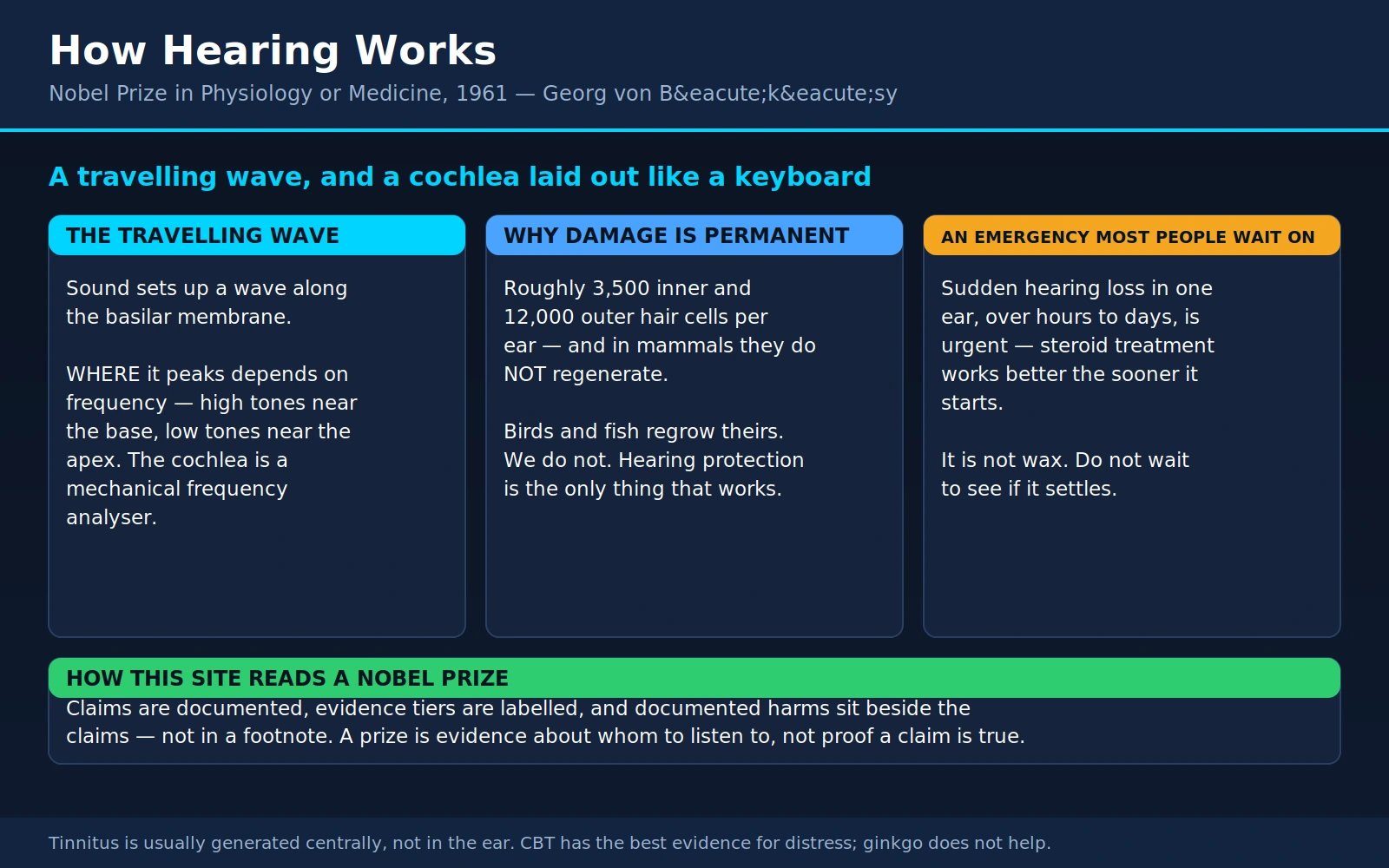
Table of Contents
- The Man Who Arrived at the Ear Sideways
- The Problem: How Does a Pressure Wave Become a Pitch?
- What He Actually Did
- The Travelling Wave
- What He Could Not See — and the Honest Update
- Inner Hair Cells and Outer Hair Cells
- How Hearing Is Lost
- Noise, in Numbers You Can Actually Use
- Tinnitus
- Hearing Aids, Implants, and the Dementia Question
- Where Mainstream Medicine Agrees — and What Remains Debated
- Key Research Papers
- Connections
- Featured Videos
1. The Man Who Arrived at the Ear Sideways
Georg von Békésy (1899–1972) won the 1961 Nobel Prize in Physiology or Medicine, alone and unshared, "for his discoveries concerning the physical mechanism of stimulation within the cochlea." He was not a physician. He had never trained in medicine, never treated a patient, and never held a medical degree. He was a physicist who had spent more than twenty years working for a telephone company.
He was born in Budapest in 1899, the son of a Hungarian diplomat, which meant a childhood spent moving between Munich, Constantinople, Zurich and Bern. He took a degree in chemistry at Bern and then a doctorate in physics from the University of Budapest in 1923. In the same year he joined the research laboratory of the Hungarian Post Office — which, as in most of Europe at the time, ran the national telephone system.
His assignment there is the whole origin of the story. Telephone calls sounded bad, and the laboratory's job was to work out why and fix it. Békésy did something that sounds obvious in hindsight and was not obvious at all at the time: he treated the telephone as a chain of components in series — the microphone, the line, the amplifier, the earpiece — and reasoned that the quality of the whole chain is set by its weakest link. There is no point spending money improving a component that is already better than the worst one. So he set out to rank them.
The weakest link, he concluded, was the last one: the human ear. And unlike the microphone and the earpiece, whose transfer characteristics could be measured on the bench, nobody actually knew how the ear worked. The engineering question — where should we spend our budget? — had turned into a physiological one. Békésy spent the next four decades answering it.
He worked at the Post Office laboratory in Budapest until 1946, publishing a long run of papers in German in journals such as Annalen der Physik, Physikalische Zeitschrift and Akustische Zeitschrift through the late 1920s, 1930s and early 1940s. Those early papers are the foundation of everything that followed, and most of them are not indexed in PubMed at all — MEDLINE's coverage begins in the mid-1940s and does not extend to interwar German physics journals. Readers who want the primary material in English should look instead to his 1960 book Experiments in Hearing (McGraw-Hill), an edited collection in which he translated and consolidated the earlier work himself. It is a book, not a journal article, which is why it appears here as a recommendation rather than as a numbered citation.
After the war he moved briefly to the Karolinska Institute in Stockholm, then in 1947 to Harvard, where he spent nearly twenty years in the Psycho-Acoustic Laboratory. In 1966 he moved again, to the University of Hawaii, as a professor of sensory sciences; he died in Honolulu in 1972. He never married, worked largely alone, built most of his own instruments by hand, and assembled a serious collection of Asian and classical art that he later left to the Nobel Foundation.
The reason he is on this site is not only the prize. It is that his work is the reason anyone can explain to you what is happening inside your ear right now — and, because that mechanism is now understood, why some kinds of hearing loss are preventable, why some are urgent, and why others are permanent. Sections 7 through 10 of this page are the practical half, and they are the half most readers came for.
2. The Problem: How Does a Pressure Wave Become a Pitch?
Start with what actually arrives at your head. Sound is nothing but a travelling pattern of small pressure fluctuations in air. A struck piano string compresses the air around it, that compression pushes the next parcel of air, and a wave propagates outward. By the time it reaches you, all the information — the note, the timbre, the words, the direction — is encoded in how the air pressure at your eardrum wiggles up and down over time. That is one number changing over time. Nothing more.
Your brain, however, does not experience one number. It experiences a violin distinguishable from a cello playing the same note, a consonant distinguishable from another consonant, and a voice picked out of a restaurant. Somewhere between the eardrum and the auditory nerve, that single fluctuating pressure has to be pulled apart into its component frequencies. In mathematical language, something in your head performs a Fourier analysis. The question Békésy inherited was: what does it, and how?
Helmholtz's answer: a harp inside the head
The dominant theory came from Hermann von Helmholtz, who set it out in Die Lehre von den Tonempfindungen in 1863. Helmholtz knew about sympathetic resonance: sing a note near a piano with the dampers lifted and the string tuned to that note will start to sound on its own, while the others stay quiet. A bank of tuned resonators is therefore a frequency analyser. Feed a complex sound into it and each resonator responds only to its own frequency — the analysis happens automatically, in the mechanics, with no computation at all.
Helmholtz proposed that the inner ear contains exactly such a bank. Running the length of the coiled cochlea is a strip of tissue called the basilar membrane, and it looked, under a microscope, as though it were built of transverse fibres of graded length — short and taut at one end, long and slack at the other. Helmholtz suggested these fibres were the strings: each tuned to its own frequency, each resonating independently, each connected to its own nerve fibre. Pitch would then simply be which string moved. It is an elegant theory, it is nearly right, and it is wrong in an important way.
The rival answer: the whole thing moves, and the brain sorts it out
The competing family of theories — often called telephone or frequency theories, associated with William Rutherford in the 1880s — held that the cochlea does no analysis at all. The membrane vibrates as a whole, reproducing the incoming waveform much as a telephone diaphragm does, and the auditory nerve carries that waveform to the brain, which does the sorting centrally. A later variant, the volley theory of Wever and Bray in the 1930s, pointed out that although a single nerve fibre cannot fire fast enough to encode a high-frequency tone, a squad of fibres taking turns could collectively track it.
Both families had genuine evidence behind them. Both had genuine problems. Helmholtz's tuned strings looked too heavily damped, sitting as they do in a viscous fluid, to ring the way tuning demanded. The telephone theories struggled to explain how the brain could resolve frequencies above a few thousand hertz from nerve firing patterns alone. The argument ran for the better part of a century.
And here is the striking part: throughout that entire century, nobody had watched. The cochlea is a fluid-filled spiral roughly 35 millimetres long uncoiled, wound into about two and three-quarter turns, and packed into a volume smaller than a pea — buried inside the petrous portion of the temporal bone, the hardest and densest bone in the human body. Its motions at ordinary sound levels are smaller than the wavelength of light. Opening it destroys it; opening it without destroying it had not been done. The theories were arguments from anatomy, from psychophysics, and from physical plausibility. They were not arguments from observation, because there were no observations.
3. What He Actually Did
Békésy's contribution is often summarised in one sentence — "he showed that a travelling wave moves along the basilar membrane" — and that sentence badly undersells it. The finding took perhaps a paragraph to state. Getting into a position where anyone could state it took twenty years of instrument-building, and the craft is the achievement.
He worked mostly with temporal bones taken from human cadavers, supplemented by guinea pig, cat, cow and elephant cochleae — the range of species mattered, because comparing a huge cochlea to a small one told him which features were general and which were incidental. He became extraordinarily fast at the dissection, drilling into the bone to open the cochlear duct without collapsing it, so that a preparation could be made while the tissue was still fresh enough to have realistic mechanical properties. Freshness was not a nicety: dried or fixed tissue changes its stiffness completely, and stiffness is the entire subject.
Seeing motion smaller than light
Having opened the cochlea, he faced the real problem. The basilar membrane is transparent, and at conversational sound levels it moves by distances comparable to the size of a molecule. Three tricks solved it.
Tracers. He sprinkled fine particles — silver flakes, powdered coal, aluminium — onto the membrane's surface. A transparent sheet moving invisibly becomes a visible object once it carries specks that catch the light.
Stroboscopic illumination. A membrane oscillating hundreds or thousands of times a second is a blur. Békésy flashed his light source in step with the tone driving the ear, so that each flash caught the membrane at the same phase of its cycle. Under a strobe locked to the stimulus, a wave repeating a thousand times a second appears to stand perfectly still — and shifting the flash timing walks it slowly through the motion, turning an inaudible blur into something you can watch, sketch, and measure.
Brute loudness. Even so, the displacements at normal levels were far below what any microscope of the 1930s and 1940s could resolve, so he drove the preparation with extremely intense sound — levels well above anything a living person could safely be exposed to. This is not a criticism; it was the only way. But it becomes the crucial caveat in section 5, and Békésy himself said so at the time.
Alongside these he built a running series of scaled-up mechanical models: rubber and plastic membranes in fluid-filled tubes, sized so that a wave which is microscopic in a real cochlea becomes centimetres long and visibly slow. One of his most inventive experiments, described in the Proceedings of the National Academy of Sciences in 1956, ran a large mechanical cochlea model along a subject's forearm, so that the skin stood in for the sensory surface of the basilar membrane. He could then simply ask the person where on their arm they felt the vibration, and watch that place move as he changed the frequency. It is a beautiful piece of experimental design: it turns an inaccessible internal measurement into a question a volunteer can answer out loud.
The instrument in the clinic
One more piece of his engineering reached patients directly. Békésy designed a self-recording audiometer: instead of a technician presenting tones and marking responses, the machine sweeps slowly through frequency while the listener holds a button down as long as they can hear the tone and releases it when they cannot. The tone gets quieter while the button is held and louder when it is released, so the trace zigzags along the listener's own threshold, drawing the audiogram automatically. Békésy audiometry was a clinical standard for decades, and the shape of the zigzag — how wide it is, and whether continuous and interrupted tones trace differently — carried diagnostic information about where in the auditory system a problem sat. Modern automated audiometry, including the app-based hearing tests now bundled with consumer devices, descends directly from that button.
4. The Travelling Wave
What he saw was neither of the two theories on offer.
The basilar membrane does not have independently tuned strings, and it does not move as a rigid whole. When the stapes — the last of the three middle-ear bones, and the smallest bone in the body — pistons in and out of the oval window, it launches a travelling wave that runs along the membrane from the base of the cochlea toward the apex. The wave grows in amplitude as it advances, reaches a maximum at some point along the membrane, and then dies away sharply. It does not reflect back. It does not stand still. It is far closer to the ripple that runs down a flicked rope than to a plucked piano string.
The decisive observation is where the maximum sits, because that turned out to depend on frequency:
- High frequencies peak near the base of the cochlea, close to the stapes, and die out before travelling far.
- Low frequencies travel much further and peak near the apex, at the inner end of the spiral.
- Everything in between lands in between, in an orderly progression along the membrane.
The reason is mechanical, and once you see it you cannot unsee it. The basilar membrane is not uniform. At the base it is narrow — roughly a tenth of a millimetre across — and stiff. Toward the apex it becomes several times wider and dramatically floppier, with stiffness falling by something on the order of a hundredfold from one end to the other. (These figures are approximate and vary between species and between measurement methods.) Counter-intuitively, the membrane gets wider as the bony canal housing it gets narrower. That graded stiffness is what steers the wave: a stiff region passes high frequencies along efficiently and resists low ones, while a floppy region can only respond to slow oscillations. The wave keeps travelling until it reaches the place where the local mechanics match its frequency, dumps its energy there, and stops.
So Helmholtz was right about the conclusion — place codes pitch — and wrong about the mechanism. There are no independent resonators. There is one continuous, coupled, graded structure, and a wave that finds its own address on it. Békésy put this precisely in his 1956 review in Science: adjust two elastic properties of a membrane — the coupling between adjacent parts, and the absolute stiffness — and you can make it behave like any of the competing theories predicted. Set those two numbers to the values actually measured in a fresh human cochlea, and what you get is travelling waves whose maximum shifts along the membrane as frequency changes, with the place of the maximum determining the pitch.
Tonotopy: the keyboard that never ends
The consequence is that the cochlea is a mechanical frequency analyser laid out like a keyboard. Frequency is converted into position before a single nerve has fired. Every point along the membrane has a characteristic frequency to which it responds best, running smoothly from roughly 20,000 hertz at the base to roughly 20 hertz at the apex in a healthy young ear.
That map is called tonotopy, and its most remarkable property is that the nervous system never throws it away. Each auditory nerve fibre picks up from one small region of the membrane and inherits that region's characteristic frequency. The fibres project in order to the cochlear nucleus in the brainstem, and the order is preserved. It is preserved again through the superior olivary complex, the inferior colliculus in the midbrain, and the medial geniculate body of the thalamus. It arrives, still intact, at the primary auditory cortex in the temporal lobe, which is itself laid out as a frequency map. You can put an electrode into a person's auditory cortex, move it a few millimetres, and watch the best frequency shift smoothly — a direct cortical readout of a physical position inside a bone-encased spiral several centimetres away.
This is a genuinely deep organising principle, and it has a close family resemblance to how the other senses are wired. The retina maps visual space onto the cortex (retinotopy); the body surface maps onto the somatosensory cortex (somatotopy); the cochlea maps frequency. In every case a physical arrangement at the sensory sheet is carried forward as a physical arrangement in the brain. Our page on Wald, Hartline and Granit — the 1967 prize, for the chemistry and physiology of vision — covers the equivalent story for the eye, and Julius and Patapoutian covers touch and temperature.
5. What He Could Not See — and the Honest Update
Békésy's picture is correct. It is also incomplete, and the way it is incomplete is one of the more satisfying stories in twentieth-century biology.
Recall the constraint. He worked on cadaver cochleae, at very high sound levels, because that was the only way to see anything. Both conditions matter, and both push the measurement in the same direction. What he was watching was the passive mechanics of the cochlea — what the structure does when it is a piece of graded, damped, fluid-loaded material and nothing more.
And the passive travelling wave has a problem: its peak is too broad. Human beings can reliably distinguish tones differing by well under one percent in frequency. The envelope Békésy measured is a gentle hump spread over several millimetres of membrane, far too blunt to support that. Nor could a passive membrane explain sensitivity: at the threshold of hearing, the required displacement of the membrane is of the order of a fraction of a nanometre — roughly the diameter of an atom — which is smaller than the random thermal jostling of the fluid around it. A purely passive detector should be drowned in its own noise.
Békésy was well aware of this. His proposed solution — visible in that same 1956 Science paper, and the reason for the experiment with the arm — was that the nervous system sharpens the blunt mechanical peak, by lateral inhibition: neighbouring channels suppress each other, so a broad hump of excitation is whittled down to a narrow ridge. He had shown that exact effect on the skin, where a broad vibration produces a surprisingly sharp, localised sensation, and he spent the last part of his career on lateral inhibition across the senses. He was right that sharpening happens. He was wrong about where.
Gold's prediction, ignored for thirty years
In 1948 the astrophysicist Thomas Gold — then a young researcher at Cambridge, later famous for entirely unrelated arguments about cosmology and pulsars — made the physicist's objection. Working with the zoologist R. J. Pumphrey, he published a short note in Nature — "Phase memory of the ear; a proof of the resonance hypothesis," 1948;161(4095):640 — arguing from the ear's ability to retain phase information that the auditory system behaves like a sharply tuned resonant device rather than a broadly responding one. In a companion paper in the Proceedings of the Royal Society of London, Series B, also 1948, Gold argued that a resonator immersed in a viscous fluid simply cannot be that sharply tuned unless something is feeding energy back in to cancel the damping — in engineering terms, a regenerative amplifier. (That Royal Society paper predates MEDLINE's coverage and is not indexed in PubMed, which is why it appears here with journal and year but without a link.)
Gold's argument was largely ignored for three decades. He was not a biologist, the claim sounded exotic, and there was no way to test it.
Then the ear was caught making sound
In 1978 David Kemp, working in London, put a sensitive microphone into a sealed ear canal, delivered faint clicks, and averaged the response. What came back was not simply the ear canal's echo. Several milliseconds after each click — far too late to be a passive middle-ear ringing — there was an additional, slowly decaying oscillation. It was present in every normal ear he tested, and absent in ears with cochlear deafness. He concluded it originated in a nonlinear mechanism inside the cochlea that responds mechanically to sound.
The ear, in other words, emits sound. These are otoacoustic emissions, and they are the direct evidence that something inside the cochlea is actively generating mechanical energy rather than merely absorbing it. Gold had been right.
This has a consequence you may already have benefited from without knowing it. Because otoacoustic emissions are present when the cochlea works and absent when it does not, and because measuring them requires nothing from the subject — no button, no attention, no language — they are the basis of newborn hearing screening. A probe goes in the ear of a sleeping baby, clicks are played, and the machine listens for the ear to answer back. Universal newborn screening programmes, now standard across much of the world, have pulled the average age of diagnosis of congenital hearing loss down from years to weeks, which matters enormously for language development. That is a 1978 basic-science curiosity turned into routine care.
The cochlear amplifier
The source of the energy turned out to be the outer hair cells. In 1985, William Brownell and colleagues isolated single outer hair cells and showed that passing current across them made them physically change length — shortening when depolarised, lengthening when hyperpolarised, fast enough and cleanly enough to influence the mechanics of the membrane they sit on. Cells that move in response to voltage, at acoustic frequencies. In 2000, Jing Zheng, Peter Dallos and colleagues identified the protein responsible and named it prestin (from the musical presto) — a membrane protein, related to a family of anion transporters, that acts as a direct voltage-to-length motor. Expressing it in kidney cells made those cells change shape with voltage too. In 2002, in Nature, M. Charles Liberman and colleagues showed that mice engineered without prestin lose outer hair cell electromotility and lose the cochlear amplifier along with it.
So the modern picture, summarised authoritatively by Luis Robles and Mario Ruggero in Physiological Reviews in 2001, is this. Békésy's travelling wave is real and is the substrate. On top of it sits a cochlear amplifier: outer hair cells detect the local motion, and push back in phase with it, cycle by cycle, adding energy exactly where the wave is peaking. The result is that in a living, healthy cochlea at low sound levels, the response is roughly a hundred to a thousand times larger and dramatically more sharply tuned than the passive mechanics alone would give. The amplifier also works compressively — it gives enormous gain to quiet sounds and almost none to loud ones, which is how the ear squeezes a range of intensities spanning a factor of about a trillion into a manageable range of neural responses.
The first hint of this in a living animal came in 1971, when William Rhode used the Mössbauer technique — a nuclear-physics method sensitive to minute velocities — to measure basilar membrane vibration in anaesthetised squirrel monkeys, and found behaviour that the cadaver preparations had not shown. The amplifier is exquisitely fragile: it depends on healthy outer hair cells and adequate blood supply, and it fades within minutes of death. That is precisely why Békésy could not have seen it. His preparations had it switched off.
None of this diminishes him, and it is worth being clear about why. He established, by direct observation, the structural fact on which everything since has been built: sound becomes place. The correction is not "he was wrong"; it is "there is a second stage nobody could measure with 1940s instruments on dead tissue." Every subsequent discovery in this field — emissions, electromotility, prestin, the whole active-cochlea programme — is a refinement of the map he drew, and each one uses his vocabulary to describe itself. That is what a foundational result looks like.
6. Inner Hair Cells and Outer Hair Cells
Sitting on the basilar membrane is the organ of Corti, and in it are the cells that actually convert motion into signal. There are two kinds, they do different jobs, and telling them apart explains a great deal of clinical hearing loss.
Inner hair cells — the actual microphones
There is a single row of inner hair cells, roughly 3,500 per human ear (an approximate, commonly quoted figure; published counts vary). These are the true sensory receptors. Each carries a bundle of stiff hair-like stereocilia on its top surface, arranged in a staircase of increasing height. When the basilar membrane moves, shearing forces deflect that bundle. Fine protein filaments called tip links run from the side of each stereocilium to the tip of its shorter neighbour, and deflecting the bundle pulls on these links, which physically yanks open mechanotransduction channels in the membrane.
Ions rush in, the cell depolarises, it releases neurotransmitter, and an auditory nerve fibre fires. That is the whole conversion. The elegant, brutal part is that there is no chemical intermediary and no second messenger cascade: the sound literally pulls the channel open by a physical tether. It is the fastest sensory transduction in the body, which it has to be, because it has to keep up with tens of thousands of cycles per second.
This mechanism — a mechanically gated ion channel — is the same broad principle that runs through touch and pressure sensing, which is why this page and our page on David Julius and Ardem Patapoutian (the 2021 prize, for the receptors for temperature and touch) are describing cousins. And because the output is an ion flux driving an action potential in a nerve fibre, everything downstream is the machinery worked out by Hodgkin, Huxley and Eccles — the hair cell is the mechanotransducer at the front end of exactly the ion-channel physiology they described.
About 95 percent of the fibres in the auditory nerve carry signal from inner hair cells to the brain. Almost everything you consciously hear comes through this row of 3,500 cells.
Outer hair cells — the amplifier
There are three rows of outer hair cells, roughly 12,000 per ear (again approximate). Only a small minority of ascending nerve fibres come from them. Instead, they receive a heavy descending supply from the brainstem — the olivocochlear efferents — which means the brain can adjust them.
Their job is the one described in section 5: they are the motors of the cochlear amplifier. Loaded with prestin, they contract and elongate in step with the incoming wave, boosting quiet sounds and sharpening the tuning of the region they sit on. They are less "sensors" than "active suspension."
The clinical consequence is direct and useful. Outer hair cells are considerably more vulnerable than inner hair cells to noise, to ageing, and to ototoxic drugs. So the typical early pattern of acquired hearing loss is not deafness — it is the loss of the amplifier. Quiet sounds disappear while loud sounds remain loud (the phenomenon of recruitment: "don't shout, I'm not deaf — I just can't make out what you're saying"), tuning gets blurry, and separating a voice from background noise becomes disproportionately hard. That combination — normal-ish loudness perception, terrible clarity in a restaurant — is the signature of outer hair cell loss, and it is why so many people with early hearing loss insist their hearing is fine and everyone else mumbles. And because otoacoustic emissions are generated by outer hair cells, testing emissions is a direct check on the health of exactly the cells that fail first.
The fact that matters most: they do not come back
Here is the sentence to take away from this whole section. Mammals do not regenerate cochlear hair cells. You are born with your full complement, production has ceased before birth, and every one you lose is lost permanently. There is no repair pathway, no stem cell reserve in the human organ of Corti that reconstitutes them, and no treatment currently available that grows them back. Damage accumulates monotonically over a lifetime.
Everything in sections 7 and 8 follows from that one biological fact. Hearing protection is not a nice precaution; it is the only intervention that exists, because there is no repair afterwards.
Which makes the exception all the more interesting. In 1988, two groups published back to back in Science — Jeffrey Corwin and Douglas Cotanche in chickens, Brenda Ryals and Edwin Rubel in quail — showing that after acoustic trauma, birds replace their lost hair cells. Supporting cells that normally never divide re-enter the cell cycle at the injury site and produce new sensory cells, and hearing recovers. Fish and amphibians do the same thing routinely. The capacity is ancient; mammals appear to have lost or suppressed it somewhere along the line.
That is where the research hope lives: not in protecting cells better, but in finding the switch birds still have and mammals have turned off. Progress has been slower than the excitement of the late 1980s suggested. Attempts to force supporting cells to become hair cells — using inhibitors of Notch signalling, or forced expression of the transcription factor Atoh1 — have produced new hair-cell-like cells in animals, but the leading clinical candidate to reach a substantial phase 2 trial did not meet its endpoints and that programme was discontinued. Separately, and genuinely successfully, gene therapy for congenital deafness caused by mutations in OTOF (the otoferlin gene) restored useful hearing in deaf children in trials reported from 2024 — but note precisely what that is: those children have intact hair cells that cannot release neurotransmitter, and the therapy fixes the missing protein. It repairs a broken cell; it does not build a new one. Regeneration remains unsolved.
7. How Hearing Is Lost
With the mechanism in hand, the clinical picture organises itself. Hearing loss is conventionally divided by where the chain breaks.
Conductive loss: the sound never reaches the cochlea
Something blocks or stiffens the mechanical path from the air to the oval window. The cochlea is fine; the delivery is broken. Causes include:
- Cerumen (earwax) impaction — the single most common and most trivially fixable cause of sudden muffled hearing in one ear. Worth ruling out before anything else, and worth having removed properly rather than pushed further in with a cotton bud.
- Otitis media with effusion — fluid behind an intact eardrum, damping its motion. Very common in children; usually resolves, sometimes needs drainage.
- Tympanic membrane perforation — from infection, barotrauma, or a poked object.
- Otosclerosis — abnormal bone growth fixes the stapes so it can no longer piston freely. It typically begins in early adulthood, runs in families, and is more common in women, often worsening in pregnancy. It is one of the few causes of hearing loss that surgery genuinely fixes: a stapedectomy replaces the fixed bone with a prosthesis and can restore hearing dramatically.
- Ossicular discontinuity and cholesteatoma — the chain of middle ear bones broken by trauma, or eroded by a destructive skin cyst growing in the middle ear.
The general rule for conductive loss is that it is often treatable, sometimes curable, and rarely urgent in the way the next category is.
Sensorineural loss: the cochlea or the nerve
Here the hair cells, their synapses, or the auditory nerve itself are damaged. This is the large category, it is mostly permanent, and it is where prevention does all the work.
Noise-induced hearing loss. Excessive sound damages the cochlea by at least two mechanisms working together. There is direct mechanical injury — violent motion of the basilar membrane shears and fractures the stereocilia bundles and can tear tip links, and at extreme levels physically disrupts the organ of Corti. And there is metabolic injury — sustained overstimulation drives excessive metabolic demand in hair cells, generating reactive oxygen species and calcium overload that kill the cell over hours to days after the exposure has ended. Outer hair cells, being the most metabolically active, go first, and the base of the cochlea is hit hardest, which is why noise damage shows up as high-frequency loss. The characteristic audiogram finding is a "noise notch" — a dip centred around 4,000 hertz with partial recovery at 8,000 — a fingerprint distinctive enough to be recognisable decades later.
Synaptopathy, or "hidden hearing loss" — a genuinely important recent finding. In 2009, Sharon Kujawa and Charles Liberman reported something that changed how this field thinks about noise. They exposed mice to noise loud enough to cause a threshold shift that completely recovered — the textbook definition of temporary, reversible damage. The hair cells survived intact. But when they looked at the synapses between inner hair cells and auditory nerve fibres, they found acute, permanent loss of nerve terminals, followed over months by slow degeneration of the cochlear nerve fibres themselves. In other words: an exposure that leaves your audiogram normal can still permanently destroy part of the wiring, and conventional threshold testing cannot see it.
They noted that this should specifically damage the ability to hear in noisy environments, and could plausibly contribute to tinnitus and to sound sensitivity. This matches a common and previously baffling clinical presentation: people who say they cannot follow a conversation in a restaurant, are told their hearing test is normal, and are effectively dismissed. How much of human difficulty-in-noise is explained by synaptopathy is still genuinely unsettled — the mouse work is clear, the human measurement is hard, and the field is actively arguing about how to detect it in living people. But it is now a mainstream research concern rather than a fringe one, and it substantially raises the stakes on "loud but only temporarily."
Age-related hearing loss (presbycusis). Cumulative loss of hair cells, stria vascularis function, and neural elements over decades, hitting high frequencies first and progressing downward. Consonants — s, f, th, sh, t, k — carry most of their energy at high frequencies and most of the information distinguishing one word from another, while vowels are low-frequency and loud. That mismatch is why presbycusis presents as "I can hear you, I just can't understand you," and why it is so often experienced as other people mumbling. It is not purely a clock: lifetime noise exposure, cardiovascular disease, diabetes, smoking, and genetics all load onto it, which means part of what we call ageing is accumulated, preventable damage.
Ototoxic drugs. Several important medicines poison hair cells. Naming them specifically matters, because the risk is manageable when it is known about:
- Aminoglycoside antibiotics — gentamicin, tobramycin, amikacin, streptomycin, neomycin. These preferentially destroy outer hair cells at the cochlear base, causing permanent high-frequency loss, and some (gentamicin especially) are also vestibulotoxic, damaging balance. Loss can begin or progress after the course is finished. A specific and important point: people carrying the mitochondrial variant m.1555A>G in the MT-RNR1 gene can suffer severe, permanent deafness from a single conventional dose. Because mitochondrial DNA is maternally inherited, a family history of deafness after antibiotics on the mother's side is a real warning sign worth mentioning to a doctor, and rapid genetic testing before emergency aminoglycoside dosing is now used in some neonatal units.
- Platinum chemotherapy — cisplatin above all, carboplatin less so. Cisplatin ototoxicity is common, dose-related, permanent, and disproportionately affects children treated for cancer. Sodium thiosulfate given after cisplatin infusion is now approved in some settings to reduce it in paediatric patients.
- Loop diuretics — furosemide, bumetanide, ethacrynic acid — at high intravenous doses or in kidney failure. Usually reversible on its own, but the combination of a loop diuretic and an aminoglycoside is markedly more damaging than either alone, and that combination is common in hospital.
- High-dose salicylates — aspirin at large doses causes tinnitus and a mild-to-moderate reversible hearing loss, historically used as a dosing guide in rheumatology. This one does recover on stopping. Quinine behaves similarly.
If you are on any of these and notice new tinnitus or hearing change, that is worth reporting promptly rather than at the next routine appointment — not to stop a necessary drug on your own, but because monitoring and dose adjustment exist.
Other sensorineural causes include head trauma and temporal bone fracture, meningitis (a classic cause of profound acquired deafness in children, and one reason meningitis is followed by hearing assessment), congenital cytomegalovirus infection, autoimmune inner ear disease, Ménière's disease, and vestibular schwannoma (acoustic neuroma) — a benign tumour on the balance nerve that classically presents with one-sided hearing loss and tinnitus, which is a large part of why asymmetry is always taken seriously.
Sudden sensorineural hearing loss is a medical emergency
If you lose hearing suddenly in one ear — over minutes, hours, or up to three days — and it is not simply a blocked, wax-filled or infected ear, you should be assessed the same day or the next day. Not next week. This is one of the genuine emergencies in ear medicine, and almost nobody knows it.
The clinical definition used in the American guideline is a sensorineural loss of at least 30 decibels across at least three adjacent frequencies, developing within 72 hours. Most cases are one-sided, in most no cause is ever identified, and it is frequently mistaken by the person experiencing it — and sometimes by a first clinician — for wax, an infection, or a blocked eustachian tube from a cold.
The reason the timing matters is that the standard treatment is corticosteroids, and the evidence such as it is favours starting them early — the 2019 clinical practice guideline from the American Academy of Otolaryngology–Head and Neck Surgery frames steroids as an option for initial therapy within the first two weeks of onset, with intratympanic steroid injection offered for incomplete recovery in the roughly two-to-six-week window afterwards. Past that, the door closes. There is no treatment for hearing lost six months ago.
A rough bedside distinction you can make yourself while arranging to be seen, and which is not a substitute for being seen: hum loudly. If the hum sounds louder in the bad ear, the problem is most likely conductive — wax, fluid, a blocked middle ear — which is far less urgent. If the hum sounds louder in the good ear, that points toward sensorineural loss, which is the urgent one. (This is the principle behind the Weber tuning-fork test.) Vertigo accompanying the loss is a poor prognostic sign and another reason to be seen quickly.
Two further points, in the interest of honesty. First, a substantial fraction of sudden sensorineural hearing loss recovers spontaneously without any treatment — published estimates vary widely but are often in the range of a third to a half or more — and that high spontaneous recovery rate is precisely why the steroid evidence is so hard to interpret. There has never been a large, modern, adequately powered placebo-controlled trial. The 2011 JAMA trial by Steven Rauch and colleagues, which is the best-known randomised study in this area, did not compare steroids against placebo at all; it compared oral prednisone against intratympanic methylprednisolone in 250 patients and found the injected route non-inferior to the oral one. That answers "which route" and not "does it work." Second, the same guideline recommends against a list of things patients are often given: routine CT scanning of the head, routine blood testing, antivirals, thrombolytics, vasodilators and vasoactive substances. What it does recommend is prompt audiometry and evaluation for retrocochlear pathology — usually MRI, or auditory brainstem response testing — to make sure the cause is not a tumour.
None of that undercuts the headline. The treatment window is measured in days to a couple of weeks, the downside of being assessed promptly is an afternoon, and the downside of waiting is potentially permanent. Go.
8. Noise, in Numbers You Can Actually Use
Noise is the largest preventable cause of hearing loss on earth, and the reason people underestimate it is that the decibel scale is deeply counter-intuitive.
The scale lies to your intuition
Decibels are logarithmic. The consequences are worth memorising:
- +3 dB doubles the sound intensity — the actual physical energy arriving at your ear. Three decibels sounds like a rounding error. It is a factor of two.
- +10 dB is ten times the intensity, and is roughly what people perceive as "twice as loud." Perception and physics diverge, and perception is the one that fools you.
- So a 100 dB concert is not "slightly louder" than an 85 dB workshop. It carries about thirty times the sound energy.
Second, damage accumulates as a dose: level multiplied by time. Because +3 dB doubles the intensity, every 3 dB increase halves the time you can safely be exposed. This is the "3 dB exchange rate," and it is the single most useful idea in this section.
The exposure limits, and roughly what fits inside them
The US National Institute for Occupational Safety and Health (NIOSH) recommended exposure limit is 85 dBA for 8 hours per day, with the 3 dB exchange rate. Working that through gives a table worth carrying in your head:
- 85 dB — 8 hours
- 88 dB — 4 hours
- 91 dB — 2 hours
- 94 dB — 1 hour
- 100 dB — about 15 minutes
- 106 dB — under 4 minutes
- 115 dB — under 30 seconds
Note that the legally enforceable US occupational standard (the OSHA permissible exposure limit) is more permissive — 90 dBA for 8 hours with a 5 dB exchange rate — which means that a workplace can be fully compliant with the law and still be damaging its workers' hearing by the health-based standard. Compliance is a floor, not a target. For recreational listening, the World Health Organization and the International Telecommunication Union have promoted a safe-listening standard of roughly 80 dB for a total of 40 hours a week for adults, and 75 dB for more sensitive listeners.
Now the levels you actually encounter. These are typical figures and vary a great deal with distance and setting:
- Normal conversation — about 60 dB. Safe indefinitely.
- Busy city traffic, a vacuum cleaner — 75–85 dB. Around the threshold where dose starts to count.
- Lawnmower, leaf blower, hair dryer, food blender — 85–100 dB. An afternoon of yard work is a real exposure.
- Motorcycle, power drill, subway platform — 95–100 dB.
- Nightclub, rock concert, sports stadium — 100–115 dB. At 105 dB the safe dose is a few minutes; a three-hour concert exceeds it by a factor of many dozens.
- Chainsaw, angle grinder — 105–115 dB.
- Ambulance siren at close range — about 120 dB.
- Firearm without protection — 140–170 dB peak. A single unprotected shot can cause permanent damage. This is not a dose calculation; it is an instantaneous injury.
- Personal listening devices at maximum volume with typical earphones — commonly 100–110 dB, i.e. concert levels, delivered directly into the ear canal, for hours.
That last one is not a small problem. A 2022 systematic review and meta-analysis in BMJ Global Health by Dillard and colleagues (2022;7(11):e010501), working with the World Health Organization, pooled 33 studies of listening behaviour in people aged 12 to 34 and estimated that somewhere between 0.67 and 1.35 billion young people worldwide are exposed to unsafe listening practices — roughly a quarter from personal listening devices and, on their modelling, close to half from loud entertainment venues.
What to actually do
The 60/60 rule of thumb for headphones: no more than 60 percent of maximum volume, for no more than 60 minutes at a stretch. It is a rough heuristic rather than a standard — the actual output depends on the device and the earphones — but it is easy to remember and errs in the right direction. Better still, most phones now contain a headphone-level meter that reports your actual weekly dose in dB; look at it once, because the number is usually a surprise. Noise-cancelling headphones help substantially for a non-obvious reason: on a train or a plane, most of the volume people use is spent overcoming background noise, so cancelling the background lets you listen far quieter without losing anything.
Two warning signs mean you have already had too much: ringing in the ears after an event, and a muffled, underwater sensation that clears over hours. Both are the classic temporary threshold shift. The word "temporary" is dangerously reassuring — that is exactly the exposure Kujawa and Liberman showed can permanently destroy synapses while the audiogram recovers completely.
A field test for "is this too loud": if you have to raise your voice to be understood by someone at arm's length, ambient noise is probably at or above 85 dB and the clock is running.
Hearing protection is the entire intervention. Because hair cells do not regenerate, there is no treatment, supplement, or therapy that restores what noise takes. Nothing in this article's later sections repairs it. Foam earplugs, correctly rolled and inserted deep enough to seat, are cheap and give meaningful attenuation; earmuffs give more; the two together give more still, and are worth it around firearms and power tools. Two caveats. First, labelled noise reduction ratings substantially overstate real-world protection, because real-world fitting is imperfect — NIOSH advises derating the label, and for formable foam plugs assuming roughly half the printed number is a sensible working rule. Second, for music, ordinary foam plugs muffle the highs and make everything sound bad, which is why people take them out; filtered musicians' earplugs attenuate roughly evenly across frequencies for about 15 to 20 dB, so the music still sounds like music. They cost a small amount and they are the difference between wearing protection and not.
The last point is the one worth sitting with. Every other section of this page describes something you can treat, manage, or compensate for. This section describes the only part of hearing loss you can genuinely prevent, and the window for prevention is before, not after.
9. Tinnitus
Tinnitus is the perception of sound with no external source — ringing, hissing, buzzing, whistling, roaring, cricket-like chirping, sometimes a musical tone. It is extremely common. The 2020 Cochrane review on this topic opens by noting that tinnitus affects up to about 21 percent of adults, with an estimated 1 to 3 percent experiencing severe problems from it.
Before anything else: if tinnitus is distressing you, that distress is real and it is not a character failing. The most common thing people with troublesome tinnitus report is being told there is nothing wrong and nothing to be done, in a tone that implies they should stop making a fuss. Both halves of that are wrong. Something identifiable is usually happening, and there are interventions with real evidence behind them. They are not what most people expect, which is part of the problem.
What tinnitus actually is
The intuitive model — a sound being generated somewhere in the ear — is usually wrong, and the correct model explains most of what is otherwise puzzling about the condition.
Tinnitus is in the great majority of cases a consequence of hearing loss, and it is generated centrally, in the brain, not in the ear. When a region of the cochlea is damaged — by noise, age, or a drug — the auditory nerve fibres from that region stop delivering their normal background input. The central auditory system responds the way any automatic gain control responds to a lost signal: it turns up the gain. This is homeostatic plasticity, and it is not a malfunction; it is the system trying to compensate. But turning up the gain on a channel with no input amplifies whatever noise remains — the spontaneous, random activity of neurons — until it crosses the threshold of perception and is heard as a sound.
The analogy is a hearing aid or a PA system turned up too far in a silent room: you get hiss and then howl, not because there is anything to hear but because the amplification is too high for the input. This is why the pitch of a person's tinnitus usually falls in the frequency region where their hearing is worst; why it is worst in a quiet room at night, when there is nothing to mask it and nothing to occupy attention; and why searching for a sound source in the ear generally finds nothing.
It also explains a fact that surprises people: tinnitus loudness correlates poorly with tinnitus distress. Two people with identically measurable tinnitus can be, respectively, unbothered and severely disabled. What predicts distress is not the signal but the response to it — attention, sleep disruption, anxiety about what it means, and the loop in which monitoring the sound makes it more salient, which increases distress, which increases monitoring. That loop is a target, and it is treatable.
What has evidence
- Hearing aids, where there is hearing loss. The mechanism points directly here: if reduced input drove the gain up, restoring input should bring it down, and in practice many people find their tinnitus recedes markedly once they are properly aided. It also refills the quiet with real sound. Because most tinnitus accompanies some hearing loss, an audiogram is the first useful step, and correcting hearing loss is the first useful treatment.
- Cognitive behavioural therapy — the best-supported intervention for distress. The 2020 Cochrane review by Fuller and colleagues pooled 28 studies and 2,733 participants. Against no intervention, CBT reduced the impact of tinnitus on quality of life at the end of treatment (standardised mean difference −0.56), which the reviewers re-expressed as about 10.9 points lower on the Tinnitus Handicap Inventory — against an estimated minimal clinically important difference of 7 points, so the effect is meaningful and not merely statistically detectable. CBT also outperformed audiological care alone and outperformed other active treatments, with a small additional benefit for depressive symptoms and essentially no adverse effects. The reviewers rated most of this low-certainty evidence and flagged an absence of data at 6 and 12 months, which is a real limitation. It is still, by a distance, the best-evidenced thing on the list. Note what CBT is doing: it does not claim to remove the sound. It changes the relationship to it — and since distress tracks the relationship rather than the signal, that is the correct target.
- Sound enrichment. Not silence. A fan, a white or pink noise generator, a radio at low volume, rain sounds, an open window — anything that means the auditory system is not straining in a void. Particularly useful at bedtime, when most people's tinnitus is worst and sleep is what actually degrades quality of life.
- Treating what is treatable underneath it. Impacted wax, middle ear fluid, an ototoxic drug that could be changed, untreated sleep apnoea, and — because anxiety and depression both amplify tinnitus distress and are amplified by it — treating those in their own right.
What does not have good evidence
Ginkgo biloba, the most widely sold tinnitus supplement in the world, does not have evidence of benefit. The 2022 Cochrane review by Sereda and colleagues covered 12 studies and 1,915 participants. Pooling the two studies with usable data on the primary outcome, ginkgo produced a mean difference of −1.35 points on the Tinnitus Handicap Inventory (a 0–100 scale, 95% CI −8.26 to +5.55) at three to six months — a result whose confidence interval straddles zero and whose point estimate is a fifth of the smallest difference a patient would notice. The reviewers graded the certainty as very low and concluded there is uncertainty about both benefits and harms. On the safety side there is at least reassurance: no serious adverse effects (bleeding or seizures) were reported across four studies and 1,154 participants, and other side effects were no more frequent than with placebo. So the fair summary is: probably harmless for most people, and there is no good reason to expect it to work. This site covers ginkgo on its own page for its other proposed uses; for tinnitus specifically, the evidence is not there.
The same broad picture applies to most other supplements marketed for tinnitus — zinc, melatonin, various vitamin blends, and proprietary "tinnitus formulas." Evidence ranges from thin to absent. Melatonin has some limited support specifically for sleep in people with tinnitus, which is a genuine benefit but is not the same as treating the tinnitus. Be actively suspicious of anything sold as a tinnitus cure. This is a large, desperate market with no approved pharmacological treatment, which makes it a magnet for products that cost a great deal and do nothing. A useful filter: any product claiming to eliminate tinnitus is making a claim no licensed treatment currently makes.
Red flags that need assessment
Most tinnitus is benign in the sense that it does not indicate dangerous underlying disease. These features are the exceptions, and each warrants a medical assessment rather than watchful waiting:
- One-sided (unilateral) tinnitus, especially with one-sided hearing loss — the pattern that raises the question of a vestibular schwannoma or other retrocochlear lesion. Usually it is nothing; it is checked because occasionally it is not.
- Pulsatile tinnitus — a whooshing or thumping synchronised with your heartbeat. This is a genuinely different thing: it often represents real sound from turbulent blood flow, and the differential includes vascular abnormalities, a dural arteriovenous fistula, carotid disease, a glomus tumour, and raised intracranial pressure. It merits imaging.
- Tinnitus with sudden hearing loss — see section 7. That is the emergency, and the tinnitus is the alarm bell, not the problem.
- Tinnitus with vertigo, particularly episodic vertigo with fluctuating hearing and a sense of fullness — the Ménière's pattern.
- Objective tinnitus — a sound another person can actually hear, such as a rhythmic clicking from middle-ear muscle spasm.
- New tinnitus after starting a drug, or after head injury.
- Tinnitus driving significant distress, insomnia, or hopelessness. This is a red flag in its own right, and it is the one that is most treatable. Severe tinnitus distress carries a real association with depression, and it deserves the same seriousness as any other cause of that suffering.
The realistic message for the large majority is neither "there's a cure" nor "there's nothing to be done." It is that most people habituate substantially over months to a couple of years — the sound stops being a signal the brain flags as important, and drops out of awareness for longer and longer stretches — and that the interventions above measurably speed that up. The goal of good tinnitus care is not silence. It is for the sound to stop mattering, and that is an achievable goal for most people.
10. Hearing Aids, Implants, and the Dementia Question
The cost of leaving it
Hearing loss is under-treated to a degree that is hard to justify. Estimates vary by country, but only a minority of adults who would benefit from hearing aids use them, and the average delay between noticing a problem and doing something about it is commonly quoted as several years to a decade. The reasons are familiar: cost, stigma, the belief that it is not bad enough yet, and the specific self-deception described in section 6 — that other people mumble.
Untreated hearing loss is associated with social withdrawal, reduced participation, depression, higher fall risk, and faster cognitive decline. Those associations are consistent and substantial. They are also, on their own, associations, and the direction of causation is genuinely arguable: withdrawing from company is an obvious consequence of not being able to follow it, and early dementia can itself reduce the ability to make sense of degraded speech.
What the ACHIEVE trial actually found
This is worth getting right, because it is one of the most widely misreported results in recent medicine. You will see it summarised as "hearing aids prevent dementia." That is not what the trial showed.
ACHIEVE, published in The Lancet in 2023 by Frank Lin and colleagues, was a large, well-designed randomised controlled trial. It enrolled 977 adults aged 70 to 84 with untreated hearing loss and no substantial cognitive impairment, across four US sites, and randomised them 1:1 to either a hearing intervention (audiological counselling plus hearing aids) or a control intervention of health education. The primary endpoint was the three-year change in a global cognition score.
The primary result was null. Over three years, cognitive decline was essentially identical in the two groups: −0.200 standard deviation units in the hearing intervention group versus −0.202 in the control group, a difference of 0.002 (95% CI −0.077 to 0.081), p = 0.96. In the total cohort, the hearing intervention did not slow cognitive decline.
The interesting part is why the story did not end there. The trial had recruited from two quite different populations at each site: participants already enrolled in the long-running ARIC cardiovascular cohort, who were older and carried more risk factors for cognitive decline and had lower baseline cognitive scores; and healthy volunteers recruited fresh from the community. A prespecified sensitivity analysis found that the effect of the hearing intervention differed significantly between these two groups (p for interaction = 0.010), with an apparent benefit among the higher-risk ARIC participants and none among the healthy volunteers.
The authors' own interpretation is the one to hold onto: the intervention did not reduce cognitive decline in the primary analysis of the total cohort, but the findings suggest that it might do so in populations of older adults at increased risk of cognitive decline, and not in populations at decreased risk. That is a legitimate, prespecified, hypothesis-generating finding in a subgroup — and it is not the same as a positive trial. Subgroup effects that look this promising have failed to replicate many times before, which is exactly why they are reported as hypotheses.
Hearing loss does continue to appear among the modifiable risk factors in the 2024 report of the Lancet standing Commission on dementia prevention, intervention and care. The honest position, therefore, is: hearing loss is an established risk marker; treating it has clear, immediate, well-demonstrated benefits for communication, participation and mood; whether it slows cognitive decline is unproven overall and plausible in higher-risk older adults. That is a perfectly good reason to treat hearing loss. It is not a licence for anyone to sell hearing aids as dementia prevention.
Over-the-counter hearing aids
Access has genuinely improved. In October 2022 a US Food and Drug Administration rule created a regulated over-the-counter hearing aid category for adults 18 and over with perceived mild to moderate hearing loss — no prescription, no audiologist visit, no medical exam required. Prices for OTC devices commonly run at a fraction of the traditional prescription route, which in the US has often meant several thousand dollars a pair, frequently uninsured. Several other countries have moved in similar directions, and the distinction between a regulated OTC hearing aid and an unregulated "personal sound amplification product" matters: the former has output limits and performance requirements, the latter does not.
Does self-fitting work? A randomised clinical trial published in JAMA Otolaryngology–Head & Neck Surgery in 2023 by De Sousa and colleagues (2023;149(6):522–530) put it to the test, randomising 68 adults with self-perceived mild-to-moderate loss to either fit a commercially available self-fitting OTC hearing aid themselves using the supplied app and instructions with remote support, or have the same device fitted by an audiologist using real-ear verification and best-practice prescriptive targets. After a two-week take-home trial the self-fitting group actually reported slightly better outcomes; by the end of the six-week trial there were no meaningful differences between the groups on any outcome measure, including speech recognition in noise.
That is a real and encouraging result, and it deserves its caveats: 64 participants in the analysis, one device, a six-week horizon, and self-perceived rather than audiometrically stratified hearing loss. It does not show that professional fitting is worthless, and it does not extend to more severe or asymmetric loss. What it does support is that for straightforward mild-to-moderate age-related loss, a competent self-fitting device with remote support is a legitimate option rather than a compromise — which, given that the alternative for most people is no device at all, is a meaningful public health gain.
The general advice remains: get an audiogram before buying, because it tells you whether your loss is in the range OTC devices address, and because it catches the asymmetries and red flags that need a doctor rather than a device. And expect an adjustment period. Hearing aids restore sounds your brain has stopped expecting — footsteps, paper rustling, your own voice — and the first fortnight almost always feels wrong. Most people who abandon hearing aids do so in that fortnight.
Cochlear implants, and the return to Békésy
When hair cell loss is severe enough that amplification no longer helps — there is no point making the sound louder if the cells that transduce it are gone — a cochlear implant bypasses them entirely. An external processor picks up sound, splits it into frequency bands, and transmits the pattern through the skin to an implanted receiver, which drives an electrode array threaded into the scala tympani of the cochlea. The electrodes stimulate the auditory nerve directly.
And the reason it works at all is section 4. The array is inserted so that its basal electrodes sit where high frequencies belong and its apical electrodes sit where low frequencies belong — the processor sends high-frequency energy to the basal contacts and low-frequency energy to the apical ones. The cochlear implant is a piece of clinical engineering built directly on the tonotopic map von Békésy discovered. Without knowing that place codes frequency, and in what order, the device would be unbuildable.
What implants do well: restore useful speech understanding in quiet. Many adults implanted for post-lingual deafness achieve high open-set sentence recognition — understanding conversation without lip-reading, using the telephone — and for children implanted early, spoken language development can approach that of hearing peers. Against profound deafness, that is transformative.
What they do not do is restore normal hearing, and it is worth being concrete about why. A typical array has on the order of 12 to 22 electrodes standing in for roughly 3,500 inner hair cells, and current spreads through the fluid so that adjacent electrodes stimulate overlapping populations of nerve fibres. The effective number of independent frequency channels is therefore small — commonly estimated at around eight or fewer. That is enough for speech in quiet, which is remarkably robust to spectral degradation, and it is not enough for the fine spectral detail that music depends on. Most implant users describe music as poor, pitch and timbre as unreliable, and speech in background noise as remaining difficult. Outcomes also vary widely between individuals and are generally better with a shorter duration of deafness before implantation. There is, additionally, a Deaf cultural perspective — particularly regarding implantation of deaf children of Deaf parents — which regards deafness as a linguistic and cultural identity rather than a deficit to be corrected, and which deserves acknowledgement rather than dismissal in any honest account.
11. Where Mainstream Medicine Agrees — and What Remains Debated
Settled
- The travelling wave and tonotopy. Sound sets up a wave along the basilar membrane whose peak position depends on frequency, and that frequency map is preserved from cochlea to auditory cortex. This is textbook fact, not controversy.
- The cochlear amplifier exists and is powered by outer hair cells. Otoacoustic emissions, outer hair cell electromotility, prestin, and the prestin-knockout phenotype form a closed chain of evidence.
- Mammalian hair cells do not regenerate. Noise damage is permanent, and prevention is the only intervention.
- Sudden sensorineural hearing loss requires urgent assessment, and the workup should exclude retrocochlear pathology.
- Hearing aids improve communication, participation, and quality of life in people with hearing loss. This is not seriously disputed.
- CBT reduces tinnitus-related distress, and is the best-supported intervention for it.
- No supplement has been shown to cure or meaningfully treat tinnitus, ginkgo included.
- Newborn hearing screening using otoacoustic emissions and auditory brainstem responses improves outcomes by enabling early intervention.
Genuinely unsettled
- Whether treating hearing loss slows cognitive decline. ACHIEVE was null overall with a prespecified subgroup signal in higher-risk participants. Further trials and longer follow-up are needed. Anyone stating this as established fact in either direction is ahead of the evidence.
- How much cochlear synaptopathy explains human difficulty hearing in noise. The animal evidence is strong and the concept is mainstream; reliably measuring it in living humans, and quantifying its contribution to real-world complaints with a normal audiogram, remains an open and actively contested problem.
- Whether corticosteroids actually improve outcomes in sudden sensorineural hearing loss. They are standard practice and are recommended as an option, but the high rate of spontaneous recovery and the absence of a large modern placebo-controlled trial mean the size of the true effect is uncertain. Best current practice is still to treat early, because the potential gain is large and the alternative is doing nothing during the only window that exists.
- Whether hair cell regeneration will translate to humans. Birds do it; the pathways are partly known; the most advanced clinical candidate to date failed its trial. Gene therapy for specific genetic deafnesses is succeeding, but that is repair of a defined molecular defect, not regeneration.
- Safe listening thresholds for personal audio devices, and how to regulate them, remain matters of policy debate rather than settled science — the exposure limits were built for occupational noise and are being extended to recreational listening on the basis of reasonable but incomplete evidence.
- The role of the descending olivocochlear system. The brain can turn its own outer hair cells down; whether that constitutes a meaningful protective reflex against noise in humans, and whether it can be exploited therapeutically, is unresolved.
- Whether the apex of the cochlea works like the base. The compressive nonlinearity that defines the amplifier is well documented at the base; whether the amplifier plays a comparable role at the low-frequency apex is less clear, as Robles and Ruggero noted directly.
12. Key Research Papers
Every citation below has been checked against its PubMed record for journal, year, volume, issue and pages. Von Békésy's earliest work, published in German in physics journals from the late 1920s onward, predates MEDLINE indexing and is not linkable here; his 1960 book Experiments in Hearing (McGraw-Hill) collects and translates it.
- von Békésy G. Direct observation of the vibrations of the cochlear partition under a microscope. Acta Otolaryngologica. 1952;42(3):197–201. (PMID 12976092) — the method paper: the preparation and the microscopy that let anyone see the membrane move at all.
- von Békésy G. Current status of theories of hearing. Science. 1956;123(3201):779–783. (PMID 13324083) — his own account of the resonance-versus-travelling-wave argument, including the point that both patterns follow from two elastic properties of the membrane, and that the measured human values produce travelling waves whose maximum shifts with frequency.
- von Békésy G. Simplified model to demonstrate the energy flow and formation of traveling waves similar to those found in the cochlea. Proceedings of the National Academy of Sciences of the USA. 1956;42(12):930–944. (PMID 16589979) — the scaled mechanical models, including the version read out through the skin of the forearm.
- Kemp DT. Stimulated acoustic emissions from within the human auditory system. The Journal of the Acoustical Society of America. 1978;64(5):1386–1391. (PMID 744838) — the discovery of otoacoustic emissions: a slowly decaying response present in every normal ear and absent in cochlear deafness. The basis of newborn hearing screening.
- Brownell WE, Bader CR, Bertrand D, de Ribaupierre Y. Evoked mechanical responses of isolated cochlear outer hair cells. Science. 1985;227(4683):194–196. (PMID 3966153) — outer hair cells shorten when depolarised and lengthen when hyperpolarised, in a way that could influence the mechanics of the cochlear partition.
- Corwin JT, Cotanche DA. Regeneration of sensory hair cells after acoustic trauma. Science. 1988;240(4860):1772–1774. (PMID 3381100) — in the chicken cochlea, supporting cells that normally never divide re-enter mitosis after noise damage and replace lost hair cells. Ryals and Rubel reported the same phenomenon in quail in the immediately following pages of the same issue.
- Zheng J, Shen W, He DZ, Long KB, Madison LD, Dallos P. Prestin is the motor protein of cochlear outer hair cells. Nature. 2000;405(6783):149–155. (PMID 10821263) — identification of the voltage-driven motor protein; expressing it in kidney cells conferred voltage-induced shape change. The knockout confirmation followed in Nature in 2002 (Liberman and colleagues), showing that mice without prestin lose both electromotility and the cochlear amplifier.
- Robles L, Ruggero MA. Mechanics of the mammalian cochlea. Physiological Reviews. 2001;81(3):1305–1352. (PMID 11427697) — the authoritative synthesis: travelling waves with high frequencies at the base and low at the apex, plus a level-dependent compressive nonlinearity at the base that makes near-threshold responses sensitive and sharply tuned, attributed to positive feedback from outer hair cells.
- Kujawa SG, Liberman MC. Adding insult to injury: cochlear nerve degeneration after "temporary" noise-induced hearing loss. The Journal of Neuroscience. 2009;29(45):14077–14085. (PMID 19906956) — cochlear synaptopathy. Noise causing fully reversible threshold shift, with sensory cells left intact, still caused acute loss of afferent nerve terminals and delayed cochlear nerve degeneration.
- Rauch SD, Halpin CF, Antonelli PJ, et al. Oral vs intratympanic corticosteroid therapy for idiopathic sudden sensorineural hearing loss: a randomized trial. JAMA. 2011;305(20):2071–2079. (PMID 21610239) — a non-inferiority trial in 250 patients. Intratympanic methylprednisolone was not inferior to oral prednisone at two months. Note carefully that this compares two routes of steroid, not steroid against placebo.
- Chandrasekhar SS, Tsai Do BS, Schwartz SR, et al. Clinical Practice Guideline: Sudden Hearing Loss (Update). Otolaryngology–Head and Neck Surgery. 2019;161(1_suppl):S1–S45. (PMID 31369359) — the reference standard for urgent evaluation, steroid timing, and the tests and treatments that should not be routinely used.
- Fuller T, Cima R, Langguth B, Mazurek B, Vlaeyen JW, Hoare DJ. Cognitive behavioural therapy for tinnitus. Cochrane Database of Systematic Reviews. 2020;1(1):CD012614. (PMID 31912887) — 28 studies, 2,733 participants. CBT reduced the impact of tinnitus on quality of life at end of treatment, equivalent to about 10.9 points on the Tinnitus Handicap Inventory against a minimal clinically important difference of 7. Low-certainty evidence, with no data at 6 or 12 months.
- Sereda M, Xia J, Scutt P, Hilton MP, El Refaie A, Hoare DJ. Ginkgo biloba for tinnitus. Cochrane Database of Systematic Reviews. 2022;11(11):CD013514. (PMID 36383762) — 12 studies, 1,915 participants. Little to no effect on tinnitus severity (mean difference −1.35 on a 0–100 scale, 95% CI −8.26 to 5.55), very low certainty; no serious adverse effects reported. This review supersedes the earlier Cochrane reviews of the same question published in 2004 and 2013.
- Lin FR, Pike JR, Albert MS, et al. Hearing intervention versus health education control to reduce cognitive decline in older adults with hearing loss in the USA (ACHIEVE): a multicentre, randomised controlled trial. The Lancet. 2023;402(10404):786–797. (PMID 37478886) — 977 participants aged 70–84. The primary analysis was null: three-year cognitive change was −0.200 SD with the hearing intervention versus −0.202 with control, difference 0.002, p = 0.96. A prespecified sensitivity analysis found the effect differed between the two recruited cohorts (p interaction = 0.010), suggesting possible benefit in older adults at higher risk of cognitive decline.
Three further papers are cited inline in the text above rather than numbered here, and each is linked at the point where it is discussed: Pumphrey and Gold's 1948 Nature note on phase memory (section 5), De Sousa and colleagues' 2023 randomised trial of self-fitting over-the-counter hearing aids in JAMA Otolaryngology–Head & Neck Surgery (section 10), and Dillard and colleagues' 2022 global estimate of unsafe listening in BMJ Global Health (section 8).
Live PubMed Searches
- Cochlear travelling wave — Békésy
- Cochlear synaptopathy and hidden hearing loss
- Sudden sensorineural hearing loss — steroids
- Tinnitus — cognitive behavioural therapy
- Hearing aids and cognitive decline
13. Connections
- Notable Doctors — the full index of physicians and scientists profiled on this site.
- Nobel Prize in Physiology or Medicine — the complete roll of laureates. Von Békésy took the 1961 prize alone, and remains one of very few laureates in the medicine category whose work was essentially physics.
- Wald, Hartline & Granit — the 1967 prize for the physiology and chemistry of vision. The sister story: how the eye turns photons into signal, as the cochlea turns pressure into place.
- David Julius & Ardem Patapoutian — the 2021 prize for the receptors for temperature and touch. Hair cells are mechanotransducers, and the PIEZO channels of touch are their conceptual cousins.
- Hodgkin, Huxley & Eccles — the ionic basis of the nerve impulse. A hair cell is a mechanotransducer whose tip links physically pull open ion channels, feeding directly into the membrane physiology these three worked out.
- Cajal & Golgi — the neuron doctrine. Tonotopy only means anything because ordered populations of individual neurons carry the cochlear map intact into the cortex.
- Carlsson, Greengard & Kandel — signal transduction and plasticity in the nervous system. The central gain changes that generate tinnitus are plasticity of exactly this kind.
- Ear, Nose & Throat — the full ENT section, covering the ear, sinuses, throat and voice.
- Hearing Loss — the clinical page: types, testing, audiograms, and management.
- Tinnitus — the dedicated clinical page, in more detail than section 9 of this article.
- Sudden Sensorineural Hearing Loss — the emergency described in section 7, covered in full.
- Hearing Aids — types, fitting, over-the-counter options, and getting used to them.
- Ginkgo biloba — the herb most widely sold for tinnitus, with the Cochrane evidence on that specific use set out honestly alongside its other proposed applications.
- Alzheimer's Disease — where the hearing-and-cognition question leads, and why the ACHIEVE result matters for how it is discussed.