Frederick Gowland Hopkins: Accessory Food Factors, Glutathione, and the Idea of the Vitamin
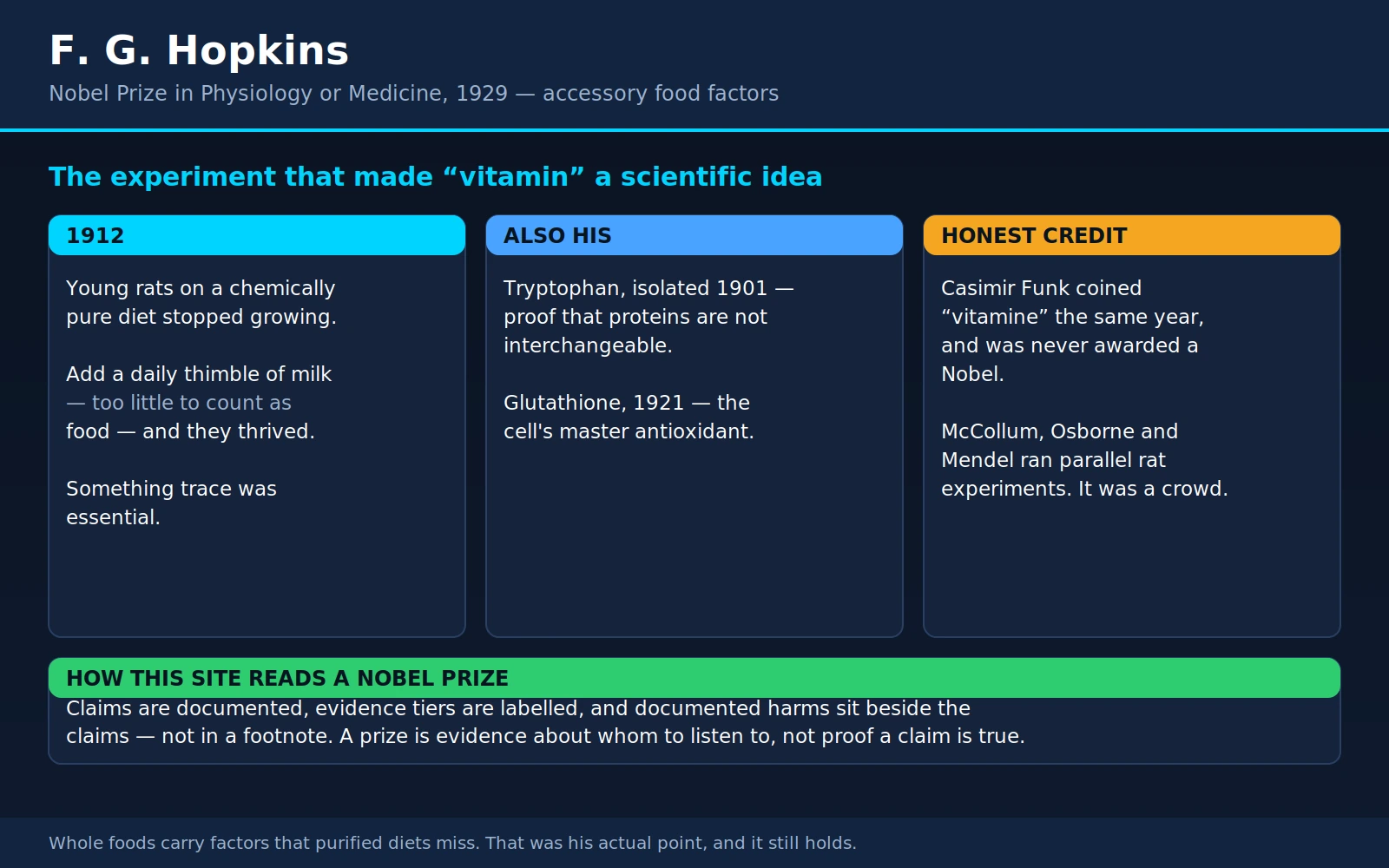
Table of Contents
- Who He Was
- The World's Food Theory Before Him
- Tryptophan First, 1901
- The 1912 Experiment
- Naming Rights, Honestly
- Glutathione, 1921
- Muscle and Lactic Acid, 1907
- The Cambridge School
- Where Mainstream Medicine Agrees — and Where the Story Gets Simplified
- What Hopkins Means for You Today
- Key Research Papers
- Connections
- Featured Videos
1. Who He Was
Sir Frederick Gowland Hopkins (1861–1947) is the scientist who turned the vitamin from a folk suspicion into a scientific fact. In 1912 he published the experiment that proved ordinary food contains trace substances — he called them "accessory food factors" — that are invisible to chemical analysis of protein, fat, and carbohydrate, yet without which young animals simply stop growing and die. For that work he shared the 1929 Nobel Prize in Physiology or Medicine with Christiaan Eijkman, the Dutch physician whose chicken experiments in Java had traced beriberi to polished rice. Along the way Hopkins also discovered two molecules that still headline modern health conversations: the amino acid tryptophan (1901) and the cell's master antioxidant, glutathione (1921). Few scientists have ever named that many things your body cannot live without.
Nothing about his start predicted any of it. Hopkins was born on June 20, 1861, in Eastbourne, a seaside town in Sussex, England. His father, a London bookseller with a taste for science, died when Frederick was an infant, and the boy grew up quiet, bookish, and largely self-directed — his first publication, at seventeen, was a note in a natural-history magazine on the defensive vapor of the bombardier beetle. Formal schooling ended early: at seventeen he was placed as a clerk in a London insurance office, a job he later remembered with something close to horror. A small family legacy bought his escape — a chemistry course at the Royal School of Mines — and analytical chemistry became his door into science. He spent years as assistant to Sir Thomas Stevenson, the Home Office analyst at Guy's Hospital whose laboratory examined the evidence in some of Victorian England's most famous poisoning trials, and he took his University of London chemistry degree externally, studying around the day job.
Only then did he study medicine, at Guy's Hospital, qualifying in 1894 at the age of thirty-three — ancient by the standards of scientific careers. In 1898 the physiologist Michael Foster invited him to Cambridge to teach the chemical side of physiology. The pay was thin, the subject barely existed, and for a decade Hopkins scraped by on tutoring and examining work; the strain contributed to a breakdown in his health around 1910. But from that unpromising foothold he built British biochemistry itself — a readership in 1902, a Trinity College fellowship in 1910, Cambridge's first Chair of Biochemistry in 1914 (created for him), and in 1924 the Sir William Dunn Institute of Biochemistry, which under him became arguably the most influential biochemistry department on Earth.
The honors eventually caught up with the work: a knighthood in 1925, the Royal Society's Copley Medal in 1926, the Nobel Prize in 1929, the presidency of the Royal Society from 1930 to 1935, and the Order of Merit — Britain's rarest civilian honor — in 1935. Colleagues called him "Hoppy," and by every account he remained gentle, generous with credit, and allergic to self-promotion. He worked almost to the end, and died in Cambridge on May 16, 1947, at eighty-five. (One more legacy, of a different kind: his younger daughter, Jacquetta Hawkes, became one of the twentieth century's best-known archaeologists and writers.)
2. The World's Food Theory Before Him
To feel the size of what Hopkins did, you have to picture how confident nutrition science was in 1900 — and how wrong. The nineteenth century had produced a beautifully tidy chemical account of food. Justus von Liebig and his successors had sorted diet into protein, fat, and carbohydrate, plus minerals and water. Calorimetry researchers had measured the energy in every foodstuff and the energy a working body burns, and the books balanced. By the numbers, feeding was a solved problem: supply enough calories, enough protein, and the right mineral salts, and you had supplied everything. A chemist could analyze a diet to four decimal places and pronounce it complete.
The trouble was that people kept sickening and dying on diets the arithmetic called perfect. Scurvy gutted navies and polar expeditions; beriberi paralyzed and killed across rice-eating Asia; rickets bent the bones of children in industrial cities; pellagra ravaged corn-fed regions of Italy and the American South. And because the germ theory of disease was the triumphant new science of the age, the default explanation for all of them was infection or poison — something bad present in food or environment, never something good absent. Scurvy was blamed on ptomaine toxins in tainted preserved meat. Pellagra was blamed on a mold toxin in spoiled corn. Beriberi was hunted as a germ for decades — Eijkman himself was sent to Java as part of a commission looking for the beriberi microbe, and even after his polished-rice experiments he first explained the result as a toxin-and-antidote story rather than a missing nutrient. (The missing substance was eventually isolated and named thiamine, vitamin B1.)
A few dissenting clues existed, mostly ignored. In 1881 Nikolai Lunin, working in Gustav von Bunge's laboratory, found that mice died on a purified diet assembled from milk's known components — casein, milk fat, milk sugar, salts — yet thrived on whole milk, and concluded that milk must contain "small quantities of unknown substances essential to life." In 1905 the Dutch physiologist Cornelis Pekelharing reached the same conclusion and published it in Dutch, where almost nobody read it. The observations sat there, unexplained and untrusted, because purified-diet experiments were notoriously finicky and because the reigning theory said they had to be wrong. What the field needed was someone with the analytical skill to make the experiment airtight and the standing to make it stick. That is precisely the combination Hopkins brought.
3. Tryptophan First, 1901
Hopkins' road to the vitamin concept began, oddly, with a color reaction. Chemists knew that proteins treated with certain reagents turned violet (the Adamkiewicz reaction), but nobody knew which part of the protein was responsible. In 1901, Hopkins and his student Sydney Cole ran tryptic digests of casein — milk protein broken down by digestive enzymes — and isolated the substance behind the color: a previously unknown amino acid they characterized and that became known as tryptophan. It was a virtuoso piece of analytical chemistry, published in the Journal of Physiology, and it handed Hopkins something more valuable than a new compound: a purified amino acid he could add to or withhold from a diet at will.
That made a decisive experiment possible. Around 1906, with his collaborator Edith Willcock, Hopkins fed young mice on zein — the major protein of corn, which happens to contain virtually no tryptophan — as their only protein. The mice failed rapidly. Adding pure tryptophan to the same diet did not make them flourish, but it kept them alive roughly twice as long. The conclusion was quietly revolutionary: proteins are not interchangeable fuel. A gram of corn protein and a gram of milk protein are not nutritionally equal, because what matters is the specific amino acids inside — and some of them the body cannot make for itself. (Zein turns out to be short of lysine as well as tryptophan, which is why tryptophan alone extended life without restoring growth; American workers Thomas Osborne and Lafayette Mendel later filled in that picture.)
Here is the seed of an idea that now underpins every nutrition label: the concept of the essential nutrient — a specific chemical the body absolutely requires, cannot synthesize, and must obtain from food. Tryptophan was among the first substances proved to work that way, and it remains one of the nine essential amino acids today; our tryptophan page covers its modern story, from serotonin and sleep to protein-rich food sources. For Hopkins, the zein experiment did something more personal: it taught him that growth of a young animal is the most sensitive instrument ever devised for detecting what a diet is missing. He was about to point that instrument at something far smaller than an amino acid.
4. The 1912 Experiment — the One That Made the Vitamin
The experiment that created the vitamin concept is almost embarrassingly simple to describe. Take young, growing rats. Feed them a diet built entirely from purified ingredients — casein for protein, lard for fat, starch and sugar for carbohydrate, plus a carefully complete mixture of mineral salts. By the chemistry of 1912, that diet is perfect: every known nutritional requirement is met, with energy to spare. The rats eat it. And they stop growing. They do not starve — they eat adequate calories — they simply plateau, sicken, and begin to fail, as if the food were somehow hollow.
Then the famous stroke: give half the animals a daily supplement of plain milk — about a thimbleful, a few cubic centimetres, amounting to only a few percent of the diet's energy, far too little to count as "food" in any caloric sense. Those rats resume growing almost immediately and thrive. Partway through the experiment, Hopkins swapped the groups: the milk-fed rats lost their supplement and their growth curve bent over and stalled, while the previously failing rats got the milk and shot upward past them. Plotted on one chart, the two curves cross — a scissors shape that became one of the most reproduced figures in the history of nutrition. Hopkins was a careful enough experimentalist to control for the obvious objection, matching food intake between groups so that the milk's effect could not be explained by the supplemented animals simply eating more.
His interpretation, published in the Journal of Physiology in 1912 under the deliberately modest title "Feeding experiments illustrating the importance of accessory factors in normal dietaries," was that normal foods contain minute amounts of unidentified substances — accessory food factors — that are indispensable for growth and health, and that purification strips away. He had said it in outline as early as 1906, telling an audience of public analysts that no animal can live on a mixture of pure protein, fat and carbohydrate, even with the necessary inorganic material supplied — but in 1906 that was an assertion. In 1912 it was a demonstrated law of biology, delivered with controls, growth curves, and the authority of Cambridge's leading biochemist.
It is worth being precise about why this experiment, rather than any single disease cure, created the vitamin as a concept. Each deficiency disease, taken alone, could be explained away — a toxin here, an infection there, a special local circumstance somewhere else. Eijkman's rice experiments had been folded into exactly such a story. What Hopkins showed was general: not "this disease comes from that food," but "growth and life themselves depend on trace substances present in ordinary food and absent from chemically complete purified diets." Beriberi, scurvy, and rickets stopped being three unrelated mysteries and became three instances of one principle — each the shadow of a different missing factor. That single conceptual move is what the Nobel committee honored in 1929, citing Hopkins "for his discovery of the growth-stimulating vitamins."
5. Naming Rights, Honestly
Hopkins did not coin the word "vitamin," and this page will not pretend otherwise. In 1912 — the same year as the rat paper — the Polish-born biochemist Casimir Funk, working at the Lister Institute in London on the anti-beriberi factor in rice polishings, published a sweeping review proposing that beriberi, scurvy, pellagra, and rickets were all caused by the absence of special substances in the diet, which he named "vitamines" — vital amines. The name was catchy, mostly wrong (the substances are vital, but most are not amines — which is why the biochemist Jack Drummond proposed dropping the final "e" in 1920), and enormously effective at making the idea travel. Funk was nominated for the Nobel Prize repeatedly and never received it — an omission historians still argue about, and one this site simply notes plainly: the man who named the vitamin died unlaureled.
Nor were Hopkins and Funk alone. In the United States, Elmer McCollum and Marguerite Davis at Wisconsin and Thomas Osborne and Lafayette Mendel at Yale were running parallel purified-diet rat experiments, and in 1913 identified the first specific factor — "fat-soluble A," the future vitamin A — launching the alphabet nomenclature we still use. Behind all of them stood Lunin's and Pekelharing's neglected milk experiments, Eijkman's chickens, and Gerrit Grijns, Eijkman's successor in Java, who in 1901 had given the beriberi findings their correct missing-nutrient interpretation before almost anyone was ready to hear it. The discovery of the vitamins was a crowd, not a lone genius — a crowd spread across three decades and three continents.
When the Nobel committee finally acted in 1929 — seventeen years after the annus mirabilis of 1912 — it chose the two men it judged the field's founders: Eijkman, whose accidental chicken epidemic had produced the first experimental deficiency disease, and Hopkins, whose growth experiments had turned scattered observations into a general biological principle. Hopkins, characteristically, used his Nobel lecture to distribute credit backward to Lunin, Pekelharing, and the rest. Reasonable people can argue with the committee's cut — Funk, Grijns, and McCollum all have serious claims — but the two names chosen do mark the two ends of the discovery honestly: the man who stumbled onto the phenomenon, and the man who proved what it meant. The full roster of nutrition's laureates is on our Nobel Prize in Medicine page.
6. Glutathione, 1921 — His Second Famous Molecule
Most scientists would retire happily on the vitamin concept. Hopkins, past sixty, produced a second discovery that modern readers may search for more often than his first. In 1921, pursuing his lifelong interest in how cells manage oxidation, he isolated from yeast, liver, and muscle a small sulfur-containing molecule that was strikingly easy to oxidize and reduce again — a chemical that could soak up oxidative hits and be recharged. He named it glutathione, and published it in the Biochemical Journal as "On an Autoxidisable Constituent of the Cell." (A French worker, J. de Rey-Pailhade, had glimpsed a sulfur substance he called "philothion" back in 1888; Hopkins' work defined the real molecule. His first structure — a two-amino-acid peptide — was slightly wrong, and by 1929 he and others had corrected it: glutathione is a tripeptide of glutamate, cysteine, and glycine.)
What does glutathione actually do? In plain language: it is the cell's rechargeable battery for handling oxidative stress, and the most abundant small antioxidant molecule in your body — present inside cells at concentrations a thousand times higher than most hormones. Three jobs matter most. First, peroxide disposal: the enzyme glutathione peroxidase uses glutathione's sulfur to neutralize hydrogen peroxide and lipid peroxides — genuinely destructive oxidants — and a partner enzyme, glutathione reductase, immediately recharges the spent glutathione using energy from food. Second, recycling other antioxidants: glutathione helps restore oxidized vitamin C and, indirectly, vitamin E to active duty. Third, detoxification: liver enzymes (the glutathione S-transferases) bolt glutathione onto drugs, pollutants, and reactive metabolites so they can be excreted — this is exactly how the body disposes of acetaminophen's toxic byproduct, and why an overdose that exhausts liver glutathione destroys the liver. Our glutathione page covers the full biology.
Now the honest supplement note, tiered the way this site tiers every claim. Established: glutathione's central role in redox biology and detoxification is textbook fact, and low glutathione status accompanies aging and many chronic diseases. Thin and mixed: swallowing glutathione to raise it. The molecule is a peptide, and digestion treats it like food protein; classic pharmacokinetic studies found that even large oral doses barely moved blood levels, and a one-month randomized trial found no change. The best news for oral glutathione is a six-month randomized trial (Richie 2015) in which daily supplementation raised red-blood-cell glutathione by roughly a third — a real but modest effect that took months, and one study is one study. Better supported routes: giving the body the rate-limiting raw material, cysteine — which is what N-acetylcysteine (NAC) does; NAC is the standard-of-care antidote for acetaminophen poisoning precisely because it refills liver glutathione, with evidence in respiratory and psychiatric conditions ranging from promising to mixed — and simply eating enough protein (sulfur amino acids), alongside vegetables such as broccoli and other crucifers whose compounds nudge the body's own glutathione-building enzymes. Whole foods and precursors, not glutathione capsules, are where the evidence currently lives — a conclusion Hopkins, of all people, would have found familiar.
7. Muscle and Lactic Acid, 1907
One more Hopkins landmark deserves a paragraph, because a whole branch of physiology grew from it. In 1907, with Walter Morley Fletcher, he settled a question that had defeated a generation: does working muscle really produce lactic acid, or was the acid an artifact of the brutal ways chemists processed the tissue? The prior methods themselves triggered lactic acid formation, so every measurement was contaminated. Fletcher and Hopkins developed a cold-alcohol technique gentle enough to freeze the muscle's true chemical state, and with it showed the clean pattern: resting muscle contains little lactic acid, muscle contracting to fatigue accumulates it, and — the crucial observation — muscle recovering in oxygen clears it away (Fletcher & Hopkins, J Physiol 1907). That result founded the modern study of muscle energetics: A. V. Hill and Otto Meyerhof built directly on it in work that won the 1922 Nobel Prize, and every athlete who has ever heard the phrase "lactic acid" is hearing an echo of this paper. It was typical of Hopkins that the field-founding contribution here was, at bottom, better analytical chemistry — the insurance clerk's escape skill, still paying dividends.
8. The Cambridge School
Ask historians of science what Hopkins' greatest discovery was and a surprising number will answer: other biochemists. When he arrived at Cambridge in 1898, biochemistry in Britain barely existed as an independent science — it was a service subject, a little chemistry done in the corners of physiology and medicine. Hopkins insisted it was a discipline in its own right, with its own question: how do the molecules of the living cell actually work? He fought for it through two decades of cramped quarters and borrowed money until the Dunn Institute opened in 1924, and then filled the building with an extraordinary generation — J. B. S. Haldane, Joseph and Dorothy Needham, Malcolm Dixon, and Marjory Stephenson, the pioneer of bacterial biochemistry who in 1945 became one of the first two women ever elected Fellows of the Royal Society. The department was famously informal, argumentative, and open — to women and to foreigners alike — at a time when almost nowhere else was.
Two visitors matter especially to this site's story. In the late 1920s a restless Hungarian named Albert Szent-Györgyi worked in Hopkins' department, where he isolated the mysterious reducing substance he called "hexuronic acid" — identified a few years later as ascorbic acid, vitamin C, and worth the 1937 Nobel Prize. And in 1933, when Nazi race laws expelled Hans Krebs from his post at Freiburg, it was Hopkins who brought him to Cambridge within months — Krebs, trained in Otto Warburg's Berlin laboratory, went on to map the citric acid cycle and win the 1953 Nobel Prize. Krebs was not an isolated act of kindness: as President of the Royal Society from 1930 to 1935, Hopkins lent his name and his office's weight to the organized rescue of scholars displaced by the Nazi regime, and his department absorbed several of them.
This is the "teacher of teachers" legacy: count the Nobel Prizes that passed through Hopkins' orbit — his own, Szent-Györgyi's, Krebs', the Hill–Meyerhof prize built on his muscle work — and then count the professorships his students took across Britain and the world, and the case that he built modern biochemistry stops looking like Cambridge sentimentality and starts looking like arithmetic. He proved that trace factors in a culture, as in a diet, determine whether young things grow.
9. Where Mainstream Medicine Agrees — and Where the Story Gets Simplified
Where everyone agrees: the essential-micronutrient concept Hopkins proved is now the load-bearing floor of nutrition science and clinical medicine. Every RDA and Daily Value, every fortified staple food, every prenatal folate tablet, every micronutrient added to intravenous feeding descends from the 1912 principle that ordinary food carries trace substances life cannot proceed without. The deficiency diseases that filled hospitals in 1900 — scurvy, beriberi, rickets, pellagra — are now so rare in well-fed countries that doctors sometimes fail to recognize them. Very few experiments in history have a cleaner line from bench to global public health.
Where the story gets simplified, first: the lone-genius telling. As section 5 laid out, the vitamin was discovered by a crowd — Lunin, Pekelharing, Eijkman, Grijns, Funk, McCollum, Osborne, Mendel — and Hopkins himself insisted on saying so. Historians also note, fairly, that his 1912 growth curves were strikingly clean for so small a milk supplement, and that contemporaries did not always find the experiment easy to replicate; what made the paper decisive was less any single perfect curve than its design, its controls, and the force of its argument. Treating Hopkins as the sole inventor of the vitamin flatters him in exactly the way he refused to flatter himself.
Second: the word "vitamin" today does far more marketing work than scientific work. Hopkins proved something precise — that tiny amounts of specific substances are essential, and that their absence causes disease. The supplement aisle quietly converts that into a different claim: that if a little is essential, a lot must be optimizing. Nothing in the accessory-factor concept implies that. Deficiency sits at one end of a curve; the curve flattens once the need is met, and for several vitamins it eventually turns harmful at high doses. Megadose culture — the world of gram-level self-experimentation associated with figures like Linus Pauling — is a separate hypothesis that must win or lose on its own trial evidence, and it cannot borrow Hopkins' authority. He demonstrated the necessity of thimblefuls, not the superiority of buckets.
10. What Hopkins Means for You Today
Whole foods carry factors that purified diets miss. That is not a wellness slogan; it is the literal, experimentally proven point of the 1912 paper, and it has been re-proven on humans in unhappy ways ever since — most starkly when early intravenous feeding formulas, built like Hopkins' purified rat diets from pure protein, glucose, and fat, produced deficiency syndromes in patients until vitamins and trace elements were added one by one. It remains the single best reason to build a diet on actual foods — meat, fish, eggs, dairy, vegetables, fruit, brown rice — rather than on refined ingredients plus a multivitamin patch. A century of chemistry has named some fifty essential nutrients; a reasonable humility, and the whole Hopkins lesson, is that food is graded on what it contains, not on what a formula remembered to include.
Every RDA is his experiment, institutionalized. When a label tells you a serving provides 30% of your daily vitamin C, it is applying the concept Hopkins proved: a specific, quantifiable, absolute requirement for a trace substance. The concept even earns its keep in reverse — recognizing that restrictive diets, ultra-processed eating patterns, bariatric surgery, and alcoholism each create predictable deficiency risks is Hopkins' principle wearing modern clothes.
His two molecules are still working. Tryptophan is the dietary raw material for serotonin and melatonin, which is why it appears in every conversation about protein, mood, and sleep — our tryptophan page sorts the solid physiology from the overclaimed, including the cautionary 1989 contamination episode that made regulators wary of tryptophan supplements for a decade. Glutathione anchors the modern science of oxidative stress and detoxification, and the practical, evidence-backed ways to support it — adequate protein, NAC where clinically indicated, cruciferous vegetables — are covered on our glutathione page. It is a fitting afterlife for the insurance clerk who came to science late, measured what everyone else overlooked, and proved that the smallest things in food are the ones you cannot live without.
11. Key Research Papers
- Hopkins FG. Feeding experiments illustrating the importance of accessory factors in normal dietaries. J Physiol 1912;44(5-6):425-60
- Hopkins FG, Cole SW. A contribution to the chemistry of proteids: Part I. A preliminary study of a hitherto undescribed product of tryptic digestion. J Physiol 1901;27(4-5):418-28
- Hopkins FG. On an autoxidisable constituent of the cell. Biochem J 1921;15(2):286-305
- Carpenter KJ. A short history of nutritional science: part 3 (1912-1944). J Nutr 2003;133(10):3023-32
- Semba RD. The discovery of the vitamins. Int J Vitam Nutr Res 2012;82(5):310-5
- Piro A, Tagarelli G, Lagonia P, Tagarelli A, Quattrone A. Casimir Funk: his discovery of the vitamins and their deficiency disorders. Ann Nutr Metab 2010;57(2):85-8
- Kamminga H. Frederick Gowland Hopkins and the unification of biochemistry. Trends Biochem Sci 1997;22(5):184-7
- Forman HJ, Zhang H, Rinna A. Glutathione: overview of its protective roles, measurement, and biosynthesis. Mol Aspects Med 2009;30(1-2):1-12
- Tenório MCDS, Graciliano NG, Moura FA, Oliveira ACM, Goulart MOF. N-Acetylcysteine (NAC): impacts on human health. Antioxidants (Basel) 2021;10(6)
- Richard DM, Dawes MA, Mathias CW, Acheson A, Hill-Kapturczak N, Dougherty DM. L-Tryptophan: basic metabolic functions, behavioral research and therapeutic indications. Int J Tryptophan Res 2009;2:45-60
Live PubMed Searches
- Hopkins accessory food factors
- Discovery of vitamins history
- Glutathione physiology
- Tryptophan essential amino acid
- Casimir Funk vitamine
Connections
- All Notable Doctors
- Christiaan Eijkman — his 1929 co-laureate; beriberi, polished rice, and the chickens that started it all
- Albert Szent-Györgyi — isolated vitamin C's parent compound in Hopkins' own department
- Henrik Dam & Edward Doisy — vitamin K: the accessory-factor method finding another factor
- Whipple, Minot & Murphy — pernicious anemia and the food factor that became vitamin B12
- Hans Krebs — the refugee Hopkins sheltered in 1933, who mapped the citric acid cycle
- Otto Warburg — Krebs' teacher; cellular respiration and oxidation, Hopkins' lifelong theme
- Linus Pauling — megadose vitamin culture: the claim Hopkins' work does not make
- Nobel Prize in Medicine — the full wing of nutrition and medicine laureates
- Vitamins — every page in this category descends from the accessory-factor concept
- Vitamin B1 (Thiamine) — the anti-beriberi factor, first of the vitamins to be run to ground
- Glutathione — the molecule Hopkins isolated in 1921: biology, testing, and supplements
- Tryptophan — his 1901 discovery: serotonin, sleep, and food sources
- N-Acetylcysteine (NAC) — the evidence-backed way to raise the glutathione he discovered
- Amino Acids — the essential-nutrient idea, amino acid by amino acid