Barbara McClintock: Jumping Genes and Thirty Years of Being Ignored
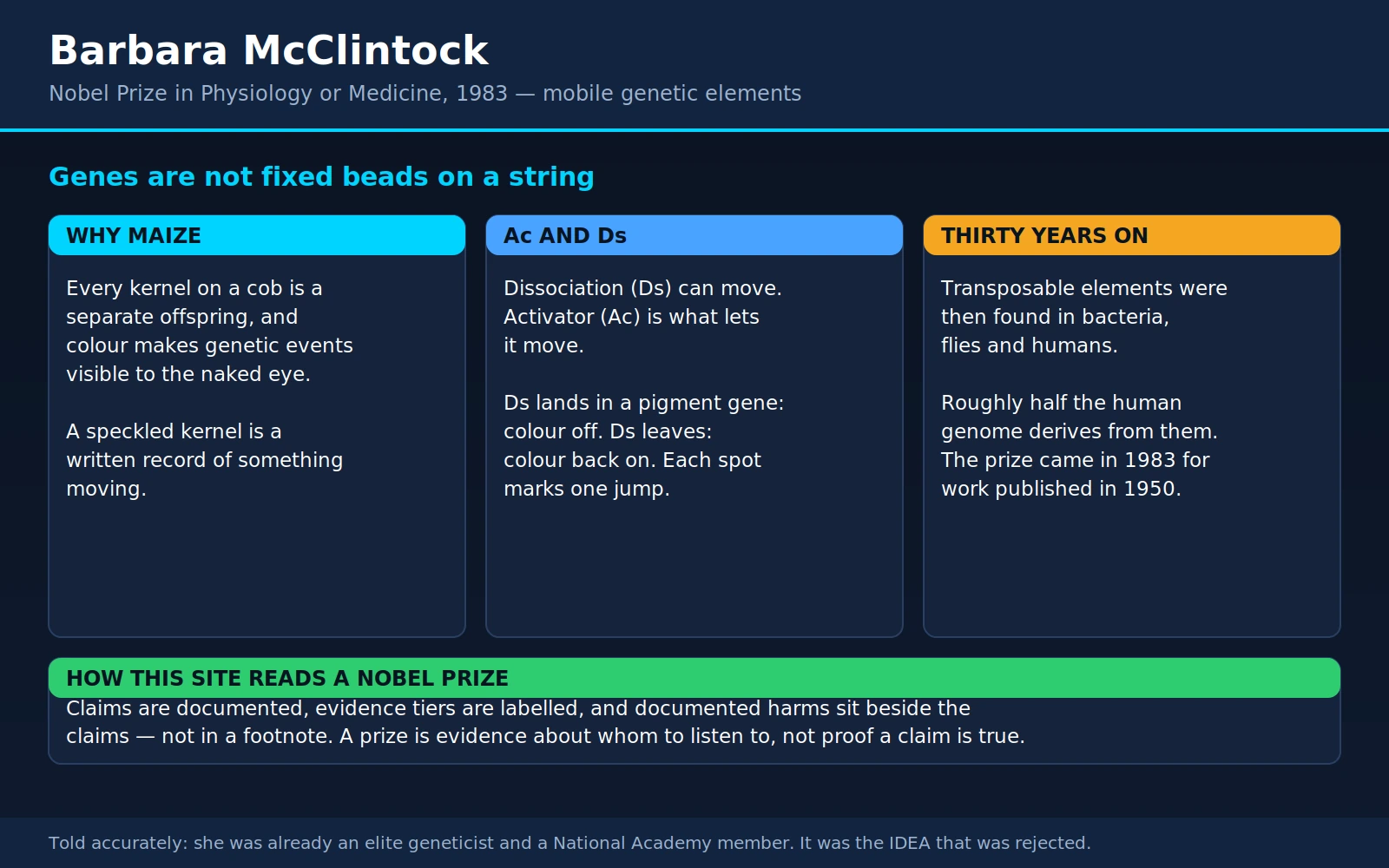
Table of Contents
- The Prize and the Woman
- What She Could See That Others Could Not
- The Broken Chromosome That Would Not Stay Broken
- Ac and Ds: The Discovery, 1944–1950
- The Reception, Told Accurately
- Vindication: Molecular Biology Catches Up
- What Jumping Genes Do in You
- What It Does Not Mean
- Her Method: A Feeling for the Organism
- Where Mainstream Science Agrees — and What the Record Complicates
- Key Research Papers
- Connections
- Featured Videos
1. The Prize and the Woman
On October 10, 1983, the Nobel Assembly at Sweden's Karolinska Institute announced that the Prize in Physiology or Medicine would go to Barbara McClintock, "for her discovery of mobile genetic elements." She was eighty-one years old. She had made the discovery in the 1940s and published it in 1950 and 1951. The prize arrived, in other words, more than three decades after the work — one of the longest gaps between a discovery and its Nobel in the history of the award.
Two other facts about that prize are worth stating precisely, because both get garbled in the retelling. First, it was unshared: the whole prize, not a half or a third, and McClintock remains the only woman ever to receive an unshared Nobel Prize in Physiology or Medicine. (Women had won the Medicine prize before — Gerty Cori in 1947, Rosalyn Yalow in 1977 — and have won it many times since, but always sharing it with one or two colleagues.) Second, she found out the way she found out most things: alone. The story she told afterwards was that she heard it on the radio in her apartment at Cold Spring Harbor, had no telephone, and went out for her usual morning walk in the woods.
McClintock was born in Hartford, Connecticut, on June 16, 1902, and died on Long Island on September 2, 1992, a few months after her ninetieth birthday. She took her bachelor's degree at Cornell in 1923 and her doctorate in botany there in 1927, and she spent the second half of her life — from 1941 onward — at the Carnegie Institution's Department of Genetics at Cold Spring Harbor, on the north shore of Long Island. She never married, had no children, kept a small apartment near the lab, and worked in a field of maize she planted, pollinated, harvested and examined largely with her own hands. When people describe her as a solitary worker, this is what they mean literally: she grew the corn, she made the crosses with paper bags and a pollination brush, she shucked the ears, and she then spent the winter at a microscope looking at the chromosomes of the plants she had grown.
Now the part of the story that is usually told too simply. It is true that her central idea was rejected for a long time, and this page will not soften that. But the standard version — unknown woman, dismissed by the establishment, vindicated at the end — is wrong in a way that makes the real story less interesting rather than more. By the 1930s Barbara McClintock was not an outsider. She was one of the most respected cytogeneticists alive.
The evidence is not subtle. In 1944 she was elected to the National Academy of Sciences, only the third woman ever elected to it. In 1945 she served as president of the Genetics Society of America, the first woman to hold that office. She had been vice-president of the same society in 1939. Her doctoral and postdoctoral years at Cornell put her at the center of the most productive maize-genetics group in the world, alongside Marcus Rhoades and George Beadle — Beadle would take a Nobel of his own in 1958 — and by her early thirties she had already done several pieces of work that any geneticist would have been content to be remembered for. She held a Guggenheim Fellowship, a Rockefeller-funded position, and from 1941 a permanent research post at Carnegie with no teaching duties and no requirement to chase grants, which was among the most enviable arrangements in American science.
So the thing that was rejected was not her credentials, her competence, or her access. It was her idea. That is the more interesting fact, and it is the reason this page exists. A scientist at the summit of her field, with an unimpeachable technical record, presented a carefully documented result — and her colleagues could not make themselves believe it for the better part of thirty years. Understanding why is worth more than another round of the myth.
2. What She Could See That Others Could Not
To follow what McClintock did, you need to understand two things: why maize was the right organism, and what she could do with a microscope that almost nobody else could.
Maize is a gift to a geneticist, and the gift is visibility. An ear of corn is not one plant — it is several hundred separate offspring, each kernel the product of its own fertilization, all of them lined up in rows on a single cob and all developing side by side under identical conditions. A researcher working with mice counts a litter; a researcher working with maize counts a few hundred siblings per ear and several thousand per season. And crucially, maize kernels carry colour. The pigments in the outer layer of a kernel — the deep purples and reds of anthocyanin, or their absence — are made by a chain of enzymes, each specified by a gene. Break any gene in the chain and the kernel is colourless. Restore it and the pigment comes back.
That means a maize kernel is a readout device. If a pigment gene is working, you see colour. If it is broken, you see none. And — this is the part that mattered — if the gene breaks or is repaired partway through the kernel's development, you see a patch: a coloured spot on a pale kernel, or a pale streak on a coloured one, whose size tells you roughly how early or late in development the change happened. A big spot means the event happened early, when few cells were present and each one went on to produce many descendants. A shower of tiny dots means it happened late and often. McClintock spent her career reading these patterns the way a radiologist reads a film, and no amount of description quite conveys how much information is sitting on the surface of a speckled ear of corn once you know how to look at it.
The second thing was cytology — the physical examination of chromosomes down a microscope. Maize chromosomes at a particular stage of pollen formation are large, well-spread, and marked along their length with dense knobs and other landmarks that differ between varieties. McClintock, as a graduate student and young researcher at Cornell, developed the staining and squash techniques that made the ten maize chromosomes individually identifiable for the first time, and she became, by common consent, the best in the world at telling one from another and at spotting when one had been altered. She identified the chromosomal region that organizes the nucleolus. She described ring chromosomes, formed when a broken chromosome's two ends fuse to each other. This was not idle taxonomy: it meant she could look at a plant, see a physical abnormality in a specific chromosome, and then look at that plant's offspring and see what the abnormality did.
Which sets up the experiment that would have made her reputation even if she had never discovered transposition. In 1931, working with her graduate student Harriet Creighton, McClintock addressed a question that had been open since the beginning of genetics. Geneticists knew from breeding data that traits which normally travel together sometimes get separated in the offspring — a phenomenon called crossing over or recombination, and the rate of it was already being used to build genetic maps. But the assumption that recombination happened because chromosomes physically swapped segments with each other was exactly that: an assumption. Nobody had shown it.
Creighton and McClintock found a maize plant carrying a chromosome 9 with two visible physical oddities — a conspicuous knob on one end and an extra piece of chromosome 8 attached to the other — paired with a normal chromosome 9. Those physical markers sat at opposite ends of a stretch that also carried two ordinary genetic markers (kernel colour and starchiness). So they could ask the question directly: when the genetic markers get shuffled in the offspring, do the physical markers get shuffled with them? They did. Plants that had inherited a recombined combination of the genes turned out, under the microscope, to have a recombined combination of the chromosome features as well. Genetic recombination corresponds to a physical exchange of chromosome segments — observed, not inferred. Their four-page paper in the Proceedings of the National Academy of Sciences is one of the landmark experiments of twentieth-century biology, and it appeared when McClintock was twenty-nine.
Keep that in mind for what follows. When she later reported something strange, she was not a fringe figure making an extraordinary claim. She was the person who had proved, with this same organism and this same microscope, one of the foundational facts everyone else's work rested on.
3. The Broken Chromosome That Would Not Stay Broken
The road to jumping genes started with breakage. In the late 1930s McClintock was studying what happens to a chromosome that has lost a normal end.
Chromosome ends — telomeres — are protective caps; a chromosome without one behaves like a frayed rope. McClintock worked out, in maize, a cycle that is now in every genetics textbook and that she named the breakage-fusion-bridge cycle. It goes like this. A chromosome breaks. The broken end is "sticky" and fuses with the broken end of its own newly copied sister, producing a single chromosome with two centromeres — two attachment points where the cell's machinery grabs on during division. When the cell divides, the two centromeres are pulled toward opposite poles, the chromosome is stretched between them into a visible bridge, and the bridge snaps. Now there are two daughter cells, each with a broken chromosome end, and each of them repeats the whole performance in the next division. One break begets an endless sequence of breaks, and each one lands somewhere slightly different, so genes are duplicated in one cell line and lost in another, over and over, generation after generation of cells.
This was already an important discovery in its own right — it is the reason chromosome instability is a recognized engine of genetic change, and breakage-fusion-bridge cycles are now known to occur in human tumours as one of the ways cancer cells scramble their genomes. But for McClintock, the cycle's real value was as a tool. It was a controlled way of shattering chromosomes and then watching what the plant did about it.
In the summers of the early 1940s, she planted the products of those broken chromosomes and started harvesting ears that did not make sense. Kernels came up with twin sectors — two adjacent patches on the same kernel, one showing more pigment than normal and one showing less, as though a single cell division had handed one daughter an excess of something and the other a deficit. Kernels came up streaked, spotted, freckled, or striped, in patterns that repeated reliably from plant to plant. Whole ears showed the same distinctive speckling generation after generation, which meant it was heritable, which meant it was genetic and not some accident of weather or soil.
Now, mutation was not a new idea. Genes were known to change. What was strange about these kernels was the pattern: the changes were happening far too often to be ordinary mutation, they were reversible — a gene would switch off and then, in some descendant cell, switch back on — and above all their timing was regular. In a given genetic background, the spots would consistently appear early and be large; change the background, and they would consistently appear late and be small. Random damage does not keep a schedule. Something was moving through these plants' chromosomes on a controlled timetable, and McClintock set out to find out what.
4. Ac and Ds: The Discovery, 1944–1950
The summer of 1944 is the usual starting date. McClintock self-pollinated a set of plants derived from her broken-chromosome experiments — a standard way of bringing hidden variation into the open — and grew out the results. She spent the next six years doing what almost no one else had the patience or the eyes for: following individual chromosome features and individual kernel patterns through generation after generation of maize, correlating what she saw down the microscope with what she saw on the cob.
What she found, in the form the textbooks now state it, was a two-element system.
The first element she called Dissociation, abbreviated Ds. She named it for what it first appeared to do: it marked the exact spot on chromosome 9 where breakage kept happening. But as she tracked it, Ds did something that a fixed point on a chromosome has no business doing. It moved. In one plant it sat at one position; in a descendant it was somewhere else entirely, sometimes on a different chromosome. The breakage point moved with it. Whatever Ds was, it was a discrete piece of genetic material that could leave one location and insert itself into another.
The second element she called Activator, abbreviated Ac. Ac was the permission slip. In a plant with Ds but no Ac, Ds sat perfectly still and nothing happened. Add Ac — by crossing in a plant that carried it — and Ds began to move. Increase the number of copies of Ac, and the timing of Ds's movement shifted in a dose-dependent way, which is precisely why the spot patterns were so consistent within a genetic background and so different between backgrounds. Ac could also move itself. In modern terms, Ac is an autonomous transposable element that encodes the enzyme (a transposase) that does the cutting and pasting, and Ds is a broken version of Ac that has lost the ability to make that enzyme but retains the sequences the enzyme recognizes — so Ds can only move when an Ac somewhere in the same nucleus supplies the missing machinery in trade.
And here is where the speckled kernel becomes evidence rather than decoration. When Ds lands inside a pigment gene, it interrupts the gene and the gene stops working — the cell and all its descendants make no pigment. When Ds later jumps back out of that gene, the gene is restored and pigment production resumes in that cell and everything descended from it. A kernel with a coloured spot on a colourless background is therefore a physical record, written in dye, of a piece of DNA leaving a gene at a particular moment in that kernel's development. The size of the spot tells you when it happened. The number of spots tells you how often. A single ear of maize holds hundreds of independent replicates of the experiment, and you can read the whole thing with your eyes.
McClintock presented this work publicly at the Cold Spring Harbor Symposium in 1951 and published it in the Proceedings of the National Academy of Sciences in 1950, under a title — "The origin and behavior of mutable loci in maize" — that gives no hint of how much it upended.
Because the implication was not small. In 1950 the working picture of a chromosome was a string of beads: genes in a fixed linear order, each at its own address, the order stable and mappable, which was after all the entire basis of the genetic maps geneticists had spent forty years building. McClintock's elements were beads that got up and walked. Genes had addresses, but some genetic material was not bound by them.
Her own interpretation went further still, and this is the part that got her into trouble. She did not present Ac and Ds as chromosomal vandals or curiosities. She called them controlling elements, and she argued that their real function was regulation — that they were how the genome turned genes on and off at the right time in the right cells. Her reasoning was direct: an element that switches a pigment gene off when it inserts and back on when it leaves is, by definition, controlling when that gene is expressed. She thought she was looking at a general mechanism of development, the answer to the question of how one fertilized egg with one genome builds a body full of different cell types. That was a leap beyond her data, and we will return to it. But the underlying insight — that the genome contains elements whose job is to control other genes, and that a gene's activity depends on what is sitting near it — was correct, was years ahead of its time, and anticipated the whole field of gene regulation. The lac operon, the first properly worked-out gene-control system in any organism, would not be described by Jacob and Monod until 1960.
5. The Reception, Told Accurately
McClintock's own account of the 1951 symposium, given many times in later years, was that the talk was met with bafflement and, in places, hostility. She described stony faces, said that "nobody understood," and recalled being treated as if she had lost her grip. She said the experience taught her to stop trying. By the mid-1950s she had largely stopped submitting this line of work to mainstream journals and was publishing it instead in the Carnegie Institution of Washington Year Books — her employer's annual reports, which are real publications, permanently archived and citable, but which are not what anyone would call a way of reaching the field.
That is her testimony and it should be taken seriously. It should also be set alongside what the archival record shows, because historians who have gone through the correspondence, the citation trail and the symposium proceedings — most thoroughly Nathaniel Comfort in The Tangled Field (2001) — have found the picture more complicated than the legend. She was invited to speak repeatedly, including at prestigious meetings. The published symposium discussion shows people asking questions rather than sitting in silence. Her 1950 and 1951 papers were cited, modestly but steadily, throughout the decade. A handful of colleagues understood the work well and said so — Marcus Rhoades at Indiana, who had known her since Cornell; Royal Alexander Brink at Wisconsin, who independently found a mobile element of his own in maize and called it Modulator; Peter Peterson, who found another and called it Enhancer. Maize geneticists, in short, mostly believed her, because they could see the same kernels she could. Her funding was never cut, her position was never threatened, and honours continued to arrive.
So the honest formulation is not "she was ignored by everyone." It is narrower and more damning: a small community accepted her result, and the wider field of genetics did not take it up. Why not?
Several reasons, and none of them is simply "because she was a woman," although it would be naive to think her sex had no effect on how readily an unfamiliar claim from her was entertained.
The first reason is that the field was moving away from her organism. The years around 1951 are exactly when genetics changed address. Watson and Crick published the structure of DNA in 1953; the action moved to bacteria and the viruses that infect them, organisms that reproduce in twenty minutes rather than one growing season and that let you do biochemistry on your genetics. A maize geneticist waited a year for each generation. To a young researcher at the phage meetings, results from a cornfield were beginning to feel like news from another century, and this is the sense in which McClintock's timing was cruel: she published her most radical result at the precise moment her whole discipline was being reclassified as old-fashioned.
The second reason is that the claim looked local. Transposition in maize could be, and largely was, filed as a botanical peculiarity — a quirk of a domesticated grass with an unusually messy genome, interesting to corn people, irrelevant to the general laws of heredity. There was no reason yet to think it happened anywhere else, and there was no proposed mechanism at all: nobody could say how a piece of chromosome would detach itself and reinsert, because nobody would know what DNA looked like at that level of detail for another twenty years.
The third reason is that her writing was extraordinarily difficult. This is said kindly and it is said by her admirers. Her papers of this period are dense with maize-specific nomenclature, compressed, and organized around the genetic logic of her crosses rather than around a narrative anyone could follow. Reading the 1950 PNAS paper today, with the answer already known, is hard work; reading it in 1950 without the answer, in an organism you did not work on, was harder still.
The fourth reason is the interpretive overreach mentioned above. She was not merely claiming that elements move — a bounded, checkable claim. She was claiming that mobile controlling elements were the mechanism of developmental regulation for the whole organism, a far larger claim that her maize kernels could not support. Colleagues who were prepared to accept the first claim often heard it wrapped in the second and rejected the package.
McClintock herself, in her Nobel lecture, offered a diagnosis that is characteristically generous and probably right: the concepts were "so unfamiliar that they could not be integrated into the then accepted knowledge." Her result was not disproved. It was unusable. There was nowhere to put it.
6. Vindication: Molecular Biology Catches Up
What changed was not a new argument. It was that other people, working on other organisms with new tools, kept tripping over the same phenomenon until it stopped being possible to call it a maize curiosity.
It started with bacteria. In the late 1960s, researchers studying mutations in Escherichia coli found that certain mutations were caused not by a chemical change to a base but by the arrival of a discrete chunk of DNA that had inserted itself into the gene — and that could later leave again. These were named insertion sequences. Then, in the early 1970s, came something with immediate practical weight: bacterial genes for antibiotic resistance were found sitting on mobile units that could hop between chromosomes and plasmids and, by way of plasmids, between bacterial cells and even between species. These units were christened transposons. Suddenly transposition was not an agricultural footnote — it was the mechanism by which resistance to antibiotics spreads through a hospital.
Then it turned up everywhere else. Mobile elements were found in yeast, in Drosophila (where they turned out to account for a large share of spontaneous mutations, and where the P element was eventually turned into the standard tool for engineering fly genomes), in plants beyond maize, in mammals. When DNA sequencing and cloning matured in the late 1970s and 1980s, McClintock's own elements were isolated as physical DNA: Ac and Ds were cloned in the early 1980s, largely through the work of Nina Fedoroff and others, and they were exactly what she had inferred them to be — discrete sequences with recognizable ends, with Ds a deletion-damaged derivative of Ac, and with Ac encoding the transposase enzyme that moves them both. Thirty years of maize breeding had been read correctly.
Honours followed the mechanism, and they came in a rush. In 1981 she received the Lasker Award, the Wolf Prize in Medicine, and a MacArthur Fellowship in the very first class of that programme. In 1983 came the Nobel.
The last piece of the vindication was the biggest, and she lived to see the beginning of it but not the number. When the human genome was sequenced — the initial analysis was published in Nature in 2001, nine years after her death — one of the headline findings was how much of our DNA is derived from transposable elements. That first analysis put it at roughly 45 percent. Later work with more sensitive methods for recognizing very old, decayed copies has pushed the estimate higher; a fair statement today is that something like half of the human genome, and quite possibly more, consists of sequences descended from mobile elements. Treat those figures as approximate, because they depend on how far back you can still recognize a fossil.
Sit with that for a moment, because it reframes the whole story. The idea that was too strange to integrate in 1951 turned out to describe the single largest component of the human genome by mass. There is more transposon-derived DNA in you than there is DNA that codes for proteins — not a little more, but something like twenty-five times more. What McClintock's colleagues could not find room for was, it turned out, most of the room.
7. What Jumping Genes Do in You
This is the part that matters medically, and it needs to be told in tiers, because the honest answer ranges from "this is textbook, well documented, and rare" to "this is an active research question" to "this is being oversold to you."
The inventory. Two families dominate the human genome. LINE-1 (long interspersed nuclear element 1, often written L1) is about 6,000 letters long at full length and accounts for something like 17 percent of your DNA in around half a million copies — but the great majority of those copies are broken, truncated fossils. The number that can still actually move in any one person's genome is small: current estimates put it at roughly 80 to 100 active elements, and a handful of especially "hot" ones do most of the work. Alu elements are much shorter, about 300 letters, and much more numerous — on the order of a million copies, roughly a tenth of the genome. Alu cannot move on its own; it borrows LINE-1's machinery, the way Ds borrowed Ac's. McClintock's two-element logic, discovered in corn in the 1940s, is running inside your cells right now.
Both of these are retrotransposons: they move by a copy-and-paste route through an RNA intermediate, which is why their copy numbers are so high. McClintock's Ac and Ds are DNA transposons, which cut and paste. Humans carry the fossils of DNA transposons too, but ours have been immobile for tens of millions of years.
Tier one: insertions that cause disease. Real, documented, and uncommon. The classic case is the one that broke the subject open. In 1988, Haig Kazazian's group was sequencing the factor VIII gene in boys with haemophilia A whose mutations had arisen new, in neither parent. In two unrelated patients they found the same astonishing thing: a fresh LINE-1 element had inserted itself into the middle of the factor VIII gene, wrecking it. This was the first demonstration that a human genetic disease could be caused by a jumping gene — McClintock's mechanism, in a child, in a clinic. Since then the catalogue has grown steadily. A 2016 review by Hancks and Kazazian counted on the order of 120 documented germline insertions causing human disease, spread across a few dozen conditions including haemophilia A and B, Duchenne muscular dystrophy, some cases of neurofibromatosis, cystic fibrosis, several inherited eye and kidney disorders, and others. That number keeps rising as more genomes are sequenced.
Keep the scale honest: retrotransposon insertions are estimated to cause somewhere around one in several hundred to one in a thousand new disease-causing mutations in humans. That is a real, non-zero, clinically documented category — and it is a small slice of genetic disease. If you have a genetic condition, the odds are overwhelming that a jumping gene did not cause it.
There is a quieter and probably larger contribution too. Because Alu elements are similar to each other and scattered everywhere, the cell's repair machinery sometimes lines up two Alus that are not actually the same place and recombines between them, deleting or duplicating everything in between. This Alu-mediated recombination causes a meaningful share of the large deletions found in genes such as the LDL receptor gene in familial hypercholesterolaemia. Here the elements are not jumping at all; their mere presence, in enormous numbers, gives the genome many chances to mis-align.
Tier two: a transposon that your immune system domesticated. Every one of us makes an enormous repertoire of antibodies — far more distinct kinds than we have genes — and the way we do it is by physically cutting and rejoining gene segments in developing lymphocytes, an assembly process called V(D)J recombination. It is carried out by two proteins, RAG1 and RAG2, which cut DNA at specific signal sequences and let the ends be stitched together in new combinations. In 1998, Agrawal, Eastman and Schatz showed that RAG1 and RAG2 together can perform genuine transposition in the test tube: they can take a piece of DNA cut at those signals and insert it into an unrelated target. The interpretation, since strongly supported by sequence comparisons that trace RAG to an ancient family of DNA transposons, is that the vertebrate adaptive immune system was built out of a domesticated jumping gene that landed in an ancestral genome roughly half a billion years ago and was put to work.
This is not a metaphor and it has consequences you can see in a clinic: children born with defective RAG1 or RAG2 cannot assemble antibody and T-cell receptor genes, and the result is severe combined immunodeficiency. The mechanism McClintock found in corn is, in a directly traceable evolutionary sense, the reason you can make antibodies at all. Susumu Tonegawa's Nobel in 1987 — four years after McClintock's, and likewise unshared — was for working out how that shuffling generates antibody diversity.
Domestication is a broader theme than the immune system, incidentally. Over evolutionary time, transposable elements have repeatedly been captured and repurposed as switches and control sequences for ordinary genes — which is, in a way McClintock did not anticipate in detail but would have relished, her controlling-element idea arriving through the back door.
Tier three: transposons in cancer. Real, and still being mapped. The controls that keep LINE-1 quiet in normal cells — chemical silencing of the DNA, plus dedicated protein and small-RNA systems — loosen in many tumours, and LINE-1 starts moving again in the tumour's own cells. A pan-cancer analysis of nearly 3,000 tumour genomes published in 2020 found somatic LINE-1 insertions in a large fraction of samples, heavily concentrated in certain cancer types — oesophageal, head and neck, lung squamous and colorectal among the most active — and showed that in some cases the insertions do real damage, driving structural rearrangements and deleting tumour-suppressor genes. There is also a celebrated single case from 1992: a colon tumour in which a LINE-1 had inserted into the APC tumour-suppressor gene, apparently as an early driving event.
The careful framing is this: LINE-1 reactivation is a consequence of the loss of genomic control that characterizes cancer, and in a minority of cases it becomes an additional cause of further damage. It is not a general theory of cancer, and nothing about it changes screening or treatment today. It is a genuine research front, which is a different thing from a clinical fact.
What all of this adds up to. Most transposable-element DNA in your genome is doing nothing at all. It has been silenced by chemical marks on the DNA, by proteins that recognize and shut down specific families of elements, and by small RNAs that patrol especially vigorously in germ cells — a layered defence, evolved over hundreds of millions of years, that mostly works. That does not make this DNA "junk" in the dismissive sense the word carried in the 1970s: a substantial and growing list of these sequences has been shown to serve as regulatory switches, and their sheer bulk shapes how chromosomes fold and where breaks occur. But neither is it a hidden control panel secretly running your health. The accurate summary is: largely dormant, occasionally consequential, evolutionarily fundamental, and not something you can feel.
8. What It Does Not Mean
We include this section on every page in this series where a real discovery has been adopted as marketing language, and McClintock's has been, thoroughly. Her vocabulary is nearly ideal for the purpose: "controlling elements," "the genome responds to challenge," "genes are not fixed." Put those phrases next to a supplement bottle and you have a sales pitch that borrows a Nobel Prize.
So let us separate the parts carefully, because the true part here is genuinely interesting and does not need help.
What is true. Gene regulation is real and it is central to biology. Your cells all carry the same genome and yet a liver cell and a neuron are utterly different, because different genes are switched on in each. Regulation responds to the outside world: what you eat, how you sleep, whether you exercise, what you are exposed to, whether you are ill, and how old you are all change which genes are being read and how strongly. Chemical marks on DNA and its packaging proteins — the machinery usually labelled "epigenetics" — are part of how that happens, and they are, among other jobs, exactly what keeps transposable elements silent. A statement like "your genes are not your destiny" is, in this narrow and real sense, correct: for most common conditions, inherited variants shift your odds rather than settle your fate, and how you live shifts them too.
What is not true. None of that means that a supplement, a diet protocol, a mental state or a detox regimen rewrites your genome, activates or deactivates your jumping genes on purpose, or "reprograms your DNA." Consider what would be required. Your body contains on the order of thirty trillion cells. A product that genuinely mobilized transposable elements across them would not be a wellness intervention; it would be a mutagen, and the outcome you would expect from randomly inserting DNA into genes across trillions of cells is cancer, not vitality. The very fact that these elements are locked down so heavily is the reason you are healthy. "Activating" them is not a goal any responsible biologist would set.
Three specific claims worth naming, with our reading of the evidence:
- "Supplement X silences your jumping genes / repairs your DNA." Not supported. There is legitimate laboratory research into compounds that affect DNA methylation and into drugs that reactivate silenced sequences in tumours — that work is real, it is being done with pharmaceutical agents at controlled doses in defined diseases, and it has nothing to do with over-the-counter products. No supplement has been shown to control transposon activity in people, let alone to produce a health benefit by doing so.
- "McClintock proved the genome responds intelligently to your environment, so your thoughts and choices reshape your DNA." This misreads her, and we address it directly in the next section, because the phrase being quoted comes from her most speculative writing and was not established by her data.
- "Half your DNA is viral/junk, and detoxing clears it." Nothing clears it, and nothing should. Those sequences are part of your inherited genome, present in every cell from conception, in the same copies as your parents' — not an accumulated contaminant, and not removable by any process, dietary or otherwise.
We are not saying this to be dour. We are saying it because the real finding is more remarkable than the marketing version: a woman looking at speckled corn in the 1940s identified a mechanism that turns out to constitute half of your genome, to have built your immune system, and to occasionally cause disease in ways doctors can now sequence and name. That story does not need a supplement attached to it.
9. Her Method: A Feeling for the Organism
In 1983, the year of the Nobel, the physicist and historian of science Evelyn Fox Keller published a biography of McClintock called A Feeling for the Organism. The phrase is McClintock's own, and it did more than any other single sentence to shape how she is remembered.
What she meant by it was concrete rather than mystical, at least in its defensible form. She meant that she had spent so many years with maize — growing it, pollinating it, waiting for it, examining thousands upon thousands of its cells — that she had built up an intuition for what was normal in that organism and could therefore notice, immediately and without being able to articulate why, when something was not. She talked about knowing her plants individually, about paying attention to the exceptions rather than sweeping them into the error bars, and about the necessity of enough time. "I know every plant in the field," she said. "I know them intimately, and I find it a great pleasure to know them."
There is a real methodological lesson there, and it runs directly against how research is often organized now. McClintock's discovery required six uninterrupted years of watching one system, in an organism the field was abandoning, funded by an institution that did not ask her what she would produce. The Carnegie position gave her no teaching, no grant cycle, and no obligation to publish on a schedule. It is legitimate to ask how a modern early-career researcher, on three-year funding with annual deliverables, would be able to do what she did — and honest to notice that the answer is probably "not at all." Long, patient, unfashionable observation of a single system is a research strategy with a real track record, and it is the one that is hardest to fund.
Now the counterpoint, which fairness requires and which admirers of the "feeling for the organism" idea tend to skip.
In her later years, and notably in her Nobel lecture — "The significance of responses of the genome to challenge," published in Science in 1984 — McClintock developed a much larger thesis: that the genome is a sensitive organ of the cell, that it monitors its own condition, and that under stress it responds by restructuring itself in ways that are, if not quite purposeful, then at least far from random. She wrote of the cell recognizing danger and taking action. She speculated that genome reorganization under challenge might be a mechanism of rapid evolutionary change.
This went past what her data showed, and it is right to say so plainly. Parts of it have held up: it is well established that stress — heat, tissue culture, wide crosses, viral infection — can loosen the controls on transposable elements and increase their activity in various organisms, and it is well established that this generates variation. But the mainstream interpretation of that is not that the genome is deciding anything. It is that stress disrupts the silencing machinery, transposons move as a side effect, most of the resulting changes are neutral or harmful, and natural selection sorts the outcomes afterwards. The language of a genome that "senses" and "responds" invites a directed, goal-seeking reading that the evidence does not carry, and that reading is precisely what gets quoted in the marketing described in the previous section.
The fair summary is that the same disposition produced both halves. A scientist who trusts a strange result because she knows her organism intimately, and who follows an anomalous kernel pattern for six years while the field looks elsewhere, is the kind of scientist who discovers transposition. She is also the kind of scientist who, later and with less evidence, is inclined to believe the organism knows what it is doing. The first instinct earned a Nobel Prize. The second remains an interesting speculation, and should be labelled as one.
10. Where Mainstream Science Agrees — and What the Record Complicates
Where mainstream science agrees with McClintock, without qualification:
- Transposition is real and universal. Mobile genetic elements exist in bacteria, plants, fungi, insects, and animals including humans. This is not contested by anyone.
- Ac and Ds are exactly what she said they were. Cloned and sequenced in the 1980s, they proved to be a two-element system in which the autonomous element encodes the transposase and the non-autonomous element is a damaged derivative that borrows it — the architecture she deduced from kernel colours decades before anyone could read a base sequence.
- The 1931 Creighton–McClintock experiment is foundational. Genetic recombination corresponds to physical exchange of chromosome segments. It is in every textbook and has never been in doubt since.
- The breakage-fusion-bridge cycle is a genuine mechanism of genome instability and is now recognized in human cancer cells.
- Transposable-element sequences make up roughly half the human genome (approximate; the figure depends on detection methods and has risen with better ones).
- Fresh insertions cause a documented, if uncommon, set of human diseases — the haemophilia A cases of 1988 being the founding example.
- Mobile elements have repeatedly been co-opted into useful biology, the adaptive immune system's V(D)J machinery being the most spectacular case.
What the historical record complicates:
- "She was an unknown outsider." No. National Academy of Sciences in 1944, president of the Genetics Society of America in 1945, a secure funded post at Carnegie for life. She was an insider whose idea was rejected, which is a rarer and more instructive situation.
- "Nobody believed her for thirty years." Too strong. Maize geneticists largely did believe her; at least two of them independently found mobile elements of their own. The wider field did not adopt the idea, which is different from disbelieving it, and much of the delay had ordinary intellectual causes: no known mechanism, an unfashionable organism, and papers that were genuinely hard to read.
- "She stopped publishing because she was silenced." She stopped submitting this line of work to mainstream journals and published it in the Carnegie Year Books instead — a choice, made after a discouraging reception, that unquestionably reduced her audience and contributed to the very obscurity later attributed entirely to her critics.
- "The Nobel vindicated her theory of gene control." Not as she framed it. The prize citation reads "for her discovery of mobile genetic elements" — the phenomenon, not her larger claim that mobile controlling elements are the general mechanism of developmental regulation. That larger claim was not borne out in her form; development is regulated principally by transcription factors and chromatin. The gentler and true version is that transposable elements do contribute regulatory sequences, and that she was right about the principle of positional control while wrong about the specific machinery.
- "Her later writing was as solid as her early work." It was not, and she would have been the last person to want that smoothed over. The Nobel lecture's vision of a genome sensing and responding to challenge outran the evidence, and continues to be quoted well outside anything it can support.
The reason to hold all of this together rather than pick the flattering half is that the accurate story carries the better lesson. An idea can be correct, carefully documented, and presented by an eminent scientist with an unblemished record — and still fail to be absorbed, for thirty years, because the field has nowhere to put it. That is not a story about one woman's mistreatment. It is a story about how knowledge actually moves, and it should make anyone reading a confident consensus — in either direction — a little more careful.
11. Key Research Papers
- Creighton HB, McClintock B. A correlation of cytological and genetical crossing-over in Zea mays. Proc Natl Acad Sci U S A 1931;17(8):492-7
- McClintock B. The origin and behavior of mutable loci in maize. Proc Natl Acad Sci U S A 1950;36(6):344-55
- McClintock B. Chromosome organization and genic expression. Cold Spring Harb Symp Quant Biol 1951;16:13-47
- McClintock B. The significance of responses of the genome to challenge (Nobel Lecture). Science 1984;226(4676):792-801
- Kazazian HH Jr, Wong C, Youssoufian H, Scott AF, Phillips DG, Antonarakis SE. Haemophilia A resulting from de novo insertion of L1 sequences represents a novel mechanism for mutation in man. Nature 1988;332(6160):164-6
- Agrawal A, Eastman QM, Schatz DG. Transposition mediated by RAG1 and RAG2 and its implications for the evolution of the immune system. Nature 1998;394(6695):744-51
- Lander ES, Linton LM, Birren B, et al. Initial sequencing and analysis of the human genome. Nature 2001;409(6822):860-921
- Huang CR, Burns KH, Boeke JD. Active transposition in genomes. Annu Rev Genet 2012;46:651-75
- Fedoroff NV. Transposable elements, epigenetics, and genome evolution. Science 2012;338(6108):758-67
- Hancks DC, Kazazian HH Jr. Roles for retrotransposon insertions in human disease. Mob DNA 2016;7:9
- Chuong EB, Elde NC, Feschotte C. Regulatory activities of transposable elements: from conflicts to benefits. Nat Rev Genet 2017;18(2):71-86
- Bourque G, Burns KH, Gehring M, et al. Ten things you should know about transposable elements. Genome Biol 2018;19(1):199
- Rodriguez-Martin B, Alvarez EG, Baez-Ortega A, et al. Pan-cancer analysis of whole genomes identifies driver rearrangements promoted by LINE-1 retrotransposition. Nat Genet 2020;52(3):306-19
Live PubMed Searches
- McClintock transposable elements maize
- LINE-1 retrotransposon human disease
- Transposable elements human genome
- V(D)J recombination RAG transposon
- Transposon activity in cancer
The Nobel Foundation's own summary of the 1983 award, including the presentation speech and her lecture, is at nobelprize.org — 1983 Prize in Physiology or Medicine.
Connections
- All Notable Doctors
- The Nobel Prize in Medicine — every laureate from 1901 onward, and what each prize was actually for
- Watson, Crick & Wilkins — the DNA structure published in 1953, two years after her symposium talk; the discovery that redirected genetics away from her cornfield
- Blackburn, Greider & Szostak — telomeres and the enzyme that maintains them; women laureates in chromosome biology working on exactly the chromosome ends whose loss set off McClintock's breakage-fusion-bridge cycle
- Rosalyn Yalow — radioimmunoassay, and the second woman to take the Medicine Nobel; another career built at one institution, against the grain
- Shinya Yamanaka — induced pluripotent stem cells: reprogramming an adult cell by switching four genes on, which is gene regulation doing exactly the developmental work McClintock believed her controlling elements did
- Allison & Honjo — checkpoint immunotherapy, and a modern chapter in the immune system whose gene-shuffling machinery descends from a domesticated transposon
- Genetic Conditions — the site's index of inherited and chromosomal disorders
- Haemophilia — the disease in which a jumping gene was first caught causing human illness, in 1988
- Severe Combined Immunodeficiency — what happens when the RAG proteins, descended from an ancient transposase, cannot assemble antibody genes
- Immune System Conditions — the wider immunology section
- Cancer & Oncology — where LINE-1 elements reawaken, and where breakage-fusion-bridge cycles turn up in real tumours