Axel & Buck: How You Smell, and What It Means When You Cannot
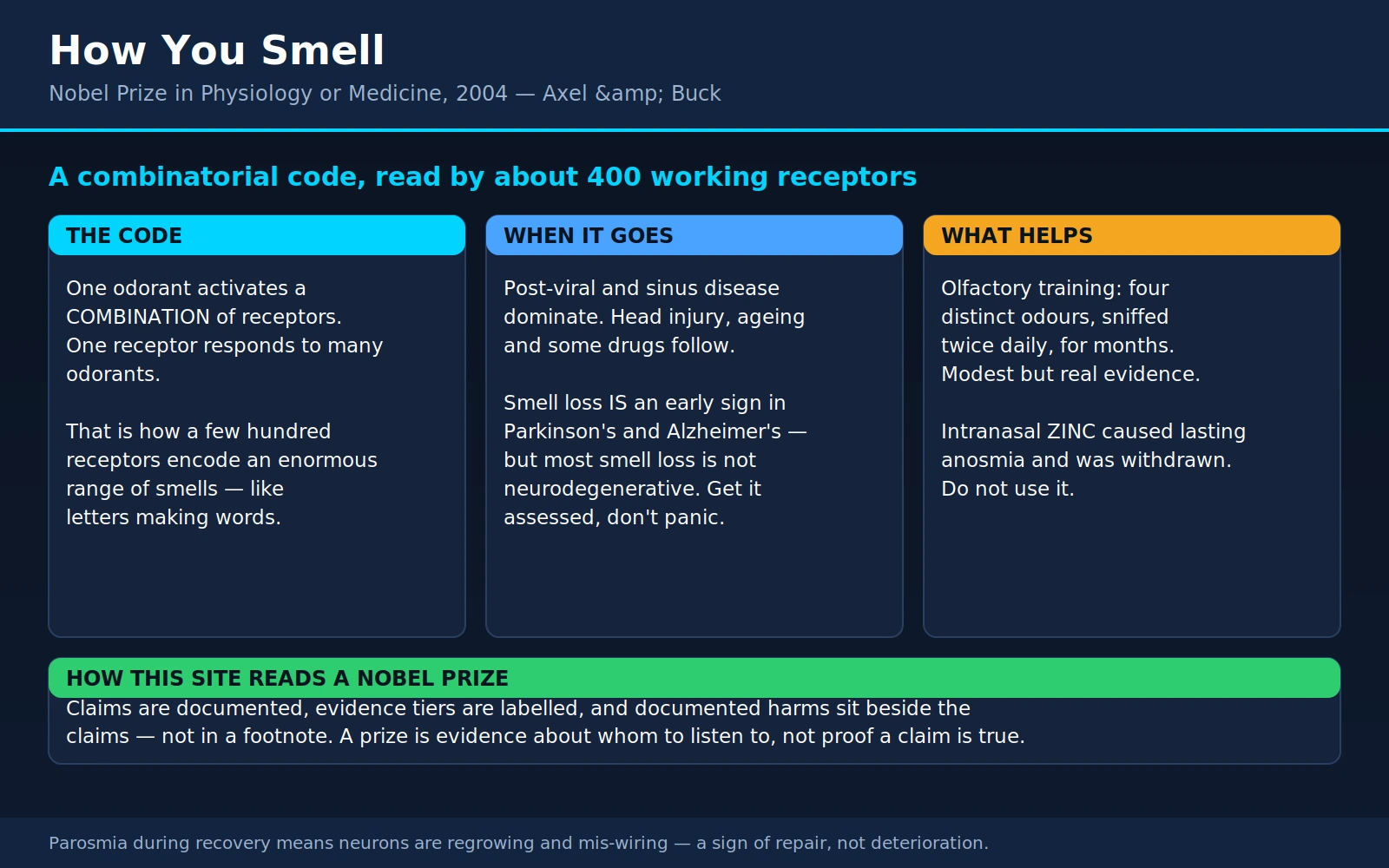
In 2004 the Nobel Prize in Physiology or Medicine went to Richard Axel and Linda B. Buck — "for their discoveries of odorant receptors and the organization of the olfactory system." They had answered a question that sounds childishly simple and had defeated science for a century: how does a nose tell one smell from another?
This page tells that story. But it is also, deliberately, the place on this site where we deal with the loss of the sense of smell — because the two subjects are the same subject. Once you understand what Axel and Buck found, you understand why smell can fail, why it sometimes comes back, why food tastes like cardboard when your nose stops working, why some people recovering from a virus start smelling sewage in coffee, and what the evidence actually supports doing about it.
If you have lost your sense of smell and you came here for the practical part, skip to section 6. Nothing in the science sections is a prerequisite. But the biology is the reason the advice works, so it is worth coming back for.
Table of Contents
- The Prize and the Two Scientists
- The Problem: Finding a Receptor Nobody Had Seen
- The 1991 Discovery: A Thousand Genes for Smell
- One Neuron, One Receptor — and the Combinatorial Code
- Why Smell Feels Different from the Other Senses
- Losing Your Sense of Smell: What Actually Causes It
- COVID-19 and Smell: The Honest Record
- What Actually Helps
- Living With Smell Loss
- Taste Is Not Smell — and Human Pheromones Are Not Established
- Where Mainstream Medicine Agrees — and What Remains Debated
- Key Research Papers
- Connections
- Featured Videos
1. The Prize and the Two Scientists
Richard Axel (born 1946 in New York City) trained in medicine at Johns Hopkins and built his career at Columbia University, where he has spent his working life as a molecular biologist and, later, a neuroscientist. By the 1980s his laboratory was already well known — among other things for co-developing the gene-transfer methods that let researchers move DNA into mammalian cells, a technique that quietly underwrote a great deal of the biotechnology industry.
Linda B. Buck (born 1947 in Seattle) took a longer and less linear road. She studied psychology and microbiology at the University of Washington, took a PhD in immunology at the University of Texas Southwestern, and then — in her early thirties, already a trained immunologist — changed fields entirely. She joined Axel's laboratory at Columbia as a postdoctoral fellow because she had read a paper about olfaction and could not stop thinking about it.
She spent most of a decade on the problem. The paper that won the prize was published in 1991, while she was still a postdoc in Axel's lab, with Buck as first author and Axel as senior author. She started her own laboratory at Harvard Medical School the same year, and in 2002 moved to the Fred Hutchinson Cancer Research Center in Seattle, where she continued to work on the olfactory system.
That sequence is worth pausing on, because credit for work done by postdoctoral researchers is a live and unresolved issue in science. A great deal of the most original work in biology is done by people in exactly Buck's position — scientifically mature, intellectually independent, formally junior, and paid accordingly. The 2004 Nobel recognised both the laboratory head and the postdoc who did the decisive experiments, which is the outcome one would want and is not the outcome that always happens. It is fair to note that Buck has consistently credited Axel's laboratory environment and the freedom it gave her, and Axel has consistently credited Buck's insight and persistence. Neither has ever suggested the other was along for the ride.
Buck was also, at the time, one of a small number of women to have received the Nobel Prize in Physiology or Medicine — a category that in a century of awards has been overwhelmingly male. She shares that distinction with figures elsewhere on this site, including Barbara McClintock and Rita Levi-Montalcini.
A note on integrity, because it belongs here
Between 2008 and 2010, Buck retracted three papers from her own laboratory — a 2001 paper in Nature, a 2005 paper in the Proceedings of the National Academy of Sciences, and a 2006 paper in Science — all concerning maps of odour representation in the olfactory cortex, and all sharing a first author whose underlying data could not be reproduced. Buck initiated the retractions herself after her own attempts at replication failed.
We mention this for two reasons. First, because a page that only reports the triumphs of a scientist is a poor guide to how science actually works. Second, and more usefully: none of the retracted work is the prize-winning work. The 1991 discovery of the odorant receptor family, the one-neuron-one-receptor rule, the convergence of receptor-matched neurons onto single glomeruli, and the combinatorial code have all been replicated exhaustively by laboratories all over the world for more than thirty years. The retractions concerned later, downstream questions about how the signal is arranged once it reaches the cortex. Withdrawing your own papers when they do not hold up is what a scientist is supposed to do, and it is rarer than it should be.
2. The Problem: Finding a Receptor Nobody Had Seen
By the late 1980s, vision was largely solved at the molecular level. We knew there were three cone photopigments in the human retina, we had their genes, and we understood how three receptor types could generate the perception of millions of colours. Hearing was understood as a mechanical frequency analysis performed along the cochlea. Touch, temperature and pain were less clear, but were being pursued — that work would eventually earn David Julius and Ardem Patapoutian the 2021 prize.
Smell was a blank. Nobody had identified a single odorant receptor. Nobody knew how many there were. Nobody could say what an odour receptor even looked like.
And the prevailing intuition pointed in the wrong direction. Reasoning by analogy with colour vision, many researchers assumed there would be a small number of "primary odours", perhaps seven, perhaps a dozen, from which all other smells were mixed. There had been many such schemes going back to Linnaeus. Making a very large number of receptors seemed genetically extravagant — why would an organism spend hundreds of genes on smelling when three suffice for seeing colour?
The experimental obstacle was equally severe. To find a receptor by conventional biochemistry, you generally need to purify it, and to purify it you need a lot of tissue and something that binds it tightly. Odorant receptors are membrane proteins present in tiny quantities, scattered through a patch of tissue high in the nasal cavity that is roughly the size of a postage stamp, and odorants bind them weakly and transiently. Decades of purification attempts had produced essentially nothing.
Buck's move: stop looking, start predicting
Buck's contribution was not a new machine or a bigger dataset. It was a piece of reasoning. Rather than searching for the receptor, she asked what its gene would have to look like if it existed, and then searched for genes with exactly those properties. She set out three predictions:
- The receptor should be a G-protein-coupled receptor. Earlier work had shown that odorants trigger a rise in cyclic AMP inside olfactory neurons via a G protein, which is the signature of the enormous GPCR superfamily — the same architecture used by rhodopsin in the eye, by adrenaline receptors, and by a large fraction of all prescription drugs. GPCRs share a distinctive structure: a protein that threads back and forth through the cell membrane seven times. That structure leaves a recognisable fingerprint in the DNA sequence, which can be fished for.
- The genes should be expressed only in olfactory tissue. A receptor whose job is smelling has no business being switched on in liver or muscle. So a gene that appeared in olfactory epithelium and nowhere else was a candidate; a gene that appeared everywhere was not.
- They should form a large multigene family. If the nose can distinguish a great many odours, and if a receptor only recognises a limited range of molecular shapes, then there should be many related-but-different genes — variations on a theme, of the sort produced by repeated gene duplication and divergence. The signal to look for was therefore not one gene but a family of near-relatives.
Each of these predictions independently narrowed the search. Taken together they turned an impossible purification problem into a tractable molecular-biology problem: use the polymerase chain reaction with primers designed against the conserved parts of seven-transmembrane receptors, run it on complementary DNA from rat olfactory epithelium, and see what family of sequences comes out.
This is a good illustration of something that is easy to state and hard to do: a well-posed question is often worth more than a better instrument. Buck had no technology unavailable to her competitors. She had a hypothesis specific enough to be searched for.
3. The 1991 Discovery: A Thousand Genes for Smell
The result appeared in Cell in April 1991 under a characteristically cautious title: "A novel multigene family may encode odorant receptors: a molecular basis for odor recognition." The word may is doing real work there — Buck and Axel had not yet proved that these proteins bind odours, and they said so.
What they reported was that they had cloned and characterised eighteen different members of an extremely large family of genes encoding seven-transmembrane proteins whose expression was restricted to the olfactory epithelium. Eighteen sequences, all clearly relatives, all clearly confined to the nose.
It is worth being precise here, because the story is usually told wrong. The 1991 paper did not count a thousand genes. It found eighteen and demonstrated that they were the visible tip of something enormous. The full size of the family was established over the following decade, as sequencing improved and whole genomes became available:
- Mouse: roughly 1,300 odorant receptor genes in total, of which about a fifth are pseudogenes — broken copies that are no longer translated into working protein. That leaves on the order of 1,000 functional receptors. (Zhang & Firestein, Nature Neuroscience 2002, working from the mouse genome, reported 1,296 genes including about 20% pseudogenes.)
- Human: roughly 800 odorant receptor genes and pseudogenes, of which only around 400 are intact and functional. The first genome-scale survey found over 900 sequences with at least 63% disrupted by pseudogene-forming mutations.
Treat every one of these numbers as approximate. Human counts in particular vary between about 350 and 450 functional receptors depending on the genome assembly, the gene-finding algorithm, and where the analyst draws the line between "damaged but working" and "pseudogene". They also vary between people: odorant receptor genes are unusually polymorphic, and two healthy individuals can differ in which receptors they carry in working order. This is part of why smell is so idiosyncratic — why some people find coriander soapy, why the smell of asparagus in urine is obvious to some and undetectable to others, and why perfume that suits one person is unbearable to the next.
Three per cent of your genes are for smelling
The size of the family was the shock. At the time it was announced, this was the largest gene family known in any mammal, and it still ranks among the largest. Roughly 3% of all the genes in the genome are devoted to odorant receptors. A mammal spends more of its genetic inheritance on smell than on almost anything else.
That single fact reframed a great deal. The intuition that "there cannot be many receptors" had been exactly backwards. Evolution had not economised on smell; it had gone to extraordinary lengths, duplicating and re-duplicating a receptor gene until there were a thousand versions, each tuned slightly differently. The 400-odd broken human copies tell their own story — our lineage has been steadily losing olfactory receptors, and comparative work in primates links that loss to the increasing dominance of vision. We are not bad at smelling because our noses are poorly built. We are, relatively speaking, running a reduced version of a system our ancestors ran at full size.
4. One Neuron, One Receptor — and the Combinatorial Code
Finding the receptors was the discovery. Working out how they are arranged is what turned the discovery into an explanation, and it is the part of this story most worth understanding.
Rule one: each sensory neuron uses only one receptor
Your olfactory epithelium contains on the order of ten million olfactory sensory neurons. Each one is a genuine neuron: a cell body in the nasal lining, hair-like cilia projecting into the mucus where odour molecules dissolve, and a thin axon running up through the bone into the brain.
Every one of those neurons carries the full set of a thousand receptor genes in its nucleus. But each neuron expresses essentially only one of them. One neuron, one receptor — the rest of the family stays silent. Which receptor a given neuron ends up using appears to be chosen more or less at random during development, and once chosen, it sticks. Work from Axel's laboratory showed that the choice runs even deeper than picking a gene: only one of the two parental copies of the chosen gene is active, so the cell commits not merely to a receptor but to a single allele of it.
This is a remarkable piece of cellular decision-making, and the mechanism behind it is still not completely understood. But its consequence is simple and important: a single olfactory neuron reports on exactly one receptor's worth of the world. It is a one-bit sensor. All of the richness has to come from combining them.
Rule two: matched neurons converge on the same target
The neurons using any given receptor are scattered essentially at random across a broad zone of the nasal lining — they are not clustered together. That seems like a design flaw. If your "rose receptor" cells are sprinkled all over the epithelium, how does the brain know they all mean the same thing?
The answer is that the sorting happens at the destination rather than the source. Every olfactory neuron sends its axon to the olfactory bulb, a pair of structures at the front underside of the brain. The bulb contains roughly two thousand small spherical relay stations called glomeruli. Buck's laboratory showed with receptor-specific probes that each receptor type maps onto a small, distinct subset of glomeruli, producing an orderly map in the brain out of a disorderly arrangement in the nose. Peter Mombaerts, working with Axel, then made this visible directly by genetically labelling the axons of neurons expressing a chosen receptor and watching where they went: they converged on just two fixed positions among the roughly 1,800 glomeruli in the mouse bulb, in the same places in animal after animal.
So the wiring performs a sorting operation. Ten million scattered neurons, each reporting on one receptor, are gathered into about a thousand tidy bundles, each bundle representing one receptor type, each sitting at a reproducible address. The olfactory bulb is a map of receptors. An odour becomes a pattern of lit-up spots on that map.
Rule three — the crucial one: the code is combinatorial
Here is the idea that makes the whole system work, established in 1999 by Bettina Malnic working in Buck's laboratory. They combined calcium imaging (watching which individual neurons fire when a given odour is delivered) with single-cell genetic analysis (asking which receptor each responding neuron happened to be using). The findings were these:
- One receptor responds to many different odorants. A receptor is not a lock with exactly one key. It is broadly tuned — it responds to a family of molecules that share some structural feature, more strongly to some than to others.
- One odorant activates many different receptors. There is no "banana receptor". Banana activates a set.
- Different odorants activate different combinations. And this is the point: the identity of a smell is carried by which set lights up, not by which single receptor does.
The arithmetic of this is what should stay with you. Suppose — purely to make the point — that a given odour activates a combination of three receptors out of a thousand, and that the brain can tell one combination from another. The number of distinct three-receptor combinations available from a thousand receptors is over 160 million. Allow combinations of four and the number runs past 40 billion. A modest number of components, read as a pattern rather than individually, generates an effectively unlimited number of distinct signals.
It is the same trick as an alphabet. Twenty-six letters do not limit you to twenty-six words. It is the same trick as the three cone types in your retina, which give you millions of colours — except that the nose runs it with a thousand components instead of three, which is why the olfactory system out-resolves every other sense in sheer number of discriminable stimuli.
Malnic's study added one more detail with large everyday consequences. Small changes to a molecule, or even a change in its concentration, change its receptor code — and therefore change what it smells like. That is why indole smells floral in a jasmine blossom and faecal in a concentrated bottle; why a tiny structural change turns a pleasant smell into an unpleasant one; and why perfumers can be blindsided by a molecule that behaves entirely differently at 1% than it did at 10%.
5. Why Smell Feels Different from the Other Senses
Almost everyone has had the experience: a smell arrives and, before any thought at all, so does a memory — a specific room, a person, a summer. It arrives whole, and with feeling attached. Nothing a photograph or a piece of music does is quite like it.
There is a structural reason this is plausible, and it lies in the wiring.
Every other sense routes through the thalamus. Sight, sound, touch and taste all deliver their signals first to the thalamus, deep in the middle of the brain, which acts as a relay and gating station before passing information on to the relevant cortex. Smell largely does not. From the olfactory bulb, projections run directly to the piriform cortex (where odour identity is assembled), to the amygdala (emotion, threat, salience), and to the entorhinal cortex, which is the main gateway into the hippocampus and therefore into memory formation. Odour information reaches emotional and memory structures in remarkably few synapses, and without the thalamic checkpoint the other senses pass through.
State this for what it is: a good structural explanation, not a proved causal chain. The anatomy is not in dispute — the direct olfactory projections to amygdala and entorhinal cortex are textbook. What is harder to establish is that this anatomy is the reason odour-evoked memories feel more emotional, more sudden and older than memories cued by words or pictures. Experimental work does support the phenomenon itself: memories cued by odours tend to be rated as more emotional and to come from earlier in life than memories cued the same content presented as a word or a picture. Whether that is because of the missing thalamic relay, or because of how odours are learned in childhood, or both, is not settled. The anatomy makes the effect unsurprising. It does not prove the mechanism.
The other structural fact: these neurons regenerate
Here is something that matters enormously if you have lost your sense of smell.
Olfactory sensory neurons sit in a hostile place. They are neurons with one end exposed to the open air — to cold, viruses, dust, ammonia, chlorine, smoke and everything else you breathe. They are damaged constantly. And so, unlike almost every other neuron in the adult mammalian nervous system, they are continuously replaced. Basal stem cells in the olfactory epithelium divide and generate new sensory neurons throughout life, and those new neurons grow fresh axons through the skull and re-establish connections in the olfactory bulb. This was demonstrated in a classic series of studies by Pasquale Graziadei and colleagues in the late 1970s, and it remains one of the very few examples of genuine neuronal regeneration in the adult mammalian brain.
Two consequences follow, and they run through the rest of this page:
- Recovery from some kinds of smell loss is genuinely possible, in a way that recovery from, say, a severed optic nerve is not. The tissue rebuilds itself.
- Rebuilding is not the same as rebuilding correctly. A regenerating neuron has to find its way back to the right glomerulus. When it does not, the map is wrong — and the smell that arrives at the cortex is misfiled. This is the leading explanation for parosmia, which we come to in section 7.
6. Losing Your Sense of Smell: What Actually Causes It
Smell loss is far more common than most people assume, and far less often assessed. In the US National Health and Nutrition Examination Survey — which, unusually, measured smell with an odour-identification test rather than asking people about it — 12.4% of adults aged 40 and over had olfactory dysfunction, about 13.3 million people, with 3.2% anosmic or severely hyposmic. The age gradient is steep: 4.2% at ages 40–49, 12.7% at 60–69, and 39.4% at 80 and over.
Some vocabulary, because you will meet it:
- Anosmia — no sense of smell at all.
- Hyposmia — reduced sense of smell. Far commoner than complete anosmia.
- Parosmia — smells are present but distorted, usually unpleasantly. Coffee smells of petrol or sewage; meat smells rotten.
- Phantosmia — smelling something that is not there at all, often smoke or burning.
- Normosmia — normal smell function, for completeness.
The causes, roughly in order of how often they are responsible
1. Post-viral (post-infectious) olfactory loss. Historically the single largest identifiable cause, and since 2020 overwhelmingly so. An upper respiratory infection — the common cold, influenza, parainfluenza, and notably SARS-CoV-2 — damages the olfactory epithelium, and the smell does not return with the rest of the recovery. Important distinction: this is not the temporary blocked-nose loss you get while congested, which resolves with the congestion. Post-viral loss persists after the nose is clear. It is commoner in women and in middle age and later. Most cases improve substantially, many completely, and improvement can continue for years.
2. Chronic rhinosinusitis, with or without nasal polyps. The second great cause, and the most treatable one. Here the problem is largely conductive: inflamed, swollen or polyp-filled tissue physically prevents odour molecules from reaching the olfactory cleft high in the nose, and chronic inflammation damages the epithelium as well. The tell is that the loss fluctuates — better on some days, worse with a flare — and usually comes with congestion, facial pressure, post-nasal drip or a reduced sense of taste alongside. This is the group for whom treating the underlying disease often restores smell. See Sinusitis and Nasal Polyps.
3. Head trauma. The olfactory nerve does not enter the skull as one cable. It enters as dozens of fine filaments passing through the perforations of the cribriform plate, a thin, sieve-like shelf of bone at the roof of the nose. In a head impact — particularly a blow to the back of the head, which causes the brain to move relative to the skull — those filaments can be sheared off. Loss is often immediate and complete, and prognosis is poorer than for post-viral loss, though partial recovery over one to two years is well documented. Frontal-lobe contusion can also damage the olfactory bulbs directly.
4. Ageing. The NHANES numbers above show how steep this is. Olfactory decline with age is normal, gradual, and usually unnoticed until it is substantial — which is precisely why it is often first detected as a complaint that "food has no taste any more." Several things contribute: fewer functioning sensory neurons, slower regeneration from the stem cell pool, cumulative viral and toxic damage, and bony changes narrowing the olfactory cleft.
5. Medications and toxic exposures. A long list, and worth reviewing with a pharmacist rather than assumed. Some chemotherapy agents, some antibiotics, some antithyroid drugs, nasal decongestant overuse, intranasal zinc preparations (see section 8 — this one caused real and lasting harm), and occupational exposure to solvents, formaldehyde, cadmium and other metals. Smoking causes a dose-dependent reduction in smell that partially recovers after quitting.
6. Structural and less common causes. Severely deviated septum, nasal tumours, olfactory groove meningioma (usually with other signs), previous sinus surgery, radiotherapy to the head and neck, uncontrolled diabetes, hypothyroidism, and a small number of congenital conditions — most notably Kallmann syndrome, in which people are born without a functioning sense of smell alongside delayed or absent puberty.
7. Neurodegenerative disease. This needs its own discussion, immediately below.
Smell loss and neurodegenerative disease: accurate, and not a reason to panic
This is the part of the subject that most frightens people who look it up, and it is usually presented badly. Here is the accurate version.
What is true: reduced smell is an early feature of both Parkinson's disease and Alzheimer's disease, and it typically appears before the symptoms those diseases are known for. In the Honolulu-Asia Aging Study, over 2,000 men aged 71–95 who were free of Parkinson's and dementia were given a smell test and then followed for up to eight years. Among those in the worst quartile for odour identification, the risk of a subsequent Parkinson's diagnosis was several times higher than in the top half, and the effect was concentrated in the first four years of follow-up. This fits what pathologists see: in Parkinson's, the abnormal protein deposits appear in the olfactory bulb and lower brainstem at a stage before the substantia nigra is substantially affected. Similar early olfactory involvement is well documented in Alzheimer's disease.
What is equally true, and gets left out:
- Most smell loss is not neurodegenerative. Post-viral loss and sinus disease account for the great majority of cases seen in smell clinics. Ageing accounts for much of the rest. Neurodegenerative disease is a small minority of the total.
- The direction of inference matters enormously. "Most people with Parkinson's have poor smell" is a very different statement from "most people with poor smell get Parkinson's" — and the second is false. Because reduced smell is common and Parkinson's is not, the great majority of people with a poor smell test will never develop it.
- The pattern is different. Neurodegenerative smell loss is typically gradual, painless, bilateral, unnoticed by the person themselves, and accompanied over time by other signs. Post-viral loss is typically sudden, dateable to a specific illness, and noticed immediately. If you can name the week you lost your sense of smell and it was the week you had a virus, you are almost certainly not describing a neurodegenerative process.
- A cause worth finding is a reason to get assessed, not a reason to be frightened. The commonest causes are the treatable ones. Being seen by an ENT clinic gets you a formal smell test, an examination of the nose that can find polyps or inflammation, imaging where warranted, and a real prognosis instead of an internet-shaped one.
Further reading on this site: Parkinson's Disease, Alzheimer's Disease, and Anosmia.
7. COVID-19 and Smell: The Honest Record
In the spring of 2020, before testing was widely available, sudden loss of smell turned out to be one of the most informative symptoms anyone could report. In a large symptom-tracking study, loss of smell and taste was reported by 65% of people who tested positive against 22% of those who tested negative — an odds ratio of about 6.7, which is unusually specific for any single symptom of a respiratory infection. For a period, "I can't smell anything" was better evidence of infection than fever.
The mechanism, and why it is reassuring
The obvious fear in 2020 was that the virus was killing olfactory neurons, and that anosmia therefore meant the virus was in the nervous system. The evidence went the other way, and this is one of the more genuinely comforting findings of the pandemic.
In 2020 a large collaborative study led by David Brann examined which cells of the olfactory system actually carry the molecular machinery SARS-CoV-2 needs to get into a cell — the ACE2 receptor and the enzyme TMPRSS2. Bulk sequencing showed the olfactory mucosa expresses both. But single-cell sequencing showed where: ACE2 was expressed in support cells, stem cells and perivascular cells — not in the olfactory sensory neurons themselves. Immunostaining confirmed it, showing widespread ACE2 protein in the sustentacular cells, the tall supporting cells that surround and maintain the sensory neurons.
Sustentacular cells are the nurses of the olfactory epithelium. They maintain the ionic composition of the mucus the receptor cilia sit in, they support the sensory neurons metabolically, and they clear debris. Damage them and the sensory neurons stop working — the environment they need is gone — but the neurons themselves are not necessarily destroyed. And crucially, sustentacular cells regenerate quickly.
That is very probably why COVID-19 anosmia is usually a matter of weeks rather than a permanent injury. The damage is to the support structure, not primarily to the sensor.
How often does it come back?
The best long-term data come from cohorts followed since the first wave. In a group of adults with mild COVID-19 assessed repeatedly at hospitals in Treviso and Trieste, 66% reported altered smell or taste at the time of infection. At three years, only 5% still had any alteration, and 92% of those originally affected reported complete resolution. Notably, of the people who still had a problem two years in, about two-thirds went on to recover fully or partially by year three.
Three practical points from that:
- The large majority recover, most of them within weeks to a few months.
- A minority do not, and their difficulty is real and under-acknowledged. A few per cent of an enormous number of infections is a great many people.
- Late recovery happens. Improvement two and three years out is documented. Being told "if it hasn't come back by six months it never will" is not supported by the data.
Parosmia: the part nobody explains, and should
Many people recovering from post-viral smell loss go through a phase that is worse, subjectively, than the loss itself. Smell returns — but wrong. Coffee smells of burning rubber or sewage. Onions, garlic, meat, chocolate and toothpaste are common triggers. Food becomes revolting rather than merely absent. People stop eating, lose weight, avoid cooking for their families, and become distressed in a way that "you've lost your sense of smell" does not begin to describe.
If this is happening to you, here is what you are usually not told:
Parosmia is a sign of regeneration, not of deterioration. Recall from section 5 that olfactory sensory neurons regrow, and that a regrowing neuron has to find its way back to the correct glomerulus in the olfactory bulb. The leading explanation for parosmia is that this rewiring is imperfect: neurons carrying a given receptor reconnect to the wrong targets, so the receptor code arriving at the cortex no longer matches the pattern the brain learned. The signal is real, the receptors are working, the map is temporarily misfiled. Research into which molecules trigger it supports a receptor-level phenomenon — work using gas chromatography olfactometry identified a set of specific, extremely potent odour-active molecules, sharing structural features and detectable at very low thresholds, that reliably provoke the distortion across different people.
And the clinical association points the same way. In a study of 153 people with post-infectious smell loss undergoing olfactory training, having parosmia at the first visit predicted greater clinically relevant improvement in odour discrimination and identification. That is a retrospective study rather than a trial, and it should not be oversold — but it is consistent with the mechanism, and it points in a direction patients are rarely given.
The reassurance is medically real: parosmia is generally a phase in recovery rather than a new disease. It commonly begins two to six months after the initial loss, and it usually fades over months, sometimes over a year or two. It is miserable while it lasts. It is not a sign that something is getting worse.
Practical coping, while you wait it out:
- Identify and avoid your specific triggers rather than avoiding food generally. Most people have a short list, and it is often coffee, onion, garlic, meat and chocolate. The rest of the diet may be tolerable.
- Cold or room-temperature food releases far fewer volatile molecules than hot food, so it triggers less. Many people with parosmia manage on cold meals during the worst phase.
- Bland, high-protein foods — eggs, plain yoghurt, unseasoned chicken, beans, nuts — are frequently tolerated when strong-smelling food is not. The goal during this phase is to keep eating enough, not to eat interestingly.
- Weigh yourself weekly. Unintended weight loss during parosmia is common and is the thing most worth catching early. Tell your doctor if it is happening.
- Continue olfactory training. It is not a cure for parosmia, but the evidence supports continuing it, and longer, varied training appears to do better (see below).
8. What Actually Helps
Tiered honestly, best evidence first.
Tier 1: Olfactory training — the intervention with the best evidence
Olfactory training is deliberate, structured, repeated sniffing of a fixed set of distinct odours. It was introduced by Thomas Hummel's group in Dresden in 2009 and has since become the standard first-line treatment for post-viral and idiopathic smell loss worldwide. It is cheap, has no meaningful side effects, and you can do it yourself.
The classical protocol, as originally tested:
- Four odours, chosen to span different odour categories: rose (phenyl ethyl alcohol — floral), eucalyptus (eucalyptol — resinous), lemon (citronellal — fruity) and clove (eugenol — spicy).
- Twice daily, morning and evening.
- About 20–30 seconds per odour, sniffing gently and repeatedly — short sniffs, not one long inhalation. Roughly five minutes per session in total.
- Concentrate while you do it. This is not passive exposure. Look at the label, think about what the smell should be, try to recall the memory of it. The training appears to work partly by driving central plasticity, and attention matters.
- Minimum 12 weeks in the original study; four months or more in later work; longer is better.
Practically: essential oils in small jars work perfectly well. Put a few drops on a cotton pad inside a small screw-top jar, one jar per odour, label them, and keep them somewhere you will actually see them twice a day. Replace the pads every month or so as they lose potency. Purpose-made kits exist and are fine, but they are not necessary.
The evidence, stated honestly. In the original 2009 study, 40 patients trained for 12 weeks and 16 did not; the training group improved on overall smell testing and on thresholds for the trained odours, while the untrained group did not change. Since then the effect has been confirmed repeatedly. A meta-analysis of 13 studies found significant benefit across identification, discrimination and overall score, with smaller effects on detection threshold, and found that training duration influenced how well it worked. A meta-analysis focused specifically on post-viral loss found that patients who trained had about 2.8 times the odds (95% CI 1.7–4.6) of achieving a clinically meaningful improvement compared with controls.
That is a real effect and it is worth doing. It is also modest. Olfactory training is not a cure; it shifts the odds of meaningful improvement, on top of a recovery process that is often happening anyway. Trials are mostly unblinded and mostly in post-viral loss, which is where the evidence is strongest — it is weaker for post-traumatic loss and for smell loss from sinus disease, where the underlying problem needs treating first.
Two refinements that appear to do better. A study of 85 people with post-infectious loss compared classical training (the same four odours throughout) with modified training — three different sets of four odours used in sequence, changing every 12 weeks, over 36 weeks. Both beat no training; changing the odour set and extending the duration did better than sticking with the same four. So: train for longer than you think, and change your odours every three months. The same group later found modified training helpful specifically for COVID-related parosmia.
Tier 2: Treating inflammation, where inflammation is the cause
If the cause is chronic rhinosinusitis, nasal polyps or allergic inflammation, then treating that disease is the treatment for the smell loss, and it can work very well. Nasal polyps in particular can take away smell almost completely and give it back when they are treated. Steroids in this setting are genuinely effective — but how they are delivered turns out to matter a great deal, and this is where a lot of disappointment comes from.
Standard steroid nasal sprays reach the olfactory cleft poorly. The olfactory epithelium sits high up at the roof of the nasal cavity; a spray delivered as a fine mist from the nostril mostly deposits low and in front. In a study comparing routes, mometasone nasal spray did not significantly improve olfactory function in a mixed group of patients with smell loss.
High-volume steroid irrigation does better. In a randomised trial, 138 patients with smell loss and no visible sinus inflammation received olfactory training plus either saline irrigation or budesonide irrigation for six months. In the budesonide group 43.9% had a clinically significant improvement, against 26.9% with saline (p = 0.039; adjusted odds ratio 3.93). Younger age and shorter duration of loss also predicted improvement. The mechanism is plausibly simple: a large-volume rinse with the head positioned appropriately delivers the drug where a spray does not. This is a treatment to discuss with an ENT specialist rather than to improvise.
A short course of oral steroids is sometimes used both as treatment and as a diagnostic test: if smell returns on prednisolone, the problem has an inflammatory component that is worth pursuing. In the same comparison above, systemic corticosteroids did improve olfactory function across diagnostic groups, though the study was unblinded and steroids carry real risks — blood-sugar disturbance, mood change, insomnia, bone effects with repeated courses. This is a clinician's decision, made with your history in front of them.
Tier 3: Weak, early or unproven — and one that caused harm
⚠ Intranasal zinc: do not use it. This one is not merely useless — it caused permanent damage. Zinc gluconate nasal gels and swabs were sold widely as cold remedies. A case series described 17 patients who developed anosmia after using intranasal zinc gluconate, with a stereotyped and unmistakable sequence the authors called "squirt, sniff, burn, and anosmia": application, deep sniff, immediate intense burning lasting minutes to hours, and loss of smell within 48 hours. Seven of the 17 never developed any cold symptoms at all, ruling out post-viral loss as the explanation. Zinc cations are directly toxic to olfactory epithelium. Following the reports and subsequent FDA action, the products were withdrawn from the US market. Some of the damage was permanent.
Oral zinc supplements are a different matter, and are also not a treatment for smell loss. Correcting a genuine zinc deficiency — which is uncommon in well-nourished people but occurs in malabsorption, alcohol dependence and some chronic diseases — can improve taste and smell, because zinc is required by enzymes in these tissues. But taking zinc for smell loss in the absence of deficiency is not supported, and high-dose zinc taken long-term causes copper deficiency, which has its own neurological consequences. See Zinc for the full picture. If you want to know your zinc status, it is a blood test, not a guess.
Intranasal vitamin A: thin evidence, biologically plausible. Vitamin A (as retinoic acid) is involved in the differentiation of olfactory neurons, so there is a reason to try it. A retrospective study of 170 patients found that adding topical vitamin A (10,000 IU/day for 8 weeks) to olfactory training produced improvement in 37% of post-infectious patients versus 23% on training alone. That is encouraging and it is not proof: the study was retrospective and unblinded, and its own authors called for prospective placebo-controlled trials, which have not settled the question. Note also that this is topical vitamin A. Oral vitamin A in high doses is genuinely toxic and is not a substitute.
Platelet-rich plasma: early, small, promising, not established. PRP is prepared from your own blood and injected into the olfactory cleft mucosa; the rationale is that its growth factors may support regeneration. A pilot study of just seven patients with persistent loss who had already failed training and budesonide reported no serious adverse effects; the two with complete anosmia did not improve, while five with partial loss improved by an average of about 6 points on the Sniffin' Sticks composite score. Small controlled studies since have been cautiously positive. Seven patients is a pilot, not evidence of efficacy, and PRP is an out-of-pocket procedure in most places. It is reasonable to discuss in a specialist clinic after the established options; it is not a first step.
Things with no good evidence for smell loss: alpha-lipoic acid (studied, unconvincing), theophylline (oral or intranasal; small studies, poor quality), sodium citrate rinses (transient at best), vitamin B12 unless you are deficient, homeopathic nasal preparations, and the general run of "smell restoration" supplements sold online. If a product promises to restore your sense of smell, be aware that the condition frequently improves on its own over months — which makes almost any intervention look effective to the person taking it.
When to see a doctor
Get assessed rather than waiting if any of these apply: the loss was sudden and has not improved after two to four weeks; it followed a head injury; it is on one side only; it comes with nosebleeds, facial numbness, visual change, headache or neurological symptoms; it is accompanied by persistent one-sided nasal blockage or discharge; or it is affecting your eating, weight or mood. An ENT clinic can perform a validated smell test (Sniffin' Sticks or UPSIT), examine the nose endoscopically, and image where necessary. A measured baseline is worth having — it is the only way to know later whether you are improving.
9. Living With Smell Loss
This section exists because losing your sense of smell is routinely treated as a minor inconvenience, including by clinicians, and it is not one. People who have it are frequently told there is nothing to be done and sent away. That is both inaccurate — see the previous section — and unkind.
It takes most of flavour with it
Understand this clearly, because it explains almost everything else. What you call the "taste" of food is mostly smell. Your tongue detects five qualities and no more: sweet, salty, sour, bitter and umami (savoury). Everything else — strawberry, coffee, roast lamb, basil, chocolate, wine — is odour, detected by exactly the receptors Buck and Axel discovered, reaching them through the back of the throat as you chew and swallow. This is called retronasal olfaction, and it is why food goes flat when you have a cold and why holding your nose while eating a jellybean leaves you with sweetness and nothing else.
So people with anosmia usually say they have "lost their sense of taste". They generally have not: sweet, salt, sour, bitter and umami are typically intact and a formal taste test will show it. What they have lost is flavour, which is the larger part of the experience. Being told "your taste is normal" when food has become meaningless is maddening, and it happens constantly. The right framing is: your taste is intact, your flavour perception is not, and flavour is mostly smell.
What follows from that
Eating changes, and so does weight. It goes both ways. Some people lose interest in food entirely and lose weight without meaning to. Others chase the sensations that still work — salt, sugar, fat, chilli heat and texture, none of which depend on smell — and gain weight or push their salt and sugar intake up substantially. Both are worth watching for.
Mood suffers, and this is not weakness. The association between olfactory loss and depression is consistent across the literature; a systematic review of the relationship found the two reliably linked, and clinical experience matches it. There are obvious reasons: eating stops being a pleasure, shared meals become an ordeal, and the sense that quietly carried a great deal of memory and intimacy — the smell of your partner, your children, your home — simply is not there. People also describe a distinctive feeling of detachment, of being sealed off from the world. If this is you, say so to your doctor. It is a recognised consequence of a real physical condition.
Social life shrinks. Restaurants stop being worth the money. Cooking for other people becomes anxious, because you cannot check the seasoning. Many people also worry constantly about their own smell — body odour, breath, whether the house smells — because they have no way to check. That worry is normal and it is usually unfounded, but a trusted person you can ask directly, without embarrassment, helps enormously.
Safety: the practical, non-negotiable part
Smell is a warning system, and losing it removes a layer of protection you have relied on without noticing. This is not theoretical. In a study of 445 patients at a smell and taste clinic, 37% of those with impaired smell had experienced at least one olfactory-related hazardous event, against 19% of those with normal smell, and the rate rose steadily with severity — 45% among those with complete anosmia. Cooking incidents were commonest (45% of events), followed by eating spoiled food (25%), undetected gas leaks (23%) and undetected fire (7%). The NHANES data make the same point from the other direction: among adults aged 70 and over, 20% could not correctly identify the smell of smoke and 31% could not identify natural gas.
Do these things. They are cheap and they work.
- Fit smoke alarms and test them monthly. One on every floor, and outside sleeping areas. If you cannot smell smoke, the alarm is not a backup — it is your only detector.
- Fit a natural gas or propane detector if you have any gas appliance. The mercaptan added to household gas is there specifically so you can smell a leak; if you cannot, you need an instrument that can. Fit a carbon monoxide alarm as well — carbon monoxide is odourless, so this one matters for everybody, but it matters more when the rest of your chemical warning system is offline.
- Consider switching to electric or induction cooking if you are choosing new appliances. If you keep gas, use hobs with flame-failure cut-off devices, and be deliberate about checking that burners are actually off.
- Go by dates and by rules, not by sniffing. Label leftovers with the date they were made. Adopt a fixed rule — three days in the fridge for cooked food, for instance — and throw things out on the rule rather than on a judgement you can no longer make. Keep a fridge thermometer. When in doubt, discard it; food is cheaper than food poisoning.
- Ask someone else to check anything that matters: milk, meat, whether the kitchen smells of gas, whether something is burning. Enlist a household member rather than trying to manage alone.
- Be careful with cleaning products. You will not smell fumes building up, and you will not smell the accident of mixing bleach with an ammonia-based cleaner. Ventilate as a matter of routine, not as a response to a smell.
- Set timers when cooking, always, including for things you would normally judge by smell.
- Keep a personal hygiene schedule by the clock — laundry, showering, changing bedding — rather than by when things seem to need it. It removes an anxiety you cannot otherwise resolve.
Making food work again
The senses that survive are taste (the five qualities), texture, temperature, and the trigeminal sensations — the burn of chilli, the cool of mint, the prickle of carbonation, the sharpness of mustard and horseradish. These are carried by a different nerve entirely and are usually preserved. Cook to them:
- Build in contrast of texture — something crunchy against something soft. Toasted nuts and seeds, crisp vegetables, crackling, croutons.
- Use acid generously. Lemon, lime, vinegar. Sourness is a tongue sensation and it survives intact.
- Use umami-rich foods — mushrooms, aged cheese, tomato, anchovy, bone broth, fermented foods. Savouriness also survives.
- Use trigeminal ingredients deliberately — black pepper, chilli, ginger, mustard, horseradish, mint, sparkling water. They give food an edge and a presence that has nothing to do with smell.
- Play with temperature. Hot and cold together in the same dish is a real sensation and a real pleasure.
- Watch the salt and sugar. The natural response is to add more of both, and it is worth noticing before it becomes a habit that costs you elsewhere. Acid and umami do a lot of the same work without the same consequences.
Finally: connect with other people who have it. Patient organisations for smell disorders exist in many countries, and people consistently report that the single most useful thing was talking to someone who did not need it explained.
10. Taste Is Not Smell — and Human Pheromones Are Not Established
Getting taste and flavour right
To state it once more, plainly, because the confusion causes real problems in the clinic and real misery at home:
- Taste is what taste buds on the tongue, palate and throat detect. There are five accepted qualities: sweet, salty, sour, bitter, umami. That is the whole list. (Fat may be a sixth; it is argued about.) Taste is carried by cranial nerves VII, IX and X, and it is rarely lost. True total loss of taste — ageusia — is uncommon.
- Smell is what the olfactory receptors detect, via two routes: orthonasal (sniffing through the nostrils) and retronasal (odours released in the mouth travelling up the back of the throat as you chew and swallow).
- Flavour is the brain's combination of the two, plus texture, temperature and trigeminal sensation. It is not a separate sense; it is an integrated percept, and it is dominated by retronasal smell.
The old "tongue map" — sweet at the tip, bitter at the back — is wrong and has been known to be wrong for decades. It originated in a mistranslation of a German thesis and it survives only in textbooks that copy each other. All five qualities are detectable across the tongue.
The practical upshot: if food tastes of nothing, the problem is almost always your nose. That is worth knowing because it points at treatments that exist. A person told "you have lost your sense of taste" gets no useful advice. A person told "your flavour perception is gone because your smell is gone, and here is what to do about smell" gets olfactory training, an ENT assessment and a prognosis.
Human pheromones: what is actually established
Pheromone-branded perfumes, sprays and "attraction" products are a substantial industry, and the marketing generally implies a settled science. The science is not settled. Stated plainly and without contempt for anyone who has bought one:
Pheromones are unambiguously real in other animals. They are chemical signals released by one individual that produce a specific, stereotyped response in another of the same species. In moths, mice, pigs and many other species they are identified, synthesised, and demonstrably effective in controlled bioassays. There is no controversy about the concept.
The organ that detects them in other mammals is essentially non-functional in adult humans. Most mammals have a vomeronasal organ (Jacobson's organ), a small structure at the base of the nasal septum with its own receptor neurons and its own nerve into the brain. Humans have a vomeronasal pit — a small anatomical remnant, visible endoscopically in a variable proportion of people, and inconsistently visible even in the same person on different days. When it has been examined histologically, the picture is consistent: the cells lining it express keratin rather than olfactory markers, there are no identifiable sensory neurons, and there are no vomeronasal nerve bundles connecting it to the brain. The genes encoding vomeronasal receptors are largely pseudogenes in humans, and the gene for the ion channel those receptors signal through is broken. A structure with no sensory neurons and no nerve to the brain cannot be transmitting anything to the brain.
No human pheromone has been definitively identified. The four molecules named in essentially all commercial products — androstenone, androstenol, androstadienone and estratetraenol — were never established by the standard route. As Tristram Wyatt has set out in detail, demonstrating a pheromone requires showing an odour-mediated behavioural or physiological response, identifying and synthesising the responsible molecule, and then confirming its activity in a bioassay. For these four steroids, that chain was never completed. The human studies that support them tend to have small samples, effects larger than could plausibly be real, and little successful replication — the standard recipe for false positives. Androstadienone in particular has been tested many times with inconsistent results.
What is reasonably supported is that humans respond to each other's body odour in meaningful ways: people can identify relatives by smell, body odour changes with illness and diet, odour preference is linked to immune-gene similarity in at least some studies, and infants orient to their mother's scent. Wyatt notes that one of the more promising genuine leads is a secretion from the areolar glands of lactating mothers that appears to stimulate suckling in any infant, not only her own — which is exactly the kind of stereotyped, reproducible response a real pheromone would produce. Human chemical communication is a legitimate and active field.
So the honest tier is this: body odour carries real social and biological information; no specific human pheromone molecule has been established; the vomeronasal organ is not a functioning sensory organ in adults; and commercial pheromone products rest on animal data and on human studies that are weak or unreplicated. If wearing one makes you feel more confident, that is a genuine effect and it belongs to you rather than to the bottle. Just do not pay a premium expecting chemistry to do the work.
11. Where Mainstream Medicine Agrees — and What Remains Debated
Settled and not seriously disputed
- Odorant receptors are a very large family of G-protein-coupled receptors, discovered by Buck and Axel in 1991, comprising roughly 3% of mammalian genes.
- Each olfactory sensory neuron expresses essentially a single odorant receptor type.
- Neurons expressing the same receptor, though scattered across the epithelium, converge on the same small number of glomeruli in the olfactory bulb, producing a reproducible spatial map.
- Odour identity is encoded combinatorially: one receptor responds to many odorants, one odorant activates many receptors, and identity lies in the pattern.
- Olfactory sensory neurons regenerate throughout adult life from a basal stem cell population.
- What people call the taste of food is predominantly retronasal smell; the tongue contributes five qualities.
- Olfactory training is effective enough to be first-line treatment for post-viral and idiopathic smell loss, and its effect size is modest.
- Reduced smell is an early feature of Parkinson's disease and Alzheimer's disease, often preceding the classical symptoms by years.
- Intranasal zinc gluconate caused olfactory damage; the products were withdrawn.
Genuinely debated
How many odours can humans distinguish? The figure "10,000" appears in a great many textbooks and press releases. It should not be trusted — it traces back to a rough estimate from the 1920s and was never validated experimentally. In 2014 a study in Science by Bushdid and colleagues attempted to measure it properly, testing how well people could discriminate mixtures of odorants sharing varying numbers of components, and extrapolated that humans can distinguish at least a trillion olfactory stimuli. The result was widely reported.
It was then challenged hard, and the challenges are serious. Gerkin and Castro argued in eLife that the estimation framework is fragile enough to produce almost any answer from the same data, including values many orders of magnitude larger or smaller, and — a pointed objection — that the formula used actually yields an upper bound rather than the lower bound reported. Separately, Markus Meister argued that the mathematical method used to extrapolate from a limited experimental sample simply does not support the conclusion. The original authors have defended their approach.
The honest answer is that nobody knows. Humans can distinguish very many odours — certainly far more than the number of receptors, which is the interesting point and follows directly from the combinatorial code. The precise number is contested, and neither "10,000" nor "one trillion" should be quoted as established fact. It is a good example of a number that circulated widely because it was memorable rather than because it was solid.
Should smell testing be used to screen for neurodegenerative disease? The predictive association is real and is described in section 6. Whether that justifies population screening is a different question, and the answer is currently no. The tests are cheap and quick, but smell loss is common and its causes are mostly benign, so a positive result in an unselected population would be far more often a false alarm than a true early warning. There is also no disease-modifying treatment to offer someone identified early, which is the usual condition for screening to be worthwhile. Where olfactory testing is genuinely useful is in a clinic: helping distinguish Parkinson's disease from conditions that mimic it — essential tremor and drug-induced parkinsonism typically spare smell, Parkinson's typically does not — and as one measure among many in research cohorts. That is a diagnostic role, not a screening one, and the distinction matters.
Smaller open questions: the mechanism by which a neuron selects one receptor and silences the other 999 is still not fully explained; whether olfactory training works by peripheral regeneration, central plasticity, or both is unresolved; the optimal odour set, session length and duration for training have not been established by head-to-head trials; and the reason some people recover from post-viral loss and others do not remains largely unexplained.
12. Key Research Papers
- Buck L, Axel R. A novel multigene family may encode odorant receptors: a molecular basis for odor recognition. Cell 1991;65(1):175-87 — the discovery paper; 18 cloned members of a large olfactory-specific seven-transmembrane gene family.
- Mombaerts P, Wang F, Dulac C, et al. Visualizing an olfactory sensory map. Cell 1996;87(4):675-86 — neurons expressing one receptor converge on two fixed loci among ~1,800 glomeruli.
- Malnic B, Hirono J, Sato T, Buck LB. Combinatorial receptor codes for odors. Cell 1999;96(5):713-23 — the central idea: one receptor recognises many odorants, one odorant activates many receptors, identity lies in the combination.
- Glusman G, Yanai I, Rubin I, Lancet D. The complete human olfactory subgenome. Genome Research 2001;11(5):685-702 — over 900 human odorant receptor genes and pseudogenes, at least 63% disrupted.
- Hoffman HJ, Rawal S, Li CM, Duffy VB. New chemosensory component in the U.S. National Health and Nutrition Examination Survey (NHANES): first-year results for measured olfactory dysfunction. Reviews in Endocrine and Metabolic Disorders 2016;17(2):221-40 — measured prevalence in US adults, and warning-odour misidentification rates in the elderly.
- Hummel T, Rissom K, Reden J, et al. Effects of olfactory training in patients with olfactory loss. The Laryngoscope 2009;119(3):496-9 — the original olfactory training protocol: rose, eucalyptus, lemon, clove, twice daily, 12 weeks.
- Altundag A, Cayonu M, Kayabasoglu G, et al. Modified olfactory training in patients with postinfectious olfactory loss. The Laryngoscope 2015;125(8):1763-6 — changing the odour set every 12 weeks and training for 36 weeks outperformed the classical protocol.
- Kattar N, Do TM, Unis GD, et al. Olfactory training for postviral olfactory dysfunction: systematic review and meta-analysis. Otolaryngology–Head and Neck Surgery 2021;164(2):244-54 — pooled odds of clinically important improvement 2.77 (95% CI 1.67–4.58) versus controls.
- Nguyen TP, Patel ZM. Budesonide irrigation with olfactory training improves outcomes compared with olfactory training alone in patients with olfactory loss. International Forum of Allergy & Rhinology 2018;8(9):977-81 — randomised trial, 43.9% improved with budesonide irrigation versus 26.9% with saline.
- Alexander TH, Davidson TM. Intranasal zinc and anosmia: the zinc-induced anosmia syndrome. The Laryngoscope 2006;116(2):217-20 — 17 patients, the "squirt, sniff, burn, anosmia" sequence; the harm that led to withdrawal of intranasal zinc products.
- Brann DH, Tsukahara T, Weinreb C, et al. Non-neuronal expression of SARS-CoV-2 entry genes in the olfactory system suggests mechanisms underlying COVID-19-associated anosmia. Science Advances 2020;6(31):eabc5801 — ACE2 in sustentacular support cells and stem cells, not in olfactory sensory neurons.
- Parker JK, Kelly CE, Gane SB. Insights into the molecular triggers of parosmia based on gas chromatography olfactometry. Communications Medicine 2022;2:58 — 15 shared molecular triggers of parosmia, supporting a receptor-level phenomenon during regeneration.
- Boscolo-Rizzo P, Spinato G, Hopkins C, et al. Evaluating long-term smell or taste dysfunction in mildly symptomatic COVID-19 patients: a 3-year follow-up study. European Archives of Oto-Rhino-Laryngology 2023;280(12):5625-30 — 92% complete resolution at three years; late recovery after two years is common.
- Doty RL. Olfactory dysfunction in neurodegenerative diseases: is there a common pathological substrate? The Lancet Neurology 2017;16(6):478-88 — the spectrum of smell loss across neurodegenerative disease, and what it may share.
- Bushdid C, Magnasco MO, Vosshall LB, Keller A. Humans can discriminate more than 1 trillion olfactory stimuli. Science 2014;343(6177):1370-2 — the paper that displaced the old "10,000 odours" figure.
- Gerkin RC, Castro JB. The number of olfactory stimuli that humans can discriminate is still unknown. eLife 2015;4:e08127 — the rebuttal; the estimation framework is fragile and the formula gives an upper, not a lower, bound.
Live PubMed Searches
- Odorant receptor gene family
- Olfactory training for smell loss
- COVID-19 anosmia recovery
- Parosmia mechanism
- Olfactory dysfunction as an early sign of Parkinson's
13. Connections
- All Notable Doctors
- Nobel Prize in Physiology or Medicine — the complete roll of laureates, 1901 to the present
- David Julius & Ardem Patapoutian — the 2021 prize for temperature and touch receptors: the other great sensory-receptor discovery, and a close parallel to this one
- Santiago Ramón y Cajal & Camillo Golgi — the 1906 prize; Cajal drew the olfactory bulb's glomeruli long before anyone knew what they were for
- Carlsson, Greengard & Kandel — the 2000 prize for signal transduction in the nervous system, and the cellular basis of memory
- Barbara McClintock — transposable elements and gene regulation; the odorant receptors are a textbook case of a gene family built by duplication, and of a cell switching one gene on and 999 off
- Ear, Nose & Throat Conditions — the full ENT section, including the disorders that most often take smell away
- Anosmia — the clinical page on loss of smell: assessment, testing and management
- Sinusitis — the second great cause of smell loss, and the most treatable one
- Nasal Polyps — when smell loss is obstructive and often reversible
- Neurology — the wider neurological section
- Parkinson's Disease — smell loss frequently precedes the movement symptoms by years
- Alzheimer's Disease — early olfactory involvement, and what it does and does not predict
- Zinc — the mineral genuinely involved in taste and smell, and the intranasal form that caused lasting damage