Ambros & Ruvkun: MicroRNA and the Second Layer of Gene Control
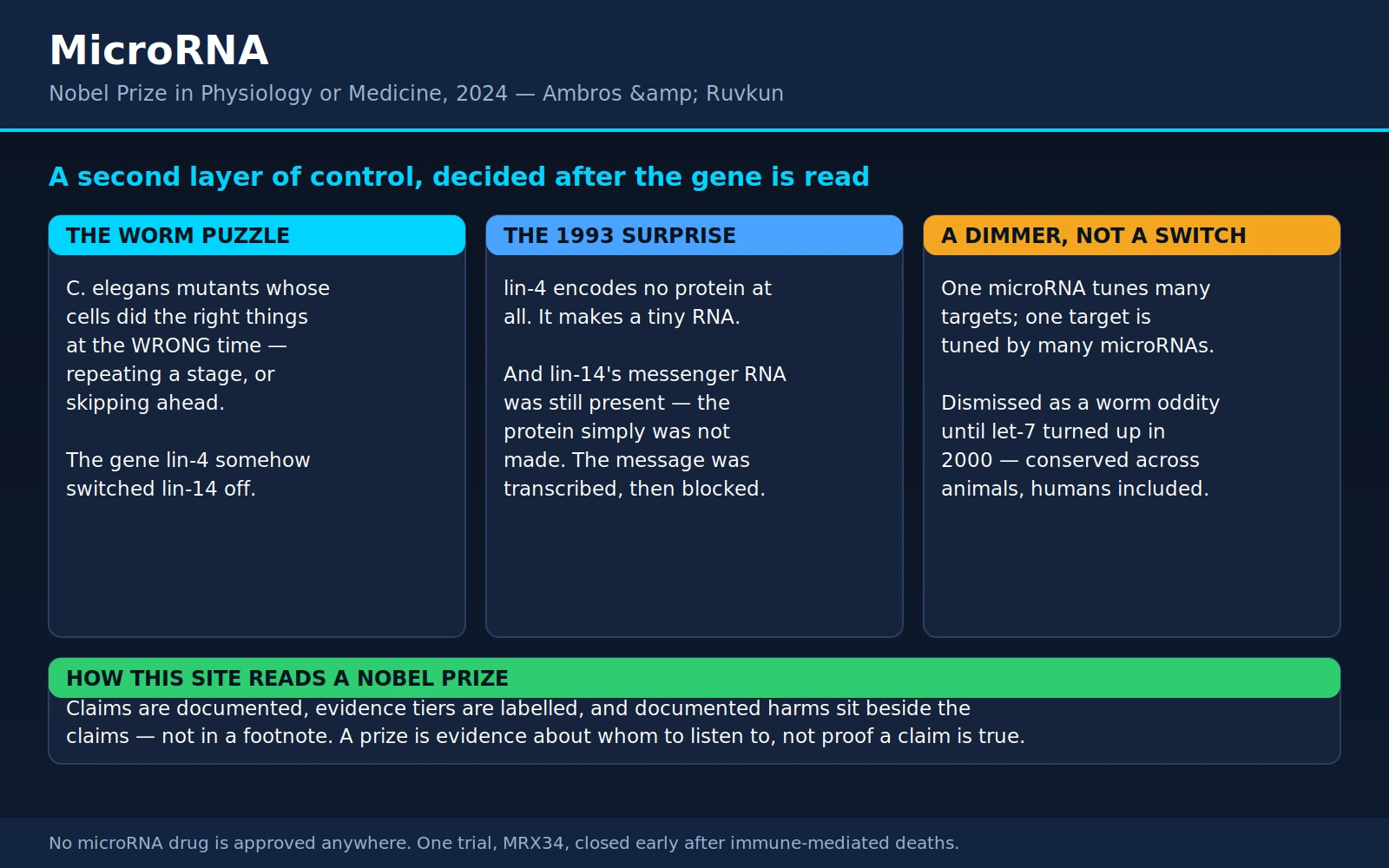
Table of Contents
- The Prize and the Two Scientists
- The Worm
- The Puzzle: lin-4 and lin-14
- 1993: The Surprise
- Seven Years as a Worm Curiosity
- What MicroRNAs Do in You
- Medicine: Diagnostics First
- Medicine: Therapeutics, With the Failures Included
- What This Does Not License
- Why the Prize Took Thirty Years
- Where Mainstream Science Agrees — and What Remains Debated
- Key Research Papers
- Connections
- Featured Videos
1. The Prize and the Two Scientists
In October 2024, the Nobel Assembly at the Karolinska Institutet awarded the Nobel Prize in Physiology or Medicine jointly to Victor Ambros and Gary Ruvkun "for the discovery of microRNA and its role in post-transcriptional gene regulation." The work being honoured had been published in 1993 — thirty-one years earlier — in two papers that appeared back to back in the same issue of the journal Cell, and that most of biology ignored for the better part of a decade.
What they found, in the plainest terms available: genes are not simply switched on or off at the moment they are copied. A gene can be transcribed into messenger RNA perfectly normally, and a second layer of control can then decide whether that message is actually read and turned into protein. The agents of that second layer are tiny RNA molecules about twenty-two building blocks long — roughly a hundredth the length of a typical messenger RNA — which stick to their targets by simple base-pairing and quietly turn the volume down. They are now called microRNAs, and the human genome encodes a great many of them.
The two men came to the problem from the same room. Both were postdoctoral fellows in the laboratory of H. Robert Horvitz at the Massachusetts Institute of Technology in the 1980s — Horvitz himself would share the 2002 Nobel Prize in Physiology or Medicine with Sydney Brenner and John Sulston for work on the genetic control of organ development and programmed cell death, so the microRNA discovery is in a real sense a second harvest from the same laboratory and the same small animal. Ambros, born in 1953 in New Hampshire, had done his doctoral work at MIT with David Baltimore on the RNA of poliovirus. Ruvkun, born in 1952 in California, had done his at Harvard with Frederick Ausubel on nitrogen-fixation genes in bacteria. Neither of them set out to discover a new layer of gene regulation. They set out to explain why certain mutant worms did the right things at the wrong time.
After leaving Horvitz's lab they ran separate laboratories — Ambros at Harvard, then Dartmouth, and from 2008 at the University of Massachusetts Medical School in Worcester; Ruvkun at Massachusetts General Hospital and Harvard Medical School, where he has remained. They were working on the two halves of one puzzle: Ambros on the gene that did the silencing, Ruvkun on the gene that got silenced. And here the story does something unusual enough that it is worth pausing on.
They did not race each other. They talked. Through 1992 and 1993 the two laboratories compared their unpublished sequence data directly — and it was in laying one sequence against the other that the answer appeared, because the tiny RNA that Ambros had found was a near-perfect complementary match to a stretch of the message that Ruvkun had found. Neither result made complete sense alone. Together they made a mechanism. The two papers were submitted and published side by side, and each cites the other. In a research culture that rewards being first by a fortnight, it is worth saying out loud that this discovery was made by two competitors who chose to show each other their data before publication, and that the Nobel Committee honoured both of them for it.
2. The Worm
Everything in this story happened first in a roundworm called Caenorhabditis elegans, and it is worth understanding why anyone would spend a career on it.
C. elegans is about one millimetre long — the length of the comma in this sentence. It lives in rotting plant matter, eats bacteria, and can be grown by the thousand on an agar plate seeded with E. coli. It goes from fertilised egg to egg-laying adult in about three days. Most individuals are self-fertilising hermaphrodites, which means a single worm founds a genetically uniform population, which in turn means a geneticist can find a recessive mutation without an elaborate breeding scheme. And it is transparent: put one under a good microscope and you can watch individual cells divide, migrate and die inside a living animal, without cutting it open or staining anything.
Three further facts made it extraordinary. First, the adult hermaphrodite has a fixed and known number of body cells — 959 of them, the same 959 in every normal animal. Second, the complete cell lineage is mapped: John Sulston and his colleagues traced, by direct observation, every single division from the fertilised egg to the adult, so that for any cell in the worm you can name its parent, its grandparent, and the exact moment it appeared. Third, in 1998 C. elegans became the first multicellular animal to have its genome fully sequenced.
Put those together and you get a research animal in which the phrase "this cell did the wrong thing" is a precise, checkable statement rather than an impression. If a mutant worm's cell divides at the wrong stage, you know, because you know what that cell does in a normal animal at that stage. That precision is exactly what the microRNA discovery required.
The obvious objection is the right one to raise: why would anything found in a millimetre-long worm tell us about people? The answer is that the deep machinery of animal cells is old. The last common ancestor of worms and humans lived something on the order of six hundred million years ago, and the basic apparatus — how DNA is copied, how proteins are built, how a cell decides to divide or die — was largely in place before that split. So a rule discovered in the worm is not automatically universal, but it is a good bet, and it is testable. Programmed cell death was found in C. elegans and turned out to be central to human cancer biology. RNA interference was found in C. elegans and turned out to be a general property of animal cells. MicroRNA followed the same path — though, as the next sections describe, nobody believed it for seven years.
3. The Puzzle: lin-4 and lin-14
A worm larva passes through four stages, called L1 through L4, before becoming an adult. At each stage particular cells in the skin divide in a particular pattern — some produce more skin, some produce the specialised cells of the vulva, and at the final moult the whole programme stops and the animal makes adult cuticle instead. It is a developmental timetable, and it is the same timetable in every worm.
In the Horvitz laboratory, mutants had been isolated in which the cells did the right things at the wrong time. These were named heterochronic mutants, from the Greek for "different time." They came in two flavours, and the contrast between them is the whole puzzle:
- Reiteration. Worms carrying a loss-of-function mutation in a gene called lin-4 got stuck. Their skin cells performed the L1-stage division pattern, then performed it again, and again, at each successive moult. The animal aged in every other respect; these cells did not. They never moved on to the later programmes, and the worms never made a proper vulva or adult cuticle.
- Skipping ahead. Worms carrying a loss-of-function mutation in a different gene, lin-14, did the opposite. They skipped the L1 programme entirely and ran the later, adult-stage patterns precociously — laying down adult cuticle a stage too early, in an animal that was not yet an adult.
Nothing was wrong with the cells themselves. Each one executed a perfectly normal developmental routine. What was broken was the clock that told them which routine belonged to which stage.
Genetics could go one step further and say how the two genes related. Animals lacking both lin-4 and lin-14 looked like animals lacking lin-14 alone — they skipped ahead. In genetic terms, lin-14 is downstream, and lin-4 acts by shutting lin-14 off. Normally, LIN-14 protein is abundant in the young larva, instructing cells to run the early programme; as development proceeds, LIN-14 falls away, and the later programmes are allowed to begin. Without lin-4, LIN-14 never falls, and the animal is trapped at the beginning. Without lin-14, the animal begins as though it were already past that point.
Ruvkun's laboratory added the crucial constraint in 1991. Working out which parts of the lin-14 gene were needed for it to be switched off on schedule, they found that the essential sequences were not in the part of the gene that specifies the protein, and not in the promoter region that controls whether the gene is copied at all. They were in the 3′ untranslated region — the tail end of the messenger RNA, downstream of the protein-coding instructions, a stretch that gets copied into the message but never translated. Delete those tail sequences and LIN-14 protein stayed high forever, as though lin-4 were missing.
That was a strange place for a control switch to live. The 3′ untranslated region is, by definition, the part of the message that does not encode anything. Something was reaching into the tail of a messenger RNA and using it as a target.
4. 1993: The Surprise
Two findings landed in December 1993, and neither one is remarkable on its own. Together they were a new principle.
Ambros: lin-4 does not encode a protein. Richard Lee, Rhonda Feinbaum and Victor Ambros narrowed the lin-4 gene down to a very small piece of DNA and then found something that should not have been there — or rather, found the absence of something. There was no open reading frame, no start codon leading to a sensible stretch of amino acids, nothing that could be translated into a protein. What the gene produced instead were two very small RNA molecules: one about 22 nucleotides long, and a longer one of about 61 nucleotides that folds back on itself into a hairpin and is the precursor of the short one. For a field in which "gene" had for decades meant "recipe for a protein," a gene whose entire product was a 22-letter RNA was close to a category error.
Then they did the comparison that mattered. They took the sequence of the small lin-4 RNA and lined it up against the sequence of the lin-14 3′ untranslated region — the region Ruvkun's lab had shown was required for silencing. It matched. Not once but at seven separate sites, and it matched in antisense: the small RNA's sequence was the complement of the target's, the way one strand of DNA is the complement of the other. A small RNA that can base-pair to seven places along the tail of a specific message is not a coincidence. It is a mechanism.
Ruvkun: the lin-14 gene is still being read. Bruce Wightman, Ilho Ha and Gary Ruvkun asked what was actually happening to lin-14 when lin-4 switched it off, and found that the messenger RNA was still there. Levels of lin-14 mRNA barely changed. What collapsed was the LIN-14 protein. The gene was being transcribed; the message was present in the cell; the protein was not being made from it. The regulation was post-transcriptional — downstream of the step everyone had assumed was where genes get controlled.
Put the two halves together and the picture is this:
- The cell transcribes the lin-14 gene into messenger RNA, exactly as normal. Nothing has been silenced at the DNA level.
- The lin-4 gene produces a tiny RNA whose sequence is complementary to several spots in the tail of that message.
- The tiny RNA sticks to those spots by ordinary base-pairing — A to U, G to C — the same chemistry that holds the two strands of DNA together.
- With the tiny RNA bound to its tail, the message stops producing protein. The instruction is present but no longer being carried out.
The useful analogy is a kitchen. Classical gene regulation is about which recipes get copied out of the cookbook and handed to the cooks — that is transcription, and it is real and important. What Ambros and Ruvkun found is a second stage entirely: a recipe can be copied out and handed over, and a small piece of tape can then be stuck across the instructions so that the cooks skip it. The recipe was never removed from the counter. It simply stopped being followed. And because the tape is short and sticks by sequence matching, one small RNA can tape over many different recipes at once, and the same recipe can be taped by several different small RNAs.
That is the whole idea. Everything that follows in this page is a consequence of it.
5. Seven Years as a Worm Curiosity
This is the part of the story that gets left out of the celebratory version, and it is the part most worth telling.
The 1993 papers did not set the field alight. They were read, cited politely, and largely filed under interesting worm biology. The prevailing assessment — not unreasonable at the time — was that lin-4 was an eccentric solution that C. elegans had improvised for a scheduling problem peculiar to C. elegans. Nobody had found anything like it in flies, in mice, or in people. The sequence of lin-4 itself appeared to have no counterpart outside nematodes. Small RNAs were not, in 1993, something you could easily look for: standard methods for isolating and cloning RNA discarded molecules that short as junk before you ever saw them. If you are not looking, and your methods throw the evidence away, absence of evidence is very cheap.
For seven years, then, this was a footnote. Ambros has said as much himself; so has Ruvkun. It was a real discovery in a small pond.
What broke it open was let-7. In February 2000, Ruvkun's laboratory — Brenda Reinhart, Frank Slack, Amy Pasquinelli and colleagues — reported a second gene of the same kind in C. elegans. Like lin-4, let-7 produced a small RNA, in this case exactly 21 nucleotides. Like lin-4, it worked by pairing with the 3′ untranslated regions of target messages. And it controlled a different transition in the same developmental timetable — the switch from the final larval stage to adulthood. Two independent examples of the same mechanism, controlling two different steps, is no longer an eccentricity. It is a system.
The decisive result came nine months later, in November 2000. Pasquinelli, Reinhart, Ruvkun and a large collaboration went looking for let-7 outside the worm — and found it nearly everywhere they looked. The let-7 sequence, and the timing of its appearance during development, were conserved across the animal kingdom: in flies, in molluscs, in annelid worms, in sea squirts, in vertebrates including humans. A 21-letter RNA sequence does not survive six hundred million years of evolution unchanged by accident. It survives because it is doing something the animal cannot afford to lose.
That paper ended the argument. If let-7 is in humans, then whatever let-7 does is human biology, and the mechanism Ambros and Ruvkun had described in a worm was a mechanism operating in every reader of this page.
The floodgates opened in October 2001, when three laboratories published back to back in the same issue of Science: Mariana Lagos-Quintana and Thomas Tuschl's group in Germany, Nelson Lau and David Bartel's group at MIT, and Rosalind Lee with Victor Ambros. Between them they reported dozens of new small RNAs of the same class, from worms, flies and human cells, and they agreed on a name for the class. That is where the word microRNA enters the literature. Within a few years the count was in the hundreds; within a decade, the thousands.
6. What MicroRNAs Do in You
How many, and how much of the genome they touch
Two numbers get quoted a lot, and both need care.
How many human microRNAs are there? The reference catalogue for the field is miRBase, whose version 22 release listed 38,589 hairpin precursors and 48,860 mature microRNA sequences across 271 organisms. The human entries run to well over a thousand annotated microRNA genes. But that figure should be treated as an upper bound rather than a count. Sequencing a cell produces a great many short RNA fragments, and distinguishing a genuine microRNA gene from a degradation product that happens to look like one is a judgement call. Several groups doing stricter curation — demanding evidence of proper hairpin processing, conservation across species, and consistent detection — argue that a large fraction of database entries are false positives, and put the number of confidently established human microRNA genes at a few hundred. Both numbers are in the literature; the honest summary is hundreds certainly, a couple of thousand claimed, and the field has not fully settled it.
How much of the genome is under microRNA control? The most-cited estimate comes from a 2009 computational analysis by Robin Friedman and colleagues in David Bartel's laboratory, which concluded that more than 60% of human protein-coding genes have been under evolutionary pressure to maintain pairing with microRNAs. That is a strong result, but note precisely what it is: an inference from conservation patterns in genome sequence, not a direct measurement of what is regulated in any given cell. Estimates vary with method, and different approaches give different answers. What is not in dispute is the qualitative claim — microRNA regulation is pervasive rather than exceptional, and it touches a large share of the genes you carry.
A dimmer switch, not an on/off switch
This is the single most important thing for a non-specialist to understand, and it is the thing that popular coverage most often gets wrong.
A microRNA does not usually abolish its target. The pairing between a microRNA and an animal target message is partial — the critical stretch is a short "seed" region near one end of the microRNA, six or seven nucleotides long. Short, partial matches mean two things at once. First, the effect on any one target is typically modest: protein output drops by some fraction, not to zero. Second, and more consequentially, a short match is not very specific, so a single microRNA has many targets — often hundreds — and a single message carries binding sites for many different microRNAs.
So the architecture is a mesh, not a set of wires. One microRNA nudges hundreds of genes downward a little; each gene is being nudged by several microRNAs at once; the net effect is that the cell's protein output is continuously trimmed and balanced rather than switched. Biologists often describe microRNAs as fine-tuners or buffers — they make gene expression more robust and less noisy, and they sharpen the boundaries between one cell state and the next.
Two practical consequences follow from this, and both matter later on this page. Because the effects are individually small and collectively distributed, knocking out a single microRNA often produces a mild phenotype or none at all — which is a large part of why the field was slow to take them seriously. And because any drug aimed at a microRNA will move hundreds of genes at once, microRNA therapeutics are intrinsically hard to make specific, which is a large part of why the clinical record is what section 8 describes.
The biogenesis pathway, named plainly
You will meet the following names in almost any article about microRNA, so here they are with their jobs stated in ordinary language.
- The microRNA gene is transcribed in the nucleus into a long RNA (the primary microRNA, or pri-miRNA), which folds into one or more hairpins — stretches that double back and pair with themselves.
- Drosha is a molecular scissors in the nucleus that finds those hairpins and cuts each one out of the long transcript, releasing a hairpin about 70 nucleotides long (the precursor, or pre-miRNA). It works with a partner protein, DGCR8. Drosha was identified in 2003 by Yoontae Lee and V. Narry Kim's group.
- Exportin-5 is the carrier that moves the hairpin out of the nucleus into the body of the cell.
- Dicer is a second molecular scissors, in the cytoplasm, which trims the loop off the hairpin and leaves a short double-stranded RNA about 22 nucleotides long. Dicer was identified in 2001 by Emily Bernstein and Gregory Hannon's group, in work on the closely related RNA interference pathway.
- Argonaute is the protein that takes one strand of that duplex and holds it. Argonaute plus its loaded microRNA, together with associated proteins, is called RISC — the RNA-Induced Silencing Complex. The microRNA is the address label; Argonaute is the machinery that acts on whatever the label finds.
- The complex finds its targets by seed pairing to the 3′ untranslated regions of messenger RNAs, and represses them — both by interfering with translation and, in most cases, by triggering removal of the message's protective poly(A) tail, which sends it for degradation.
Two of those steps — Dicer and Argonaute — are shared with RNA interference, the gene-silencing response to double-stranded RNA discovered by Andrew Fire and Craig Mello, also in C. elegans, and recognised with the 2006 Nobel Prize. MicroRNAs are the cell's own, genome-encoded users of that machinery. This shared plumbing is why the distinction in section 8 between microRNA drugs and siRNA drugs is subtler than it looks, and why getting it right matters.
7. Medicine: Diagnostics First
In 2008 two independent groups — Xi Chen and colleagues in Nanjing, and Patrick Mitchell with colleagues in Seattle — reported the same unexpected observation: microRNAs circulate in blood, and they are remarkably stable there. That was not obvious. Blood plasma is full of ribonucleases, enzymes that chew up loose RNA within minutes. Circulating microRNAs survive because they are not loose: they travel bound to proteins such as Argonaute, packaged in lipoprotein particles, or enclosed in small membrane vesicles. Both groups showed the molecules survived boiling, repeated freeze-thaw cycles, and extremes of pH that would destroy ordinary RNA.
The clinical appeal is immediate. A blood draw is cheap, safe and repeatable, where a tissue biopsy is none of those things. MicroRNA expression patterns are strongly tissue-specific — liver, muscle, heart and brain each have characteristic microRNAs — so a circulating profile is, in principle, a readable signature of which tissue is stressed, injured, or growing where it should not be. And because the molecules are stable, samples do not have to be handled with heroic care to be usable. Thousands of papers followed, reporting microRNA signatures for essentially every cancer, for heart disease, for liver injury, for neurological conditions, for pregnancy complications.
So why, more than fifteen years later, does your doctor almost never order one?
Because the measurement problems turned out to be genuinely hard, not merely tedious. Kenneth Witwer's 2015 review in Clinical Chemistry laid them out, and they remain the honest state of play:
- Normalisation. To say a microRNA is "elevated," you must divide by something stable. In a tissue sample there are standard reference genes for this. In plasma there is no agreed reference — no microRNA that reliably holds constant across people and conditions. Different studies normalise differently, and the choice of denominator can change the direction of the reported result.
- Pre-analytical variability. How long the tube sat before spinning, how hard it was spun, whether the anticoagulant was heparin or EDTA or citrate, whether the sample was fasting, how many freeze-thaw cycles it saw — each of these shifts measured microRNA levels, sometimes by more than the disease being studied does.
- Haemolysis. This one is decisive and it is why many early results evaporated. Red blood cells are loaded with certain microRNAs. If even a small fraction of them rupture during collection — a slightly traumatic venepuncture will do it — those microRNAs flood the plasma. Some widely reported "cancer biomarkers" of the late 2000s turned out to track how roughly the blood had been drawn.
- Small studies and weak replication. Many published signatures come from dozens of patients, are not pre-registered, and have never been tested prospectively in an independent population. The ones that have been tested have frequently failed.
Where does that leave things? Being precise about tiers, because the difference matters to anyone deciding whether to pay for a test:
- Established. MicroRNA profiling of tissue has real clinical use in one specific setting: identifying the likely origin of a metastatic cancer when standard pathology cannot determine where it started. Commercial tissue-based tests exist for this and are used.
- Promising but not established. Blood-based microRNA panels for early cancer detection, for cardiac injury, and for liver disease. Some have performed well in individual studies. None has become a standard-of-care test with the kind of large, prospective, independently replicated validation that would justify acting on the result.
- Not supported. Direct-to-consumer "microRNA wellness panels" sold to tell you your biological age, your inflammation status, your cancer risk or your optimal supplement regimen. These are sold on the strength of the research literature described above — the exploratory literature, whose own authors describe it as exploratory. If you are considering one, the question to ask the vendor is not "is there research on microRNAs?" but "has this specific panel been validated prospectively against clinical outcomes in people like me, and where is that published?" You will usually not get an answer.
8. Medicine: Therapeutics, With the Failures Included
If a microRNA is doing damage, block it. If a protective microRNA is missing, replace it. Both ideas are sound in principle, both have reached human trials, and as of now no microRNA-targeted drug has been approved by any major regulator anywhere. The record is worth walking through honestly, because it includes a case in which patients died.
Miravirsen: the one that worked, and was overtaken
The liver makes enormous quantities of one microRNA, miR-122. Hepatitis C virus exploits it: the virus's genome carries binding sites for miR-122, and rather than being silenced by it, the virus needs it to replicate. That is an unusually clean drug target — sequester miR-122 and the virus should falter, while the host's own use of it is at least partly dispensable.
Miravirsen is a chemically modified oligonucleotide designed to grab mature miR-122 and hold it in a very stable complex. In a phase 2a trial published in the New England Journal of Medicine in 2013, Harry Janssen and colleagues gave miravirsen or placebo to 36 patients with chronic hepatitis C genotype 1 — five weekly injections over 29 days. Viral load fell in a dose-dependent way, by a mean maximum of about 3 log10 IU/mL at the highest dose against 0.4 in the placebo group, and the reduction persisted well after dosing stopped. In five patients the virus became undetectable during follow-up. There were no dose-limiting adverse events, and — a genuinely striking finding — no escape mutations appeared in the virus's miR-122 binding sites.
This was a real proof of principle: a drug aimed at a human microRNA changed a human disease. It also arrived at exactly the wrong moment. Within two years, direct-acting antiviral drugs for hepatitis C were curing well over 95% of patients in eight to twelve weeks of oral tablets, with few side effects. A drug that reduces viral load cannot compete with a drug that eliminates the virus. Miravirsen was not abandoned because it failed; it was abandoned because something better arrived. The hepatitis C story is told in full on our page for Alter, Houghton and Rice, whose 2020 Nobel recognised the discovery of the virus that made those cures possible.
Cobomarsen: into the clinic, and out again
Cobomarsen (also called MRG-106) is an inhibitor of miR-155, a microRNA strongly overexpressed in several blood cancers, including cutaneous T-cell lymphoma — a lymphoma that appears in the skin. Preclinical work published by Anita Seto and colleagues in 2018 showed that inhibiting miR-155 in lymphoma cells reduced their proliferation and survival by acting on several signalling pathways at once. The drug entered clinical trials in cutaneous T-cell lymphoma, and early reports described skin lesions improving. Development was subsequently discontinued by the sponsor, and cobomarsen never reached approval. It sits in the category that most drug candidates occupy: plausible mechanism, encouraging early signal, no finished product.
MRX34: the trial that killed people
This one must be stated plainly, because the promotional literature around RNA medicine tends to skip it.
miR-34a is a microRNA that acts downstream of the tumour-suppressor protein p53 and is lost or reduced in many cancers. The therapeutic logic was replacement: manufacture a synthetic copy of miR-34a, wrap it in a lipid nanoparticle so it survives the bloodstream and enters cells, and give the tumour back the brake it had lost. The drug was MRX34, developed by Mirna Therapeutics, and it entered a first-in-human phase 1 trial in patients with advanced solid tumours who had exhausted standard treatment.
Eighty-five patients were enrolled. There were signals of activity — three partial responses, sixteen patients with stable disease lasting four cycles or more, and evidence that the drug reached tumours and altered its intended target genes. There were also fever, chills and fatigue in most patients, severe enough in a subset to be a serious problem, and all patients required steroid premedication.
In September 2016 the trial was halted early. As the published report by David Hong and colleagues states, the study was closed because of serious immune-mediated adverse events that resulted in four patient deaths. The immune system reacted violently to the drug — a synthetic double-stranded RNA delivered in a lipid particle is, to the innate immune system, an excellent impression of a virus. Cytokine release, in patients already weakened by advanced cancer, proved fatal in four cases.
Those four deaths belong in any honest account of microRNA medicine. They are not evidence that the underlying science is wrong — the same report documents that the drug did what it was designed to do at the molecular level. They are evidence of something the field has had to absorb: a molecule that adjusts hundreds of genes across every tissue it reaches is very difficult to aim, and RNA delivered into the bloodstream in a lipid package can provoke exactly the response evolution built the immune system to mount against viruses. Enthusiasm for RNA as a drug class must be weighed against that record, not despite it.
Why siRNA drugs are approved: "RNA drug" is not one thing
Here is where careful reading pays off, because a reader who has heard that RNA drugs are approved and working may reasonably wonder why this page is so cautious.
Approved siRNA drugs exist. Patisiran, approved in 2018, treats hereditary transthyretin-mediated amyloidosis — a disease in which a misfolded liver protein accumulates in nerves and heart. In the APOLLO trial reported by David Adams and colleagues, it improved neuropathy measures against placebo. Inclisiran lowers LDL cholesterol by silencing PCSK9 in the liver; in the ORION-10 and ORION-11 trials reported by Kausik Ray and colleagues, twice-yearly injections cut LDL cholesterol by roughly 50%. Several other siRNA drugs have followed.
These work, and they use the Argonaute machinery microRNAs use. But they are not microRNA drugs, and the difference is precisely the difference that makes them tractable:
- A small interfering RNA is designed for near-perfect complementarity to one chosen message. Full pairing directs Argonaute to cut that message. The result is a clean, near-complete knockdown of a single gene — a scalpel.
- A microRNA pairs partially, through its short seed, with hundreds of messages, reducing each modestly — a rheostat wired to the whole panel.
Add to that a delivery advantage: patisiran and inclisiran both act on the liver, and the liver is the one organ that oligonucleotide chemistry reaches easily and selectively. Inclisiran in particular uses a sugar tag (GalNAc) recognised by a receptor found almost exclusively on liver cells, which is why it can be given as a small subcutaneous injection twice a year rather than an infusion.
So when marketing copy says "RNA therapy is here," the accurate reply is: siRNA therapy for single liver-expressed targets is here and it is genuinely good; mRNA vaccines are here and they work (see Karikó and Weissman); microRNA therapy is not here, has a partial success that was overtaken and a phase 1 trial with four deaths, and remains an open research problem. Three different technologies, three different states of maturity, one shared word.
9. What This Does Not License
A genuine Nobel-calibre discovery is exceptionally useful raw material for marketing. "MicroRNA" now appears on supplement labels, in exosome-clinic brochures, and in a large amount of online wellness writing. Some of it descends from a real scientific claim that deserves to be examined properly rather than waved away, so let us do that first.
The strongest version of the claim: plant microRNAs in your blood
In 2012, Lin Zhang, Chen-Yu Zhang and a large group at Nanjing University published a paper in Cell Research reporting something remarkable. They found plant microRNAs in the blood of humans and animals, and argued they had arrived there through food. One in particular, MIR168a — abundant in rice — was among the most enriched plant microRNAs in the serum of Chinese subjects. Going further, they reported that MIR168a could bind the messenger RNA for a human and mouse protein called LDLRAP1, that it reduced LDLRAP1 levels in liver, and that this in turn slowed the removal of LDL cholesterol from mouse plasma.
If that were right, it would be genuinely important: the food you eat would be regulating your genes directly, by sequence, and a diet would be a kind of prescription. This is the claim — usually stripped of its qualifiers — behind a great deal of "food talks to your genes" content, and behind supplements sold as sources of regulatory plant microRNAs.
What happened next
Multiple independent groups tried to reproduce it, and could not. This is not a case of one lab disagreeing, or of a finding that is merely unconfirmed. It is a case of repeated, methodologically careful failure to replicate, together with a persuasive explanation of where the original signal came from.
- Feeding studies found no meaningful uptake. In 2013, Bryan Dickinson and colleagues fed mice diets rich in plant microRNAs and looked for them in blood and tissue. They found no detectable oral bioavailability, and no effect on LDLRAP1. Fairness requires noting that this group's authors included scientists from an agricultural biotechnology company and an RNA therapeutics company — readers should know who funds a negative result. The original authors published a reply in the same issue defending their findings. That exchange alone would leave the question open.
- Independent quantitative work found the amounts far too small to matter. Kenneth Witwer and colleagues, using both real-time quantitative PCR and droplet digital PCR — a method that counts individual molecules — looked for plant microRNAs in mammalian blood and reported little evidence for general uptake of dietary microRNAs. Even where a plant sequence was detectable at all, the copy numbers were orders of magnitude below the level at which a microRNA is thought to regulate anything. A microRNA works by occupying binding sites; a handful of molecules distributed through a body cannot occupy a meaningful number of them.
- The signal was traced substantially to contamination. This is the finding that settled it for most of the field. In 2014, Juan Pablo Tosar and colleagues mined large public sequencing datasets and showed that apparent "foreign" microRNAs in animal samples track the contamination profile of sequencing itself — plant material and other environmental nucleic acids present in laboratory reagents, on surfaces, and in sample handling. Modern sequencing is sensitive enough to detect a few stray molecules, which means it is also sensitive enough to detect a few stray molecules that were never in the animal. The pattern of "detected" plant microRNAs looked like the pattern of what contaminates experiments, not the pattern of what people had eaten.
The honest tier, stated plainly: dietary cross-kingdom microRNA transfer is not established. The original observation was published in a real journal by real scientists and deserved the serious testing it received. It received that testing and did not survive it. There may yet be special cases — some researchers continue to work on this, and the question of whether particular foods or particular preparations behave differently is not formally closed — but there is no basis today for telling anyone that eating a plant delivers regulatory microRNAs into their cells. Any product sold on that premise is being sold on a claim the evidence does not support.
Note also what the original paper claimed even at its strongest: that a rice microRNA raised LDL cholesterol by interfering with its clearance. That is a harm claim, not a benefit claim. Marketing that cites this literature as a reason to buy plant-microRNA supplements has inverted the direction of its own source.
Exosome and "microRNA therapy" clinics
A second and more consequential problem. Clinics — often the same clinics that sell unapproved stem-cell treatments — now market exosome therapy, typically an injection or infusion of vesicles derived from cultured stem cells, advertised as delivering regulatory microRNAs to repair joints, reverse hair loss, treat neurological disease, or slow ageing. The scientific hook is real: cells do release vesicles containing microRNAs, and vesicle-mediated signalling is an active research field.
What is being sold is not that research. Three points:
- These products are unapproved. There is no regulatory approval anywhere for an exosome product as a treatment for any disease. Regulators including the FDA have issued public warnings about clinics marketing them, and have reported serious infections traced to contaminated preparations. An unapproved biological injected in a commercial clinic has neither a demonstrated benefit nor a characterised risk profile.
- The dose arithmetic is unfavourable. Researchers examining vesicle preparations have repeatedly found that the number of microRNA molecules per vesicle is very low — frequently averaging well below one copy per vesicle. For a microRNA to regulate a gene, enough copies must reach the same cell to occupy its binding sites. It is difficult to reconcile the measured stoichiometry with the claimed effects.
- The cost falls on patients with the least room to absorb it. These treatments run to thousands of dollars, are not covered by insurance, and are marketed hardest to people with conditions conventional medicine handles badly — which is precisely the population least able to afford a bet that does not pay.
Our page on Shinya Yamanaka covers the unregulated-clinic problem in detail, including how the gap between a Nobel-winning discovery and a marketed product gets filled by people who did neither.
None of this is a reason to be cynical about microRNA science. It is a reason to hold a firm line between this mechanism is real and important and therefore this product works. The first statement is true. The second does not follow from it, and no amount of accurate biology in a brochure's opening paragraph makes the closing paragraph's claim true.
10. Why the Prize Took Thirty Years
From publication in December 1993 to the Nobel announcement in October 2024 is thirty-one years. That gap is not an oversight, and the shape of it recurs so often on this site that it is worth naming.
The 1993 finding was correct, complete, and unpersuasive. It was unpersuasive for a defensible reason: it described one gene, in one animal, solving one animal's scheduling problem, using a molecule nobody had seen elsewhere and that the standard methods of the day would have discarded unexamined. A careful scientist in 1994 who filed it under "interesting worm biology" was making a reasonable call on the evidence available. What changed the verdict was not a better argument — it was conservation. The moment let-7 was shown to exist in humans, flies and molluscs with the same sequence and the same timing, the finding stopped being about worms.
That pattern — a real discovery in an odd system, ignored until someone shows it is general — runs right through the Nobel wing of this site:
- Barbara McClintock described transposable elements in maize in the 1940s and was met with silence for decades; her prize came in 1983, when molecular biology found the same jumping genes in bacteria and in people. Her work is also the direct ancestor of this one in subject matter: she was describing genome regulation that the textbook model had no room for.
- Yoshinori Ohsumi worked out autophagy by watching starving yeast cells under a microscope, in a subject so unfashionable he had it largely to himself; the genes he named turned out to have human counterparts implicated in cancer and neurodegeneration.
- Stanley Prusiner proposed that a protein alone could be infectious, on evidence from scrapie in sheep, and was treated as a crank for a decade before the prion concept became the explanation for a family of human diseases.
The common ingredient is not that the establishment was foolish. It is that generality is a separate discovery from the original observation, and it usually has to be demonstrated before anyone will act on the first one. A finding in maize, or yeast, or a millimetre-long worm is provisionally a fact about maize, yeast, or worms. The interval between the discovery and the prize is the interval in which somebody does the work of showing it is a fact about life.
It is a good argument for funding curiosity-driven research in obscure organisms, and a good argument for patience with results that do not yet fit. It is not an argument that every ignored idea is a suppressed truth — the great majority of ideas that fail to persuade the scientific community fail because they are wrong. The difference between McClintock and a crank is not that she was ignored. It is that when the tools arrived, her claim was confirmed. That is the test, and it is the same test this page applies to the exosome clinics in section 9.
11. Where Mainstream Science Agrees — and What Remains Debated
Settled
- MicroRNAs exist and are pervasive. They are genuine genes with genuine RNA products, present in essentially all animals and plants, and in humans they number in the hundreds at minimum.
- The mechanism is post-transcriptional. A microRNA acts after a gene has been transcribed, by base-pairing to the message — usually in the 3′ untranslated region — and reducing the amount of protein made from it. This was the core 1993 finding and it has never been overturned.
- The biogenesis pathway is worked out. Transcription, Drosha, export, Dicer, loading into Argonaute and RISC — each step has been demonstrated biochemically and genetically.
- let-7 and many other microRNAs are deeply conserved. The same sequences, doing comparable jobs, across animals separated by hundreds of millions of years.
- MicroRNAs matter in development and disease. Dysregulation is well documented in cancers, cardiovascular disease and neurological conditions. That microRNAs are involved is not in dispute.
- Dietary plant microRNAs do not meaningfully regulate human genes. As section 9 sets out, this has been tested and has not held up.
Genuinely open
- How many human microRNA genes are real. The gap between the permissive catalogue count and the strictly curated count is large, and the field has not converged.
- Which specific target predictions are true. Computational tools predict enormous numbers of microRNA-target pairs. Only a small minority have been experimentally validated, and the false-positive rate of prediction is high. A claim that "miR-X regulates gene Y" is often a prediction dressed as a finding.
- Translational repression versus message destruction. Both happen. How the balance is struck — and whether repression of translation is mostly a transient prelude to degrading the message — is still argued, with the weight of recent evidence favouring destabilisation as the dominant steady-state effect.
- Whether circulating microRNAs are signals or debris. Whether microRNAs released into blood are doing deliberate cell-to-cell communication, or are mostly the residue of dying and turning-over cells, is unresolved. The stoichiometry argument in section 9 cuts against the strong signalling interpretation without disproving it.
- Whether microRNA therapeutics can be made safe and specific. The delivery problem and the many-targets problem are both real. Chemistry has improved considerably since MRX34; whether that is enough is an empirical question nobody can yet answer.
- Whether microRNA biomarkers will reach the clinic at scale. The biology may be sound while the assay remains unfit for clinical decisions. Standardisation efforts continue.
Not supported
- That eating particular foods delivers regulatory microRNAs into your cells.
- That commercially sold exosome or "microRNA therapy" injections have demonstrated benefit for any condition.
- That a direct-to-consumer blood microRNA panel can tell you your biological age, your disease risk, or which supplements to take.
12. Key Research Papers
- Wightman B, Bürglin TR, Gatto J, Arasu P, Ruvkun G. Negative regulatory sequences in the lin-14 3′ untranslated region are necessary to generate a temporal switch during Caenorhabditis elegans development. Genes Dev 1991;5(10):1813-24
- Lee RC, Feinbaum RL, Ambros V. The C. elegans heterochronic gene lin-4 encodes small RNAs with antisense complementarity to lin-14. Cell 1993;75(5):843-54
- Wightman B, Ha I, Ruvkun G. Posttranscriptional regulation of the heterochronic gene lin-14 by lin-4 mediates temporal pattern formation in C. elegans. Cell 1993;75(5):855-62
- Reinhart BJ, Slack FJ, Basson M, et al. The 21-nucleotide let-7 RNA regulates developmental timing in Caenorhabditis elegans. Nature 2000;403(6772):901-6
- Pasquinelli AE, Reinhart BJ, Slack F, et al. Conservation of the sequence and temporal expression of let-7 heterochronic regulatory RNA. Nature 2000;408(6808):86-9
- Lagos-Quintana M, Rauhut R, Lendeckel W, Tuschl T. Identification of novel genes coding for small expressed RNAs. Science 2001;294(5543):853-8
- Lee RC, Ambros V. An extensive class of small RNAs in Caenorhabditis elegans. Science 2001;294(5543):862-4
- Lee Y, Ahn C, Han J, et al. The nuclear RNase III Drosha initiates microRNA processing. Nature 2003;425(6956):415-9
- Friedman RC, Farh KK, Burge CB, Bartel DP. Most mammalian mRNAs are conserved targets of microRNAs. Genome Res 2009;19(1):92-105
- Bartel DP. Metazoan MicroRNAs. Cell 2018;173(1):20-51
- Witwer KW. Circulating microRNA biomarker studies: pitfalls and potential solutions. Clin Chem 2015;61(1):56-63
- Janssen HL, Reesink HW, Lawitz EJ, et al. Treatment of HCV infection by targeting microRNA. N Engl J Med 2013;368(18):1685-94
- Hong DS, Kang YK, Borad M, et al. Phase 1 study of MRX34, a liposomal miR-34a mimic, in patients with advanced solid tumours. Br J Cancer 2020;122(11):1630-1637
- Zhang L, Hou D, Chen X, et al. Exogenous plant MIR168a specifically targets mammalian LDLRAP1: evidence of cross-kingdom regulation by microRNA. Cell Res 2012;22(1):107-26
- Dickinson B, Zhang Y, Petrick JS, Heck G, Ivashuta S, Marshall WS. Lack of detectable oral bioavailability of plant microRNAs after feeding in mice. Nat Biotechnol 2013;31(11):965-7
- Tosar JP, Rovira C, Naya H, Cayota A. Mining of public sequencing databases supports a non-dietary origin for putative foreign miRNAs: underestimated effects of contamination in NGS. RNA 2014;20(6):754-7
Live PubMed Searches
- MicroRNA discovery: lin-4 and let-7
- Circulating microRNA biomarkers
- MicroRNA therapeutics in clinical trials
- Dietary plant microRNA and cross-kingdom transfer
- Exosome therapy: unproven claims
Connections
- All Notable Doctors
- Nobel Prize in Physiology or Medicine — every laureate from 1901 to 2025, including the 2024 award to Ambros and Ruvkun
- Barbara McClintock — jumping genes in maize, and the direct ancestor of this story: genome regulation the textbook had no room for, ignored for thirty years
- Watson, Crick & Wilkins — the double helix, and the base-pairing chemistry that microRNAs use to find their targets
- Karikó & Weissman — the other RNA prize: messenger RNA as a medicine, and why "RNA drug" describes several different technologies at different stages of maturity
- Shinya Yamanaka — reprogrammed stem cells, and the unregulated-clinic problem that exosome and "microRNA therapy" marketing now belongs to
- Yoshinori Ohsumi — autophagy found in yeast: another obscure model organism that turned out to be describing human biology
- Stanley Prusiner — prions, and a decade of being disbelieved before the evidence arrived
- Alter, Houghton & Rice — hepatitis C, the direct-acting antivirals that made miravirsen commercially moot, and the cure that followed
- Blackburn, Greider & Szostak — telomeres and telomerase, and a parallel lesson in how quickly real biology becomes anti-ageing marketing
- Svante Pääbo — ancient DNA, and how contamination is detected and controlled in ultra-sensitive sequencing
- Nobel Prizes That Aged Badly — the counterweight: prizes are awarded by people, and people are sometimes wrong
- Genetics — inherited disease, gene regulation, and how genetic information actually gets used
- Oncology — cancer, where microRNA dysregulation is best documented and where microRNA therapeutics have been tried hardest
- Lymphoma — including cutaneous T-cell lymphoma, the target disease for the anti-miR-155 drug cobomarsen