 — March 3, 2026
· A Shot vs. Daily Doses for Kids With Multiple Food Allergies
— March 3, 2026
· A Shot vs. Daily Doses for Kids With Multiple Food Allergies
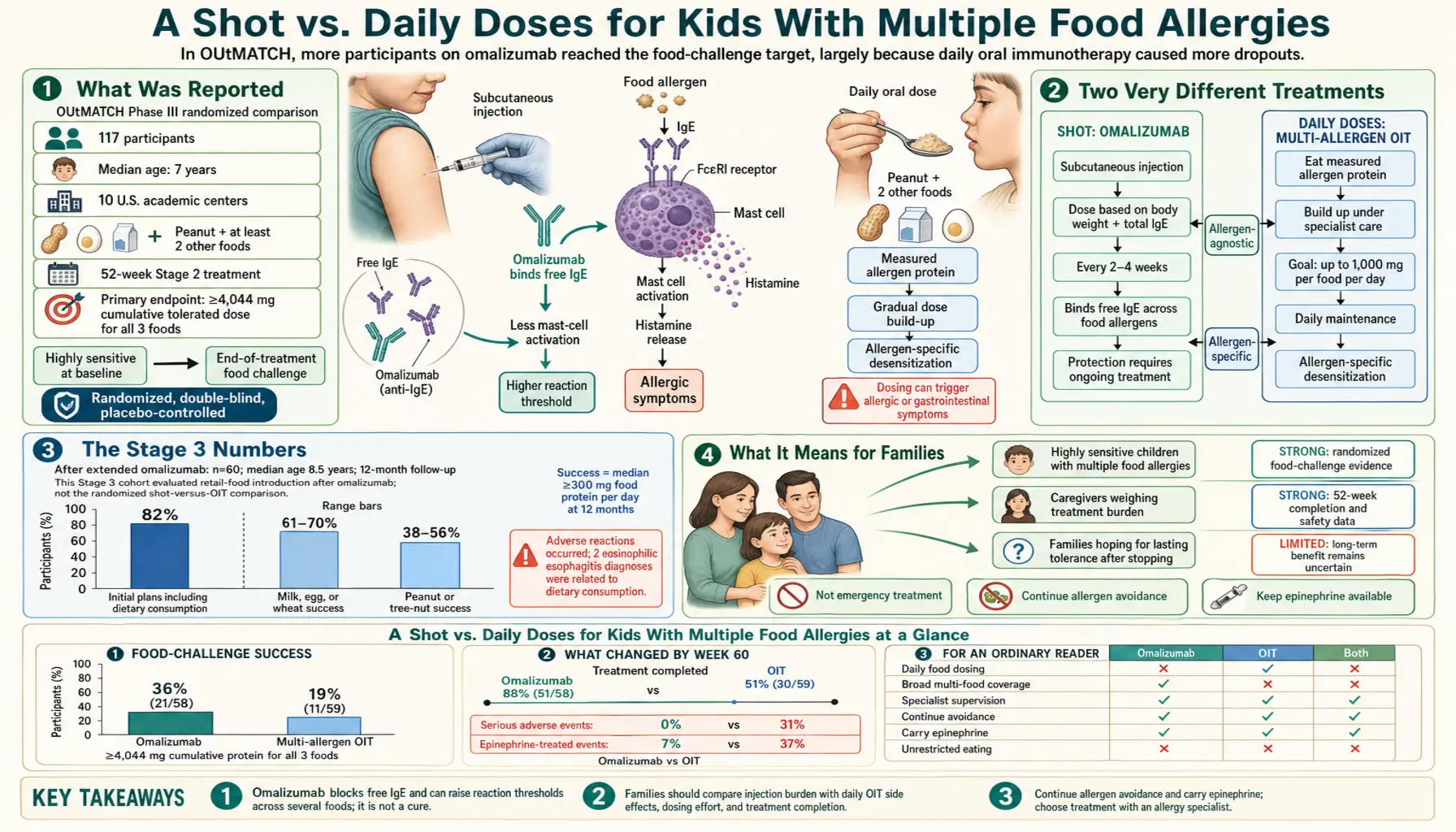
At the American Academy of Allergy, Asthma & Immunology (AAAAI) 2026 Annual Meeting in Philadelphia (February 27 – March 2), investigators in OUtMATCH, a National Institutes of Health–funded trial in people allergic to several foods at once, reported results from its third and final stage. After about a year of treatment, participants who had received a periodic antibody injection (omalizumab) alone went on to eat their trigger foods as part of everyday meals about as often as those who had received omalizumab-facilitated daily oral immunotherapy, a far more demanding routine. This report covers what was shown, the numbers, and the limits of the data.
Table of Contents
- 1. What Was Reported
- 2. Two Very Different Treatments
- 3. The Stage 3 Numbers
- 4. How the Two Routes Differ
- 5. Limits of the Evidence
- 6. What the Findings Show
- Key Research Papers
- PubMed Topic Searches
- Connections
- Featured Videos
1. What Was Reported
The study is called OUtMATCH (Omalizumab as Monotherapy and as Adjunct Therapy to Multi-Allergen OIT in Food Allergic Participants), a three-stage phase 3 trial funded by the National Institute of Allergy and Infectious Diseases (NIAID), with additional support from the drug's two industry co-developers, and carried out by the NIAID-funded Consortium for Food Allergy Research (CoFAR) at ten U.S. sites. It enrolled people aged 1 to 55 who were allergic to peanut and at least two other common foods — milk, egg, wheat, cashew, hazelnut, or walnut. In practice it is overwhelmingly a pediatric trial: 177 of the 180 participants randomized in Stage 1 were children and adolescents. The Stage 3 abstract's lead author is Sharon Chinthrajah, MD of Stanford University's Sean N. Parker Center for Allergy and Asthma Research; its senior author, Robert Wood, MD of Johns Hopkins, is first author of the trial's Stage 1 and Stage 2 papers. Stage 3 asked whether, after both treatments stop, participants can eat their allergenic foods in the forms normally eaten — and keep eating them.
2. Two Very Different Treatments
Multiple food allergy has no cure. The standard of care is strict avoidance plus carrying epinephrine for accidental exposure and anaphylaxis. Two active strategies now compete to do better than avoidance alone:
Omalizumab is an anti-IgE monoclonal antibody given as an injection every two to four weeks. It mops up the IgE antibodies that drive allergic reactions, raising the amount of a food a person can be exposed to before reacting. On February 16, 2024 the FDA approved it as the first medication to reduce allergic reactions to more than one type of food after accidental exposure, in patients aged 1 year and older — an approval based on a planned interim analysis of OUtMATCH Stage 1. In the published Stage 1 results, 67% of the children and adolescents on omalizumab (79 of 118) could eat a single dose of at least 600 mg of peanut protein (about 2.5 peanuts, per NIH) without dose-limiting symptoms, versus 7% (4 of 59) on placebo. The FDA states that people taking omalizumab must continue to avoid the foods they are allergic to, and NIH notes that it is not approved for the emergency treatment of allergic reactions.
Oral immunotherapy (OIT) takes the opposite approach: the child eats tiny, slowly escalating daily doses of the allergen itself until the body is desensitized. Trials show it can desensitize, but the regimen is demanding — a daily dose that can itself trigger reactions, plus months of careful up-dosing. OUtMATCH Stage 2 compared the two routes head to head; Stage 3 followed participants as they moved on to eating the foods in everyday form.
Stage 2, the randomized, double-blind comparison, was later published in JAMA Pediatrics (2026). All 117 participants (median age 7) received 16 weeks of open-label omalizumab; from week 8 they added active or placebo multi-food OIT, escalated toward 1,000 mg per food, and from week 16 they received blinded omalizumab or placebo injections for 44 more weeks — so one group continued on omalizumab alone and the other on OIT after a short course of omalizumab. On the primary end point, tolerating a cumulative 4,044 mg or more of protein for all three foods, omalizumab was superior in the intention-to-treat analysis (36% vs 19%; odds ratio 2.6, P = .03), with no difference in the per-protocol analyses. 88% of the omalizumab group completed the stage, against 51% of the OIT group, and the OIT group had more serious adverse events (31% vs 0%), more events leading to discontinuation (22% vs 0%) and more events treated with epinephrine (37% vs 7%). The authors conclude that the difference in success was largely driven by the high rate of discontinuation in the OIT group, mostly related to adverse events.
3. The Stage 3 Numbers
According to the AAAAI's summary of the abstract, 80 of 81 participants who had completed about a year of treatment — either omalizumab on its own or omalizumab-facilitated multi-food OIT — qualified for a dietary consumption plan to integrate one to three of their allergenic foods into a normal diet. Success was defined as eating a median of 300 mg a day of the allergenic food, judged from daily diaries at three and six months and from study-team evaluations over 12 months.
The core finding: at 6 months, more than 60% of participants in both groups were successfully eating the foods, and the two approaches were statistically similar. By daily diary, across all foods, success at 3 and 6 months was 77% and 65% after multi-food OIT versus 66% and 63% after omalizumab, with no significant difference between the groups (P = 0.10 and P = 0.77). Individual foods showed comparable outcomes, and study-team evaluations found no group differences at 3, 6, 9 or 12 months. The lead author summarized that after about a year of either treatment, more than 60% of participants were successfully eating their allergenic foods regularly.
The researchers reported similar safety between the groups among the 52 participants (22 after OIT, 30 after omalizumab) who stayed on dietary plans for all three foods for 12 months: the share with any adverse event was similar, two serious adverse events occurred during the open-feeding transition from OIT to dietary consumption, and one case of eosinophilic esophagitis developed during dietary consumption after omalizumab. The Pharmacy Times meeting report adds that in the omalizumab group 2 participants (7%) needed epinephrine and 3 (10%) met anaphylaxis criteria potentially related to eating the allergen. In short: among those who completed treatment, two very different treatment burdens ended in similar dietary outcomes.
4. How the Two Routes Differ
With dietary outcomes similar in Stage 3, the two routes differ mainly in what the treatment itself involves. Omalizumab involves no daily allergen dosing and no up-dosing schedule — an injection every two to four weeks — and the Pharmacy Times meeting report described it as a viable, possibly less-intensive alternative for long-term desensitization; its drawbacks are ongoing injections, a high drug price, and insurance hurdles. OIT uses the allergenic food itself and works directly on the specific foods, but it requires a daily dose of the very allergen, with the reaction risk and time that implies — and in Stage 2 about half of the OIT group did not complete treatment. Both depend on continued exposure to keep working — desensitization, not a permanent cure.
5. Limits of the Evidence
The Stage 3 results have several limits:
- Stage 3 is conference data, not yet a full peer-reviewed paper. The Stage 1 results are published in the New England Journal of Medicine and the Stage 2 results in JAMA Pediatrics; the Stage 3 figures above come from an AAAAI meeting abstract (published in a Journal of Allergy and Clinical Immunology supplement) and the AAAAI's summary of it, and may shift when a complete manuscript is peer-reviewed.
- The Stage 3 sample is small (80 participants) and includes only people who completed treatment. In Stage 2, 88% of the omalizumab group but 51% of the OIT group completed, with OIT discontinuation mostly related to adverse events, so Stage 3 compares those who finished each route, not everyone who started it.
- Neither treatment is a cure. Protection depends on ongoing exposure: the authors of an earlier peanut OIT trial (POISED, 2019) concluded that stopping OIT, or even reducing the daily dose to 300 mg, could increase the likelihood of reactivity returning, and an earlier Stage 3 report on the first 60 Stage 1 participants (2025) found that eating of the foods generally declined over time and many participants returned to avoidance. Standard care still includes an epinephrine auto-injector and an anaphylaxis plan.
- Adverse events occurred in both groups. "Comparable safety" here means similar rates, not event-free; the earlier Stage 3 report recorded episodes of anaphylaxis, epinephrine use and 2 diagnoses of eosinophilic esophagitis related to eating the foods.
- Cost and access remain open questions. Omalizumab is expensive and requires long-term injections; the multi-year cost and insurance picture is unsettled.
- This is specialist territory. In OUtMATCH, both treatments were given at academic allergy centers under study-team supervision, and avoidance plus epinephrine remains the baseline standard of care.
6. What the Findings Show
For people with several food allergies at once, OUtMATCH now gives trial data on two routes beyond strict avoidance. Stage 3 found that, among participants who completed about a year of treatment, dietary-consumption success was statistically similar after omalizumab alone and after omalizumab-facilitated daily OIT, with more than 60% eating their allergenic foods regularly and no group differences in study-team evaluations through 12 months. Stage 2 found that more participants on omalizumab reached the food-challenge target in the intention-to-treat analysis, largely because more participants in the OIT group dropped out, mostly because of adverse events. Neither route is a cure and neither is free of risk; decisions about either treatment belong with a pediatric allergist.
Key Research Papers
- Wood RA, Togias A, Sicherer SH, et al. Omalizumab for the Treatment of Multiple Food Allergies (OUtMATCH Stage 1). New England Journal of Medicine. 2024;390(10):889–899. · PMID 38407394. — doi:10.1056/NEJMoa2312382 · PubMed PMID: 38407394
- Chinthrajah RS, Lanser B, Scurlock A, Dantzer J, Sindher S, Leung D, et al. (2026). Evaluation of dietary consumption feasibility following treatment with multi-food oral immunotherapy or omalizumab in OUtMATCH (OUtMATCH Stage 3). Journal of Allergy and Clinical Immunology 157(2):AB419 (meeting abstract, AAAAI 2026 Annual Meeting, Philadelphia, February 27 – March 2, 2026). Trial registration: ClinicalTrials.gov NCT03881696 — DOI: 10.1016/j.jaci.2025.12.928
- Wood RA, et al. Protocol design and synopsis: Omalizumab as Monotherapy and as Adjunct Therapy to Multiallergen OIT in Children and Adults with Food Allergy (OUtMATCH). J Allergy Clin Immunol Glob. 2022;1(4):225–232. PMID 37779534. — PubMed PMID: 37779534
- NIAID/NIH News Release. Antibody reduces allergic reactions to multiple foods in NIH clinical trial. February 25, 2024. nih.gov news release
- U.S. Food and Drug Administration. FDA Approves First Medication to Help Reduce Allergic Reactions to Multiple Foods After Accidental Exposure. February 16, 2024. fda.gov press announcement
- Recapping AAAAI 2026: updates on food allergy, atopic disease, and asthma. Pharmacy Times. March 2026. pharmacytimes.com
- Wood RA, Togias A, Burk CM, Sindher S, Dantzer JA, Sicherer S, et al. (2026). Treatment of Multifood Allergy With Omalizumab or Multiallergen Oral Immunotherapy: A Randomized Clinical Trial (OUtMATCH Stage 2). JAMA Pediatrics 180(10):1067-1075. — PubMed PMID: 42507431
- Dantzer J, Virkud Y, Wang J, Sicherer S, Groetch M, Shreffler W, et al. (2025). Introduction of allergenic foods after treatment with omalizumab. Journal of Allergy and Clinical Immunology 156(2):394-405. — PubMed PMID: 40447195
- Chinthrajah RS, Purington N, Andorf S, Long A, O'Laughlin KL, Lyu SC, et al. (2019). Sustained outcomes in oral immunotherapy for peanut allergy (POISED study): a large, randomised, double-blind, placebo-controlled, phase 2 study. Lancet 394(10207):1437-1449. — PubMed PMID: 31522849
- American Academy of Allergy, Asthma & Immunology. Omalizumab is as Effective as Multi-Food Oral Immunotherapy for Allergenic Food Tolerability. News release, February 10, 2026. aaaai.org news release
PubMed Topic Searches
- PubMed: OUtMATCH omalizumab food allergy
- PubMed: omalizumab multiple food allergy children
- PubMed: oral immunotherapy peanut allergy children
- PubMed: multi-allergen oral immunotherapy desensitization
- PubMed: anti-IgE food allergy treatment pediatric
- PubMed: food allergy desensitization dietary introduction