Maitake Mushroom — Benefits Deep Dive
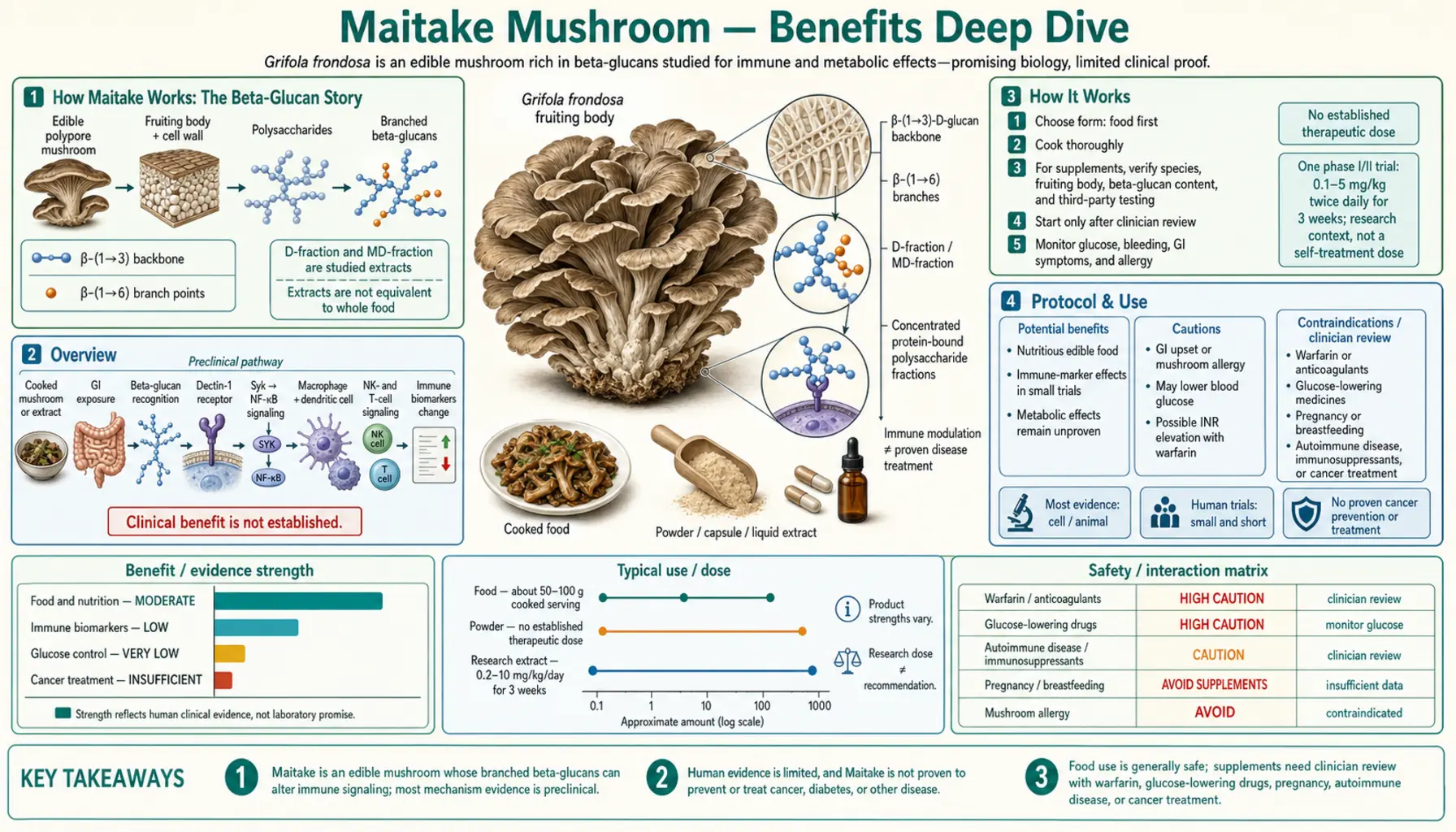
Maitake (Grifola frondosa, "hen of the woods") is both a prized culinary mushroom and one of the most researched functional fungi. Almost all of its studied benefits trace to a single family of molecules — its branched beta-glucan polysaccharides, best known as the "D-fraction" and "MD-fraction" — plus a distinct metabolic glycoprotein called the "SX-fraction." The four deep-dive pages below cover where maitake's research is most developed: immune modulation, blood-sugar and insulin sensitivity, cancer (as a research adjunct only), and cholesterol and blood pressure. Throughout, the framing is honest: maitake has genuinely interesting biology, but most of its evidence is preclinical (cells and animals), with only small, early human studies — it is a healthy food and an experimental adjunct, not a proven cure for anything.
Deep-Dive Articles
Immune Support
The D-fraction and MD-fraction beta-glucans, how they engage the Dectin-1 receptor on macrophages and dendritic cells, natural-killer-cell activation, and the honest limits of the small human immunology trials — including a Sloan Kettering dose-finding trial that found maitake is a two-directional immune modulator, not a simple "boost."
Blood Sugar & Insulin Sensitivity
The SX-fraction glycoprotein, viscous-fiber effects on post-meal glucose, insulin-sensitizing signaling through the Akt–GSK-3 and PPAR-delta pathways, the gut-microbiome route, and the small human PCOS ovulation study — with a clear statement that the human diabetes evidence is preliminary.
Cancer Research (Honest)
What the D-fraction cancer research actually shows and does not show: a large preclinical literature in cells and mice, one small phase I/II immunology trial, no outcome trials, and why maitake must be treated as an experimental adjunct discussed with the oncology team — never a substitute for treatment.
Cholesterol & Blood Pressure
The lipid-lowering fiber and polysaccharide evidence, bile-acid and gut-microbiome mechanisms, fatty-liver (NAFLD) studies, the spontaneously-hypertensive-rat blood-pressure work, a newly isolated maitake blood-pressure peptide, and the honest bottom line that human cardiovascular evidence is thin.
Table of Contents
- Deep-Dive Articles
- How Maitake Works: The Beta-Glucan Story
- Research Papers: Immune Support
- Research Papers: Blood Sugar & Insulin
- Research Papers: Cancer (Honest Framing)
- Research Papers: Cholesterol & Blood Pressure
- External Authoritative Resources
- Connections
- Featured Videos
How Maitake Works: The Beta-Glucan Story
Understanding maitake means understanding its polysaccharides. The cell wall of the mushroom is built largely from beta-glucan — long chains of glucose joined by beta-1,3 bonds with beta-1,6 branches, in maitake's case unusually highly branched and partly bound to protein. These molecules are essentially fiber: they are not digested and absorbed like a vitamin. Their effects arise in three ways.
- Immune pattern recognition. Beta-1,3-glucan is a molecular signature of fungal cell walls, and the human immune system has a dedicated receptor for it — Dectin-1 on macrophages, dendritic cells, and neutrophils. Engaging Dectin-1 primes innate immune cells and coordinates a broader response. This is the basis of the immune research.
- Metabolic signaling and viscous fiber. A distinct, smaller glycoprotein (the SX-fraction) and the viscous fiber together influence glucose and lipid handling — slowing carbohydrate absorption, improving insulin signaling in the liver and muscle, and lowering cholesterol via bile-acid binding. This underlies both the blood-sugar and cholesterol and blood-pressure research.
- Prebiotic / gut-microbiome effects. Because maitake fiber reaches the colon undigested, gut bacteria ferment it into short-chain fatty acids that influence inflammation, glucose control, and lipids from the gut — a mechanism that ties the metabolic benefits together.
Two practical consequences follow. First, extraction method matters: a culinary mushroom, a hot-water tea, and a purified "D-fraction" are chemically different, which is a major reason study results and commercial products vary. Second, most evidence is preclinical: the mechanisms above are best demonstrated in cells and animals, and the human trials remain small and preliminary. The deep-dive pages keep that distinction explicit throughout.
Research Papers: Immune Support
- Kodama N et al. (2003). Effect of Maitake D-Fraction on the activation of NK cells in cancer patients. Journal of Medicinal Food, 6(4):371–377. — PubMed 14977447
- Masuda Y et al. (2012). Soluble β-glucan from Grifola frondosa induces proliferation and Dectin-1/Syk signaling in resident macrophages. Journal of Leukocyte Biology, 91(4):547–556. — PubMed 22028332
- Masuda Y et al. (2013). Oral soluble β-glucans from Grifola frondosa induce a systemic antitumor immune response in tumor-bearing mice. International Journal of Cancer, 133(1):108–119. — PubMed 23280601
- Ito K et al. (2009). Maitake beta-glucan enhances granulopoiesis and granulocyte mobilization via G-CSF and CXCR4/SDF-1. International Immunopharmacology, 9(10):1189–1196. — PubMed 19573626
- Lin H et al. (2004). Maitake MD-fraction enhances bone-marrow colony formation and reduces doxorubicin toxicity in vitro. International Immunopharmacology, 4(1):91–99. — PubMed 14975363
- Mayell M (2001). Maitake extracts and their therapeutic potential (review). Alternative Medicine Review, 6(1):48–60. — PubMed 11207456
Research Papers: Blood Sugar & Insulin
- Preuss HG et al. (2007). Enhanced insulin-hypoglycemic activity in rats consuming a specific maitake glycoprotein (SX-fraction). Molecular and Cellular Biochemistry, 306(1–2):105–113. — PubMed 17671829
- Horio H et al. (2001). Maitake improves glucose tolerance of experimental diabetic rats. Journal of Nutritional Science and Vitaminology (Tokyo), 47(1):57–63. — Search PubMed
- Ma X et al. (2014). A Grifola frondosa polysaccharide relieves insulin resistance in HepG2 cells via the Akt–GSK-3 pathway. Glycoconjugate Journal, 31(5):355–363. — PubMed 24908430
- Aoki H et al. (2018). Maitake extract activates PPARδ and improves glucose intolerance in obese mice. Bioscience, Biotechnology, and Biochemistry, 82(9):1550–1559. — PubMed 29873587
- Chen JT et al. (2010). Maitake extract induces ovulation in patients with polycystic ovary syndrome. Journal of Alternative and Complementary Medicine, 16(12):1295–1299. — PubMed 21034160
- Xiao C et al. (2015). Maitake polysaccharides F2 and F3 improve insulin resistance in diabetic rats. Food & Function, 6(11):3567–3575. — PubMed 26311233
Research Papers: Cancer (Honest Framing)
Note: the studies below are predominantly preclinical (cells and mice) plus one small phase I/II immunology trial. None demonstrates that maitake treats or cures cancer in humans. See the Cancer Research page for the full, honest appraisal.
- Deng G et al. (2009). A phase I/II trial of a maitake polysaccharide extract in breast cancer patients: immunological effects. Journal of Cancer Research and Clinical Oncology, 135(9):1215–1221. — PubMed 19253021
- Narayanan S et al. (2023). Medicinal Mushroom Supplements in Cancer: A Systematic Review of Clinical Studies. Current Oncology Reports, 25(6):569–587. — PubMed 36995535
- Kodama N et al. (2002). Can maitake MD-fraction aid cancer patients? Alternative Medicine Review, 7(3):236–239. — PubMed 12126464
- Alonso EN et al. (2018). Antitumoral and antimetastatic activity of Maitake D-Fraction in triple-negative breast cancer cells. Oncotarget, 9(34):23396–23412. — PubMed 29805742
- Masuda Y et al. (2009). Maitake beta-glucan reduces myelosuppression and nephrotoxicity of cisplatin in mice. International Immunopharmacology, 9(5):620–626. — PubMed 19249389
- Sevindik M et al. (2025). The role of medicinal mushrooms in cancer treatment (review). International Journal of Medicinal Mushrooms, 27(12):1–24. — PubMed 41135064
Research Papers: Cholesterol & Blood Pressure
- Kabir Y et al. (1987). Shiitake and maitake mushrooms lower blood pressure and plasma lipids in spontaneously hypertensive rats. Journal of Nutritional Science and Vitaminology (Tokyo), 33(5):341–346. — PubMed 3443885
- Fukushima M et al. (2001). Cholesterol-lowering effects of maitake, shiitake, and enokitake fiber in rats. Experimental Biology and Medicine (Maywood), 226(8):758–765. — PubMed 11520942
- Preuss HG et al. (2010). Maitake extracts ameliorate progressive hypertension and metabolic perturbations in aging female rats. International Journal of Medical Sciences, 7(4):169–180. — PubMed 20567593
- Ding Y et al. (2016). Mechanisms underlying the hypolipidaemic effects of Grifola frondosa in rat liver. Frontiers in Microbiology, 7:1186. — PubMed 27536279
- Wu WT, Hsu TH, Chen WL, et al. (2022). Polysaccharides of Grifola frondosa (maitake) ameliorate oxidative stress and hypercholesterolaemia in hamsters fed a high-fat, high-cholesterol diet. Journal of Pharmacy and Pharmacology, 74(9):1296–1306. — PubMed 35567773
- Cai Q et al. (2025). A maitake hexapeptide (APPLRP) lowers blood pressure and vascular inflammation in spontaneously hypertensive rats. Journal of Agricultural and Food Chemistry, 73(47):30458–30472. — PubMed 41229141
External Authoritative Resources
- Memorial Sloan Kettering — About Herbs: Maitake — clinician-reviewed, evidence-graded summary of purported uses vs. actual data
- National Cancer Institute — Complementary and Alternative Medicine
- PubMed — all Grifola frondosa research
- PubMed — Maitake D-fraction research
Connections
- Maitake Mushroom (Main Page)
- Maitake for Immune Support
- Maitake for Blood Sugar & Insulin
- Maitake and Cancer Research
- Maitake for Cholesterol & BP
- Reishi Mushroom
- Shiitake Mushroom
- Turkey Tail Mushroom
- Lion's Mane Mushroom
- Cordyceps Mushroom
- Immune Boosting
- Type 2 Diabetes
- Hypertension
- Oncology (Diseases)
- All Mushrooms