Maitake Mushroom (Grifola frondosa) -- Hen of the Woods
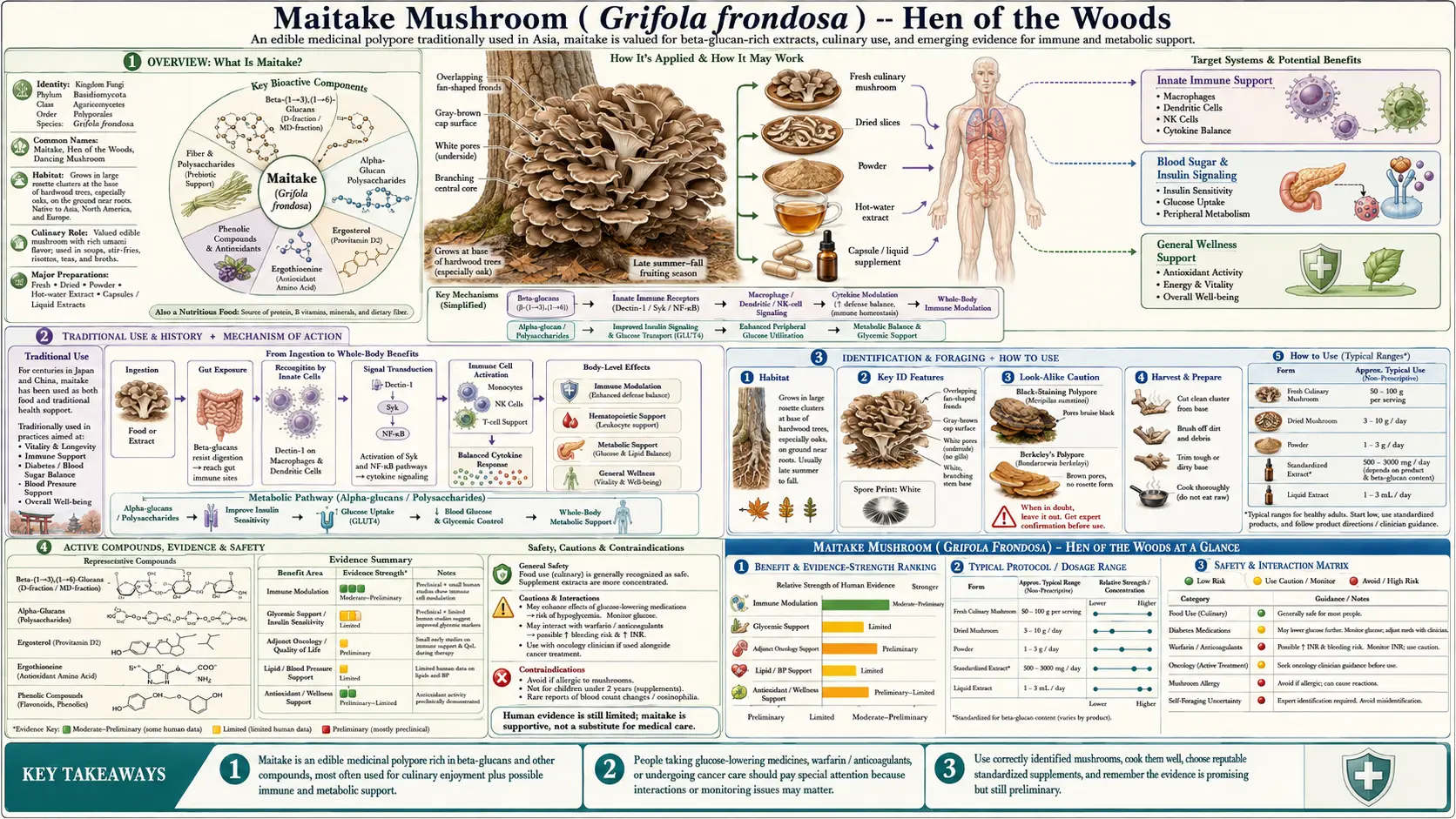
Maitake (Grifola frondosa) is a large, frilly polypore mushroom that grows in overlapping fan-shaped clusters at the base of oaks and other hardwoods. In Japan its name means "dancing mushroom," and in North America it is known as "hen of the woods" for its ruffled, feather-like fronds. It is prized as both a choice edible and a subject of modern immunology research, where its beta-glucan fractions — particularly the standardized "D-fraction" and "MD-fraction" — have been studied for effects on immune cells, blood sugar, and lipids. This page summarizes what the science actually shows, carefully separating strong human evidence from preliminary laboratory and animal work.
Table of Contents
- Overview
- Traditional Use & History
- Identification & Foraging
- Active Compounds
- Immune Modulation
- Blood Sugar & Insulin Sensitivity
- Cholesterol & Lipids
- Blood Pressure
- Cancer-Immunotherapy Support
- Antioxidant Effects
- Culinary Use & Nutrition
- Forms & Dosage
- Safety & Cautions
- Research Papers
- Connections
- Featured Videos
Overview
Maitake is one of a small group of fungi — alongside reishi, shiitake, turkey tail, and lion's mane — that bridge the kitchen and the research laboratory. As a food it is a tender, savory, meaty mushroom that has been gathered and farmed in East Asia for centuries. As a research subject it is studied chiefly for its cell-wall polysaccharides, large branched sugar molecules called beta-glucans that the immune system recognizes much as it recognizes the surfaces of microbes.
The most-studied preparation is a hot-water and alcohol extract enriched in a protein-bound beta-glucan known as the D-fraction, and a more purified version called the MD-fraction. These have been examined in test tubes, in animals, and in a handful of small human studies for their ability to activate immune cells. A separate water-soluble preparation, the SX-fraction, has been investigated for effects on blood glucose and blood pressure.
It is important to set expectations honestly. Much of the maitake literature is preclinical — cell cultures and rodent models — and the human trials are generally small, short, and preliminary. Maitake is a promising and well-tolerated food and supplement, but it is not a proven treatment for any disease. The sections below flag, in each case, what level of evidence supports each claim.
Traditional Use & History
Maitake has a long history as a wild-foraged delicacy in Japan, China, and the temperate forests of eastern North America and Europe. In Japan its prized status gave rise to the romantic tradition that foragers would "dance" with joy on finding a large cluster — one widely repeated origin story for the name mai-take, "dancing mushroom." Old fruiting bodies can reach the size of a basketball and weigh several kilograms, so a single find could feed a household.
It is worth being precise about the medicinal tradition. The use of mushrooms such as maitake, reishi, and turkey tail as health-promoting foods and folk remedies belongs to the East Asian herbal and dietary tradition — principally Chinese and Japanese — not to Ayurveda, the medical tradition of the Indian subcontinent. Maitake is not a classical Ayurvedic herb, and claims that frame it that way are mistaken. In East Asian usage it was valued as a strengthening, longevity-associated food rather than as a remedy for a single named illness.
Serious scientific interest is comparatively recent. From the 1980s onward, Japanese researchers — Hiroaki Nanba and colleagues prominent among them — began isolating and characterizing maitake's beta-glucan fractions and testing their immunological activity, which is how the D-fraction and MD-fraction entered the literature. Commercial cultivation of maitake was also developed in Japan in the late 20th century, transforming it from a hard-to-find wild mushroom into a widely available grocery item.
Identification & Foraging
In the wild, maitake is a polypore — a mushroom that releases spores from pores on its underside rather than from gills. It forms a large rosette of many overlapping, spoon- to fan-shaped grayish-brown caps arising from a branched, pale stalk base. It is typically found in autumn at the base of living or recently dead oaks, and occasionally other hardwoods such as maple or elm, often returning to the same tree year after year.
Maitake has relatively few dangerous look-alikes for a careful observer, but mushroom foraging always carries serious risk, and several other large bracket and polypore fungi share its habitat. Never eat a wild mushroom on the basis of a web description. Positive identification should be confirmed by an experienced local forager or mycological society, and only young, fresh specimens are worth collecting. Tough, old, or insect-ridden fronds are unpalatable.
The good news for most readers is that maitake is now widely cultivated and sold fresh and dried in many supermarkets and Asian grocers, often under the names "maitake" or "hen of the woods." Cultivated maitake is identical in species and removes the identification risk entirely, which is why it is the practical source for both cooking and supplementation.
Active Compounds
Maitake's biological interest centers on its cell-wall polysaccharides. The headline constituents are beta-glucans — long chains of glucose units joined by beta-(1,3) and beta-(1,6) linkages. The standardized D-fraction and the more purified MD-fraction are protein-bound beta-glucan complexes (proteoglucans) extracted from the fruiting body; these are the fractions most studied for immune activity. A distinct water-soluble preparation, the SX-fraction, is investigated mainly in the metabolic literature.
Maitake also contains alpha-glucans and other polysaccharides, dietary fiber, and a range of smaller molecules. Like other fungi it is rich in ergosterol, the fungal sterol that is the precursor to vitamin D2 (ergocalciferol) — which is why mushrooms exposed to ultraviolet light can accumulate meaningful amounts of vitamin D. It supplies B vitamins, the trace mineral copper, potassium, and the antioxidant amino-acid derivative ergothioneine that is characteristic of mushrooms.
An important caveat for supplements: beta-glucan content and structure vary widely with the part of the mushroom used (fruiting body versus mycelium grown on grain), the extraction method, and processing. Two products both labeled "maitake" can differ substantially in their actual beta-glucan dose, which is one reason standardized fractions are used in research.
Immune Modulation
The best-developed line of maitake research is immunological. Beta-glucans are recognized by pattern-recognition receptors — notably Dectin-1 and complement receptor 3 — on innate immune cells. In laboratory and animal studies, maitake D-fraction and related beta-glucans have been reported to activate macrophages, enhance the cytotoxic activity of natural killer (NK) cells, and stimulate dendritic cells, which in turn help orient the adaptive immune response.
For example, controlled animal work has shown that D-fraction can enhance NK-cell cytotoxicity against tumor cells, and that its antitumor effects in mice depend on NK-cell activation; other studies point to a dendritic-cell-driven, T-helper-1-dominant response. A soluble maitake beta-glucan has been shown to drive tumor regression in mice through dendritic-cell-mediated immunity, particularly when combined with another immune-activating agent.
These are mechanistically interesting and consistent results, but they are largely preclinical. They establish that maitake beta-glucans engage real immune pathways; they do not establish that eating maitake or taking a supplement prevents or treats infection or cancer in people. Human immune data exist (see the cancer section) but remain limited.
Blood Sugar & Insulin Sensitivity
Maitake is one of the more frequently studied mushrooms for glucose metabolism, mainly through its SX-fraction and other polysaccharides. In rodent models of diabetes, maitake extracts and isolated polysaccharides have repeatedly been reported to lower blood glucose, improve insulin sensitivity, and favorably shift gut-microbiota composition. Proposed mechanisms include reduced intestinal glucose absorption, improved insulin signaling, and microbiome-mediated effects on metabolism.
The human evidence is far thinner. There is no large, well-controlled clinical trial demonstrating that maitake meaningfully improves blood-sugar control or treats type 2 diabetes in people. The metabolic story is therefore promising but preliminary: strong and consistent in animals, largely unproven in humans.
This evidence gap matters practically. Maitake should not be relied upon as a treatment for diabetes or prediabetes in place of proven therapy. And because animal data suggest a real glucose-lowering effect, anyone taking insulin or oral diabetes medication should be aware of a theoretical additive risk — see Safety & Cautions.
Cholesterol & Lipids
Maitake polysaccharides have been investigated for effects on blood lipids, again primarily in animals. In rodents and hamsters fed high-fat or high-cholesterol diets, maitake extracts have been reported to lower total and LDL cholesterol and triglycerides, sometimes alongside reduced oxidative stress and shifts in the gut microbiota. Soluble fiber and beta-glucans plausibly contribute by binding bile acids and reducing cholesterol absorption, a mechanism shared with other beta-glucan sources such as oats.
As with blood sugar, robust human trials are lacking. The lipid-lowering effect is a reasonable hypothesis supported by animal data and by the known behavior of dietary beta-glucans, but it has not been confirmed in well-designed clinical studies of maitake specifically. Treat any cholesterol claim as preliminary, and continue evidence-based lipid management under medical guidance.
Blood Pressure
A smaller body of work has looked at blood pressure. The maitake SX-fraction has been reported to favorably influence both blood glucose and blood pressure in a streptozotocin-induced diabetic rat model, and some earlier animal work suggested antihypertensive effects of maitake fractions. These observations are preliminary and confined to animal models; there is no convincing human evidence that maitake lowers blood pressure, and it should not be used in place of established treatment for hypertension.
Cancer-Immunotherapy Support
This is the area most prone to overstatement, so it deserves careful framing. Maitake is not a cancer treatment. The interest here is narrowly immunological: whether maitake beta-glucans can modulate immune activity in cancer patients, as an adjunct to conventional care.
The key human study is a phase I/II trial led by Gary Deng and colleagues at Memorial Sloan Kettering Cancer Center, published in 2009, which gave an oral maitake polysaccharide extract to postmenopausal breast-cancer patients. The trial's purpose was to measure immunologic effects and to find a dosing range; it reported measurable, dose-dependent changes in several immune-cell parameters (some increasing, some decreasing). Crucially, it was a small early-phase study designed to assess immune response and tolerability — not to test whether maitake shrinks tumors, improves survival, or treats cancer. It does not support any treatment claim.
The remainder of the cancer literature is preclinical: cell-culture and mouse studies in which D-fraction or soluble maitake beta-glucans slow tumor growth or alter gene expression in cancer cells, generally by activating NK cells and dendritic-cell-mediated immunity. Such findings justify continued research but say nothing definitive about people. Anyone with cancer should make treatment decisions with their oncology team, and should disclose any mushroom supplement they take, since immune-active compounds could in principle interact with immunotherapy or other treatment.
Antioxidant Effects
Maitake, like most edible mushrooms, contains antioxidant compounds — polyphenols, the fungal antioxidant ergothioneine, and bioactive polysaccharides — and maitake extracts show free-radical-scavenging and antioxidant activity in laboratory assays. In some animal studies the lipid- and glucose-related benefits were accompanied by reduced markers of oxidative stress.
These are largely test-tube and animal observations. As with many "antioxidant food" claims, the leap from in-vitro antioxidant capacity to a measurable health benefit in humans is not well supported. The reasonable takeaway is that maitake is a nutritious, antioxidant-containing whole food — a sensible part of a varied diet — rather than a proven antioxidant therapy.
Culinary Use & Nutrition
Maitake is an excellent culinary mushroom with a rich, earthy, slightly peppery flavor and a satisfying texture that holds up to cooking. The fronds can be torn into clusters and sauteed, roasted, grilled, or added to soups, stir-fries, and grain dishes; they crisp beautifully at the edges when roasted with a little oil and salt. They pair well with garlic, butter, and herbs, and make a hearty meat substitute.
Nutritionally, maitake is low in calories and provides dietary fiber (including beta-glucans), several B vitamins (such as niacin and riboflavin), the trace mineral copper, and potassium. Because it is rich in ergosterol, maitake exposed to ultraviolet light — whether from sun-drying or commercial UV treatment — can accumulate substantial vitamin D2, making UV-exposed mushrooms one of the few plant-kingdom dietary sources of vitamin D. As with all mushrooms, maitake should be cooked rather than eaten raw, both for digestibility and to break down heat-labile compounds.
Forms & Dosage
Maitake is taken in two broad ways. The first is simply as food — fresh or dried fruiting bodies in cooking — which delivers fiber, nutrients, and naturally occurring beta-glucans within a normal diet. The second is as a supplement, available as dried fruiting-body powder and capsules, hot-water extracts, and standardized D-fraction / MD-fraction liquid or capsule products, plus the SX-fraction in some metabolic-focused products.
There is no established, evidence-based "correct" dose for maitake, because the human trials are few and used different preparations. Standardized D-fraction products are typically dosed by their beta-glucan content following the manufacturer's directions; the Deng breast-cancer trial used a defined per-kilogram dosing range purely to study immune response. When choosing a supplement, prefer products that specify the part used (fruiting body is the research norm) and provide a measured beta-glucan content, since potency varies widely between products.
The honest bottom line: for general wellness, eating maitake as a food is a pleasant, low-risk choice. For supplements, look for transparent, standardized products, start low, and treat marketing claims of disease treatment with skepticism.
Safety & Cautions
Maitake is widely eaten and generally well tolerated; the main culinary caution is the universal one for wild mushrooms — correct identification — which cultivated maitake removes. Supplements have a good safety record in the short-term studies conducted, with mild digestive upset being the most common complaint.
Several specific cautions apply:
- Diabetes medication (hypoglycemia synergy): Because maitake may lower blood glucose, combining it with insulin or oral hypoglycemic drugs could in theory cause blood sugar to fall too low. People on these medications should monitor closely and consult their clinician before adding maitake supplements.
- Anticoagulant / antiplatelet drugs: Mushroom polysaccharides may have mild effects on blood clotting, so caution is reasonable if you take warfarin, direct oral anticoagulants, or antiplatelet agents.
- Blood pressure: Given the (preliminary) blood-pressure data, those on antihypertensive therapy should be aware of a theoretical additive effect.
- Immune-active conditions and immunotherapy: Because maitake modulates immune cells, people with autoimmune disease, transplant recipients on immunosuppressants, and cancer patients on immunotherapy should discuss it with their care team before use.
- Pregnancy, breastfeeding, and children: There is insufficient safety data for concentrated supplements in these groups; food amounts are considered ordinary diet.
- Allergy: Mushroom allergy is uncommon but possible.
Educational disclaimer: This page is for general information and education only. It is not medical advice, and nothing here is intended to diagnose, treat, cure, or prevent any disease. Maitake is not a proven treatment for any condition. Always consult a qualified healthcare professional before starting any supplement, especially if you are pregnant, breastfeeding, taking medication, or managing a health condition.
Research Papers
Selected peer-reviewed literature. Links resolve to PubMed or DOI.
- Deng G, Lin H, Seidman A, et al. A phase I/II trial of a polysaccharide extract from Grifola frondosa (Maitake mushroom) in breast cancer patients: immunological effects. J Cancer Res Clin Oncol. 2009;135(9):1215-21.
- Kodama N, Komuta K, Sakai N, et al. Effects of D-Fraction, a polysaccharide from Grifola frondosa on tumor growth involve activation of NK cells. Biol Pharm Bull. 2002;25(12):1647-50.
- Kodama N, Asakawa A, Inui A, et al. Enhancement of cytotoxicity of NK cells by D-Fraction, a polysaccharide from Grifola frondosa. Oncol Rep. 2005;13(3):497-502.
- Masuda Y, Nawa D, Nakayama Y, et al. Soluble β-glucan from Grifola frondosa induces tumor regression in synergy with TLR9 agonist via dendritic cell-mediated immunity. J Leukoc Biol. 2015;98(6):1015-25.
- Alonso EN, Orozco M, Eloy Nieto A, et al. Genes related to suppression of malignant phenotype induced by Maitake D-Fraction in breast cancer cells. J Med Food. 2013;16(7):602-17.
- Preuss HG, Echard B, Fu J, et al. Fraction SX of maitake mushroom favorably influences blood glucose levels and blood pressure in streptozotocin-induced diabetic rats. J Med Food. 2012;15(10):901-8.
- Chen Y, Liu D, Wang D, et al. Hypoglycemic activity and gut microbiota regulation of a novel polysaccharide from Grifola frondosa in type 2 diabetic mice. Food Chem Toxicol. 2019;126:295-302.
- Guo WL, Deng JC, Pan YY, et al. Hypoglycemic and hypolipidemic activities of Grifola frondosa polysaccharides and their relationships with the modulation of intestinal microflora in diabetic mice. Int J Biol Macromol. 2020;153:1231-1240.
- Wu WT, Hsu TH, Chen WL, et al. Polysaccharides of Grifola frondosa ameliorate oxidative stress and hypercholesterolaemia in hamsters fed a high-fat, high-cholesterol diet. J Pharm Pharmacol. 2022;74(9):1296-1306.
- Wu JY, Siu KC, Geng P. Bioactive Ingredients and Medicinal Values of Grifola frondosa (Maitake). Foods. 2021;10(1):95.
- PubMed topic search: maitake D-fraction immune macrophage.
- PubMed topic search: Grifola frondosa ergosterol vitamin D.
Connections
- Medicinal Mushrooms (overview)
- Reishi Mushroom
- Lion's Mane Mushroom
- Chaga Mushroom
- Turkey Tail Mushroom
- Ergothioneine
- Herbs
- Remedies
- Vitamins
- Minerals
- Food