Enoki Mushroom for Heart & Metabolic Health
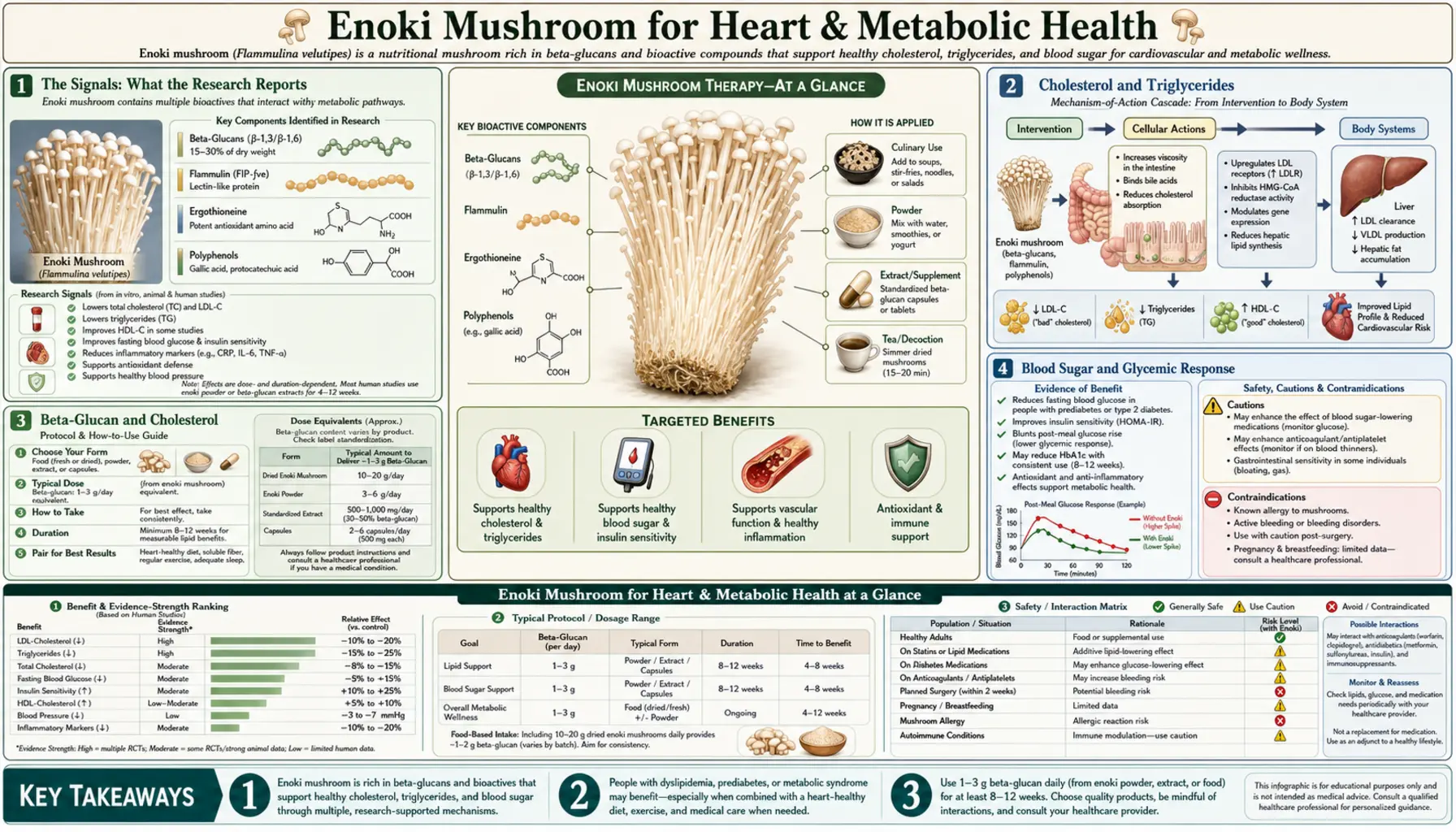
Search the enoki literature and you will find intriguing headlines: animal studies reporting lower cholesterol and triglycerides, effects on oxidative damage, and fiber fractions that blunt blood sugar. These signals are real research findings — but they come mostly from rats, chickens, and test tubes, not from controlled human trials, and it is easy to inflate them into a "cholesterol-lowering superfood" claim the evidence does not support. This page does the opposite. It lays out exactly what the metabolic research reports, marks clearly where it is preliminary and non-human, and then places enoki where the evidence genuinely puts it: as a low-calorie, high-fiber, potassium- and antioxidant-containing food that fits comfortably inside a heart-healthy eating pattern. That pattern — not any single mushroom — is what the strong human evidence actually supports.
Table of Contents
- The Signals: What the Research Reports
- Cholesterol and Triglycerides
- Beta-Glucan and Cholesterol
- Blood Sugar and Glycemic Response
- Weight and Metabolic Syndrome
- Potassium and Blood Pressure
- What Human Cohort Studies Show
- Putting It Together: Where Enoki Fits
- Cautions
- Key Research Papers
- Connections
- Featured Videos
The Signals: What the Research Reports
Several animal and laboratory studies have explored whether enoki affects blood fats and metabolism, and the findings are worth stating plainly — along with their limits. Work in rodents and in poultry feeding trials has reported hypolipidemic (cholesterol- and triglyceride-lowering) and antioxidant effects from enoki fruiting bodies or stem material. One study in laying hens described effects on oxidative damage and on the synthesis of egg-yolk precursors through liver-blood-ovary signaling, and a dedicated study reported hypolipidemic and antioxidant activity of enoki mushrooms in an experimental model.
These are genuinely interesting biological signals. They are also, without exception in the enoki-specific literature, preliminary and largely non-human. Feeding a concentrated mushroom fraction to rats or chickens is a long way from a randomized controlled trial showing that eating enoki lowers cholesterol or improves metabolic markers in people. Nothing in this section should be read as evidence that enoki treats high cholesterol, diabetes, or heart disease. The rest of the page unpacks each mechanism and then returns to the one thing that is well supported — that enoki fits a dietary pattern known to help.
Cholesterol and Triglycerides
The clearest enoki-specific metabolic study is a report of hypolipidemic and antioxidant activity in an experimental model, in which enoki mushroom material was associated with lower blood lipids and reduced markers of oxidative stress. Similar directional findings appear across rodent and poultry work, giving a reasonably consistent — if preliminary — picture that enoki fractions can nudge blood fats downward in animals.
Two mechanisms are usually proposed. First, the fiber (discussed on the Gut Health & Fiber page) can bind bile acids in the gut, prompting the liver to pull cholesterol from the blood to make more bile, and fermentation products from fiber can influence lipid metabolism. Second, enoki's antioxidant compounds may reduce the oxidation of LDL particles, a step in artery plaque formation. Both mechanisms are plausible and align with how other high-fiber, antioxidant-containing foods behave — but demonstrating them in a rat is not the same as showing a meaningful cholesterol change in a person eating ordinary servings of enoki. For clinical context on lipids, see our Cardiology section.
Beta-Glucan and Cholesterol
One reason the cholesterol angle is biologically believable is beta-glucan. Beta-glucans from oats and barley have well-established, human-proven cholesterol-lowering effects — strong enough that regulators permit a heart-health claim for oat beta-glucan — achieved mainly by forming a viscous gel that traps bile acids. Fungal beta-glucans, including those in enoki, are chemically distinct from cereal beta-glucans (a different linkage pattern), and it cannot be assumed that they lower cholesterol to the same degree; the human evidence for mushroom beta-glucan on cholesterol is much thinner than for oats.
Reviews such as Jayachandran and colleagues' analysis of beta-glucans, gut microbiota, and human health discuss how these fibers can influence lipid and metabolic markers through both viscosity and fermentation. The honest reading for enoki is that it contains a class of fiber with real cholesterol-modifying potential, that the best human evidence for that potential comes from cereal rather than mushroom beta-glucans, and that enoki is therefore a reasonable contributor to a fiber-rich, heart-supportive diet rather than a substitute for proven measures like oats, a Mediterranean-style pattern, or prescribed therapy.
Blood Sugar and Glycemic Response
Enoki is low in available carbohydrate and high in fiber, which gives it a naturally gentle effect on blood sugar. Fiber slows the digestion and absorption of carbohydrate, blunting the post-meal glucose rise, and the study characterizing insoluble dietary fiber from several food sources specifically examined potential hypoglycemic (blood-sugar-lowering) effects of such fibers. Adding a low-calorie, high-fiber food like enoki to a meal can modestly lower the meal's overall glycemic impact, mainly by displacing more rapidly digested ingredients and adding fiber.
As with lipids, this is a general property of high-fiber vegetables rather than a unique enoki drug effect, and there is little direct human trial data on enoki and glycemic control. For people with or at risk of type 2 diabetes, the sensible message is that mushrooms like enoki are a smart, filling, low-glycemic addition to meals — part of the overall dietary approach discussed in our Type 2 Diabetes page — not a treatment in themselves.
Weight and Metabolic Syndrome
Perhaps the most practical metabolic benefit of enoki has nothing to do with a special bioactive: it is an excellent tool for calorie management. Enoki is mostly water and fiber, so it adds volume, chewing time, and satiety to meals for very few calories. Using mushrooms to bulk out dishes — replacing part of the higher-calorie ingredients with enoki in stir-fries, soups, and noodle bowls — is a legitimate, evidence-aligned strategy for eating more food while consuming fewer calories, which supports weight management and, through it, better metabolic health.
Since excess weight is a central driver of metabolic syndrome, type 2 diabetes, and cardiovascular risk, this low-energy-density role is arguably enoki's most defensible contribution to metabolic health — more so than any hypolipidemic animal study. Notably, the 2025 FIP-fve study in an obese allergic-asthma model reported improvement in related metabolic dysfunction alongside its immune effects, an interesting hint that enoki's bioactives may touch metabolism too, though it remains early animal data. For the broader picture, see our Obesity page.
Potassium and Blood Pressure
Like most mushrooms, enoki contributes potassium, an electrolyte central to blood-pressure regulation and to normal nerve and muscle function. Diets higher in potassium and lower in sodium are consistently associated with healthier blood pressure, and potassium-rich whole foods are a cornerstone of heart-healthy eating patterns such as DASH and the Mediterranean diet. Enoki's potassium is a modest but real part of what makes it a heart-friendly ingredient.
The important qualifier runs the other way: because enoki supplies potassium, people with advanced kidney disease or those on potassium-restricted diets or certain medications must account for it rather than treat it as free. For most people with healthy kidneys, though, getting potassium from vegetables and fungi like enoki is exactly what dietary guidance encourages. Our Potassium page and Hypertension page cover this balance in detail.
What Human Cohort Studies Show
The strongest human evidence touching enoki is not about enoki specifically but about mushroom intake in general. A prospective study by Ba and colleagues using NHANES data, combined with a meta-analysis, examined the relationship between dietary mushroom intake and mortality risk, finding that higher mushroom consumption was associated with a modestly lower risk of death. Other cohort studies have linked mushroom intake to lower risk of some chronic conditions.
These findings are encouraging and consistent with mushrooms being a healthy food — but they carry the standard limits of observational nutrition research. They cannot isolate enoki from other mushrooms or from the overall dietary and lifestyle patterns of people who eat more mushrooms, and association is not causation: mushroom eaters may simply eat more vegetables and live healthier lives overall. The appropriate conclusion is that including mushrooms such as enoki in the diet is consistent with better long-term health outcomes at the population level, which supports eating them, without proving that enoki itself produces a specific cardiovascular or metabolic benefit.
Putting It Together: Where Enoki Fits
Assembling the evidence honestly gives a clear, useful picture:
- Strong ground: enoki is low in calories, high in fiber, and contributes potassium and antioxidant compounds — all features of foods that belong in a heart-healthy, metabolically supportive diet. Using it to add volume and satiety while lowering calories is a genuinely good strategy.
- Plausible but unproven in humans: the hypolipidemic and hypoglycemic effects seen in animal and fiber studies. These are believable given enoki's fiber and antioxidants, but direct human evidence for enoki is lacking, so do not rely on enoki to lower your cholesterol or blood sugar.
- Not supported: any claim that enoki treats, prevents, or reverses heart disease, diabetes, or metabolic syndrome. It is a food that fits a good pattern, not a medicine.
The bottom line mirrors the whole Benefits section: enjoy enoki as a nutritious, filling, low-calorie ingredient within an overall heart-healthy pattern like the Mediterranean diet, keep expectations for any single-food effect modest, and never let a "superfood" narrative substitute for the well-proven basics — and for medical care where it is needed.
Cautions
- Not a substitute for treatment. Do not use enoki in place of prescribed medication or medical management for high cholesterol, diabetes, high blood pressure, or heart disease. Discuss any dietary changes with your clinician.
- Potassium and kidney disease. Enoki contributes potassium; people with advanced kidney disease or on potassium-restricted diets or potassium-affecting medications should count it and consult their care team.
- Listeria risk — cook thoroughly. Any heart-health benefit depends on eating enoki safely. It has been repeatedly linked to listeriosis outbreaks; cook it fully, refrigerate promptly, and never eat it raw — especially if pregnant, elderly, or immunocompromised.
- Animal-study caveat. The cholesterol- and triglyceride-lowering findings are largely from rodents and poultry; treat them as preliminary, not as human-proven results.
Key Research Papers
- Hypolipidemic and antioxidant activity of enoki mushrooms (Flammulina velutipes). Biomed Res Int. 2014. — PubMed 25250317
- Ba DM et al. Prospective study of dietary mushroom intake and risk of mortality (NHANES 2003–2014 and meta-analysis). Nutr J. 2021. — PubMed 34548082
- Characterization of insoluble dietary fiber from three food sources and their potential hypoglycemic and hypolipidemic effects. Food Funct. 2021. — PubMed 34100044
- Jayachandran M et al. A critical review on the impacts of beta-glucans on gut microbiota and human health. J Nutr Biochem. 2018. — PubMed 30196242
- Fungal immunomodulatory protein FIP-fve mitigates airway inflammation and metabolic dysfunction in an obese allergic asthma model. Sci Rep. 2025. — PubMed 40998975
- Biological activities and bioactive constituents of Flammulina velutipes: an updated systematic review. J Sci Food Agric. 2026. — PubMed 41906329
PubMed Topic Searches
- PubMed: Flammulina velutipes hypolipidemic
- PubMed: mushroom beta-glucan cholesterol
- PubMed: mushroom consumption cardiovascular risk
- PubMed: low-energy-density foods and weight
- PubMed: potassium intake and blood pressure
Connections
- Enoki Mushroom (Main Page)
- Enoki Benefits Hub
- Enoki Gut Health & Fiber
- Enoki Antioxidant Protection
- Cardiology
- Hypertension
- Type 2 Diabetes
- Obesity
- Mediterranean Diet
- Potassium
- Shiitake Mushroom
- Medicinal Mushrooms (overview)