Cordyceps Mushroom (Cordyceps militaris & Ophiocordyceps sinensis)
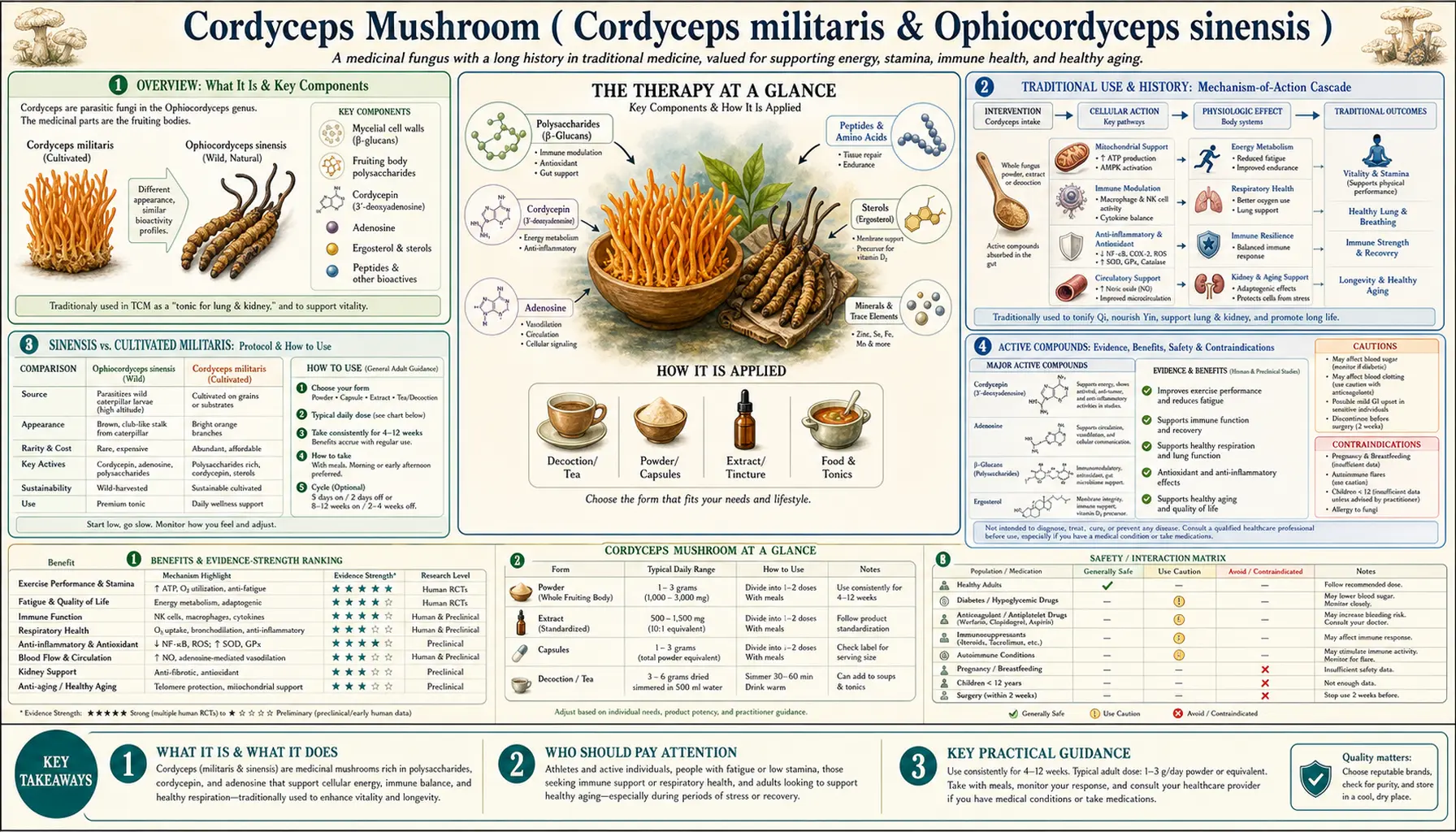
Cordyceps is a group of parasitic fungi best known for two species used in supplements: the wild Himalayan Ophiocordyceps sinensis (formerly Cordyceps sinensis), which grows out of moth caterpillar larvae high on the Tibetan Plateau, and the cultivated, lab-grown Cordyceps militaris, an orange club fungus now produced on grain or soy substrate worldwide. Both are marketed as energy, stamina, and lung tonics. This page separates the long traditional reputation and promising laboratory findings from what controlled human trials actually show — which, for several popular claims, is still modest or mixed.
Table of Contents
- Overview
- Traditional Use & History
- Sinensis vs. Cultivated Militaris
- Active Compounds
- Exercise Performance & Aerobic Capacity
- Cellular Energy & Fatigue
- Lung & Respiratory Support
- Kidney Support
- Libido & Reproductive Health
- Anti-inflammatory, Antioxidant & Blood Sugar
- Immune Modulation
- Forms, Quality & Dosage
- Safety & Cautions
- Research Papers
- Connections
- Featured Videos
Overview
Cordyceps are entomopathogenic fungi — they infect insects, consume the host, and then push a fruiting stalk out of the corpse. Of more than 600 described species, two dominate the wellness market. Ophiocordyceps sinensis is the wild, hand-collected caterpillar fungus of the Himalayas; it is one of the most expensive biological commodities on Earth, selling for tens of thousands of US dollars per kilogram at the top grades. Because wild harvest cannot meet demand and is ecologically fragile, most modern products instead use cultivated mycelium or fruiting bodies of Cordyceps militaris, or a fermented mycelial strain of O. sinensis called Cs-4 (also sold as Paecilomyces hepiali).
The traditional reputation centers on energy, breathing, stamina, and recovery from illness or overwork. Laboratory and animal studies report a wide range of activities — antioxidant, anti-inflammatory, immunomodulatory, blood-sugar-lowering, and antitumor effects — but the human clinical record is far thinner. The most relevant honest summary is that Cordyceps is biologically interesting and generally well tolerated, while several of its headline claims (notably big aerobic-performance boosts) are supported mainly by older, sometimes hard-to-replicate data.
Traditional Use & History
In the Himalayan and Tibetan world the wild fungus is called yartsa gunbu in Tibetan and yarsagumba in Nepali — literally "summer grass, winter worm," capturing the folk belief that the organism is an animal in winter and a plant in summer. Tibetan, Nepali, and Bhutanese herders have used it as a restorative tonic, and its collection now underpins a large share of rural cash income across the high plateau.
In Traditional Chinese Medicine (TCM), dong chong xia cao is classified as a warming tonic that "tonifies the lungs and kidneys," used historically for chronic cough, asthma-like breathlessness, fatigue, low back pain, and convalescence. These are the organ systems modern marketing still emphasizes (lung = breathing/stamina; kidney = energy, vitality, and in TCM theory reproductive function).
It is worth being honest about the herbal lineage. Classical Ayurveda did not feature mushrooms prominently — fungi were often viewed with caution in older Ayurvedic texts — so the frequent framing of Cordyceps as an ancient Ayurvedic Rasayana overstates its history. Cordyceps entered the modern "adaptogen" and Rasayana-style wellness vocabulary relatively recently, largely in the late 20th and 21st centuries as global supplement interest grew. Its deep documented use is Tibetan/Himalayan and Chinese, not classical Indian. Western attention surged in 1993 after Chinese distance runners set world records and their coach credited a Cordyceps-based tonic — a claim later complicated by doping allegations against that program, and a useful reminder to separate marketing folklore from evidence.
Sinensis vs. Cultivated Militaris
These two species are not interchangeable, and the distinction matters when reading labels and studies.
- Ophiocordyceps sinensis (wild "caterpillar fungus"): Cannot yet be fully cultivated as a true fruiting body at commercial scale, so authentic wild material is scarce, costly, and a frequent target of adulteration. Much of the credible human research uses the fermented mycelial strain Cs-4 rather than the wild specimen.
- Cordyceps militaris (cultivated): Grows readily as bright-orange fruiting bodies on grain or other substrate, making it sustainable and reproducible. Crucially, C. militaris typically contains far more cordycepin — the signature bioactive nucleoside — than wild O. sinensis, which can carry very little. For this reason most modern cordycepin research and many "high-potency" products use C. militaris.
The practical takeaway: a product saying simply "Cordyceps" without naming the species and form tells you little. Because wild harvest is ecologically stressful for fragile alpine grasslands and the fungus is increasingly scarce, cultivated C. militaris is generally the more sustainable and analytically consistent choice.
Active Compounds
Cordyceps contains several constituent classes thought to drive its activity:
- Cordycepin (3′-deoxyadenosine): The most-studied compound, a nucleoside analog structurally similar to adenosine but missing one oxygen. In the lab it interferes with RNA synthesis and shows anti-inflammatory, antiproliferative, and immune-signaling effects. Concentrated in C. militaris; often low or absent in wild O. sinensis.
- Adenosine: A nucleoside involved in energy metabolism and cell signaling; sometimes used as a standardization marker for O. sinensis products.
- Cordycepic acid (D-mannitol): A sugar alcohol present in notable amounts; historically a marker compound, though it is common in many fungi and not unique to Cordyceps.
- Polysaccharides & beta-glucans: Complex carbohydrates believed to underlie much of the immune-modulating and antioxidant activity reported for mushroom extracts generally.
- Ergosterol and sterols: Fungal sterols (the vitamin-D2 precursor) with antioxidant and signaling roles in cell studies.
Because cordycepin is unevenly distributed and many extracts standardize loosely, the actual chemistry of a Cordyceps product depends heavily on species, strain, growing method, and extraction.
Exercise Performance & Aerobic Capacity
This is Cordyceps' most famous and most overhyped claim, so it deserves a careful, honest read. The folklore traces to the 1993 Chinese running records, but well-controlled trials tell a more measured story.
In a double-blind, placebo-controlled trial in healthy older adults, the Cs-4 strain of O. sinensis modestly improved a metabolic threshold during exercise, suggesting a small benefit to aerobic capacity in a deconditioned population. A separate randomized study found that C. militaris supplementation improved tolerance to high-intensity exercise after several weeks of use, though shorter (acute) dosing showed little effect.
However, results in trained or young, fit individuals are mixed and frequently null. A study of a commercial Ophiocordyceps-plus-Ganoderma blend found no significant improvement in maximal-exercise physiology in healthy young participants, and a trial of a multi-ingredient supplement containing Cordyceps and Rhodiola in active men showed limited isolated benefit attributable to Cordyceps. Many positive studies are small, short, or use blends, making it hard to credit Cordyceps alone.
Honest bottom line: Cordyceps may give a small VO2max or exercise-tolerance edge after weeks of use, more plausibly in older or untrained people than in elite athletes. It is not a substitute for training, and dramatic performance claims are not well supported.
Cellular Energy & Fatigue
The proposed mechanism behind energy and stamina claims is improved cellular energy handling. Animal and cell studies report that Cordyceps extracts can raise ATP availability, support mitochondrial function, and reduce markers of fatigue and oxidative stress after exertion. Some rodent work also reports antiaging-type effects on learning, memory, and antioxidant enzymes with C. sinensis extract.
These mechanistic findings are consistent with the modest exercise data, but the leap from "raises ATP in tissue or in mice" to "boosts a healthy person's day-to-day energy" is not firmly established in humans. People with fatigue from an underlying medical cause (anemia, thyroid disease, sleep apnea, depression) should pursue diagnosis rather than rely on a supplement.
Lung & Respiratory Support
The TCM use of Cordyceps for cough, breathlessness, and lung weakness aligns with its modern "respiratory tonic" reputation. Preclinical studies report bronchodilator-like and anti-inflammatory effects in airway models, and small clinical reports from China have explored adjunct use in chronic respiratory conditions. The proposed benefit ties into the aerobic-capacity findings — better oxygen utilization could plausibly aid exertional breathing.
That said, high-quality, independent human trials for asthma, COPD, or other lung disease are limited and not strong enough to recommend Cordyceps as a treatment. It should never replace prescribed inhalers or respiratory medications, and anyone with significant breathing problems should be managed by a clinician. (This page does not cover any infectious respiratory illness.)
Kidney Support
"Kidney tonification" is a core TCM indication, and Cordyceps and the Cs-4 strain have been studied as adjuncts in chronic kidney disease and in protecting against drug-induced kidney injury. Some studies suggest possible benefits on kidney function markers, immune parameters, and post-transplant outcomes when used alongside conventional care in Chinese clinical settings.
It is important to be candid: much of this evidence is preclinical or comes from older, smaller, or methodologically limited trials, and TCM "kidney" theory is not the same as Western renal physiology. Cordyceps is not an established treatment for kidney disease. People with reduced kidney function are also more vulnerable to contaminants such as heavy metals (a real concern with adulterated wild material) and should only use supplements under medical supervision.
Libido & Reproductive Health
Reflecting its TCM "kidney/vitality" role, Cordyceps has a long reputation as an aphrodisiac and reproductive tonic. Animal studies provide the clearest support: in rodent models, C. militaris has improved sexual behavior and sperm parameters, including in diabetic rats, and other rodent work reports effects on reproductive hormones and testicular antioxidant status.
Human evidence is sparse and lower quality. While the traditional and preclinical signals are intuitively consistent, there are no large, rigorous human trials confirming a meaningful effect on libido, fertility, or hormone levels. Treat these claims as plausible-but-unproven in people.
Anti-inflammatory, Antioxidant & Blood Sugar
Across cell and animal studies, Cordyceps extracts and cordycepin show consistent antioxidant activity (scavenging free radicals, boosting endogenous antioxidant enzymes) and anti-inflammatory activity (dampening pro-inflammatory signaling such as NF-κB and inflammatory cytokines). These overlapping effects are the common thread linking many of the fungus's proposed benefits.
For blood sugar, rodent studies of C. militaris polysaccharides report improved glucose handling and insulin sensitivity, fitting a broader pattern seen with several medicinal mushrooms. As with the other endpoints, robust human trials are lacking, so Cordyceps should not be used to manage diabetes in place of established therapy — and anyone on glucose-lowering medication who adds it should monitor for additive effects.
Immune Modulation
Mushroom beta-glucans and polysaccharides are classic immune modulators, and Cordyceps is no exception. Reviews describe immune-stimulatory effects — activating macrophages, natural killer (NK) cells, and cytokine responses — alongside more nuanced immunoregulatory actions. Cordycepin specifically has been studied for antitumor immune effects; for example, it can enhance antitumor immunity in colon-cancer models by reducing a "don't-eat-me" checkpoint signal on tumor cells, improving immune clearance in the lab.
Two honest caveats follow. First, "boosts the immune system" is a marketing oversimplification; what these compounds really do is modulate immune signaling, which is not automatically beneficial. Second — and clinically important — immune activation is precisely why people with autoimmune disease or those taking immunosuppressant drugs should be cautious (see Safety).
Forms, Quality & Dosage
Cordyceps products vary enormously, and quality is the single biggest variable in whether you get anything useful:
- Cs-4 (fermented O. sinensis mycelium): The form behind much of the better human research; standardized and reproducible.
- C. militaris fruiting body: Sustainable, high in cordycepin, increasingly the premium cultivated option. Look for products reporting beta-glucan and/or cordycepin content.
- Mycelium-on-grain (MOG): Common and inexpensive, but the powder includes the leftover grain substrate, which dilutes active content with starch. Labels touting "polysaccharides" can be mostly residual grain glucans, not fungal beta-glucans.
Because human dosing studies differ by species and extract, there is no single official dose. Trials and traditional use commonly fall in the range of roughly 1–3 grams per day of extract, with Cs-4 studies often in this neighborhood. Prefer products that name the exact species and form, disclose how they standardize (cordycepin for C. militaris; adenosine for O. sinensis), and ideally provide third-party testing. Give any trial several weeks — the modest exercise benefits appeared with chronic, not single-dose, use.
Safety & Cautions
Cordyceps is generally well tolerated in studies, with mild, infrequent side effects such as nausea, dry mouth, or stomach upset. Still, several real cautions apply:
- Autoimmune disease & immunosuppressants: Because Cordyceps can stimulate immune activity, it may theoretically worsen autoimmune conditions (such as lupus, rheumatoid arthritis, or multiple sclerosis) and could counteract immunosuppressant medications — including drugs taken after organ transplant. Avoid unless cleared by your physician.
- Anticoagulants / antiplatelets & surgery: Some data suggest Cordyceps may affect bleeding/clotting; use caution if you take warfarin, DOACs, aspirin, or similar drugs, and discontinue before scheduled surgery.
- Blood-sugar medications: Possible additive glucose-lowering effects warrant monitoring in people with diabetes.
- Heavy-metal adulteration of wild sinensis: Wild O. sinensis is expensive and heavily adulterated. Counterfeit specimens have been weighted with lead wire or other materials, and some wild and cultivated samples have shown elevated arsenic or other heavy metals. This is a genuine contamination risk — favor reputable, tested, cultivated products.
- Pregnancy & breastfeeding: Insufficient safety data; avoid.
Educational disclaimer: This page is for general information only and is not medical advice. Supplements are not regulated like medicines, and product quality varies widely. Nothing here is intended to diagnose, treat, cure, or prevent any disease. Talk with a qualified healthcare professional before starting Cordyceps, especially if you are pregnant or breastfeeding, have an autoimmune or kidney condition, or take prescription medications — including blood thinners, immunosuppressants, or diabetes drugs.
Research Papers
Selected peer-reviewed literature. Links resolve to PubMed or DOI.
- Chen S, Li Z, Krochmal R, et al. Effect of Cs-4 (Cordyceps sinensis) on exercise performance in healthy older subjects: a double-blind, placebo-controlled trial. J Altern Complement Med. 2010;16(5):585-590.
- Hirsch KR, Smith-Ryan AE, Roelofs EJ, et al. Cordyceps militaris Improves Tolerance to High-Intensity Exercise After Acute and Chronic Supplementation. J Diet Suppl. 2017;14(1):42-53.
- Rossi P, Buonocore D, Altobelli E, et al. Effects of a Commercial Supplement of Ophiocordyceps sinensis and Ganoderma lucidum on Physiological Responses to Maximal Exercise in Healthy Young Participants. Int J Med Mushrooms. 2018;20(4):359-367.
- Smith-Ryan AE, et al. Effects of Concurrent Training and a Multi-Ingredient Performance Supplement Containing Rhodiola rosea and Cordyceps sinensis on Body Composition, Performance, and Health in Active Men. J Diet Suppl. 2021;18(6):597-613.
- Liu Y, Wang J, Wang W, et al. The Chemical Constituents and Pharmacological Actions of Cordyceps sinensis. Evid Based Complement Alternat Med. 2015;2015:575063.
- Phull AR, Ahmed M, Park HJ. Cordyceps spp.: A Review on Its Immune-Stimulatory and Other Biological Potentials. Front Pharmacol. 2020;11:602364.
- Ethnopharmacology and current conservational status of Cordyceps sinensis. Z Naturforsch C J Biosci. 2025;80(7-8):297-315.
- Ji DB, Ye J, Li CL, et al. Antiaging effect of Cordyceps sinensis extract. Phytother Res. 2009;23(1):116-122.
- Cordycepin enhances anti-tumor immunity in colon cancer by inhibiting phagocytosis immune checkpoint CD47 expression. Int Immunopharmacol. 2022;107:108695.
- A study of the aphrodisiac properties of Cordyceps militaris in streptozotocin-induced diabetic male rats. Vet World. 2021;14(2):537-544.
- PubMed topic search: cordyceps exercise performance VO2max.
- PubMed topic search: Cordyceps militaris cordycepin.
- PubMed topic search: Ophiocordyceps sinensis pharmacology review.
- PubMed topic search: cordyceps fatigue energy.
Connections
- Medicinal Mushrooms (overview)
- Reishi Mushroom
- Lion's Mane Mushroom
- Chaga Mushroom
- Turkey Tail Mushroom
- Ergothioneine
- Herbs
- Remedies
- Vitamins
- Minerals
- Food