Agaricus Blazei Mushroom for Liver and Antioxidant Support
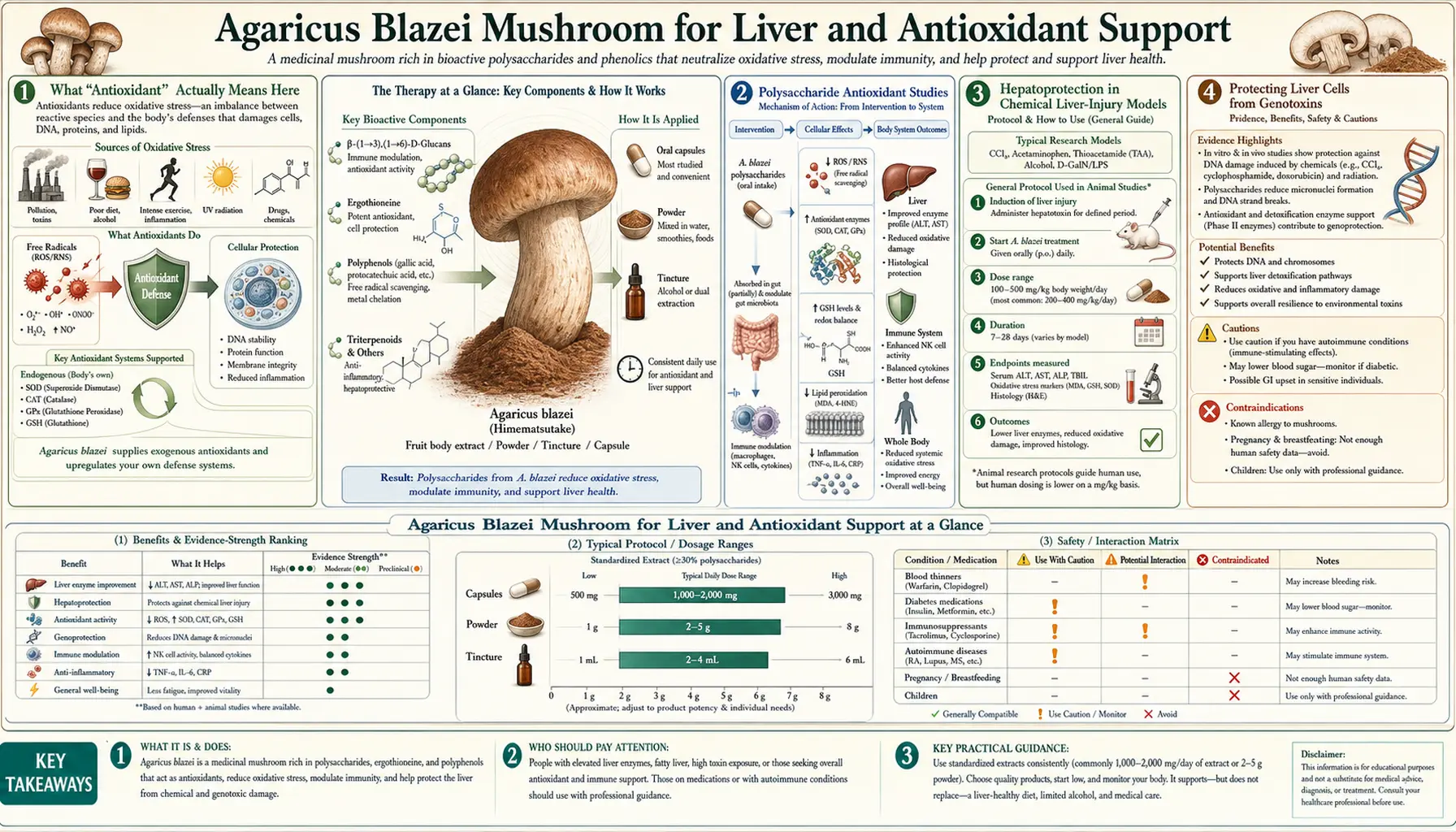
This page carries an unusual duty: it presents both the promising and the cautionary sides of Agaricus blazei and the liver, because the honest evidence points in two directions at once. On one hand, the mushroom's polysaccharides show antioxidant activity in the laboratory, and in animal models they protect the liver against chemical injury. On the other hand, there are real published case reports of severe liver injury in people — particularly cancer patients — who took Agaricus supplements. Both things are true. The antioxidant biology is genuine but mostly preclinical; the human liver-injury reports are rare but serious. Understanding this paradox is essential to using the mushroom sensibly, and it is the reason “natural” can never be assumed to mean “safe for the liver.”
Table of Contents
- What “Antioxidant” Actually Means Here
- Polysaccharide Antioxidant Studies
- Hepatoprotection in Chemical Liver-Injury Models
- Protecting Liver Cells from Genotoxins
- Liver Carcinogenesis Models: A Mixed Picture
- A Small Human Signal: Chronic Hepatitis B
- Beyond the Liver: Systemic Oxidative Parameters
- The Important Paradox: Case Reports of Liver INJURY
- Who Should Be Cautious
- Practical Notes
- Key Research Papers
- External Resources
- Connections
- Featured Videos
What “Antioxidant” Actually Means Here
“Antioxidant” is one of the most overused words in supplement marketing, so it is worth being precise. In the Agaricus blazei literature it refers to two related things: (1) the direct chemical ability of the mushroom's compounds to neutralize reactive free radicals in a test tube (measured by assays such as DPPH, ABTS, and hydroxyl-radical scavenging), and (2) the biological ability, in cells and animals, to reduce markers of oxidative damage such as lipid peroxidation (measured as malondialdehyde) and to support the body's own antioxidant enzymes such as superoxide dismutase, catalase, and glutathione peroxidase.
The liver is the organ where this matters most, because the liver is the body's chemical-processing plant. It detoxifies drugs, alcohol, and environmental toxins, and that work generates a heavy load of reactive oxygen species. Many forms of liver damage — from alcohol, from certain drugs, from fatty-liver disease — involve oxidative stress. An agent that genuinely reduces hepatic oxidative stress is therefore biologically plausible as a liver protectant, which is exactly the hypothesis the animal studies test.
Polysaccharide Antioxidant Studies
Multiple studies confirm that polysaccharides extracted from Agaricus blazei have measurable antioxidant activity, and — importantly for anyone buying a product — that the strength of that activity depends heavily on how the mushroom is processed. Research has shown that the drying method changes the antioxidant properties of the extracted polysaccharides, and that different extraction methods yield polysaccharides with different antioxidant capacities. A hot-water extract of the fungus has also demonstrated antioxidant activity in both test-tube and animal (in vivo) settings.
The practical lesson from this processing-sensitivity is the same one that runs through all Agaricus blazei research: the “same” mushroom can be weak or strong depending on cultivation, drying, and extraction, which makes standardization and third-party testing genuinely important and makes cross-study comparison difficult.
Hepatoprotection in Chemical Liver-Injury Models
The most direct animal evidence for liver protection comes from carbon tetrachloride (CCl4) models. CCl4 is a classic laboratory hepatotoxin: the liver metabolizes it into a reactive radical that triggers lipid peroxidation and cell death, producing a reliable, reproducible pattern of liver injury that researchers use to test protective agents. In these models, Agaricus blazei Murill extract reduced CCl4-induced liver injury in rats, and a separate study reported that the mushroom acted as an efficient hepatoprotective and antioxidant agent against CCl4-induced injury, with lower liver-enzyme elevations and reduced markers of oxidative damage in the treated animals.
These are among the more convincing preclinical results for the mushroom, because they combine a clear injury model with a measurable, mechanistically-sensible protective effect. The honest boundary is that CCl4 poisoning in a rat is not human liver disease, and protecting a rat from an industrial solvent does not establish that the mushroom protects human livers from alcohol, medication, or fatty-liver disease.
Protecting Liver Cells from Genotoxins
A related line of work uses HepG2 cells, a human liver-derived cell line, to test whether Agaricus blazei compounds can protect liver-cell DNA from damage. A beta-glucan extracted from Agaricus blazei prevented the genotoxic (DNA-damaging) effects of benzo[a]pyrene — a carcinogen from smoke and charred food — in these human liver cells. This connects the mushroom's antioxidant activity to a potential protective role against DNA-level injury, and it overlaps with the chemoprevention discussion on the Cancer Research page.
As with all cell-line work, this demonstrates a mechanism under controlled conditions; it does not establish that consuming the mushroom protects a living person's liver from carcinogens.
Liver Carcinogenesis Models: A Mixed Picture
Honesty requires presenting the inconsistent results in the liver-cancer prevention models. Using diethylnitrosamine (DEN), a chemical that initiates liver cancer in rats, different studies reached different conclusions. Some reported that dietary Agaricus blazei reduced the development of preneoplastic (precancerous) liver foci and influenced DEN-induced liver toxicity favorably. Yet another carefully conducted study found that Agaricus blazei (Himematsutake) did not alter the development of DEN-initiated hepatic preneoplastic foci at all.
This split is informative rather than embarrassing. It tells us that any chemopreventive effect on the liver is, at best, modest and dependent on the specific extract, dose, and timing — not a robust, reliable phenomenon. Presenting only the positive studies would misrepresent the evidence; the balanced reading is “possible weak effect, not consistently reproducible.”
A Small Human Signal: Chronic Hepatitis B
There is one small human study worth mentioning with appropriate caution. In patients with chronic hepatitis B, an Agaricus blazei Murill extract was reported to help normalize liver function (improve elevated liver-enzyme levels). This is an intriguing signal because it is one of the few pieces of human liver data, and hepatitis B is a major cause of liver disease worldwide.
The caveats are substantial: it is a small study, liver enzymes are a surrogate marker rather than a hard outcome like reduced cirrhosis or liver cancer, and it has not been replicated in large independent trials. It should be read as a hypothesis-generating observation, not as evidence that Agaricus blazei treats hepatitis B — a condition for which effective antiviral medications exist and should not be replaced. See our Hepatitis B page for the standard picture.
Beyond the Liver: Systemic Oxidative Parameters
The mushroom's antioxidant reach has been probed in other tissues too. In one study, treating old rats with an aqueous Agaricus blazei extract improved oxidative and functional parameters in brain tissue and brain mitochondria, suggesting the antioxidant effect is systemic rather than confined to the liver. This fits the general theme of the mushroom acting as a mild, broad antioxidant support rather than a targeted drug.
These findings are preliminary and animal-based, and aging-brain models are notoriously hard to translate. They are best understood as evidence that the antioxidant activity is real and body-wide in animals, not as a claim about protecting human brains.
The Important Paradox: Case Reports of Liver INJURY
Here is the crucial counterweight to everything above. Despite the mushroom's hepatoprotective reputation in animal studies, there are published human case reports of serious liver injury associated with Agaricus supplements. A notable report described severe hepatic dysfunction in cancer patients that may have been induced by an Agaricus health-food product. This is not a contradiction that can be waved away; it is a real and important safety signal.
How can an antioxidant mushroom that protects rat livers also be linked to human liver injury? Several explanations are plausible and not mutually exclusive:
- Idiosyncratic reactions: Some people have unpredictable, individual hypersensitivity to botanical and fungal products, independent of any average effect.
- Product quality and contamination: Supplements are loosely regulated; contamination, adulteration, or heavy-metal content (Agaricus mushrooms accumulate cadmium) can injure the liver regardless of the mushroom's intrinsic properties.
- Dose and concentration: Concentrated extracts at high doses differ greatly from eating the mushroom as a food; the animal “protective” doses and the human “injury” exposures are not the same thing.
- Interactions and vulnerable patients: Cancer patients on chemotherapy already have stressed livers, so an added hepatic insult is more likely to become clinically apparent.
The take-home message is not “the mushroom is dangerous” nor “the mushroom is protective” — it is that both protective and harmful effects have been observed, that individual responses vary, and that the liver deserves respect and monitoring whenever concentrated supplements are used.
Who Should Be Cautious
- People with existing liver disease (hepatitis, cirrhosis, fatty liver) — the organ is already compromised; do not self-treat with concentrated extracts.
- Cancer patients, especially those on chemotherapy — this is the population with documented liver-injury reports.
- Anyone on medications metabolized by the liver or already flagged for liver monitoring.
- Heavy alcohol users — additive oxidative and metabolic liver stress.
- Pregnant or breastfeeding individuals — safety not established.
For anyone in these groups who still wishes to use Agaricus blazei, the sensible course is to involve a clinician and to have liver-function blood tests before and during use.
Practical Notes
If you choose to use Agaricus blazei for general antioxidant support in the absence of liver disease, favor food-grade quantities and reputable, third-party-tested products over high-dose concentrated extracts, and stop immediately and seek care if you notice signs of liver trouble — unusual fatigue, nausea, right-upper-abdomen discomfort, dark urine, pale stools, or yellowing of the skin or eyes (jaundice). Because Agaricus mushrooms concentrate cadmium and other metals from soil, heavy-metal testing is a meaningful quality marker for this species in particular.
Whole antioxidant-rich foods — colorful vegetables and fruit, other culinary mushrooms, and a varied diet — remain a lower-risk way to support the body's antioxidant defenses than any single concentrated supplement.
Key Research Papers
- Al-Dbass AM, et al. (2012). Agaricus blazei Murill as an efficient hepatoprotective and antioxidant agent against CCl4-induced liver injury in rats. Saudi Journal of Biological Sciences. — PubMed PMID: 23961190
- Wu MF, et al. (2011). Agaricus blazei Murill extract abrogates CCl4-induced liver injury in rats. In Vivo. — PubMed PMID: 21282732
- Angeli JP, et al. (2009). Beta-glucan extracted from the medicinal mushroom Agaricus blazei prevents the genotoxic effects of benzo[a]pyrene in the human hepatoma cell line HepG2. Archives of Toxicology. — PubMed PMID: 18528685
- Watanabe T, et al. (2008). In vitro and in vivo anti-oxidant activity of hot water extract of basidiomycetes-X, newly identified edible fungus. Biological and Pharmaceutical Bulletin. — PubMed PMID: 18175952
- Wu S, et al. (2014). Drying effects on the antioxidant properties of polysaccharides obtained from Agaricus blazei Murrill. Carbohydrate Polymers. — PubMed PMID: 24528748
- Jia S, et al. (2013). Effects of extraction methods on the antioxidant activities of polysaccharides from Agaricus blazei Murrill. International Journal of Biological Macromolecules. — PubMed PMID: 23994789
- Pinheiro F, et al. (2003). Chemoprevention of preneoplastic liver foci development by dietary mushroom Agaricus blazei Murrill in the rat. Food and Chemical Toxicology. — PubMed PMID: 12963007
- Barbisan LF, et al. (2002). Influence of aqueous extract of Agaricus blazei on rat liver toxicity induced by different doses of diethylnitrosamine. Journal of Ethnopharmacology. — PubMed PMID: 12413704
- Barbisan LF, et al. (2003). Agaricus blazei (Himematsutake) does not alter the development of rat diethylnitrosamine-initiated hepatic preneoplastic foci. Cancer Science. — PubMed PMID: 12708495
- Hsu CH, et al. (2008). The mushroom Agaricus blazei Murill extract normalizes liver function in patients with chronic hepatitis B. Journal of Alternative and Complementary Medicine. — PubMed PMID: 18370584
- de Sá-Nakanishi AB, et al. (2014). Effects of treating old rats with an aqueous Agaricus blazei extract on oxidative and functional parameters of the brain tissue and brain mitochondria. Oxidative Medicine and Cellular Longevity. — PubMed PMID: 24876914
- Mukai H, et al. (2006). An alternative medicine, Agaricus blazei, may have induced severe hepatic dysfunction in cancer patients. Japanese Journal of Clinical Oncology. — PubMed PMID: 17105737
PubMed Topic Searches
- PubMed: Agaricus blazei hepatoprotective
- PubMed: Agaricus blazei antioxidant polysaccharide
- PubMed: Agaricus blazei liver injury
- PubMed: Agaricus blazei hepatitis B
- PubMed: Agaricus blazei oxidative stress
- PubMed: mushroom supplement hepatotoxicity
External Resources
- Memorial Sloan Kettering — About Herbs: Agaricus (notes adverse effects and interactions)
- NIH NCCIH — Herbs at a Glance
- PubMed — all Agaricus blazei liver research
Connections
- Agaricus Blazei Mushroom (Main Page)
- Agaricus Blazei Benefits Hub
- Immune Support
- Cancer Research (Safety)
- Blood Sugar Support
- Liver Disease (Overview)
- Non-Alcoholic Fatty Liver Disease
- Hepatitis B
- Liver Cirrhosis
- Antioxidants
- Selenium
- Reishi Mushroom
- Turkey Tail Mushroom
- Gastroenterology (Conditions)
- All Mushrooms