Agaricus Blazei Mushroom for Blood Sugar Support
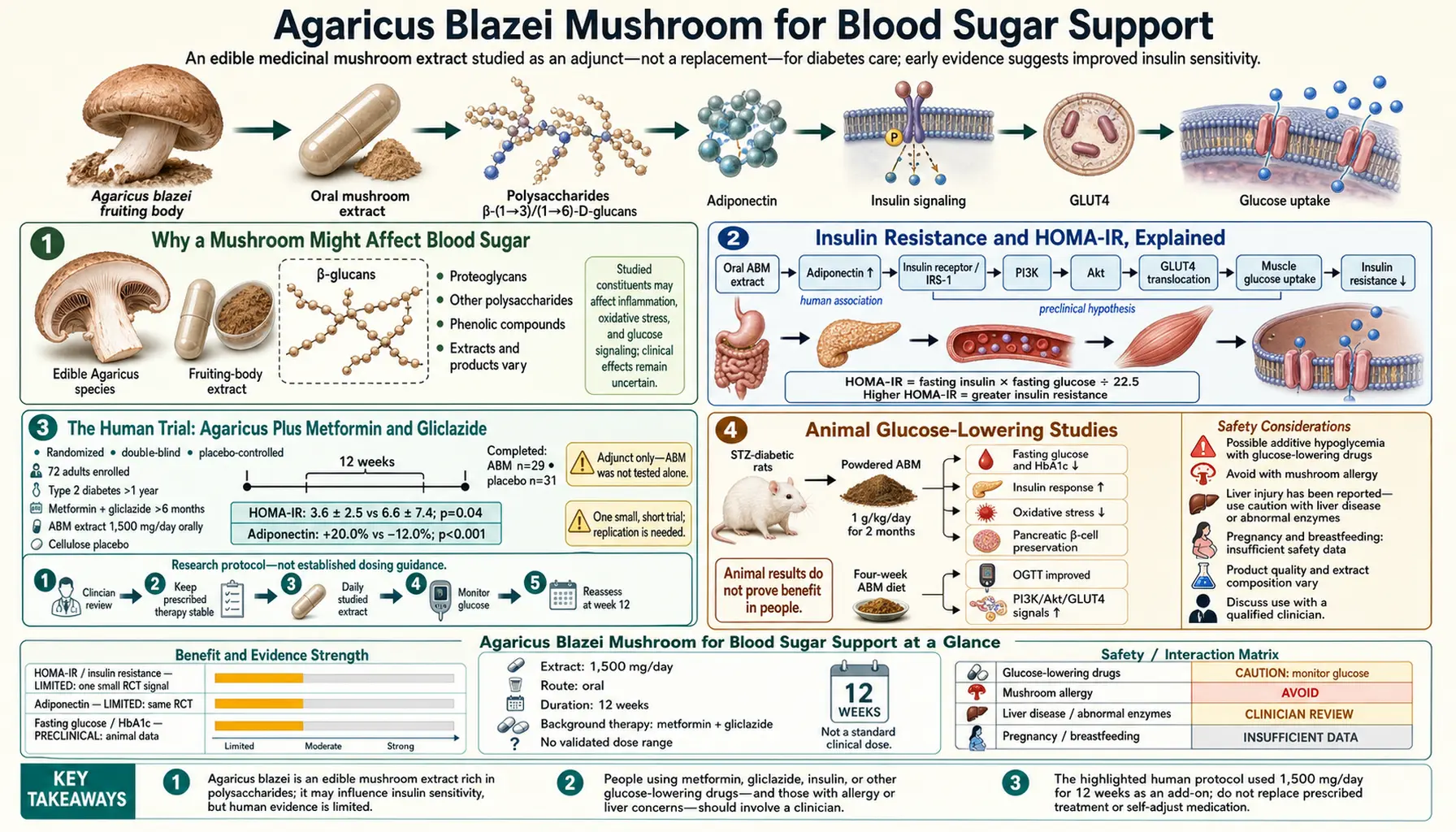
Among the benefits attributed to Agaricus blazei, blood-sugar support has one of the more interesting evidence bases because it includes an actual randomized human trial — a rarity for this mushroom. In that study, an Agaricus blazei extract added to standard diabetes medication improved insulin resistance in people with type 2 diabetes. Animal studies point in the same direction, showing lower blood glucose and better metabolic markers. This page explains what insulin resistance is, walks through the human and animal data honestly, describes the proposed mechanisms (beta-glucan fiber effects, antioxidant activity, and improved insulin signaling), and is candid about the limits: the human evidence is a single small trial, and Agaricus blazei is a possible adjunct to — never a replacement for — proven diabetes care.
Table of Contents
- Why a Mushroom Might Affect Blood Sugar
- Insulin Resistance and HOMA-IR, Explained
- The Human Trial: Agaricus Plus Metformin and Gliclazide
- Animal Glucose-Lowering Studies
- Diet-Induced Obesity and Insulin Resistance
- Oxidative Stress in Diabetic Tissues
- Proposed Mechanisms
- The Honest Limits of the Evidence
- Practical Considerations and Hypoglycemia Risk
- Cautions and Interactions
- Key Research Papers
- External Resources
- Connections
- Featured Videos
Why a Mushroom Might Affect Blood Sugar
There are two broad reasons a beta-glucan-rich mushroom could plausibly influence blood sugar. The first is mechanical and familiar: soluble beta-glucan fiber (the same family of molecule made famous by oat bran) forms a viscous gel in the gut that slows the absorption of glucose after a meal, blunting the post-meal spike. The second is metabolic and more specific: laboratory work suggests Agaricus blazei polysaccharides may improve the way tissues respond to insulin and may reduce the oxidative stress that accompanies and worsens diabetes.
These are genuinely different mechanisms — one is about slowing sugar entry, the other about the body using insulin more effectively — and the human trial is notable precisely because it pointed to the second, insulin sensitivity, rather than merely the first.
Insulin Resistance and HOMA-IR, Explained
Type 2 diabetes is driven largely by insulin resistance: the pancreas still makes insulin, but muscle, liver, and fat cells respond to it poorly, so glucose stays high in the blood and the pancreas has to work ever harder. Improving insulin sensitivity — making cells respond to insulin again — is a central goal of diabetes treatment and the mechanism of the first-line drug metformin.
Researchers estimate insulin resistance with a simple calculation called HOMA-IR (Homeostatic Model Assessment of Insulin Resistance), derived from fasting glucose and fasting insulin. A lower HOMA-IR means better insulin sensitivity. HOMA-IR is the exact measure that improved in the Agaricus blazei human trial, which is why that study is more meaningful than one that only looked at a single glucose reading.
For a fuller picture of the underlying condition, see our pages on Insulin Resistance and Type 2 Diabetes.
The Human Trial: Agaricus Plus Metformin and Gliclazide
The centerpiece of the human evidence is a randomized, double-blind, placebo-controlled trial in people with type 2 diabetes. Participants continued their standard oral medications — metformin and gliclazide — and were additionally given either an Agaricus blazei Murill extract or placebo. After the treatment period, the group receiving the mushroom extract showed improved insulin resistance as measured by HOMA-IR, along with higher levels of adiponectin, a hormone from fat tissue that promotes insulin sensitivity.
Several things make this a reasonably good study for the field: it was randomized, it was double-blind, it used a placebo, and it measured a mechanistically meaningful endpoint (HOMA-IR) rather than a single glucose value. That combination is uncommon in mushroom research and is the main reason blood-sugar support is one of the better-supported claims for Agaricus blazei.
The honest caveats remain important: it was a single, modestly sized trial; the extract was given on top of effective drugs, so the mushroom's standalone effect is unknown; and it has not been widely replicated by independent groups. One good trial is encouraging — it is not the same as an established treatment.
Animal Glucose-Lowering Studies
Animal work is consistent with the human signal. In streptozotocin-induced diabetic rats (a standard chemical model of diabetes), semipurified fractions from Agaricus blazei submerged-culture broth reduced blood glucose levels. Separately, beta-glucans from Agaricus blazei and their enzymatically hydrolyzed oligosaccharides showed anti-diabetic activity in laboratory studies, suggesting that both the intact fiber and smaller breakdown fragments may contribute.
These rodent studies help establish plausibility and point toward mechanisms, but the usual translation gap applies: doses are high, models are artificial, and glucose-lowering in a diabetic rat does not guarantee a clinically useful effect in a person managing diabetes with diet and medication.
Diet-Induced Obesity and Insulin Resistance
Because obesity and insulin resistance are tightly linked, researchers have also tested Agaricus blazei in diet-induced obesity models. In rats fed a fattening diet, supplementation with an Agaricus blazei extract helped prevent diet-induced obesity and the insulin resistance that normally accompanies it. This connects the mushroom's metabolic effects to the broader picture of metabolic syndrome — the cluster of abdominal obesity, high blood pressure, abnormal lipids, and high blood sugar that raises the risk of both diabetes and heart disease.
As a prevention signal in animals this is encouraging, but no human weight-loss or metabolic-syndrome trial of Agaricus blazei supports a claim of preventing obesity or diabetes in people.
Oxidative Stress in Diabetic Tissues
Chronically high blood sugar damages tissues in part through oxidative stress — an excess of reactive oxygen species that harms blood vessels, nerves, kidneys, and other organs, and drives the long-term complications of diabetes. Because Agaricus blazei polysaccharides have antioxidant activity, several studies have asked whether the mushroom can protect diabetic tissues. In one, Agaricus blazei reduced oxidative damage in the lung tissue of rats with streptozotocin-induced diabetes.
This is a mechanistically coherent extension of the mushroom's antioxidant properties (covered on the Liver & Antioxidant page), but again it is animal-level evidence about tissue markers, not proof that the mushroom prevents diabetic complications in humans.
Proposed Mechanisms
Pulling the threads together, the mechanisms proposed for Agaricus blazei's blood-sugar effects are:
- Viscous-fiber glucose blunting — soluble beta-glucan slows carbohydrate absorption, lowering post-meal glucose peaks.
- Improved insulin sensitivity — the human trial showed lower HOMA-IR and higher adiponectin, implying tissues respond better to insulin.
- Antioxidant protection — reduced oxidative stress may protect insulin-producing beta cells and insulin-sensitive tissues.
- Anti-inflammatory signaling — chronic low-grade inflammation contributes to insulin resistance, and the mushroom's modulation of inflammatory pathways may play a role.
These mechanisms are complementary rather than competing, and the truth is likely a mixture. None is fully proven in humans.
The Honest Limits of the Evidence
- The human evidence is essentially one randomized trial, done as an add-on to standard medication, without broad independent replication.
- Most supporting data are from diabetic rodents, with the usual translation caveats.
- There is no standardized product, dose, or duration validated against blood-sugar outcomes.
- Effect sizes, where measured, are modest — a helpful nudge at best, not a substitute for medication or lifestyle change.
Practical Considerations and Hypoglycemia Risk
If you have diabetes and are considering Agaricus blazei, the most important practical point is the flip side of its benefit: because it may lower blood sugar and improve insulin sensitivity, combining it with glucose-lowering drugs (especially insulin or sulfonylureas such as gliclazide or glipizide) could, in theory, push blood sugar too low (hypoglycemia). Anyone using it alongside diabetes medication should monitor blood glucose more closely and discuss possible dose adjustments with their clinician — never adjust prescription medication on your own.
Diet and lifestyle remain the foundation. A supplement that modestly improves insulin sensitivity cannot outweigh the effects of overall dietary pattern, physical activity, weight, and sleep. Treat Agaricus blazei, at most, as a small potential adjunct within a program built on proven measures.
Cautions and Interactions
- Additive glucose-lowering: Risk of hypoglycemia when combined with insulin or sulfonylureas; monitor closely.
- Do not stop prescribed medication: Agaricus blazei is not a replacement for diabetes drugs or insulin.
- Surgery: Because of possible blood-sugar effects, discontinue before scheduled surgery per your clinician's advice.
- Liver caution: See the liver-injury reports on the Liver & Antioxidant page — relevant since diabetes and fatty liver often coexist.
- Heavy metals and quality: Choose third-party-tested products.
- Pregnancy and breastfeeding: Safety not established; avoid medicinal doses.
Key Research Papers
- Hsu CH, et al. (2007). The mushroom Agaricus blazei Murill in combination with metformin and gliclazide improves insulin resistance in type 2 diabetes: a randomized, double-blinded, and placebo-controlled clinical trial. Journal of Alternative and Complementary Medicine. — PubMed PMID: 17309383
- Oh TW, et al. (2010). Semipurified fractions from the submerged-culture broth of Agaricus blazei Murill reduce blood glucose levels in streptozotocin-induced diabetic rats. Journal of Agricultural and Food Chemistry. — PubMed PMID: 20196600
- Kim YW, et al. (2005). Anti-diabetic activity of beta-glucans and their enzymatically hydrolyzed oligosaccharides from Agaricus blazei. Biotechnology Letters. — PubMed PMID: 15928854
- Vincent M, et al. (2013). Dietary supplementation with Agaricus blazei murill extract prevents diet-induced obesity and insulin resistance in rats. Obesity (Silver Spring). — PubMed PMID: 23592663
- Di Naso FC, et al. (2010). Effect of Agaricus blazei Murill on the pulmonary tissue of animals with streptozotocin-induced diabetes. Experimental Diabetes Research. — PubMed PMID: 20585363
- Hetland G, et al. (2011). The mushroom Agaricus blazei Murill elicits medicinal effects on tumor, infection, allergy, and inflammation through its modulation of innate immunity and amelioration of Th1/Th2 imbalance and inflammation. Advances in Pharmacological Sciences. — PubMed PMID: 21912538
- Mukai H, et al. (2006). An alternative medicine, Agaricus blazei, may have induced severe hepatic dysfunction in cancer patients. Japanese Journal of Clinical Oncology. — PubMed PMID: 17105737
PubMed Topic Searches
- PubMed: Agaricus blazei insulin resistance
- PubMed: Agaricus blazei blood glucose
- PubMed: Agaricus blazei beta-glucan antidiabetic
- PubMed: Agaricus blazei adiponectin
- PubMed: beta-glucan postprandial glucose
- PubMed: mushroom polysaccharide type 2 diabetes
External Resources
- Memorial Sloan Kettering — About Herbs: Agaricus
- NIH NCCIH — Herbs at a Glance
- PubMed — all Agaricus blazei diabetes research
Connections
- Agaricus Blazei Mushroom (Main Page)
- Agaricus Blazei Benefits Hub
- Immune Support
- Liver & Antioxidant Support
- Type 2 Diabetes
- Insulin Resistance
- Metabolic Syndrome
- Diabetes (Overview)
- Non-Alcoholic Fatty Liver Disease
- Maitake Mushroom
- Reishi Mushroom
- Endocrinology (Conditions)
- Antioxidants
- Zinc
- All Mushrooms
- Covered in depth on its own page: Insulin Resistance