Selenium for Cancer Prevention
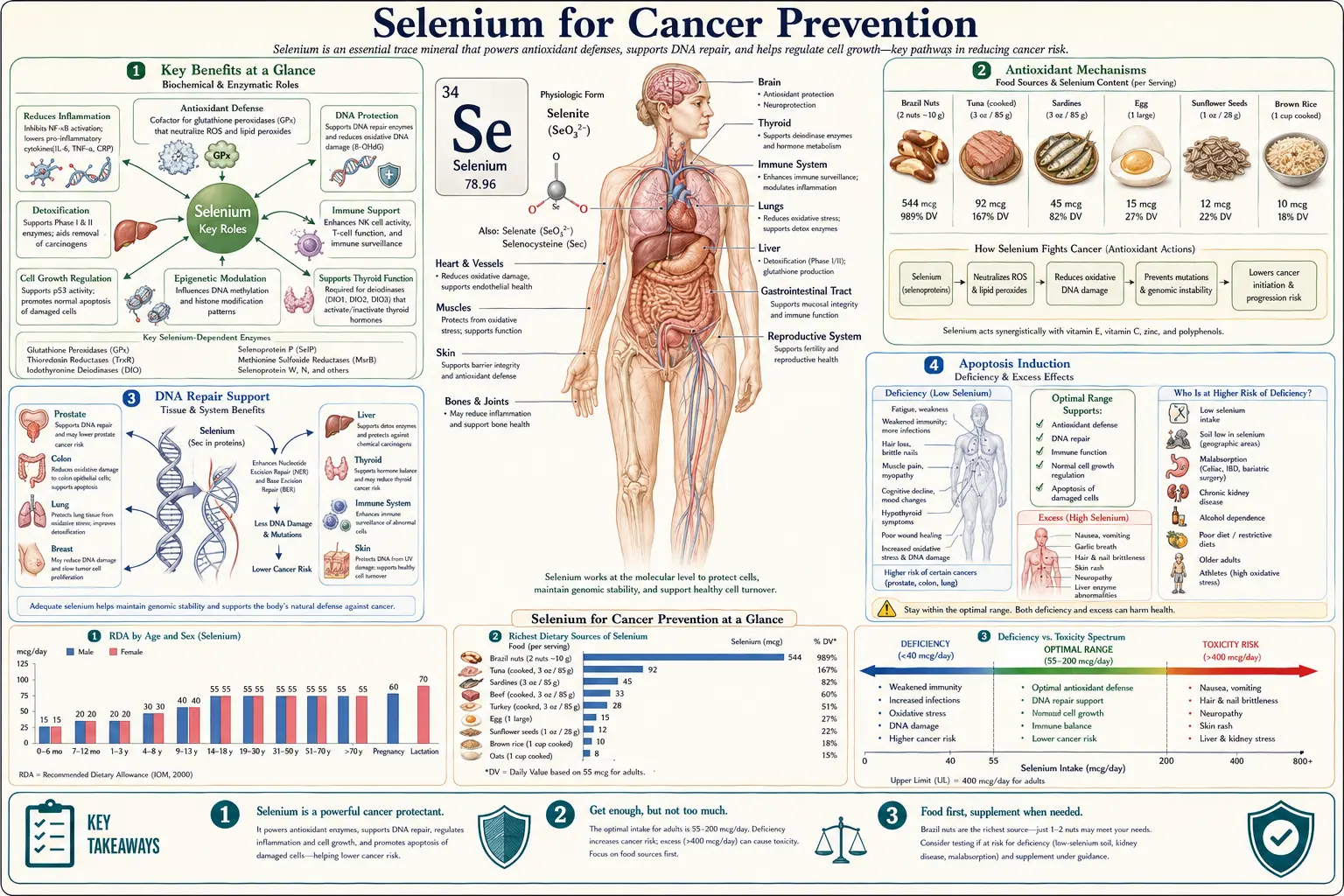
Selenium is an essential trace element that has attracted significant scientific attention for its potential role in cancer prevention. Incorporated into selenoproteins as the amino acid selenocysteine, selenium participates in antioxidant defense, DNA repair, immune regulation, and apoptosis — all processes that are central to the body's ability to prevent malignant transformation and tumor progression.
Table of Contents
- Key Benefits at a Glance
- Antioxidant Mechanisms
- DNA Repair Support
- Apoptosis Induction
- Immune Surveillance Enhancement
- Selenoproteins and Tumor Suppression
- Epidemiological Evidence
- Clinical Trials (NPC and SELECT)
- Dosing and Dietary Sources
- Safety and U-Shaped Risk Curve
- Key Research Papers
- Connections
- Featured Videos
Key Benefits at a Glance
- Antioxidant defense – Glutathione peroxidases and thioredoxin reductases neutralize reactive oxygen species that drive mutagenesis.
- Supports DNA repair – Enhances p53 function, base and nucleotide excision repair, and Gadd45-mediated genome maintenance.
- Selective apoptosis – Methylselenol and selenodiglutathione preferentially induce programmed death in transformed cells.
- Immune surveillance – Improves natural killer (NK) cell activity, cytotoxic T cell function, and M1 macrophage polarization.
- Prostate cancer (low-baseline men) – The NPC trial reported a 52% reduction in prostate cancer incidence at 200 mcg/day; a later analysis found significant reductions only in men whose starting plasma selenium was in the lower two-thirds (below 123.2 ng/mL), and the result was not replicated in selenium-replete SELECT participants. A 2018 Cochrane review found that the NPC idea — that people with low selenium could lower their cancer risk by taking more — “has not been confirmed.”
- U-shaped dose-response – Some researchers describe a U-shaped link in which both low and high selenium status carry risk (Rayman 2012); the 2018 Cochrane review, pooling 70 cohort studies, found no evidence of a dose-response relation between selenium status and cancer risk.
Antioxidant Mechanisms
- Glutathione peroxidases (GPx) are a family of selenoenzymes that reduce hydrogen peroxide and lipid hydroperoxides to water and corresponding alcohols, using glutathione as an electron donor. By neutralizing reactive oxygen species (ROS), GPx enzymes prevent oxidative damage to DNA, proteins, and lipid membranes that can initiate carcinogenesis.
- Thioredoxin reductases (TrxR) are selenoproteins that maintain the thioredoxin system in its reduced state. This system is critical for redox regulation of transcription factors, cell proliferation, and protection against oxidative stress-induced mutagenesis.
- Selenoprotein P (SELENOP) is the major selenium transport protein in plasma and also functions as an extracellular antioxidant. It contains up to 10 selenocysteine residues and can reduce phospholipid hydroperoxides in cell membranes and lipoproteins.
- Reduction of oxidative DNA damage by selenium-dependent enzymes decreases the frequency of mutagenic lesions such as 8-hydroxydeoxyguanosine (8-OHdG), a well-established biomarker of oxidative DNA damage and cancer risk.
DNA Repair Support
- p53 tumor suppressor activation is influenced by selenium status. Selenium supports the redox-dependent folding of p53 into its active DNA-binding conformation, enhancing its ability to induce cell cycle arrest and DNA repair gene expression in response to genotoxic stress.
- Base excision repair (BER) and nucleotide excision repair (NER) pathways are upregulated in cells with adequate selenium supply. These repair mechanisms correct oxidative and bulky DNA lesions before they can lead to permanent mutations.
- BRCA1 expression has been shown to be modulated by selenium in some experimental models. BRCA1 plays a central role in homologous recombination repair of double-strand DNA breaks, and its dysfunction is associated with breast and ovarian cancers.
- Gadd45 (growth arrest and DNA damage) gene expression is enhanced by selenium supplementation, promoting genomic stability by facilitating DNA repair and preventing the accumulation of mutations that drive tumor initiation.
Apoptosis Induction
- Selenium metabolites, particularly methylselenol and selenodiglutathione, can selectively trigger apoptosis in transformed and premalignant cells through both intrinsic (mitochondrial) and extrinsic (death receptor) pathways.
- Caspase activation by selenium compounds involves cytochrome c release from mitochondria, activation of caspase-9, and subsequent activation of executioner caspases-3 and -7, leading to controlled cell death.
- Pro-apoptotic protein upregulation of Bax, Bad, and Bim, along with downregulation of anti-apoptotic proteins Bcl-2 and Bcl-xL, has been demonstrated in cancer cell lines treated with physiological concentrations of selenium.
- Selective toxicity is an important feature of selenium's anticancer activity. At appropriate doses, selenium compounds preferentially induce apoptosis in cancer cells while sparing normal cells, likely due to differences in redox status and metabolic activity.
Immune Surveillance Enhancement
- Natural killer (NK) cell activity is enhanced by adequate selenium status. Natural killer cells are a critical component of innate immune surveillance, responsible for identifying and destroying virally infected and transformed cells before they can establish tumors.
- Cytotoxic T lymphocyte (CTL) function depends on selenium for optimal proliferation and cytolytic capacity. Selenium supplementation has been shown to increase CTL activity and improve the adaptive immune response against tumor antigens.
- Macrophage activation and cytokine production are modulated by selenium. Adequate selenium promotes the M1 macrophage phenotype associated with anti-tumor immunity rather than the M2 phenotype that supports tumor growth.
- Antibody production by B lymphocytes is supported by selenium, contributing to immune surveillance mechanisms that can recognize and target tumor-associated antigens through antibody-dependent cellular cytotoxicity (ADCC).
Selenoproteins and Tumor Suppression
- Selenoprotein 15 (Sep15/SELENOF) resides in the endoplasmic reticulum and participates in protein quality control. Polymorphisms in the Sep15 gene have been associated with altered cancer risk, and loss of Sep15 expression has been observed in several tumor types.
- Glutathione peroxidase 3 (GPx3) is frequently silenced by promoter methylation in various cancers including prostate, gastric, and cervical carcinomas. Its tumor-suppressive function includes inhibition of reactive oxygen species-mediated signaling that promotes cell proliferation and survival.
- Methionine sulfoxide reductase B1 (MsrB1/SELENOR) is a selenoprotein that repairs oxidized methionine residues in proteins, helping maintain proper protein function and preventing the accumulation of damaged proteins that can promote malignant transformation.
- Iodothyronine deiodinases are selenoproteins that regulate thyroid hormone metabolism. Thyroid hormones influence cell differentiation and proliferation, and disruption of selenium-dependent thyroid hormone activation has been linked to thyroid cancer risk.
Epidemiological Evidence
- Geographic correlations between soil selenium content and cancer mortality rates were among the earliest observations suggesting a protective role. Regions with higher soil selenium, and consequently higher dietary selenium intake, tend to have lower rates of certain cancers.
- Prospective cohort studies have found inverse associations between baseline selenium levels (measured in toenails, serum, or plasma) and subsequent risk of prostate, lung, colorectal, and bladder cancers, though results have been inconsistent across populations.
- Prostate cancer has been the most extensively studied malignancy in relation to selenium. Several observational studies have reported reduced risk among men with higher selenium status, particularly those with low baseline selenium levels.
- Dose-response relationships: some researchers describe a U-shaped curve, where both deficiency and excess selenium may increase cancer risk, and a narrow protective window of about 120 to 160 micrograms per liter of plasma has been proposed. The 2018 Cochrane review, pooling 70 cohort studies with over 2.36 million people, found no evidence of a dose-response relation between selenium status and cancer risk, and judged the certainty of the observational evidence very low.
Clinical Trials
- The Nutritional Prevention of Cancer (NPC) Trial (first report 1996; final blinded results 2002) was a landmark randomized controlled trial of 1,312 people with a history of skin cancer, given 200 mcg/day of selenium as selenized yeast or placebo. It did not reduce skin cancer, its main target (relative risk 1.10 for basal cell and 1.14 for squamous cell carcinoma), but in secondary analyses to the end of blinded treatment it reduced total cancer incidence by 25% (hazard ratio 0.75) and prostate cancer incidence by 52% (hazard ratio 0.48), an effect confined to men and to people with lower baseline plasma selenium (below 121.6 ng/mL). These secondary endpoint findings generated enormous interest in selenium as a chemopreventive agent.
- The SELECT Trial (Selenium and Vitamin E Cancer Prevention Trial; data to October 2008, published January 2009) was a large-scale randomized trial of 35,533 men that found no reduction in prostate cancer risk from selenium supplementation (200 mcg/day as selenomethionine; hazard ratio 1.04), and a rise with vitamin E (400 IU/day; hazard ratio 1.13) that was not statistically significant (P = .06). Notably, participants had higher baseline selenium levels than those in the NPC trial; the later analyses below found no benefit, and a higher risk of high-grade prostate cancer in men whose selenium was already high.
- SELECT longer follow-up (2011) – With data to July 2011, 620 men in the vitamin E arm developed prostate cancer versus 529 on placebo, a statistically significant 17% increase (hazard ratio 1.17), or 1.6 extra cases per 1,000 person-years; selenium alone gave a hazard ratio of 1.09, which was not statistically significant.
- SELECT by starting selenium (2014) – An analysis by toenail selenium found that selenium pills had no effect in men with low selenium status, but raised high-grade prostate cancer by 91% in men whose selenium was already higher (P = .007); vitamin E alone raised total prostate cancer by 63% in men with lower selenium status.
- Cochrane review (2018) – Pooling 10 randomized trials with 27,232 participants, the review found that selenium supplements did not change the chance of getting any cancer (risk ratio 1.01 in the trials with low risk of bias) or of dying of cancer (risk ratio 1.02). In SELECT, the largest trial, selenium raised the risk of hair loss (alopecia) and skin inflammation (dermatitis), and the trials together showed a slightly higher risk of type 2 diabetes.
- Differences in selenium form between the NPC trial (selenized yeast containing multiple selenium species) and SELECT (pure selenomethionine) may partly explain the discrepant results, as different selenium compounds have distinct metabolic fates and biological activities.
- Current clinical recommendations do not support routine selenium supplementation for cancer prevention in well-nourished populations. The Recommended Dietary Allowance is 55 mcg/day for adults (60 in pregnancy, 70 during breastfeeding). A 2012 Lancet review noted that extra selenium may benefit people with low status, while people with adequate-to-high status might be affected adversely.
- Ongoing research focuses on identifying individuals most likely to benefit from selenium supplementation based on genotype (selenoprotein gene polymorphisms), baseline selenium status, and specific cancer type, moving toward a precision prevention approach.
Dosing and Dietary Sources
- Recommended Dietary Allowance (RDA) (adults) – 55 mcg/day; pregnancy 60 mcg/day; lactation 70 mcg/day.
- Optimal plasma selenium – Observational data suggest 120–160 mcg/L for selenoprotein saturation.
- Brazil nuts – One nut commonly supplies 68–91 mcg (but ranges 5–100+ mcg depending on soil); at that content, a single nut can exceed the adult RDA of 55 mcg/day.
- Seafood – Tuna, sardines, halibut, shrimp are excellent sources.
- Other dietary sources – Pasture-raised eggs, organ meats, sunflower seeds, whole-grain bread (when grown in selenium-rich soils).
- Supplement forms – Selenomethionine (high bioavailability) and sodium selenite/selenate (direct incorporation into selenoproteins).
Safety and U-Shaped Risk Curve
- Tolerable Upper Intake Level (UL) – 400 mcg/day from all sources.
- Selenosis – Chronic intake > 400 mcg/day may cause garlic breath, hair and nail brittleness, peripheral neuropathy, and gastrointestinal (GI) upset.
- Type 2 diabetes signal – Long-term follow-up of the NPC trial suggested increased type 2 diabetes risk in selenium-replete participants: among 1,202 participants without diabetes followed for an average of 7.7 years, type 2 diabetes developed in 58 on selenium versus 39 on placebo (hazard ratio 1.55), and the risk was highest (hazard ratio 2.70) in those with the highest starting plasma selenium.
- U-shaped curve – In the NPC trial, cancer-prevention benefits appeared in individuals with baseline plasma selenium < 122 mcg/L, a pattern the 2018 Cochrane review found not confirmed by later trials; supplementing already-replete adults may increase risk.
- Drug interactions – May potentiate anticoagulants; high-dose supplementation may interact with cisplatin-based chemotherapy.
This content is provided for informational purposes only and does not constitute medical advice. The adult upper limit is 400 mcg/day from all sources; one Brazil nut can supply 68–91 mcg; and in trials, giving selenium to people whose selenium was already adequate was linked to more type 2 diabetes (NPC, hazard ratio 1.55) and to more high-grade prostate cancer (SELECT, 91% higher in men with high starting selenium).
Key Research Papers
- Clark LC, Combs GF Jr, Turnbull BW, et al. Effects of selenium supplementation for cancer prevention in patients with carcinoma of the skin. A randomized controlled trial. Nutritional Prevention of Cancer Study Group. JAMA. 1996;276(24):1957-1963. — doi:10.1001/jama.1996.03540240035027
- Lippman SM, Klein EA, Goodman PJ, et al. Effect of selenium and vitamin E on risk of prostate cancer and other cancers: the Selenium and Vitamin E Cancer Prevention Trial (SELECT). JAMA. 2009;301(1):39-51. — doi:10.1001/jama.2008.864
- Rayman MP. Selenium and human health. Lancet. 2012;379(9822):1256-1268. — doi:10.1016/S0140-6736(11)61452-9
- Vinceti M, Filippini T, Del Giovane C, et al. Selenium for preventing cancer. Cochrane Database Syst Rev. 2018;(1):CD005195. — doi:10.1002/14651858.CD005195.pub4
- Hatfield DL, Tsuji PA, Carlson BA, Gladyshev VN. Selenium and selenocysteine: roles in cancer, health, and development. Trends Biochem Sci. 2014;39(3):112-120. — doi:10.1016/j.tibs.2013.12.007
- Steinbrenner H, Speckmann B, Sies H. Toward understanding success and failures in the use of selenium for cancer prevention. Antioxid Redox Signal. 2013;19(2):181-191. — doi:10.1089/ars.2013.5246
- Cai X, Wang C, Yu W, et al. Selenium exposure and cancer risk: an updated meta-analysis and meta-regression. Sci Rep. 2016;6:19213. — doi:10.1038/srep19213
- Dennert G, Zwahlen M, Brinkman M, Vinceti M, Zeegers MP, Horneber M. Selenium for preventing cancer. Cochrane Database Syst Rev. 2011;(5):CD005195. — doi:10.1002/14651858.cd005195.pub2
- Kristal AR, Darke AK, Morris JS, et al. Baseline selenium status and effects of selenium and vitamin E supplementation on prostate cancer risk. J Natl Cancer Inst. 2014;106(3):djt456. — doi:10.1093/jnci/djt456
- Duffield-Lillico AJ, Reid ME, Turnbull BW, et al. Baseline characteristics and the effect of selenium supplementation on cancer incidence in a randomized clinical trial: a summary report of the Nutritional Prevention of Cancer Trial. Cancer Epidemiol Biomarkers Prev. 2002;11(7):630-639. — PubMed PMID: 12101110
- Duffield-Lillico AJ, Dalkin BL, Reid ME, et al. Selenium supplementation, baseline plasma selenium status and incidence of prostate cancer: an analysis of the complete treatment period of the Nutritional Prevention of Cancer Trial. BJU Int. 2003;91(7):608-612. — doi:10.1046/j.1464-410x.2003.04167.x
- Klein EA, Thompson IM Jr, Tangen CM, et al. Vitamin E and the risk of prostate cancer: the Selenium and Vitamin E Cancer Prevention Trial (SELECT). JAMA. 2011;306(14):1549-1556. — doi:10.1001/jama.2011.1437
- Stranges S, Marshall JR, Natarajan R, et al. Effects of long-term selenium supplementation on the incidence of type 2 diabetes: a randomized trial. Ann Intern Med. 2007;147(4):217-223. — doi:10.7326/0003-4819-147-4-200708210-00175
- PubMed — selenium + cancer prevention + randomized
- NIH Office of Dietary Supplements — Selenium Fact Sheet
- Linus Pauling Institute — Selenium
Connections
- All Minerals
- Selenium Benefits Hub
- Selenium
- Selenium for Antioxidant Defense
- Selenium for Immune Function
- Selenium and Thyroid Function
- Selenium and Cancer Prevention — selenoprotein biology, the NPC and SELECT trials, evidence across prostate/colorectal/lung cancers, and the U-shaped dose-response curve.
- Vitamin E
- Cancer
- Coffee and Cancer Prevention
- Aspirin and Cancer Prevention
- Zinc
- Iodine
- Vitamin D3
- Prostate Conditions
- Glutathione
- Oxidative Stress
- Methionine
- Thyroid Cancer
- Tuna
- Eggs
- Organ Meats
- Prostate-Specific Antigen Test
- Deficiency
- Toxicity
- History
- Sources