Boron for Arthritis and Joints
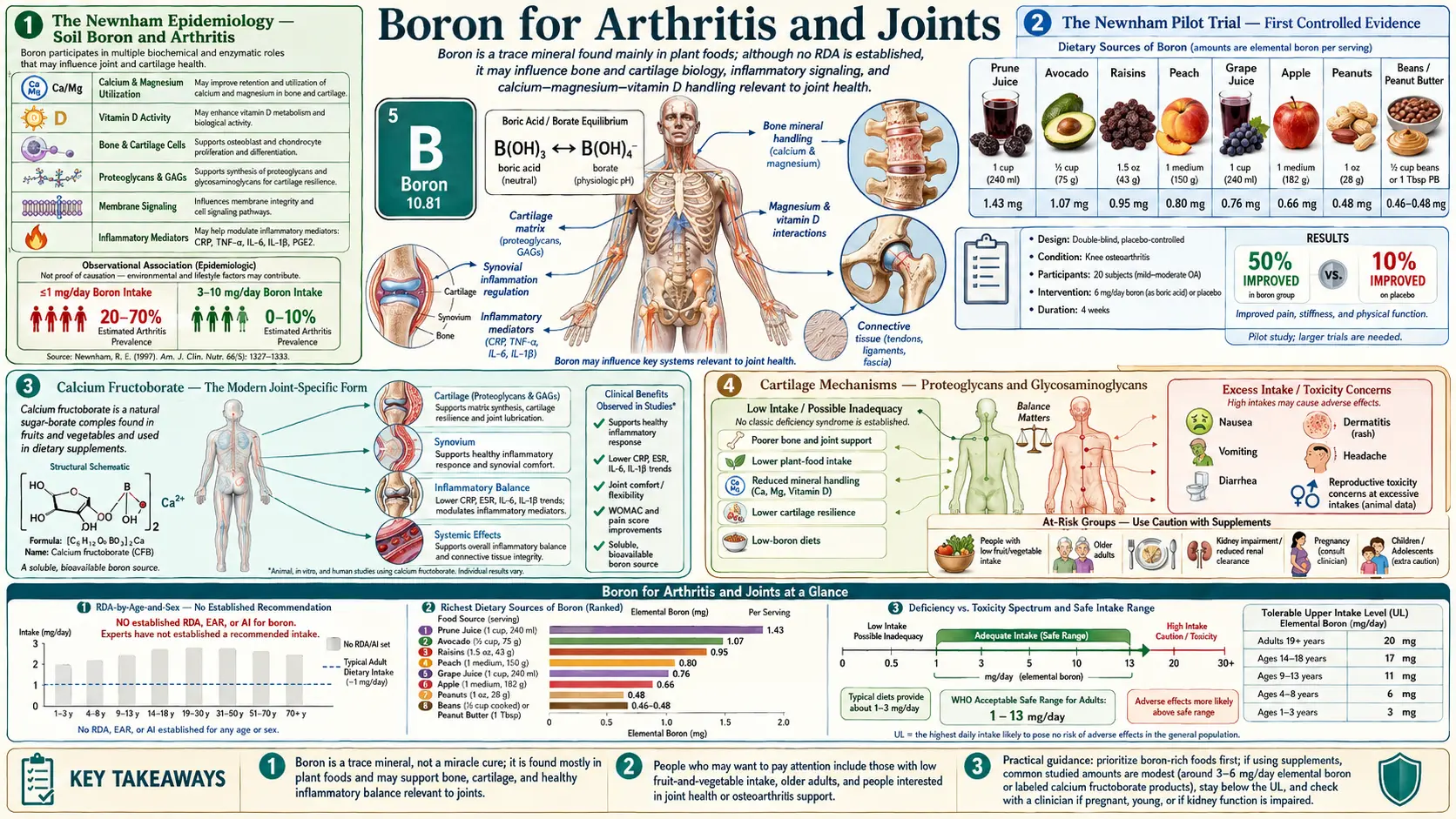
Rex E. Newnham, the researcher most associated with the idea that boron matters for joints, wrote that the idea began in 1963 with his own arthritis: by his account, 6 mg a day of boron (as sodium tetraborate) relieved his own joint pain, swelling and stiffness. He went on to estimate arthritis rates in areas with high and low boron intake, and a small double-blind trial he co-authored (20 people with osteoarthritis, 6 mg/day boron for 8 weeks) reported improvement in 50% of those who started on boron against 10% on placebo. Later, short trials tested calcium fructoborate, a sugar–borate complex, mostly over about two weeks. This page sets out what those studies did and did not show, the laboratory and animal work on mechanisms, and the safety limits set by regulators.
Table of Contents
- The Newnham Epidemiology — Soil Boron and Arthritis
- The 1990 Pilot Trial — Travers, Rennie and Newnham
- Calcium Fructoborate — The Form Used in Later Trials
- Cartilage Mechanisms — Proteoglycans and Glycosaminoglycans
- Inflammation Markers — What Was Measured
- Subchondral Bone and Cartilage Crosstalk
- Osteoarthritis — Doses the Trials Used
- Rheumatoid Arthritis — A Different Mechanism
- Other Joint Conditions — Gout, PsA, Joint Trauma
- Other Nutrients Studied in Joint Health
- Safety, Upper Limits and Interactions
- Key Research Papers
- Connections
- Featured Videos
The Newnham Epidemiology — Soil Boron and Arthritis
In his 1994 account in Environmental Health Perspectives, Newnham described the steps that led him to epidemiology. He had reported that arthritic femur heads contained about half the boron of healthy ones (29.6 ppm against 56 ppm), and other researchers found lower boron in bone and synovial fluid from people with rheumatoid arthritis. In 1981 an Australian regulation declared boron and its compounds a poison, which ended the sale of boron supplements there; he then set out to look for a relationship between arthritis and low boron intake.
His summary of that work, which was published in conference proceedings rather than in indexed journals:
- Areas where boron intake is usually 1 mg a day or less — estimated arthritis incidence of 20–70%
- Areas where boron intake is usually 3–10 mg a day — estimated arthritis incidence of 0–10%
In a 1991 paper in Nutrition and Health he described visiting Jamaica, Mauritius, Fiji and Israel to measure boron in locally eaten food. He reported low boron levels in food grown on the sugar-producing lands of the first three, which he attributed to heavy use of soluble chemical fertilizers, and high boron levels in Israeli foods, which he linked to a low incidence of arthritis there. Country-by-country percentages for these places are widely repeated, but they do not appear in the abstracts of his indexed papers.
These are ecological comparisons: they set estimated rates for whole areas against estimated intakes for those areas. Diet, sun exposure, physical work, age structure, genetic background and the way arthritis was counted all differ between such places, so comparisons of this kind cannot on their own show that boron intake is the cause of the difference. No prospective study of individual boron intake and arthritis risk was found among the sources reviewed for this page.
Proposed mechanisms involve cartilage, inflammation and the bone beneath the cartilage. The sections below describe the laboratory, animal and human studies behind each and how far each has been tested.
The 1990 Pilot Trial — Travers, Rennie and Newnham
Travers, Rennie and Newnham published a double-blind, placebo-controlled pilot trial in the Journal of Nutritional Medicine in 1990. According to Newnham's 1994 description, it was run at the Royal Melbourne Hospital between 1983 and 1987. Twenty patients with radiographically confirmed osteoarthritis, under 75 years of age, with symptoms for fewer than 10 years and free of heart and kidney disease, received either 6 mg/day boron (55 mg of sodium tetraborate decahydrate) or a placebo, and were assessed at the start, after 3 weeks and after 8 weeks. The affected joints included knees, wrists, toes, necks, backs, shoulders and hips.
The findings, as Newnham reported them:
- Two patients (one in each group) dropped out before the 3-week visit, and three more (two on boron, one on placebo) dropped out between weeks 3 and 8, apparently because their condition had worsened; 15 of the 20 finished
- At 3 weeks there was no significant difference between the groups
- At 8 weeks, seven patients on boron and one on placebo said they had improved; the difference was statistically significant (P<0.05, Fisher's exact test), and pain on passive movement was significantly lower in the boron group
- Of those who started the trial, 50% on boron improved against 10% on placebo; of those who completed it, 71% on boron improved
- Younger patients and those with more recent arthritis tended to respond better
- No side effects were apparent, and blood counts and liver and kidney tests did not change significantly
The trial was small (n=20), short (8 weeks), lost 5 of its 20 participants, and studied osteoarthritis only. It has not been repeated with the same sodium tetraborate formulation in any trial found for this page; later trials used calcium fructoborate.
Calcium Fructoborate — The Form Used in Later Trials
Calcium fructoborate is a calcium salt of a fructose–borate complex, one of a family of sugar–borate complexes that occur naturally in plants. Most of its clinical trials come from a small group of researchers in Romania (led by Romulus Scorei) and the United States. A 2011 review by Scorei and Rotaru described its anti-inflammatory activity as coming largely from in vitro studies.
The joint trials, as their abstracts describe them:
- Scorei and colleagues, 2011 (pilot) — 116 people were recruited, 72 started and 60 completed; all had primary knee osteoarthritis. Groups received calcium fructoborate supplying 1.5, 3 or 6 mg boron a day, or a placebo, for 15 days. The outcomes were blood markers — C-reactive protein (CRP), fibrinogen and erythrocyte sedimentation rate, plus blood lipids. The authors reported a beneficial effect on the inflammatory markers in all treated groups compared with placebo and slight changes in lipids; no serious adverse events were reported. The abstract does not report a pain-score result.
- Reyes-Izquierdo and colleagues, 2012 (pilot) — a double-blind, placebo-controlled pilot study whose title reports that short-term calcium fructoborate improved WOMAC and McGill pain scores and biomarkers associated with knee osteoarthritis.
- Pietrzkowski and colleagues, 2014 — 60 people with self-reported knee discomfort received 110 mg calcium fructoborate twice a day or a placebo for 14 days. Compared with placebo, the WOMAC score fell by an estimated 13.73 points more at day 14 (P<0.0001; at day 7 the difference of 5.3 points was not significant, P=0.06), and the McGill Pain Questionnaire score by 8.9 points more at day 14. The placebo group's scores did not change.
All were described as short-term (the two with stated durations lasted 14 and 15 days), and the trials that measured pain were small. Trial reports give the dose either as milligrams of calcium fructoborate or as milligrams of boron: one trial report states that 112 mg/day of calcium fructoborate is equivalent to 3.0 mg boron/day. No trial found for this page compared calcium fructoborate head-to-head with an inorganic boron form such as boric acid or sodium tetraborate for joint symptoms.
Cartilage Mechanisms — Proteoglycans and Glycosaminoglycans
Articular cartilage is composed of chondrocytes (cells) embedded in an extracellular matrix of type II collagen fibrils and a hydrated proteoglycan gel. The proteoglycans (predominantly aggrecan) consist of a core protein with multiple covalently attached glycosaminoglycan (GAG) chains — primarily chondroitin sulfate and keratan sulfate. The GAG chains are highly negatively charged and attract water into the cartilage matrix, producing the gel-like consistency that gives cartilage its compressive resistance and elastic properties.
The progressive loss of proteoglycans and GAGs is a central biochemical feature of osteoarthritis. As the cartilage loses its hydrated proteoglycan content, it loses its compressive resistance, the collagen fibrillar network is mechanically stressed, fibrillation and erosion of the cartilage surface follows, and eventually the underlying subchondral bone is exposed. The clinical correlates are joint pain, stiffness, and reduced range of motion.
How boron might act on this tissue is largely a matter of hypothesis:
- Boroester formation — a 2014 review by Nielsen describes findings suggesting that boron acts by forming boroesters with biomolecules that carry cis-hydroxyl groups, including S-adenosylmethionine, NAD, glycoproteins and glycolipids. Whether this happens in cartilage proteoglycans in people, and whether it protects them, has not been shown
- Cartilage-degrading enzymes — the matrix metalloproteinases (particularly MMP-13, which degrades type II collagen) and the ADAMTS enzymes that degrade aggrecan are switched on by inflammatory cytokines in osteoarthritis. No human study found for this page measured these enzymes after boron intake
- Vitamin D — the vitamin D receptor is expressed in chondrocytes. In one study of eight healthy men, a week of 10 mg/day boron was followed by higher blood vitamin D; effects on cartilage were not measured
No study found for this page measured cartilage structure or proteoglycan content in people taking boron.
Inflammation Markers — What Was Measured
Joint inflammation contributes to symptoms in both osteoarthritis (where it is secondary to cartilage damage) and rheumatoid arthritis (where it is the primary disease process). Pro-inflammatory cytokines produced by synovial cells and immune cells (IL-1-beta, IL-6, TNF-alpha) drive cartilage matrix breakdown, bone remodeling and the pain, stiffness, swelling and warmth of an inflamed joint.
What studies of boron and inflammation found:
- Cell studies of calcium fructoborate — the 2011 Scorei and Rotaru review reports that in vitro it inhibited superoxide and the release of IL-1-beta, IL-6 and nitric oxide, but increased TNF-alpha production and had no effect on the expression of the COX-2 enzyme
- Healthy men, inorganic boron — Naghii and colleagues (2011) gave eight healthy men 10 mg boron a day for a week. hsCRP and TNF-alpha fell within six hours of the first dose, and all three inflammatory markers measured were lower after a week; cortisol, vitamin D and dihydrotestosterone rose
- Healthy adults, calcium fructoborate — in a 30-day double-blind trial (Rogoveanu and colleagues, 2015), 112 mg/day of calcium fructoborate lowered CRP by 31.3% and IL-1-beta by 29.2% from baseline, and both doses tested lowered IL-6
- Knee osteoarthritis, calcium fructoborate — the 2011 Scorei pilot reported lower inflammatory markers (CRP, fibrinogen, sedimentation rate) than placebo after 15 days
- Animals — Newnham's 1994 review cites reports that rats given an arthritis-inducing adjuvant developed less inflammation when given boron, and that boron showed anti-arthritic activity in formaldehyde-induced arthritis in rats
These are short studies of blood markers, most of them in healthy people. None compared boron with NSAIDs or tested whether it changes NSAID use.
Subchondral Bone and Cartilage Crosstalk
Osteoarthritis is not exclusively a cartilage disease. The subchondral bone (the layer of bone immediately beneath articular cartilage) undergoes progressive sclerosis, microfracture, and remodeling that contribute to and exacerbate the overlying cartilage damage. The bone-cartilage interaction is bidirectional — cartilage damage allows abnormal mechanical loading of the subchondral bone, while subchondral bone changes alter the mechanical environment of the cartilage and accelerate cartilage degradation.
This is why bone findings are often discussed alongside cartilage findings in boron research. The bone evidence is covered on the Bone Density page. At the cell level, Hakki and colleagues (2010) found that boron at low concentrations increased mineralized nodules and the expression of bone-matrix genes (collagen type I, osteopontin, bone sialoprotein, osteocalcin, RUNX2) in a mouse pre-osteoblast cell line. Newnham's 1994 review also repeats surgeons' observations that bones of patients who took boron were harder to cut. Neither finding shows an effect on the subchondral bone of an osteoarthritic joint, which no human study found for this page has measured.
Osteoarthritis — Doses the Trials Used
The doses and durations in the osteoarthritis and knee-discomfort trials:
- Sodium tetraborate — 6 mg boron a day for 8 weeks (Travers, Rennie and Newnham, 1990)
- Calcium fructoborate — 1.5, 3 or 6 mg boron a day for 15 days (Scorei, 2011); 110 mg calcium fructoborate twice a day for 14 days (Pietrzkowski, 2014)
- Time to response — in the 1990 trial, Newnham reported that people under 60 generally responded within a month, while those aged 60 to 70 needed up to two months. The calcium fructoborate trials reported changes at 7 and 14 days but did not follow people beyond that
None of these trials tested boron for longer than 8 weeks, compared it with standard osteoarthritis treatments, or examined whether it changes the need for joint surgery. Topical boron products have no trial data in the sources reviewed for this page.
Osteoarthritis is covered in full on the Arthritis page and the Joint Pain page.
Rheumatoid Arthritis — A Different Mechanism
Rheumatoid arthritis (RA) differs fundamentally from osteoarthritis. RA is an autoimmune disease in which the immune system targets the synovial lining of joints, producing pannus formation, severe synovial inflammation, and secondary cartilage and bone destruction. The disease is systemic (extra-articular manifestations are common) and its cytokine drivers (particularly TNF-alpha and IL-6) differ from those primarily implicated in osteoarthritis.
The boron evidence for RA is thinner still than for osteoarthritis:
- Newnham's regional estimates refer to “arthritis” without separating RA from osteoarthritis
- Lower boron concentrations were reported in bone and synovial fluid from people with RA (as cited in Newnham's 1994 review; the original was a conference paper)
- The boron and calcium fructoborate trials described on this page enrolled people with osteoarthritis or knee discomfort, not RA
- The inflammatory-marker findings above come mostly from healthy people; their relevance to RA has not been tested
RA is treated with disease-modifying anti-rheumatic drugs (DMARDs) and biologics, which have changed the outlook of the disease for most patients treated early. None of the boron studies described here tested boron alongside them.
Other Joint Conditions — Gout, PsA, Joint Trauma
No trial of boron was found for any of the following. Claims made for them rest on extrapolation from the inflammation and bone findings above:
- Gout — the inflammatory arthritis caused by urate crystal deposition in joints. No study found for this page links boron to uric acid levels or gout attacks
- Psoriatic arthritis (PsA) — the inflammatory arthritis associated with psoriasis, an immune-mediated condition managed with DMARDs and biologics
- Ankylosing spondylitis — axial spondyloarthritis; the same lack of trial data applies
- Joint trauma and post-surgical recovery — Newnham's 1994 review mentions a clinical impression that boron accelerated fracture healing; no controlled study of it was cited
- Athletic overuse and hypermobility syndromes — tendonitis, bursitis, Ehlers–Danlos syndrome and generalized joint hypermobility have no boron trial data
Other Nutrients Studied in Joint Health
Boron is often discussed alongside other nutrients and supplements that have been studied in osteoarthritis. Each has its own evidence, covered on its own page (see Connections below): glucosamine and chondroitin, MSM, collagen peptides, vitamin C (a cofactor for collagen synthesis), vitamin D, vitamin K2, magnesium, omega-3 fatty acids, curcumin, boswellia, SAMe and oral hyaluronic acid. No trial found for this page tested boron in combination with any of them.
Body weight is one of the most studied non-supplement factors. In an 18-month diet and exercise trial in 142 overweight and obese older adults with knee osteoarthritis, Messier and colleagues (2005) reported that each pound of weight lost was associated with a four-fold reduction in the load on the knee per step during daily activities.
Safety, Upper Limits and Interactions
- Upper limits — the US Tolerable Upper Intake Level (UL), set by the Institute of Medicine, is 20 mg/day for adults; the European Food Safety Authority (EFSA, 2004) set a lower adult UL of 10 mg/day (0.16 mg per kg of body weight per day)
- Short-term trials — the 1990 trial reported no apparent side effects over 8 weeks at 6 mg/day, and the 2011 calcium fructoborate pilot reported no serious adverse events over 15 days. These trials were too small and short to detect uncommon or long-term effects
- Pregnancy — in rats fed boric acid throughout pregnancy, fetal body weight was reduced and rib changes increased at the higher doses; the no-observed-adverse-effect level was 55 mg boric acid per kg per day at gestation day 20 (Price and colleagues, 1996). No trial of boron supplements in human pregnancy was found among the sources reviewed for this page
- Kidney disease — the 1990 trial excluded people with kidney or heart disease
- Drug interactions — no study found for this page tested boron supplements together with NSAIDs, DMARDs, biologics, glucocorticoids, urate-lowering drugs or anticoagulants, so the absence of reported interactions reflects a lack of study rather than proof of safety
Decisions about supplements, especially alongside prescription treatment for arthritis, belong with a clinician.
Key Research Papers
- Travers RL, Rennie GC, Newnham RE (1990). Boron and arthritis: the results of a double-blind pilot study. Journal of Nutritional Medicine 1:127-132. — doi:10.3109/13590849009003147
- Newnham RE (1994). Essentiality of boron for healthy bones and joints. Environmental Health Perspectives 102 Suppl 7:83-85. — PubMed PMID: 7889887
- Scorei RI, Rotaru P (2011). Calcium fructoborate — potential anti-inflammatory agent. Biological Trace Element Research 143(3):1223-1238. — PubMed PMID: 21274653
- Pietrzkowski Z, Phelan MJ, Keller R, Shu C, Argumedo R, Reyes-Izquierdo T (2014). Short-term efficacy of calcium fructoborate on subjects with knee discomfort: a comparative, double-blind, placebo-controlled clinical study. Clinical Interventions in Aging 9:895-899. — PubMed PMID: 24940052
- Reyes-Izquierdo T, Nemzer B, Gonzalez AE, Zhou Q, Argumedo R, Shu C, Pietrzkowski Z (2012). Short-term intake of calcium fructoborate improves WOMAC and McGill scores and beneficially modulates biomarkers associated with knee osteoarthritis: a pilot clinical double-blinded placebo-controlled study. American Journal of Biomedical Sciences 4:111-122. — doi:10.5099/aj120200111
- Naghii MR (1999). The significance of dietary boron, with particular reference to athletes. Nutrition and Health 13(1):31-37. — PubMed PMID: 10376277
- Newnham RE (1991). The role of boron in human nutrition. Journal of Applied Nutrition. — PubMed (not indexed in PubMed; details unverified)
- Hakki SS, Bozkurt BS, Hakki EE (2010). Boron regulates mineralized tissue-associated proteins in osteoblasts (MC3T3-E1). Journal of Trace Elements in Medicine and Biology 24(4):243-250. — PubMed PMID: 20685097
- Mahabir S, Spitz MR, Barrera SL, Dong YQ, Eastham C, Forman MR (2008). Dietary boron and hormone replacement therapy as risk factors for lung cancer in women. American Journal of Epidemiology 167(9):1070-1080. — PubMed PMID: 18343880
- Korkmaz M, Uzgören E, Bakirdere S, Aydin F, Ataman OY (2007). Effects of dietary boron on cervical cytopathology and on micronucleus frequency in exfoliated buccal cells. Environmental Toxicology 22(1):17-25. — PubMed PMID: 17295277
- Nielsen FH (2014). Update on human health effects of boron. Journal of Trace Elements in Medicine and Biology 28(4):383-387. — PubMed PMID: 25063690
- Newnham RE (1991). Agricultural practices affect arthritis. Nutrition and Health 7(2):89-100. — PubMed PMID: 1645463
- Scorei R, Mitrut P, Petrisor I, Scorei I (2011). A double-blind, placebo-controlled pilot study to evaluate the effect of calcium fructoborate on systemic inflammation and dyslipidemia markers for middle-aged people with primary osteoarthritis. Biological Trace Element Research 144(1-3):253-263. — PubMed PMID: 21607703
- Rogoveanu OC, Mogoşanu GD, Bejenaru C, Bejenaru LE, Croitoru O, Neamţu J, Pietrzkowski Z, Reyes-Izquierdo T, Biţă A, Scorei ID, Scorei RI (2015). Effects of calcium fructoborate on levels of C-reactive protein, total cholesterol, low-density lipoprotein, triglycerides, IL-1β, IL-6, and MCP-1: a double-blind, placebo-controlled clinical study. Biological Trace Element Research 163(1-2):124-131. — PubMed PMID: 25433580
- Naghii MR, Mofid M, Asgari AR, Hedayati M, Daneshpour MS (2011). Comparative effects of daily and weekly boron supplementation on plasma steroid hormones and proinflammatory cytokines. Journal of Trace Elements in Medicine and Biology 25(1):54-58. — PubMed PMID: 21129941
- Hunter JM, Nemzer BV, Rangavajla N, Biţă A, Rogoveanu OC, Neamţu J, Scorei IR, Bejenaru LE, Rău G, Bejenaru C, Mogoşanu GD (2019). The fructoborates: part of a family of naturally occurring sugar-borate complexes — biochemistry, physiology, and impact on human health: a review. Biological Trace Element Research 188(1):11-25. — PubMed PMID: 30343480
- Messier SP, Gutekunst DJ, Davis C, DeVita P (2005). Weight loss reduces knee-joint loads in overweight and obese older adults with knee osteoarthritis. Arthritis and Rheumatism 52(7):2026-2032. — PubMed PMID: 15986358
- Price CJ, Strong PL, Marr MC, Myers CB, Murray FJ (1996). Developmental toxicity NOAEL and postnatal recovery in rats fed boric acid during gestation. Fundamental and Applied Toxicology 32(2):179-193. — PubMed PMID: 8921321
- Pizzorno L (2015). Nothing boring about boron. Integrative Medicine (Encinitas) 14(4):35-48 (review; states the US UL of 20 mg/day). — PubMed PMID: 26770156
- EFSA Panel on Dietetic Products, Nutrition and Allergies (2004). Opinion related to the Tolerable Upper Intake Level of boron (sodium borate and boric acid). EFSA Journal 2(8):80. — doi:10.2903/j.efsa.2004.80
PubMed Topic Searches
Connections
- All Minerals
- Boron Overview
- Boron Benefits Hub
- Boron for Bone Density
- Boron for Hormone Balance
- Boron for Cognitive Function
- Arthritis
- Osteoarthritis — the condition with the strongest boron trial evidence, from the Newnham pilot study to the calcium fructoborate WOMAC trials.
- Osteoporosis
- Joint Pain
- Pain & Allergy
- Magnesium
- Calcium
- Vitamin D3
- Vitamin K2
- Vitamin C
- Collagen
- Omega-3 Fatty Acids
- Turmeric/Curcumin
- Boswellia
- MSM
- Glucosamine & Chondroitin
- Deficiency
- Toxicity
- History