Osteoarthritis
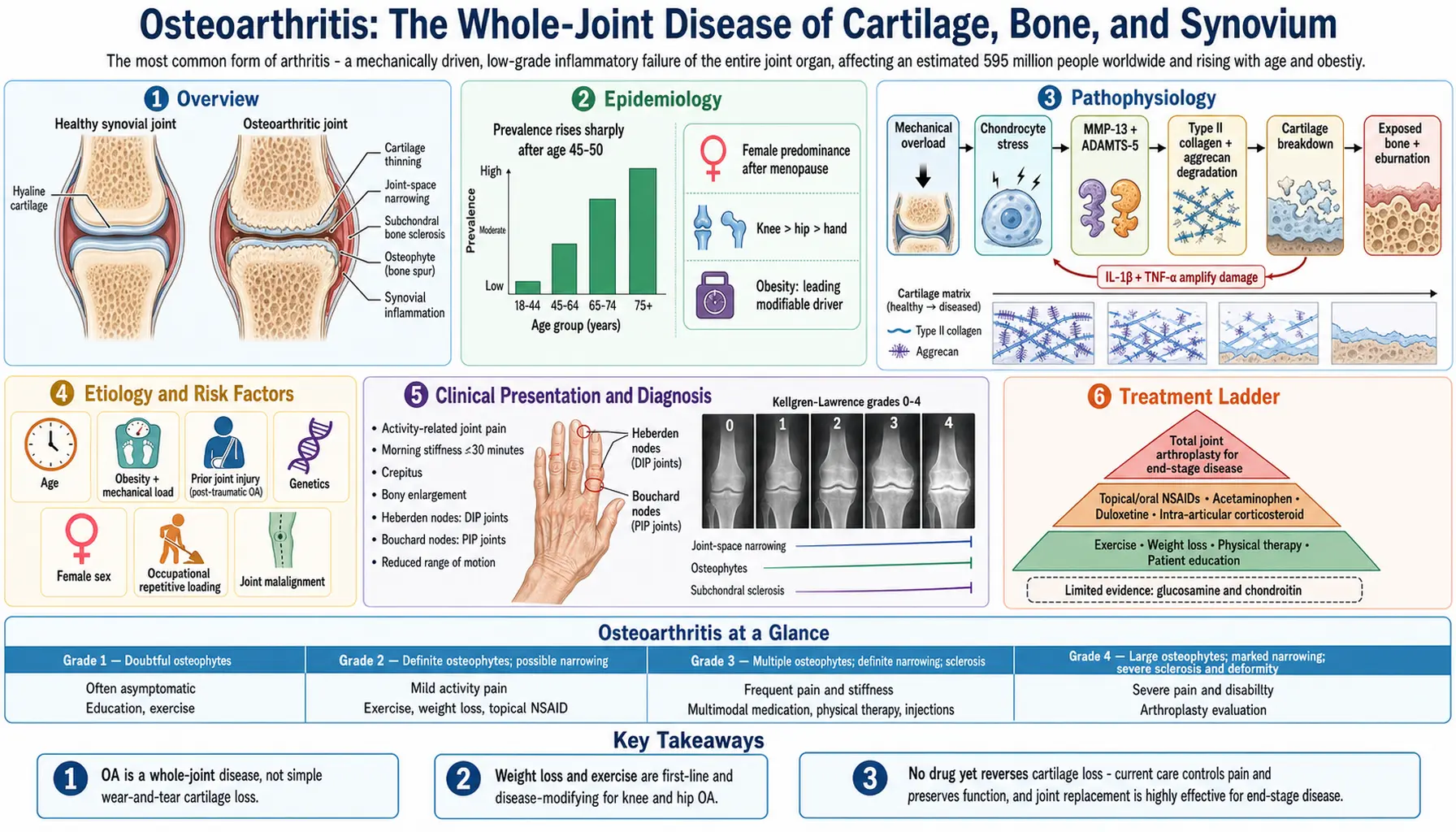
Table of Contents
1. Overview
Osteoarthritis (OA) is the most common joint disease. A 2021 JAMA review estimated that it affects more than 240 million people worldwide, including more than 32 million in the United States, and called it the most frequent reason for activity limitation in adults (Katz 2021). Aching knees on stairs, hips that stiffen after sitting, and pain at the base of the thumb are typical ways it shows itself.
For decades, osteoarthritis was described as simple "wear and tear". Reviews of the joint biology describe that label as a misnomer: osteoarthritis is abnormal remodeling of joint tissues driven by inflammatory mediators within the joint, and its pathological changes involve the cartilage, the bone underneath it (subchondral bone), the joint lining (synovium), the ligaments, the menisci, the joint capsule, and the surrounding muscles, nerves and fat pads — which is why researchers call it a disease of the joint as an organ (Loeser 2012; Katz 2021).
The distinction matters because "wear and tear" implies that using a joint makes things worse. The guideline evidence points the other way: the 2019 American College of Rheumatology/Arthritis Foundation guideline strongly recommends exercise for knee, hip and hand osteoarthritis, and strongly recommends weight loss for knee and hip osteoarthritis in people who are overweight or obese (Kolasinski 2020); the OARSI 2019 guideline lists education and structured land-based exercise, with or without dietary weight management, as core treatments for knee OA (Bannuru 2019). In a meta-analysis of running studies, recreational runners had a lower occurrence of hip and knee osteoarthritis than sedentary controls (Alentorn-Geli 2017).
Osteoarthritis is different from rheumatoid arthritis (RA), a chronic inflammatory joint disease that can cause cartilage and bone damage (Smolen 2016). The two are often confused — this article points out the distinctions along the way. For a comparison of all the major arthritis types, see the Arthritis overview.
2. Epidemiology
Osteoarthritis is extraordinarily common, and the number of people living with it is rising:
- United States: more than 32 million people, according to the 2021 JAMA review (Katz 2021).
- Worldwide: the Global Burden of Disease Study 2021 estimated that 595 million people had osteoarthritis in 2020 — 7.6% of the global population — an increase of 132.2% in total cases since 1990. Knee was the most common site, high body-mass index contributed to 20.4% of osteoarthritis, and cases were projected to rise by 74.9% for knee and 78.6% for hip osteoarthritis by 2050 (GBD 2021 Osteoarthritis Collaborators 2023).
- Lifetime risk: in the Johnston County Osteoarthritis Project (3,068 adults aged 45 and over in North Carolina), the lifetime risk of symptomatic knee osteoarthritis was 44.7%; it was 56.8% in people with a history of knee injury and about 2 in 3 among people with obesity (Murphy 2008).
- Age: the GBD analysis reports that osteoarthritis most frequently occurs after age 40 and that prevalence increases steeply with age; for adults aged 70 and older it was the seventh-ranked cause of years lived with disability (GBD 2021 Osteoarthritis Collaborators 2023).
- Sex: female sex is among the listed risk factors (Katz 2021).
- Most-affected joints: osteoarthritis can involve almost any joint but typically affects the hands, knees, hips and feet (Katz 2021); twin studies also cover osteoarthritis of the hip and spine (Spector 2004).
The GBD authors expect the demand on health systems, including joint replacements, to rise in all regions as populations grow and age (GBD 2021 Osteoarthritis Collaborators 2023).
3. Pathophysiology
The ends of the bones in a joint are capped with articular cartilage, a tissue maintained by cells called chondrocytes within a matrix that includes type II collagen and the proteoglycan aggrecan. In normal adult cartilage at rest, chondrocytes are quiescent and there is very little turnover of the matrix (Loeser 2012).
In osteoarthritis, several things happen at once — this is why researchers call it a whole-joint disease (Loeser 2012):
- Cartilage breakdown. The earliest changes appear at the joint surface where mechanical forces, especially shear stress, are greatest. Chondrocytes become "activated" — proliferating, forming clusters and producing both matrix proteins and matrix-degrading enzymes. In early osteoarthritis, MMP-3 and the aggrecanase ADAMTS-5 degrade aggrecan; collagenases follow, in particular MMP-13, which is highly efficient at degrading type II collagen. Once the collagen network is degraded, the review states, a state appears to be reached that cannot be reversed (Loeser 2012).
- The subchondral bone remodels. The bone beneath the cartilage thickens, osteophytes (bony spurs) form, and MRI shows bone marrow lesions that likely reflect remodeling of microdamage (Loeser 2012). In a study of 401 people with knee osteoarthritis, bone marrow lesions were found in 77.5% of those with painful knees versus 30% of those without knee pain, though among people with pain the lesions were not associated with pain severity (Felson 2001).
- The synovium becomes inflamed. Synovial inflammatory infiltrates are found in many osteoarthritis patients, generally of lower grade than in rheumatoid arthritis; synovitis occurs even in early disease and becomes more prevalent with advancing stage. The most-studied inflammatory mediators, interleukin-1β and TNF-α, can suppress matrix synthesis and promote cartilage breakdown, but attempts to block them in patients have shown only minimal symptomatic benefit (Loeser 2012).
- The whole organ is affected. Ligaments and, in the knee, the menisci degenerate, the joint capsule thickens, and periarticular muscles, nerves, bursae and fat pads can change (Loeser 2012).
- The nervous system can become sensitized. A systematic review of 36 studies concluded that, although peripheral mechanisms are involved in osteoarthritis pain, hypersensitivity of the central nervous system (central sensitization) plays a significant role in a subgroup of patients (Lluch 2014). This helps explain why pain and X-ray findings often do not match, and why duloxetine, a drug acting on the nervous system, has been studied in osteoarthritis (see Treatment).
Aging also changes cartilage: advanced glycation end-products accumulate and make it more "brittle", and chondrocytes with features of the senescence-associated secretory phenotype produce more cytokines, chemokines and MMPs (Loeser 2012).
4. Etiology and Risk Factors
The most common risk factors for osteoarthritis are age, sex, prior joint injury, obesity, genetic predisposition, and mechanical factors including malalignment and abnormal joint shape (Loeser 2012):
- Age — described as the strongest risk factor for osteoarthritis (Loeser 2012).
- Obesity. A meta-analysis of 14 prospective studies found that overweight and obesity were associated with knee osteoarthritis risks of 2.45 and 4.55 times that of normal weight, respectively, and that risk rose by 35% for every 5 kg/m² increase in body-mass index (Zheng 2015). In a gait study of 142 older adults with knee osteoarthritis, a 1 kg weight reduction was associated with about a 4-unit reduction in knee-joint forces; the authors summarize this as each pound of weight lost producing a 4-fold reduction in the load on the knee per step (Messier 2005). In the Framingham Study, women whose body-mass index fell by 2 units or more (about 5.1 kg) over 10 years had over 50% lower odds of developing symptomatic knee osteoarthritis (odds ratio 0.46) (Felson 1992).
- Prior joint injury. A review of anterior cruciate ligament (ACL) and meniscus injuries found that 10 to 20 years after diagnosis, on average 50% of people with a diagnosed ACL or meniscus tear have osteoarthritis with associated pain and functional impairment, and that there is a lack of evidence that repair or reconstructive surgery protects against it (Lohmander 2007). This is how "post-traumatic" osteoarthritis appears in younger people — the review's phrase is "the young patient with an old knee".
- Genetics. Classic twin studies put the genetic influence at 39% to 65% for radiographic hand and knee osteoarthritis in women, about 60% for hip and about 70% for spine osteoarthritis (Spector 2004). One well-replicated example is a variant in the GDF5 gene, associated with knee osteoarthritis in a meta-analysis of more than 11,000 European and Asian individuals (Chapman 2008).
- Occupation. A meta-analysis of 71 studies found increased odds of knee osteoarthritis (odds ratio 1.52) in physically demanding jobs compared with sedentary work; occupational lifting, kneeling, climbing, squatting and standing were all associated with higher odds, and job titles included farmer, builder, metal worker and floor layer (Wang 2020). Running is discussed under Prevention.
- Joint alignment. In a cohort of 237 people with knee osteoarthritis, bow-legged (varus) alignment was associated with a 4-fold increase in the odds of inner-knee progression over 18 months, and knock-kneed (valgus) alignment with a nearly 5-fold increase in outer-knee progression (Sharma 2001).
- Muscle weakness. A meta-analysis of five cohort studies (5,707 participants) found that knee-extensor (quadriceps) weakness was associated with an increased risk of developing symptomatic knee osteoarthritis (odds ratio 1.65) in both men and women (Øiestad 2015).
5. Clinical Presentation
Osteoarthritis typically causes joint pain, stiffness, functional limitation and loss of valued activities such as walking for exercise (Katz 2021). The UK NICE guideline describes the typical picture as activity-related joint pain with either no morning joint stiffness or morning stiffness lasting no longer than 30 minutes (NICE NG226). Other common features include:
- Bony enlargement — a useful examination finding in knee osteoarthritis (Katz 2021); osteophytes form at the joint margins (Loeser 2012).
- Reduced function — difficulty with walking, stairs and daily tasks; in hip osteoarthritis, pain elicited with internal rotation of the hip is a useful examination finding (Katz 2021).
- Flares — NICE describes flares as a temporary worsening of pain, swelling and stiffness that can affect sleep, activity and wellbeing (NICE NG226).
Typical joint patterns
- Knee — the most common site of osteoarthritis worldwide (GBD 2021 Osteoarthritis Collaborators 2023). Varus and valgus alignment load the inner and outer compartments respectively (Sharma 2001).
- Hip — pain with internal rotation of the hip is a diagnostic clue (Katz 2021).
- Hand — hand osteoarthritis has a strong genetic component (Spector 2004). The 2019 ACR guideline addresses the base-of-the-thumb (first carpometacarpal, CMC) joint separately, strongly recommending hand orthoses there (Kolasinski 2020).
- Spine — twin studies estimate the genetic influence on spine osteoarthritis at about 70% (Spector 2004). Back and leg-nerve symptoms with other causes are covered on the sciatica page.
Osteoarthritis vs. rheumatoid arthritis
The distinction matters because the treatments differ. Rheumatoid arthritis is a chronic inflammatory joint disease in which early diagnosis is described as key to treatment success; autoantibodies and high disease activity are risk factors for poor outcomes (Smolen 2016). The synovial inflammation of osteoarthritis is generally of lower grade than in rheumatoid arthritis (Loeser 2012). NICE lists prolonged morning joint stiffness, rapid worsening, deformity and a hot swollen joint among the "atypical features" that point away from a straightforward osteoarthritis diagnosis and toward imaging or an alternative diagnosis (NICE NG226). The Rheumatoid Arthritis page covers that disease in detail.
6. Diagnosis
Osteoarthritis is a clinical diagnosis. NICE recommends diagnosing it clinically, without imaging, in people who are 45 or over, have activity-related joint pain, and have either no morning joint-related stiffness or stiffness lasting no longer than 30 minutes; the guideline recommends against routine imaging unless there are atypical features or features suggesting an alternative or additional diagnosis (NICE NG226). A 2019 Lancet seminar describes the diagnosis of osteoarthritis as clinically based despite the widespread overuse of imaging (Hunter 2019).
X-rays and the Kellgren-Lawrence grades
When X-rays are taken, osteoarthritis is commonly graded on the Kellgren-Lawrence (KL) scale, proposed in 1957 (Kellgren 1957; Kohn 2016). The grade descriptions as summarized in a 2016 review (Kohn 2016):
- Grade 0 — none.
- Grade 1 — doubtful narrowing of the joint space with possible osteophyte formation.
- Grade 2 — possible narrowing of the joint space with definite osteophyte formation. (Grade 2 and above is the usual threshold for "radiographic OA".)
- Grade 3 — definite narrowing of the joint space, moderate osteophyte formation, some sclerosis, and possible deformity of the bone ends.
- Grade 4 — large osteophytes, severe narrowing of the joint space with marked sclerosis, and definite deformity of the bone ends.
X-rays and symptoms often don't match
A systematic review of population studies found that among people with knee pain, the proportion with radiographic knee osteoarthritis ranged from 15% to 76%, and among people with radiographic knee osteoarthritis, the proportion with pain ranged from 15% to 81%. The authors concluded that knee X-ray results should not be used in isolation when assessing individual patients with knee pain (Bedson 2008). Pain can arise from structures plain X-rays do not show, such as bone marrow lesions (Felson 2001) and nervous-system sensitization (Lluch 2014).
Other tests
- MRI — in a Framingham sample of 991 people aged 50 to 90, meniscal tears or meniscal destruction on MRI ranged from 19% of women aged 50 to 59 to 56% of men aged 70 to 90, and 61% of people with meniscal tears had had no knee pain, aching or stiffness in the previous month (Englund 2008). NICE recommends against routine imaging for diagnosis (NICE NG226).
- Look-alike conditions — NICE's atypical features (recent trauma, prolonged morning stiffness, rapid worsening, a hot swollen joint, or concerns about infection or malignancy) are the situations in which it suggests imaging or an alternative or additional diagnosis (NICE NG226). Other causes of joint pain, such as gout, have their own pages.
7. Treatment
No drug is approved that regrows cartilage or halts osteoarthritis. The guidelines summarized below — the 2019 American College of Rheumatology/Arthritis Foundation guideline (Kolasinski 2020), the OARSI 2019 guideline (Bannuru 2019) and the UK NICE guideline NG226 — place exercise, weight management and education at the centre, with medicines and injections as additions. Decisions about any treatment belong with a clinician; the ACR guideline itself stresses shared decision-making that accounts for each patient's values, preferences and comorbidities (Kolasinski 2020).
7.1 Exercise — first-line in every guideline
- Guidelines: exercise is strongly recommended for knee, hip and hand osteoarthritis by the ACR, which notes that current evidence is insufficient to recommend a specific "best" exercise or dose (Kolasinski 2020). OARSI lists structured land-based exercise as a core treatment (Bannuru 2019), and NICE recommends offering therapeutic exercise tailored to the person's needs to all people with osteoarthritis (NICE NG226).
- Cochrane evidence: the 2015 Cochrane review (54 studies) found high-quality evidence that land-based exercise reduced knee pain by the equivalent of 12 points on a 0-to-100 scale immediately after treatment, with benefits sustained for two to six months; the authors judged the effect moderate to small but comparable with estimates reported for NSAIDs (Fransen 2015). The 2024 update (139 trials, 12,468 participants) found that, compared with attention control or placebo, exercise may slightly improve pain (8.7 points on a 0-to-100 scale, low-certainty evidence) and likely improves physical function (Lawford 2024).
- Tai chi is strongly recommended for knee and hip osteoarthritis by the ACR (Kolasinski 2020). In a 52-week trial of 204 people with knee osteoarthritis, 12 weeks of tai chi produced benefits similar to a standard course of physical therapy, with significantly greater improvements in depression and the physical component of quality of life (Wang 2016).
- Starting out: NICE notes that joint pain may increase when therapeutic exercise begins, and that regular, consistent exercise is beneficial for the joints in the long term (NICE NG226). In the Cochrane review, the adverse events reported were increased knee or low-back pain, and no study reported a serious adverse event (Fransen 2015).
7.2 Weight loss
The IDEA trial (Messier 2013) randomized 454 overweight and obese adults aged 55 and over with knee osteoarthritis to intensive diet plus exercise, diet alone, or exercise alone for 18 months. Mean weight loss was 10.6 kg (11.4%) with diet plus exercise, 8.9 kg (9.5%) with diet, and 1.8 kg (2.0%) with exercise. The diet group had lower knee compressive forces than the exercise group, both diet groups had lower interleukin-6 levels, and the diet-plus-exercise group had less pain and better function than both other groups. The ACR guideline describes a dose-response: a loss of 5% or more of body weight can be associated with clinical and mechanistic changes, and clinically important benefits continue to increase with losses of 5–10%, 10–20% and more than 20% (Kolasinski 2020). NICE states that any amount of weight loss is likely to be beneficial, but losing 10% of body weight is likely to be better than 5% (NICE NG226). The Obesity page covers weight-loss approaches.
7.3 Medications — what the guidelines say
- Topical NSAIDs (e.g., diclofenac gel). Strongly recommended for knee osteoarthritis and conditionally recommended for hand osteoarthritis by the ACR, which states, in keeping with the principle that medicines with the least systemic exposure are preferable, that topical NSAIDs should be considered before oral NSAIDs (Kolasinski 2020). OARSI strongly recommends them for knee osteoarthritis (Level 1A) (Bannuru 2019), and NICE recommends offering a topical NSAID for knee osteoarthritis (NICE NG226).
- Oral NSAIDs (ibuprofen, naproxen, celecoxib). Strongly recommended by the ACR, which calls them the initial oral medicine of choice and states that doses should be as low as possible and treatment as short as possible (Kolasinski 2020). OARSI does not recommend any oral NSAID for people with cardiovascular comorbidities or frailty (Bannuru 2019); NICE lists potential gastrointestinal, renal, liver and cardiovascular toxicity as considerations (NICE NG226). An individual-participant meta-analysis of NSAID trials found that a coxib or high-dose diclofenac increased major vascular events by about a third, heart-failure risk was roughly doubled by all NSAIDs, and all NSAID regimens increased upper gastrointestinal complications, with high-dose naproxen carrying less vascular risk than the other NSAIDs (CNT Collaboration 2013).
- Acetaminophen (paracetamol). The guidelines differ. The 2019 ACR guideline conditionally recommends acetaminophen for knee, hip and hand osteoarthritis, while noting that its effect sizes in trials are very small, that longer-term treatment is no better than placebo for most people, that its Patient Panel found it ineffective for most individuals, that it may be appropriate for short-term, episodic use in people who cannot take NSAIDs, and that regular use requires monitoring for liver toxicity (Kolasinski 2020). OARSI 2019 conditionally does not recommend it (Level 4A/4B) (Bannuru 2019), and NICE recommends against offering it routinely (NICE NG226). A 2015 meta-analysis found high-quality evidence of a statistically significant but not clinically important effect on hip and knee osteoarthritis pain (3.7 points on a 0-to-100 scale), and that people taking it were nearly four times more likely to have abnormal liver-function test results, of uncertain clinical importance (Machado 2015).
- Duloxetine. An SNRI antidepressant, conditionally recommended for knee, hip and hand osteoarthritis by the ACR, which states that, of the centrally acting agents, only duloxetine has adequate evidence on which to base recommendations for use in osteoarthritis (Kolasinski 2020); the 2021 JAMA review describes it as having demonstrated efficacy (Katz 2021).
- Opioids (including tramadol). The ACR conditionally recommends tramadol and conditionally recommends against other opioids, citing very modest long-term benefits and a high risk of toxicity and dependence (Kolasinski 2020). OARSI strongly does not recommend oral or transdermal opioids (Level 5) (Bannuru 2019), and NICE recommends against offering strong opioids, stating that their risks outweigh their benefits (NICE NG226).
7.4 Injections — what they do and don't do
- Corticosteroid ("cortisone") injections. Strongly recommended for knee and hip osteoarthritis by the ACR, which cites trials showing short-term efficacy in knee osteoarthritis (Kolasinski 2020). NICE describes the relief as short-term (2 to 10 weeks) (NICE NG226). In a 2-year randomized trial of 140 people with knee osteoarthritis and ultrasound signs of synovitis, 40 mg of triamcinolone injected every 3 months produced significantly greater cartilage loss than saline (cartilage thickness change −0.21 mm vs −0.10 mm) and no significant difference in knee pain; the authors concluded that the findings do not support this treatment (McAlindon 2017).
- Hyaluronic acid ("gel" / viscosupplementation) injections. The ACR conditionally recommends against them for knee and thumb-base osteoarthritis and strongly recommends against them for hip osteoarthritis, noting that when analysis is limited to trials at low risk of bias, their effect compared with saline approaches zero (Kolasinski 2020). OARSI places them at Level 1B/2 for knee osteoarthritis depending on comorbidities and does not recommend them for hip or polyarticular osteoarthritis (Bannuru 2019); NICE recommends against offering them (NICE NG226). A meta-analysis of 89 trials (12,667 adults) found that the 18 large trials with blinded outcome assessment showed a clinically irrelevant effect, and that viscosupplementation increased the risk of serious adverse events (relative risk 1.41) (Rutjes 2012).
- Platelet-rich plasma (PRP) and stem-cell injections — see Recent Research. The ACR strongly recommends against both for knee and hip osteoarthritis (Kolasinski 2020).
7.5 Supplements — what the trials found
- Glucosamine and chondroitin. The US GAIT trial (Clegg 2006) randomized 1,583 people with symptomatic knee osteoarthritis to glucosamine 1,500 mg daily, chondroitin sulfate 1,200 mg daily, both, celecoxib, or placebo for 24 weeks. Overall, glucosamine and chondroitin alone or combined did not reduce pain effectively; response rates were not significantly higher than placebo's 60.1%, while celecoxib's was. In an exploratory subgroup with moderate-to-severe pain, the combination had a higher response rate than placebo (79.2% vs 54.3%). A European trial of glucosamine sulfate 1,500 mg daily in 212 people over 3 years reported no significant joint-space loss with glucosamine versus progressive narrowing with placebo (Reginster 2001). The 2019 ACR guideline strongly recommends against glucosamine for knee, hip and hand osteoarthritis, stating that the data at lowest risk of bias fail to show important benefit over placebo and that discrepancies between industry-sponsored and publicly funded studies raise serious concerns about publication bias; it strongly recommends against chondroitin for knee and hip osteoarthritis (and against combination products) but conditionally recommends chondroitin for hand osteoarthritis (Kolasinski 2020). NICE recommends against offering glucosamine (NICE NG226).
- Curcumin (turmeric extract). A 2016 meta-analysis of 8 randomized trials found that turmeric extracts and curcumin reduced pain scores compared with placebo, with no significant difference from pain medicines in five studies, and concluded that the evidence supports the efficacy of turmeric extract (about 1,000 mg/day of curcumin), while stating that the number of trials, total sample size and methodological quality were not sufficient for definitive conclusions (Daily 2016). In a 4-week multicenter trial, 367 people with knee osteoarthritis received a Curcuma domestica extract (1,500 mg/day) or ibuprofen (1,200 mg/day); the extract was non-inferior on WOMAC total, pain and function scores, and abdominal pain or discomfort was significantly more frequent with ibuprofen (Kuptniratsaikul 2014). The US National Center for Complementary and Integrative Health (NCCIH) states that highly bioavailable curcumin formulations may harm the liver and that liver damage has been reported in some people who used them (NCCIH, Turmeric). See Turmeric.
- Boswellia serrata (Indian frankincense). A 2020 meta-analysis of seven trials (545 patients) concluded that boswellia and its extracts may relieve pain and stiffness and improve function in osteoarthritis (Yu 2020). The evidence base is much smaller than for exercise. See Boswellia.
- Collagen. In a 180-day trial of 191 volunteers with knee osteoarthritis, 40 mg daily of undenatured type II collagen reduced the total WOMAC score more than placebo and more than glucosamine hydrochloride plus chondroitin sulfate; two of the three authors listed affiliations with the company that supplies the ingredient (Lugo 2016). See Collagen.
- Omega-3 fish oil. The ACR conditionally recommends against fish oil, noting that only one published trial had addressed it in osteoarthritis and that it failed to show efficacy of a higher dose over a lower dose (Kolasinski 2020). In that 2-year trial of 202 people, the low-dose group had greater improvement in pain and function at 2 years than the high-dose group, with no difference in cartilage volume loss (Hill 2016).
- Vitamin D. The ACR conditionally recommends against vitamin D, noting that some trials showed small effects, others no benefit, and that pooled data were null (Kolasinski 2020).
7.6 What did NOT work in sham-controlled and randomized surgery trials
- Arthroscopic debridement/lavage ("clean-out scope") for knee OA. In the Moseley trial (NEJM 2002), 180 patients were randomized to arthroscopic debridement, arthroscopic lavage, or placebo surgery (skin incisions and a simulated debridement without insertion of the arthroscope), with patients and outcome assessors blinded. At no point over 24 months did either real procedure produce less pain or better function than the placebo procedure (Moseley 2002). A second randomized trial in moderate-to-severe knee osteoarthritis (92 patients assigned to surgery, 86 to physical and medical therapy alone) found that arthroscopic surgery added to optimized physical and medical therapy provided no additional benefit at 2 years (Kirkley 2008). NICE recommends against offering arthroscopic lavage or debridement for osteoarthritis (NICE NG226).
- Arthroscopic partial meniscectomy for degenerative meniscus tears. The Finnish FIDELITY trial randomized 146 patients aged 35 to 65 with symptoms of a degenerative medial meniscus tear and no knee osteoarthritis to partial meniscectomy or sham surgery: outcomes at 12 months were no better after the real procedure (Sihvonen 2013). Meniscal tears are common on MRI in middle-aged and older people, often without symptoms (Englund 2008).
- Wedged insoles — lateral and medial wedged insoles are conditionally recommended against by the ACR, which states that the literature does not demonstrate clear efficacy (Kolasinski 2020).
Simple aids with guideline support: the ACR strongly recommends a cane for knee or hip osteoarthritis that substantially affects walking, stability or pain, tibiofemoral knee braces for knee osteoarthritis in people who can tolerate them, and hand orthoses for base-of-the-thumb osteoarthritis; it conditionally recommends heat or cold (thermal interventions) (Kolasinski 2020).
7.7 Joint replacement — outcomes
NICE suggests considering referral for joint replacement when joint symptoms substantially affect quality of life and non-surgical management is ineffective or unsuitable, using clinical assessment rather than numerical severity scores, and not excluding people on the basis of age, sex, smoking, comorbidities or body weight (NICE NG226). The 2021 JAMA review states that total joint replacement effectively relieves pain for people with advanced symptoms and structural damage (Katz 2021). Published outcome data:
- Total hip replacement — called "the operation of the century" in a 2007 Lancet review, which states that in the 1960s it revolutionised the management of elderly patients crippled with arthritis (Learmonth 2007). Pooled national-registry data show about 58% of hip replacements lasting 25 years (Evans 2019, hip).
- Total knee replacement — in an Ontario study of 1,703 primary knee replacements, about one in five (19%) patients were not satisfied with the outcome; the strongest predictor of dissatisfaction was unmet expectations (Bourne 2010, TKA satisfaction). Pooled registry data show about 82% of knee replacements lasting 25 years (Evans 2019, knee).
- Hip vs knee: in a comparison by the same group, overall satisfaction was 89% after hip replacement and 81% after knee replacement, and 96% versus 89% would undergo the surgery again (Bourne 2010, THA vs TKA).
8. Complications
- Mobility loss and disability. Osteoarthritis is the most frequent reason for activity limitation in adults (Katz 2021), and for adults aged 70 and older it is the seventh-ranked cause of years lived with disability (GBD 2021 Osteoarthritis Collaborators 2023). Fragile bones are covered on the Osteoporosis page.
- Inactivity and mortality. People with osteoarthritis have more comorbidities and are more sedentary than people without it, and the 2021 JAMA review attributes a 20% higher age-adjusted mortality to the reduced physical activity (Katz 2021).
- Depression and anxiety. A meta-analysis of 49 studies found a pooled prevalence of depressive symptoms of 19.9% and of anxiety symptoms of 21.3% among people with osteoarthritis — about one in five — though it was uncertain whether these rates are higher than in people without osteoarthritis (Stubbs 2016).
- Chronic pain sensitization. Central sensitization plays a significant role in osteoarthritis pain for a subgroup of patients (Lluch 2014) — see Chronic Pain.
- Treatment complications. NSAIDs increase upper gastrointestinal complications and, depending on the drug, vascular events and heart failure (CNT Collaboration 2013); hyaluronic acid injections were associated with more serious adverse events in a meta-analysis (Rutjes 2012); and in trials of the nerve-growth-factor antibody tanezumab, joint safety events including rapidly progressive osteoarthritis were significantly more common than with NSAIDs (Hochberg 2021).
9. Prognosis
There is no effective cure for osteoarthritis (GBD 2021 Osteoarthritis Collaborators 2023). Research identifies several factors linked to how it develops and progresses:
- Factors linked to progression or onset: varus and valgus malalignment (Sharma 2001), obesity (Zheng 2015), prior joint injury (Lohmander 2007), and quadriceps weakness (Øiestad 2015). Several of these can change over time.
- What changed outcomes in trials: exercise reduced knee pain and improved function (Fransen 2015; Lawford 2024), and diet-induced weight loss of about 10% combined with exercise improved pain and function more than exercise alone (Messier 2013).
- Life expectancy: osteoarthritis is not itself described as fatal, but the reduced physical activity associated with it is linked to a 20% higher age-adjusted mortality (Katz 2021).
- Advanced disease: total joint replacement effectively relieves pain for people with advanced symptoms and structural damage (Katz 2021), and registry data show about 58% of hip and 82% of knee replacements lasting 25 years (Evans 2019, hip; Evans 2019, knee).
10. Prevention
- Body weight. In the Framingham Study, women whose body-mass index fell by 2 units or more (about 5.1 kg) over 10 years had over 50% lower odds of developing symptomatic knee osteoarthritis (Felson 1992), and each pound of weight lost is associated with a 4-fold reduction in knee load per step (Messier 2005). Obesity is a robust risk factor for knee osteoarthritis (Zheng 2015).
- Joint-injury prevention programmes. Because ACL and meniscus injuries are followed by osteoarthritis in about half of people within 10 to 20 years (Lohmander 2007), the GBD authors list recreational injury prevention among potentially modifiable risk factors for osteoarthritis (GBD 2021 Osteoarthritis Collaborators 2023). A 2018 meta-analysis of eight meta-analyses found that neuromuscular warm-up programmes for ACL injury reduction reduced the risk of all ACL injuries by 50% in all athletes (odds ratio 0.5, 95% CI 0.41–0.59) and of non-contact ACL injuries by 67% in female athletes (odds ratio 0.33); six of the eight meta-analyses included only female athletes, and the authors found insufficient data to draw conclusions for male athletes (Webster 2018).
- Running and activity. A 2017 meta-analysis of 17 studies (114,829 individuals) found an overall prevalence of hip and knee osteoarthritis of 3.5% in recreational runners, 10.2% in sedentary non-running controls and 13.3% in competitive runners. Compared with controls, the odds ratio was 0.86 for recreational and 1.34 for competitive runners (neither difference from controls was statistically significant), while the difference between competitive and recreational runners was significant. The authors concluded that a more sedentary lifestyle and long exposure to high-volume or high-intensity running are both associated with hip and knee osteoarthritis, but that it was not possible to determine whether these associations were causal or confounded by factors such as previous injury (Alentorn-Geli 2017).
- Muscle strength. Quadriceps weakness is associated with a higher risk of developing symptomatic knee osteoarthritis (Øiestad 2015).
- Occupational load. Physically demanding work involving lifting, kneeling, climbing, squatting and standing is associated with higher odds of knee osteoarthritis (Wang 2020). The GBD authors note that injury prevention and occupational hazards had not yet been modelled as modifiable risk factors (GBD 2021 Osteoarthritis Collaborators 2023).
11. Recent Research and Advances
- The search for DMOADs (disease-modifying OA drugs). No drug is yet approved that slows structural progression. In the FORWARD trial (549 participants), intra-articular sprifermin (a recombinant fibroblast growth factor-18) at 100 µg every 6 or 12 months increased total femorotibial cartilage thickness over 2 years compared with placebo — statistically significant but of uncertain clinical importance — while the 30 µg doses did not, and there were no significant differences in WOMAC symptom scores (Hochberg 2019). The 2021 JAMA review lists cathepsin K inhibitors, Wnt inhibitors and anabolic growth factors among compounds with promising results in trials (Katz 2021).
- Nerve-growth-factor inhibitors. In a phase III trial of 3,021 patients with hip or knee osteoarthritis, subcutaneous tanezumab improved pain and function compared with NSAIDs (significantly so at the 5 mg dose), but a composite of joint safety events (adjudicated rapidly progressive osteoarthritis, osteonecrosis, subchondral insufficiency fracture or pathologic fracture) was significantly more common than with NSAIDs, in a dose-dependent way (Hochberg 2021).
- GLP-1 drugs and weight loss. In the 68-week STEP 9 trial (407 participants with obesity and knee osteoarthritis), weekly semaglutide 2.4 mg produced a mean weight change of −13.7% versus −3.2% with placebo and a WOMAC pain change of −41.7 versus −27.5 points (0-to-100 scale); adverse events leading to permanent discontinuation occurred in 6.7% versus 3.0%, most often gastrointestinal (Bliddal 2024).
- Metformin. In a 6-month randomized trial of 107 people with knee osteoarthritis and overweight or obesity, metformin 2,000 mg/day reduced knee pain by 31.3 mm versus 18.9 mm with placebo on a 100-mm scale (difference 11.4 mm; the trial's stated minimum clinically important difference was 15 mm); the authors called for a larger confirmatory trial (Pan 2025).
- PRP and "stem cells". In the RESTORE trial, 288 people aged 50 and over with mild-to-moderate medial knee osteoarthritis received three weekly injections of platelet-rich plasma or saline placebo; at 12 months there was no significant difference in knee pain or medial tibial cartilage volume, and 29 of 31 secondary outcomes showed no difference (Bennell 2021). The ACR strongly recommends against PRP and stem-cell injections for knee and hip osteoarthritis, citing the heterogeneity and lack of standardization of the preparations and techniques (Kolasinski 2020).
- Research agenda. The ACR guideline lists better understanding of integrative medicine (including massage and herbal products), fall prevention, and agents with novel mechanisms of action among the research needs it identified (Kolasinski 2020).
Key Research Papers
Historical Background
The modern radiographic era of osteoarthritis began in 1957, when Jonas Kellgren and John Lawrence published their 0–4 X-ray grading system (Kellgren 1957; Kohn 2016). In the 1960s, total hip replacement revolutionised the management of elderly patients crippled with arthritis (Learmonth 2007); the British orthopaedic surgeon Sir John Charnley (1911–82) is best known for developing the low-friction arthroplasty, described as the first truly successful total hip replacement (Jackson 2011). More recently, research into synovitis, subchondral bone and inflammatory mediators has reframed osteoarthritis from passive "wear and tear" to abnormal remodeling of the whole joint driven by inflammatory mediators (Loeser 2012).
- Hunter DJ, Bierma-Zeinstra S. Osteoarthritis. The Lancet. 2019;393(10182):1745-1759. — doi:10.1016/S0140-6736(19)30417-9
- Kellgren JH, Lawrence JS. Radiological Assessment of Osteo-Arthrosis. Annals of the Rheumatic Diseases. 1957;16(4):494-502. — doi:10.1136/ard.16.4.494
- Messier SP, Gutekunst DJ, Davis C, DeVita P. Weight loss reduces knee-joint loads in overweight and obese older adults with knee osteoarthritis. Arthritis & Rheumatism. 2005;52(7):2026-2032. — doi:10.1002/art.21139
- Messier SP, Mihalko SL, Legault C, et al. Effects of Intensive Diet and Exercise on Knee Joint Loads, Inflammation, and Clinical Outcomes Among Overweight and Obese Adults With Knee Osteoarthritis: The IDEA Randomized Clinical Trial. JAMA. 2013;310(12):1263-1273. — doi:10.1001/jama.2013.277669
- Felson DT, Zhang Y, Anthony JM, Naimark A, Anderson JJ. Weight Loss Reduces the Risk for Symptomatic Knee Osteoarthritis in Women: The Framingham Study. Annals of Internal Medicine. 1992;116(7):535-539. — doi:10.7326/0003-4819-116-7-535
- Fransen M, McConnell S, Harmer AR, Van der Esch M, Simic M, Bennell KL. Exercise for osteoarthritis of the knee. Cochrane Database of Systematic Reviews. 2015;(1):CD004376. — doi:10.1002/14651858.CD004376.pub3 — Note: a newer version of this review was published in 2024 (Lawford 2024, below).
- Wang C, Schmid CH, Iversen MD, et al. Comparative Effectiveness of Tai Chi Versus Physical Therapy for Knee Osteoarthritis: A Randomized Trial. Annals of Internal Medicine. 2016;165(2):77-86. — doi:10.7326/M15-2143
- Moseley JB, O'Malley K, Petersen NJ, et al. A Controlled Trial of Arthroscopic Surgery for Osteoarthritis of the Knee. New England Journal of Medicine. 2002;347(2):81-88. — doi:10.1056/NEJMoa013259
- Sihvonen R, Paavola M, Malmivaara A, et al. Arthroscopic Partial Meniscectomy versus Sham Surgery for a Degenerative Meniscal Tear. New England Journal of Medicine. 2013;369(26):2515-2524. — doi:10.1056/NEJMoa1305189
- McAlindon TE, LaValley MP, Harvey WF, et al. Effect of Intra-articular Triamcinolone vs Saline on Knee Cartilage Volume and Pain in Patients With Knee Osteoarthritis: A Randomized Clinical Trial. JAMA. 2017;317(19):1967-1975. — doi:10.1001/jama.2017.5283
- Clegg DO, Reda DJ, Harris CL, et al. Glucosamine, Chondroitin Sulfate, and the Two in Combination for Painful Knee Osteoarthritis. New England Journal of Medicine. 2006;354(8):795-808. — doi:10.1056/NEJMoa052771
- Reginster JY, Deroisy R, Rovati LC, et al. Long-term effects of glucosamine sulphate on osteoarthritis progression: a randomised, placebo-controlled clinical trial. The Lancet. 2001;357(9252):251-256. — doi:10.1016/S0140-6736(00)03610-2
- Daily JW, Yang M, Park S. Efficacy of Turmeric Extracts and Curcumin for Alleviating the Symptoms of Joint Arthritis: A Systematic Review and Meta-Analysis of Randomized Clinical Trials. Journal of Medicinal Food. 2016;19(8):717-729. — doi:10.1089/jmf.2016.3705
- Alentorn-Geli E, Samuelsson K, Musahl V, Green CL, Bhandari M, Karlsson J. The Association of Recreational and Competitive Running With Hip and Knee Osteoarthritis: A Systematic Review and Meta-analysis. Journal of Orthopaedic & Sports Physical Therapy. 2017;47(6):373-390. — doi:10.2519/jospt.2017.7137
- Kolasinski SL, Neogi T, Hochberg MC, Oatis C, Guyatt G, Block J, et al. 2019 American College of Rheumatology/Arthritis Foundation Guideline for the Management of Osteoarthritis of the Hand, Hip, and Knee. Arthritis Care Res (Hoboken). 2020;72(2):149-162. — PubMed PMID: 31908149
- Bannuru RR, Osani MC, Vaysbrot EE, Arden NK, Bennell K, Bierma-Zeinstra SMA, et al. OARSI guidelines for the non-surgical management of knee, hip, and polyarticular osteoarthritis. Osteoarthritis Cartilage. 2019;27(11):1578-1589. — PubMed PMID: 31278997
- Lawford BJ, Hall M, Hinman RS, Van der Esch M, Harmer AR, Spiers L, et al. Exercise for osteoarthritis of the knee. Cochrane Database Syst Rev. 2024;12(12):CD004376. — PubMed PMID: 39625083
- Webster KE, Hewett TE. Meta-analysis of meta-analyses of anterior cruciate ligament injury reduction training programs. J Orthop Res. 2018;36(10):2696-2708. — PubMed PMID: 29737024
- Kirkley A, Birmingham TB, Litchfield RB, Giffin JR, Willits KR, Wong CJ, et al. A randomized trial of arthroscopic surgery for osteoarthritis of the knee. N Engl J Med. 2008;359(11):1097-107. — PubMed PMID: 18784099
- GBD 2021 Osteoarthritis Collaborators. Global, regional, and national burden of osteoarthritis, 1990-2020 and projections to 2050: a systematic analysis for the Global Burden of Disease Study 2021. Lancet Rheumatol. 2023;5(9):e508-e522. — PubMed PMID: 37675071
- Katz JN, Arant KR, Loeser RF. Diagnosis and Treatment of Hip and Knee Osteoarthritis: A Review. JAMA. 2021;325(6):568-578. — PubMed PMID: 33560326
- Murphy L, Schwartz TA, Helmick CG, Renner JB, Tudor G, Koch G, et al. Lifetime risk of symptomatic knee osteoarthritis. Arthritis Rheum. 2008;59(9):1207-13. — PubMed PMID: 18759314
- Lohmander LS, Englund PM, Dahl LL, Roos EM. The long-term consequence of anterior cruciate ligament and meniscus injuries: osteoarthritis. Am J Sports Med. 2007;35(10):1756-69. — PubMed PMID: 17761605
- Spector TD, MacGregor AJ. Risk factors for osteoarthritis: genetics. Osteoarthritis Cartilage. 2004;12 Suppl A:S39-44. — PubMed PMID: 14698640
- Chapman K, Takahashi A, Meulenbelt I, Watson C, Rodriguez-Lopez J, Egli R, et al. A meta-analysis of European and Asian cohorts reveals a global role of a functional SNP in the 5' UTR of GDF5 with osteoarthritis susceptibility. Hum Mol Genet. 2008;17(10):1497-504. — PubMed PMID: 18299287
- Zheng H, Chen C. Body mass index and risk of knee osteoarthritis: systematic review and meta-analysis of prospective studies. BMJ Open. 2015;5(12):e007568. — PubMed PMID: 26656979
- Wang X, Perry TA, Arden N, Chen L, Parsons CM, Cooper C, et al. Occupational Risk in Knee Osteoarthritis: A Systematic Review and Meta-Analysis of Observational Studies. Arthritis Care Res (Hoboken). 2020;72(9):1213-1223. — PubMed PMID: 32638548
- Øiestad BE, Juhl CB, Eitzen I, Thorlund JB. Knee extensor muscle weakness is a risk factor for development of knee osteoarthritis. A systematic review and meta-analysis. Osteoarthritis Cartilage. 2015;23(2):171-7. — PubMed PMID: 25450853
- Sharma L, Song J, Felson DT, Cahue S, Shamiyeh E, Dunlop DD. The role of knee alignment in disease progression and functional decline in knee osteoarthritis. JAMA. 2001;286(2):188-95. — PubMed PMID: 11448282
- Loeser RF, Goldring SR, Scanzello CR, Goldring MB. Osteoarthritis: a disease of the joint as an organ. Arthritis Rheum. 2012;64(6):1697-707. — PubMed PMID: 22392533
- Felson DT, Chaisson CE, Hill CL, Totterman SM, Gale ME, Skinner KM, et al. The association of bone marrow lesions with pain in knee osteoarthritis. Ann Intern Med. 2001;134(7):541-9. — PubMed PMID: 11281736
- Lluch E, Torres R, Nijs J, Van Oosterwijck J. Evidence for central sensitization in patients with osteoarthritis pain: a systematic literature review. Eur J Pain. 2014;18(10):1367-75. — PubMed PMID: 24700605
- Bedson J, Croft PR. The discordance between clinical and radiographic knee osteoarthritis: a systematic search and summary of the literature. BMC Musculoskelet Disord. 2008;9:116. — PubMed PMID: 18764949
- Englund M, Guermazi A, Gale D, Hunter DJ, Aliabadi P, Clancy M, et al. Incidental meniscal findings on knee MRI in middle-aged and elderly persons. N Engl J Med. 2008;359(11):1108-15. — PubMed PMID: 18784100
- Kohn MD, Sassoon AA, Fernando ND. Classifications in Brief: Kellgren-Lawrence Classification of Osteoarthritis. Clin Orthop Relat Res. 2016;474(8):1886-93. — PubMed PMID: 26872913
- Machado GC, Maher CG, Ferreira PH, Pinheiro MB, Lin CW, Day RO, et al. Efficacy and safety of paracetamol for spinal pain and osteoarthritis: systematic review and meta-analysis of randomised placebo controlled trials. BMJ. 2015;350:h1225. — PubMed PMID: 25828856
- Rutjes AW, Jüni P, da Costa BR, Trelle S, Nüesch E, Reichenbach S. Viscosupplementation for osteoarthritis of the knee: a systematic review and meta-analysis. Ann Intern Med. 2012;157(3):180-91. — PubMed PMID: 22868835
- Coxib and traditional NSAID Trialists' (CNT) Collaboration, Bhala N, Emberson J, Merhi A, Abramson S, Arber N, et al. Vascular and upper gastrointestinal effects of non-steroidal anti-inflammatory drugs: meta-analyses of individual participant data from randomised trials. Lancet. 2013;382(9894):769-79. — PubMed PMID: 23726390
- Bennell KL, Paterson KL, Metcalf BR, Duong V, Eyles J, Kasza J, et al. Effect of Intra-articular Platelet-Rich Plasma vs Placebo Injection on Pain and Medial Tibial Cartilage Volume in Patients With Knee Osteoarthritis: The RESTORE Randomized Clinical Trial. JAMA. 2021;326(20):2021-2030. — PubMed PMID: 34812863
- Kuptniratsaikul V, Dajpratham P, Taechaarpornkul W, Buntragulpoontawee M, Lukkanapichonchut P, Chootip C, et al. Efficacy and safety of Curcuma domestica extracts compared with ibuprofen in patients with knee osteoarthritis: a multicenter study. Clin Interv Aging. 2014;9:451-8. — PubMed PMID: 24672232
- Yu G, Xiang W, Zhang T, Zeng L, Yang K, Li J. Effectiveness of Boswellia and Boswellia extract for osteoarthritis patients: a systematic review and meta-analysis. BMC Complement Med Ther. 2020;20(1):225. — PubMed PMID: 32680575
- Lugo JP, Saiyed ZM, Lane NE. Efficacy and tolerability of an undenatured type II collagen supplement in modulating knee osteoarthritis symptoms: a multicenter randomized, double-blind, placebo-controlled study. Nutr J. 2016;15:14. — PubMed PMID: 26822714
- Hill CL, March LM, Aitken D, Lester SE, Battersby R, Hynes K, et al. Fish oil in knee osteoarthritis: a randomised clinical trial of low dose versus high dose. Ann Rheum Dis. 2016;75(1):23-9. — PubMed PMID: 26353789
- Bourne RB, Chesworth BM, Davis AM, Mahomed NN, Charron KD. Patient satisfaction after total knee arthroplasty: who is satisfied and who is not? Clin Orthop Relat Res. 2010;468(1):57-63. — PubMed PMID: 19844772
- Bourne RB, Chesworth B, Davis A, Mahomed N, Charron K. Comparing patient outcomes after THA and TKA: is there a difference? Clin Orthop Relat Res. 2010;468(2):542-6. — PubMed PMID: 19760472
- Evans JT, Evans JP, Walker RW, Blom AW, Whitehouse MR, Sayers A. How long does a hip replacement last? A systematic review and meta-analysis of case series and national registry reports with more than 15 years of follow-up. Lancet. 2019;393(10172):647-654. — PubMed PMID: 30782340
- Evans JT, Walker RW, Evans JP, Blom AW, Sayers A, Whitehouse MR. How long does a knee replacement last? A systematic review and meta-analysis of case series and national registry reports with more than 15 years of follow-up. Lancet. 2019;393(10172):655-663. — PubMed PMID: 30782341
- Learmonth ID, Young C, Rorabeck C. The operation of the century: total hip replacement. Lancet. 2007;370(9597):1508-19. — PubMed PMID: 17964352
- Hochberg MC, Guermazi A, Guehring H, Aydemir A, Wax S, Fleuranceau-Morel P, et al. Effect of Intra-Articular Sprifermin vs Placebo on Femorotibial Joint Cartilage Thickness in Patients With Osteoarthritis: The FORWARD Randomized Clinical Trial. JAMA. 2019;322(14):1360-1370. — PubMed PMID: 31593273
- Hochberg MC, Carrino JA, Schnitzer TJ, Guermazi A, Walsh DA, White A, et al. Long-Term Safety and Efficacy of Subcutaneous Tanezumab Versus Nonsteroidal Antiinflammatory Drugs for Hip or Knee Osteoarthritis: A Randomized Trial. Arthritis Rheumatol. 2021;73(7):1167-1177. — PubMed PMID: 33538113
- Bliddal H, Bays H, Czernichow S, Uddén Hemmingsson J, Hjelmesæth J, Hoffmann Morville T, et al. Once-Weekly Semaglutide in Persons with Obesity and Knee Osteoarthritis. N Engl J Med. 2024;391(17):1573-1583. — PubMed PMID: 39476339
- Pan F, Wang Y, Lim YZ, Urquhart DM, Estee MM, Wluka AE, et al. Metformin for Knee Osteoarthritis in Patients With Overweight or Obesity: A Randomized Clinical Trial. JAMA. 2025;333(20):1804-1812. — PubMed PMID: 40274279
- Stubbs B, Aluko Y, Myint PK, Smith TO. Prevalence of depressive symptoms and anxiety in osteoarthritis: a systematic review and meta-analysis. Age Ageing. 2016;45(2):228-35. — PubMed PMID: 26795974
- Jackson J. Father of the modern hip replacement: Professor Sir John Charnley (1911-82). J Med Biogr. 2011;19(4):151-6. — PubMed PMID: 22319187
- Smolen JS, Aletaha D, McInnes IB. Rheumatoid arthritis. Lancet. 2016;388(10055):2023-2038. — PubMed PMID: 27156434
- National Institute for Health and Care Excellence (NICE). Osteoarthritis in over 16s: diagnosis and management. NICE guideline NG226. 19 October 2022. — nice.org.uk/guidance/ng226
- National Center for Complementary and Integrative Health (NCCIH). Turmeric. Last updated April 2025. — nccih.nih.gov/health/turmeric
PubMed Topic Searches
Live PubMed searches for current research on osteoarthritis — each link opens the latest peer-reviewed literature on that subtopic:
- PubMed: Osteoarthritis pathophysiology and synovitis
- PubMed: Exercise therapy for knee osteoarthritis (RCTs)
- PubMed: Weight loss and knee osteoarthritis pain
- PubMed: Topical NSAIDs for knee osteoarthritis
- PubMed: Corticosteroid injections and knee cartilage
- PubMed: Glucosamine and chondroitin trials
- PubMed: Curcumin for knee osteoarthritis
- PubMed: Boswellia serrata for osteoarthritis
- PubMed: Collagen supplementation in osteoarthritis
- PubMed: Knee replacement outcomes and satisfaction
- PubMed: Running and knee osteoarthritis risk
- PubMed: Disease-modifying osteoarthritis drugs (DMOADs)
Connections
- Rheumatology
- How a Joint Works and What Goes Wrong in Arthritis — interactive animation
- Arthritis — Overview of All Types
- Rheumatoid Arthritis
- Gout
- Osteoporosis
- Fibromyalgia
- Obesity
- Chronic Pain
- Herniated Disc
- Sciatica
- Tendinitis
- Carpal Tunnel Syndrome
- Turmeric (Curcumin)
- Boswellia
- Collagen
- Exercise as Medicine
- Plantar Fasciitis
- Frozen Shoulder
- Low Back Pain
- Cryotherapy for Pain, Arthritis and Inflammation
- Collagen for Joint Health — the trial evidence for collagen peptides and undenatured Type II collagen.
- Boron for Arthritis and Joints — the Newnham soil-boron epidemiology and the calcium fructoborate joint-pain trials.
- Turmeric for Anti-Inflammatory and Joint Health — the Daily 2016 meta-analysis and the curcumin-versus-NSAID head-to-head trials.
- Ginger for Anti-Inflammatory Effects and Osteoarthritis — the Altman 2001 knee-OA trial and the ginger-versus-ibuprofen crossover.
- Herbs covered on this site that discuss this condition: Devil's Claw · Meadowsweet · Ringworm Bush (Senna alata) · Cissus quadrangularis (Veldt Grape) · Noni (Morinda citrifolia) · Comfrey
- Discussed in depth on these pages: Comfrey for Osteoarthritis and Back Pain · Arthritis: History and Discovery
- Dr. Bryan Ardis: Nicotine Patches for Arthritis