Hyponatremia (Low Sodium): Confusion and Headache
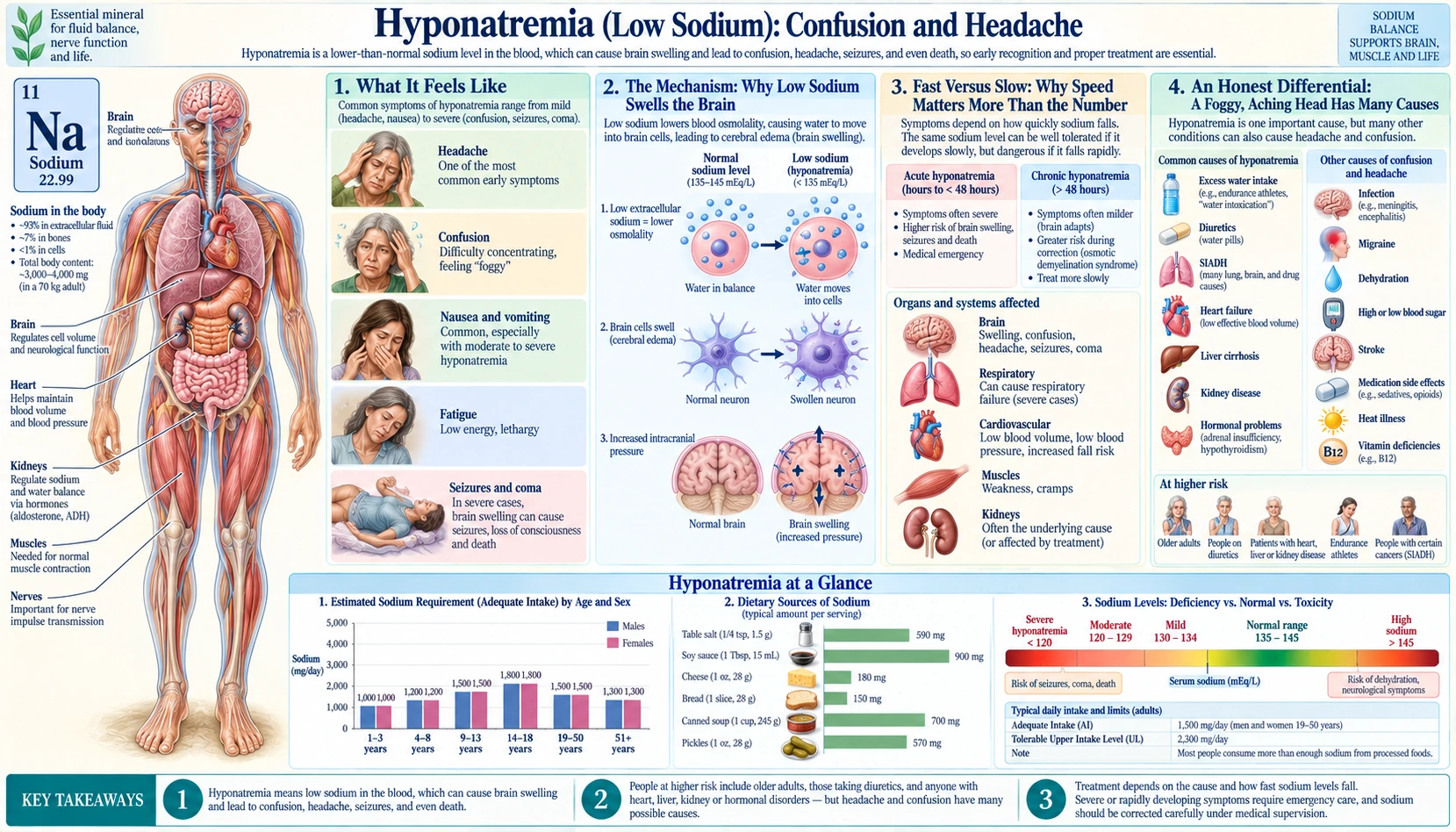
When blood sodium falls too low — a condition doctors call hyponatremia — the symptom that frightens families most is a change in the mind. A normally sharp parent becomes vague and repeats questions; a partner develops a dull, pressing headache that will not lift; an older relative grows confused, unsteady, and oddly “not themselves.” These are not signs of a weak character or simple tiredness. They are the brain reacting to water shifting into its cells — mild swelling that blunts thinking and stretches the lining around the brain until the head aches. This page explains why low sodium specifically targets the brain, why headache and confusion travel together, how to tell this apart from the many other causes of a foggy, aching head, and why correcting it must be done carefully rather than fast.
Table of Contents
- What It Feels Like
- The Mechanism: Why Low Sodium Swells the Brain
- Fast Versus Slow: Why Speed Matters More Than the Number
- An Honest Differential: A Foggy, Aching Head Has Many Causes
- Clues That Point Toward Low Sodium
- Common Situations That Cause It
- Getting Tested and Diagnosed
- Correcting Low Sodium Safely
- When to Seek Care / Red Flags
- Key Research Papers
- Connections
- Featured Videos
What It Feels Like
The mental changes of low sodium are easy to overlook precisely because they are gentle at first — more of a quiet dimming than a dramatic event. People around the person often notice before the person does. The most common everyday descriptions are:
- A dull, all-over headache — not the throbbing of a migraine on one side, but a heavy, pressing ache that sits across the whole head and does not respond well to ordinary pain relievers. Many people describe it as “pressure” rather than sharp pain.
- Mental fog and slowed thinking — the world feels as if it is running half a step slow. Tasks that are normally automatic — following a recipe, balancing a checkbook, holding a thread in conversation — take visible effort, and the person may pause mid-sentence searching for an ordinary word.
- Confusion and disorientation — as sodium falls further, the person may lose track of the day, the place, or the order of events. They repeat questions they have already asked, mix up names, or seem “vague” in a way relatives find unsettling and hard to put into words.
- Trouble concentrating and a short fuse — difficulty paying attention, irritability, restlessness, or a flat, withdrawn mood are common. In older adults this is frequently mistaken for the start of dementia.
- Unsteadiness — even mild low sodium subtly impairs attention and balance, so the person may feel wobbly, trip on familiar steps, or have near-falls long before any obvious mental change is visible.
As hyponatremia becomes severe, this gentle dimming can escalate — to marked drowsiness, vomiting, a depressed level of consciousness, seizures, and ultimately coma. That escalation is what makes the early, “just a bit foggy” stage worth taking seriously: it is the leading edge of something that can become an emergency. The good news is that the brain symptoms of low sodium are usually fully reversible once sodium is brought back to normal at a safe pace.
The Mechanism: Why Low Sodium Swells the Brain
To understand why low sodium hits the brain, it helps to know what sodium actually does. Sodium is the main dissolved particle (the main solute) in the fluid outside your cells — in blood and in the watery space between cells. Because of that, sodium is the chief determinant of your blood's osmolality: in plain terms, how concentrated the fluid is. And water always moves toward the more concentrated side of a membrane, chasing the higher solute — a process called osmosis.
Here is the key chain of events. When blood sodium falls, the fluid outside the cells becomes more dilute — more watery — than the fluid inside the cells. Water then flows from the dilute outside into the more concentrated inside, and the cells swell. In most of the body a little cell swelling is harmless. The brain is the exception, because it is sealed inside a rigid box — the skull — with almost no room to expand. As brain cells take on water, pressure inside the skull rises, the brain's coverings are stretched, and the brain itself is gently squeezed. That swelling is called cerebral edema, and it is the direct cause of the headache and the confusion: the stretched, pressurized lining produces the dull, all-over ache, and the swollen, compressed brain tissue cannot do its electrical work cleanly, so thinking slows and consciousness dims.
An analogy. Picture each brain cell as a raisin sitting in salty water. Keep the water salty and the raisin stays its normal size. Now pour in fresh water until the brine is weak and watery: the raisin swells and plumps up as water moves into it. Your brain cells do exactly this when blood sodium drops — except the brain has no slack space to swell into, so the “plumping” presses outward against the skull. The headache is the stretch; the confusion is the pressure on tissue that runs on precise electrical signals.
The brain is not entirely defenseless. Within hours it begins to protect itself by pumping particles — first salts like potassium and chloride, then small organic molecules called osmolytes — out of its cells. With fewer particles inside, the cells stop drawing in water and the swelling eases. This brain-volume adaptation is why someone whose sodium has drifted down slowly over weeks may feel only mildly foggy at a sodium level that would cause seizures if it had crashed in a single day. It is an elegant defense — but, as the next section explains, it also sets a trap for treatment.
Fast Versus Slow: Why Speed Matters More Than the Number
One of the most important and least intuitive facts about low sodium is that how fast it fell matters as much as how low it is. The same sodium number can produce wildly different symptoms depending on whether it dropped overnight or crept down over weeks — and it shapes how the problem must be fixed.
- Acute hyponatremia (sodium falling sharply over roughly 48 hours or less) gives the brain no time to pump particles out and shrink itself. The cells swell quickly, pressure rises fast, and symptoms can be severe even at sodium levels that someone else tolerates calmly — severe headache, vomiting, agitation, seizures, and dangerous swelling. The classic settings are an athlete who overdrinks plain water during an endurance event, or a hospital patient given too much dilute intravenous fluid.
- Chronic hyponatremia (sodium drifting down over days to weeks) gives the brain time to adapt by expelling osmolytes, so even quite low readings may cause only the subtle fog, mild headache, unsteadiness, and attention problems described above. This is the common pattern in older adults on certain medications.
Now the trap. Because the chronically low brain has already shrunk itself by dumping osmolytes, it has lost its internal cushion. If sodium is then raised too quickly, water is suddenly pulled out of brain cells faster than they can replace those protective particles, and the cells shrink and dehydrate. In a vulnerable region of the brainstem this can strip the insulation off nerve fibers — a serious, sometimes permanent injury called osmotic demyelination syndrome (historically “central pontine myelinolysis”). Cruelly, it often appears days after the sodium has been “successfully” corrected, as new and worsening neurological problems. This is the single biggest reason low sodium must be corrected at a controlled, deliberate pace — and why this is a job for clinicians with frequent blood checks, not for guesswork at home.
An Honest Differential: A Foggy, Aching Head Has Many Causes
It is important to be straight about this: confusion and headache are among the least specific symptoms in all of medicine. A foggy, aching head is the final common pathway for dozens of conditions, and low sodium is only one of them — often not the most likely one. Treating “confusion + headache” as proof of hyponatremia would be a mistake. Common alternative explanations include:
- Dehydration and other electrolyte problems — high sodium, low potassium, low magnesium, low or high calcium, and high blood sugar can all cloud thinking and ache the head.
- Infection — in older adults especially, a urinary tract infection, pneumonia, or any significant infection can present mainly as new confusion (delirium), sometimes with no fever.
- Medications and alcohol — sedatives, opioids, sleep aids, anticholinergic drugs, and alcohol (including withdrawal) are frequent, very treatable causes of fog and headache.
- Primary headache and neurological disorders — migraine, tension headache, a concussion, a stroke or bleed, a brain tumor, or rising pressure inside the skull from other causes.
- Low oxygen or low blood pressure — heart or lung disease that lowers oxygen delivery, or simply standing up too fast (see dizziness and lightheadedness).
- Thyroid and adrenal disease, liver or kidney failure — an underactive thyroid or adrenal insufficiency can cause fog and low sodium at the same time, which is exactly why testing matters.
- Sleep deprivation, depression, and ordinary brain fog — common, real, and far more frequent than electrolyte disturbances.
Because so many conditions look alike, symptoms alone cannot show whether new or worsening confusion with headache comes from low sodium. A blood panel that checks sodium is one of the very first and cheapest tests done precisely because hyponatremia is a common, reversible, and easily missed contributor that hides among all these other causes.
Clues That Point Toward Low Sodium
While confusion and headache are not specific, a few features make low sodium a more likely explanation and are common reasons a sodium check is done:
- A relevant fluid story. The symptoms followed a bout of heavy vomiting or diarrhea, days of poor eating, a long endurance event with lots of plain-water drinking, or a recent start or dose increase of a “water pill” (diuretic).
- Headache and confusion together, with nausea. The combination of a dull headache, mental fogging, and nausea — in someone who is not obviously ill in another way — is a classic low-sodium pattern, because all three flow from brain swelling.
- An older adult on multiple medications. Hyponatremia is common in the elderly, where it shows up as new confusion, unsteadiness, repeated falls, or a vague decline that families wrongly attribute to “just getting old” or early dementia.
- It tracks with fluid changes. Symptoms that worsen with drinking large volumes of water and improve with fluid restriction point toward dilutional low sodium.
- Subtle balance and attention problems out of proportion to the person's baseline — mild chronic hyponatremia measurably impairs gait and attention, so unexplained unsteadiness in someone otherwise well is a real clue. In one emergency-department study, 21.3% of 122 people with mild chronic low sodium (average 126 mEq/L) had been admitted for a fall, against 5.3% of matched controls; in a smaller group tested with and without low sodium, attention-test reaction times were slower and errors more frequent with low sodium, changes the researchers found comparable to those seen after drinking alcohol.
These point toward low sodium; none of them prove it. The confirmation is always a blood test, covered below. Low sodium frequently travels with companion symptoms covered on sibling pages — nausea and vomiting, muscle cramps, and fatigue and falls — and the presence of several together strengthens the case.
Common Situations That Cause It
Low sodium is rarely about eating too little salt. Far more often, it reflects a problem with water — the body holding on to or taking in too much water, which dilutes the sodium that is there. The most common causes that lead to brain symptoms are:
- SIADH (the syndrome of inappropriate antidiuretic hormone). The body releases too much of the water-retaining hormone vasopressin, so the kidneys hold water and dilute the blood. It is the single most common cause of chronic hyponatremia and is triggered by many medications (including some antidepressants, antipsychotics, antiseizure drugs, and chemotherapy), lung disease and pneumonia, brain injuries, pain, nausea, and some cancers.
- Diuretics (“water pills”). Thiazide diuretics, very widely prescribed for blood pressure, are a leading cause of low sodium in older adults — sometimes within days to weeks of starting. New confusion after a diuretic change is a recognized warning sign.
- Gut and fluid losses with water replacement. Heavy vomiting and diarrhea, or heavy sweating, lose salt and water together — and if the losses are then replaced with plain water alone, sodium falls further.
- Drinking too much water (water intoxication). Overdrinking plain water faster than the kidneys can clear it — classically during marathons and other endurance events, but also in certain psychiatric conditions (psychogenic polydipsia) and some social-media “water challenges” can cause acute, dangerous hyponatremia and brain swelling. At the 2002 Boston Marathon, 13% of 488 finishers tested had low sodium and 0.6% had critically low sodium (120 mmol/L or less); low sodium was linked with weight gain during the race, drinking more than 3 litres of fluid, drinking at every mile and finishing times over 4 hours.
- Beer potomania and the “tea-and-toast” diet. A diet very low in protein and salt but high in fluid (heavy beer drinking, or an older person living mainly on tea and toast) leaves the kidneys unable to excrete enough free water, and sodium drops.
- Heart, liver, and kidney disease. Heart failure, cirrhosis, and advanced kidney disease cause the body to retain water out of proportion to sodium, diluting the blood.
- Hormone deficiencies. An underactive thyroid and adrenal insufficiency (low cortisol) both impair water handling and are reversible causes worth testing for.
Identifying which mechanism is at work matters enormously, because the fixes are opposite. Someone who is fluid-overloaded from heart failure or SIADH is usually treated by restricting fluid, while someone depleted by vomiting needs salt and fluid given back. Guessing wrong can worsen the problem, which is why hospitals first test which mechanism is at work.
Getting Tested and Diagnosed
Confirming low sodium is quick and inexpensive. The core test is a Comprehensive Metabolic Panel (CMP) — a routine blood draw that reports serum sodium directly, along with potassium, chloride, kidney function, and glucose. Normal serum sodium is about 135–145 mEq/L. As a rough guide to severity (people vary, and how fast it fell matters as much as the number):
- Mild (130–134 mEq/L) — often subtle: faint fog, mild unsteadiness, attention lapses, or no obvious symptom at all.
- Moderate (125–129 mEq/L) — headache, clearer confusion, nausea, sluggishness; the stage where families usually notice.
- Severe (<125 mEq/L, or any rapidly falling level) — vomiting, marked confusion, drowsiness, seizures, and risk of coma. This is a medical emergency regardless of the exact number.
Finding low sodium is only step one; the harder question is why. To answer it, clinicians typically add a few targeted tests — blood and urine osmolality (how concentrated each is), urine sodium, an assessment of whether the person is dry, normal, or fluid-overloaded, and often thyroid and (when suspected) adrenal hormone testing. This systematic workup is what distinguishes SIADH from a diuretic effect from heart failure, and it is what tells the team whether to restrict fluid or replace salt. Where confusion is significant, brain imaging (a computed tomography (CT) or magnetic resonance imaging (MRI)) may be done to rule out the other causes listed above. The reassuring bottom line: a single cheap blood panel both confirms the diagnosis and launches the search for its cause.
Correcting Low Sodium Safely
How low sodium is corrected depends entirely on how fast it fell, how low it is, and how sick the person is — and the single most important principle is controlled speed. Raising sodium too quickly is genuinely dangerous (see the demyelination trap above), so this is managed by clinicians with repeated blood checks, not improvised at home.
- Treat the cause, and match the fix to the mechanism. If a diuretic or other drug is the culprit, it is stopped or changed. If the body is holding too much water (SIADH, heart failure, cirrhosis), the mainstay is fluid restriction — deliberately limiting how much is drunk — sometimes with medications that help the kidneys clear free water. If the person is salt-and-water depleted from vomiting or diarrhea, salt and fluid are carefully replaced.
- Severe or symptomatic cases (seizures, deep confusion, coma) are treated urgently in hospital, often with a small, closely monitored dose of concentrated (“hypertonic”) saline to lift sodium just enough to relieve dangerous brain swelling — then a deliberate pause. Guidelines cap how much sodium may rise in the first 24 hours specifically to prevent osmotic demyelination, and the level is rechecked every few hours. In the SALSA trial, for example, “overcorrection” was defined as a rise of more than 12 mmol/L within 24 hours or more than 18 mmol/L within 48 hours.
- Mild chronic cases may be managed gradually with fluid restriction and addressing the underlying problem, often as an outpatient with follow-up blood tests.
- Why home salt-loading or fluid cutting can backfire. Extra salt or salt tablets can worsen low sodium caused by fluid overload (heart failure, cirrhosis), and sharply cutting fluids can worsen low sodium caused by vomiting or diarrhea; the mechanism decides the direction, and only a blood test shows the sodium level.
What newer studies show about correction speed. The SALSA randomized trial (178 adults in Korea with symptomatic sodium of 125 mmol/L or less) compared 3% hypertonic saline given as rapid small boluses with a slow continuous drip. Overcorrection was similar (17.2% with boluses vs 24.2% with the drip), but the bolus group needed treatment to bring sodium back down less often (41.4% vs 57.1%) and reached the target rate within an hour more often (32.2% vs 17.6%). A 2025 meta-analysis of 16 cohort studies (11,811 hospitalized adults with severe low sodium) found that rapid correction (8–10 mEq/L or more in 24 hours) was associated with 32 fewer in-hospital deaths per 1,000 patients than slow correction and 221 fewer than very slow correction, with no statistically significant rise in osmotic demyelination. These were observational studies, not trials, and the guideline limits on first-day correction remain in place.
For endurance athletes, the Boston Marathon study above found that the runners at risk were those who gained weight during the race, drank more than 3 litres, drank at every mile and ran for more than 4 hours; drinking to thirst rather than forcing large volumes of plain water, and taking a sports drink or salty foods on very long efforts, is the everyday practice described for avoiding acute, exercise-associated low sodium.
When to Seek Care / Red Flags
Mild fog can be evaluated at a routine appointment, but certain features mean get emergency help right away — by calling emergency services, not waiting for an appointment:
- A seizure, or any new jerking, twitching, or loss of consciousness.
- Marked or rapidly worsening confusion — the person cannot stay awake, does not know where they are, or cannot be roused normally.
- A severe or sudden “worst-ever” headache, or a headache with vomiting, especially after heavy water intake or an endurance event.
- Persistent vomiting alongside headache and fogging.
- New trouble speaking, weakness on one side, or a facial droop — possible stroke, which needs the same emergency response.
- New neurological symptoms appearing days after low sodium was treated — worsening confusion, difficulty swallowing or speaking, or new weakness can signal osmotic demyelination and must be reported immediately.
The dangerous pattern to remember is headache plus worsening confusion plus vomiting, particularly after a lot of plain-water drinking — that trio suggests brain swelling from acute low sodium and is a true emergency. Confirming or ruling out severe hyponatremia takes one quick blood test, and the brain symptoms are reversible when caught and corrected in time.
Key Research Papers
- Sterns RH (2015). Disorders of Plasma Sodium — Causes, Consequences, and Correction. New England Journal of Medicine;372(1):55-65. — DOI: 10.1056/NEJMra1404489. — doi:10.1056/NEJMra1404489
- Adrogué HJ, Madias NE (2000). Hyponatremia. New England Journal of Medicine;342(21):1581-1589. — DOI: 10.1056/NEJM200005253422107. — doi:10.1056/NEJM200005253422107
- Spasovski G, Vanholder R, Allolio B, et al. (2014). Clinical practice guideline on diagnosis and treatment of hyponatraemia. Nephrology Dialysis Transplantation;29(Suppl 2):i1-i39. — DOI: 10.1093/ndt/gfu040. — doi:10.1093/ndt/gfu040
- Verbalis JG, Goldsmith SR, Greenberg A, et al. (2013). Diagnosis, Evaluation, and Treatment of Hyponatremia: Expert Panel Recommendations. The American Journal of Medicine;126(10 Suppl 1):S1-S42. — DOI: 10.1016/j.amjmed.2013.07.006. — doi:10.1016/j.amjmed.2013.07.006
- Sterns RH (2018). Treatment of Severe Hyponatremia. Clinical Journal of the American Society of Nephrology;13(4):641-649. — DOI: 10.2215/CJN.10440917. — doi:10.2215/CJN.10440917
- Gullans SR, Verbalis JG (1993). Control of Brain Volume During Hyperosmolar and Hypoosmolar Conditions. Annual Review of Medicine;44:289-301. — DOI: 10.1146/annurev.med.44.1.289. — doi:10.1146/annurev.med.44.1.289
- Ellison DH, Berl T (2007). The Syndrome of Inappropriate Antidiuresis. New England Journal of Medicine;356(20):2064-2072. — DOI: 10.1056/NEJMcp066837. — doi:10.1056/NEJMcp066837
- Almond CSD, Shin AY, Fortescue EB, et al. (2005). Hyponatremia among Runners in the Boston Marathon. New England Journal of Medicine;352(15):1550-1556. — DOI: 10.1056/NEJMoa043901. — doi:10.1056/NEJMoa043901
- Renneboog B, Musch W, Vandemergel X, et al. (2006). Mild Chronic Hyponatremia Is Associated With Falls, Unsteadiness, and Attention Deficits. The American Journal of Medicine;119(1):71.e1-71.e8. — DOI: 10.1016/j.amjmed.2005.09.026. — doi:10.1016/j.amjmed.2005.09.026
- Ayus JC, Negri AL, Kalantar-Zadeh K, Moritz ML (2012). Is chronic hyponatremia a novel risk factor for hip fracture in the elderly? Nephrology Dialysis Transplantation;27(10):3725-3731. — DOI: 10.1093/ndt/gfs412. — doi:10.1093/ndt/gfs412
- Baek SH, Jo YH, Ahn S, Medina-Liabres K, Oh YK, Lee JB, Kim S (2021). Risk of Overcorrection in Rapid Intermittent Bolus vs Slow Continuous Infusion Therapies of Hypertonic Saline for Patients With Symptomatic Hyponatremia: The SALSA Randomized Clinical Trial. JAMA Internal Medicine;181(1):81-92. — PubMed PMID: 33104189
- Ayus JC, Moritz ML, Fuentes NA, Mejia JR, Alfonso JM, Shin S, Fralick M, Ciapponi A (2025). Correction Rates and Clinical Outcomes in Hospitalized Adults With Severe Hyponatremia: A Systematic Review and Meta-Analysis. JAMA Internal Medicine;185(1):38-51. — PubMed PMID: 39556338
- Sterns RH, Riggs JE, Schochet SS (1986). Osmotic Demyelination Syndrome Following Correction of Hyponatremia. New England Journal of Medicine;314(24):1535-1542. — DOI: 10.1056/NEJM198606123142402. — doi:10.1056/NEJM198606123142402
- Anderson RJ, Chung HM, Kluge R, Schrier RW (1985). Hyponatremia: A Prospective Analysis of Its Epidemiology and the Pathogenetic Role of Vasopressin. Annals of Internal Medicine;102(2):164-168. — DOI: 10.7326/0003-4819-102-2-164. — doi:10.7326/0003-4819-102-2-164
PubMed Topic Searches
Connections
- All Minerals
- Hyponatremia Symptom Hub
- Hyponatremia and Nausea & Vomiting
- Hyponatremia and Muscle Cramps
- Hyponatremia and Fatigue & Falls
- Sodium Overview
- Potassium
- Magnesium
- Chloride
- Comprehensive Metabolic Panel
- Neurology
- Epilepsy & Seizures
- Headache
- Brain Fog
- Dizziness
- Lightheadedness
- Kidney Disease