Addison's Disease
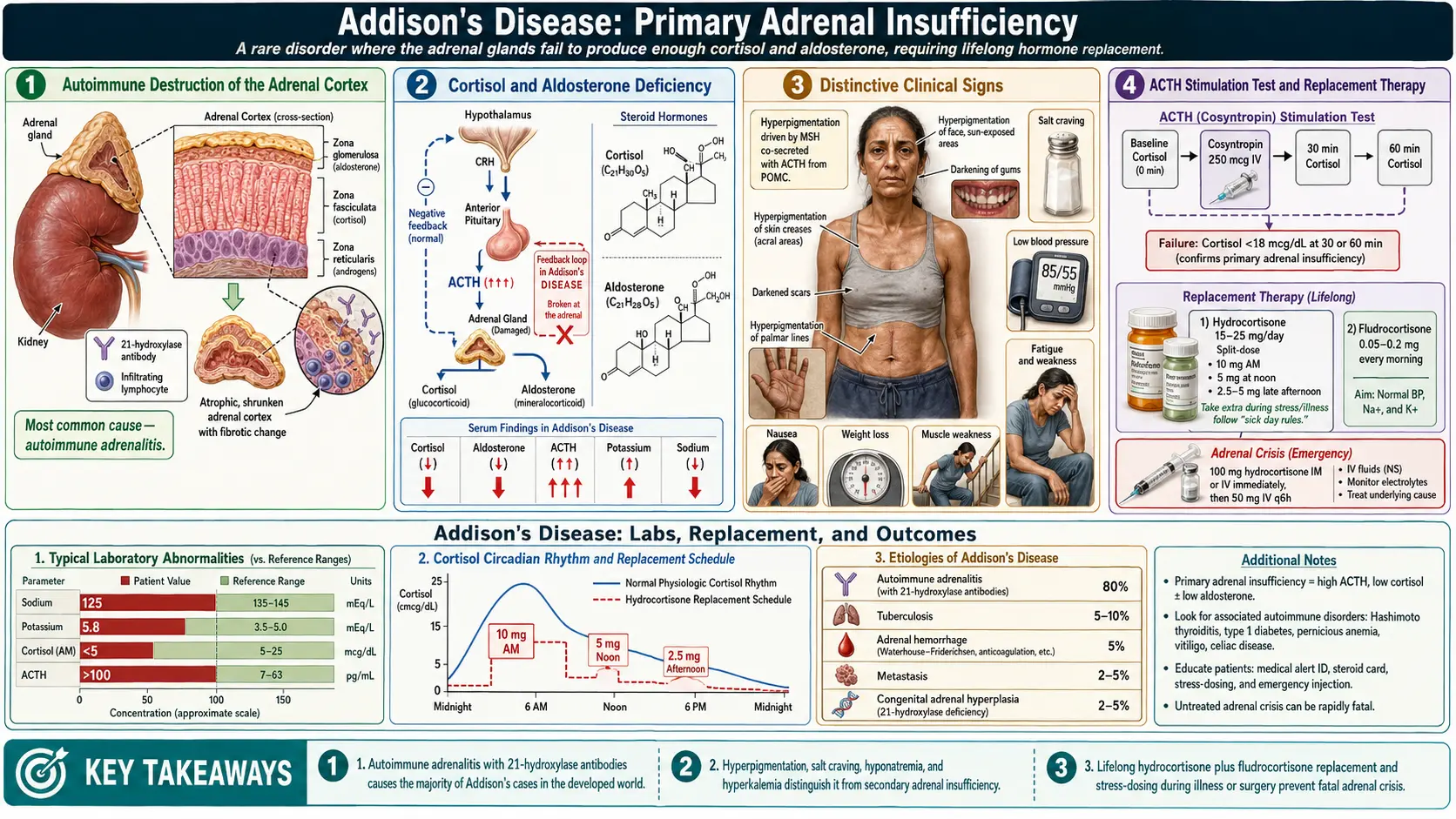
What Addison's Disease Is
Addison's Disease, also known as primary adrenal insufficiency, is a rare disorder that occurs when the adrenal glands do not produce enough cortisol and, in some cases, aldosterone. These hormones are vital for various bodily functions, including stress response, metabolism, and blood pressure regulation.
Causes and Risk Factors
- Autoimmune response: The most common cause, where the immune system attacks the adrenal glands.
- Infections: Such as tuberculosis or other infections that can damage the adrenal glands.
- Genetic disorders: Conditions like congenital adrenal hyperplasia.
- Adrenal gland cancer: Tumors affecting adrenal function.
How common it is: a study in western Norway, covering a population of 916,000, found 128 patients — a prevalence of 140 people per million — with about 0.62 new cases per 100,000 people a year over the previous decade, a higher prevalence than earlier reports from anywhere. Forty percent of the patients (51) had another hormone (endocrine) disease as well, and the cause was almost always autoimmune or unknown (idiopathic).
Symptoms of Addison's Disease
Common symptoms include:
- Chronic fatigue
- Muscle weakness
- Unintentional weight loss
- Low blood pressure, sometimes leading to fainting
- Darkening of the skin (hyperpigmentation), especially on scars and skin creases
- Salt craving
- Nausea, vomiting, and diarrhea
Diagnosis and Treatment
Diagnostic Tests
Diagnosis typically involves:
- Blood tests: To measure cortisol, sodium, potassium, and adrenocorticotropic hormone (ACTH) levels.
- Adrenocorticotropic hormone stimulation test: Checks how the adrenal glands respond to adrenocorticotropic hormone.
- Imaging tests: Such as computed tomography (CT) scans of the adrenal glands or pituitary gland if needed.
Treatment Options
- Hormone replacement therapy: To replace missing cortisol and, if necessary, aldosterone.
- Emergency hydrocortisone injection: For times of significant stress, such as surgery or severe illness.
- Regular monitoring: To adjust hormone levels as needed and manage symptoms.
Prognosis
With appropriate treatment, individuals with Addison's disease can lead largely normal daily lives, but they require lifelong hormone therapy and periodic health monitoring.
Death rates nevertheless remain higher than in the general population. A Swedish population study of 1,675 patients, followed for an average of 6.5 years, found the risk of death was 2.19 times that of the background population for men and 2.86 times for women, with the excess deaths from heart and blood-vessel disease, cancer and infections. A 2025 meta-analysis of 7 studies (9,876 patients with primary adrenal insufficiency, including congenital adrenal hyperplasia) found death rates about 2.5 times those of the reference population (pooled hazard ratio 2.51), with heart and blood-vessel disease the main cause of death.
How Adrenal Crisis Happens
An adrenal crisis is the life-threatening complication of adrenal insufficiency: the body suddenly has far too little cortisol to cope with a stress. A German prospective study followed 423 people with long-term adrenal insufficiency (221 with the primary, Addison type and 202 with the secondary type) for 2 years, after every one of them had received detailed written instructions on raising their steroid dose during stress. Even so, 64 crises occurred in 767.5 patient-years — 8.3 crises per 100 patient-years.
- Triggers: mainly stomach and gut infections, fever and emotional stress (20% each), but also major pain, surgery, strenuous physical activity, heat and pregnancy; 7% of crises began suddenly with no clear cause.
- Repeat crises: people who had already had a crisis were at higher risk of another (odds ratio 2.85).
- Deaths: 4 deaths were linked to a crisis — about 6% of crises, or 0.5 crisis-related deaths per 100 patient-years.
Vomiting, severe weakness, fainting and confusion in a person with Addison's disease are signs of a possible adrenal crisis, which hospitals treat as an emergency; an emergency hydrocortisone injection is the treatment used for a crisis.
Key Research Papers
Historical Background
Addison's disease was first described in 1855 by the English physician Thomas Addison in his monograph "On the Constitutional and Local Effects of Disease of the Suprarenal Capsules," making it one of the earliest recognized endocrine disorders. In the mid-1930s Edward Kendall and Tadeus Reichstein isolated and analyzed several hormones of the adrenal cortex; these became the basis for cortisone preparations that, with input from Kendall and Philip Hench, were used at the end of the 1940s to treat rheumatoid arthritis, and the three shared the 1950 Nobel Prize in Physiology or Medicine “for their discoveries relating to the hormones of the adrenal cortex, their structure and biological effects.” Cortisone treatment transformed Addison's disease from a fatal diagnosis into a manageable chronic disease.
- Bornstein SR, Allolio B, Arlt W, et al. Diagnosis and Treatment of Primary Adrenal Insufficiency: An Endocrine Society Clinical Practice Guideline. J Clin Endocrinol Metab. 2016;101(2):364-389. — doi:10.1210/jc.2015-1710
- Husebye ES, Allolio B, Arlt W, et al. Consensus statement on the diagnosis, treatment and follow-up of patients with primary adrenal insufficiency. J Intern Med. 2014;275(2):104-115. — doi:10.1111/joim.12162
- Arlt W, Allolio B. Adrenal insufficiency. Lancet. 2003;361(9372):1881-1893. — doi:10.1016/s0140-6736(03)13492-7
- Betterle C, Dal Pra C, Mantero F, Zanchetta R. Autoimmune adrenal insufficiency and autoimmune polyendocrine syndromes: autoantibodies, autoantigens, and their applicability in diagnosis and disease prediction. Endocr Rev. 2002;23(3):327-364. — doi:10.1210/edrv.23.3.0466
- Erichsen MM, Lovas K, Skinningsrud B, et al. Clinical, immunological, and genetic features of autoimmune primary adrenal insufficiency: observations from a Norwegian registry. J Clin Endocrinol Metab. 2009;94(12):4882-4890. — doi:10.1210/jc.2009-1368
- Løvås K, Husebye ES. High prevalence and increasing incidence of Addison's disease in western Norway. Clin Endocrinol (Oxf). 2002;56(6):787-791. — doi:10.1046/j.1365-2265.2002.t01-1-01552.x
- Grossman AB. Clinical review: The diagnosis and management of central hypoadrenalism. J Clin Endocrinol Metab. 2010;95(11):4855-4863. — doi:10.1210/jc.2010-0982
- Bancos I, Hahner S, Tomlinson J, Arlt W. Diagnosis and management of adrenal insufficiency. Lancet Diabetes Endocrinol. 2015;3(3):216-226. — doi:10.1016/s2213-8587(14)70142-1
- Rushworth RL, Torpy DJ, Falhammar H. Adrenal crises: perspectives and research directions. Endocrine. 2017;55(2):336-345. — doi:10.1007/s12020-016-1204-2
- Bergthorsdottir R, Leonsson-Zachrisson M, Oden A, Johannsson G. Premature mortality in patients with Addison's disease: a population-based study. J Clin Endocrinol Metab. 2006;91(12):4849-4853. — doi:10.1210/jc.2006-0076
- Quinkler M, Beuschlein F, Hahner S, et al. Adrenal cortical insufficiency — a life threatening illness with multiple etiologies. Dtsch Arztebl Int. 2013;110(51-52):882-888. — doi:10.3238/arztebl.2013.0882
- Charmandari E, Nicolaides NC, Chrousos GP. Adrenal insufficiency. Lancet. 2014;383(9935):2152-2167. — doi:10.1016/s0140-6736(13)61684-0
- Hahner S, Spinnler C, Fassnacht M, et al. High incidence of adrenal crisis in educated patients with chronic adrenal insufficiency: a prospective study. J Clin Endocrinol Metab. 2015;100(2):407-416. — doi:10.1210/jc.2014-3191
- Dalakas K, Allosso F, Basile C, et al. Increased mortality in primary adrenal insufficiency: a systematic review and meta-analysis. Eur J Endocrinol. 2025;193(4):S53-S60. — doi:10.1093/ejendo/lvaf186
PubMed Topic Searches
The following PubMed topic searches aggregate the current peer-reviewed literature. Each link opens a live PubMed query — results update as new studies are indexed.
- PubMed: Addison disease
- PubMed: Primary adrenal insufficiency
- PubMed: Autoimmune adrenalitis
- PubMed: Adrenal crisis
- PubMed: ACTH stimulation test
- PubMed: Hydrocortisone replacement
- PubMed: Fludrocortisone Addison
- PubMed: Adrenal insufficiency diagnosis
- PubMed: Autoimmune polyendocrine syndrome
- PubMed: Secondary adrenal insufficiency
- PubMed: Cortisol deficiency
- PubMed: 21-hydroxylase antibodies
Table of Contents
Connections
- Endocrinology
- Your Daily Cortisol Rhythm — interactive animation
- The Stress Response & Cortisol — interactive animation
- Cushing's Syndrome
- Adrenal Fatigue
- Hashimoto's Thyroiditis
- Thyroid Disorders
- Diabetes
- Pheochromocytoma
- Potassium
- Vitamin D3
- Magnesium
- Hypertension
- Anemia
- Fatigue
- Depression
- Anxiety
- DHEA-S Test
- Hyperparathyroidism
- Lightheadedness
- Cortisol Test
- Ashwagandha