Lugol's Iodine
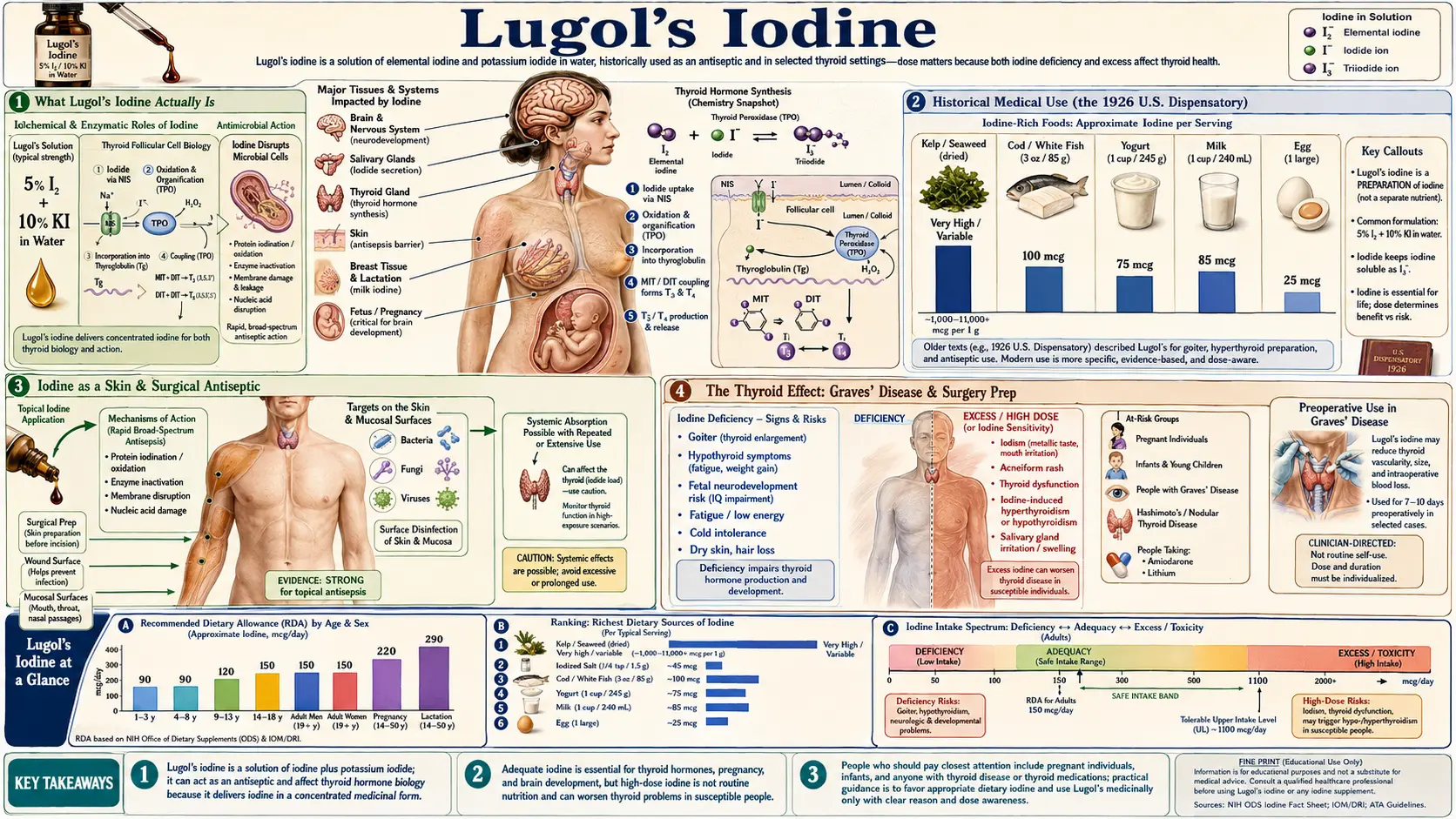
Lugol's iodine is one of the oldest medicines still sitting on hospital and pharmacy shelves — a deep-amber liquid of elemental iodine and potassium iodide dissolved in water, invented in 1829 and listed as a serious drug in the 1926 U.S. Dispensatory. It is easy to confuse with the dietary mineral iodine your thyroid needs in microgram amounts every day, but it is a different thing used in a different way: a concentrated pharmacologic dose, measured in milligrams, with real and specific medical jobs — disinfecting skin before surgery, calming an overactive thyroid before an operation, and (in its close relative, potassium-iodide tablets) shielding the thyroid after a nuclear release. This page explains what Lugol's actually is, what doctors in 1926 used it for, what holds up today, and — just as importantly — why high-dose iodine is not a casual supplement and can swing your thyroid in either direction if you take too much. For the dietary mineral itself — how much you need, deficiency, and food sources — see the companion Iodine page.
Table of Contents
- What Lugol's Iodine Actually Is
- Historical Medical Use (the 1926 U.S. Dispensatory)
- Iodine as a Skin & Surgical Antiseptic
- The Thyroid Effect: Graves' Disease & Surgery Prep
- Radiation Thyroid Blockade (and Why It's KI, Not Lugol's)
- How Lugol's Is Used Today
- Safety, Cautions & Myths
- Lugol's vs. Dietary Iodine — Don't Confuse Them
- Key Research Papers
- Connections
- Featured Videos
What Lugol's Iodine Actually Is
Lugol's solution is a simple but clever piece of chemistry. Iodine in its pure elemental form (written I2) barely dissolves in water — it would just sit there. The French physician Jean Guillaume Auguste Lugol solved this in 1829 by dissolving the iodine together with potassium iodide (KI). The iodide acts like a chemical "handle," grabbing the elemental iodine to form a soluble complex (triiodide, I3−) so the whole thing goes cleanly into water. The result is a stable, deep brown-orange liquid that delivers both forms of iodine at once.
The classic formula — "Lugol's strong solution" — is roughly 5% iodine plus 10% potassium iodide in water. That works out to about 6.3 milligrams of total iodine per drop, which is an enormous amount compared with the body's daily need (an adult needs roughly 150 micrograms a day — a single drop of strong Lugol's contains dozens of days' worth). Today you'll also see diluted versions sold and labeled by percentage — 2%, 5%, 7%, even 15% — so the iodine in "a few drops" can vary wildly between bottles. This matters enormously for dosing, and it is the single most common way people accidentally take far too much. Always read the strength on the label; "a couple of drops" is not a meaningful dose without knowing the percentage.
Because it contains free I2, Lugol's is also a mild oxidizing agent — which is exactly what makes it useful as a disinfectant and as a chemical stain (it's the same iodine reaction that turns starch blue-black in a school chemistry class, and the basis of the cervical "Schiller test" doctors still use to spot abnormal tissue). It's a versatile molecule, but a potent one.
Historical Medical Use (the 1926 U.S. Dispensatory)
By the time the 21st edition of the U.S. Dispensatory appeared in 1926, Lugol's solution had already been a mainstream physician's tool for nearly a century, and three of its main uses then map almost exactly onto what the science later confirmed:
- As a surgical antiseptic. In the era before modern scrubs, painting the skin with an iodine solution to prepare a surgical field — and to clean wounds — was standard practice. Iodine was prized as one of the most broadly effective germ-killers available.
- For overactive thyroid (hyperthyroid) conditions. Physicians had noticed that giving concentrated iodine could rapidly settle the racing pulse, sweating, and agitation of severe hyperthyroidism, and could shrink and "firm up" an enlarged, overactive thyroid gland before surgery — a discovery associated with the Mayo Clinic endocrinologist Henry Plummer, who introduced preoperative iodine around 1923.
- To protect the thyroid. The understanding that flooding the body with stable iodine influences how the thyroid handles iodine was already taking shape; this later became the scientific basis for shielding the gland against radioactive iodine.
Here is the honest framing that matters: all three of these 1926 uses turned out to rest on real biology. That's unusual for a century-old remedy — many were wrong. But the way they're used has been refined a great deal, the doses have been made precise, and important safety limits have been added. The sections below take each one in turn, separating what 1926 got right from how it's actually done today.
Iodine as a Skin & Surgical Antiseptic
The antiseptic use is the most enduring. Iodine kills an extraordinarily broad range of microbes — bacteria, fungi, viruses, and spores — by oxidizing their proteins and membranes, and germs do not readily develop resistance to it the way they do to antibiotics. That's why iodine-based products are still part of modern surgery and wound care.
What has changed is the form. Raw Lugol's and old-fashioned "tincture of iodine" sting, stain skin and fabric a stubborn brown, and can irritate. So most antiseptic iodine today is povidone-iodine (sold as Betadine) — iodine bound to a carrier molecule (a "povidone" polymer) that releases the active iodine slowly and gently. It is gentler on tissue while keeping iodine's powerful kill. Reviews of povidone-iodine in skin preparation, hand disinfection, and wound care confirm broad-spectrum activity with a good safety record (Durani 2008; Bigliardi 2017).
An important modern nuance, in the spirit of giving you the real evidence rather than the legend: iodine is excellent, but it is not automatically the best skin prep for every operation. A large randomized trial published in the New England Journal of Medicine found that for preventing surgical-site infection after clean-contaminated surgery, a chlorhexidine-alcohol scrub outperformed aqueous povidone-iodine (Darouiche 2010). The takeaway isn't that iodine "failed" — it remains a frontline antiseptic in countless settings, including eye surgery and many wound applications — but that antisepsis has moved on from a one-size-fits-all answer. For everyday home use, plain povidone-iodine or other modern antiseptics are appropriate; there is no reason to dab concentrated Lugol's on a cut.
The Thyroid Effect: Graves' Disease & Surgery Prep
This is where Lugol's does something genuinely counterintuitive. Iodine is the raw material the thyroid uses to build its hormones — so you'd expect a big dose of iodine to rev the gland up. In a healthy person over time it can. But give a large, sudden dose, and for a couple of weeks the opposite happens: the thyroid briefly slams on the brakes and makes less hormone, and it also releases less of its stored hormone into the blood. This temporary shutdown in response to an iodine flood is called the acute Wolff–Chaikoff effect, and it's the mechanism behind the old hyperthyroid use.
In Graves' disease — the autoimmune condition that is the most common cause of an overactive thyroid — and especially in the medical emergency called thyroid storm, doctors still use this. A short course of iodine (Lugol's solution or its cousin SSKI, "saturated solution of potassium iodide") rapidly lowers thyroid hormone output and calms a dangerously overactive gland. There's an important sequencing rule clinicians follow: in Graves', iodine is given after the patient has first been started on an antithyroid drug, because giving iodine alone to an untreated patient can occasionally backfire and fuel the gland (the "Jod-Basedow" problem discussed in the safety section).
The other classic use is preparing the thyroid for surgery, exactly as Henry Plummer pioneered a century ago. For a week or two before a thyroidectomy in Graves' disease, iodine shrinks the gland, firms it up, and — importantly for the surgeon — markedly reduces its blood supply, which means less bleeding during the operation. Modern studies support this: a randomized trial found a short preoperative course of potassium iodide reduced the thyroid's blood flow and intraoperative blood loss (Whalen 2017), and contemporary case series and a long-term follow-up confirm iodide's rapid, if often temporary, control of Graves' hyperthyroidism (Fujikawa 2024). So the 1926 instinct was correct — it has simply been turned into a precise, short, supervised protocol rather than an open-ended treatment.
Radiation Thyroid Blockade (and Why It's KI, Not Lugol's)
The third 1926 idea — using iodine to "protect the thyroid" — became one of public health's most important emergency tools, but with a key clarification about which iodine product is used.
The thyroid cannot tell the difference between safe, stable iodine and radioactive iodine (iodine-131), which is one of the main hazards released in a nuclear-reactor accident or weapon detonation. If radioiodine is inhaled or eaten, the thyroid greedily soaks it up and concentrates it, and the radiation can cause thyroid cancer years later — a risk that fell hardest on children after the 1986 Chernobyl disaster. The protective trick is simple: flood the thyroid with stable iodine first, so the gland is "full" and has no room to take up the radioactive kind, which is then simply excreted in urine. This is called thyroid blocking or radiation thyroid blockade.
The agent used for this is potassium iodide (KI) — supplied as standardized, single-dose tablets (commonly 65 mg and 130 mg) stockpiled by governments and given to people near a release. It is deliberately not Lugol's solution. Lugol's contains elemental iodine, which is harsher on the gut and far harder to dose accurately by the drop; KI tablets give a known, uniform amount that's easy to hand out to a frightened population, including precise smaller doses for children and infants. (In an absolute emergency with nothing else available, public-health authorities have sometimes described how iodine solutions could be used — but the tablet is the intended, approved product.)
Timing is everything, and the science is precise about it: KI works best taken shortly before or right at the time of exposure, and its protective value drops off sharply if taken many hours late (Zanzonico & Becker 2000). For that reason, the decision to take it is made by public-health and emergency authorities, not by individuals guessing — both the timing and the dose must match the actual release (Becker & Zanzonico 1997). KI protects only the thyroid from only radioactive iodine; it does nothing against other radiation or other radioactive materials, and it is not a general "anti-radiation pill." It is also not something to take preventively "just in case" — taken without a real exposure, the dose carries its own thyroid risks (next section) and provides no benefit.
How Lugol's Is Used Today
Lugol's solution remains a legitimate, FDA-recognized drug — but its honest, current uses are narrow and mostly clinical:
- Short-term thyroid control before surgery and in thyroid storm — under an endocrinologist or hospital team, in Graves' disease, typically for days to a couple of weeks, after antithyroid drugs are on board.
- A diagnostic stain. Diluted Lugol's is painted on tissue to reveal abnormalities — most familiarly the cervix during colposcopy (the Schiller/"Lugol's iodine test"), where normal tissue stains dark and suspicious areas stay pale. It's also used in the lab to stain starch and certain cells.
- Water disinfection (emergency/field). A few drops can disinfect questionable drinking water in a pinch — a niche, short-term use, not for routine long-term consumption.
- Iodine deficiency programs (rare, supervised). In parts of the world with severe dietary iodine deficiency, controlled iodine supplementation is a public-health measure — but in most developed countries, iodized salt and a normal diet already supply enough, and this is not a do-it-yourself reason to take milligram doses.
What Lugol's is not a evidence-based treatment for is the long list of conditions marketed online — it is not a general "detox," not a proven treatment for fibrocystic breasts or "iodine deficiency" you self-diagnosed, not an immune tonic, and not a cancer remedy. If you are worried about iodine in your diet, the right move is a conversation with your clinician and, where appropriate, a urinary iodine or thyroid blood test — not pouring milligram doses from a brown bottle.
Safety, Cautions & Myths
This is the section the enthusiastic videos and supplement sellers usually skip, and it's the most important one. High-dose iodine is a drug, and the same property that makes Lugol's useful — its potency — is what makes casual self-dosing risky.
- It can push your thyroid either way. This is the crucial paradox. Too much iodine can cause hypothyroidism (an underactive gland) when the thyroid fails to "escape" the Wolff–Chaikoff brake and stays shut down — a real, documented effect, especially in people with underlying thyroid disease such as Hashimoto's (Markou 2001). But too much iodine can also cause hyperthyroidism — the "Jod-Basedow" phenomenon — particularly in people with nodular goiters or those who were previously iodine-deficient. The same bottle can tip different people in opposite directions, and you often can't predict which. A comprehensive review of the consequences of iodine excess documents both hypo- and hyperthyroidism, as well as thyroiditis and autoimmune effects (Leung & Braverman 2014).
- Iodism. Chronic excess iodine causes a syndrome called iodism: a brassy or metallic taste, burning mouth and throat, excess saliva, runny nose, headache, stomach upset, and an acne-like skin rash (iododerma). It usually settles when iodine is stopped — but it's a clear sign of overdose.
- Allergy and reactions. True iodine allergy is uncommon but real, ranging from rash to, rarely, serious reactions. (Note: the old worry that "shellfish allergy = iodine allergy" or that it predicts reactions to iodinated contrast dye is a myth — those are separate issues — but genuine sensitivity to iodine products does exist.)
- Pregnancy, breastfeeding, and babies. The fetal and infant thyroid is especially vulnerable to iodine excess, which can cause goiter or hypothyroidism in the baby. High-dose iodine in pregnancy and lactation should only ever be used on specific medical advice. (This is the opposite of the routine, modest iodine nutrition that pregnancy needs — a normal prenatal-level intake is important; megadoses are harmful.)
- Drug interactions. Iodine adds to other iodine sources and to drugs like amiodarone (which is loaded with iodine) and lithium (which itself affects the thyroid); combining them can worsen thyroid effects.
- Thyroid blockade is a public-health decision. To repeat the key point: potassium-iodide thyroid blockade after radiation exposure should be taken only under official public-health or clinical direction, matched to a real release and the right timing and dose. It is not for stockpiling-and-self-dosing on rumor, and taking it without an exposure carries the thyroid risks above with no benefit.
The bottom line on safety: Lugol's iodine has real, specific medical roles, but it is not a benign daily supplement, and "more is better" is exactly wrong for iodine — both deficiency and excess cause thyroid disease, so the goal is the right amount, not the biggest dose. If you have any thyroid condition (Hashimoto's, Graves', nodules, prior thyroid surgery or radioactive-iodine treatment), do not take high-dose iodine without your doctor. For ordinary dietary needs, see Iodine.
Lugol's vs. Dietary Iodine — Don't Confuse Them
It's worth stating plainly because the confusion causes real harm. Dietary iodine is a trace mineral your thyroid needs in microgram amounts (about 150 µg/day for adults, more in pregnancy), supplied easily by iodized salt, dairy, seafood, and seaweed; the whole story of getting enough, deficiency, goiter, and food sources lives on the Iodine page and its Thyroid Function and Brain Development articles.
Lugol's iodine is a concentrated pharmaceutical preparation delivering milligram doses (a single drop of strong Lugol's can exceed a month's worth of the dietary requirement). It is a tool for specific medical jobs — antisepsis, short-term thyroid control, diagnostic staining — not a way to "get your daily iodine." Treating a milligram-dose drug as if it were a microgram-dose nutrient is precisely how people end up with iodine-induced thyroid disease. Selenium status matters here too: adequate selenium supports the enzymes that handle thyroid hormone, and the thyroid works best when iodine and selenium are both in a healthy range — another reason balance, not megadosing, is the goal.
Key Research Papers
- Darouiche RO, Wall MJ Jr, Itani KMF, et al. (2010). Chlorhexidine–Alcohol versus Povidone–Iodine for Surgical-Site Antisepsis. New England Journal of Medicine, 362(1):18–26. — Landmark randomized trial: a chlorhexidine-alcohol scrub prevented more surgical-site infections than aqueous povidone-iodine, reframing iodine as one excellent option rather than the automatic best skin prep. (VERIFIED)
- Bigliardi PL, Alsagoff SAL, El-Kafrawi HY, et al. (2017). Povidone iodine in wound healing: A review of current concepts and practices. International Journal of Surgery, 44:260–268. — Modern review of iodine's broad-spectrum antiseptic activity and its place in contemporary wound care. (VERIFIED)
- Durani P, Leaper D. (2008). Povidone–iodine: use in hand disinfection, skin preparation and antiseptic irrigation. International Wound Journal, 5(3):376–387. — Reviews how the gentler povidone-iodine form delivers iodine's germ-killing power for skin prep and disinfection. (VERIFIED)
- Whalen G, Sullivan M, Maranda L, et al. (2017). Randomized trial of a short course of preoperative potassium iodide in patients undergoing thyroidectomy for Graves' disease. The American Journal of Surgery, 213(4):805–809. — Confirms Plummer's century-old observation: a brief preoperative iodide course reduces the thyroid's blood supply and intraoperative blood loss. (VERIFIED)
- Fujikawa M, Okamura K. (2024). Graves' hyperthyroidism treated with potassium iodide: early response and after 2 years of follow-up. European Thyroid Journal, 13(6). — Contemporary data on iodide's rapid control of Graves' hyperthyroidism and the limits of its longer-term use. (VERIFIED)
- Zanzonico PB, Becker DV. (2000). Effects of Time of Administration and Dietary Iodine Levels on Potassium Iodide (KI) Blockade of Thyroid Irradiation by 131I from Radioactive Fallout. Health Physics, 78(6):660–667. — Quantifies how thyroid protection depends critically on taking KI before/at exposure and falls off sharply if delayed. (VERIFIED)
- Becker DV, Zanzonico P. (1997). Potassium Iodide for Thyroid Blockade in a Reactor Accident: Administrative Policies That Govern Its Use. Thyroid, 7(2):193–197. — Explains why radiation thyroid blockade is a directed public-health intervention, with dosing and timing set by authorities. (VERIFIED)
- Robbins J, Dunn JT, Bouville A, et al. (2001). Iodine Nutrition and the Risk from Radioactive Iodine: A Workshop Report in the Chernobyl Long-Term Follow-Up Study. Thyroid, 11(5):487–491. — Links the Chernobyl childhood thyroid-cancer experience to iodine status and the rationale for stable-iodine blockade. (VERIFIED)
- Leung AM, Braverman LE. (2014). Consequences of excess iodine. Nature Reviews Endocrinology, 10(3):136–142. — Authoritative review documenting that iodine excess can cause hypothyroidism, hyperthyroidism, and thyroid autoimmunity — the core safety message of this page. (VERIFIED)
- Markou K, Georgopoulos N, Kyriazopoulou V, Vagenakis AG. (2001). Iodine-Induced Hypothyroidism. Thyroid, 11(5):501–510. — Details how a large iodine load can lock the thyroid into the Wolff–Chaikoff "off" state and cause hypothyroidism, especially with underlying thyroid disease. (VERIFIED)
Live PubMed Searches
- Wolff–Chaikoff effect — excess iodide and the thyroid (foundational 1948 concept; SEARCHLINK)
- Lugol's solution in Graves' disease and thyroidectomy
- Potassium iodide thyroid blockade after radiation accidents
- Jod-Basedow — iodine-induced hyperthyroidism
Connections
- All Minerals
- Iodine (dietary mineral)
- Iodine & Thyroid Function
- Iodine & Brain Development
- Selenium
- Graves' Disease
- Hyperthyroidism
- Hypothyroidism
- Hashimoto's Thyroiditis
- Thyroid Disorders
- Endocrinology