Copper: Food Sources & Daily Intake
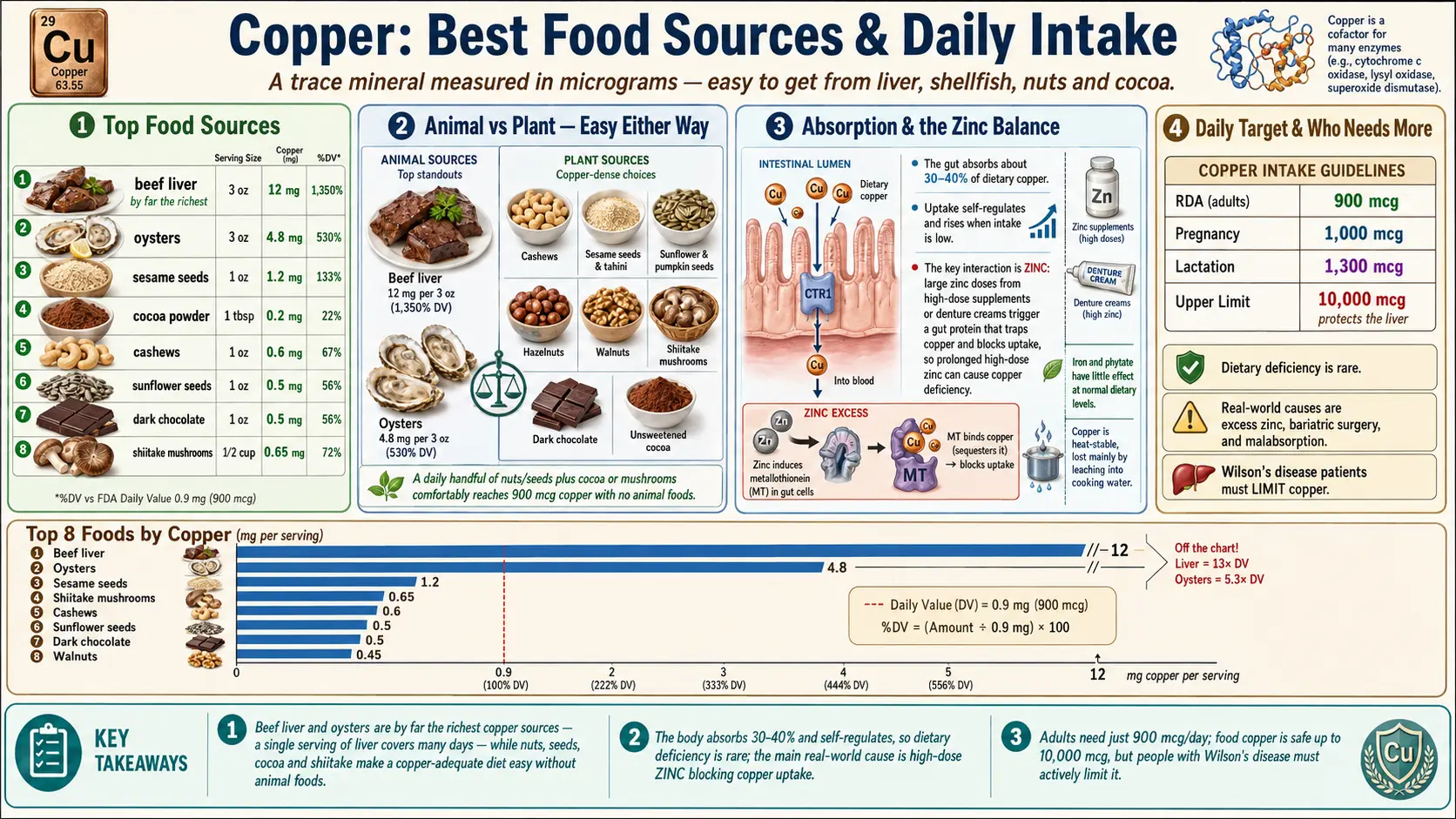
Copper is a trace mineral the body needs only in tiny amounts, yet it is essential: it lets enzymes move iron into the bloodstream, build the collagen and elastin that hold connective tissue together, and generate energy inside mitochondria. It is found across both animal and plant foods — organ meats and shellfish are the richest, but nuts, seeds, mushrooms, dark chocolate and dried fruit make a copper-adequate diet easy without any animal foods at all.
| Copper: Food Sources & Daily Intake | ||||||
|---|---|---|---|---|---|---|
| Rank | Food (serving) | Per 100 g | %DV / 100g | Glucose | Fructose | Notes |
| 1 | Beef Liver 3 oz / 85 g | 14 mg | 🟢 1,589% | 0 | 0 | By far the richest whole-food source of copper — a single small serving covers many days’ worth. |
| 2 | Oysters 3 oz / 85 g | 5.7 mg | 🟢 634% | 1.2 | 0 | Among the densest seafood sources of copper and zinc together. |
| 3 | Sesame Seeds 1 oz / 28 g | 4.1 mg | 🟢 453% | — | — | Tahini (sesame paste) carries the same copper — a spoonful adds up fast. |
| 4 | Cocoa Powder 1 tbsp / 5 g | 3.8 mg | 🟢 421% | — | — | Unsweetened cocoa is one of the most copper-dense foods by weight. |
| 5 | Cashews 1 oz / 28 g | 2.2 mg | 🟢 247% | — | — | A handful is a convenient, copper-dense snack. |
| 6 | Sunflower Seeds 1 oz / 28 g | 1.8 mg | 🟢 203% | 0.0 | 0 | |
| 7 | Dark Chocolate 1 oz / 28 g | 1.8 mg | 🟢 197% | 0 | 0 | The higher the cocoa percentage, the more copper. |
| 8 | Hazelnuts 1 oz / 28 g | 1.7 mg | 🟢 191% | 0.1 | 0.1 | |
| 9 | Walnuts 1 oz / 28 g | 1.6 mg | 🟢 177% | 0.1 | 0.1 | |
| 10 | Lobster 3 oz / 85 g | 1.6 mg | 🟢 172% | 0 | 0 | |
| 11 | Pumpkin Seeds 1 oz / 28 g | 1.3 mg | 🟢 142% | 0.1 | 0.1 | |
| 12 | Almonds 1 oz / 28 g | 1.1 mg | 🟢 122% | 0.0 | 0.0 | |
| 13 | Shiitake Mushrooms ½ cup / 73 g | 0.9 mg | 🟢 100% | — | — | One of the best plant sources, and easy to cook into any savory dish. |
| 14 | Crab 3 oz / 85 g | 0.8 mg | 🟢 90% | 0 | 0 | |
| 15 | Pork Organ Meats 3 oz / 85 g | 0.7 mg | 🟢 76% | — | — | Nutrient-dense organ meat. |
| 16 | Beef Organ Meats 3 oz / 85 g | 0.6 mg | 🟢 63% | 0 | 0 | Nutrient-dense organ meat. |
| 17 | Brown Rice 1 cup / 195 g | 0.1 mg | 🟡 12% | 0 | 0 | Common staple. |
| 18 | Chicken Organ Meats 3 oz / 85 g | 0.3 mg | 🟡 33% | — | — | Nutrient-dense organ meat (giblets). |
Table of Contents
- How to Read These Tables
- Recommended Intakes & Upper Limits
- Bioavailability & Absorption
- Cooking & Storage
- Vegetarian & Vegan Sources
- Who Needs to Pay Attention
- Data Sources & References
- Connections
- Featured Videos
How to Read These Tables
- Measured in micrograms — a little goes a long way. Adult needs are under 1 milligram a day. Because the numbers are small, this page reports the requirement in micrograms (mcg); 900 mcg is the same as the 0.9 mg printed on supplement labels.
- %DV vs RDA. The %DV column compares a serving against the FDA Daily Value of 0.9 mg (900 mcg). Your personal target (the RDA) is 900 mcg for most adults, rising in pregnancy and lactation — see the second table.
- One food can dominate. Copper is unusually concentrated in a few foods. Beef liver alone supplies several days’ worth in one serving, so it is easy to over-rely on a single item — spreading intake across shellfish, nuts, seeds and cocoa gives steadier coverage.
Recommended Intakes & Upper Limits
Your personal target depends on age, sex and pregnancy. The Daily Value used for the %DV column above is a single label figure; the table below is the age-specific guidance.
| Life stage | RDA / AI (mg/day) | Upper limit (mg/day) |
|---|---|---|
| Infants 0–6 mo | 200* (AI) | Not set |
| Infants 7–12 mo | 220* (AI) | Not set |
| Children 1–3 y | 340 | 1,000 |
| Children 4–8 y | 440 | 3,000 |
| Children 9–13 y | 700 | 5,000 |
| Adolescents 14–18 y | 890 | 8,000 |
| Adults 19+ y | 900 | 10,000 |
| Pregnancy | 1,000 | 8,000–10,000 |
| Lactation | 1,300 | 8,000–10,000 |
Bioavailability & Absorption
From a typical mixed diet the gut absorbs roughly 30–40% of the copper you eat, and — importantly — absorption rises when intake is low and falls when intake is high, so the body self-regulates well across ordinary diets. The single most important interaction is with zinc: large zinc doses (from high-dose supplements or denture creams) trigger a gut protein that traps copper in shed intestinal cells, blocking its uptake. This is why a long run of high-dose zinc can quietly cause copper deficiency. At normal dietary levels, iron and phytate have little effect on copper absorption.
Cooking & Storage
Copper is a stable mineral — it is not destroyed by heat, light or air the way fragile vitamins are. The only real loss is leaching into cooking water: boiling vegetables or simmering meat lets some copper dissolve out, so it is saved if you keep the broth or cook with less water (steaming, roasting, stir-frying). Because beef liver is the standout source, gentle cooking that keeps it tender also keeps its copper intact.
Vegetarian & Vegan Sources
Although liver and oysters top the list, copper is genuinely easy to get on a plant-based diet. Cashews, sesame seeds and tahini, sunflower and pumpkin seeds, hazelnuts, shiitake and white mushrooms, dark chocolate and unsweetened cocoa, potatoes and dried fruit are all solid sources, and several are extremely dense by weight. A daily handful of nuts or seeds plus some cocoa or mushrooms comfortably reaches the 900 mcg target with the animal sources off the table.
Who Needs to Pay Attention
Dietary copper deficiency is rare in healthy people eating varied diets. The most common real-world cause is the opposite of a food problem: excess zinc from high-dose supplements (or zinc-containing denture adhesives), which blocks copper absorption and can lead to anemia, low white-blood-cell counts and, if prolonged, nerve damage that may not fully reverse. Other at-risk groups include people after bariatric surgery or with malabsorption. At the other extreme, Wilson’s disease is a genetic disorder in which copper accumulates to toxic levels in the liver and brain — people with Wilson’s must actively limit copper. For everyone else, food copper is safe; the UL is set to keep total intake from food plus supplements from straining the liver.
Data Sources & References
- NIH Office of Dietary Supplements — Copper Fact Sheet (DV, RDA, UL)
- Linus Pauling Institute — Copper Micronutrient Information Center
- PubMed — Wapnir RA, Copper absorption and bioavailability
- PubMed — Zinc-induced copper deficiency, sideroblastic anemia, and neutropenia
Connections
- All Minerals
- Copper (Main Page)
- Copper Benefits
- Copper History
- Zinc (copper–zinc balance)
- Iron (copper enables iron transport)
- Morley Robbins (copper & mineral balance)
- Eggs