Hypochloremia (Low Chloride): Symptoms, Causes, and Recovery
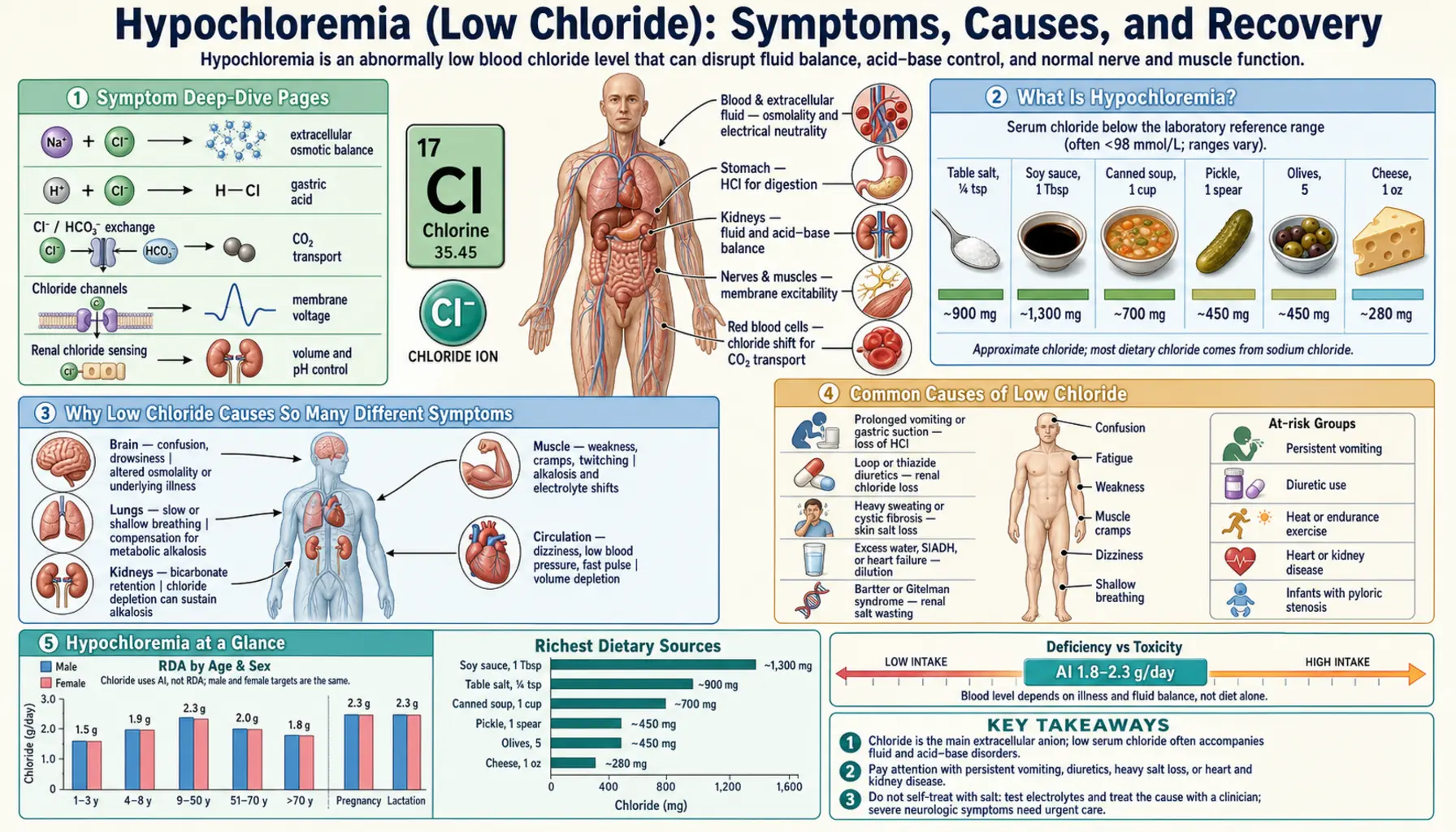
Hypochloremia means low chloride in the blood — a serum level below about 98 mmol/L, where the normal range is roughly 98–106. Chloride is the negatively charged twin of sodium and the other half of ordinary table salt, and although it rarely gets named, it does quiet, essential work: it balances the body's positive charges, helps the kidney and lungs hold the blood's acid level steady, and supplies the "chloric" half of stomach acid. By itself, low chloride seldom produces dramatic symptoms you could point to. Instead it is usually a clue — a flag that the body has lost fluid and acid, most often through repeated vomiting, suctioning of stomach contents, or strong water pills, and that the blood has tipped into a state called metabolic alkalosis (too alkaline). The symptoms people actually feel — lightheadedness, weakness, muscle twitching, sluggishness, sometimes a slow shallow drift in breathing — come largely from that alkalosis and from the dehydration and companion losses of sodium and potassium that travel with it. The reassuring news is that hypochloremia is easy to find on an ordinary blood panel and, in most everyday cases, straightforward to correct: replacing chloride (usually as salt and fluid) reverses the alkalosis and the symptoms together, once the underlying loss is stopped. This hub explains what hypochloremia is, why a single low number ripples into so many systems, what causes it, and exactly how it is diagnosed and corrected — with deep-dive pages on the two situations that matter most.
Symptom Deep-Dive Pages
Metabolic Alkalosis
The blood-chemistry state that low chloride creates — why losing chloride pushes the blood too alkaline, how doctors recognize "chloride-responsive" alkalosis on a blood gas, and why the cure is so often simply salt and water.
Vomiting & Dehydration
The most common road to low chloride: repeated vomiting and the volume depletion that follows. What is actually being lost, why the kidney makes things worse before it makes them better, and how to rehydrate safely.
Table of Contents
- Symptom Deep-Dive Pages
- What Is Hypochloremia?
- Why Low Chloride Causes So Many Different Symptoms
- Common Causes of Low Chloride
- Chloride, Sodium, Potassium, and Bicarbonate
- How Hypochloremia Is Diagnosed
- How Low Chloride Is Corrected
- When to Seek Care / Red Flags
- Key Research Papers
- Connections
- Featured Videos
What Is Hypochloremia?
Chloride is an electrolyte — a mineral that carries an electrical charge when dissolved in body fluid. It is written Cl−, a chlorine atom that has gained one extra electron and so carries a single negative charge. Chloride is the most abundant negatively charged ion in the fluid outside your cells, the mirror image of sodium (Na+), the most abundant positive one. Hypochloremia is the medical word for a blood (serum) chloride level below the normal range, which most laboratories report as roughly 98 to 106 mmol/L (some labs use slightly different cut-offs, but a value under about 98 is generally called low). The word combines "hypo-" (low) with "chlor-" (chloride).
Two features make chloride different from the more famous electrolytes, and both shape how you should think about a low value:
- Chloride rarely travels alone. Because it is the counter-charge to sodium, chloride is usually lost, gained, and replaced with sodium and water. A low chloride is therefore most often part of a larger picture — fluid loss, a sodium problem, or a shift in the blood's acid balance — rather than an isolated "chloride deficiency" in the way people imagine running low on, say, iron.
- Chloride is a key player in acid–base balance. The body keeps the blood's acidity within an extremely narrow window. Chloride and bicarbonate (the body's main buffer base) move in opposite directions to help hold that balance. When chloride falls, bicarbonate tends to rise to keep the charges balanced, and the blood drifts toward being too alkaline — a state called metabolic alkalosis. This is the single most important consequence of low chloride and the reason it matters clinically.
How low the number falls, and how fast, shapes what a person experiences:
- Mild (about 90–98 mmol/L) — Frequently there are no symptoms at all, and the low value is simply noticed on a routine blood panel. When the body does notice, it is usually because of the accompanying alkalosis or dehydration rather than the chloride number itself: a little extra fatigue, mild lightheadedness on standing, or vague muscle heaviness.
- Moderate (about 85–90 mmol/L) — Now the alkalosis is usually meaningful. People may feel genuinely weak, lightheaded, queasy, or notice muscle twitching, cramps, or tingling around the mouth and fingers. Often there is an obvious cause in the background — days of vomiting, a strong diuretic, or stomach-tube drainage — and dehydration is part of the picture.
- Severe (below about 85 mmol/L) — This usually signals a serious underlying process and a marked metabolic alkalosis. Confusion, pronounced weakness, heart-rhythm disturbances (driven mainly by the potassium losses that accompany it), and a compensating slow, shallow breathing pattern can appear. This is hospital territory, and the chloride number is one of several that need urgent attention together.
It is worth holding one idea front and center, because it differs from how the other electrolytes work: a low chloride is best read as a signpost. On its own it is rarely the thing hurting you; it points to why — lost fluid and acid, a diuretic effect, or alkalosis — and correcting that underlying cause is what makes both the number and the symptoms come right.
Why Low Chloride Causes So Many Different Symptoms
The puzzle of hypochloremia is how a quiet, rarely-discussed mineral can be linked to symptoms as varied as dizziness, muscle twitching, weakness, sluggish breathing, and an irregular heartbeat. The short answer is that chloride itself causes very few symptoms directly; instead, a falling chloride sets off a chain of events — chiefly metabolic alkalosis and the fluid and potassium losses that come with it — and it is that chain that produces what people feel. Understand the chain and the scattered symptoms make sense.
Here is the core idea in everyday language. Picture the fluid outside your cells as a tank that must stay electrically neutral: the positive charges (mostly sodium) and the negative charges (mostly chloride and bicarbonate) have to add up to the same total. Chloride and bicarbonate share the negative side of that ledger. So when chloride is lost — say, as hydrochloric acid is vomited out of the stomach — the body keeps the books balanced by holding on to bicarbonate instead. Bicarbonate is a base, so as it accumulates the blood becomes too alkaline. Galla described this clearly: chloride depletion is the central driver that both generates and maintains this metabolic alkalosis, and the kidney cannot fully correct the alkalosis until chloride is given back. Luke and Galla made the point sharply — it is the chloride depletion, not simply the loss of fluid volume, that keeps the alkalosis going.
That alkalosis, plus the dehydration and the parallel loss of potassium, is what ripples outward into many systems at once:
- Nerves and muscles — an alkaline blood lowers the amount of free, active calcium available to nerves and muscles, making them irritable. The result is the classic alkalosis symptoms: tingling around the lips and fingertips, muscle twitching, cramps, and in severe cases spasm. (This same mechanism explains the muscle complaints discussed on the Metabolic Alkalosis deep dive.)
- Blood pressure and the brain — because chloride loss almost always comes with fluid and sodium loss, the body is often volume-depleted (dehydrated). That produces lightheadedness, weakness, and a fast heartbeat — especially on standing. See Vomiting & Dehydration and the general Dizziness page.
- The heart — the danger to heart rhythm in this setting comes mostly from the low potassium that accompanies chloride-depletion alkalosis (the same hormonal response that wastes chloride and bicarbonate also wastes potassium). Low potassium destabilizes the heart's electrical recovery between beats and can trigger palpitations or arrhythmias.
- Breathing — the lungs help regulate acid balance, so when the blood is too alkaline the body deliberately slows and shallows the breathing to hold on to carbon dioxide (a mild acid) and pull the pH back down. People around the patient may notice this before the patient does; it is a compensation, not a lung problem.
This is the unifying theme to carry into the deep-dive pages: hypochloremia rarely shouts in its own voice. It speaks through metabolic alkalosis, dehydration, and the loss of its companion electrolytes — which is exactly why fixing the chloride (and the cause behind it) tends to settle all of those symptoms together.
Common Causes of Low Chloride
Chloride falls for one of three broad reasons: you are losing it (the most common, almost always alongside fluid), it becomes diluted by too much water in the blood, or it is traded away as the blood retains bicarbonate. Most everyday cases come from losses through the stomach or the kidney. Here are the causes worth knowing.
- Vomiting and gastric suction — the classic cause. Stomach fluid is rich in hydrochloric acid, so vomiting (or drainage through a nasogastric tube) loses chloride and acid directly, and the body retains bicarbonate to compensate. This is the textbook route to chloride-depletion alkalosis. A stomach bug with days of vomiting, severe morning sickness (hyperemesis), or a bowel obstruction can all do it. See the Vomiting & Dehydration deep dive and the general Nausea & Vomiting page.
- Diuretics ("water pills") — loop diuretics (such as furosemide) and thiazide diuretics (such as hydrochlorothiazide), used for high blood pressure and heart failure, make the kidney excrete sodium, potassium, and chloride. With ongoing use this is a very common cause of a low chloride together with a mild metabolic alkalosis. (This is the opposite situation from the chloride excess some IV fluids cause — see the Chloride Toxicity hub.)
- Misuse of laxatives, diuretics, or self-induced vomiting — chronic heavy use of stimulant laxatives or water pills, or repeated self-induced vomiting (sometimes in the setting of an eating disorder), is a classic cause of stubborn, unexplained hypochloremia and alkalosis and should be considered when no other reason fits.
- Diarrhea (a different pattern) — while vomiting raises the risk of alkalosis, some diarrheal illnesses lose bicarbonate-rich fluid and can instead cause a low chloride with a more acidic picture. The lesson is that the blood's acid balance — not the chloride number alone — tells you what is happening.
- Congestive heart failure and advanced liver or kidney disease — in these conditions the body can retain excess water, diluting the blood and lowering both sodium and chloride. In heart failure specifically, a low chloride has emerged as a notable marker of more severe disease and worse outcomes (Vaduganathan and colleagues; Kataoka's "chloride theory"), partly reflecting both the illness and the intensity of diuretic treatment.
- SIADH (excess antidiuretic hormone) — a condition in which the body holds on to too much water, diluting the blood. Chloride falls in parallel with sodium. It has many triggers, including certain medications, lung conditions, and brain injury.
- Excess sweating without salt replacement — prolonged heavy sweating (endurance exercise in heat, hot-environment labor) loses salt — both sodium and chloride — and, if replaced with plain water alone, can lower both. This usually matters only when losses are large and sustained.
- Adrenal hormone disorders — conditions that raise aldosterone or cortisol (or large amounts of real licorice, which mimics aldosterone) drive the kidney to waste potassium and hydrogen, producing a metabolic alkalosis in which chloride is often low as well.
A practical note: these causes often combine. An older adult on a loop diuretic for heart failure who then catches a vomiting illness and eats and drinks poorly for a few days can develop a clearly low chloride from the sum of several modest pushes in the same direction.
Chloride, Sodium, Potassium, and Bicarbonate
If you remember one thing beyond the basics, make it this: chloride is a team player, and its number only makes sense alongside sodium, potassium, and bicarbonate. A chloride value read in isolation tells you very little; read together with those three, it often tells the whole story. This is why the standard blood panel reports all of them at once.
Here is how the partnerships work:
- Chloride and sodium — these two are the major partners of salt and tend to rise and fall together. When both are low and the person is dehydrated, the problem is usually loss of salt and water. When both are low but the person is fluid-overloaded (as in heart failure or SIADH), the problem is usually too much water diluting the blood. Sorting which one it is decides the treatment. For the deficiency side of sodium, see Hyponatremia (Low Sodium); for the mineral overview, see Sodium.
- Chloride and bicarbonate — these are the two main negative ions, and they move in opposite directions to keep the blood electrically balanced. A low chloride with a high bicarbonate is the fingerprint of metabolic alkalosis; a low chloride with a low bicarbonate points instead toward an acidic process such as some diarrheas. Hamm and colleagues lay out this acid–base partnership in detail.
- Chloride and potassium — the same conditions that deplete chloride (vomiting, diuretics, excess aldosterone) usually deplete potassium as well, and the resulting metabolic alkalosis drives still more potassium into cells and out through the kidney. As a result, low chloride and low potassium frequently appear together, and the potassium loss is often what creates the real danger to the heart and muscles. Correcting both — commonly with potassium chloride, which conveniently replaces both ions at once — is usually part of the fix. See Hypokalemia (Low Potassium) and the Potassium overview.
The takeaway: chloride is the quiet member of a four-part chemistry that the body holds in careful balance. Reading the four together — sodium, chloride, potassium, and bicarbonate — turns a confusing single low number into a clear diagnosis, which is exactly what the next section is about.
How Hypochloremia Is Diagnosed
The reassuring part of this story is that hypochloremia is usually easy to detect. It is most often found on a simple blood test — either a basic metabolic panel (BMP) or a comprehensive metabolic panel (CMP), both of which are routine, inexpensive, and report serum chloride directly alongside sodium, potassium, and bicarbonate (often labeled CO2 on the report). Many people first learn their chloride is low not because anyone went looking for it, but because the value turned up on bloodwork ordered for something else. For what the panel measures and how to read it, see the Comprehensive Metabolic Panel page.
Because chloride means little in isolation, the real diagnostic work is interpreting it in context. Depending on the clinical picture, a doctor may add or look closely at:
- The bicarbonate (CO2) on the same panel — the single most useful companion value. A low chloride paired with a high bicarbonate strongly suggests metabolic alkalosis; paired with a low bicarbonate, it points toward an acidic process instead. This one pairing often reveals what is going on.
- An arterial or venous blood gas — when the acid balance needs to be confirmed, a blood gas measures the actual blood pH and carbon dioxide, distinguishing a true metabolic alkalosis (and how the lungs are compensating) from other patterns. Nagami's reviews walk through how chloride fits into these acid–base readings.
- An assessment of fluid status — the clinician checks for dehydration (dry mouth, low blood pressure, a fast heart rate, lightheadedness on standing) versus fluid overload (swelling, breathlessness). This is what separates "lost salt and water" from "diluted by too much water," and it changes the treatment entirely.
- A urine chloride — a particularly valuable test in metabolic alkalosis. A low urine chloride means the body is hungrily holding on to chloride and the problem is chloride-responsive (vomiting, prior diuretics, dehydration) — the kind that gets better with salt and fluid. A high urine chloride points instead to ongoing diuretic effect or a hormone-driven cause. This single test often decides the diagnosis and the cure.
- Potassium and magnesium — checked alongside chloride because they so often fall together and because low potassium drives the most dangerous complications.
One technical caveat worth knowing: chloride can occasionally read falsely high or low because of how the sample is handled, or because of unusual substances in the blood (for example, very high lipids or certain drugs can interfere with some methods). If a result does not fit the person at all, it is sometimes simply repeated.
How Low Chloride Is Corrected
Treatment is matched to the cause, the fluid status, and the severity of any alkalosis. The unifying principles are simple: give back chloride (almost always as salt and fluid), replace the potassium that traveled with it, and fix the underlying reason so the loss does not simply continue.
- Mild cases — food, fluids, and stopping the loss. When chloride is only modestly low and there are no worrying symptoms, the gentlest fix is often to stop the cause and replace salt and water by mouth. Chloride is abundant in the diet — it is half of ordinary table salt and is found in nearly all salty and savory foods, including broths, pickled foods, cheeses, and processed foods. A salty broth such as bone broth is a practical, palatable way to replace both salt and fluid. (Bananas and other potassium-rich foods help replace the potassium that often accompanies the loss — see Bananas.) Importantly, most people in developed countries already eat more than enough chloride; an isolated dietary chloride deficiency in a healthy adult is rare.
- Moderate cases — oral rehydration and electrolyte replacement. When losses have been larger — a few days of vomiting, for instance — a balanced oral rehydration solution (which contains sodium, chloride, potassium, and sugar in measured amounts) is more effective than plain water, because plain water replaces neither the salt nor the chloride that were lost. Potassium chloride is frequently prescribed in this setting because it replaces both the potassium and the chloride at once.
- Severe or symptomatic cases — intravenous saline in hospital. When the person is significantly dehydrated, markedly alkalotic, or unable to keep fluids down, chloride is given through a vein as saline (salt water). Restoring chloride and fluid volume allows the kidney to finally release the excess bicarbonate, which corrects the metabolic alkalosis — this is why chloride-responsive alkalosis is often called "saline-responsive." Potassium is usually added to the fluid as needed. The choice and rate of intravenous fluid are made carefully; the large randomized SMART trial (Semler and colleagues) showed that the specific fluid chosen has real consequences, which is why these decisions belong to the medical team.
- Always: replace the potassium. Because low potassium so reliably accompanies chloride-depletion alkalosis and drives the heart and muscle risks, checking and replacing potassium is part of correcting hypochloremia, not an afterthought.
- Always: treat the cause. Replacing chloride without addressing why it dropped simply resets the clock. That might mean controlling vomiting, adjusting or pausing a diuretic, treating heart failure or liver disease differently, addressing laxative or diuretic misuse, or investigating a hormone-driven cause.
For most people the outlook is excellent: once chloride and fluid are restored, the alkalosis corrects, the potassium comes back up, and the lightheadedness, weakness, twitching, and queasiness resolve — often within a day or two — provided the underlying loss has been stopped.
When to Seek Care / Red Flags
Most situations that lower chloride — a short bout of vomiting, a recently started water pill — are handled with fluids and a non-urgent check of your bloodwork, especially if you are otherwise well and able to drink. But certain symptoms mean the chloride loss, the alkalosis, or the accompanying dehydration and potassium loss may be serious. Seek emergency care right away if you have any of the following:
- Persistent vomiting — vomiting that will not stop, or that prevents you from keeping down any fluids, which both deepens the losses and signals dangerous dehydration.
- Palpitations or an irregular heartbeat — a racing, pounding, fluttering, or skipping heartbeat, which can reflect the low potassium that accompanies chloride-depletion alkalosis.
- Fainting, near-fainting, or severe lightheadedness — especially on standing, a sign of significant dehydration or a rhythm problem.
- Confusion, marked weakness, or muscle spasm — including tingling and twitching that progresses to cramping or stiffening, which can signal a severe alkalosis.
- Slow, shallow, or labored breathing in someone who is ill — while mild slowing can be the body compensating for alkalosis, a noticeably struggling breathing pattern needs urgent evaluation.
People at higher risk — those on diuretics, with heart failure, advanced liver or kidney disease, or an eating disorder involving vomiting or laxative misuse — should have a lower threshold for getting checked, because in these settings the chloride, potassium, and acid balance can shift quickly and together. When in doubt, a quick blood panel settles the question. For related symptoms, see Nausea & Vomiting and Dizziness.
Key Research Papers
- Galla JH (2000). Metabolic Alkalosis. Journal of the American Society of Nephrology;11(2):369-375. — DOI: 10.1681/ASN.V112369
- Luke RG, Galla JH (2012). It Is Chloride Depletion Alkalosis, Not Contraction Alkalosis. Journal of the American Society of Nephrology;23(2):204-207. — DOI: 10.1681/ASN.2011070720
- Hamm LL, Nakhoul N, Hering-Smith KS (2015). Acid-Base Homeostasis. Clinical Journal of the American Society of Nephrology;10(12):2232-2242. — DOI: 10.2215/CJN.07400715
- Nagami GT (2016). Hyperchloremia — Why and how. Nefrología;36(4):347-353. — DOI: 10.1016/j.nefro.2016.04.001
- Bandak G, Kashani KB (2017). Chloride in intensive care units: a key electrolyte. F1000Research;6:1930. — DOI: 10.12688/f1000research.11401.1
- Vaduganathan M, Pallais JC, Fenves AZ, Butler J, Gheorghiade M (2016). Serum Chloride in Heart Failure: A Salty Prognosis. European Journal of Heart Failure;18(6):669-671. — DOI: 10.1002/ejhf.546
- Kataoka H (2017). Proposal for Heart Failure Progression Based on the ‘Chloride Theory’. ESC Heart Failure;4(4):623-631. — DOI: 10.1002/ehf2.12191
- Semler MW, Self WH, Wanderer JP, Ehrenfeld JM, Wang L, et al. (2018). Balanced Crystalloids versus Saline in Critically Ill Adults. New England Journal of Medicine;378(9):829-839. — DOI: 10.1056/NEJMoa1711584
- Berend K, van Hulsteijn LH, Gans ROB (2012). Chloride: The queen of electrolytes? European Journal of Internal Medicine;23(3):203-211. — PubMed
- Suetrong B, Pisitsak C, Boyd JH, Russell JA, Walley KR (2016). Hyperchloremia and moderate increase in serum chloride are associated with acute kidney injury in severe sepsis and septic shock patients. Critical Care;20:315. — PubMed
- National Academies of Sciences, Engineering, and Medicine (2019). Dietary Reference Intakes for Sodium and Potassium. Washington, DC: The National Academies Press. (Chloride Adequate Intake is set in molar parallel with sodium.) — National Academies / NCBI Bookshelf
PubMed Topic Searches
- PubMed — Hypochloremia: causes, diagnosis, and management
- PubMed — Chloride depletion and metabolic alkalosis
- PubMed — Vomiting, hypochloremia, and metabolic alkalosis
- PubMed — Serum chloride and prognosis in heart failure
- PubMed — Urine chloride and saline-responsive alkalosis
Connections
- All Minerals
- Hypochloremia: Metabolic Alkalosis
- Hypochloremia: Vomiting & Dehydration
- Chloride Toxicity (High Chloride)
- Chloride Overview
- Sodium
- Hyponatremia (Low Sodium)
- Potassium
- Hypokalemia (Low Potassium)
- Magnesium
- Comprehensive Metabolic Panel
- Nausea & Vomiting
- Dizziness
- Gastroesophageal Reflux Disease
- Eating Disorders
- Kidney Disease
- Bone Broth
- Bananas