Reverse T3 (rT3) Test
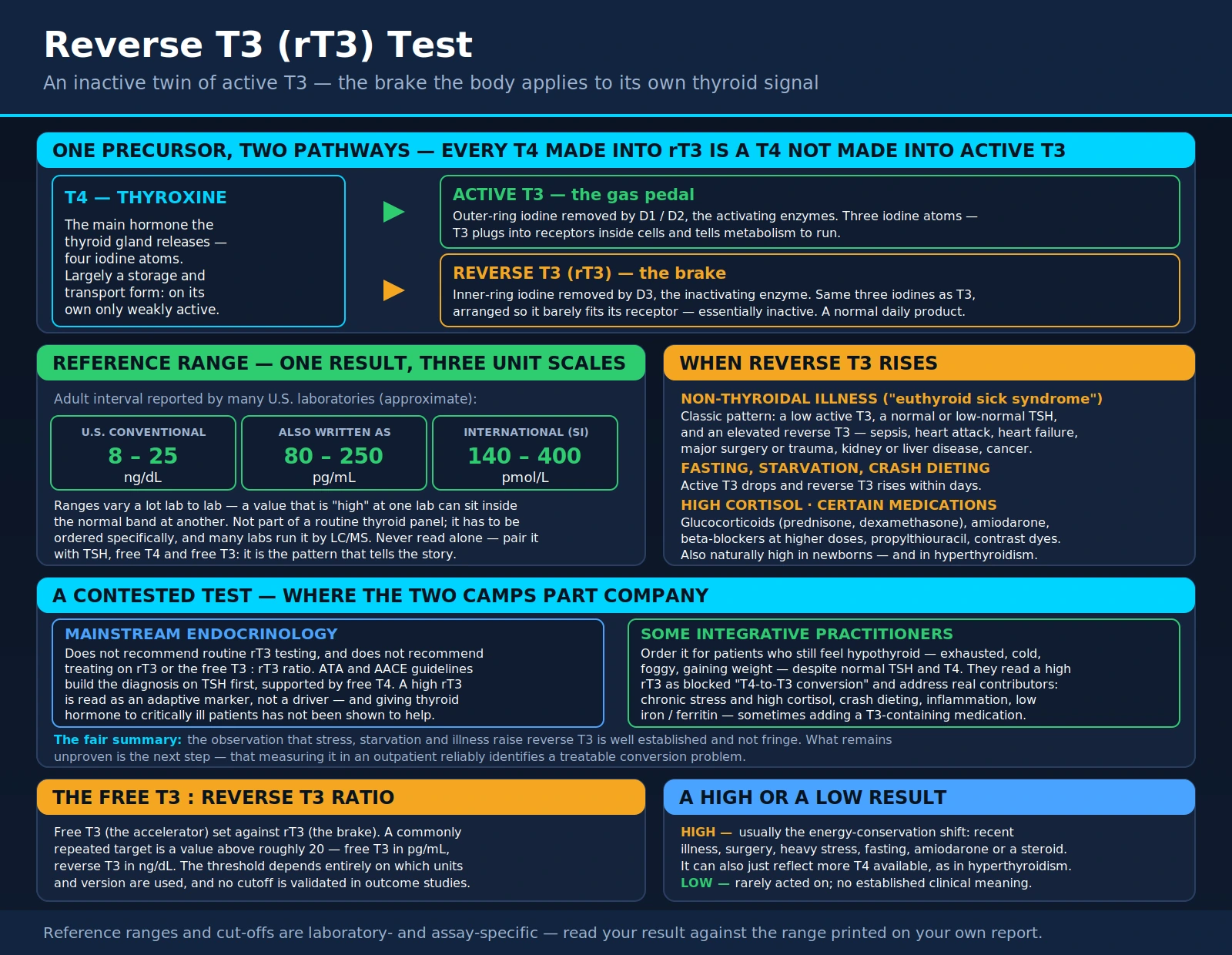
Reverse T3 (rT3) is a real thyroid molecule, but an unusual one: it is an inactive twin of the body's main active thyroid hormone. Your thyroid gland puts out mostly T4, a storage form that other tissues convert into the powerful, metabolism-driving hormone T3. That same T4 can instead be converted down a second pathway into reverse T3 — a look-alike molecule that does almost nothing. Think of it as a brake the body applies to its own thyroid signal. The reverse T3 blood test measures how much of this braking form is circulating. It is a genuine lab that hospitals use in critically ill patients, but it has become popular in a very different setting: some integrative and functional-medicine practitioners order it to explain stubborn "hypothyroid" symptoms in people whose standard thyroid tests look normal. That use is controversial. This page explains, in plain language and even-handedly, what reverse T3 is, why it rises, what the free T3 : reverse T3 ratio idea is about, and why mainstream thyroid specialists and integrative practitioners disagree about ordering it.
Table of Contents
- What Reverse T3 Is
- How the Body Makes rT3 (the Braking Pathway)
- When Reverse T3 Rises
- The rT3 Test & Reference Ranges
- The Free T3 : Reverse T3 Ratio Idea
- What Mainstream Endocrinology Says
- Why Some Practitioners Order It
- What High or Low Results Mean
- Preparation & Getting Tested
- Research Papers
- Connections
- Featured Videos
What Reverse T3 Is
To understand reverse T3, it helps to start with the two thyroid hormones most people already know about:
- T4 (thyroxine) — the main hormone your thyroid gland releases. It carries four iodine atoms (that is the "4"). T4 is largely a storage and transport form: on its own it is only weakly active. Most of it circulates until body tissues convert it into something more potent.
- T3 (triiodothyronine) — the active hormone, carrying three iodine atoms. T3 is what actually plugs into receptors inside your cells and tells your metabolism to run — setting your body temperature, heart rate, energy use, and more. Only a small amount of T3 comes straight from the gland; most is made outside the thyroid by trimming one iodine off T4.
Here is the key: T4 can be trimmed in two different places, and which iodine gets removed makes all the difference.
- Remove an iodine from one side (the "outer ring"), and you get active T3 — the gas pedal.
- Remove an iodine from the other side (the "inner ring"), and you get reverse T3 — a molecule with the same three iodines as T3 but arranged so it barely fits its receptor. It is essentially inactive.
So reverse T3 is not a defect or a poison. It is a normal, expected product that the body makes every day. Chemically it is an isomer of T3 — same ingredients, different arrangement, and because of that arrangement it does not switch on your metabolism. Its main biological meaning is what it represents: every T4 molecule turned into rT3 is a T4 molecule that was not turned into active T3. Making reverse T3 is one of the body's ways of dialing its own thyroid signal down without changing how much hormone the gland releases.
How the Body Makes rT3 (the Braking Pathway)
The conversion of T4 is done by a small family of enzymes called deiodinases (dee-EYE-oh-din-ay-sez) — literally "iodine removers." There are three of them, and they behave like a set of switches:
- D1 and D2 — the activating enzymes. They strip the outer-ring iodine off T4 to make active T3. D2 in particular fine-tunes how much active hormone specific tissues (like the brain and pituitary) get.
- D3 — the inactivating enzyme. It strips the inner-ring iodine to make reverse T3, and it also breaks active T3 down into an inactive form. D3 is the body's off-switch for thyroid signaling.
Under ordinary, healthy conditions these enzymes sit in a comfortable balance, and a modest, steady amount of reverse T3 is always present. But the balance can shift. When the body wants to conserve energy — during illness, starvation, or intense stress — it tends to turn down the activating D1 enzyme and turn up the inactivating D3 enzyme. The result is less active T3 and more reverse T3. Reverse T3 also lingers a little longer at these times because the same enzyme changes slow its normal breakdown.
This is why doctors describe the pattern as a braking or energy-conservation response. It is generally understood as the body deliberately easing off the metabolic accelerator when running at full speed would be costly or dangerous — not as the thyroid failing. The deiodinase enzymes and their role in this switching have been mapped in detail in the endocrinology literature (see Research Papers).
When Reverse T3 Rises
Reverse T3 climbs, and active T3 usually falls, in a range of situations that share a common thread: the body is under pressure and shifting into energy-saving mode. The most established of these is a well-recognized clinical pattern.
Non-thyroidal illness ("euthyroid sick syndrome")
When someone is seriously ill — think a hospital or intensive-care setting — the thyroid blood tests often change even though the thyroid gland itself is working fine. Doctors call this non-thyroidal illness syndrome (NTIS), or by its older name, euthyroid sick syndrome ("euthyroid" meaning normal thyroid function). The classic picture is a low active T3, a normal or low-normal TSH, and an elevated reverse T3. It shows up with:
- Serious infections and sepsis
- Heart attack, heart failure, and after major surgery or trauma
- Advanced kidney or liver disease
- Cancer and other chronic wasting illnesses
The mainstream understanding is that this is an adaptive response — the body protecting itself by lowering its metabolic rate during a crisis, much like a struggling business cutting spending. As the person recovers, the pattern typically reverses on its own.
Fasting, starvation, and low-calorie dieting
Going without food — whether from illness, famine, an eating disorder, or an aggressive very-low-calorie diet — produces the same shift: active T3 drops and reverse T3 rises within days. This is one of the body's oldest survival tricks, slowing metabolism to stretch limited fuel. It is also part of why prolonged crash dieting can leave people feeling cold, tired, and sluggish.
Severe stress and high cortisol
Major physical or emotional stress raises the stress hormone cortisol, which tends to suppress the activating conversion of T4 to T3 and nudge more toward reverse T3. Chronic stress states are frequently invoked when reverse T3 is discussed in integrative medicine.
Certain medications
Several drugs push T4 toward reverse T3, including:
- Glucocorticoids (steroids such as prednisone or dexamethasone)
- Amiodarone, a heart-rhythm drug that is very iodine-rich and strongly blocks the activating enzyme, sharply raising reverse T3
- Beta-blockers at higher doses (for example propranolol)
- Propylthiouracil (an anti-thyroid medication) and iodinated contrast dyes
A couple of other points round out the picture. Reverse T3 tends to be naturally high in newborns and in cord blood. And in hyperthyroidism, where there is simply more T4 to work with, reverse T3 can also be elevated — a reminder that a high value is not automatically a sign of an "underactive" state.
The rT3 Test & Reference Ranges
The reverse T3 test is a simple blood draw, usually from a vein in the arm, and does not require special equipment beyond a standard lab that offers it (many run it by a technique called liquid chromatography–mass spectrometry, or LC/MS, for accuracy). It is not part of a routine thyroid panel; it has to be ordered specifically, and some insurers do not cover it, so it is worth asking about cost in advance.
Reference ranges vary quite a bit from lab to lab and depend on the units and the assay used, so the number on your own report should always be read against that lab's stated range rather than a fixed universal cutoff. As a rough orientation, many U.S. laboratories report an adult reference interval of roughly 8 to 25 ng/dL (nanograms per deciliter) — sometimes written as about 80 to 250 pg/mL, or in international units as roughly 140 to 400 pmol/L. Because different labs anchor these ranges differently, a value that is "high" at one lab could sit inside the normal band at another. This variability is one of the practical reasons the test is used cautiously.
Reverse T3 is almost never interpreted alone. To mean anything, it is read alongside the standard thyroid measurements — TSH, free T4, and free T3 — because it is the pattern across those numbers, not reverse T3 by itself, that tells a story.
The Free T3 : Reverse T3 Ratio Idea
Within integrative and functional-medicine circles, reverse T3 is most often discussed as part of a ratio rather than as a stand-alone number: the free T3 : reverse T3 ratio. The reasoning goes like this. Free T3 is the active, "go" hormone; reverse T3 is the inactive "brake." Comparing the two — how much accelerator relative to how much brake — is offered as a snapshot of whether the body is using its thyroid hormone or parking it.
A high reverse T3 with a relatively low free T3 is interpreted by these practitioners as a sign that T4 is being shunted down the braking pathway — a state sometimes described as impaired "T4-to-T3 conversion" or "thyroid resistance." The proposed practical upshot is that a person could have hypothyroid-type symptoms (fatigue, weight gain, cold intolerance, brain fog, hair thinning) even when their TSH and T4 look normal, because not enough active hormone is reaching the tissues.
Two honest caveats belong right next to that idea:
- The cutoffs are not standardized. You will see figures quoted for a "good" ratio (a commonly repeated target is a value above roughly 20 when free T3 is in pg/mL and reverse T3 in ng/dL), but the exact threshold depends entirely on which units and which version of the ratio are used, and no cutoff has been validated in outcome studies for guiding treatment.
- The context matters. A high reverse T3 or a low ratio genuinely can reflect the energy-conservation response described above — but that response is usually a consequence of illness, stress, dieting, or medication, not a primary thyroid disease that needs its own thyroid drug. Where researchers have studied a T3-to-reverse-T3 ratio, it has mostly been as a prognostic marker of how sick someone is in the ICU, not as a treatment target in otherwise-well outpatients (see Research Papers).
What Mainstream Endocrinology Says
It is important to state the conventional position plainly, because it is the majority view among thyroid specialists. Mainstream endocrinology generally does not recommend routine reverse T3 testing, and does not recommend treating patients based on reverse T3 or the free T3 : reverse T3 ratio.
The major professional guidelines for diagnosing and treating hypothyroidism — from the American Thyroid Association (ATA) and the American Association of Clinical Endocrinologists (AACE) — build the diagnosis around TSH first, supported by free T4, and do not endorse reverse T3 as a tool for diagnosis or for guiding therapy (see Research Papers). The reasoning behind this stance:
- Reverse T3 is seen as a marker, not a driver. In the best-studied setting — non-thyroidal illness — a high reverse T3 is viewed as the body's adaptive response to being unwell, a downstream sign rather than a disease to be corrected. Trying to "fix" the number is treating the messenger.
- Treating it hasn't been shown to help — and may harm. Studies that gave thyroid hormone to critically ill patients with the low-T3/high-rT3 pattern have generally not shown benefit, and pushing metabolism back up during a serious illness carries real risks. This is a major reason the reflex to "correct" the pattern is discouraged.
- The test is imperfect and hard to interpret. Reference ranges differ widely between labs, the value is influenced by many non-thyroid factors, and there is no validated threshold for acting on it in a well outpatient. That makes it an unreliable basis for prescribing.
- Symptoms like fatigue and weight gain are common and non-specific. Mainstream practice cautions against pinning them on reverse T3 when many other explanations — sleep, mood, anemia, iron status, other illnesses — are more likely and more treatable.
None of this means a person's symptoms are imaginary. It means the conventional view is that reverse T3 is not a proven way to explain or treat them.
Why Some Practitioners Order It
On the other side, some integrative, functional-medicine, and naturopathic practitioners do order reverse T3, and it is worth understanding their reasoning fairly rather than dismissing it. Their case usually rests on a real clinical frustration: a subset of patients continue to feel unwell in a distinctly "hypothyroid" way — exhausted, cold, foggy, gaining weight — despite thyroid labs that fall inside the normal range and, sometimes, despite taking standard T4 (levothyroxine) replacement.
For these practitioners, reverse T3 offers a candidate explanation: perhaps the problem is not how much hormone is present but how well it is being converted and used at the tissue level. A high reverse T3 or a low free T3 : reverse T3 ratio is taken as evidence that conversion is being blocked — and they point to real contributors that can genuinely shift the deiodinase balance, such as chronic stress and high cortisol, crash dieting, inflammation, and low iron/ferritin. Their typical response is to address those underlying stressors and, in some cases, to add a T3-containing thyroid medication (such as liothyronine or desiccated thyroid extract) rather than T4 alone.
The fair summary is this: the observation that stress, starvation, and illness raise reverse T3 is well established and not fringe. What remains unproven is the next step — that measuring reverse T3 in an outpatient reliably identifies a treatable "conversion problem," and that prescribing T3 based on that number improves outcomes. That leap is where the mainstream and integrative views part company. A patient considering this route deserves to know both that the underlying biology is real and that the treatment rationale has not been validated in controlled trials.
What High or Low Results Mean
Because reverse T3 is only meaningful in context, here is how the common patterns are generally read — always in combination with TSH, free T4, and free T3, and always in light of what else is going on in a person's life and health.
A high reverse T3
An elevated reverse T3 — especially paired with a low or low-normal free T3 — most often reflects the energy-conservation shift: recent or ongoing illness, a hospital stay, major surgery, significant stress, fasting or aggressive dieting, or a medication like amiodarone or a steroid. In the conventional view this is usually a marker of that situation rather than an independent thyroid disease. Integrative practitioners may instead read it as impaired conversion worth addressing. A high value can also simply reflect more available T4, as in hyperthyroidism.
A low reverse T3
A low reverse T3 draws far less attention and is rarely acted upon on its own. It generally is not considered a problem and does not have an established clinical meaning that changes management.
The practical bottom line
Reverse T3 is best thought of as one clue among several, never a diagnosis by itself. If your reverse T3 is flagged high, the most useful questions are usually: Was I recently ill, dieting hard, under heavy stress, or on a medication that raises it? What are my TSH, free T4, and free T3 doing? How do I actually feel? Any decision to treat — particularly to start a T3-containing medication — is a judgment call that should be made with a clinician who can see the whole picture, and patients should feel free to ask directly how strong the evidence is for the specific plan being proposed.
Preparation & Getting Tested
Reverse T3 does not require elaborate preparation, but a few practical points make the result more useful and easier to interpret:
- Timing around illness and dieting. Because acute illness, fasting, and very-low-calorie dieting temporarily raise reverse T3, a value drawn during or right after any of these may not reflect your usual state. If the goal is to assess your baseline, it is generally better to test when you are well and eating normally.
- Bring your medication list. Steroids, amiodarone, beta-blockers, and some other drugs shift the result, so make sure whoever interprets the test knows everything you take, including supplements. Do not stop any prescribed medication to "prepare" for the test unless your clinician tells you to.
- Test the whole panel together. Order reverse T3 alongside TSH, free T4, and free T3 — ideally from the same blood draw — so the numbers can be read as a pattern. A reverse T3 in isolation is hard to act on.
- Fasting is usually not required for thyroid testing, though some people draw thyroid labs in the morning for consistency. Follow your lab's or clinician's specific instructions.
- Use the same lab for follow-up. If you are tracking reverse T3 over time or watching a ratio, repeating the test at the same laboratory keeps the assay and reference range consistent, which makes any change more trustworthy.
- Ask about coverage. Reverse T3 is often not part of routine testing and may be an out-of-pocket cost. It is reasonable to ask, before the draw, what the test will cost and what specific decision the result will inform.
Most importantly, use the result as a starting point for a conversation, not a verdict. A single lab value — especially one as context-dependent and debated as reverse T3 — is only as useful as the interpretation around it.
Research Papers
- Peeters RP, Wouters PJ, van Toor H, Kaptein E, Visser TJ, Van den Berghe G. Serum 3,3',5'-triiodothyronine (rT3) and 3,5,3'-triiodothyronine/rT3 are prognostic markers in critically ill patients and are associated with postmortem tissue deiodinase activities. Journal of Clinical Endocrinology & Metabolism. 2005;90(8):4559–4565. doi:10.1210/jc.2005-0535 — A key study showing that reverse T3 and the T3/rT3 ratio track how ill patients are and mirror actual tissue enzyme activity — the ratio studied as a prognostic marker, not a treatment target.
- Peeters RP, Wouters PJ, Kaptein E, van Toor H, Visser TJ, Van den Berghe G. Reduced activation and increased inactivation of thyroid hormone in tissues of critically ill patients. Journal of Clinical Endocrinology & Metabolism. 2003;88(7):3202–3211. doi:10.1210/jc.2002-022013 — Direct evidence that serious illness turns down the T4-to-T3 activating enzymes and turns up the inactivating enzyme, explaining the low-T3/high-rT3 pattern.
- Van den Berghe G. Non-thyroidal illness in the ICU: a syndrome with different faces. Thyroid. 2014;24(10):1456–1465. doi:10.1089/thy.2014.0201 — A review of why thyroid labs shift in critical illness and why the rise in reverse T3 is best understood as an adaptive, energy-conserving response.
- Warner MH, Beckett GJ. Mechanisms behind the non-thyroidal illness syndrome: an update. Journal of Endocrinology. 2010;205(1):1–13. doi:10.1677/JOE-09-0412 — An accessible overview of the deiodinase and cytokine changes that lower active T3 and raise reverse T3 during illness.
- Chopra IJ. Euthyroid sick syndrome: is it a misnomer? Journal of Clinical Endocrinology & Metabolism. 1997;82(2):329–334. doi:10.1210/jcem.82.2.3745 — A classic discussion of whether the low-T3/high-rT3 state of illness is truly "normal thyroid function," framing the long-running debate over how to interpret it.
- Fliers E, Bianco AC, Langouche L, Boelen A. Thyroid function in critically ill patients. Lancet Diabetes & Endocrinology. 2015;3(10):816–825. doi:10.1016/S2213-8587(15)00225-9 — A modern review concluding that routinely correcting the illness-related thyroid pattern is not supported and may be harmful.
- Wartofsky L, Burman KD. Alterations in thyroid function in patients with systemic illness: the "euthyroid sick syndrome." Endocrine Reviews. 1982;3(2):164–217. doi:10.1210/edrv-3-2-164 — The foundational review that named and characterized the euthyroid sick syndrome, including the rise in reverse T3.
- Jonklaas J, Bianco AC, Bauer AJ, et al. Guidelines for the treatment of hypothyroidism: prepared by the American Thyroid Association Task Force on Thyroid Hormone Replacement. Thyroid. 2014;24(12):1670–1751. doi:10.1089/thy.2014.0028 — Major professional guidance that builds treatment around TSH and free T4 and does not endorse reverse T3 for diagnosing or guiding therapy.
- Garber JR, Cobin RH, Gharib H, et al. Clinical practice guidelines for hypothyroidism in adults: cosponsored by the American Association of Clinical Endocrinologists and the American Thyroid Association. Thyroid. 2012;22(12):1200–1235. doi:10.1089/thy.2012.0205 — Companion guidelines that likewise center diagnosis on TSH and free T4 rather than reverse T3.
- Bianco AC, Salvatore D, Gereben B, Berry MJ, Larsen PR. Biochemistry, cellular and molecular biology, and physiological roles of the iodothyronine selenodeiodinases. Endocrine Reviews. 2002;23(1):38–89. doi:10.1210/edrv.23.1.0455 — The reference work on the D1, D2, and D3 enzymes that decide whether T4 becomes active T3 or inactive reverse T3.
Connections
- All Lab Tests
- Thyroid Panel
- Hormone Panel
- Cortisol Test
- Ferritin Test
- Hypothyroidism
- Hashimoto's Thyroiditis
- Hyperthyroidism
- Endocrinology