Prealbumin (Transthyretin) Test
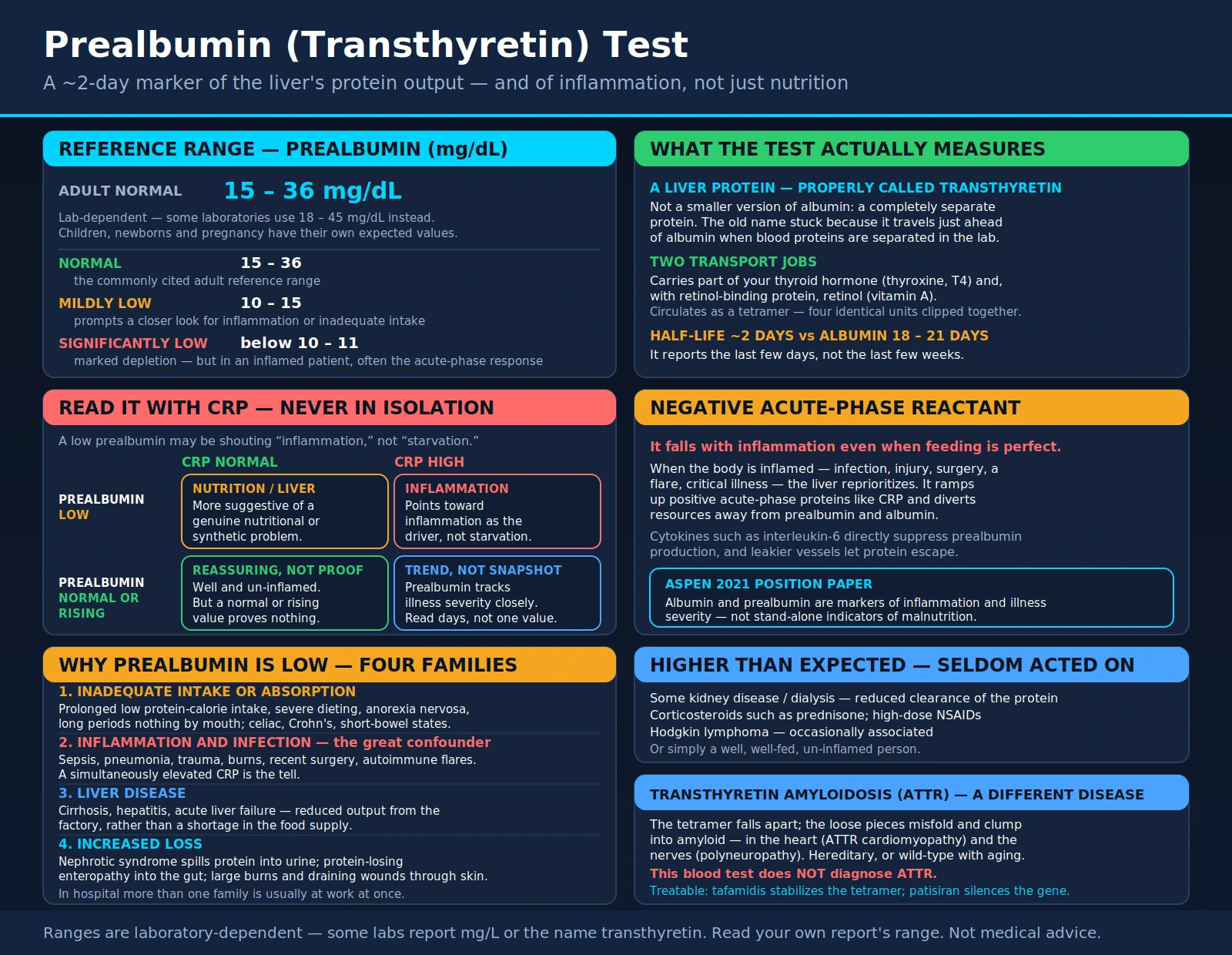
The prealbumin test is a simple blood test that measures a protein made by your liver. Despite its name, prealbumin is not a smaller version of albumin — it is a completely separate protein that scientists now more accurately call transthyretin (because it helps carry thyroid hormone and vitamin A through the blood). The name "prealbumin" stuck simply because it travels slightly ahead of albumin when blood proteins are separated in the laboratory. For decades, doctors reached for this test as a quick way to gauge whether a person was getting enough protein and calories, especially in the hospital. The appeal is real: prealbumin turns over quickly, so its level can shift within a few days rather than the several weeks it takes albumin to move. But there is an equally important catch that this page will not gloss over — prealbumin also drops sharply whenever the body is inflamed or fighting illness, regardless of how well someone is eating. Modern nutrition guidelines have therefore stepped back from treating it as a stand-alone verdict on nutrition. This page explains, in plain language, what the test measures, why it is ordered, where it is genuinely useful, and where it can mislead.
Table of Contents
- What Prealbumin (Transthyretin) Is
- Why the Test Is Ordered
- The Honest Caveat: A Negative Acute-Phase Reactant
- Reference Range and What Low vs High Means
- Causes of a Low Prealbumin
- Causes of a Higher-Than-Expected Prealbumin
- Using Prealbumin to Monitor Nutrition Support
- Transthyretin and TTR Amyloidosis
- How the Test Is Done and How to Prepare
- What This Test Can and Can't Tell You
- Research Papers
- Connections
- Featured Videos
What Prealbumin (Transthyretin) Is
Prealbumin is a protein your liver builds and releases into the bloodstream. Its modern, more accurate name is transthyretin — a word stitched together from its two transport jobs: it carries a portion of your thyroid hormone (thyroxine, or T4) and, working with a partner protein called retinol-binding protein, it helps ferry retinol (vitamin A) through the blood. Circulating transthyretin normally travels as a group of four identical units clipped together, a shape called a tetramer.
The single most important physical fact about prealbumin, for anyone interpreting the test, is its short life span. A prealbumin molecule lasts only about 2 days in the circulation before it is cleared and replaced. Compare that with albumin, its more famous cousin, which lingers for roughly 18 to 21 days. Because prealbumin is replaced so rapidly, its blood level reflects what your liver has been doing over just the last few days — a much more current snapshot than albumin provides. That responsiveness is exactly why the test became popular for nutrition, and, as the next sections explain, also why it is so easily thrown off by illness.
The blood test itself reports a concentration, most often in milligrams per deciliter (mg/dL). Some laboratories report it in milligrams per liter (mg/L) or use the transthyretin name on the report, so it is worth checking the units and the name your particular lab uses.
Why the Test Is Ordered
Historically, the prealbumin test earned its place as a marker of recent nutritional status and of the body's response to nutrition support. The logic runs like this: proteins such as albumin, prealbumin, and transferrin are all built by the liver from the amino acid building blocks that food supplies. If someone is starved of protein and calories, the liver has less raw material and slows production. Because prealbumin turns over in about two days, its level falls (and, hopefully, recovers) faster than the slow-moving albumin — so in theory it could act as an early warning of a developing deficit and an early sign that feeding is working.
In practice, clinicians have ordered prealbumin in situations such as:
- Hospital and critical-care settings — to screen for protein-energy malnutrition and to follow patients receiving tube feeding (enteral nutrition) or intravenous feeding (parenteral nutrition).
- Chronic illness follow-up — conditions such as advanced kidney disease, liver disease, cancer, or eating disorders, where protein status is a recurring concern.
- Before major surgery — as one of several inputs used to flag patients who may benefit from nutritional support beforehand.
- Tracking a trend over time — a series of prealbumin values across days can, in the right context, show a direction of travel that a single reading cannot.
It is best understood as one instrument in a larger dashboard, not a warning light that means the same thing every time it glows. The reason for that caution is the subject of the next section.
The Honest Caveat: A Negative Acute-Phase Reactant
Here is the part that matters most, and the part that older textbooks often under-stated. Prealbumin is a negative acute-phase reactant. When the body mounts an inflammatory response — from infection, injury, surgery, a flare of a chronic disease, or critical illness — the liver reprioritizes. It ramps up production of "positive" acute-phase proteins like C-reactive protein (CRP) and diverts resources away from proteins like prealbumin and albumin. On top of that, inflammatory signaling molecules (cytokines such as interleukin-6) directly suppress prealbumin production and blood vessels grow leakier, letting protein escape the circulation.
The consequence is blunt: prealbumin can fall steeply during illness even when a person is being fed perfectly well. A low value may be shouting "inflammation," not "starvation." Conversely, when the inflammation settles, prealbumin can rebound within days — which can look like a nutritional victory even if nothing about the diet changed.
This is not a fringe critique; it is now the mainstream position. In 2021 the American Society for Parenteral and Enteral Nutrition (ASPEN) issued a position paper concluding that serum proteins such as albumin and prealbumin are markers of inflammation and illness severity, not reliable stand-alone indicators of malnutrition or of adequate nutritional intake. Earlier consensus definitions of malnutrition had already removed these proteins as diagnostic criteria for the same reason. The practical guidance that follows from this is consistent:
- Never interpret prealbumin in isolation. Pair it with a marker of inflammation — most often CRP. A low prealbumin with a high CRP points toward inflammation as the driver; a low prealbumin with a normal CRP is more suggestive of a genuine nutritional or synthetic problem.
- Anchor it to the clinical picture. Weight history, muscle mass, appetite, intake records, and a physical exam by a dietitian carry more diagnostic weight than any single protein number.
- Read trends, not snapshots — and read them cautiously. Even a rising trend may reflect resolving inflammation rather than nutritional repletion.
None of this means the test is worthless. It means the test answers a narrower question than its reputation once implied. Used as a barometer of the inflammatory storm and the liver's synthetic capacity — rather than as a scorecard of the dinner tray — prealbumin still carries useful information.
Reference Range and What Low vs High Means
A commonly cited adult reference range for prealbumin is roughly 15 to 36 mg/dL, though the exact numbers are lab-dependent — some laboratories use ranges such as 18 to 45 mg/dL, and children, newborns, and pregnant individuals have their own expected values. Always read your result against the reference range printed on your own report, not against a number from the internet.
As a rough orientation only (your lab's cutoffs govern):
- Normal: about 15–36 mg/dL.
- Mildly low: roughly 10–15 mg/dL — often prompts a closer look for inflammation or inadequate intake.
- Significantly low: below about 10–11 mg/dL — historically flagged as marked depletion, but in a sick, inflamed patient this frequently reflects the acute-phase response rather than starvation.
What a low value can mean: insufficient protein-calorie intake or absorption, active inflammation or infection, liver disease (less protein made), or protein loss through the kidneys or gut. Because several of these travel together in hospitalized patients, a low number rarely has a single tidy explanation.
What a high value can mean: a genuinely elevated prealbumin is far less commonly acted upon, but it can appear in certain kidney conditions, with corticosteroid ("steroid") use, and occasionally with Hodgkin lymphoma or high-dose non-steroidal anti-inflammatory drug use. It can also simply reflect a well-nourished person without inflammation.
Causes of a Low Prealbumin
A below-range prealbumin has four broad families of causes. In real patients — especially in the hospital — more than one is often at work simultaneously, which is precisely why the number needs context.
1. Inadequate intake or absorption (malnutrition)
Prolonged low protein-calorie intake, severe dieting, anorexia nervosa, extended periods of nothing by mouth, or malabsorption from conditions such as celiac disease, Crohn's disease, or short-bowel states can all lower the raw material the liver needs. This is the classic reason the test was ordered — but it is only trustworthy as an explanation when inflammation has been ruled out.
2. Inflammation and infection
As covered above, this is the great confounder. Sepsis, pneumonia, trauma, burns, recent surgery, and flares of autoimmune or inflammatory disease all push prealbumin down through the acute-phase response, independent of diet. A simultaneously elevated CRP is the tell.
3. Liver disease
Because the liver manufactures prealbumin, significant liver dysfunction — cirrhosis, hepatitis, or acute liver failure — reduces production and lowers the blood level. Here a low prealbumin reflects the factory's reduced output rather than the food supply.
4. Increased loss
Protein can be lost faster than the liver can replace it. In nephrotic syndrome, damaged kidney filters spill protein into the urine. In protein-losing enteropathy, protein leaks into the gut. Large burns and draining wounds lose protein through the skin surface. In these settings a low prealbumin marks a leak, not a shortage of supply.
Causes of a Higher-Than-Expected Prealbumin
Elevated prealbumin draws far less clinical attention than a low value, and it is rarely a problem in its own right. Recognized associations include:
- Some kidney disease: reduced clearance of transthyretin can raise the measured level; prealbumin is sometimes higher in people on dialysis for reasons tied to how the kidneys handle the protein.
- Corticosteroids ("steroids"): medications such as prednisone can nudge prealbumin upward.
- High-dose NSAIDs: heavy use of non-steroidal anti-inflammatory drugs has been linked to higher readings.
- Hodgkin lymphoma: occasionally associated with an elevated prealbumin.
- Simply being well and un-inflamed: in a healthy, well-fed person with no inflammation, a value at the upper end of normal is unremarkable.
Because a high prealbumin seldom changes management on its own, the clinical conversation almost always centers on low values and what is driving them.
Using Prealbumin to Monitor Nutrition Support — Honestly
So where does that leave prealbumin at the bedside of someone on tube or intravenous feeding? The honest answer is: useful as a trend, in context, and never as a solo scorecard.
Its short half-life genuinely makes prealbumin more responsive than albumin, so a series of values over several days can move in a way that tracks the overall clinical trajectory. But study after study has shown that these movements often mirror the rise and fall of inflammation more faithfully than the calories delivered. A prealbumin that climbs as a patient recovers may be reporting that the infection is clearing — a welcome sign, but not proof that the feeding plan hit a protein target. That is why the modern approach de-emphasizes chasing a prealbumin number and instead relies on:
- Nutrition-focused physical assessment by a dietitian — muscle and fat stores, hand-grip strength, signs of wasting.
- Actual intake versus estimated needs — counting what is truly delivered and absorbed.
- Weight trends, functional status, and wound healing.
- Inflammation markers (CRP) read alongside any protein value, so a change in prealbumin is interpreted in light of whether inflammation is rising or falling.
Used this way — as a supporting data point interpreted next to CRP and the clinical exam — prealbumin can add color to the picture. Used as a stand-alone verdict on whether nutrition is "working," it overpromises. The clearest takeaway from the last two decades of research is that treating the prealbumin number itself as the goal can be misleading.
Transthyretin and TTR Amyloidosis
Transthyretin has a second, entirely separate role in medicine that is worth understanding, because the same protein appears in a very different disease. In a group of conditions called transthyretin amyloidosis (ATTR), the transthyretin protein becomes unstable, its normal four-part tetramer falls apart, and the loose pieces misfold and clump into deposits called amyloid. These deposits accumulate in tissues — most importantly the heart (causing a stiff, failing heart muscle known as ATTR cardiomyopathy) and the nerves (causing a progressive polyneuropathy with numbness, weakness, and pain).
ATTR comes in two forms: a hereditary type caused by inherited variants in the transthyretin gene, and a wild-type form (formerly called senile systemic amyloidosis) that occurs with aging even without a gene variant and is an increasingly recognized cause of heart failure in older adults.
Two points keep this honest. First, the routine prealbumin blood test described on this page is a nutrition/inflammation marker and is not how amyloidosis is diagnosed — ATTR is identified through specialized imaging, biopsy, genetic testing, and specialist evaluation, not a standard prealbumin level. Second, the disease is now treatable: tafamidis, a drug that stabilizes the transthyretin tetramer so it is less likely to fall apart, was shown in a landmark randomized trial to reduce deaths and hospitalizations in ATTR cardiomyopathy, and gene-silencing therapies such as patisiran have transformed the outlook for the hereditary neuropathy. If you have arrived at this page after a doctor mentioned "transthyretin" in the context of the heart or nerves, that is a different clinical story from the nutrition test — and one worth pursuing with a specialist.
How the Test Is Done and How to Prepare
The prealbumin test is an ordinary blood draw. A phlebotomist collects a small sample from a vein in your arm, usually into a single tube, and the sample is analyzed in the laboratory. There is nothing unusual about the procedure itself — the same brief pinch and a minute or two of pressure afterward as with any routine blood test.
- Fasting: Prealbumin generally does not require fasting. However, it is frequently drawn together with other tests (such as a metabolic panel) that may, so follow whatever instructions your ordering clinician gives for the whole set of tests.
- Timing around illness: Because inflammation lowers the result, the timing relative to an acute infection or recent surgery strongly affects interpretation. This is a reason a pairing test like CRP is often drawn at the same time.
- Medications: Mention corticosteroids, NSAIDs, and any hormone or nutrition therapies, since several can move the number.
- Results: Most laboratories return prealbumin within a day. Interpret it against the reference range on your own report and alongside the rest of your results.
What This Test Can and Can't Tell You
To close the loop honestly, here is the plain summary many people come to this page looking for.
What prealbumin can do:
- Give a relatively recent readout (last few days) of your liver's protein production, because the protein turns over quickly.
- Serve as one supporting data point — especially as a trend — when read alongside CRP and a proper clinical and dietary assessment.
- Reflect, quite sensitively, the presence and severity of inflammation and illness.
What prealbumin can't do:
- Serve as a reliable stand-alone test for malnutrition — a low value does not, by itself, prove poor nutrition, and a normal or rising value does not, by itself, prove good nutrition.
- Tell you why it is low without help — distinguishing inflammation from inadequate intake from liver disease from protein loss requires other tests and clinical judgment.
- Diagnose transthyretin amyloidosis, which is a separate disease requiring specialized testing.
Helpful questions to ask your care team: Was a CRP (or other inflammation marker) checked at the same time? Given my current illness, how much of this result is likely inflammation versus nutrition? Is a dietitian's nutrition-focused assessment part of the plan? Are we following a trend over several days, or reading a single value? What, specifically, would change in my care based on this result?
Research Papers
- Ingenbleek Y, De Visscher M, De Nayer P. Measurement of prealbumin as index of protein-calorie malnutrition. Lancet. 1972;300(7768):106-109. doi:10.1016/s0140-6736(72)91596-6 — the early study that introduced prealbumin as a nutrition marker.
- Ingenbleek Y, Young V. Transthyretin (prealbumin) in health and disease: nutritional implications. Annu Rev Nutr. 1994;14:495-533. doi:10.1146/annurev.nu.14.070194.002431 — comprehensive review of transthyretin biology and its nutritional uses.
- Shenkin A. Serum prealbumin: is it a marker of nutritional status or of risk of malnutrition? Clin Chem. 2006;52(12):2177-2179. doi:10.1373/clinchem.2006.077412 — influential editorial arguing prealbumin reflects illness risk more than nutrition itself.
- Devakonda A, George L, Raoof S, Esan A, Saleh A, Bernstein LH. Transthyretin as a marker to predict outcome in critically ill patients. Clin Biochem. 2008;41(14-15):1126-1130. doi:10.1016/j.clinbiochem.2008.06.016 — links prealbumin levels to prognosis in intensive care.
- Ingenbleek Y, Bernstein LH. Plasma transthyretin as a biomarker of lean body mass and catabolic states. Adv Nutr. 2015;6(5):572-580. doi:10.3945/an.115.008508 — reframes transthyretin as a marker of lean tissue and catabolism.
- Bharadwaj S, Ginoya S, Tandon P, et al. Malnutrition: laboratory markers vs nutritional assessment. Gastroenterol Rep (Oxf). 2016;4(4):272-280. doi:10.1093/gastro/gow013 — compares protein markers with hands-on nutritional assessment.
- Dellière S, Cynober L. Is transthyretin a good marker of nutritional status? Clin Nutr. 2017;36(2):364-370. doi:10.1016/j.clnu.2016.06.004 — critically examines the limits of transthyretin as a nutrition test.
- Keller U. Nutritional laboratory markers in malnutrition. J Clin Med. 2019;8(6):775. doi:10.3390/jcm8060775 — reviews albumin, prealbumin, and other markers and their inflammation confounding.
- Evans DC, Corkins MR, Malone A, et al. The use of visceral proteins as nutrition markers: an ASPEN position paper. Nutr Clin Pract. 2021;36(1):22-28. doi:10.1002/ncp.10588 — the key modern guidance: albumin and prealbumin are inflammation markers, not stand-alone nutrition tests.
- Ranasinghe RNK, Biswas M, Vincent RP. Prealbumin: the clinical utility and analytical methodologies. Ann Clin Biochem. 2022;59(1):7-14. doi:10.1177/0004563220931885 — up-to-date look at how prealbumin is measured and where it helps.
- Ando Y, Coelho T, Berk JL, et al. Guideline of transthyretin-related hereditary amyloidosis for clinicians. Orphanet J Rare Dis. 2013;8:31. doi:10.1186/1750-1172-8-31 — clinical overview of hereditary transthyretin amyloidosis.
- Maurer MS, Schwartz JH, Gundapaneni B, et al. Tafamidis treatment for patients with transthyretin amyloid cardiomyopathy. N Engl J Med. 2018;379(11):1007-1016. doi:10.1056/NEJMoa1805689 — landmark trial showing a transthyretin stabilizer reduces death and hospitalization in ATTR cardiomyopathy.
PubMed: prealbumin transthyretin nutritional assessment
Connections
- All Lab Tests
- Albumin
- Comprehensive Metabolic Panel
- Liver Function Tests
- Inflammatory Markers
- High-Sensitivity CRP
- Kidney Function Tests
- Celiac Panel
- Celiac Disease
- Crohn's Disease
- Gastroenterology
- Amino Acids