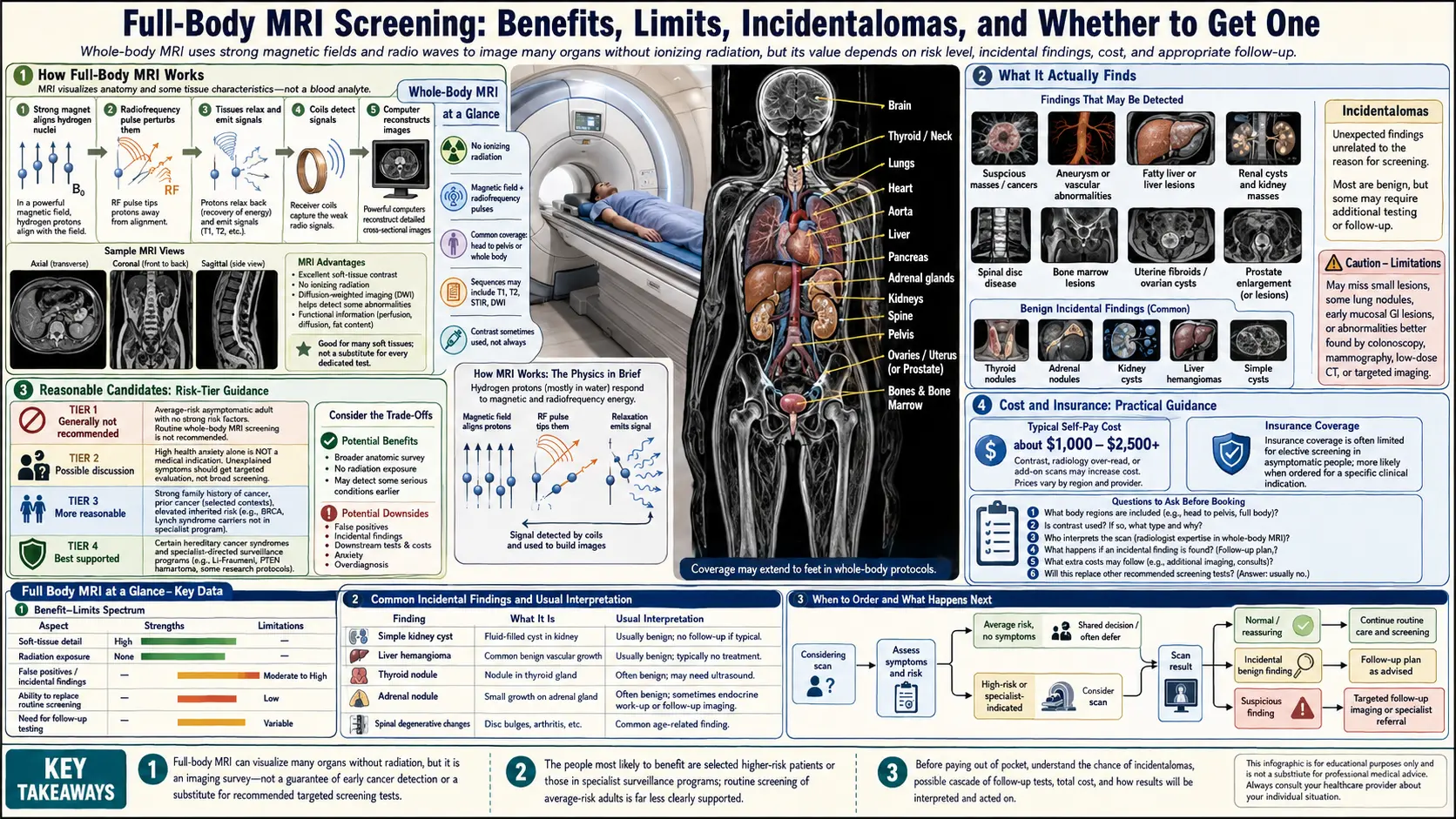
Full-Body MRI Screening: Benefits, Limits, Incidentalomas, and the Evidence
Full-body MRI screening (whole-body MRI, WB-MRI) is a single magnetic-resonance examination that images most of the body in one session without ionizing radiation. It is sold directly to consumers by commercial imaging services and is part of recommended surveillance for some inherited cancer-predisposition syndromes. Proponents describe it as a way to find tumors, aneurysms and other disease before symptoms appear. Critics point to the high rate of incidental findings, the follow-up testing they trigger, and the absence of outcome data showing that screening people without symptoms extends life.
This article sets out what systematic reviews have found about the yield of whole-body MRI in people without symptoms, what radiology and cancer-genetics bodies have stated, and where it is part of guideline surveillance.
Table of Contents
How Full-Body MRI Works
MRI uses a strong magnetic field and radio-frequency pulses to produce detailed images of soft tissue without ionizing radiation. Whole-body screening protocols combine several sequences across the body; a 2021 review of published protocols identified the sequences common to them (T1-weighted, T2-weighted and diffusion-weighted imaging among them) and discussed extra sequences for particular groups (PubMed PMID: 34338948). In 2021 an international expert panel published ONCO-RADS, a standard for acquiring, interpreting and reporting whole-body MRI for cancer screening in people at higher risk, with five assessment categories for findings (PubMed PMID: 33904776). Where a protocol includes gadolinium-based contrast, a 2018 Canadian Association of Radiologists review found that very small amounts of gadolinium deposit in the human brain, that the clinical significance is unknown, and that there was no conclusive evidence linking the deposits to any adverse patient outcome (PubMed PMID: 30249408).
Who Offers It
Whole-body MRI for people without symptoms is offered by direct-to-consumer imaging companies, independent imaging centres and some hospital and academic radiology departments. Protocols differ between services — in which body regions are covered, which sequences are used, and whether vascular or colon imaging is included — and a 2025 meta-analysis listed unstandardized protocols as one of the limits of the evidence (PubMed PMID: 40884613).
What It Actually Finds
Two systematic reviews of whole-body MRI in adults without symptoms or known cancer-predisposition syndromes report:
- Confirmed cancers: a 2025 meta-analysis of 10 studies (9,024 participants) found a pooled detection rate of 1.57% for confirmed cancer (95% CI 1.22–2.03%); most included studies had a moderate to serious risk of bias (PubMed PMID: 40884613).
- Critical or indeterminate incidental findings: a 2019 systematic review of 12 studies (5,373 people) found a pooled prevalence of 32.1% (95% CI 18.3–50.1%) — 13.4% critical and 13.9% indeterminate — with very large differences between studies. The rate was higher in studies that added (cardio)vascular or colon MRI (49.7% vs 23.0%) (Search PubMed).
- False positives and verification: in the same review, six studies reporting false-positive findings gave a pooled proportion of 16.0% (95% CI 1.9–65.8%); no study reported long-term (>5-year) verification of negative scans, and only one reported false negatives (2.0%) (Search PubMed).
The Incidentaloma Problem
Incidentalomas are abnormalities found on imaging that are unrelated to any symptom. An umbrella review of 20 systematic reviews found that how often they appear varies widely by test — more than a third of cardiac MRI and some chest CT scans, about 22% of spine and brain MRI — and that the share that turn out to be malignant varies by organ: under 5% for brain, parotid and adrenal incidentalomas, around a quarter for renal, thyroid and ovarian ones, and 42% for breast incidentalomas (PubMed PMID: 29914908). Each finding can lead to further imaging, biopsy or surgery.
Screening also raises the problem of overdiagnosis: the diagnosis of a cancer that would otherwise not have gone on to cause symptoms or death. Welch and Black describe its two prerequisites as a silent disease reservoir and activities that detect it, particularly screening (PubMed PMID: 20413742).
On the psychological side, a prospective study of 121 people from the general population screened with whole-body MRI found abnormal findings in every participant; disclosing them was followed by only a slight increase in depressive symptoms at one year, the number and severity of findings were not significantly related to psychological change, and certain personality traits influenced distress (PubMed PMID: 38821883).
What the Evidence Supports and Doesn’t
No outcome data show that whole-body MRI screening of people without symptoms prolongs life. The 2025 meta-analysis concluded that modest detection rates, frequent incidental findings, unstandardized protocols and the lack of long-term outcome or cost-effectiveness data limit its current clinical utility (PubMed PMID: 40884613). In an April 17, 2023 statement, the American College of Radiology said that it “does not believe there is sufficient evidence to justify recommending total body screening for patients with no clinical symptoms, risk factors or a family history suggesting underlying disease or serious injury”, and that there is no documented evidence that total body screening is cost-efficient or effective in prolonging life (ACR statement, 2023).
Where It Is Part of Guideline Surveillance
- Cancer-predisposition syndromes: a 2021 review of recommendations reports that whole-body MRI is recommended for cancer screening in adults and children with cancer-predisposition syndromes (PubMed PMID: 34338948).
- Li-Fraumeni syndrome (germline TP53 variants): a 2017 American Association for Cancer Research expert panel recommended that all people with Li-Fraumeni syndrome be offered surveillance, using a modified “Toronto protocol” of physical exams, blood tests and imaging (PubMed PMID: 28572266). In a 2017 meta-analysis of 578 TP53 carriers from 13 cohorts, baseline whole-body MRI found 225 lesions needing follow-up in 173 people and 42 cancers in 39 people, 35 of them new localized cancers treated with curative intent; the estimated detection rate for new localized primary cancers was 7% (95% CI 5–9%) (PubMed PMID: 28772291).
- Symptoms: imaging ordered to investigate symptoms is diagnostic imaging, a separate question from screening people who have none.
Where the Evidence Is Weakest
- Adults at average risk without symptoms: this is the group the 2023 ACR statement addresses, and the group in which the reviews above found a pooled 1.57% rate of confirmed cancer alongside a high rate of incidental and false-positive findings (PubMed PMID: 40884613, Search PubMed).
- Negative scans: no study in the 2019 review followed negative scans for more than five years, so how reliably a normal scan rules disease out is not known (Search PubMed).
- Comparison with established screening: whole-body MRI has not been tested in randomized trials against mortality outcomes in the way breast and colorectal cancer screening have.
Cost-Effectiveness
Prices are set by individual services and are not reported in the systematic reviews cited here. The 2025 meta-analysis found no cost-effectiveness data for whole-body MRI screening in people without symptoms (PubMed PMID: 40884613), and the 2023 ACR statement reported no documented evidence that total body screening is cost-efficient.
Key Research Papers
- Kwee RM, Kwee TC (2019). Whole-body MRI for preventive health screening: a systematic review of the literature. Journal of Magnetic Resonance Imaging 50(5):1489–1503 — Search PubMed
- Martins da Fonseca J, Trennepohl T, Pinheiro LG, et al. (2026; online 2025). Whole-body MRI for opportunistic cancer detection in asymptomatic individuals: a systematic review and meta-analysis. European Radiology 36(3):1813–1823 — PubMed PMID: 40884613
- Ballinger ML, Best A, Mai PL, et al. (2017). Baseline surveillance in Li-Fraumeni syndrome using whole-body magnetic resonance imaging: a meta-analysis. JAMA Oncology 3(12):1634–1639 — PubMed PMID: 28772291
- Kratz CP, Achatz MI, Brugières L, et al. (2017). Cancer screening recommendations for individuals with Li-Fraumeni syndrome. Clinical Cancer Research 23(11):e38–e45 — PubMed PMID: 28572266
- Petralia G, Zugni F, Summers PE, et al. (2021). Whole-body magnetic resonance imaging (WB-MRI) for cancer screening: recommendations for use. La Radiologia Medica 126(11):1434–1450 — PubMed PMID: 34338948
- Petralia G, Koh DM, Attariwala R, et al. (2021). Oncologically Relevant Findings Reporting and Data System (ONCO-RADS): guidelines for the acquisition, interpretation, and reporting of whole-body MRI for cancer screening. Radiology 299(3):494–507 — PubMed PMID: 33904776
- O’Sullivan JW, Muntinga T, Grigg S, Ioannidis JPA (2018). Prevalence and outcomes of incidental imaging findings: umbrella review. BMJ 361:k2387 — PubMed PMID: 29914908
- Welch HG, Black WC (2010). Overdiagnosis in cancer. Journal of the National Cancer Institute 102(9):605–613 — PubMed PMID: 20413742
- Conti L, Mazzoni D, Marzorati C, et al. (2025). Observations regarding the detection of abnormal findings following a cancer screening whole-body MRI in asymptomatic subjects: the psychological consequences and the role of personality traits over time. Journal of Magnetic Resonance Imaging 61(2):634–645 — PubMed PMID: 38821883
- Costa AF, van der Pol CB, Maralani PJ, et al. (2018). Gadolinium deposition in the brain: a systematic review of existing guidelines and policy statement issued by the Canadian Association of Radiologists. Canadian Association of Radiologists Journal 69(4):373–382 — PubMed PMID: 30249408
- American College of Radiology (April 17, 2023). ACR statement on screening total body MRI — acr.org
PubMed Topic Searches
- Whole body MRI screening — PubMed literature search
- Incidentaloma management — PubMed literature search
- Commercial whole body MRI screening service — PubMed literature search
- Whole body MRI cancer screening — PubMed literature search
- Li-Fraumeni syndrome MRI screening — PubMed literature search
- MRI false positive rate — PubMed literature search
- Whole body MRI BRCA — PubMed literature search
- Asymptomatic screening MRI — PubMed literature search
- Screening overdiagnosis imaging — PubMed literature search
- Whole body MRI multiple myeloma — PubMed literature search
External Authoritative Resources
Connections
- All Lab Tests
- Coronary Calcium Score
- Cancer
- ApoB
- Soft Plaque and CAC Limitations
- MESA Risk Calculator and Age Percentiles
- Agatston Score Calculation and Interpretation
- CAC Zero and the Power of Negative Result
- Lipoprotein(a)
- Lipid Panel
- Anxiety
- Multiple Myeloma
- Calcium
- Complete Blood Count
- Cancer Treatment
- Laparoscopy Excision vs Ablation
- Ovarian Cysts
- ANA dsDNA and Lupus Autoantibodies
- Longevity Protocols
Featured Videos