Ceruloplasmin Test
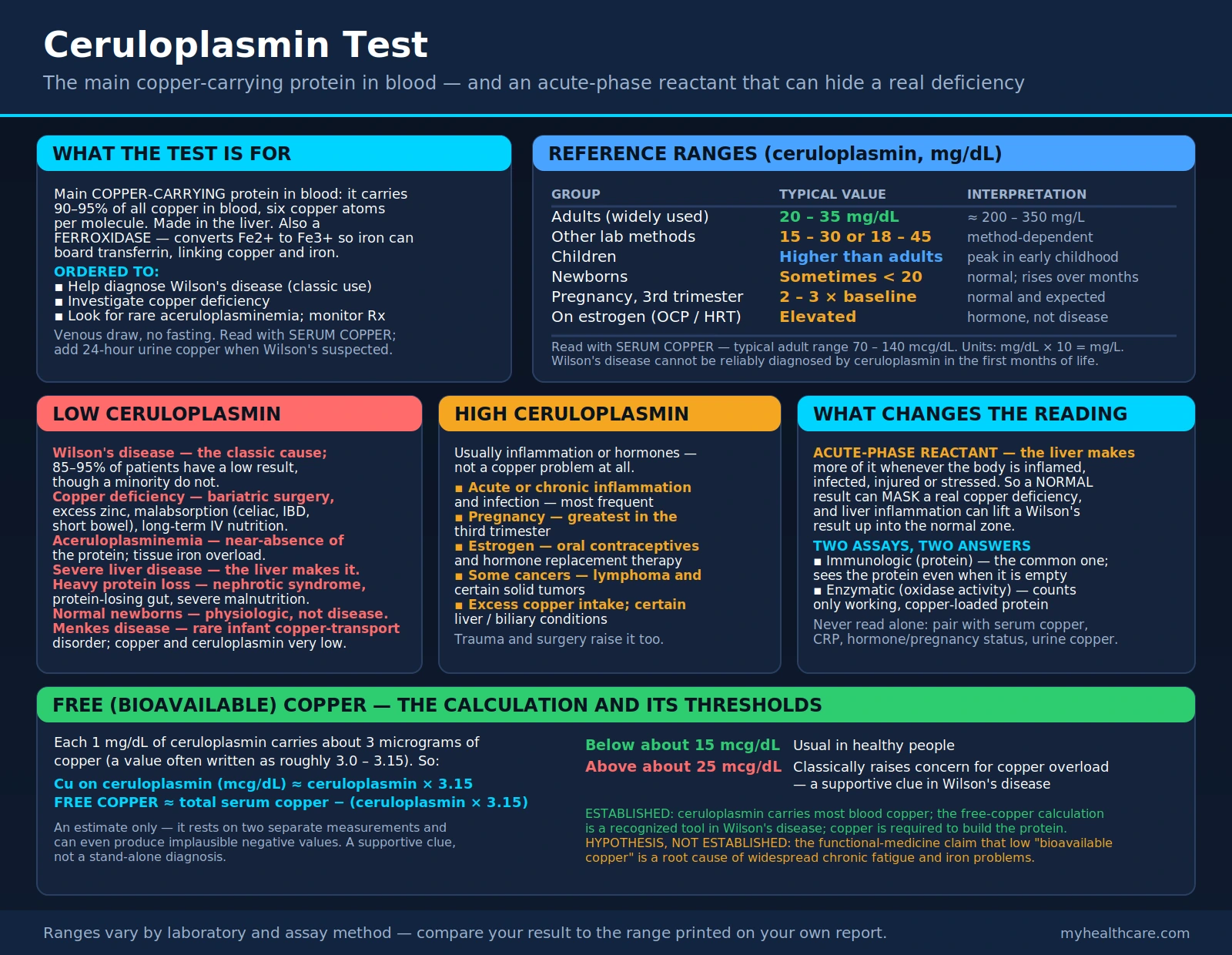
The ceruloplasmin test measures a single protein in your blood — but it is a protein that does two big jobs at once, which is why doctors order it and why the result can be surprisingly tricky to read. Ceruloplasmin (say it "seh-ROO-loh-PLAZ-min") is the main copper-carrying protein in your bloodstream, ferrying roughly 90–95% of all the copper in your blood. It is also a ferroxidase, an enzyme that helps your body move iron safely — so this one number quietly links copper and iron together. The test is most famous for its role in diagnosing Wilson's disease, a treatable-but-dangerous copper-storage disorder in which ceruloplasmin is classically low. But it is also used to investigate copper deficiency and a rare iron disorder called aceruloplasminemia. The single most important thing to understand before your test is that ceruloplasmin is an acute-phase reactant: it rises with inflammation, infection, pregnancy, and estrogen — so a "normal" number can sometimes hide a real deficiency. This page explains, in plain language, what the test measures, why it is ordered, how to read the result, and how the "free copper" calculation works.
Table of Contents
- What Ceruloplasmin Is
- The Iron Connection (Ferroxidase)
- Why the Test Is Ordered
- What the Test Actually Measures
- The Acute-Phase Reactant Catch
- Reference Ranges
- Free (Bioavailable) Copper & the Calculation
- What Low and High Results Mean
- How to Prepare for the Test
- Research Papers
- Connections
- Featured Videos
What Ceruloplasmin Is
Ceruloplasmin is a large protein made mainly in your liver and released into the blood. Its name comes from the Latin caeruleus, meaning "sky-blue" — because purified ceruloplasmin has a striking blue color, a clue that it holds copper atoms tucked inside. Each molecule carries six copper atoms, and it is this copper-loaded design that makes ceruloplasmin the body's principal copper transporter.
Here is the number worth remembering: ceruloplasmin carries roughly 90–95% of the copper circulating in your blood. The small remainder rides loosely on another protein (albumin) and on tiny transport molecules, or drifts as "free" copper. That free fraction matters a great deal, and we will return to it in the free-copper section.
Because ceruloplasmin holds most of your blood copper, the two tests are closely linked. When ceruloplasmin goes up or down, your total serum copper tends to move in the same direction — which is exactly why doctors usually order ceruloplasmin and serum copper together rather than alone. Reading one without the other is a classic way to be misled.
A few practical points about the protein itself:
- It is built in the liver. Copper is loaded onto the protein inside liver cells by a copper-transporting pump called ATP7B. If that loading step fails — as it does in Wilson's disease — the copper-free version of the protein (called apoceruloplasmin) is unstable and breaks down quickly, so blood levels fall.
- It is not the same as "copper status." Ceruloplasmin reflects copper carried in the blood, but it is also swayed by inflammation and hormones. It is a useful window on copper, not a perfect one.
- It does real work. Beyond transport, ceruloplasmin is an enzyme with antioxidant activity and an important role in iron handling — the subject of the next section.
The Iron Connection (Ferroxidase)
One of the most under-appreciated facts about ceruloplasmin is that it is not just about copper — it is essential for moving iron. Ceruloplasmin is a ferroxidase, meaning it chemically converts iron from one form to another. Specifically, it oxidizes ferrous iron (Fe2+) into ferric iron (Fe3+), the only form that can climb aboard the body's main iron-transport protein, transferrin, and travel safely to where it is needed.
Think of it this way: iron leaving your cells (from the gut, the liver, or recycled from old red blood cells) has to be handed off to transferrin to be shipped out. Ceruloplasmin is the "loading dock supervisor" that puts iron into the right chemical form for that handoff. Without enough functioning ceruloplasmin, iron gets stuck inside cells instead of circulating — and paradoxically, the body can develop iron overload in the tissues while looking iron-deficient in the blood.
This is not a theoretical idea. There is a rare inherited disease called aceruloplasminemia, in which people make essentially no functional ceruloplasmin at all. Instead of a copper problem, they develop iron accumulation in the brain, liver, pancreas, and retina — leading to diabetes, retinal degeneration, and a movement/cognitive disorder, usually in adulthood. Aceruloplasminemia is powerful proof that ceruloplasmin's iron-handling job is real and important, and it is one reason a very low ceruloplasmin result is never dismissed casually.
The copper–iron link also runs the other way: because building working ceruloplasmin requires copper, a copper deficiency can quietly impair iron transport and produce an anemia that does not improve with iron supplements — only with copper. This copper–iron–ceruloplasmin triad is discussed further on the Hemoglobin and Ceruloplasmin and Copper–Iron Dysregulation pages.
Why the Test Is Ordered
Doctors do not order ceruloplasmin as part of a routine checkup. It is a targeted test, requested when a specific clinical question comes up. The most common reasons are:
1. To help diagnose Wilson's disease (the classic reason)
This is by far the best-known use. Wilson's disease is an inherited disorder in which the liver cannot export copper properly, so copper builds up to toxic levels in the liver, brain, and eyes. In most people with Wilson's disease, ceruloplasmin is low — because the faulty copper pump can't load copper onto the protein, and the empty protein degrades. A low ceruloplasmin in a young person with unexplained liver disease, tremor, slurred speech, or new psychiatric symptoms is an important clue that points toward Wilson's.
Wilson's disease is worth catching precisely because it is one of the few genetic diseases that is treatable — and untreated, it can be fatal. That is why doctors have a low threshold to check ceruloplasmin in the right setting. Importantly, ceruloplasmin alone does not diagnose Wilson's; it is combined with serum copper, a 24-hour urine copper collection, an eye exam for Kayser–Fleischer rings, and sometimes genetic testing or liver biopsy. (See the companion Copper Test page for the full Wilson's workup.)
2. To investigate copper deficiency
Ceruloplasmin also drops when the body simply does not have enough copper. Acquired copper deficiency is more common than many people realize, and it can cause a serious spinal-cord problem (a B12-like myelopathy with numbness and unsteady walking), anemia, and a low white-cell count. Common causes include prior gastric bypass / bariatric surgery, taking too much zinc (which blocks copper absorption), and malabsorption conditions. A low ceruloplasmin supports the diagnosis.
3. To investigate unexplained iron problems
Less commonly, ceruloplasmin is checked when someone has an unusual iron picture — particularly iron building up in tissues with neurological symptoms — to look for the rare aceruloplasminemia described above.
4. To monitor treatment
In people already diagnosed with Wilson's disease or copper deficiency, ceruloplasmin (usually alongside serum and urine copper) can help track how treatment is going over time.
What the Test Actually Measures
This is a subtle but genuinely important point, because there are two different ways to measure ceruloplasmin, and they don't always agree.
- The immunologic (protein) assay — the common, widely available method. It uses antibodies to detect the ceruloplasmin protein, whether or not that protein is actually loaded with copper. This is the number most labs report.
- The enzymatic (activity) assay — a less common method that measures ceruloplasmin's oxidase activity, meaning only the fully copper-loaded, working protein counts.
Why does this matter? In Wilson's disease, the liver often releases the empty, copper-free form of the protein (apoceruloplasmin). The antibody-based test may still "see" that empty protein and report a falsely reassuring number, while the activity-based test — which only counts working enzyme — reads lower and more truthfully. Specialists have long argued that measuring ceruloplasmin by its activity, or by a combination of methods, gives a more accurate picture in tricky Wilson's cases. If your immunologic ceruloplasmin looks borderline but the clinical suspicion is high, this is one reason your doctor may not stop there.
The test itself is simple for you: it is a standard blood draw from a vein in the arm, often bundled with serum copper (and sometimes a 24-hour urine copper collection ordered separately). No special equipment or discomfort beyond an ordinary blood test.
The Acute-Phase Reactant Catch
If you remember only one caution from this page, make it this one. Ceruloplasmin is a positive acute-phase reactant. In plain terms, the liver pumps out more of it whenever the body is inflamed, infected, injured, or stressed. So the level can be pushed upward by things that have nothing to do with your copper status.
The things that raise ceruloplasmin include:
- Infection and inflammation of almost any kind — from a bad cold to a chronic inflammatory disease such as rheumatoid arthritis.
- Pregnancy — ceruloplasmin can roughly double or triple by the third trimester. This is completely normal and expected.
- Estrogen — birth-control pills and hormone replacement therapy raise ceruloplasmin substantially. Estrogen is one of the single most powerful drivers of ceruloplasmin production.
- Physical trauma, surgery, and some cancers.
Here is why this is more than trivia: a "normal" ceruloplasmin can mask a real deficiency. Imagine someone who is genuinely low in copper but who also has an active infection or is taking estrogen. The inflammation or hormone pushes their ceruloplasmin up into the normal range, and the deficiency gets missed. The same trap exists in Wilson's disease — if a patient has liver inflammation, their ceruloplasmin can be dragged up into the "normal" zone even though the underlying disease is present.
This is the central reason ceruloplasmin is never interpreted in isolation. Your doctor will read it alongside your symptoms, your serum copper, markers of inflammation (like CRP), your hormone and pregnancy status, and often a 24-hour urine copper — which is not fooled by inflammation the way the blood protein is.
Reference Ranges
Reference ranges differ from lab to lab and depend on the exact method used, so always compare your result to the range printed on your own report. The following are widely used adult approximations, given here as a general guide only:
- Ceruloplasmin (adults): roughly 20–35 mg/dL (about 200–350 mg/L). Some labs cite 15–30 or 18–45 mg/dL depending on method.
- Children: tend to run higher than adults, often peaking in the toddler and early-childhood years before settling toward adult values.
- Newborns: are naturally low at birth — sometimes below 20 mg/dL — and levels rise over the first several months of life. Because of this, a low ceruloplasmin in a young infant is not automatically abnormal, and Wilson's disease cannot be reliably diagnosed by ceruloplasmin in the first months of life.
- Pregnancy (third trimester): markedly elevated — frequently two to three times the non-pregnant level — and considered normal.
- On estrogen (oral contraceptives or HRT): elevated; a high result in this context usually reflects the hormone, not disease.
For context, ceruloplasmin is usually reported next to serum copper, whose typical adult range is about 70–140 micrograms per deciliter (mcg/dL). The two are meant to be read as a pair. Units also vary: some international labs report ceruloplasmin in mg/L (multiply mg/dL by 10) and copper in micromol/L. When in doubt, the numbers and units printed on your lab report — not any general table — are what apply to you.
Free (Bioavailable) Copper & the Calculation
Because ceruloplasmin carries most of your blood copper, you can combine the ceruloplasmin and serum-copper results to estimate how much copper is not bound to ceruloplasmin — the so-called free copper or non-ceruloplasmin-bound copper. This is the loosely-held, more chemically reactive fraction, and it is the part that can deposit in tissues and cause damage when it runs high.
The classic estimate works like this. Each 1 mg/dL of ceruloplasmin carries about 3 micrograms of copper (a value often written as roughly 3.0–3.15). So:
- Copper carried by ceruloplasmin (mcg/dL) ≈ ceruloplasmin (mg/dL) × 3.15
- Free copper (mcg/dL) ≈ total serum copper − (ceruloplasmin × 3.15)
In healthy people, free copper is usually below about 15 mcg/dL. A markedly high value — classically above about 25 mcg/dL — raises concern for copper overload and has traditionally been used as a supportive clue in Wilson's disease and to help monitor its treatment. This use of the free-copper calculation in Wilson's disease is an established part of the specialist toolkit, described in major hepatology guidelines.
Two honest caveats are important. First, the calculation is only an estimate. It depends on the accuracy of two separate measurements, and if either is off — or if ceruloplasmin is high because of inflammation — the subtraction can produce numbers that are hard to interpret, sometimes even implausible negative values. For that reason, some specialists now prefer to measure the non-ceruloplasmin-bound copper more directly rather than rely on the subtraction. Second, the calculated value is a supportive clue, not a stand-alone diagnosis.
You will also encounter the "free copper" and "bioavailable copper" idea in a different setting: functional-medicine copper-balance frameworks, most prominently the work of Morley Robbins and the Root Cause Protocol. These frameworks put ceruloplasmin and "bioavailable copper" at the center of a broader theory about fatigue, iron dysregulation, and chronic illness, and they use the same subtraction concept borrowed from Wilson's-disease monitoring. It is worth being clear and neutral about where the science stands:
- Established: ceruloplasmin carries most blood copper; the free-copper calculation is a recognized tool in Wilson's disease; copper is genuinely required to build functional ceruloplasmin; and ceruloplasmin has a real role in iron metabolism.
- Hypothesis / not established: the broader functional-medicine claim that low "bioavailable copper" is a root cause of widespread chronic fatigue and iron problems in otherwise healthy people, and the specific supplement protocols built around it, are not supported by the same level of clinical evidence and are not part of mainstream diagnostic guidelines.
In short, the free-copper concept is real and clinically useful in specific diseases; the sweeping wellness framework built on top of it is an interesting hypothesis that outruns the current evidence. If you are exploring copper balance, the calculation is a reasonable thing to discuss with a knowledgeable clinician — ideally one who will interpret it alongside inflammation, iron studies, and your actual symptoms.
What Low and High Results Mean
Because ceruloplasmin moves for many reasons, an abnormal result is a starting point for investigation, not a verdict. Here is how doctors think about the two directions.
Low ceruloplasmin
A low level means either the body is not building the protein properly, is not loading copper onto it, or simply does not have enough copper. Common and important causes include:
- Wilson's disease — the classic cause; the faulty copper pump leaves the protein empty and it degrades. (Roughly 85–95% of Wilson's patients have low ceruloplasmin, though a minority do not — another reason it can't be used alone.)
- Copper deficiency — from bariatric surgery, excess zinc intake, malabsorption (celiac disease, inflammatory bowel disease, short-bowel syndrome), or long-term IV nutrition without added copper.
- Aceruloplasminemia — the rare inherited near-absence of functional ceruloplasmin, causing tissue iron overload.
- Severe liver disease — because the liver makes the protein, advanced liver failure can lower production.
- Heavy protein loss — nephrotic syndrome (protein lost in urine) or protein-losing gut conditions, and severe malnutrition.
- Normal newborns — a physiologically low level in early infancy, not a disease.
- Menkes disease — a rare inherited copper-transport disorder of infancy, in which copper can't be absorbed and distributed, so both copper and ceruloplasmin are very low.
High ceruloplasmin
Because it is an acute-phase protein, a high level most often reflects inflammation or hormones rather than a copper problem. Common causes include:
- Acute or chronic inflammation and infection — the most frequent reason for a high reading.
- Pregnancy — a normal, expected rise, greatest in the third trimester.
- Estrogen exposure — oral contraceptives and hormone replacement therapy.
- Some cancers (for example lymphoma and certain solid tumors) — as part of the inflammatory response, not dietary excess.
- Excess copper intake and certain liver/biliary conditions — a less common contributor.
Notice the recurring theme: a high ceruloplasmin usually says "there is inflammation or estrogen at work," while a low ceruloplasmin usually says "look into copper handling — Wilson's, deficiency, or the liver." Neither result is meaningful without the clinical story and the companion copper tests.
How to Prepare for the Test
The ceruloplasmin test is a simple blood draw, and in most cases it requires no special preparation — no fasting is generally needed. That said, because so many everyday things move the result, a little preparation and disclosure make the number far more useful:
- Tell your provider about hormones. Birth-control pills, hormone patches or rings, and hormone replacement therapy all raise ceruloplasmin. Your doctor needs to know so the result isn't misread. When precise copper status is critical, testing may be scheduled after a period off estrogen.
- Mention pregnancy or possible pregnancy. Ceruloplasmin rises sharply in pregnancy, so this context is essential for interpretation.
- Report recent illness, infection, injury, or surgery. Active inflammation can push the level up. If the goal is to detect a deficiency, it may be worth waiting until an acute illness has settled.
- List your supplements — especially zinc and copper. High-dose zinc (including some cold lozenges and, historically, certain denture creams) can cause copper deficiency; copper supplements do the opposite. Your provider needs the full list.
- Bring your medication list. Some drugs influence copper metabolism; disclosing everything helps.
- Ask what else is being ordered. Ceruloplasmin is most informative when paired with serum copper, and, when Wilson's disease is suspected, a 24-hour urine copper collection. Knowing the full plan helps you follow any collection instructions correctly.
Follow any specific instructions your ordering clinician or lab gives you, since protocols vary. And remember that whatever your number is, it is one piece of a larger picture — the meaning comes from reading it together with your symptoms, your copper level, and your individual circumstances.
Research Papers
All citations below were verified against the Crossref database. Each links to the original peer-reviewed source.
- Hellman NE, Gitlin JD. Ceruloplasmin metabolism and function. Annual Review of Nutrition. 2002;22:439–458. doi:10.1146/annurev.nutr.22.012502.114457 — A foundational review of how ceruloplasmin is made, how it carries copper, and its enzymatic roles.
- Harris ZL, Durley AP, Man TK, Gitlin JD. Targeted gene disruption reveals an essential role for ceruloplasmin in cellular iron efflux. Proceedings of the National Academy of Sciences. 1999;96(19):10812–10817. doi:10.1073/pnas.96.19.10812 — Landmark work showing ceruloplasmin's ferroxidase activity is needed to move iron out of cells, cementing the copper–iron link.
- Roberts EA, Schilsky ML. Diagnosis and treatment of Wilson disease: an update. Hepatology. 2008;47(6):2089–2111. doi:10.1002/hep.22261 — The AASLD practice guideline detailing how ceruloplasmin, serum copper, and urine copper are combined to diagnose Wilson's disease.
- European Association for the Study of the Liver. EASL Clinical Practice Guidelines: Wilson's disease. Journal of Hepatology. 2012;56(3):671–685. doi:10.1016/j.jhep.2011.11.007 — European guideline covering ceruloplasmin's role and the use of non-ceruloplasmin-bound (free) copper in Wilson's diagnosis and monitoring.
- Twomey PJ, Viljoen A, House IM, Reynolds TM, Wierzbicki AS. Relationship between serum copper, ceruloplasmin, and non-ceruloplasmin-bound copper in routine clinical practice. Clinical Chemistry. 2005;51(8):1558–1559. doi:10.1373/clinchem.2005.052688 — Examines the free-copper calculation in everyday practice and its limitations, including implausible negative values.
- Walshe JM. Wilson's disease: the importance of measuring serum caeruloplasmin non-immunologically. Annals of Clinical Biochemistry. 2003;40(2):115–121. doi:10.1258/000456303763046021 — Argues that enzymatic (activity) assays are more reliable than antibody assays in Wilson's disease.
- Mak CM, Lam CW. Diagnosis of Wilson's disease: a comprehensive review. Critical Reviews in Clinical Laboratory Sciences. 2008;45(3):263–290. doi:10.1080/10408360801991055 — A detailed look at the strengths and pitfalls of every laboratory marker, including why ceruloplasmin can mislead.
- Kumar N. Copper deficiency myelopathy (human swayback). Mayo Clinic Proceedings. 2006;81(10):1371–1384. doi:10.4065/81.10.1371 — Describes the B12-like spinal-cord syndrome of acquired copper deficiency, in which ceruloplasmin is typically low.
- Jaiser SR, Winston GP. Copper deficiency myelopathy. Journal of Neurology. 2010;257(6):869–881. doi:10.1007/s00415-010-5511-x — Reviews causes (bariatric surgery, excess zinc) and the diagnostic role of copper and ceruloplasmin testing.
- Miyajima H. Aceruloplasminemia. Neuropathology. 2015;35(1):83–90. doi:10.1111/neup.12149 — Reviews the rare inherited absence of functional ceruloplasmin and the tissue iron overload that results, illustrating the ferroxidase role.
Live PubMed Searches
- Ceruloplasmin and copper — clinical interpretation (PubMed)
- Wilson disease — ceruloplasmin and free copper (PubMed)
- Ceruloplasmin ferroxidase and iron metabolism (PubMed)
- Ceruloplasmin as an acute-phase reactant — estrogen and pregnancy (PubMed)
Connections
- All Lab Tests
- Copper Test (Serum Copper & Ceruloplasmin)
- Copper (Mineral)
- Ceruloplasmin & Bioavailable Copper
- Copper–Iron Dysregulation
- Hemoglobin & Ceruloplasmin
- Iron Panel
- Iron (Mineral)
- Zinc Test
- Zinc (Mineral)
- Liver Disease
- Wilson's Disease — the copper-storage disorder this test screens for.