Homocysteine: Cardiovascular Risk and Methylation Marker
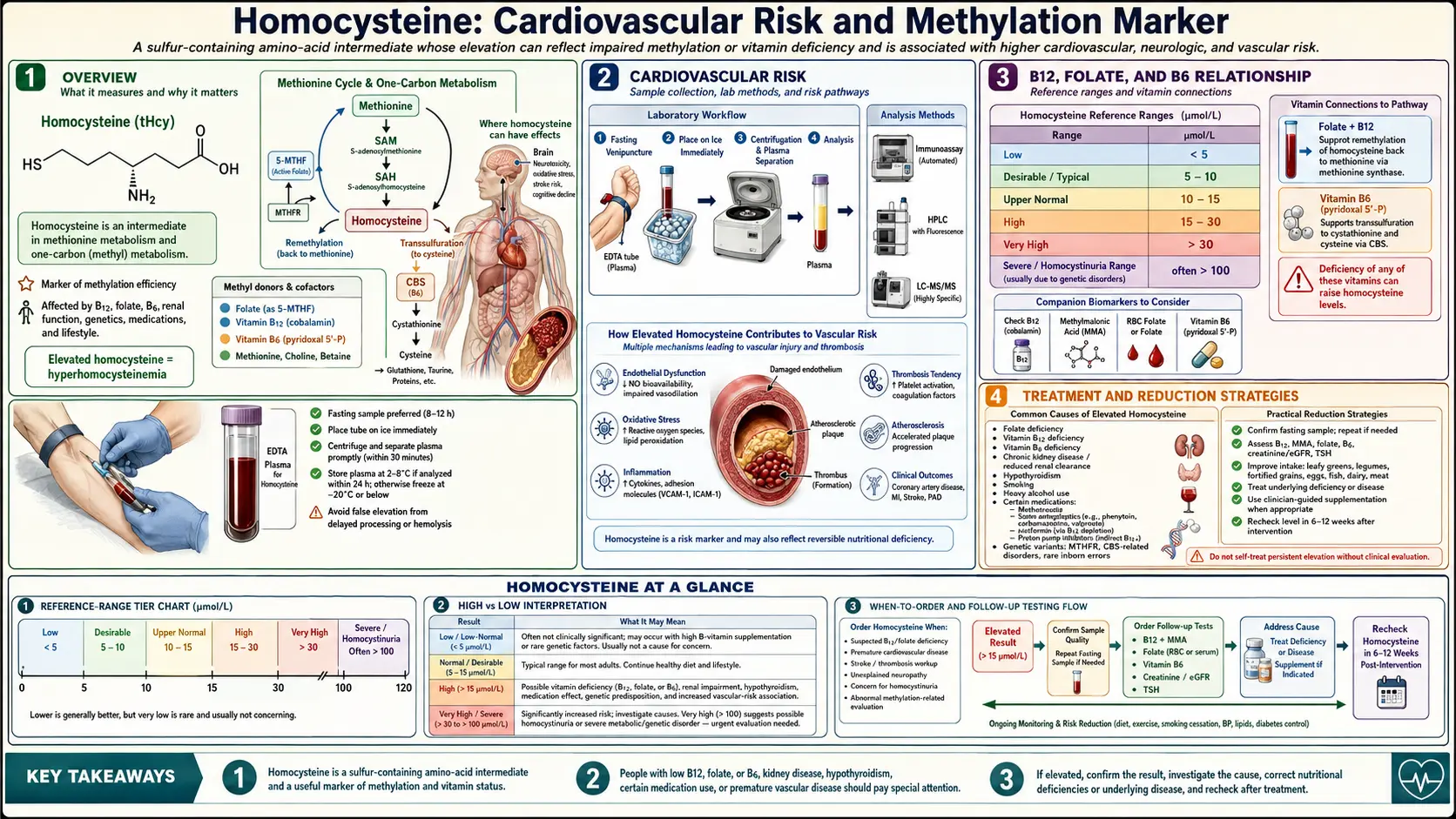
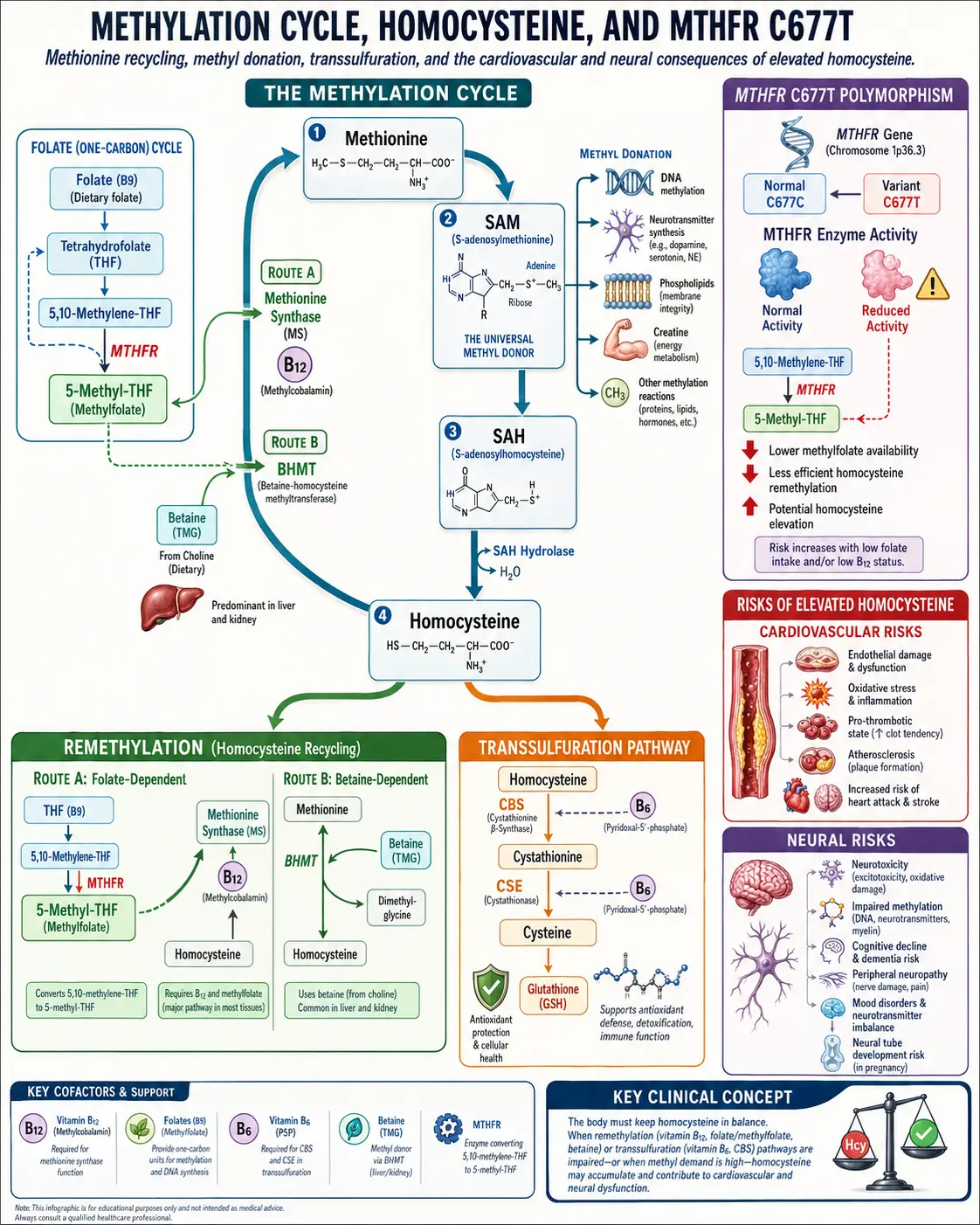
Homocysteine is a sulfur-containing amino acid produced during the metabolism of methionine. Unlike most biomarkers, elevated homocysteine is a modifiable risk factor tied to nutritional status, genetic variants, and methylation capacity. It is among the most clinically actionable cardiovascular and neurological risk markers available through routine blood testing.
Interactive Visualization The Methylation Cycle — hand off a methyl group Watch folate and B12 recycle homocysteine into methionine — then knock out B12 and see the folate trap slam shut. Launch → Interactive Visualization Vitamin B12’s Impossible Journey Five stages, two carrier proteins, a working stomach and one specific stretch of gut. Break any link — a PPI, metformin, pernicious anaemia — and absorption collapses. Launch →Table of Contents
Overview
Homocysteine is formed when the essential amino acid methionine loses a methyl group during normal cellular metabolism. Under healthy conditions, homocysteine is rapidly recycled back into methionine via the folate and B12-dependent methylation cycle, or converted to cysteine via the transsulfuration pathway requiring vitamin B6. When these pathways are impaired — due to nutritional deficiencies or genetic variants — homocysteine accumulates in the blood.
In laboratory and animal work, elevated homocysteine damages vascular endothelium, promotes oxidative stress, interferes with nitric oxide signaling and appears neurotoxic. In people, elevated homocysteine reliably predicts cardiovascular disease and dementia.
What it does not do is respond to treatment with better outcomes. This is the single most important thing to understand about this test, and most pages about it leave it out. Large randomized trials have lowered homocysteine by roughly a quarter using B vitamins and found no reduction in heart attacks, strokes, dementia or death. Genetic studies of people with lifelong elevated homocysteine find no excess coronary disease. The honest reading is that homocysteine is a good marker of something — B-vitamin status, kidney function, general metabolic health — and a poor target. The section Does Lowering It Actually Help? lays out that evidence in full, because it should shape how you read everything else on this page.
When Ordered
Clinicians order a homocysteine blood test in the following circumstances:
- Evaluation of cardiovascular disease risk, particularly in patients with premature heart disease or stroke without traditional risk factors
- Suspected vitamin B12 or folate deficiency, especially in patients with macrocytic anemia or neurological symptoms
- Assessment of methylation capacity in patients with fatigue, cognitive decline, or mood disorders
- Known or suspected MTHFR gene variant carriers
- Monitoring of patients on long-term methotrexate, metformin, or proton pump inhibitor therapy, which can deplete B12 and folate
- Recurrent pregnancy loss or thrombotic events in younger individuals
- Cognitive decline evaluation, particularly in patients at risk for Alzheimer's disease
- Routine preventive wellness screening in integrative or functional medicine contexts
The test requires a fasting blood draw, as recent high-protein meals can transiently elevate homocysteine levels.
Reference Ranges
Homocysteine — Optimal (µmol/L)
Homocysteine — Clinical Classification (µmol/L)
Most conventional laboratories report a normal upper limit of 15 µmol/L. Integrative and preventive-medicine practitioners commonly treat anything above 10 µmol/L as carrying incremental risk, and some target below 8 µmol/L.
Be clear about what those tighter targets rest on. They come from observational data showing that people with lower homocysteine have fewer cardiovascular events. No trial has shown that driving your own number from 12 down to 7 changes your risk — the trials that lowered homocysteine by about a quarter found no benefit. A target below 8 is therefore a reasonable-sounding number without outcome evidence behind it, not a validated goal. Levels above 30 µmol/L are a different matter entirely: severe hyperhomocysteinemia usually reflects an inherited metabolic disorder such as homocystinuria, where treatment genuinely does prevent catastrophic vascular and skeletal complications.
Cardiovascular Risk
Elevated homocysteine is an independent risk marker for coronary artery disease, stroke, peripheral arterial disease, and venous thromboembolism — it predicts these events after adjustment for other risk factors. Whether it causes them is a separate question, and the answer is probably no; see the next section. The mechanisms below are well described in cell and animal models, which is why the causal story sounded so convincing for so long:
- Endothelial injury: Homocysteine directly injures vascular endothelial cells, impairing their ability to regulate vasomotor tone and prevent platelet adhesion.
- Oxidative stress: Auto-oxidation of homocysteine generates reactive oxygen species (ROS) including superoxide and hydrogen peroxide, causing lipid peroxidation and oxidative damage to vessel walls.
- Nitric oxide impairment: Homocysteine reduces bioavailability of nitric oxide, a potent vasodilator, promoting vasoconstriction and hypertension.
- Procoagulant effects: Homocysteine activates coagulation factors, inhibits anticoagulant proteins such as thrombomodulin and protein C, and enhances platelet aggregation, collectively promoting thrombosis.
- LDL oxidation: Elevated homocysteine accelerates oxidation of LDL cholesterol, a key step in atherogenesis and plaque formation.
The size of that association is smaller than the figures usually quoted. Early case-control analyses reported that each 5 µmol/L rise carried roughly 60% more stroke risk, and that number is still widely repeated. The Homocysteine Studies Collaboration pooled 30 studies and found that the retrospective studies — those measuring homocysteine after disease onset — gave systematically stronger associations than prospective studies of healthy people. Restricting to the prospective data and adjusting for known cardiovascular risk factors and regression dilution bias, a 25% lower homocysteine (about 3 µmol/L) was associated with 11% lower ischemic heart disease risk (odds ratio 0.89, 95% CI 0.83-0.96) and 19% lower stroke risk (odds ratio 0.81, 95% CI 0.69-0.95).
Their own conclusion: elevated homocysteine is "at most a modest independent predictor of IHD and stroke risk in healthy populations." That is a considerably weaker statement than the one this page previously made, and it is the better-adjusted one.
Does Lowering It Actually Help?
Homocysteine looked, for about two decades, like one of the great modifiable risk factors. It predicted heart disease. It had a plausible mechanism. It responded dramatically to cheap, safe B vitamins. Everything pointed one way, and then the trials were done.
The cardiovascular trials
Eight large randomized placebo-controlled trials of folic acid supplementation, covering 37,485 people at increased cardiovascular risk, were pooled using individual participant data. Folic acid lowered homocysteine by an average of 25%. Over a median five years there were 9,326 major vascular events. The results:
- Major vascular events: rate ratio 1.01 (95% CI 0.97-1.05) — no effect
- Major coronary events: rate ratio 1.03 (95% CI 0.97-1.10) — no effect
- Stroke: rate ratio 0.96 (95% CI 0.87-1.06) — no effect
- All-cause mortality: rate ratio 1.02 (95% CI 0.97-1.08) — no effect
- Cancer incidence: rate ratio 1.05 (95% CI 0.98-1.13) — no significant increase, but the confidence interval does not exclude a small one, which is why long-term high-dose folic acid is not casually recommended
There was no benefit in any subgroup studied. These are narrow confidence intervals around 1.0, which is the statistically meaningful kind of negative result: not "we could not tell," but "if there is an effect, it is small enough that five years and 37,485 people could not find it."
The genetic evidence
If homocysteine causes coronary disease, then people born with a genotype that keeps their homocysteine elevated for life should have more coronary disease. The MTHFR C677T TT genotype does exactly that — it raises homocysteine by roughly 20% from birth.
Nineteen unpublished datasets containing 48,175 coronary heart disease cases and 67,961 controls were assembled specifically to test this while sidestepping publication bias. Comparing TT with CC homozygotes, the odds ratio for coronary heart disease was 1.02 (95% CI 0.98-1.07, p = 0.28) — nothing. In low-folate unsupplemented populations, where the genotype effect should be largest, it was 1.01 (0.95-1.07).
By contrast, the 86 published studies gave an odds ratio of 1.15 (1.09-1.21). The gap between the published and unpublished literature was itself statistically significant (p = 0.001). The authors attributed it to publication bias — small positive studies get written up, small null ones do not. This is a useful thing to know about nutritional epidemiology generally, not just about homocysteine.
The one exception worth knowing
Evidence should be reported in both directions, and there is a real positive trial. The China Stroke Primary Prevention Trial randomized 20,702 adults with hypertension and no prior stroke or heart attack to enalapril alone or enalapril plus 0.8 mg folic acid. China does not fortify its food supply with folic acid, so baseline folate status was low. Over a median 4.5 years:
- First stroke: 2.7% versus 3.4%, hazard ratio 0.79 (95% CI 0.68-0.93) — a real reduction
- First ischemic stroke: hazard ratio 0.76 (95% CI 0.64-0.91)
- Myocardial infarction: hazard ratio 1.04 (95% CI 0.60-1.82) — nothing
- All-cause death: hazard ratio 0.94 (95% CI 0.81-1.10) — nothing
The most likely reading is that this trial corrected a genuine population-wide folate deficiency, and that correcting folate deficiency prevents strokes. That is a different claim from "lowering homocysteine prevents strokes," and it does not transfer to countries with mandatory folic acid fortification — the United States, Canada, Australia and about eighty others — where the deficiency being corrected largely does not exist. It is also worth noting that even here, folic acid did nothing for heart attacks or mortality.
The cognition trials
Eleven trials with cognitive data on about 22,000 people were pooled. B vitamins lowered homocysteine by 26 to 28%. The effect on cognition, over a mean of five years, was a z-score difference of 0.00 (95% CI −0.05 to 0.06) for individual cognitive domains and −0.01 (−0.03 to 0.02) for global cognitive function. Expressed as cognitive aging, a 25% homocysteine reduction bought 0.02 years (95% CI −0.10 to 0.13) per year of treatment — and the analysis was precise enough to exclude any benefit larger than one month per year of treatment.
So what is the test for?
It remains genuinely useful, just for narrower purposes than the risk-factor framing suggests:
- Detecting functional B12 or folate deficiency. Homocysteine rises early in B12 depletion, often before serum B12 falls below the reference range and before anemia appears. Here the target of treatment is the deficiency, not the number — and correcting a real B12 deficiency does prevent real neurological harm.
- Diagnosing and monitoring homocystinuria and other inborn errors of metabolism, where homocysteine runs above 50 to 100 µmol/L and treatment is unambiguously beneficial.
- Risk stratification, in the same way a high hs-CRP is informative: it tells you this person is at higher risk, without telling you that pushing the number down will lower that risk.
What the evidence does not support is treating a homocysteine of 12 or 14 µmol/L in an otherwise well-nourished person as a modifiable cardiovascular or cognitive risk factor. If your clinician has you on high-dose B vitamins for that reason alone, this is a fair thing to ask about.
MTHFR Connection
The MTHFR gene encodes methylenetetrahydrofolate reductase, the enzyme that converts folate into its active form, 5-methyltetrahydrofolate (5-MTHF). This active folate is essential for the remethylation of homocysteine back to methionine. Two common single nucleotide polymorphisms (SNPs) in the MTHFR gene are clinically significant:
- C677T (rs1801133): This variant reduces enzyme activity by approximately 35% in heterozygotes and up to 70% in homozygotes. The TT homozygous genotype is present in roughly 10–15% of the population in many ethnic groups and is strongly associated with elevated homocysteine.
- A1298C (rs1801131): This variant has a more modest effect on enzyme activity but can compound the impact of C677T, particularly in compound heterozygotes who carry one copy of each variant.
Individuals with reduced MTHFR function convert standard synthetic folic acid to active 5-MTHF less efficiently. Supplementation with the pre-methylated form — L-methylfolate (5-MTHF) — bypasses that step and lowers homocysteine more effectively in carriers. MTHFR variants also reduce production of SAMe (S-adenosylmethionine), the universal methyl donor used in neurotransmitter synthesis, DNA methylation, and gene regulation.
An important caveat before anyone treats a genotype. Carrying TT does raise your homocysteine for life — and in the largest, publication-bias-resistant analysis available (48,175 coronary cases, 67,961 controls) it does not raise your risk of coronary heart disease: odds ratio 1.02, 95% CI 0.98-1.07. This is the strongest single argument that homocysteine is a marker rather than a cause, because unlike a supplement trial it tests a lifetime of exposure. MTHFR genotyping is widely sold as cardiovascular risk assessment; on the coronary endpoint, the evidence does not support that use. Its legitimate uses are explaining an unexplained high homocysteine, and guiding folate form in someone who needs folate anyway.
B12, Folate, and B6 Relationship
The three primary nutritional drivers of homocysteine metabolism are vitamins B12, B9 (folate), and B6. Each operates through distinct enzymatic pathways:
- Vitamin B12 (cobalamin): Required as a cofactor for methionine synthase, the enzyme that transfers the methyl group from 5-MTHF to homocysteine, converting it back to methionine. B12 deficiency is among the most common causes of elevated homocysteine, particularly in older adults, vegans, and those on metformin or proton pump inhibitors.
- Folate (B9): Provides the methyl group (as 5-MTHF) used by methionine synthase to remethylate homocysteine. Dietary folate deficiency or malabsorption directly impairs this cycle. Active L-methylfolate is more bioavailable than synthetic folic acid, especially in MTHFR variant carriers.
- Vitamin B6 (pyridoxine): Required as a cofactor for cystathionine beta-synthase and cystathionine gamma-lyase, enzymes in the transsulfuration pathway that irreversibly converts excess homocysteine to cysteine and ultimately to glutathione. B6 deficiency impairs this secondary disposal route.
Testing homocysteine alongside serum B12, red blood cell folate, and plasma B6 levels helps identify the specific nutritional deficiency driving elevation. Homocysteine often rises before frank deficiency symptoms appear, making it a sensitive early indicator of suboptimal B-vitamin status.
Alzheimer's and Cognitive Decline Link
The association between elevated homocysteine and neurodegeneration is one of the most consistent in nutritional neuroscience. Multiple large longitudinal cohorts, including the Framingham Heart Study, have found that elevated homocysteine roughly doubles the risk of Alzheimer's disease and all-cause dementia. Those are observational findings: they establish that homocysteine predicts dementia, not that it causes it or that lowering it prevents it.
The mechanisms of neurotoxicity are multifactorial:
- Excitotoxicity: Homocysteine is a partial agonist at NMDA glutamate receptors. Chronic low-level activation of NMDA receptors promotes neuronal calcium influx and excitotoxic cell death, particularly in hippocampal neurons.
- DNA damage: Homocysteine promotes oxidative DNA strand breaks and impairs DNA repair mechanisms in neurons, accelerating neuronal aging and apoptosis.
- Cerebrovascular damage: Homocysteine injures cerebral blood vessels, promoting small vessel disease, silent brain infarcts, and white matter hyperintensities — all associated with cognitive impairment.
- Impaired methylation: Reduced SAMe production downstream of elevated homocysteine impairs methylation of phosphatidylcholine (required for neuronal membrane integrity), myelin, and neurotransmitters including dopamine and serotonin.
- Amyloid and tau pathology: Animal studies suggest homocysteine may promote both amyloid-beta deposition and tau hyperphosphorylation, the two hallmark pathologies of Alzheimer's disease.
The trial most often cited here is VITACOG. It deserves to be described accurately, because it is smaller and narrower than its reputation. In 168 participants with mild cognitive impairment who completed the MRI arm, high-dose B vitamins slowed the rate of whole-brain atrophy from 1.08% per year on placebo to 0.76% per year on treatment (P = 0.001). In the subgroup whose baseline homocysteine was above 13 µmol/L, the atrophy rate was 53% lower on treatment. Two things to hold on to: brain volume on MRI is a surrogate endpoint, not a clinical one, and the trial's senior author is named on two University of Oxford patents covering the use of folic acid to treat Alzheimer's disease — a conflict he declared, and one worth knowing when weighing a small positive trial against large null ones.
And the large trials are null. Eleven randomized trials with cognitive data on roughly 22,000 people were pooled. B vitamins lowered homocysteine by 26 to 28%, and the effect on cognition over a mean five years was a z-score difference of 0.00 (95% CI −0.05 to 0.06) across individual cognitive domains, and −0.01 (−0.03 to 0.02) for global cognitive function. The authors' conclusion was unambiguous: "Homocysteine lowering by using B vitamins had no significant effect on individual cognitive domains or global cognitive function or on cognitive aging."
How to hold both results at once: it is possible that B vitamins help a specific group — people with mild cognitive impairment and genuinely elevated homocysteine and adequate omega-3 status, which is the subgroup VITACOG's follow-up analyses kept pointing to — and that this signal disappears when diluted into 22,000 mostly-normal-homocysteine participants. That is a legitimate hypothesis. It is not established fact, and it is being sold as one. If you are considering high-dose B vitamins for memory, the honest position is that a small trial found a surrogate benefit in a selected group and the large trials found nothing.
Treatment and Reduction Strategies
Homocysteine responds readily to B-vitamin therapy — that has never been in doubt, and the trials above lowered it by roughly a quarter without difficulty. The question is what you are treating. The strategies below are appropriate when the goal is correcting an actual B12, folate, or B6 deficiency, managing homocystinuria, or addressing a drug-induced depletion. They are not supported as a way to reduce cardiovascular or dementia risk in a well-nourished person whose only abnormality is the number itself.
- L-Methylfolate (5-MTHF): The active, pre-methylated form of folate is the cornerstone of homocysteine-lowering therapy, particularly in MTHFR variant carriers who cannot efficiently activate synthetic folic acid. Typical therapeutic doses range from 400 mcg to 5 mg daily depending on severity and genotype.
- Methylcobalamin (active B12): The methylated form of B12 is directly usable by methionine synthase without further conversion. Preferred over cyanocobalamin, especially in MTHFR carriers or individuals with absorption issues. Sublingual or injectable forms improve bioavailability when gut absorption is compromised.
- Pyridoxal-5-Phosphate (P5P): The active form of vitamin B6, P5P is the cofactor for transsulfuration enzymes and directly supports the secondary homocysteine disposal pathway. It is more bioavailable than standard pyridoxine and does not require hepatic activation.
- Riboflavin (B2): Required for MTHFR enzyme activity. Riboflavin supplementation has been shown to lower homocysteine specifically in C677T homozygotes, in whom it can offset up to 40% of the enzyme activity reduction.
- Betaine (trimethylglycine): Provides an alternative methylation pathway (BHMT pathway) that remethylates homocysteine independent of folate and B12. Particularly useful in individuals with severe elevation or malabsorption syndromes. Typical dose: 500–3000 mg daily.
- Dietary optimization: Increasing intake of dark leafy greens (folate), animal proteins (B12), legumes, and cruciferous vegetables supports the methylation cycle. Reducing excess methionine intake from high-protein diets may also be warranted in severe cases.
- Address contributing medications: Metformin, proton pump inhibitors, methotrexate, and certain anticonvulsants deplete B12 or folate and should prompt monitoring and supplementation.
With appropriate B-vitamin therapy, homocysteine typically falls 25–50% within 4–8 weeks. Follow-up testing at 8–12 weeks confirms the deficiency has been corrected.
Two safety notes that belong beside any high-dose regimen. Never give folate alone when B12 status is unknown — folate can correct the anemia of B12 deficiency while the neurological damage continues unchecked, which is how a treatable deficiency becomes permanent nerve injury. And high-dose vitamin B6 causes sensory peripheral neuropathy; cases are well documented above 200 mg/day and have been reported at lower long-term doses, so B6 is not a supplement to take indefinitely at high dose "just in case." If you are taking these because of a homocysteine result rather than a diagnosed deficiency, that risk is being run for a benefit the trials could not find.
Key Research Papers
Each citation below links to a specific paper by its PubMed ID, so the journal, year and authors can be checked. An earlier version of this section offered only keyword searches, which cannot be verified and which happened to omit every large negative trial.
Key Research Papers
- Clarke R, Halsey J, Lewington S, et al. Effects of lowering homocysteine levels with B vitamins on cardiovascular disease, cancer, and cause-specific mortality: meta-analysis of 8 randomized trials involving 37,485 individuals. Archives of Internal Medicine. 2010;170(18):1622-1631. The definitive negative result: lowering homocysteine 25% changed nothing. — PubMed PMID: 20937919
- Clarke R, Bennett DA, Parish S, et al. Homocysteine and coronary heart disease: meta-analysis of MTHFR case-control studies, avoiding publication bias. PLoS Medicine. 2012;9(2):e1001177. Lifelong genetically elevated homocysteine, 48,175 cases: odds ratio 1.02. — PubMed PMID: 22363213
- Clarke R, Bennett D, Parish S, et al. Effects of homocysteine lowering with B vitamins on cognitive aging: meta-analysis of 11 trials with cognitive data on 22,000 individuals. American Journal of Clinical Nutrition. 2014;100(2):657-666. No effect on any cognitive domain. — PubMed PMID: 24965307
- Homocysteine Studies Collaboration. Homocysteine and risk of ischemic heart disease and stroke: a meta-analysis. JAMA. 2002;288(16):2015-2022. The properly adjusted observational effect size — "at most a modest independent predictor.". — PubMed PMID: 12387654
- Bønaa KH, Njølstad I, Ueland PM, et al. Homocysteine lowering and cardiovascular events after acute myocardial infarction (NORVIT). New England Journal of Medicine. 2006;354(15):1578-1588. — PubMed PMID: 16531614
- Smith AD, Smith SM, de Jager CA, et al. Homocysteine-lowering by B vitamins slows the rate of accelerated brain atrophy in mild cognitive impairment: a randomized controlled trial (VITACOG). PLoS One. 2010;5(9):e12244. The positive surrogate-endpoint trial, 168 participants. — PubMed PMID: 20838622
- Bazzano LA, Reynolds K, Holder KN, He J. Effect of folic acid supplementation on risk of cardiovascular diseases: a meta-analysis of randomized controlled trials. JAMA. 2006;296(22):2720-2726. — PubMed PMID: 17164458
- Huo Y, Li J, Qin X, et al. Efficacy of folic acid therapy in primary prevention of stroke among adults with hypertension in China: the CSPPT randomized clinical trial. JAMA. 2015;313(13):1325-1335. The positive trial, in an unfortified population. — PubMed PMID: 25771069
- Smith AD, Refsum H, Bottiglieri T, et al. Homocysteine and dementia: an international consensus statement. Journal of Alzheimer's Disease. 2018;62(2):561-570. The case for the other side, argued by researchers who believe the subgroup effect is real. — PubMed PMID: 29480200
PubMed Topic Searches
Live queries that stay current as new studies are indexed.
- PubMed: Homocysteine cardiovascular disease
- PubMed: MTHFR C677T polymorphism
- PubMed: Homocysteine and Alzheimer's
- PubMed: B vitamins homocysteine trials
- PubMed: Homocysteine as a B12 deficiency marker
- PubMed: Methylfolate and depression
- PubMed: Homocysteine and bone fracture
- PubMed: Folate fortification and homocysteine
- PubMed: Causes of hyperhomocysteinemia
- PubMed: Vitamin B6 and peripheral neuropathy
External Authoritative Resources
Connections
- All Lab Tests
- Methylmalonic Acid — the paired metabolite that localizes B12 vs folate
- Vitamin B12’s Impossible Journey — interactive animation
- The Methylation Cycle & Homocysteine — interactive animation
- Vitamin B12
- Folate
- Vitamin B6
- Methionine
- Cysteine
- Cardiovascular Disease
- Coronary Artery Disease
- Atherosclerosis
- Stroke
- Alzheimer's Disease
- Inflammatory Markers
- Vitamin B12 Test
- Hypertension
- Anemia
- Oxidative Stress
- Garlic
- NAC
- Complete Blood Count