Blood Count and Coagulation Tests
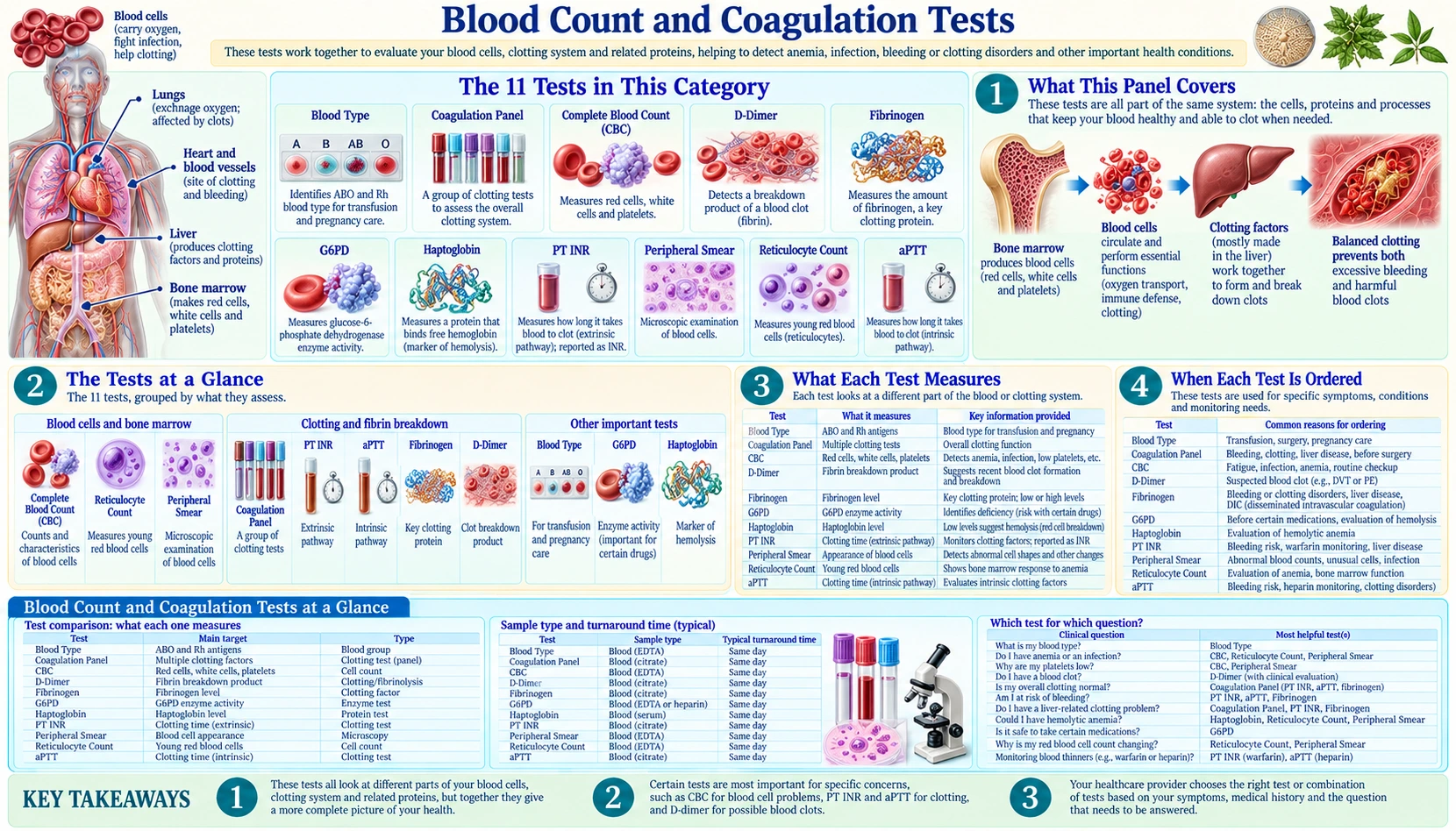
The Tests (11)
Complete Blood Count
Counts and sizes the white cells, red cells and platelets in blood, a routine snapshot of immunity, oxygen-carrying capacity and clotting.
Read the deep dive →Coagulation Panel
Groups PT/INR, aPTT, fibrinogen and D-dimer to check how blood clots, used before surgery, for bleeding disorders and anticoagulant monitoring.
Read the deep dive →aPTT
Times clotting through the intrinsic pathway, used to monitor heparin, investigate hemophilia A and B, and detect the lupus anticoagulant.
Read the deep dive →D-Dimer
Measures a fragment released as blood clots break down; a negative result helps rule out deep-vein and lung clots, but is nonspecific.
Read the deep dive →PT INR
Times clotting through the extrinsic pathway, standardised as the INR, to monitor warfarin, gauge liver function and assess bleeding risk before procedures.
Read the deep dive →Fibrinogen
Measures the liver-made clotting protein in plasma, used to assess bleeding disorders, DIC and liver function; inflammation also pushes it up.
Read the deep dive →Blood Type
Reads the inherited ABO and Rh markers on red cells, set for life, to match transfusions and flag mother–baby mismatch in pregnancy.
Read the deep dive →Reticulocyte Count
Counts brand-new red blood cells to show whether the bone marrow is keeping up, a key step in working out the cause of anemia.
Read the deep dive →Haptoglobin
Measures a liver protein that mops up free hemoglobin; a low level signals red cells being destroyed, though inflammation can mask it.
Read the deep dive →G6PD
Checks how well a red-cell enzyme guards against oxidative stress; inherited deficiency lets certain foods, medicines or infections burst red cells.
Read the deep dive →Peripheral Smear
A drop of blood stained on a slide and examined under the microscope, revealing cell shapes, abnormal cells and parasites that machines miss.
Read the deep dive →What the blood is made of, and whether it clots properly. The complete blood count sits at the centre — most other tests here explain an abnormality it found.