Amylase and Lipase
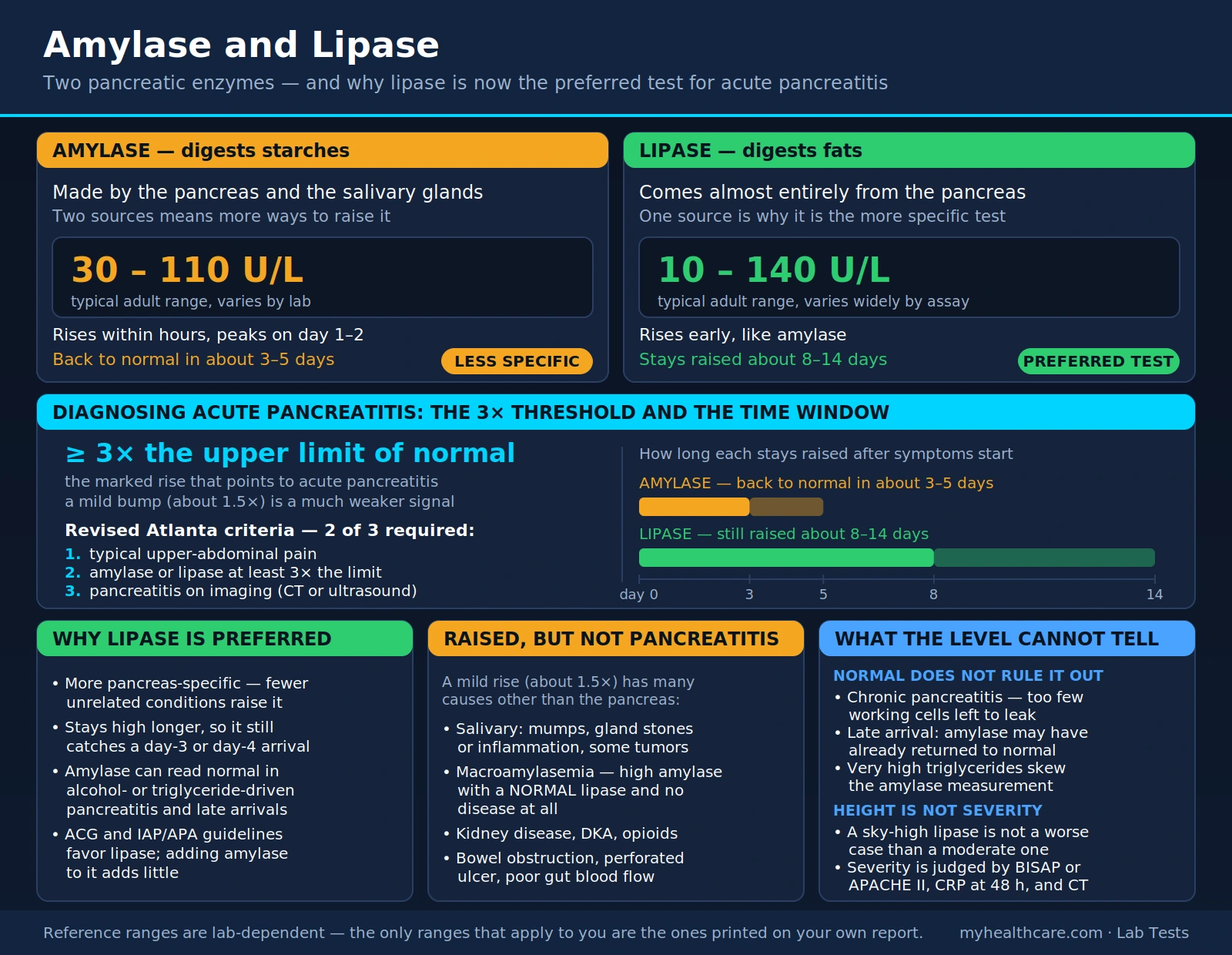
Amylase and lipase are two digestive enzymes that your body makes mostly in the pancreas, and their levels in the blood are the classic laboratory clue to a painful, potentially serious condition called acute pancreatitis — inflammation of the pancreas. When the pancreas is injured or inflamed, these enzymes leak into the bloodstream and their levels climb, so a doctor can order a simple blood test to help confirm what is causing sudden, severe belly pain. This page explains what each enzyme does, why the tests are ordered, and one genuinely useful clinical point that surprises many people: lipase is now generally the preferred test because it is more accurate for the pancreas than amylase. We will also be honest about the test's limits — other conditions can raise these enzymes, normal results do not always rule pancreatitis out, and the height of the number does not tell you how severe the illness is. The goal is to help you read your own results with realistic expectations and to know the warning signs that mean you should seek care right away.
Table of Contents
- What Amylase and Lipase Are
- Why These Tests Are Ordered
- Lipase vs. Amylase: Which Is Better?
- How the Levels Behave Over Time
- Normal Ranges and the "3× Upper Limit" Threshold
- What Elevated Levels Mean
- What Normal Levels Do Not Rule Out
- Enzyme Levels Do Not Measure Severity
- Related Tests and Finding the Cause
- When to Seek Care
- Research Papers
- Connections
- Featured Videos
What Amylase and Lipase Are
Amylase and lipase are digestive enzymes — proteins that speed up the breakdown of food so your body can absorb it. They do different jobs:
- Amylase digests starches. It breaks down carbohydrates (the starches in bread, potatoes, rice, and pasta) into simpler sugars. Amylase is made mainly by the pancreas, but it is also produced by the salivary glands in your mouth, which is why digestion of starch actually begins as you chew. Laboratories can even separate the two forms — pancreatic-type (P) and salivary-type (S) amylase — when it matters.
- Lipase digests fats. It breaks down dietary fat (triglycerides) into fatty acids that the intestine can absorb. Blood lipase comes almost entirely from the pancreas, with only tiny contributions from other tissues. That single-source origin is a big part of why lipase is such a useful pancreas test.
In normal digestion, the pancreas releases both enzymes through the pancreatic duct into the small intestine, right where the food arrives from the stomach. Only small amounts circulate in the blood. But when the pancreas becomes inflamed or injured, its cells leak enzymes directly into the bloodstream, and blood levels rise — sometimes dramatically. Measuring that rise is the whole point of the amylase and lipase blood tests.
Why These Tests Are Ordered
By far the most common reason to order amylase and lipase is to help diagnose acute pancreatitis. This is a sudden inflammation of the pancreas that typically causes intense pain in the upper abdomen, often boring straight through to the back, along with nausea and vomiting. The two most common causes are gallstones (which can block the duct the pancreas drains into) and heavy alcohol use; together these account for most cases. Less common triggers include very high blood triglycerides, certain medications, high blood calcium, abdominal trauma, and the procedure called ERCP.
Doctors do not diagnose acute pancreatitis on the blood test alone. Under the widely used revised Atlanta criteria, the diagnosis requires at least two of three findings: (1) the characteristic abdominal pain, (2) amylase or lipase at least three times the upper limit of normal, and (3) findings of pancreatitis on imaging such as a CT or ultrasound. So the enzymes are one of three pillars — powerful when they line up with the pain, but interpreted in context.
Beyond that headline use, these tests are ordered as part of the general workup of unexplained abdominal pain (to help sort a pancreatic cause from the many other reasons a belly can hurt) and occasionally to help evaluate the pancreas in other settings. They are less useful for tracking chronic pancreatitis, where a scarred, "burned-out" pancreas may make so little enzyme that the blood levels look normal even during a flare.
Lipase vs. Amylase: Which Is Better?
Here is the honest, practical point that many patients never hear: for diagnosing acute pancreatitis, lipase is generally the preferred test. It is both more sensitive (better at catching true cases) and more specific (less likely to be raised by problems outside the pancreas) than amylase. There are three main reasons:
- Lipase is more pancreas-specific. Because blood lipase comes almost entirely from the pancreas, fewer unrelated conditions raise it. Amylase, by contrast, also comes from the salivary glands and can be pushed up by mumps, salivary problems, and a range of abdominal and gynecologic conditions — each a chance for a false alarm.
- Lipase stays elevated longer. Amylase tends to return to normal within a few days, while lipase can remain high for one to two weeks. This matters because many people do not reach the hospital on day one. A patient who arrives three or four days after the pain started may have a normal amylase but a still-elevated lipase that reveals what happened.
- Amylase misses some cases. Amylase can be normal in pancreatitis caused by alcohol or by very high triglycerides, and in late presentations — situations where lipase still catches the diagnosis.
Because of this, major guidelines — including the American College of Gastroenterology and the joint international (IAP/APA) guidelines — favor lipase as the test of choice. Several studies have gone a step further and concluded that ordering both enzymes together adds little over ordering lipase alone; some emergency departments have simply stopped sending amylase for suspected pancreatitis to save cost without losing accuracy. None of this means amylase is useless — it can still help in specific situations — but if only one test is run, lipase is usually the better single choice. And neither enzyme should be read in isolation: the number only means something alongside the patient's symptoms and, when needed, imaging.
How the Levels Behave Over Time
Understanding the timing helps explain why lipase wins and why a "normal" result can be misleading. In acute pancreatitis, both enzymes usually begin rising within a few hours of the pain starting:
- Amylase tends to climb quickly, peak within the first day or two, and then fall back toward normal within roughly three to five days.
- Lipase also rises early but stays elevated much longer — often eight to fourteen days — giving a wider window to catch the diagnosis.
This is why the exact timing of the blood draw relative to when symptoms began can change the result. Draw the blood too early (in the very first hours) or too late (after amylase has already normalized) and a single enzyme can mislead. Lipase's longer tail makes it the more forgiving test for people who delay seeking care.
Normal Ranges and the "3× Upper Limit" Threshold
Reference ranges for these enzymes are lab-dependent — they vary with the specific assay and equipment each laboratory uses, so the only ranges that truly apply to you are the ones printed next to your result on the report. As a rough orientation only, typical adult ranges look something like:
- Amylase: roughly 30 to 110 units per liter (U/L), varying by lab.
- Lipase: commonly around 10 to 140 U/L, though the range varies widely between assays.
The more important number is not simply "above normal." The level that reliably points to acute pancreatitis is at least three times the upper limit of normal. That "3×" threshold is deliberately high: it is the cutoff that separates the marked elevations of true pancreatitis from the small, common, and nonspecific bumps that many other conditions produce. A result that is only mildly elevated — say, one and a half times normal — is a much weaker signal and frequently has a cause other than pancreatitis.
What Elevated Levels Mean
A markedly elevated lipase or amylase (at or above three times the upper limit) in someone with the classic upper-abdominal pain strongly suggests acute pancreatitis. But being honest about the test means naming the other causes that can raise these enzymes, because not every elevation is pancreatitis:
- Kidney disease. Both enzymes are cleared from the blood by the kidneys. When kidney function is reduced, they are cleared more slowly and can drift mildly high on their own — a common and important reason for a modest, chronic elevation.
- Other abdominal emergencies. Bowel obstruction, a perforated ulcer, and reduced blood flow to the intestine can all raise these enzymes, which is one reason imaging is often still needed to sort things out.
- Salivary and other sources (amylase especially). Because amylase also comes from the salivary glands, conditions like mumps, salivary-gland inflammation or stones, and some tumors can raise it. Certain gynecologic conditions, such as an ectopic pregnancy, can too. Lipase is largely spared from these.
- Macroamylasemia. In this harmless quirk, amylase binds to large proteins in the blood and becomes too big for the kidneys to filter out, so it accumulates. The result is a persistently high blood amylase with a normal lipase and no actual disease — a classic trap that lipase helps you avoid.
- Diabetic ketoacidosis (DKA). This serious complication of diabetes can raise both enzymes without true pancreatitis being present.
- Certain medications. Some drugs (for example, opioids, which can tighten the muscle controlling the pancreatic duct) are associated with enzyme elevations.
Because lipase is more pancreas-specific, it is less prone to these false alarms than amylase — but it is not immune. Kidney disease, DKA, and bowel problems can raise lipase too. This is exactly why the number is always read alongside the clinical picture.
What Normal Levels Do Not Rule Out
A normal amylase and lipase is reassuring, but it does not completely exclude pancreatic disease. Watch for a few situations where the enzymes can look normal despite real illness:
- Chronic pancreatitis. After years of damage, the pancreas may have too few working cells left to release much enzyme, so even a painful flare can show normal blood levels.
- Late presentation. If enough days have passed, amylase may have already returned to normal — another reason lipase, with its longer window, is preferred.
- Very high triglycerides. Pancreatitis triggered by extremely high triglycerides can, paradoxically, show a lower-than-expected amylase because the fatty blood interferes with the measurement.
In these cases, the story the patient tells and the findings on imaging carry the diagnosis, not the enzyme number alone.
Enzyme Levels Do Not Measure Severity
This point is worth stating plainly because it is so often misunderstood: how high the amylase or lipase goes does not tell you how severe the pancreatitis is. A sky-high lipase is not automatically a worse case than a moderately elevated one, and the number does not predict who will recover quickly versus who will become critically ill. The enzymes answer the question "is this pancreatitis?" — not "how bad is it?"
Severity is judged with entirely different tools: repeated clinical assessment, dedicated scoring systems (such as BISAP or APACHE II), markers like C-reactive protein measured around 48 hours, checks for organ failure, and, importantly, imaging — a contrast-enhanced CT scan can show whether pancreatic tissue has died (necrosis), which is a key driver of severity. The revised Atlanta classification uses these findings, not the enzyme level, to grade an episode as mild, moderately severe, or severe.
Related Tests and Finding the Cause
Amylase and lipase rarely travel alone. To confirm the diagnosis, gauge severity, and — crucially — find why the pancreas became inflamed, doctors usually order a cluster of tests alongside the enzymes:
- Liver function tests (LFTs). A sharply raised ALT points toward gallstones as the cause. Bilirubin and alkaline phosphatase help flag a blocked bile duct.
- Abdominal ultrasound. The first-line imaging to look for gallstones and a dilated bile duct — the search for a treatable cause.
- Triglycerides. Ordered to catch very high triglyceride levels, a cause that changes treatment.
- Calcium. High calcium is an uncommon cause of pancreatitis; calcium is also watched because it can drop in severe disease.
- CT or MRI/MRCP. Cross-sectional imaging confirms the diagnosis when it is uncertain and assesses complications such as necrosis or fluid collections.
- Complete blood count, kidney function, and glucose. Used to monitor the patient and help score severity over the first day or two.
Together these turn a single enzyme number into a full picture: what is wrong, how serious it is, and what caused it.
When to Seek Care
Acute pancreatitis is a medical emergency. Seek urgent care — go to an emergency department — if you have severe, constant pain in the upper abdomen that radiates straight through to your back, especially when it comes with persistent nausea and vomiting or you cannot keep fluids down. Warning signs that make prompt evaluation even more important include fever, a racing heartbeat, lightheadedness, a rigid or intensely tender belly, and a personal history of gallstones or heavy alcohol use.
Do not try to interpret an amylase or lipase result on your own to decide whether to go in. If the pain fits the picture above, the safe move is to be evaluated in person, where a doctor can combine the blood tests with an exam and imaging. Early diagnosis and supportive care — fluids, pain control, and treating the underlying cause — make a real difference in how acute pancreatitis turns out.
Research Papers
- Tenner S, Baillie J, DeWitt J, Vege SS. American College of Gastroenterology Guideline: Management of Acute Pancreatitis. American Journal of Gastroenterology. 2013;108(9):1400-1415. doi:10.1038/ajg.2013.218 — the landmark ACG guideline; favors lipase and requires enzyme elevation at least three times the upper limit of normal for diagnosis.
- Banks PA, Bollen TL, Dervenis C, et al. Classification of acute pancreatitis—2012: revision of the Atlanta classification and definitions by international consensus. Gut. 2013;62(1):102-111. doi:10.1136/gutjnl-2012-302779 — the revised Atlanta criteria defining the two-of-three diagnostic rule and severity grades.
- Working Group IAP/APA Acute Pancreatitis Guidelines. IAP/APA evidence-based guidelines for the management of acute pancreatitis. Pancreatology. 2013;13(4 Suppl 2):e1-e15. doi:10.1016/j.pan.2013.07.063 — international guidelines that likewise prefer serum lipase for diagnosis.
- Ismail OZ, Bhayana V. Lipase or amylase for the diagnosis of acute pancreatitis? Clinical Biochemistry. 2017;50(18):1275-1280. doi:10.1016/j.clinbiochem.2017.07.003 — a focused review concluding lipase is the more sensitive and specific single test.
- Rompianesi G, Hann A, Komolafe O, Pereira SP, Davidson BR, Gurusamy KS. Serum amylase and lipase and urinary trypsinogen and amylase for diagnosis of acute pancreatitis. Cochrane Database of Systematic Reviews. 2017;(4):CD012010. doi:10.1002/14651858.CD012010.pub2 — systematic review comparing the diagnostic accuracy of these enzyme tests.
- Keim V, Teich N, Fiedler F, Hartig W, Thiele G, Mössner J. A Comparison of Lipase and Amylase in the Diagnosis of Acute Pancreatitis in Patients with Abdominal Pain. Pancreas. 1998;16(1):45-49. doi:10.1097/00006676-199801000-00008 — a classic head-to-head study supporting lipase's diagnostic edge.
- Yadav D, Agarwal N, Pitchumoni CS. A critical evaluation of laboratory tests in acute pancreatitis. American Journal of Gastroenterology. 2002;97(6):1309-1318. doi:10.1111/j.1572-0241.2002.05766.x — reviews the strengths and pitfalls of amylase and lipase in real practice.
- Smith RC, Southwell-Keely J, Chesher D. Should serum pancreatic lipase replace serum amylase as a biomarker of acute pancreatitis? ANZ Journal of Surgery. 2005;75(6):399-404. doi:10.1111/j.1445-2197.2005.03391.x — argues lipase alone can replace amylase for diagnosis.
- Frank B, Gottlieb K. Amylase Normal, Lipase Elevated: Is It Pancreatitis? American Journal of Gastroenterology. 1999;94(2):463-469. doi:10.1111/j.1572-0241.1999.878_g.x — explores cases where lipase is high but amylase is normal, and what they mean.
- Muniraj T, Dang S, Pitchumoni CS. Pancreatitis or not? — Elevated lipase and amylase in ICU patients. Journal of Critical Care. 2015;30(6):1370-1375. doi:10.1016/j.jcrc.2015.08.020 — catalogs the many non-pancreatic reasons these enzymes rise, especially in sick patients.
- Crockett SD, Wani S, Gardner TB, Falck-Ytter Y, Barkun AN. American Gastroenterological Association Institute Guideline on Initial Management of Acute Pancreatitis. Gastroenterology. 2018;154(4):1096-1101. doi:10.1053/j.gastro.2018.01.032 — the AGA guideline on early management once the diagnosis is made.
Connections
- All Lab Tests
- Lipase Test
- Liver Function Tests
- Comprehensive Metabolic Panel
- Kidney Function
- Lipid Panel
- Pancreatitis
- Gallstones
- Diabetes
- Gastroenterology
- Nephrology & Hepatology